Within Work Prep
Can a Restart Plan Help You Switch Off?
Giving unfinished work a specific continuation point may make it easier to stop mentally rehearsing the task during leisure time.
On this page
- Why unfinished work follows people into leisure time
- What research on specific completion plans found
- Creating closure without continuing to work late
Page outline Jump by section
Introduction
Unfinished work does not have to be finished before you can mentally leave it. A more realistic stopping strategy is to give the task a credible continuation point: record what remains, decide where and when you will resume, and specify the first concrete action. Research suggests that this kind of planning can reduce the cognitive pull of incomplete goals and, for some employees, improve psychological detachment after work.[PubMed]pubmed.ncbi.nlm.nih.govConsider it done! Plan making can eliminate the cognitive effects of unfulfilled goals - PubMed…
That matters because unfinished tasks are unusually good at following people into leisure time. A 2026 meta-analysis found that having unfinished work was associated with more work-related thinking outside working hours, particularly affective rumination. Earlier diary studies linked unfinished tasks with weekend rumination and poorer sleep.[PubMed]pubmed.ncbi.nlm.nih.govUnfinished work tasks and work-related thoughts during off-job time: meta-analysis of the Zeigarnik effect in a work-recovery conte…
The useful distinction is therefore between finishing the work and finishing today’s decisions about the work. A restart plan aims for the second. It creates enough closure to stop now while also lowering the friction of starting again tomorrow.
Why unfinished work follows you home
An incomplete task leaves an unresolved goal. Instead of becoming irrelevant when the laptop closes, that goal can remain cognitively accessible: the mind keeps returning to what has not yet been achieved, what could be forgotten or what must happen next.
The strongest recent summary comes from a 2026 meta-analysis specifically examining unfinished work and off-job thoughts. Across 17 between-person samples involving 2,473 participants and 14 within-person samples involving 12,129 observations, unfinished tasks were positively associated with work-related thoughts during non-work time. The estimated association was stronger between people (ρ =.382) than within the same person across different occasions (ρ =.247), and associations were strongest when researchers measured affective rumination.[PubMed]pubmed.ncbi.nlm.nih.govUnfinished work tasks and work-related thoughts during off-job time: meta-analysis of the Zeigarnik effect in a work-recovery conte…
That finding strengthens an evidence base built from diary studies. Syrek and colleagues followed 59 employees for 12 weeks, matching 357 Friday and Monday observations. When employees ended a week with more unfinished tasks, they experienced more affective rumination, which in turn was associated with impaired weekend sleep. Employees who accumulated higher levels of unfinished work over the three-month period also reported greater weekend sleep impairment.[PubMed]pubmed.ncbi.nlm.nih.govOpen source on nih.gov.
A separate five-week diary study of 89 employees likewise examined unfinished tasks alongside time pressure. Even after accounting for time pressure, feeling that the week’s tasks had not been completed was associated with perseverative thinking and poorer sleep; perceived expectations from leaders could intensify those relationships. In other words, unfinished work is not necessarily just a proxy for being busy. The sense of unresolved work appears to matter in its own right.[PubMed]pubmed.ncbi.nlm.nih.govPub Med Unfinished tasks foster rumination and impair sleepingPub Med Unfinished tasks foster rumination and impair sleeping
This does not mean that every thought about work is harmful. Occupational research distinguishes distressing affective rumination from more constructive forms of thinking, such as problem-solving pondering and positive reflection. That distinction matters: the problem is not literally having any thought connected with work, but being unable to disengage because unresolved goals repeatedly reclaim attention.[PubMed]pubmed.ncbi.nlm.nih.govOpen source on nih.gov.
What specific completion plans actually changed
The important experimental finding is that an unfinished goal may not need to be completed to become less mentally intrusive. It may be enough to decide credibly how it will be completed.
Masicampo and Baumeister tested this idea across several laboratory studies published in 2011. They first reproduced several consequences of unfulfilled goals: unfinished goals increased intrusive thoughts during unrelated reading, made goal-related words more mentally accessible and, in one experiment, interfered with performance on an unrelated anagram task. Participants who were allowed to formulate specific plans for pursuing their unfinished goals no longer showed the same activation and interference effects.[PubMed]pubmed.ncbi.nlm.nih.govConsider it done! Plan making can eliminate the cognitive effects of unfulfilled goals - PubMed…
One detail makes the finding especially relevant to everyday planning. The effect was not simply produced by writing something reassuring on paper. Reduction in intrusive thoughts was related to the earnestness of the plan: participants who subsequently carried out their plans were also the ones who showed less intrusion. A plausible interpretation is that the mind responds to a plan that genuinely advances goal pursuit, rather than treating any to-do-list entry as closure.[PubMed]pubmed.ncbi.nlm.nih.govConsider it done! Plan making can eliminate the cognitive effects of unfulfilled goals - PubMed…
Workplace research moved the idea closer to the end-of-day problem. Brandon Smit followed 103 employees pursuing 1,127 work goals and found that employees had greater difficulty detaching from incomplete than completed goals, particularly when those goals were highly valued. In an experimental component, making plans to resolve incomplete goals increased psychological detachment among employees with personal tendencies that ordinarily made detachment difficult. The practical prescription from the study was notably specific: end-of-day plans should describe where, when and how an unfinished work goal will be completed.[ResearchGate]researchgate.netOpen source on researchgate.net.
Smit and Barber subsequently examined a daily planning intervention designed to direct attention away from incomplete work goals. Their research focused on the familiar problem that heavy workloads make detachment harder. The workload–detachment relationship was moderated by attentional factors, supporting the idea that what happens to attention after an unfinished workday can be changed rather than being an inevitable consequence of having too much to do.[PubMed]pubmed.ncbi.nlm.nih.govOpen source on nih.gov.
There is also broader intervention evidence, although it should not be mistaken for proof that restart planning alone will work for everyone. A 2021 meta-analysis covering 30 studies and 34 interventions, with 3,725 participants, found that interventions intended to improve psychological detachment produced a statistically significant average benefit of d = 0.36. Those interventions varied considerably, so this figure describes the wider detachment-intervention literature rather than the effect size of an end-of-day restart plan specifically.[PubMed]pubmed.ncbi.nlm.nih.govOpen source on nih.gov.
Creating closure without working late
The practical lesson is not to extend the working day until every open loop disappears. For many jobs that is impossible: knowledge work continuously generates drafts, unanswered questions, dependencies and tasks that span several days. Trying to obtain closure by completing everything can simply turn recovery time into more work.
Instead, use the final few minutes of work to convert an unresolved task into a restartable task. The plan should answer enough questions that tomorrow’s self does not need to reconstruct today’s thinking.
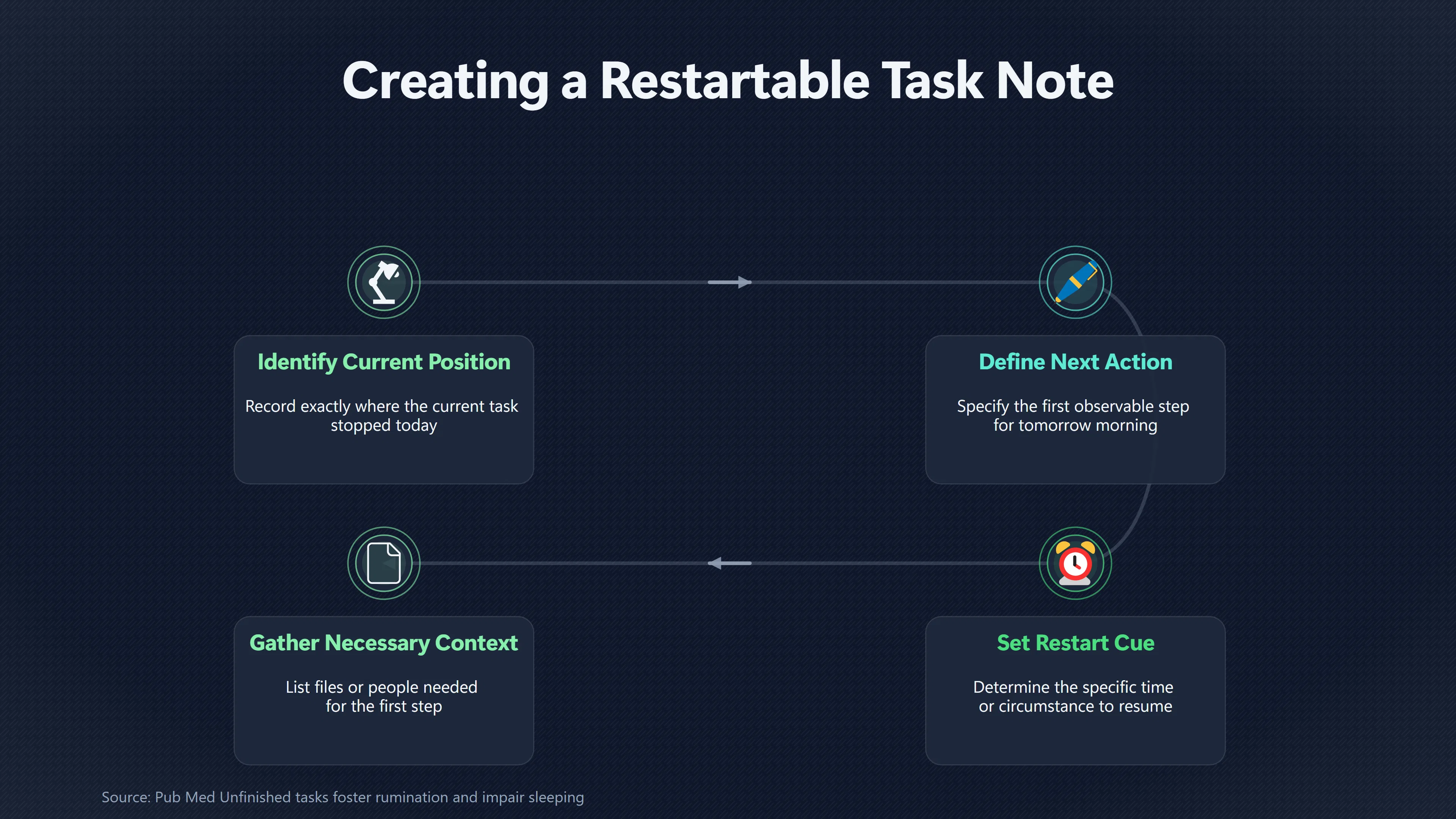
A useful restart note contains four pieces of information:
- Current position: where you actually stopped, rather than a vague description of the whole project.
- Next action: the first observable thing you will do on returning.
- Restart cue: when or under what circumstance you intend to resume.
- Necessary context: the file, information, decision or person needed to take that first step.
For example, “finish quarterly report” leaves almost the entire problem mentally open. A stronger stopping note would be: “Tomorrow at 09:15, reopen the Q2 draft at the revenue section. Check the June total against the finance spreadsheet, then write the two-sentence explanation of the variance.” The report remains unfinished, but the immediate continuation problem has been settled.
Specificity matters because planning research is not merely about reminding yourself that an obligation exists. The proposed benefit comes from resolving uncertainty about future goal pursuit. In Smit’s workplace study, the recommended dimensions were where, when and how the unfinished goal would be completed; in Masicampo and Baumeister’s experiments, it was specific plan formation rather than goal completion that removed the measured cognitive interference.[BPS Psych Hub]bpspsychub.onlinelibrary.wiley.comBPS Psych HubSuccessfully leaving work at work: The self‐regulatory underpinnings of psychological detachment - Smit - 2016 - Journal of…
There is some complementary field evidence that planning can affect rumination over longer periods. A 2023 field experiment involved 208 employees and 947 weekly observations. Participants used a planning procedure combining goal setting, planned work steps, anticipation of obstacles and alternative plans. The intervention reduced unfinished tasks and weekly rumination and increased cognitive flexibility, although it did not improve work engagement. Because this was a broader weekly planning intervention, it cannot isolate the effect of a two-minute end-of-day restart note, but it supports the larger proposition that concrete work planning can reduce unresolved work and after-work rumination in real workplaces.[PubMed Central (PMC)]pmc.ncbi.nlm.nih.govOpen source on nih.gov.
The plan must be credible, not exhaustive
A restart plan can become counterproductive if “planning to stop” turns into another hour of work. The target is not a comprehensive project plan. It is the minimum amount of decision-making required to make stopping feel safe.
That suggests a useful stopping rule: plan until you know how to restart, not until you know how to finish. For a straightforward task, one next action may be enough. For an uncertain task, the next action can itself be investigative: “At 10:00, ask Priya whether the figures have been approved; if not, work on the methodology section instead.” This leaves uncertainty in the project while removing uncertainty about what you will do.
Plans also need to be believable. “Finish everything first thing tomorrow” provides little closure if tomorrow’s calendar makes that impossible. The experimental evidence from Masicampo and Baumeister is relevant here because reduced intrusion was tied to plans participants earnestly intended and ultimately carried out. A realistic continuation point is therefore more defensible than an ambitious promise designed merely to make today’s task list look resolved.[PubMed]pubmed.ncbi.nlm.nih.govConsider it done! Plan making can eliminate the cognitive effects of unfulfilled goals - PubMed…
Nor should the method be sold as a cure for every form of work rumination. Detachment is influenced by workload, job demands, individual differences and what people actually do during non-work time. A large meta-analysis of 91 independent employee samples involving 38,124 people found that job demands were associated with poorer detachment, while detachment itself was associated with outcomes including lower exhaustion and fatigue, greater well-being and better sleep. The relationships varied substantially between studies.[PubMed Central (PMC)]pmc.ncbi.nlm.nih.govOpen source on nih.gov.
The narrower claim has stronger support: unfinished work tends to remain mentally active, and converting an unresolved goal into a specific, credible plan can reduce some of that activation and make psychological detachment easier.[PubMed]pubmed.ncbi.nlm.nih.govUnfinished work tasks and work-related thoughts during off-job time: meta-analysis of the Zeigarnik effect in a work-recovery conte…

A better definition of “done for today”
For open-ended work, “done” cannot always mean that the task itself is complete. A more workable end-of-day definition is that the task has been left in a state from which it can be resumed without reconstruction.
That means preserving the thread rather than continuing to pull it. Record the exact stopping point. Specify the first next action. Give it a realistic restart cue. Put the information somewhere you will actually encounter when work resumes. Then stop.
This approach joins two useful outcomes that are often treated separately. The restart note lowers tomorrow’s starting friction because the first decision has already been made; at the same time, it gives today’s mind a reason to stop repeatedly rehearsing the unfinished task. The research does not imply that a written plan magically erases work thoughts, nor that all after-hours reflection is undesirable. It supports a more modest and practical principle: when work cannot be completed, make its continuation concrete enough that you no longer need to keep it active in your head.[wiley.com]bpspsychub.onlinelibrary.wiley.comBPS Psych HubSuccessfully leaving work at work: The self‐regulatory underpinnings of psychological detachment - Smit - 2016 - Journal of…
Amazon book picks
Further Reading
Books and field guides related to Can a Restart Plan Help You Switch Off?. Use these as the next step if you want deeper reading beyond the article.
Getting Things Done
The personal productivity guru (Fast Company) delivers powerful methods that vastly increase your efficiency and creative results-at work...
Atomic Habits
Rating: 3.5/5 from 7 Google Books ratings
The #1 New York Times bestseller. Over 25 million copies sold! Translated into 60+ languages! Tiny Changes, Remarkable Results No matter...
Deep Work
Trade paperback. Professor and popular blogger Cal Newport reveals the new key to achieving success and true meaning in professional life...
Four Thousand Weeks
A life-changing gift of a book: What if you tried to stop doing everything, so you could finally get round to what counts? **The instant...
eBay marketplace picks
Marketplace Samples
Live-tested eBay searches with available results related to this page.
Selected fromdesk reminder sign oneBay.co.uk.



Endnotes
1.
Source: researchgate.net
Link:https://www.researchgate.net/publication/284132125_Successfully_leaving_work_at_work_The_self-regulatory_underpinnings_of_psychological_detachment
2.
Source: researchgate.net
Link:https://www.researchgate.net/publication/286970468_Psychologically_Detaching_Despite_High_Workloads_The_Role_of_Attentional_Processes
3.
Source: researchgate.net
Link:https://www.researchgate.net/publication/329685496_Antecedents_and_Outcomes_of_Smartphone_Usage_Among_Indian_Millennial_Travellers_Proceedings_of_the_International_Conference_in_Nicosia_Cyprus_January_30-February
4.
Source: researchgate.net
Link:https://www.researchgate.net/publication/329548831The_long_arm_of_the_job-_work_characteristics_and_recovery_windows_in_social_welfare_work
5.
Source: researchgate.net
Link:https://www.researchgate.net/publication/301562131_Zeigarnik%27s_Sleepless_Nights_How_Unfinished_Tasks_at_the_End_of_the_Week_Impair_Employee_Sleep_on_the_Weekend_Through_Rumination
6.
Source: researchgate.net
Link:https://www.researchgate.net/publication/51234294_Consider_It_Done_Plan_Making_Can_Eliminate_the_Cognitive_Effects_of_Unfulfilled_Goals
7.
Source: researchgate.net
Link:https://www.researchgate.net/publication/222514548_Unfulfilled_goals_interfere_with_tasks_that_require_executive_functions
8.
Source: researchgate.net
Link:https://www.researchgate.net/publication/368585570_A_field_experiment_on_the_effects_of_weekly_planning_behaviour_on_work_engagement_unfinished_tasks_rumination_and_cognitive_flexibility
9.
Source: pubmed.ncbi.nlm.nih.gov
Link:https://pubmed.ncbi.nlm.nih.gov/21688924/
Source snippet
Consider it done! Plan making can eliminate the cognitive effects of unfulfilled goals - PubMed...
10.
Source: bpspsychub.onlinelibrary.wiley.com
Link:https://bpspsychub.onlinelibrary.wiley.com/doi/10.1111/joop.12137
Source snippet
BPS Psych HubSuccessfully leaving work at work: The self‐regulatory underpinnings of psychological detachment - Smit - 2016 - Journal of...
11.
Source: pubmed.ncbi.nlm.nih.gov
Link:https://pubmed.ncbi.nlm.nih.gov/41554526/
Source snippet
Unfinished work tasks and work-related thoughts during off-job time: meta-analysis of the Zeigarnik effect in a work-recovery conte...
12.
Source: pubmed.ncbi.nlm.nih.gov
Link:https://pubmed.ncbi.nlm.nih.gov/27101340/
13.
Source: pubmed.ncbi.nlm.nih.gov
Title: Pub Med Unfinished tasks foster rumination and impair sleeping
Link:https://pubmed.ncbi.nlm.nih.gov/24933596/
14.
Source: pubmed.ncbi.nlm.nih.gov
Link:https://pubmed.ncbi.nlm.nih.gov/31434205/
15.
Source: pmc.ncbi.nlm.nih.gov
Link:https://pmc.ncbi.nlm.nih.gov/articles/PMC5233687/
16.
Source: pubmed.ncbi.nlm.nih.gov
Link:https://pubmed.ncbi.nlm.nih.gov/26652268/
17.
Source: pubmed.ncbi.nlm.nih.gov
Link:https://pubmed.ncbi.nlm.nih.gov/34096763/
18.
Source: pmc.ncbi.nlm.nih.gov
Link:https://pmc.ncbi.nlm.nih.gov/articles/PMC10952538/
19.
Source: pubmed.ncbi.nlm.nih.gov
Link:https://pubmed.ncbi.nlm.nih.gov/38515981/
20.
Source: pubmed.ncbi.nlm.nih.gov
Link:https://pubmed.ncbi.nlm.nih.gov/41231574/
21.
Source: pmc.ncbi.nlm.nih.gov
Link:https://pmc.ncbi.nlm.nih.gov/articles/PMC12292320/
22.
Source: doi.org
Link:https://doi.org/10.16993/sjwop.339
23.
Source: onlinelibrary.wiley.com
Link:https://onlinelibrary.wiley.com/doi/10.1002/job.2792
24.
Source: bpspsychub.onlinelibrary.wiley.com
Link:https://bpspsychub.onlinelibrary.wiley.com/doi/10.1111/joop.12430
25.
Source: bpspsychub.onlinelibrary.wiley.com
Link:https://bpspsychub.onlinelibrary.wiley.com/doi/abs/10.1111/joop.12430
26.
Source: pmc.ncbi.nlm.nih.gov
Link:https://pmc.ncbi.nlm.nih.gov/articles/PMC8624283/
27.
Source: doi.org
Link:https://doi.org/10.1080/09585192.2021.1945653
28.
Source: onlinelibrary.wiley.com
Link:https://onlinelibrary.wiley.com/doi/abs/10.1002/smi.2901
29.
Source: pmc.ncbi.nlm.nih.gov
Link:https://pmc.ncbi.nlm.nih.gov/articles/PMC6719247/
30.
Source: pubmed.ncbi.nlm.nih.gov
Link:https://pubmed.ncbi.nlm.nih.gov/29781629/
31.
Source: pmc.ncbi.nlm.nih.gov
Link:https://pmc.ncbi.nlm.nih.gov/articles/PMC5751022/
32.
Source: pubmed.ncbi.nlm.nih.gov
Link:https://pubmed.ncbi.nlm.nih.gov/29261139/
33.
Source: doi.org
Link:https://doi.org/10.1111/joop.12137?urlappend=%3Futm_source%3Dresearchgate
34.
Source: bpspsychub.onlinelibrary.wiley.com
Link:https://bpspsychub.onlinelibrary.wiley.com/doi/abs/10.1111/joop.12137
35.
Source: bpspsychub.onlinelibrary.wiley.com
Link:https://bpspsychub.onlinelibrary.wiley.com/doi/pdf/10.1111/joop.12137
36.
Source: doi.org
Link:https://doi.org/10.1002/JOB.1924
37.
Source: onlinelibrary.wiley.com
Link:https://onlinelibrary.wiley.com/doi/10.1002/job.1924
38.
Source: pubmed.ncbi.nlm.nih.gov
Link:https://pubmed.ncbi.nlm.nih.gov/16248688/
Additional References
39.
Source: research.rug.nl
Link:https://research.rug.nl/en/publications/zeigarniks-sleepless-nights-how-unfinished-tasks-at-the-end-of-th/
Source snippet
Groningen Research PortalZeigarnik’s sleepless nights: How unfinished tasks at the end of the week impair employee sleep on the weekend t...
40.
Source: tandfonline.com
Link:https://www.tandfonline.com/doi/full/10.1080/10615806.2026.2616302
Source snippet
Taylor & Francis OnlineUnfinished work tasks and work-related thoughts during off-job time: meta-analysis of the Zeigarnik effect in a wo...
41.
Source: youtube.com
Title: 7 Steps to end your day LESS stressed!
Link:https://www.youtube.com/watch?v=u5j3kpWxdag
Source snippet
In How Do I Eliminate Post-Shutdown Anxiety, Cal Newport breaks down how a structured end-of-day shutdown ritual and explicit plan for un...
42.
Source: youtube.com
Title: Why You Need a Shutdown Ritual: The Power of Separating Work and Personal Life
Link:https://www.youtube.com/watch?v=tBW7GbBEDWI
Source snippet
Tired of Taking Work Home? You Need this Routine...
43.
Source: youtube.com
Title: How Do I Eliminate Post-Shutdown Anxiety
Link:https://www.youtube.com/watch?v=-pdmry5gU7g
Source snippet
Why You Need a Shutdown Ritual: The Power of Separating Work and Personal Life...
44.
Source: guilfordjournals.com
Link:https://guilfordjournals.com/doi/pdf/10.1521/soco.2012.30.1.37
45.
Source: linkedin.com
Link:https://www.linkedin.com/posts/erasmus-project-work-life-flow_iopsychology-research-goalsetting-activity-7006963135517474817-UiFb
46.
Source: frontiersin.org
Link:https://www.frontiersin.org/journals/psychology/articles/10.3389/fpsyg.2022.935775/full
47.
Source: sciencedirect.com
Link:https://www.sciencedirect.com/science/article/abs/pii/S0001879109000803
48.
Source: deepdyve.com
Link:https://www.deepdyve.com/lp/wiley/successfully-leaving-work-at-work-the-self-regulatory-underpinnings-of-rJWZDtM9he