Within Habit Timelines
Why Habit Formation Timelines Vary So Widely
Across health-habit studies, individual formation estimates ranged from 4 to 335 days, making any single countdown misleading.
On this page
- What the 4 to 335 day range represents
- Why averages hide individual differences
- How to interpret two to five month estimates
Page outline Jump by section
Introduction
Habit formation can take weeks or months because a habit is not simply a behaviour repeated for a certain number of days. It is a learned link between a recurring cue and a response that becomes increasingly automatic through repetition. The speed of that learning varies substantially between people, behaviours and contexts. Modern health-habit research therefore produces a distribution of timelines rather than a universal countdown.[Compass]compass.onlinelibrary.wiley.comWhat is habit and how can it be used to change real‐world behaviour? Narrowing the theory‐reality gap - Gardner - 2024 - Social an…
The clearest recent synthesis found individual estimates ranging from 4 to 335 days. In the small number of studies that directly estimated formation time, medians were 59–66 days, while means in other studies reached 106–154 days. Those figures make “two months” a useful description of some study results, but not a deadline. For self-improvement that works, the important question is not whether a behaviour has crossed an arbitrary day count, but whether repeated performance in a recognisable context is actually becoming easier and more automatic.[PubMed Central (PMC)]pmc.ncbi.nlm.nih.govOpen source on nih.gov.
What the 4-to-335-day range actually represents
The unusually wide range comes into focus in a 2024 systematic review and meta-analysis of health-related habit formation. The review included 20 studies and 2,601 participants covering behaviours such as physical activity, healthy eating, water consumption and flossing. Yet only four studies directly reported a mean or median time to habit formation. Across those studies, individual estimates extended from four days at the shortest to 335 days at the longest.[PubMed Central (PMC)]pmc.ncbi.nlm.nih.govOpen source on nih.gov.
That 4-to-335-day span should not be read as though researchers discovered two biological types of people, one who needs four days and another who needs nearly a year. It combines observations from different people and health behaviours, using particular definitions and statistical methods for deciding when sufficient automaticity had developed. The systematic review itself warns that the evidence base for formation time remains small: 11 of its 20 included studies were rated as having a high risk of bias, and most did not directly estimate the time required to form a habit.[PubMed Central (PMC)]pmc.ncbi.nlm.nih.govOpen source on nih.gov.
One of the studies behind the extreme range illustrates another important qualification. In a randomised trial of 192 adults choosing an everyday nutrition behaviour, participants linked the behaviour either to a daily routine or to a specific time and reported on it for 84 days. Among participants classified as successfully forming a habit, the median modelled time to reach 95% of peak automaticity was 59 days, but individual estimates ranged from 4 to 335 days. Crucially, only 27 of the 117 participants whose automaticity trajectories were modelled — about 23% — met the study’s criterion for successful habit formation.[PubMed]pubmed.ncbi.nlm.nih.govHabit formation following routine-based versus time-based cue planning: A randomized controlled trial - PubMedJanuary 6, 2021…
So even the endpoints need context. “Four days” does not establish that four days normally suffices, while “335 days” does not establish that difficult habits require nearly a year. The striking result is the dispersion: people following broadly comparable habit-building instructions can develop automaticity at markedly different rates, and some attempts do not fit a clean successful-formation trajectory at all.[DOI]doi.orgHabit formation following routine‐based versus time‐based cue planning: A randomized controlled trial - Keller - 2021 - British Journa…
Why the average hides what happens to individuals
The best-known demonstration of this problem predates the systematic review. Phillippa Lally and colleagues asked 96 volunteers to choose an eating, drinking or activity behaviour and repeat it daily in the same context for 12 weeks. Rather than treating habit formation as an on/off event, the researchers repeatedly measured automaticity and fitted learning curves to individual participants. For those whose data could be modelled, the estimated time to reach 95% of their eventual automaticity ranged from 18 to 254 days.[Wiley Online Library]onlinelibrary.wiley.comWiley Online LibraryHow are habits formed: Modelling habit formation in the real world - Lally - 2010 - European Journal of Social Psycho…
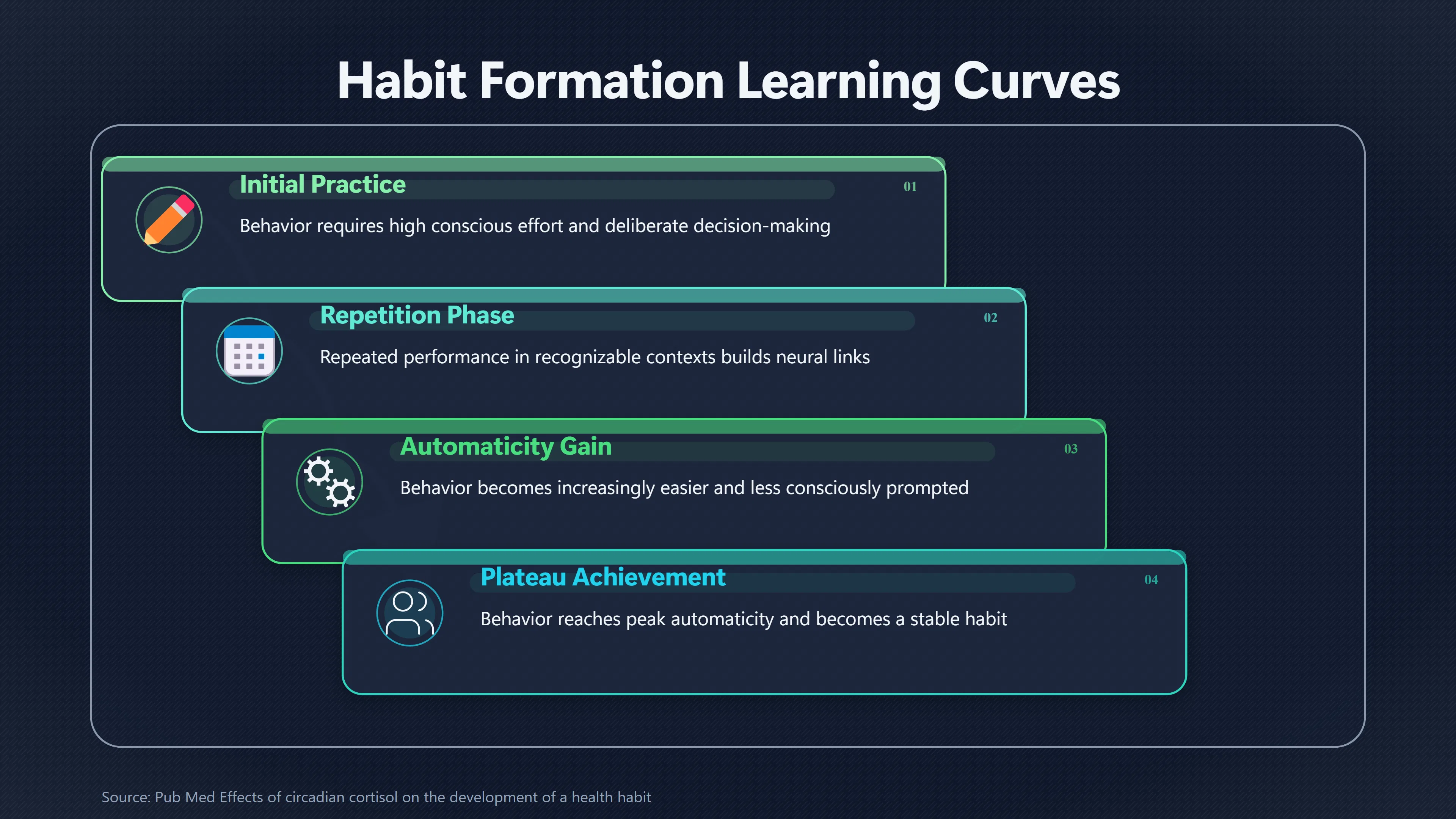
This is why the often-repeated figure of roughly 66 days is easy to misuse. It describes the centre of a highly variable set of estimates; it does not mean that people are generally unhabituated on day 65 and habitual on day 66. The underlying model describes automaticity as increasing towards a plateau, with the size of further gains diminishing as the association becomes established. Habit formation is therefore better understood as a learning curve than as a finish line.[Wiley Online Library]onlinelibrary.wiley.comWiley Online LibraryHow are habits formed: Modelling habit formation in the real world - Lally - 2010 - European Journal of Social Psycho…
Averages can also obscure differences between behaviours. Drinking water after lunch is not necessarily equivalent, as a learning task, to establishing an exercise routine. The 2024 review found evidence that habit strength varied with factors including frequency, timing, behaviour type, personal choice and behavioural regulation. That makes it risky to take an average obtained across several behaviours and turn it into a promise for one particular behaviour.[PubMed Central (PMC)]pmc.ncbi.nlm.nih.govOpen source on nih.gov.
A stretching experiment makes the point particularly clearly. Forty-eight students were followed for 90 days while trying to make a daily stretch habitual. Participants were assigned to stretch either after waking or before bed. Modelled learning curves projected automaticity at approximately 106 days for the morning group and 154 days for the evening group. Even for essentially the same target action, changing when it was performed was associated with a substantially different estimated timescale.[PubMed]pubmed.ncbi.nlm.nih.govPub Med Effects of circadian cortisol on the development of a health habitEffects of circadian cortisol on the development of a health habit - PubMed…
Why elapsed days are only a rough measure of learning
Calendar time is an imperfect proxy for what produces a habit. Current habit theory emphasises context-consistent repetition: a recurring cue becomes associated with a response, eventually allowing that cue to prompt an impulse to act with less deliberate decision-making. Thirty calendar days can therefore contain very different amounts and qualities of habit learning. Someone who performs a behaviour reliably after the same cue has a different learning history from someone who performs it sporadically under changing circumstances.[Compass]compass.onlinelibrary.wiley.comOpen source on wiley.com.
The nutrition trial supports this distinction. Repeatedly carrying out the planned behaviour in response to its cue predicted greater automaticity. The researchers found no significant advantage of linking the behaviour to a routine cue rather than a clock-time cue; what mattered strongly was repeated enactment of the cue-behaviour plan. Participants also showed diverse trajectories, including successful formation, discontinuous progress and failure to develop the expected automaticity pattern.[PubMed]pubmed.ncbi.nlm.nih.govHabit formation following routine-based versus time-based cue planning: A randomized controlled trial - PubMedJanuary 6, 2021…
Separate longitudinal research strengthens the case that the stability of the setting matters. In one study, university students attempted to build study habits for six weeks while being instructed either to keep their performance context stable or to vary places and times. A second dataset examined naturally occurring habit-building through an app. Across the analyses, greater context stability was associated with greater automaticity and better attainment of the intended repetition goal.[PubMed Central (PMC)]pmc.ncbi.nlm.nih.govPubMed Central (PMC)Context Stability in Habit Building Increases Automaticity and Goal Attainment - PMC…
This helps explain why two people can accumulate the same number of days without accumulating the same strength of habit. The relevant learning opportunities differ. A repeated action attached reliably to a recognisable situation gives the cue-response association repeated reinforcement; interruptions, inconsistent contexts and missed enactments can reduce that opportunity. Importantly, this does not mean perfect streaks are required: in Lally and colleagues’ study, missing a single opportunity did not materially derail the formation process.[Wiley Online Library]onlinelibrary.wiley.comWiley Online LibraryHow are habits formed: Modelling habit formation in the real world - Lally - 2010 - European Journal of Social Psycho…
How to interpret two-to-five-month estimates
The 2024 systematic review summarised the available health-habit literature by saying that habit formation typically required roughly two to five months, based on medians of 59–66 days and means of 106–154 days in the studies that directly reported formation times. That is a reasonable high-level description of this limited research base, provided it is treated as an expectation range rather than a prescription.[PubMed Central (PMC)]pmc.ncbi.nlm.nih.govOpen source on nih.gov.
The distinction matters in practice. At six weeks, one behaviour may already feel noticeably automatic while another still requires reminders and deliberate effort. Neither outcome, by itself, shows that the person has succeeded or failed. The evidence indicates that meaningful automaticity can develop on quite different schedules, and some participants never reach a study’s predefined threshold during its observation period.[DOI]doi.orgHabit formation following routine‐based versus time‐based cue planning: A randomized controlled trial - Keller - 2021 - British Journa…
There is another reason not to replace the 21-day myth with a “two-to-five-month rule”. Habit researchers do not all operationalise the endpoint identically. Studies commonly use self-reported automaticity and then model its trajectory, sometimes defining formation as reaching a specified proportion of the estimated plateau. Lally and colleagues, for example, estimated the point at which participants reached 95% of their eventual automaticity. Keller and colleagues likewise modelled automaticity trajectories but imposed additional criteria to identify successful formation. These are useful research conventions, not a moment at which the brain issues a certificate saying a habit is complete.[Wiley Online Library]onlinelibrary.wiley.comWiley Online LibraryHow are habits formed: Modelling habit formation in the real world - Lally - 2010 - European Journal of Social Psycho…
The systematic review also cautions against excessive precision. Only four of 20 included studies directly provided formation-time estimates, and the underlying research covered a limited selection of health behaviours. Its conclusion that habits may take two to five months is therefore better interpreted as a correction to unrealistic short deadlines than as a finely calibrated universal forecast.[PubMed Central (PMC)]pmc.ncbi.nlm.nih.govOpen source on nih.gov.

A better way to judge progress
For practical self-improvement, the wide range changes what counts as useful feedback. The calendar can tell someone how long they have been practising, but it cannot by itself tell them how habitual the behaviour has become. A more meaningful question is whether the behaviour is becoming increasingly tied to its cue and increasingly likely to occur with less conscious prompting. That is much closer to what the research actually measures when it tracks automaticity.[Compass]compass.onlinelibrary.wiley.comWhat is habit and how can it be used to change real‐world behaviour? Narrowing the theory‐reality gap - Gardner - 2024 - Social an…
A person who still needs some conscious effort after 30, 60 or even 100 days is therefore not necessarily “behind”. Depending on the behaviour and circumstances, that timescale sits comfortably within observed research ranges. Conversely, performing something daily for a fixed challenge period does not guarantee that a robust habit has formed, particularly if the behaviour has not become associated with a stable cue or if repeated enactment remains inconsistent.[PubMed Central (PMC)]pmc.ncbi.nlm.nih.govOpen source on nih.gov.
The most defensible lesson from the 4-to-335-day range is consequently not that people should expect habit formation to take 335 days. It is that a single countdown discards precisely the variation that the research keeps finding. Medians around two months can help set more realistic expectations, and studies extending towards five months show why patience may be required, but individual progress is better judged by strengthening automaticity and reliable cue-linked repetition than by reaching a predetermined date.[PubMed Central (PMC)]pmc.ncbi.nlm.nih.govOpen source on nih.gov.
Amazon book picks
Further Reading
Books and field guides related to Why Habit Formation Timelines Vary So Widely. Use these as the next step if you want deeper reading beyond the article.
Good Habits, Bad Habits
'The world's leading expert on habits' - Matthew Syed, bestselling author of Black Box Thinking and Rebel IdeasWhat if you could harness...
Atomic Habits
Rating: 3.5/5 from 7 Google Books ratings
The #1 New York Times bestseller. Over 25 million copies sold! Translated into 60+ languages! Tiny Changes, Remarkable Results No matter...
Tiny Habits
Improving your life is much easier than you think. Whether it’s losing weight, sleeping more, or restoring your work/life balance – the s...

The Power of Habit
Rating: 4.0/5 from 145 Google Books ratings
Duhigg takes us to the edge of scientific discoveries that explain why habits exist and how they can be changed. Distilling information i...
eBay marketplace picks
Marketplace Samples
Live-tested eBay searches with available results related to this page.
Selected fromhabit tracker board oneBay.co.uk.

Endnotes
1.
Source: compass.onlinelibrary.wiley.com
Link:https://compass.onlinelibrary.wiley.com/doi/full/10.1111/spc3.12975
Source snippet
What is habit and how can it be used to change real‐world behaviour? Narrowing the theory‐reality gap - Gardner - 2024 - Social an...
2.
Source: doi.org
Link:https://doi.org/10.1111/bjhp.12504
Source snippet
Habit formation following routine‐based versus time‐based cue planning: A randomized controlled trial - Keller - 2021 - British Journa...
3.
Source: onlinelibrary.wiley.com
Link:https://onlinelibrary.wiley.com/doi/abs/10.1002/ejsp.674?msockid=2489864bf52b6612230d95d6f48167ef
Source snippet
Wiley Online LibraryHow are habits formed: Modelling habit formation in the real world - Lally - 2010 - European Journal of Social Psycho...
4.
Source: onlinelibrary.wiley.com
Link:https://onlinelibrary.wiley.com/doi/abs/10.1002/ejsp.674
Source snippet
Wiley Online LibraryHow are habits formed: Modelling habit formation in the real world - Lally - 2010 - European Journal of Social Psycho...
5.
Source: compass.onlinelibrary.wiley.com
Link:https://compass.onlinelibrary.wiley.com/doi/epdf/10.1111/spc3.12975
6.
Source: doi.org
Link:https://doi.org/10.3390/healthcare12232488
7.
Source: iaap-journals.onlinelibrary.wiley.com
Link:https://iaap-journals.onlinelibrary.wiley.com/doi/10.1111/aphw.70144?af=R
8.
Source: compass.onlinelibrary.wiley.com
Link:https://compass.onlinelibrary.wiley.com/doi/10.1111/spc3.12975?af=R
9.
Source: compass.onlinelibrary.wiley.com
Link:https://compass.onlinelibrary.wiley.com/doi/abs/10.1111/spc3.12975
10.
Source: bpspsychub.onlinelibrary.wiley.com
Link:https://bpspsychub.onlinelibrary.wiley.com/doi/abs/10.1111/bjhp.12504
11.
Source: onlinelibrary.wiley.com
Link:https://onlinelibrary.wiley.com/doi/abs/10.1002/ejsp.674?msockid=038ed114f43667dd0790c4bef5146634
12.
Source: bpspsychub.onlinelibrary.wiley.com
Link:https://bpspsychub.onlinelibrary.wiley.com/share/SFKV2IDZIZUZFJF4X9N2?target=10.1111%2Fbjhp.12504
13.
Source: pmc.ncbi.nlm.nih.gov
Link:https://pmc.ncbi.nlm.nih.gov/articles/PMC9226889/
Source snippet
PubMed Central (PMC)Context Stability in Habit Building Increases Automaticity and Goal Attainment - PMC...
14.
Source: pmc.ncbi.nlm.nih.gov
Link:https://pmc.ncbi.nlm.nih.gov/articles/PMC11641623/
15.
Source: pubmed.ncbi.nlm.nih.gov
Title: Pub Med Effects of circadian cortisol on the development of a health habit
Link:https://pubmed.ncbi.nlm.nih.gov/28650196/
Source snippet
Effects of circadian cortisol on the development of a health habit - PubMed...
16.
Source: pubmed.ncbi.nlm.nih.gov
Link:https://pubmed.ncbi.nlm.nih.gov/39685110/
Source snippet
Time to Form a Habit: A Systematic Review and Meta-Analysis of Health Behaviour Habit Formation and Its Determinants - PubMed...
17.
Source: pubmed.ncbi.nlm.nih.gov
Link:https://pubmed.ncbi.nlm.nih.gov/33405284/
Source snippet
Habit formation following routine-based versus time-based cue planning: A randomized controlled trial - PubMedJanuary 6, 2021...
Published: January 6, 2021
18.
Source: pmc.ncbi.nlm.nih.gov
Link:https://pmc.ncbi.nlm.nih.gov/articles/PMC13059544/
19.
Source: pmc.ncbi.nlm.nih.gov
Link:https://pmc.ncbi.nlm.nih.gov/articles/PMC13114073/
20.
Source: pmc.ncbi.nlm.nih.gov
Link:https://pmc.ncbi.nlm.nih.gov/articles/PMC11635905/
21.
Source: pmc.ncbi.nlm.nih.gov
Link:https://pmc.ncbi.nlm.nih.gov/articles/PMC10357511/
22.
Source: pmc.ncbi.nlm.nih.gov
Link:https://pmc.ncbi.nlm.nih.gov/articles/PMC10151500/
23.
Source: pmc.ncbi.nlm.nih.gov
Link:https://pmc.ncbi.nlm.nih.gov/articles/PMC9392502/
24.
Source: pubmed.ncbi.nlm.nih.gov
Link:https://pubmed.ncbi.nlm.nih.gov/35580819/
25.
Source: pmc.ncbi.nlm.nih.gov
Link:https://pmc.ncbi.nlm.nih.gov/articles/PMC9207816/
26.
Source: pmc.ncbi.nlm.nih.gov
Link:https://pmc.ncbi.nlm.nih.gov/articles/PMC6667662/
27.
Source: pmc.ncbi.nlm.nih.gov
Link:https://pmc.ncbi.nlm.nih.gov/articles/PMC4566897/
28.
Source: pmc.ncbi.nlm.nih.gov
Link:https://pmc.ncbi.nlm.nih.gov/articles/PMC4296343/
29.
Source: pmc.ncbi.nlm.nih.gov
Link:https://pmc.ncbi.nlm.nih.gov/articles/PMC3505409/
30.
Source: ouci.dntb.gov.ua
Link:https://ouci.dntb.gov.ua/en/works/7BYjKk39/
Additional References
31.
Source: youtube.com
Title: The Science of Making & Breaking Habits | Huberman Lab Essentials
Link:https://www.youtube.com/watch?v=HXuj7wAt7u8
Source snippet
How long does it really take to form a habit Phillippa Lally 66 days "How Long Does It Really Take to Build a Habit?"...
32.
Source: youtube.com
Link:https://www.youtube.com/watch?v=kwkGr62qHm8
Source snippet
The Science of How Your Brain Forms Habits (and How to Take Control)...
33.
Source: youtube.com
Title: Habit Expert, Wendy Wood, breaks down the three bases of habit formation!
Link:https://www.youtube.com/watch?v=SihwUFcKAwk
Source snippet
How to Break Unwanted Habits and How to Create New Desired Ones with Adam Grant and Wendy Wood...
34.
Source: youtube.com
Title: The Science of How Your Brain Forms Habits (and How to Take Control)
Link:https://www.youtube.com/watch?v=idhDz9miZ3w
Source snippet
The Science of Making & Breaking Habits | Huberman Lab Essentials...
35.
Source: nature.com
Link:https://www.nature.com/articles/s41746-024-01172-y
36.
Source: youtube.com
Title: The secret habits that control your life | Wendy Wood
Link:https://www.youtube.com/watch?v=FoAODalKhv8
Source snippet
Habit Expert, Wendy Wood, breaks down the three bases of habit formation...
37.
Source: researchgate.net
Link:https://www.researchgate.net/publication/348328187_Habit_formation_following_routine-based_versus_time-based_cue_planning_A_randomized_controlled_trial
38.
Source: researchgate.net
Link:https://www.researchgate.net/publication/386593213_Time_to_Form_a_Habit_A_Systematic_Review_and_Meta-Analysis_of_Health_Behaviour_Habit_Formation_and_Its_Determinants
39.
Source: researchgate.net
Link:https://www.researchgate.net/publication/381044449_What_is_habit_and_how_can_it_be_used_to_change_real-world_behaviour_Narrowing_the_theory-reality_gap
40.
Source: visualize.jove.com
Link:https://visualize.jove.com/39685110-time-to-form-a-habit-a-systematic-review-and-meta-analysis-of-health-behaviour-habit-formation-and-its-determinants