Within Stable Contexts
Does Missing One Day Break a New Habit?
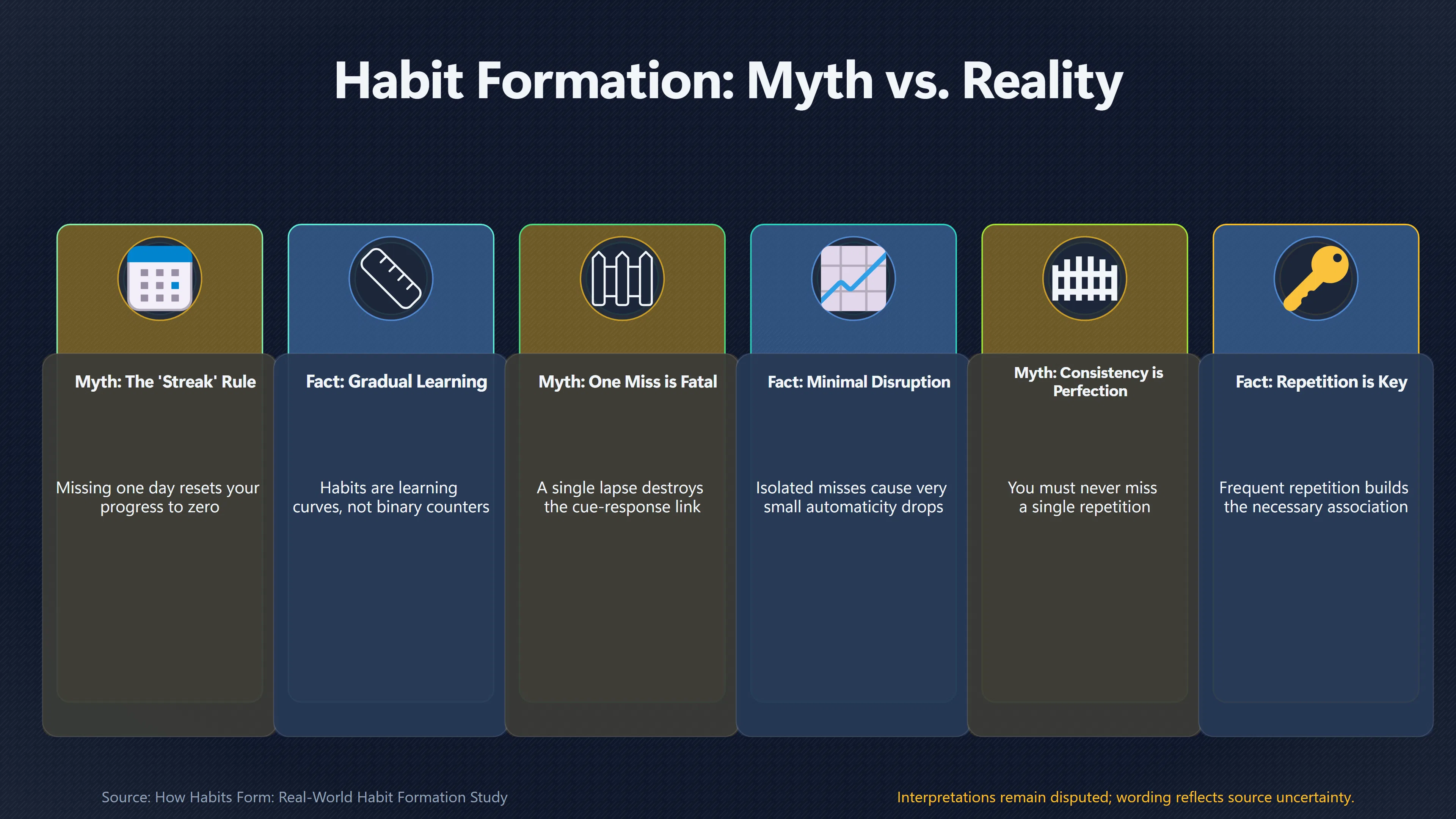
Missing one planned repetition appears far less damaging than abandoning the stable cue-response pattern over time.
On this page
- What the 12 week habit study found about missed opportunities
- Why habit growth is gradual rather than all or nothing
- How to resume without redesigning the whole routine
Page outline Jump by section
Introduction
Missing one planned repetition does not appear to break a developing habit or send habit formation back to day one. The best-known direct evidence comes from Phillippa Lally and colleagues’ 12-week study of everyday habit formation. When participants missed a single opportunity after several successful repetitions, the resulting change in automaticity was very small, and their progress resumed when they performed the behaviour again.[Wiley Online Library]onlinelibrary.wiley.comWiley Online LibraryHow are habits formed: Modelling habit formation in the real world - Lally - 2010 - European Journal of Social Psycho…
That finding matters because habit formation is better understood as gradual learning, not as maintaining an unbroken streak. Each repetition in a stable context can strengthen the relationship between a cue and a response. An isolated miss means one fewer learning opportunity; it does not erase the associations created by earlier repetitions. The more important distinction is between an occasional lapse and becoming sufficiently inconsistent that the cue-response pattern is no longer being reinforced reliably. Exactly how much consistency is necessary, however, remains uncertain.[University College London]ucl.ac.ukUniversity College London How long does it take to form a habit? | UCL NewsUniversity College LondonHow long does it take to form a habit? | UCL News - UCL – University College LondonAugust 4, 2009…
What the 12-week study found about missed opportunities
Lally and colleagues recruited 96 volunteers and asked each to choose a new health-related behaviour that could be performed once each day in response to a clear daily cue. Examples included eating fruit with lunch, drinking water with lunch and running for 15 minutes before dinner. Participants attempted the behaviour for 84 days and repeatedly rated how automatic it felt. Eighty-two participants supplied enough data for the main analysis.[Wiley Online Library]onlinelibrary.wiley.comWiley Online LibraryHow are habits formed: Modelling habit formation in the real world - Lally - 2010 - European Journal of Social Psycho…
The researchers were specifically interested in whether missing an opportunity interrupted the development of automaticity. For this analysis, they used a fairly precise definition of a miss: the participant had failed to perform the behaviour after performing it on each of the preceding three opportunities. They identified 140 such omissions among 55 participants.[studylib.net]studylib.netHow Habits Form: Real-World Habit Formation StudyJuly 16, 2009…
Immediately after one of these misses, participants’ automaticity scores fell by an average of only 0.29 points on the study’s automaticity scale — a very small change. Where the researchers also had the necessary data after the participant resumed the behaviour, the automaticity score was actually 0.55 points higher than it had been before the omission; that increase was not statistically significant.[studylib.net]studylib.netHow Habits Form: Real-World Habit Formation StudyJuly 16, 2009…
The researchers then compared those episodes with stretches in which participants performed the behaviour on three consecutive opportunities. Across those uninterrupted sequences, automaticity increased by an average of 0.79 points. In other words, the increase surrounding a single missed opportunity was broadly comparable with the increase seen during uninterrupted repetition. The authors concluded that one missed opportunity did not materially affect habit formation.[SciSpace]scispace.comhow are habits formed modelling habit formation in the real 4iq5e623zpSciSpace(PDF) How are habits formed: Modelling habit formation in the real world (2010) | Phillippa Lally | 1734 CitationsOctober 1, 2010…
That conclusion is narrower than the popular claim that “missing days doesn’t matter”. The study tested isolated omissions after recent successful repetitions. It did not establish that lengthy gaps, repeated missed opportunities or highly irregular performance are harmless. Indeed, the researchers found that more consistent performance was associated with better-fitting habit-development curves, and Lally later emphasised that very inconsistent participants did not successfully develop habits in the study.[Wiley Online Library]onlinelibrary.wiley.comWiley Online LibraryHow are habits formed: Modelling habit formation in the real world - Lally - 2010 - European Journal of Social Psycho…
Why habit growth is gradual rather than all-or-nothing
The missed-day result makes more sense once habit formation is viewed as a learning curve rather than a streak.
Lally’s participants did not suddenly cross from “no habit” to “habit” on a particular day. Their reported automaticity tended to rise relatively quickly at first and then increase by progressively smaller amounts as it approached a plateau. Researchers describe this as an asymptotic curve: repetition continues to contribute, but each later repetition generally produces a smaller incremental change than repetitions earlier in learning.[Wiley Online Library]onlinelibrary.wiley.comWiley Online LibraryHow are habits formed: Modelling habit formation in the real world - Lally - 2010 - European Journal of Social Psycho…
There was also enormous variation between individuals. Among participants whose data could be modelled, estimated times to reach 95% of their eventual automaticity ranged from 18 to 254 days. A later account of the study reports a median of about 66 days among those whose curves fitted the model. Crucially, this was not a universal deadline: the original analysis itself demonstrated that people followed markedly different trajectories.[DOI]doi.orgHabit formation following routine‐based versus time‐based cue planning: A randomized controlled trial - Keller - 2021 - British Journa…
A 2024 systematic review and meta-analysis reinforces that broader point. Across 20 studies involving 2,601 participants, the few studies that directly estimated time to habit formation reported medians of roughly 59–66 days and means of 106–154 days, with individual estimates ranging from 4 to 335 days. The review also cautioned that much of the evidence base had a high risk of bias and that relatively few studies had directly measured the time required to reach automaticity.[PubMed Central (PMC)]pmc.ncbi.nlm.nih.govOpen source on nih.gov.
So there is little scientific reason to interpret a missed Tuesday as “back to day one”. Automaticity is a continuously varying measure, not a counter that resets when a repetition is omitted. The cue-response learning established by previous repetitions does not appear to disappear simply because one opportunity passes without the response. Reviews of habit research describe habits as learned context-behaviour associations strengthened through repetition in particular situations.[PubMed Central (PMC)]pmc.ncbi.nlm.nih.govOpen source on nih.gov.
The more defensible interpretation is therefore:
- One isolated miss: the Lally study found no material disruption to the trajectory of automaticity.[Wiley Online Library]onlinelibrary.wiley.comWiley Online LibraryHow are habits formed: Modelling habit formation in the real world - Lally - 2010 - European Journal of Social Psycho…
- Frequent repetition: remains important because habit learning depends on repeated opportunities to associate the response with its context.[PubMed Central (PMC)]pmc.ncbi.nlm.nih.govOpen source on nih.gov.
- Persistent inconsistency: is more concerning, although research has not established a simple threshold such as “never miss twice” or “perform the behaviour at least 80% of the time”. UCL’s summary of the original work explicitly says that the required level of consistency was not known.[University College London]ucl.ac.ukUniversity College London How long does it take to form a habit? | UCL NewsUniversity College LondonHow long does it take to form a habit? | UCL News - UCL – University College LondonAugust 4, 2009…
This distinction prevents the evidence from being stretched too far. “One miss doesn’t reset a habit” is supported by the study. “It doesn’t matter how often you miss” is not.
A missed repetition is a lost opportunity, not lost progress
A useful way to interpret a lapse is as one learning opportunity that did not occur. Suppose the intended pattern is: finish breakfast → take a vitamin. Performing that response repeatedly after breakfast gives the recurring situation an opportunity to become associated with the action. If Wednesday’s dose is missed, Wednesday supplies no reinforcing repetition. But Monday’s and Tuesday’s learning has not thereby been shown to vanish.
This fits the broader theoretical account of habit formation. Repeated performance in a particular context strengthens a context-response association until encountering that context increasingly prompts the behaviour with less conscious deliberation. Habit interventions consequently focus on reliable context-dependent repetition, rather than perfect adherence for a predetermined number of consecutive days.[OUP Academic]academic.oup.comOpen source on oup.com.
Researchers Gardner, Lally and Wardle drew essentially this practical conclusion from the 12-week data: occasional omissions did not seriously impair formation because increases in automaticity resumed after performance resumed. Their recommended learning phase therefore centres on repeatedly performing the chosen behaviour in the chosen context until the association becomes more automatic.[PubMed Central (PMC)]pmc.ncbi.nlm.nih.govPubMed Central (PMC)Making health habitual: the psychology of ‘habit-formation’ and general practice - PMC…
This also explains why repeated lapses should not simply be treated as multiple harmless versions of the same event. If omissions become common, there are fewer successful cue-response pairings from which automaticity can develop. The 2024 systematic review identifies repetition and context stability among the important determinants of habit development while noting that the precise consistency required remains unresolved.[PubMed Central (PMC)]pmc.ncbi.nlm.nih.govOpen source on nih.gov.
How to resume without redesigning the whole routine
After one missed repetition, the evidence gives little reason to restart a habit programme, reset a conceptual “habit clock” or compensate with extra repetitions. The most evidence-consistent response is much simpler: perform the intended behaviour the next time the original cue occurs.
For example, if the plan is “after breakfast, read for ten minutes” and Monday is missed, Tuesday’s breakfast is another opportunity to reinforce the same relationship. Changing immediately to lunchtime, increasing the target to 20 minutes or inventing a new reminder can unnecessarily change the very cue-response pairing that is being learned.
That does not mean a routine should never be redesigned. Repeated misses provide different information from an isolated lapse. If the intended cue regularly fails to produce the behaviour — perhaps the cue is easy to overlook, the action is impractical at that moment, or the context varies too much — then the problem may be the design of the routine rather than the occasional interruption of it. Habit research consistently places reliable repetition in an identifiable context at the centre of formation.[Taylor & Francis Online]tandfonline.comOpen source on tandfonline.com.
For an isolated missed day, though, continuity is the more evidence-based response. The original 12-week dataset offers no support for treating one omission as a catastrophic break. UCL’s own summary is similarly restrained: one missed opportunity did not significantly affect formation, whereas people who were very inconsistent did not succeed in forming habits.[University College London]ucl.ac.ukUniversity College London How long does it take to form a habit? | UCL NewsUniversity College LondonHow long does it take to form a habit? | UCL News - UCL – University College LondonAugust 4, 2009…
The useful lesson from missed days
The strongest lesson is not that consistency is unimportant. It is that consistency and perfection are different things.
Habit formation appears to tolerate occasional noise. What it needs is enough repeated experience of the same response following a recognisable cue for automaticity to strengthen over time. The Lally study’s 140 observed omissions provide unusually concrete evidence for that distinction: one missed opportunity produced only a tiny immediate change in automaticity and did not materially alter subsequent habit development.[studylib.net]studylib.netHow Habits Form: Real-World Habit Formation StudyJuly 16, 2009…
At the same time, this result comes from one relatively small real-world study, using self-reported automaticity and mostly simple health behaviours. Later reviews regard Lally’s work as foundational but also emphasise the limited number of high-quality longitudinal studies that directly track habit formation. The 2024 systematic review found substantial variation between people and behaviours and rated 11 of its 20 included studies as having a high risk of bias.[Taylor & Francis Online]tandfonline.comOpen source on tandfonline.com.
The sensible self-improvement rule is therefore more modest than either “never miss a day” or “misses don’t matter”. Do not mistake one lapse for the loss of the habit-building work already done. Resume the same cue-response pattern at the next reasonable opportunity. What builds automaticity is the repeated pattern over time, not the preservation of a flawless streak.
Amazon book picks
Further Reading
Books and field guides related to Does Missing One Day Break a New Habit?. Use these as the next step if you want deeper reading beyond the article.
Atomic Habits
Rating: 3.5/5 from 7 Google Books ratings
The #1 New York Times bestseller. Over 25 million copies sold! Translated into 60+ languages! Tiny Changes, Remarkable Results No matter...
Tiny Habits
Improving your life is much easier than you think. Whether it’s losing weight, sleeping more, or restoring your work/life balance – the s...

The Power of Habit
Rating: 4.0/5 from 145 Google Books ratings
Duhigg takes us to the edge of scientific discoveries that explain why habits exist and how they can be changed. Distilling information i...
Good Habits, Bad Habits
'The world's leading expert on habits' - Matthew Syed, bestselling author of Black Box Thinking and Rebel IdeasWhat if you could harness...
eBay marketplace picks
Marketplace Samples
Live-tested eBay searches with available results related to this page.
Selected fromconsistency motivation poster oneBay.co.uk.

Endnotes
1.
Source: onlinelibrary.wiley.com
Link:https://onlinelibrary.wiley.com/doi/full/10.1002/ejsp.674
Source snippet
Wiley Online LibraryHow are habits formed: Modelling habit formation in the real world - Lally - 2010 - European Journal of Social Psycho...
2.
Source: studylib.net
Title: How Habits Form: Real-World Habit Formation Study
Link:https://studylib.net/doc/8103714/modelling-habit-formation-in-the-real-world
Source snippet
July 16, 2009...
Published: July 16, 2009
3.
Source: scispace.com
Title: how are habits formed modelling habit formation in the real 4iq5e623zp
Link:https://scispace.com/papers/how-are-habits-formed-modelling-habit-formation-in-the-real-4iq5e623zp
Source snippet
SciSpace(PDF) How are habits formed: Modelling habit formation in the real world (2010) | Phillippa Lally | 1734 CitationsOctober 1, 2010...
Published: October 1, 2010
4.
Source: doi.org
Link:https://doi.org/10.1111/bjhp.12504
Source snippet
Habit formation following routine‐based versus time‐based cue planning: A randomized controlled trial - Keller - 2021 - British Journa...
5.
Source: academic.oup.com
Link:https://academic.oup.com/edited-volume/62246/chapter-abstract/550940636
6.
Source: compass.onlinelibrary.wiley.com
Link:https://compass.onlinelibrary.wiley.com/doi/full/10.1111/spc3.12975
7.
Source: doi.org
Link:https://doi.org/10.7554/elife.87346.4
8.
Source: onlinelibrary.wiley.com
Link:https://onlinelibrary.wiley.com/doi/10.1002/ejsp.674?947f74f7_page=6&b158b201_page=5
9.
Source: onlinelibrary.wiley.com
Link:https://onlinelibrary.wiley.com/doi/abs/10.1002/ejsp.674
10.
Source: onlinelibrary.wiley.com
Link:https://onlinelibrary.wiley.com/doi/10.1002/ejsp.674?538fcd4b_page=1&947f74f7page=3&=%2Fen-gt%2Four-commitment%23kI3HdLdDj7HLFW4BJlUYoy23RoHF9sl3JcIXrw%3D%3D
11.
Source: onlinelibrary.wiley.com
Link:https://onlinelibrary.wiley.com/doi/abs/10.1002/ejsp.674?aff_id=24772
12.
Source: onlinelibrary.wiley.com
Link:https://onlinelibrary.wiley.com/doi/abs/10.1002/ejsp.674?MixPanelId=15e3fe314440-0468d8411-64220f54-100000-15e3fe314460
13.
Source: onlinelibrary.wiley.com
Link:https://onlinelibrary.wiley.com/doi/pdf/10.1002/ejsp.674
14.
Source: onlinelibrary.wiley.com
Link:https://onlinelibrary.wiley.com/doi/abs/10.1002/ejsp.674?source=content_type%3Areact%7Cfirst_level_url%3Aarticle%7Csection%3Amain_content%7Cbutton%3Abody_link
15.
Source: onlinelibrary.wiley.com
Link:https://onlinelibrary.wiley.com/doi/10.1002/ejsp.674?2d235898_page=2&538fcd4b_page=6&d2101103_page=8&d73ad837_page=2
16.
Source: onlinelibrary.wiley.com
Link:https://onlinelibrary.wiley.com/doi/abs/10.1002/ejsp.674?cf_chl_jschl_tk=pmd_EwcJDaCFBR9OVEL1O_0qjioww0Gc86ZzpBvCBFhrDcE-1635261061-0-gqNtZGzNAjujcnBszQi9
17.
Source: onlinelibrary.wiley.com
Link:https://onlinelibrary.wiley.com/doi/abs/10.1002/ejsp.674?538fcd4b_page=6&947f74f7_page=5
18.
Source: onlinelibrary.wiley.com
Link:https://onlinelibrary.wiley.com/doi/abs/10.1002/ejsp.674?msockid=038ed114f43667dd0790c4bef5146634
19.
Source: onlinelibrary.wiley.com
Link:https://onlinelibrary.wiley.com/doi/10.1002/ejsp.674?947f74f7_page=5&b158b201_page=5
20.
Source: pmc.ncbi.nlm.nih.gov
Link:https://pmc.ncbi.nlm.nih.gov/articles/PMC3505409/
Source snippet
PubMed Central (PMC)Making health habitual: the psychology of ‘habit-formation’ and general practice - PMC...
21.
Source: ucl.ac.uk
Title: University College London How long does it take to form a habit? | UCL News
Link:https://www.ucl.ac.uk/news/2009/aug/how-long-does-it-take-form-habit%20
Source snippet
University College LondonHow long does it take to form a habit? | UCL News - UCL – University College LondonAugust 4, 2009...
Published: August 4, 2009
22.
Source: pmc.ncbi.nlm.nih.gov
Link:https://pmc.ncbi.nlm.nih.gov/articles/PMC11641623/
23.
Source: pubmed.ncbi.nlm.nih.gov
Link:https://pubmed.ncbi.nlm.nih.gov/39685110/
Source snippet
Time to Form a Habit: A Systematic Review and Meta-Analysis of Health Behaviour Habit Formation and Its Determinants - PubMed...
24.
Source: pmc.ncbi.nlm.nih.gov
Link:https://pmc.ncbi.nlm.nih.gov/articles/PMC4566897/
25.
Source: tandfonline.com
Link:https://www.tandfonline.com/doi/full/10.1080/23311908.2022.2041277
26.
Source: tandfonline.com
Link:https://www.tandfonline.com/doi/full/10.1080/17437199.2011.603640
27.
Source: pmc.ncbi.nlm.nih.gov
Link:https://pmc.ncbi.nlm.nih.gov/articles/PMC12699912/
28.
Source: pmc.ncbi.nlm.nih.gov
Link:https://pmc.ncbi.nlm.nih.gov/articles/PMC12605160/
29.
Source: pmc.ncbi.nlm.nih.gov
Link:https://pmc.ncbi.nlm.nih.gov/articles/PMC11081634/
30.
Source: pubmed.ncbi.nlm.nih.gov
Link:https://pubmed.ncbi.nlm.nih.gov/36749452/
31.
Source: pmc.ncbi.nlm.nih.gov
Link:https://pmc.ncbi.nlm.nih.gov/articles/PMC9372943/
32.
Source: pmc.ncbi.nlm.nih.gov
Link:https://pmc.ncbi.nlm.nih.gov/articles/PMC8774291/
33.
Source: pmc.ncbi.nlm.nih.gov
Link:https://pmc.ncbi.nlm.nih.gov/articles/PMC4952053/
34.
Source: pmc.ncbi.nlm.nih.gov
Link:https://pmc.ncbi.nlm.nih.gov/articles/PMC4975085/
35.
Source: pmc.ncbi.nlm.nih.gov
Link:https://pmc.ncbi.nlm.nih.gov/articles/PMC4216661/
36.
Source: pmc.ncbi.nlm.nih.gov
Link:https://pmc.ncbi.nlm.nih.gov/articles/3505409/
37.
Source: pmc.ncbi.nlm.nih.gov
Link:https://pmc.ncbi.nlm.nih.gov/articles/PMC3552971/
38.
Source: pubmed.ncbi.nlm.nih.gov
Link:https://pubmed.ncbi.nlm.nih.gov/23211256/
39.
Source: pmc.ncbi.nlm.nih.gov
Link:https://pmc.ncbi.nlm.nih.gov/articles/PMC3553622/
40.
Source: surrey.ac.uk
Title: phillippa lally
Link:https://www.surrey.ac.uk/people/phillippa-lally
Additional References
41.
Source: youtube.com
Title: Routines Beat Willpower: Why 40% of Your Day Is Habit
Link:https://www.youtube.com/watch?v=p6efYK0r47Q
Source snippet
Phillippa Lally how long does it take to form a habit missing a day How long does it take to create a habit? The Surprising Answer...
42.
Source: youtube.com
Link:https://www.youtube.com/watch?v=kwkGr62qHm8
Source snippet
The Psychology of Habits: How Your Brain Builds a Routine...
43.
Source: youtube.com
Title: The secret habits that control your life | Wendy Wood
Link:https://www.youtube.com/watch?v=Ywec1MbeQDk
Source snippet
How to Break Unwanted Habits and How to Create New Desired Ones with Adam Grant and Wendy Wood...
44.
Source: youtube.com
Title: The Psychology of Habits: How Your Brain Builds a Routine
Link:https://www.youtube.com/watch?v=oYPzeTj59vs
Source snippet
Routines Beat Willpower: Why 40% of Your Day Is Habit...
45.
Source: researchgate.net
Link:https://www.researchgate.net/publication/375867669_Building_Habits_in_the_Digital_Age_Incorporating_Psychological_and_Knowledge_from_Practitioners_to_Inform_the_Design_of_Digital_Therapeutics
46.
Source: researchgate.net
Link:https://www.researchgate.net/publication/232586066_Implementation_Intentions
47.
Source: dojowell.com
Link:https://dojowell.com/atlas/66-day-average-habit-formation
48.
Source: elifesciences.org
Link:https://elifesciences.org/articles/87346
49.
Source: asthapanchasara.com
Link:https://www.asthapanchasara.com/
50.
Source: sciencedirect.com
Link:https://www.sciencedirect.com/science/article/pii/S0022316622004916