Within Spending Systems
Should You Budget Only Your Worst Spending Category?
Tracking one trouble category can make repeated overspending easier to spot while keeping the system simple enough to use consistently.
On this page
- Why narrow tracking can be easier to act on
- How category limits interact with impulse purchases
- What to do when the budget is repeatedly exceeded
Page outline Jump by section
Introduction
A full household budget is not always the best starting point for recurring impulse spending. If takeaway meals, clothes, beauty products, hobby purchases or another discretionary category repeatedly causes regret, tracking that one category can create a simpler and more usable constraint. The aim is not to account for every pound. It is to make one troublesome stream of spending visible before its many small purchases disappear into the rest of the month.
There is good evidence for the underlying mechanism, but not strong evidence that “budget only your worst category” is universally superior to comprehensive budgeting. Research shows that consumers commonly think and spend in categories, that tracking can become burdensome, and that budgets influence decisions most usefully when they are visible at the point of choice.[oup.com]academic.oup.comOUP AcademicMental Budgeting and Consumer Decisions | Journal of Consumer Research | Oxford AcademicJune 1, 1996…
That makes a single-category budget best understood as a targeted self-control tool: identify the recurring trouble spot, set a realistic limit from actual spending, check the remaining amount before purchases, and review repeated overruns rather than simply resetting the number.
Why narrow tracking can be easier to act on
The case for narrow tracking begins with a mundane problem: budgeting requires attention. Research by the US Consumer Financial Protection Bureau (CFPB) found that people often want to manage spending but exceed their intentions anyway. Participants described budgeting and expense tracking as overwhelming or troublesome, and even people with budgets did not necessarily compare current spending with those budgets regularly.[Consumer Financial Protection Bureau]consumerfinance.govOpen source on consumerfinance.gov.
That matters because a budget that exists only in a spreadsheet opened once a month cannot interrupt many purchases. Reducing the tracking task from “categorise my financial life” to “keep an accurate running total of takeaway spending” removes information that may be useful for broader financial planning, but it also reduces the amount of work needed for this particular behavioural intervention. The CFPB itself advises people who find comprehensive tracking overwhelming to start small, such as reviewing one week of expenses at a time.[Consumer Financial Protection Bureau]consumerfinance.govConsumer Financial Protection BureauBudgeting: How to create a budget and stick with it | Consumer Financial Protection BureauJune 5, 2019…
Category-based thinking is not an artificial budgeting trick. In a 2022 study using a nationally representative survey of 3,826 US adults, more than 90% of people who budgeted reported tracking spending through distinct categories. People differed substantially in how finely they divided those categories: some used little more than “necessities” and “discretionary”, while others separately tracked expenses such as dining out, entertainment and clothing.[Squarespace]static1.squarespace.comHow consumers budgetHow consumers budget…
Earlier experimental research by Chip Heath and Jack Soll helps explain why those divisions can influence purchases. Their work on “mental budgeting” found that consumers allocate money to expense categories and consider spending already charged to a category when making subsequent decisions. A purchase that clearly belongs to a nearly exhausted category can therefore compete psychologically with other purchases in the same category.[OUP Academic]academic.oup.comOUP AcademicMental Budgeting and Consumer Decisions | Journal of Consumer Research | Oxford AcademicJune 1, 1996…
For recurring impulse spending, this suggests an important design choice: make the category narrow enough that the purchases you want to control obviously belong in it. “Discretionary spending” may be too broad if the actual problem is frequent clothes shopping. Conversely, creating separate limits for tops, shoes, accessories and coats introduces bookkeeping that may defeat the purpose.

How a category limit interrupts impulse purchases
A category budget works differently from a general intention such as “spend less online”. The limit supplies a reference point: instead of evaluating a £35 purchase largely on whether the item seems worth £35, the buyer can also ask what £35 does to the month’s remaining clothing allowance.
That distinction is particularly useful when repeated purchases look harmless in isolation. A £12 order, £18 purchase and £25 purchase each invite a separate justification. A running category total places them in the same frame. Research on mental accounting indicates that consumers do not always treat money as perfectly interchangeable and that expenditure assigned to a category can affect subsequent consumption within it.[OUP Academic]academic.oup.comOUP AcademicMental Budgeting and Consumer Decisions | Journal of Consumer Research | Oxford AcademicJune 1, 1996…
The crucial part, however, is seeing the information before deciding. CFPB research found that people often failed to use their budgets during spending decisions. More than 90% of consumers in its qualitative research expressed interest in tools providing real-time spending feedback, and participants believed such information could help them curb impulse spending and stay within budgets. These findings primarily show demand and perceived usefulness rather than proving a particular app will reduce expenditure.[Consumer Financial Protection Bureau]consumerfinance.govOpen source on consumerfinance.gov.
Research on financial self-control more broadly supports using concrete strategies instead of expecting willpower alone to carry the decision. A 2021 meta-analysis covering 29 studies and 12 financial self-control strategies found an overall medium-sized beneficial effect on spending or saving outcomes. Strategies represented in the underlying literature included organising expenses into categories and tracking expenditure.[PubMed]pubmed.ncbi.nlm.nih.govOpen source on nih.gov.
There is an important warning here. More feedback does not automatically mean less spending. Experiments involving real-time grocery-spending feedback found different effects for different shoppers: feedback actually increased expenditure among budget-constrained shoppers in those experiments, partly through purchases of more national brands, while reducing expenditure among non-budget shoppers through substitution towards store brands.[Sage Journals]journals.sagepub.comSage Journals Smart Shopping Carts: How Real-Time Feedback Influences SpendingSage Journals Smart Shopping Carts: How Real-Time Feedback Influences Spending
So “£73 remaining” should not be interpreted as “£73 available to spend”. That turns the ceiling into a target. The useful question is not “Can I fit this purchase under the limit?” but “Knowing what I have already spent and what remains, do I still want to make this purchase?”
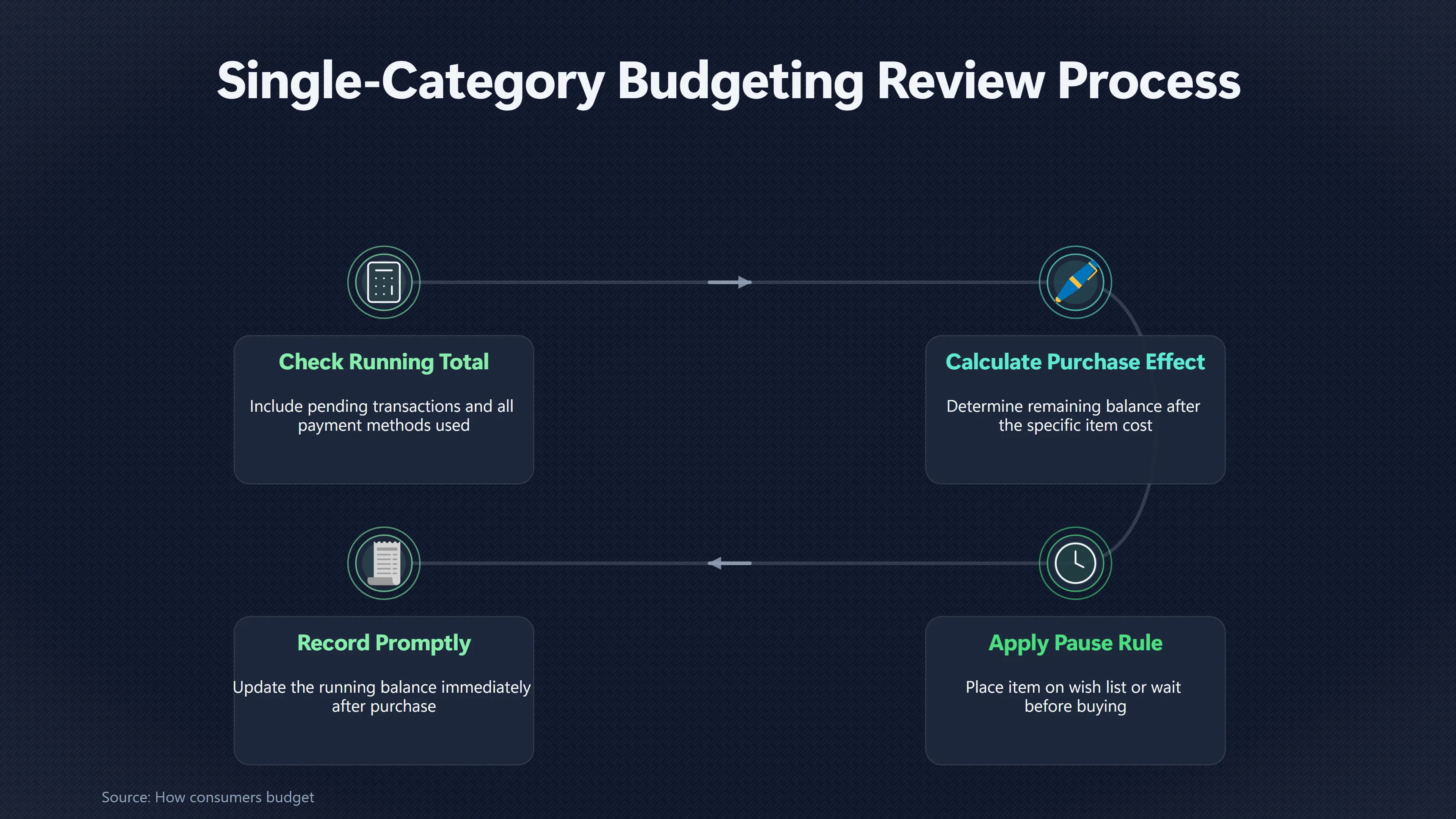
This is why a single-category budget fits naturally alongside a purchase-review step. Before a non-essential purchase in the chosen category:
- Check the running total. Include pending transactions and purchases made through different payment methods.
- Calculate the effect of this purchase. A £40 item with £55 remaining is not merely a £40 decision; it leaves £15 for the rest of the budget period.
-
Apply the existing pause rule. Put the item on a wish list or wait before buying rather than treating available budget as permission. MoneyHelper similarly recommends both budgeting and pausing before non-essential purchases when addressing impulse spending. MaPS
-
Record the purchase promptly if it goes ahead. The running balance is only useful when it reflects reality.
The budget therefore supplies information; the review step supplies friction. The two functions are related but not interchangeable.
Set the limit from reality, not aspiration
A category limit can fail before the month begins if it is based on the amount someone wishes they spent rather than the amount their behaviour suggests is plausible.
A practical starting point is to inspect several recent bank or card statements and calculate actual expenditure in the chosen category. UK guidance from MoneyHelper likewise recommends using bank statements or banking apps to make budget figures realistic and accurate. Its budgeting guidance also suggests using a spending diary or examining the previous month’s transactions to establish where money is actually going. MaPS
Suppose recent takeaway spending was £260, £230 and £270 a month. Declaring next month’s limit to be £50 creates an impressive target but provides little information once it is breached. A more useful first limit might demand a meaningful reduction while remaining achievable enough that the running balance can continue influencing decisions throughout the month.
The time period should also match the behaviour. A monthly limit works when purchases occur fairly evenly and income is monthly. A weekly sub-limit can be easier to interpret when the trouble category consists of frequent low-cost purchases. The important feature is not whether the period is a week or a month, but whether the person can tell, before today’s purchase, what today’s purchase means for the remaining period.
Category boundaries should be decided in advance as well. If the category is “takeaways”, decide whether delivery fees, workplace lunches and takeaway coffees count. Ambiguous rules make it easy to protect the budget by relabelling expenditure. A 2023 systematic review of mental-accounting research notes evidence that consumers can flexibly assign expenses to different mental accounts or create new accounts that justify spending. Wiley Online Library
A good single-category budget is therefore deliberately boring: one definition, one limit, one running total and one review rule.
What to do when the budget is repeatedly exceeded
Going over the limit once is information. Going over it repeatedly is evidence that something in the system needs changing.
Research on how consumers actually budget supports treating overspending as a prompt for adjustment rather than merely a failure of discipline. In the 2022 budgeting study, more than 87% of current budgeters said they would make some adjustment after exceeding a category limit, whether by changing spending, revising a limit or compensating elsewhere. The study was based partly on hypothetical scenarios, so it describes reported responses rather than proving what every respondent subsequently did. Squarespace
For a recurring impulse category, repeated overruns usually point towards one of three diagnoses:
- The limit is unrealistic. Actual spending may be so far above the target that the budget stops functioning as a meaningful guide. Adjust the limit gradually rather than repeatedly pretending the same unattainable number will work next month.
- The limit is not present at the decision point. If overspending is discovered only when reviewing the bank statement, improve the running total or introduce a notification or pre-purchase check. Evidence from UK banking provides a useful broader analogy: Financial Conduct Authority research found annual summaries had no measurable effect on the outcomes studied, while customers using more immediate text alerts or mobile banking showed reductions in unarranged overdraft charges. That is not a direct test of impulse-category budgets, but it illustrates the importance of timely rather than retrospective financial information. FCA
- The purchases repeatedly defeat the limit despite being visible. In that case, the category has identified the problem correctly, but budgeting alone is insufficient. The next change should be attached to the purchase itself: a waiting period, wish list or another pre-commitment that prevents the running balance becoming just another number to ignore. Research on financial self-control finds that strategies can help spending outcomes and that personally generated strategies may work particularly well when they fit the individual and the spending situation. ScienceDirect
What should generally be avoided is quietly moving money into the category every time it runs out. There will be legitimate exceptions, but automatic top-ups teach the opposite lesson: the limit changes whenever a desired purchase appears.
Nor does success require spending the full allowance. Experimental work on real-time feedback shows why remaining budget can sometimes be interpreted as spending capacity rather than a ceiling. Sage Journals If £80 remains at the end of the month, there is no need to “use” it. The behavioural goal is fewer regretted purchases, not perfect consumption of an allocated pot.
When one category is enough
A single-category system is most appropriate when ordinary finances are broadly under control but one recognisable type of discretionary purchase keeps defeating prior intentions. Its advantage is concentration: the person can learn exactly when, where and how that spending occurs without maintaining a detailed ledger of everything else.
It is less suitable when overspending is widespread, essential bills are being missed, income is insufficient for necessary expenditure, or debt repayments are creating the shortfall. Those situations require a broader view of income and outgoings rather than treating one discretionary category as the whole problem. MoneyHelper’s full budget planner, for example, calculates income and spending across categories specifically to show what is left overall. MaPS
There is also no research basis for assuming that everyone should use the same level of detail. The 2022 consumer-budgeting study found striking variation in how granular people’s real budgets are, and its authors explicitly noted that the welfare effects of different levels of categorisation remain unclear. Squarespace That argues against turning single-category budgeting into a universal rule.
Its value is narrower and more practical. When one recurring category is responsible for a disproportionate share of impulsive purchases, tracking it separately makes accumulated spending harder to overlook. Pairing that visible limit with a review before each purchase then converts a monthly aspiration into an immediate choice: given what I have already spent in this problem category, is this particular purchase still worth making?
Amazon book picks
Further Reading
Books and field guides related to Should You Budget Only Your Worst Spending Category?. Use these as the next step if you want deeper reading beyond the article.
You Need a Budget
Wall Street Journal Bestseller “Jesse Mecham has achieved the impossible: a book on budgeting that is fascinating, entertaining, and prac...
I Will Teach You to Be Rich
As seen on the new NETFLIX series! The groundbreaking NEW YORK TIMES and WALL STREET JOURNAL BESTSELLER that taught a generation how to e...
Your Money or Your Life
A fully revised edition of one of the most influential books ever written on personal finance with more than a million copies sold “The b...
The One Week Budget
Hate paying bills? So do I, and that's why I stopped! What if I told you that I haven't paid a bill in almost six years! Do you want to k...
eBay marketplace picks
Marketplace Samples
Example marketplace items related to this page. Use the search link to explore similar finds on eBay.
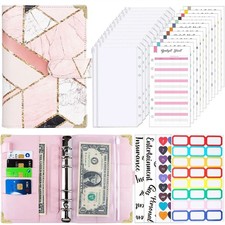
Selected frombudget binder oneBay.co.uk.



Endnotes
1.
Source: academic.oup.com
Link:https://academic.oup.com/jcr/article-abstract/23/1/40/1892763?login=false
Source snippet
OUP AcademicMental Budgeting and Consumer Decisions | Journal of Consumer Research | Oxford AcademicJune 1, 1996...
Published: June 1, 1996
2.
Source: static1.squarespace.com
Title: How consumers budget
Link:https://static1.squarespace.com/static/5a0f856fe9bfdf77b08ac0b0/t/635db5ba6939111971d3bf37/1667085755185/How-Consumers-Budget_Zhang-Sussman-WangLy-Lyu.pdf
Source snippet
How consumers budget...
3.
Source: onlinelibrary.wiley.com
Link:https://onlinelibrary.wiley.com/doi/full/10.1002/cb.2193
Source snippet
Wiley Online LibraryEffects of mental accounting on purchase decision processes: A systematic review and research agenda - Skwara - 2023...
4.
Source: fca.org.uk
Link:https://www.fca.org.uk/publications/occasional-papers/occasional-paper-no-10-message-received-impact-annual-summaries-text
5.
Source: sciencedirect.com
Link:https://www.sciencedirect.com/science/article/pii/S0022103121000925
6.
Source: sciencedirect.com
Title: Budgeting for bills: The impact on daily spending
Link:https://www.sciencedirect.com/science/article/pii/S0167268126000818
7.
Source: onlinelibrary.wiley.com
Link:https://onlinelibrary.wiley.com/doi/10.1002/cb.2193
8.
Source: academic.oup.com
Link:https://academic.oup.com/jcr/article/49/5/697/6603733?guestAccessKey=4c9f1a39-00ec-4796-88a5-e56d43d39b7a
9.
Source: academic.oup.com
Link:https://academic.oup.com/jcr/article-abstract/47/6/937/5918031?itm_content=Journal_of_Consumer_Research_0
10.
Source: onlinelibrary.wiley.com
Link:https://onlinelibrary.wiley.com/doi/abs/10.1111/ijcs.12613
11.
Source: sciencedirect.com
Link:https://www.sciencedirect.com/science/article/pii/S0736376119000338
12.
Source: sciencedirect.com
Title: Financial attention and the disposition effect
Link:https://www.sciencedirect.com/science/article/abs/pii/S0167268119301222
13.
Source: consumer.gov
Title: Making a Budget | consumer.gov
Link:https://consumer.gov/your-money/making-budget
14.
Source: onlinelibrary.wiley.com
Link:https://onlinelibrary.wiley.com/doi/10.1002/ijop.12297
15.
Source: time.com
Title: The Longer You Spend In a Store, the More Likely You Are to Cave
Link:https://time.com/3929244/shopping-budget/
16.
Source: academic.oup.com
Link:https://academic.oup.com/jcr/article-abstract/39/4/800/1798285
17.
Source: onlinelibrary.wiley.com
Link:https://onlinelibrary.wiley.com/doi/pdf/10.1002/mar.20318
18.
Source: sciencedirect.com
Title: Mental budgeting and the management of household finance
Link:https://www.sciencedirect.com/science/article/pii/S0167487011000596
19.
Source: sciencedirect.com
Link:https://www.sciencedirect.com/science/article/pii/S0747563220302569
20.
Source: sciencedirect.com
Title: How consumers budget
Link:https://www.sciencedirect.com/science/article/pii/S0167268122003493
21.
Source: sciencedirect.com
Link:https://www.sciencedirect.com/science/article/pii/S0167811617300861
22.
Source: sciencedirect.com
Link:https://www.sciencedirect.com/science/article/pii/S0167268123002950
23.
Source: sciencedirect.com
Title: How consumers budget
Link:https://www.sciencedirect.com/science/article/abs/pii/S0167268122003493
24.
Source: sciencedirect.com
Link:https://www.sciencedirect.com/author/8960230300/qiang-yan
25.
Source: consumerfinance.gov
Link:https://www.consumerfinance.gov/data-research/research-reports/consumer-insights-managing-spending/
26.
Source: consumerfinance.gov
Link:https://www.consumerfinance.gov/archive/blog/budgeting-how-to-create-a-budget-and-stick-with-it/
Source snippet
Consumer Financial Protection BureauBudgeting: How to create a budget and stick with it | Consumer Financial Protection BureauJune 5, 2019...
Published: June 5, 2019
27.
Source: pubmed.ncbi.nlm.nih.gov
Link:https://pubmed.ncbi.nlm.nih.gov/34237109/
28.
Source: pmc.ncbi.nlm.nih.gov
Link:https://pmc.ncbi.nlm.nih.gov/articles/PMC8266115/
29.
Source: journals.sagepub.com
Title: Sage Journals Smart Shopping Carts: How Real-Time Feedback Influences Spending
Link:https://journals.sagepub.com/doi/10.1509/jm.12.0060
32.
Source: moneyhelper.org.uk
Title: Ma PSManaging your money | Money Helper
Link:https://www.moneyhelper.org.uk/en/everyday-money/budgeting/beginners-guide-to-managing-your-money?source=mas
33.
Source: consumerfinance.gov
Title: Creating a buying plan | Consumer Financial Protection Bureau
Link:https://www.consumerfinance.gov/consumer-tools/educator-tools/youth-financial-education/teach/activities/creating-buying-plan/
34.
Source: consumerfinance.gov
Title: Your Money, Your Goals toolkit | Consumer Financial Protection Bureau
Link:https://www.consumerfinance.gov/consumer-tools/educator-tools/your-money-your-goals/toolkit/
35.
Source: GOV.UK
Title: www.gov.uk Money and Pensions Service: Budget Planner
Link:https://www.gov.uk/algorithmic-transparency-records/money-and-pensions-service-budget-planner
36.
Source: consumerfinance.gov
Title: Assess your spending | Consumer Financial Protection Bureau
Link:https://www.consumerfinance.gov/owning-a-home/prepare/assess-your-spending/
37.
Source: pmc.ncbi.nlm.nih.gov
Link:https://pmc.ncbi.nlm.nih.gov/articles/PMC11530402/
38.
Source: journals.sagepub.com
Link:https://journals.sagepub.com/doi/10.1177/10949968231189505
39.
Source: journals.sagepub.com
Link:https://journals.sagepub.com/doi/pdf/10.1177/10949968231189505?download=true
40.
Source: consumerfinance.gov
Link:https://www.consumerfinance.gov/rules-policy/notice-opportunities-comment/archive-closed/60-day-pra-generic-information-plan-for-consumer-complaint-information-collection-system/
41.
Source: consumerfinance.gov
Link:https://www.consumerfinance.gov/data-research/research-reports/feedback-from-the-financial-education-field/
42.
Source: consumerfinance.gov
Title: Find financial literacy activities | Consumer Financial Protection Bureau
Link:https://www.consumerfinance.gov/consumer-tools/educator-tools/youth-financial-education/teach/activities/?grade_level=2&q=&topic=18&topic=19
43.
Source: consumerfinance.gov
Title: Find financial literacy activities | Consumer Financial Protection Bureau
Link:https://www.consumerfinance.gov/consumer-tools/educator-tools/youth-financial-education/teach/activities/?grade_level=2&page=1&q=&topic=18&topic=23
44.
Source: consumerfinance.gov
Title: Find financial literacy activities | Consumer Financial Protection Bureau
Link:https://www.consumerfinance.gov/consumer-tools/educator-tools/youth-financial-education/teach/activities/?grade_level=5&grade_level=6&q=&topic=18&topic=7
45.
Source: consumerfinance.gov
Title: Find financial literacy activities | Consumer Financial Protection Bureau
Link:https://www.consumerfinance.gov/consumer-tools/educator-tools/youth-financial-education/teach/activities/?page=4&topic=18
46.
Source: pmc.ncbi.nlm.nih.gov
Link:https://pmc.ncbi.nlm.nih.gov/articles/PMC10337295/
47.
Source: doi.org
Link:https://doi.org/10.1002/CB.2193
48.
Source: consumerfinance.gov
Title: Making spending choices | Consumer Financial Protection Bureau
Link:https://www.consumerfinance.gov/consumer-tools/educator-tools/youth-financial-education/teach/activities/making-spending-choices/
49.
Source: doi.org
Link:https://doi.org/10.1371%2Fjournal.pone.0253938
50.
Source: ojs.amhinternational.com
Link:https://ojs.amhinternational.com/index.php/imbr/article/view/2997
51.
Source: consumerfinance.gov
Title: Track your spending with this easy tool | Consumer Financial Protection Bureau
Link:https://www.consumerfinance.gov/archive/blog/track-your-spending-with-this-easy-tool/
52.
Source: consumerfinance.gov
Link:https://www.consumerfinance.gov/archive/blog/five-step-spending-plan-avoid-holiday-debt/
53.
Source: consumerfinance.gov
Link:https://www.consumerfinance.gov/archive/blog/cfpb-sends-letters-financial-institution-ceos-encouraging-more-consumer-control-over-payment-methods/
54.
Source: consumerfinance.gov
Link:https://www.consumerfinance.gov/archive/blog/ordinary-trip-grocery-store-your-kid-explain-you-go/
55.
Source: consumerfinance.gov
Link:https://www.consumerfinance.gov/archive/blog/managing-your-spending-achieve-your-goals/
56.
Source: pmc.ncbi.nlm.nih.gov
Link:https://pmc.ncbi.nlm.nih.gov/articles/PMC4721399/
57.
Source: journals.sagepub.com
Link:https://journals.sagepub.com/doi/pdf/10.1509/jm.12.0060?download=true
58.
Source: journals.sagepub.com
Link:https://journals.sagepub.com/doi/abs/10.1509/jm.12.0060
59.
Source: journals.sagepub.com
Link:https://journals.sagepub.com/doi/10.1509/jm.12.0060?icid=int.sj-full-text.similar-articles.9
60.
Source: moneyhelper.org.uk
Link:https://www.moneyhelper.org.uk/en/everyday-money/budgeting
61.
Source: moneyhelper.org.uk
Link:https://www.moneyhelper.org.uk/en/everyday-money/budgeting?source=mas
62.
Source: moneyhelper.org.uk
Link:https://www.moneyhelper.org.uk/en/savings/investing?source=mas
63.
Source: doi.org
Link:https://doi.org/10.14236/ewic/BCSHCI2023.1
64.
Source: pubmed.ncbi.nlm.nih.gov
Link:https://pubmed.ncbi.nlm.nih.gov/8954873/
65.
Source: sage.cnpereading.com
Link:https://sage.cnpereading.com/doi/10.1509/jm.12.0060
Additional References
66.
Source: youtube.com
Title: How to stop spending money
Link:https://www.youtube.com/watch?v=x3vLV9b51-I
Source snippet
In How to Stop Impulse Spending Without Guilt or Extreme Budgeting, financial educator Michela Allocca explains how to build targeted sys...
67.
Source: youtube.com
Title: How to Stop Impulse Spending Without Guilt or Extreme Budgeting
Link:https://www.youtube.com/watch?v=UrQhAhjzBHI
Source snippet
How to Stop Impulse Spending (Without Shame or Deprivation)...
68.
Source: youtube.com
Title: How to Stop Impulse Spending (Without Shame or Deprivation)
Link:https://www.youtube.com/watch?v=zawiK8eltMc
Source snippet
Stop Overspending TODAY with the Cash Envelope System...
69.
Source: youtube.com
Title: Stop Overspending TODAY with the Cash Envelope System
Link:https://www.youtube.com/watch?v=iRSBCSQK_Ss
Source snippet
Why We Make Bad Choices: The Secret Power of Mental Accounting...
70.
Source: researchgate.net
Link:https://www.researchgate.net/publication/275100499_Shopper_Marketing_Nutrition_Interventions_social_norms_on_grocery_carts_increase_produce_spending_without_increasing_shopper_budgets
71.
Source: researchgate.net
Link:https://www.researchgate.net/publication/331272186_Study_on_the_Influencing_Factors_of_Mobile_Users%27_Impulse_Purchase_Behavior_in_a_Large_Online_Promotion_Activity?_tp=eyJjb250ZXh0Ijp7InBhZ2UiOiJzY2llbnRpZmljQ29udHJpYnV0aW9ucyIsInByZXZpb3VzUGFnZSI6bnVsbCwic3ViUGFnZSI6bnVsbH19
72.
Source: tandfonline.com
Link:https://www.tandfonline.com/doi/full/10.1080/23322039.2017.1291474
73.
Source: eurekamag.com
Link:https://eurekamag.com/research/095/317/095317477.php
74.
Source: 1stclasscu.co.uk
Link:https://1stclasscu.co.uk/support/budget-planner
75.
Source: researchgate.net
Link:https://www.researchgate.net/publication/250916533_Smart_Shopping_Carts_How_Real-Time_Feedback_Influences_Spending