Within Physical Capacity
When Does More Exercise Stop Helping Your Goals?
More activity is not always more useful when fatigue, soreness or injury begins to undermine work, recovery and daily responsibilities.
On this page
- Why health benefits eventually flatten at higher activity volumes
- Signs that training is exceeding current capacity
- Balancing improvement, recovery and the rest of life
Page outline Jump by section
Introduction
Exercise supports a wider life only while the training itself remains compatible with that life. More activity can still improve fitness after a person has met basic health recommendations, but the returns become progressively smaller, while the costs in time, fatigue and recovery can continue to rise. Large cohort studies suggest that much of the mortality benefit is already captured at moderate activity volumes; beyond that point, doing more may still serve sporting goals, but it becomes harder to justify simply as “more health”.[nih.gov]ncbi.nlm.nih.govWHO Guidelines on Physical Activity and Sedentary Behaviour - NCBI Bookshelf…
That distinction is important for self-improvement. The relevant question is not whether a high training volume is inherently bad. It is whether the current dose is producing enough useful adaptation to justify what it takes away from sleep, concentration, physical comfort, relationships and ordinary responsibilities. Persistent fatigue, declining performance, worsening sleep, recurrent injury or an inability to accommodate normal life demands are therefore not badges of commitment. They are evidence that training and recovery may no longer be in a productive balance.[PubMed]pubmed.ncbi.nlm.nih.govPrevention, diagnosis, and treatment of the overtraining syndrome: joint consensus statement of the European College of Sport Scien…
Why the health payoff eventually flattens
Public-health recommendations are deliberately expressed as ranges rather than as instructions to maximise exercise. The World Health Organization recommends that adults accumulate 150–300 minutes of moderate-intensity aerobic activity each week, 75–150 minutes of vigorous activity, or an equivalent combination, as well as muscle-strengthening activity on at least two days. Adults can exceed those aerobic amounts for additional benefits, but this does not imply that every extra hour produces the same return.[NCBI]ncbi.nlm.nih.govWHO Guidelines on Physical Activity and Sedentary Behaviour - NCBI Bookshelf…
The dose-response evidence makes the distinction clearer. A prospective study of 116,221 US adults followed for up to 30 years found that people reporting 150–299 minutes a week of moderate leisure-time activity had substantially lower mortality than those doing none. Moving to 300–599 minutes was associated with some further reduction, but at 600 minutes or more there was no clear additional reduction in mortality. For vigorous activity, roughly 150–300 minutes a week was associated with near-maximal mortality benefit in that study.[PubMed Central (PMC)]pmc.ncbi.nlm.nih.govPubMed Central (PMC)Long-term leisure-time physical activity intensity and all-cause and cause-specific mortality: a prospective cohort o…
An earlier pooled analysis reached a similar broad conclusion from more than 660,000 adults. Mortality benefits reached a plateau at roughly three to five times the recommended minimum, but the incremental gain was modest compared with simply reaching the minimum: the estimated mortality-risk reduction was about 31% around the recommended minimum and 39% at the apparent benefit threshold. Importantly, the study did not find excess mortality among people reporting ten or more times the minimum.[JAMA Network]jamanetwork.comJAMA NetworkLeisure Time Physical Activity and Mortality: A Detailed Pooled Analysis of the Dose-Response Relationship | Lifestyle Behavi…
That last point prevents a common misreading. A flattening benefit curve does not mean that high-volume exercise suddenly becomes dangerous. Nor does it mean that endurance athletes should stop training. High volume can be entirely rational when the goal is to run a marathon, improve cycling performance or compete in a sport. It simply changes the calculation. Once large health benefits have already been captured, another training session may offer a comparatively small additional health return while still demanding another hour of time and another dose of recovery.
This is why “more exercise” and “better self-improvement” eventually diverge. Someone training for performance may willingly accept fatigue and opportunity costs because performance is the objective. Someone exercising mainly to have more energy, think clearly, stay healthy and function well in everyday life has a different optimisation problem. For that person, exercise has begun to undermine its purpose when its marginal benefits are outweighed by its effects on the rest of the week.
When training exceeds current capacity
There is no universal number of weekly kilometres, gym sessions or training hours at which exercise becomes “too much”. Capacity varies with training history, age, intensity, nutrition, sleep, previous injury and what else is happening in a person’s life. A workload that is manageable during a quiet month may be excessive during a period of poor sleep, demanding work or heavy caring responsibilities.
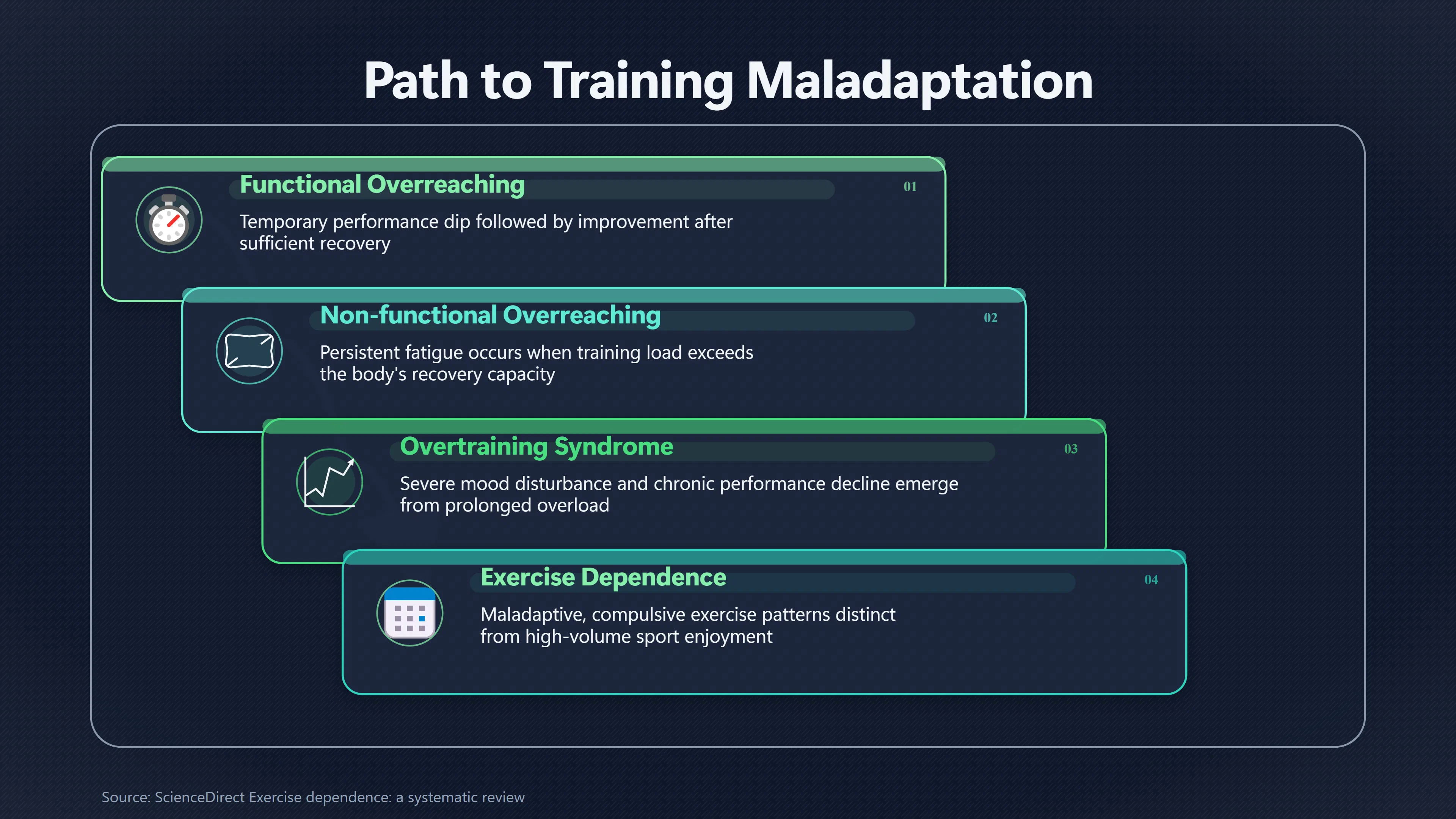
Sports medicine therefore treats the relationship between load and recovery as more informative than exercise volume in isolation. The joint consensus statement from the European College of Sport Science and American College of Sports Medicine distinguishes useful short-term overload from maladaptation. “Functional overreaching” can temporarily reduce performance before sufficient recovery produces improvement. If overload continues without adequate recovery, however, non-functional overreaching and, in more severe cases, overtraining syndrome can develop. Persistent fatigue, performance decline and mood disturbance are characteristic concerns, although there is no single laboratory marker that reliably diagnoses overtraining syndrome.[PubMed]pubmed.ncbi.nlm.nih.govPrevention, diagnosis, and treatment of the overtraining syndrome: joint consensus statement of the European College of Sport Scien…
For an ordinary exerciser, that makes patterns more useful than any magic threshold. Warning signs become more persuasive when several appear together or persist rather than resolving after normal recovery:
- Performance is falling despite continued effort. A difficult session is normal; a sustained decline while training remains high suggests that adding more load may not be producing adaptation.
- Fatigue is leaking into ordinary life. Training that repeatedly leaves someone too depleted to work effectively, study, care for family or complete routine tasks is consuming rather than supplying usable capacity.
- Normal soreness is becoming persistent pain or recurrent injury. Training creates stress that tissues must adapt to. Repeatedly increasing the demand faster than that adaptation occurs can turn a productive stimulus into a problem.
- Sleep is deteriorating. This matters particularly because sleep is itself part of the recovery process. A 2024 systematic review and meta-analysis of endurance overreaching found a small but statistically significant reduction in objectively measured sleep efficiency after intensified training, although subjective sleep ratings did not show a significant change and the underlying studies had important risk-of-bias limitations.[PubMed Central (PMC)]pmc.ncbi.nlm.nih.govPubMed Central (PMC)Does overreaching from endurance-based training impair sleep: A systematic review and meta-analysis - PMC…
- Rest stops feeling permissible. If missed sessions provoke disproportionate guilt or exercise repeatedly takes precedence over injury recovery and important commitments, the problem is no longer adequately described by weekly minutes alone. Research on exercise dependence identifies maladaptive, compulsive exercise as distinct from simply enjoying or doing a large amount of sport.[ScienceDirect]sciencedirect.comScienceDirect Exercise dependence: a systematic reviewExercise dependence: a systematic review - ScienceDirect…
These signs are deliberately broader than muscle soreness. The real boundary is functional: training is exceeding current capacity when recovery can no longer keep pace and the resulting deficit starts appearing elsewhere.

The problem is often the change, not the absolute number
A person can tolerate a substantial workload after months or years of adaptation, while a much smaller workload can cause problems if introduced abruptly. This is one reason copying an experienced athlete’s programme is a poor way to decide how much exercise is appropriate.
Research on injury and training load supports caution around abrupt increases, although it does not provide a clean universal rule. A systematic review of running-related injuries found only four eligible studies and described the evidence as very limited. Three found some association between recent increases in training load and injury, but the evidence did not establish a reliable hazardous threshold. In particular, the review found no support for treating the familiar “increase by no more than 10% per week” rule as a scientifically validated boundary.[PubMed Central (PMC)]pmc.ncbi.nlm.nih.govOpen source on nih.gov.
A broader systematic review covering athletes found emerging evidence linking training load with injury and illness and advised avoiding acute spikes in workload. But even here, the practical lesson is not that a particular percentage automatically separates safe from unsafe exercise. The response to a workload depends on the person receiving it.[PubMed]pubmed.ncbi.nlm.nih.govOpen source on nih.gov.
This makes gradual progression useful for a different reason than is sometimes claimed. It is not obedience to a universal formula; it is a way to gather information. Increasing running distance, lifting volume or session frequency gradually gives the body—and the rest of life—time to reveal whether the new level is sustainable. Persistent soreness, worsening sleep or deteriorating work performance can then prompt an adjustment before another large increase is layered on top.
Recovery is part of the training dose
Exercise is the stimulus; adaptation happens through the combination of that stimulus and subsequent recovery. Consequently, “Can I physically complete this workout?” is a weaker question than “Can I recover from doing workouts like this repeatedly?”
That distinction becomes especially important when training expenditure outruns energy intake. The International Olympic Committee’s 2023 consensus on Relative Energy Deficiency in Sport (REDs) describes how prolonged or severe low energy availability—too little dietary energy remaining after the demands of exercise—can impair physiological and psychological functioning in female and male athletes. Documented concerns include effects on bone and reproductive health, energy metabolism, immunity and performance, with increased injury risk among the potential consequences.[British Journal of Sports Medicine]bjsm.bmj.comOpen source on bmj.com.
This is not an argument that every tired recreational exerciser has REDs. The IOC framework is principally aimed at sporting populations, and fatigue has many possible causes. It illustrates a broader mechanism, however: exercise cannot be evaluated independently of the resources available to support it. Increasing training while simultaneously cutting food, losing sleep and accumulating stress can change a previously manageable routine into an unsustainable one.
Sleep creates a similar interaction. A systematic review of elite athletes found that early-morning training, increases in training load greater than 25% in the included evidence, competition schedules and some travel patterns were associated with impaired sleep. In other words, training can consume recovery not only through physiological stress but also by occupying the very hours that recovery requires.[PubMed]pubmed.ncbi.nlm.nih.govOpen source on nih.gov.
For a self-improvement programme, this is a particularly poor trade when exercise is supposed to support energy and functioning. An extra early session that requires chronic sleep restriction may improve one training metric while making the overall system worse.

Balance improvement with the rest of life
The useful exercise dose is therefore better understood as a sustainable range than a maximum. Within that range, training is challenging enough to preserve or improve capacity but recoverable enough that normal life still works.
A practical way to judge that range is to look beyond the workout itself. If performance is stable or improving, ordinary soreness resolves, sleep remains adequate, injuries are uncommon and there is still enough physical and mental energy for work and responsibilities, the programme is probably fitting the person’s present capacity reasonably well. If several of those indicators deteriorate after volume or intensity rises, reducing load can be an adjustment to the programme rather than a retreat from it.
The correct adjustment does not always mean exercising less in every dimension. Someone might preserve a valued routine while shortening sessions, replace some vigorous work with easier movement, reduce the number of hard sessions, or stop increasing volume temporarily. Because intensity, duration and frequency all contribute to load, a programme can often be made easier to recover from without abandoning regular activity.
It is also worth separating health goals from performance goals. Someone preparing for a demanding sporting event may deliberately train beyond the volume required for general health. That is a legitimate choice, but the additional workload should be recognised as the price of pursuing sporting performance rather than assumed to deliver proportionately greater health. Population studies consistently show the biggest relative gains towards the lower end of the activity curve and diminishing additional returns as volume rises.[nih.gov]pmc.ncbi.nlm.nih.govPubMed Central (PMC)Long-term leisure-time physical activity intensity and all-cause and cause-specific mortality: a prospective cohort o…
The broader self-improvement principle is simple: exercise should increase the amount of life a person can use, not merely the amount of training they can tolerate. A demanding programme can be worthwhile, but only when its demands match the goal. When extra sessions produce little additional benefit while fatigue, pain, sleep loss or scheduling pressure begin compromising everything around them, “more” has stopped being the useful measure of progress.
Amazon book picks
Further Reading
Books and field guides related to When Does More Exercise Stop Helping Your Goals?. Use these as the next step if you want deeper reading beyond the article.
Exercised
The book tells the story of how we never evolved to exercise - to do voluntary physical activity for the sake of health. Using his own re...
Good to Go
'A must-read for all athletes, from the professional to the weekend warrior.' - Wall Street Journal The New York Times Bestselling accoun...
Peak Performance
"A transfixing book on how to sustain peak performance and avoid burnout" — Adam Grant, New York Times bestselling author of Option B, Or...
Built to Move
INSTANT NEW YORK TIMES BEST SELLER • Simple but powerful physical practices to dramatically improve the way your body feels and prolong y...
eBay marketplace picks
Marketplace Samples
Live-tested eBay searches with available results related to this page.
Selected fromself improvement wall art oneBay.co.uk.



Endnotes
1.
Source: sciencedirect.com
Title: ScienceDirect Exercise dependence: a systematic review
Link:https://www.sciencedirect.com/science/article/pii/S1469029200000157
Source snippet
Exercise dependence: a systematic review - ScienceDirect...
2.
Source: sciencedirect.com
Link:https://www.sciencedirect.com/science/article/pii/S1047279726001481
3.
Source: sciencedirect.com
Link:https://www.sciencedirect.com/science/article/am/pii/S0306460318308633
4.
Source: ncbi.nlm.nih.gov
Link:https://www.ncbi.nlm.nih.gov/books/NBK566046/
Source snippet
WHO Guidelines on [Physical Activity]({{ 'physical-capacity/' | relative_url }}) and Sedentary Behaviour - NCBI Bookshelf...
5.
Source: pmc.ncbi.nlm.nih.gov
Link:https://pmc.ncbi.nlm.nih.gov/articles/PMC9378548/
Source snippet
PubMed Central (PMC)Long-term leisure-time physical activity intensity and all-cause and cause-specific mortality: a prospective cohort o...
6.
Source: jamanetwork.com
Link:https://jamanetwork.com/journals/jamainternalmedicine/fullarticle/2212267
Source snippet
JAMA NetworkLeisure Time Physical Activity and Mortality: A Detailed Pooled Analysis of the Dose-Response Relationship | Lifestyle Behavi...
7.
Source: pubmed.ncbi.nlm.nih.gov
Link:https://pubmed.ncbi.nlm.nih.gov/23247672/
Source snippet
Prevention, diagnosis, and treatment of the overtraining syndrome: joint consensus statement of the European College of Sport Scien...
8.
Source: pmc.ncbi.nlm.nih.gov
Link:https://pmc.ncbi.nlm.nih.gov/articles/PMC11135706/
Source snippet
PubMed Central (PMC)Does overreaching from endurance-based training impair sleep: A systematic review and meta-analysis - PMC...
9.
Source: ncbi.nlm.nih.gov
Link:https://www.ncbi.nlm.nih.gov/books/NBK566048/
Source snippet
SUMMARY - WHO Guidelines on Physical Activity and Sedentary Behaviour - NCBI Bookshelf...
10.
Source: pubmed.ncbi.nlm.nih.gov
Link:https://pubmed.ncbi.nlm.nih.gov/35876019/
11.
Source: pubmed.ncbi.nlm.nih.gov
Link:https://pubmed.ncbi.nlm.nih.gov/38809828/
Source snippet
Does overreaching from endurance-based training impair sleep: A systematic review and meta-analysis - PubMed...
12.
Source: pubmed.ncbi.nlm.nih.gov
Link:https://pubmed.ncbi.nlm.nih.gov/30595420/
Source snippet
Which sports are more at risk of physical exercise addiction: A systematic review - PubMed...
13.
Source: pmc.ncbi.nlm.nih.gov
Link:https://pmc.ncbi.nlm.nih.gov/articles/PMC6253751/
14.
Source: pubmed.ncbi.nlm.nih.gov
Link:https://pubmed.ncbi.nlm.nih.gov/30534459/
15.
Source: pubmed.ncbi.nlm.nih.gov
Link:https://pubmed.ncbi.nlm.nih.gov/26822969/
16.
Source: bjsm.bmj.com
Link:https://bjsm.bmj.com/content/57/17/1073
17.
Source: pubmed.ncbi.nlm.nih.gov
Link:https://pubmed.ncbi.nlm.nih.gov/30217831/
18.
Source: jamanetwork.com
Link:https://jamanetwork.com/journals/jamanetworkopen/fullarticle/2795598
19.
Source: GOV.UK
Title: www.gov.uk U K Chief Medical Officers’ physical activity guidelines
Link:https://www.gov.uk/government/publications/physical-activity-guidelines-uk-chief-medical-officers-report/uk-chief-medical-officers-physical-activity-guidelines
20.
Source: pubmed.ncbi.nlm.nih.gov
Link:https://pubmed.ncbi.nlm.nih.gov/42309274/
21.
Source: pmc.ncbi.nlm.nih.gov
Link:https://pmc.ncbi.nlm.nih.gov/articles/PMC13371730/
22.
Source: pubmed.ncbi.nlm.nih.gov
Link:https://pubmed.ncbi.nlm.nih.gov/42024448/
23.
Source: pmc.ncbi.nlm.nih.gov
Link:https://pmc.ncbi.nlm.nih.gov/articles/PMC13212749/
24.
Source: pubmed.ncbi.nlm.nih.gov
Link:https://pubmed.ncbi.nlm.nih.gov/41869606/
25.
Source: pubmed.ncbi.nlm.nih.gov
Link:https://pubmed.ncbi.nlm.nih.gov/40782920/
26.
Source: jamanetwork.com
Link:https://jamanetwork.com/journals/jamanetworkopen/fullarticle/2826554
27.
Source: pubmed.ncbi.nlm.nih.gov
Link:https://pubmed.ncbi.nlm.nih.gov/37925162/
28.
Source: pubmed.ncbi.nlm.nih.gov
Link:https://pubmed.ncbi.nlm.nih.gov/37752006/
29.
Source: jamanetwork.com
Link:https://jamanetwork.com/journals/jamainternalmedicine/fullarticle/2807854
30.
Source: pubmed.ncbi.nlm.nih.gov
Link:https://pubmed.ncbi.nlm.nih.gov/37036463/
31.
Source: jamanetwork.com
Link:https://jamanetwork.com/journals/jamanetworkopen/fullarticle/2802810
32.
Source: pubmed.ncbi.nlm.nih.gov
Link:https://pubmed.ncbi.nlm.nih.gov/36848414/
33.
Source: pubmed.ncbi.nlm.nih.gov
Link:https://pubmed.ncbi.nlm.nih.gov/36848408/
34.
Source: pmc.ncbi.nlm.nih.gov
Link:https://pmc.ncbi.nlm.nih.gov/articles/PMC9869993/
35.
Source: pmc.ncbi.nlm.nih.gov
Link:https://pmc.ncbi.nlm.nih.gov/articles/PMC9811256/
36.
Source: jamanetwork.com
Link:https://jamanetwork.com/journals/jamanetworkopen/fullarticle/2797402
37.
Source: pmc.ncbi.nlm.nih.gov
Link:https://pmc.ncbi.nlm.nih.gov/articles/PMC9586848/
38.
Source: nia.nih.gov
Title: leisure activities may improve longevity older adults
Link:https://www.nia.nih.gov/news/leisure-activities-may-improve-longevity-older-adults
39.
Source: pmc.ncbi.nlm.nih.gov
Link:https://pmc.ncbi.nlm.nih.gov/articles/PMC9403775/
40.
Source: pubmed.ncbi.nlm.nih.gov
Link:https://pubmed.ncbi.nlm.nih.gov/35876019/?tag1=Entail&tag2=Entail&tg=SEO
41.
Source: pmc.ncbi.nlm.nih.gov
Link:https://pmc.ncbi.nlm.nih.gov/articles/PMC10064988/
42.
Source: pubmed.ncbi.nlm.nih.gov
Link:https://pubmed.ncbi.nlm.nih.gov/35953241/
43.
Source: pubmed.ncbi.nlm.nih.gov
Link:https://pubmed.ncbi.nlm.nih.gov/36001316/
44.
Source: pmc.ncbi.nlm.nih.gov
Link:https://pmc.ncbi.nlm.nih.gov/articles/PMC9528699/
45.
Source: pubmed.ncbi.nlm.nih.gov
Link:https://pubmed.ncbi.nlm.nih.gov/35320774/
46.
Source: pmc.ncbi.nlm.nih.gov
Link:https://pmc.ncbi.nlm.nih.gov/articles/PMC9460078/
47.
Source: pubmed.ncbi.nlm.nih.gov
Link:https://pubmed.ncbi.nlm.nih.gov/34496702/
48.
Source: pmc.ncbi.nlm.nih.gov
Link:https://pmc.ncbi.nlm.nih.gov/articles/PMC8343120/
49.
Source: pmc.ncbi.nlm.nih.gov
Link:https://pmc.ncbi.nlm.nih.gov/articles/PMC9219310/
50.
Source: pmc.ncbi.nlm.nih.gov
Link:https://pmc.ncbi.nlm.nih.gov/articles/PMC8969858/
51.
Source: pubmed.ncbi.nlm.nih.gov
Link:https://pubmed.ncbi.nlm.nih.gov/33352457/
52.
Source: pmc.ncbi.nlm.nih.gov
Link:https://pmc.ncbi.nlm.nih.gov/articles/7719906/
53.
Source: pubmed.ncbi.nlm.nih.gov
Link:https://pubmed.ncbi.nlm.nih.gov/33329076/
54.
Source: pmc.ncbi.nlm.nih.gov
Link:https://pmc.ncbi.nlm.nih.gov/articles/PMC7714788/
55.
Source: pubmed.ncbi.nlm.nih.gov
Link:https://pubmed.ncbi.nlm.nih.gov/31810972/
56.
Source: nidirect.gov.uk
Title: Sports injuries | nidirect
Link:https://www.nidirect.gov.uk/conditions/sports-injuries
57.
Source: pmc.ncbi.nlm.nih.gov
Link:https://pmc.ncbi.nlm.nih.gov/articles/PMC5928142/
58.
Source: pubmed.ncbi.nlm.nih.gov
Link:https://pubmed.ncbi.nlm.nih.gov/29559317/
59.
Source: pubmed.ncbi.nlm.nih.gov
Link:https://pubmed.ncbi.nlm.nih.gov/29345524/
60.
Source: pmc.ncbi.nlm.nih.gov
Link:https://pmc.ncbi.nlm.nih.gov/articles/PMC5386595/
61.
Source: pmc.ncbi.nlm.nih.gov
Link:https://pmc.ncbi.nlm.nih.gov/articles/PMC5488138/
62.
Source: pmc.ncbi.nlm.nih.gov
Link:https://pmc.ncbi.nlm.nih.gov/articles/5394138/
63.
Source: pmc.ncbi.nlm.nih.gov
Link:https://pmc.ncbi.nlm.nih.gov/articles/PMC5013087/
64.
Source: pubmed.ncbi.nlm.nih.gov
Link:https://pubmed.ncbi.nlm.nih.gov/23247672/?dopt=Abstract
65.
Source: pubmed.ncbi.nlm.nih.gov
Link:https://pubmed.ncbi.nlm.nih.gov/22216780/
66.
Source: pubmed.ncbi.nlm.nih.gov
Link:https://pubmed.ncbi.nlm.nih.gov/PMC6253751/
67.
Source: pubmed.ncbi.nlm.nih.gov
Link:https://pubmed.ncbi.nlm.nih.gov/37752011/
68.
Source: pubmed.ncbi.nlm.nih.gov
Link:https://pubmed.ncbi.nlm.nih.gov/29943231/
69.
Source: ncbi.nlm.nih.gov
Link:https://www.ncbi.nlm.nih.gov/books/NBK566048/?report=printable
70.
Source: ncbi.nlm.nih.gov
Link:https://www.ncbi.nlm.nih.gov/books/NBK566045/
71.
Source: pubmed.ncbi.nlm.nih.gov
Link:https://pubmed.ncbi.nlm.nih.gov/37752007/
72.
Source: pubmed.ncbi.nlm.nih.gov
Link:https://pubmed.ncbi.nlm.nih.gov/27535991/
73.
Source: pubmed.ncbi.nlm.nih.gov
Link:https://pubmed.ncbi.nlm.nih.gov/8350709/
74.
Source: ncbi.nlm.nih.gov
Link:https://www.ncbi.nlm.nih.gov/books/NBK566046/?report=printable
75.
Source: ncbi.nlm.nih.gov
Link:https://www.ncbi.nlm.nih.gov/medgen/1809305
76.
Source: pubmed.ncbi.nlm.nih.gov
Link:https://pubmed.ncbi.nlm.nih.gov/32496431/
77.
Source: pubmed.ncbi.nlm.nih.gov
Link:https://pubmed.ncbi.nlm.nih.gov/23329605/
78.
Source: pubmed.ncbi.nlm.nih.gov
Link:https://pubmed.ncbi.nlm.nih.gov/27900583/
79.
Source: pubmed.ncbi.nlm.nih.gov
Link:https://pubmed.ncbi.nlm.nih.gov/29352373/
80.
Source: bjsm.bmj.com
Link:https://bjsm.bmj.com/content/48/7/491
81.
Source: bjsm.bmj.com
Link:https://bjsm.bmj.com/content/52/11/687
82.
Source: bjsm.bmj.com
Link:https://bjsm.bmj.com/content/57/17/1098
83.
Source: bjsm.bmj.com
Link:https://bjsm.bmj.com/content/57/17/1073.altmetrics
84.
Source: bjsm.bmj.com
Link:https://bjsm.bmj.com/content/52/11/687.abstract
85.
Source: bjsm.bmj.com
Link:https://bjsm.bmj.com/content/57/15/979
86.
Source: bmjopensem.bmj.com
Link:https://bmjopensem.bmj.com/content/1/1/e000063
87.
Source: pubmed-ncbi-nlm-nih-gov.jumper.tmu.edu.tw
Link:https://pubmed-ncbi-nlm-nih-gov.jumper.tmu.edu.tw/37752011/
Additional References
88.
Source: youtube.com
Link:https://www.youtube.com/watch?v=IQoAEVeI11Q
Source snippet
How much exercise is too much overtraining diminishing returns Junk Volume: Why You Should Avoid It For Max Muscle...
89.
Source: youtube.com
Link:https://www.youtube.com/watch?v=azVLigOZsXU
Source snippet
How Much Training Volume and Frequency for Muscle Gains? | Educational | Layne Norton PhD...
90.
Source: youtube.com
Title: The minimum effective training for the four pillars of longevity | Peter Attia
Link:https://www.youtube.com/watch?v=ExFMe4fOsUg
Source snippet
Large gains in minimal time: the minimal effective dose for hypertrophy | Dr. Brad Schoenfeld...
91.
Source: who.int
Link:https://www.who.int/publications/i/item/9789240015111
92.
Source: youtube.com
Title: Training Intensity & Volume to Balance Gains and Fatigue | Mike Israetel
Link:https://www.youtube.com/watch?v=_0McpRI0ZJc
Source snippet
Junk Volume: Why You Should Avoid It For Max Muscle...
93.
Source: youtube.com
Title: Junk Volume: Why You Should Avoid It For Max Muscle
Link:https://www.youtube.com/watch?v=ekQxEEjYLDI
Source snippet
The minimum effective training for the four pillars of longevity | Peter Attia...
94.
Source: youtu.be
Title: The Proof with Simon Hill
Link:https://youtu.be/x7O_dAc7v0M
Source snippet
Balance Over Burnout: The Truth About Over-Exercising|Fitness Burnout Is Real Here’s How to Avoid It Vani Bhalla Pahwa...
95.
Source: who.int
Title: WH O guidelines on physical activity and sedentary behaviour: at a glance
Link:https://www.who.int/poland/publications/9789240014886
96.
Source: who.int
Title: WH O guidelines on physical activity and sedentary behaviour: at a glance
Link:https://www.who.int/publications/i/item/9789240014886
97.
Source: pmnch.who.int
Title: int WH O guidelines on physical activity and sedentary behaviour
Link:https://pmnch.who.int/resources/publications/i/item/9789240015128