Within Fix the System
Why Your Habit Cue Keeps Failing
If the behaviour never comes to mind, the cue may be too vague, unstable or poorly placed to trigger action consistently.
On this page
- Signs that the cue is the real bottleneck
- How context stability affects automaticity
- Replacing vague cues with reliable events
Page outline Jump by section
Introduction
When a planned habit repeatedly fails because the behaviour simply does not come to mind, the cue is a prime suspect. A useful cue is not merely a reminder written into a plan; it is a recognisable event or context that occurs reliably enough for the brain to learn an association between that situation and the intended response. Habit research describes this process as repeated behaviour becoming linked to recurring contextual cues.[Sage Journals]journals.sagepub.comSage Journals Habits—A Repeat PerformanceSage JournalsHabits—A Repeat Performance - David T. Neal, Wendy Wood, Jeffrey M. Quinn, 2006…
The practical implication is important: forgetting does not necessarily mean the goal needs more motivation. The cue may be too vague, may occur inconsistently, may be easy to overlook, or may have become detached from the context in which the habit was learned. Research on intentional habit building finds that stable contexts are associated with greater automaticity and better repetition of the intended behaviour.[PubMed Central (PMC)]pmc.ncbi.nlm.nih.govPubMed Central (PMC)Context Stability in Habit Building Increases Automaticity and Goal Attainment - PMCJune 10, 2022…
Troubleshooting cue failure therefore means asking a narrow question: does the intended trigger reliably appear, get noticed and bring the behaviour to mind? If not, strengthening commitment while leaving the trigger unchanged addresses the wrong part of the system.
Signs that the cue is the real bottleneck
The clearest sign of cue failure is discovering the missed behaviour later and thinking, “I completely forgot.” That is different from noticing the opportunity and deciding not to act. If “read after breakfast” comes to mind but you choose to check messages instead, the cue has done at least part of its job. If reading never enters awareness until lunchtime, cueing is a more plausible bottleneck.
This distinction follows from the way habits are understood in behavioural research. Habits are not simply behaviours performed frequently; they involve learned associations through which contextual features can activate a response. Experiments and daily-life research have found that performance contexts can trigger strong habitual responses even when people’s current goals are not doing the triggering.[ScienceDirect]sciencedirect.comHow do habits guide behavior? Perceived and actual triggers of habits in daily life - ScienceDirect…
For troubleshooting purposes, several patterns particularly implicate the cue:
- The behaviour is remembered after the opportunity has passed. You remember the vitamins on the train rather than at breakfast, or remember your stretches after getting into bed.
- The habit works only on unusually orderly days. A cue such as “in the morning” may accidentally work when mornings follow one predictable sequence but disappear when that sequence changes.
- You depend on remembering to look for the reminder. A note hidden in an app or an alarm routinely dismissed during another activity is technically present but functionally weak.
- The trigger itself varies. “After lunch” is unreliable if lunch happens at a desk one day, in a café the next and not at all on another.
- A change of setting suddenly breaks an established routine. Moving house, changing jobs, travelling or rearranging the normal sequence of a day can remove cues that previously prompted behaviour without much thought.
That last pattern has direct experimental support. In research following university students through a change of university, established behaviours such as exercise, newspaper reading and television viewing were disrupted when relevant features of their performance contexts changed. Where important contextual features remained similar, habitual behaviour was more likely to persist.[PubMed]pubmed.ncbi.nlm.nih.govPub Med Changing circumstances, disrupting habitsChanging circumstances, disrupting habits - PubMed…
This makes context change a useful diagnostic test. If a routine once felt almost effortless but suddenly requires active remembering after a change in schedule or location, the loss of its old cues may explain more than a sudden loss of self-discipline.
How context stability affects automaticity
Habit automaticity develops through repeated pairing. A context is encountered, a behaviour follows, and repeated experience strengthens the association between them. Eventually, encountering relevant contextual features can help bring the response to mind with less deliberate decision-making. Reviews of habit research therefore emphasise repetition in recurring contexts rather than repetition alone.[PubMed]pubmed.ncbi.nlm.nih.govPub Med Psychology of HabitPsychology of Habit - PubMed…
A particularly relevant longitudinal study tested this principle directly. Marco Stojanovic and colleagues followed intentional habit building using two datasets. In one study, 95 university students generated 2,482 recorded study-habit repetitions over six weeks; participants were instructed either to keep their time and location stable or deliberately vary them. A second dataset covered 308 habits and 2,368 repetitions from 218 users of a habit-building app. Across both datasets, greater context stability predicted greater automaticity and higher attainment of habit-repetition goals.[PubMed Central (PMC)]pmc.ncbi.nlm.nih.govPubMed Central (PMC)Context Stability in Habit Building Increases Automaticity and Goal Attainment - PMCJune 10, 2022…
The result does not mean every habit must happen at precisely the same minute in precisely the same chair. “Context” can include location, time, preceding actions and other recurring features of the situation. Habit theory specifically recognises physical settings and preceding actions as features from which context-response associations can develop.[PubMed]pubmed.ncbi.nlm.nih.govPub Med A new look at habits and the habit-goal interfaceA new look at habits and the habit-goal interface - PubMed…
What matters for cue troubleshooting is recognisable recurrence. Consider the difference between:
Weakly specified: “I will practise Spanish in the evening.”
More stable: “When I put my dinner plate in the dishwasher, I will practise Spanish.”
The first requires the person to decide when “evening” has reached the appropriate moment and to retrieve the intention while doing something else. The second attaches the behaviour to an observable transition already occurring in the day.
There is an important qualification. A routine-based cue is not automatically superior to a clock time. In a randomised controlled trial involving 192 adults who selected an everyday nutrition behaviour, participants linked the behaviour either to a daily routine or to a specific time and reported on it for 84 days. Both approaches produced increases in plan enactment and automaticity, with no significant group-level advantage for one cue type. What strongly predicted automaticity was repeatedly performing the behaviour in response to the chosen cue.[PubMed]pubmed.ncbi.nlm.nih.govHabit formation following routine-based versus time-based cue planning: A randomized controlled trial - PubMedJanuary 6, 2021…
So the useful rule is not “never use time cues”. It is choose whichever cue you can encounter and act upon consistently. Seven o’clock can be excellent for someone whose day reliably permits action at seven; it can be a poor trigger for someone who is variously commuting, cooking, working late or exercising at that hour.

Why a cue can stop working
A cue can fail even after it once worked because the cue-response relationship depends on the circumstances in which it was learned. Modern habit research characterises habit memories as context-response associations formed through repeated, rewarding action in stable contexts. Altering those contexts can reduce the capacity of familiar stimuli to activate the usual response.[Association for Psychological Science]psychologicalscience.orgOpen source on psychologicalscience.org.
That produces several distinct forms of apparent “forgetfulness”.
The cue becomes unstable. A person starts with “meditate after breakfast”, then begins skipping breakfast or eating it at unpredictable points during the working day. The intention has not changed, but its anchor has.
The cue becomes ambiguous. “After work” sounds specific until work sometimes ends at the office, sometimes at home and sometimes after answering messages later in the evening. A cue that requires interpretation creates another decision before the intended behaviour can begin.
The cue loses visibility. Environmental prompts can disappear into their surroundings. A notebook placed conspicuously on a desk may initially attract attention, then become part of the visual background. In practical terms, the intended trigger is no longer reliably capturing attention.
The cue gets separated from immediate action. An alarm sounds for exercise while you are on a call, so you dismiss it and intend to exercise afterwards. The alarm successfully retrieved the intention, but the planned cue-response pairing has been broken: the actual behaviour now depends on remembering a second time.
The surrounding context changes. A new commute, different kitchen, holiday, changed work shift or altered morning sequence can remove several learned contextual features simultaneously. Research on “habit discontinuity” has found that changes such as moving home can weaken the influence of existing habits, although the size and duration of these effects depend on circumstances.[PubMed]pubmed.ncbi.nlm.nih.govOpen source on nih.gov.
These mechanisms explain why repeatedly adding more reminders is not always the answer. The question is whether the reminder is positioned at the point where action can actually follow.
Replacing vague cues with reliable events
The most useful repair is usually to make the cue more discriminable and more tightly connected to the opportunity to act. One established technique is an implementation intention: specifying an anticipated situation and linking it explicitly to a response — essentially, “if X occurs, then I do Y”. Research suggests that these plans work partly by increasing the accessibility of the specified cue and strengthening the association between that cue and the intended response.[ScienceDirect]sciencedirect.comOpen source on sciencedirect.com.
A large meta-analysis covering 94 independent tests found a medium-to-large overall effect of implementation intentions on goal attainment, although that literature covers goal pursuit broadly rather than habit formation alone. Its relevance here is mechanistic: specifying the triggering situation can help transfer some control from deliberate remembering to recognition of the planned situation.[ScienceDirect]sciencedirect.comOpen source on sciencedirect.com.
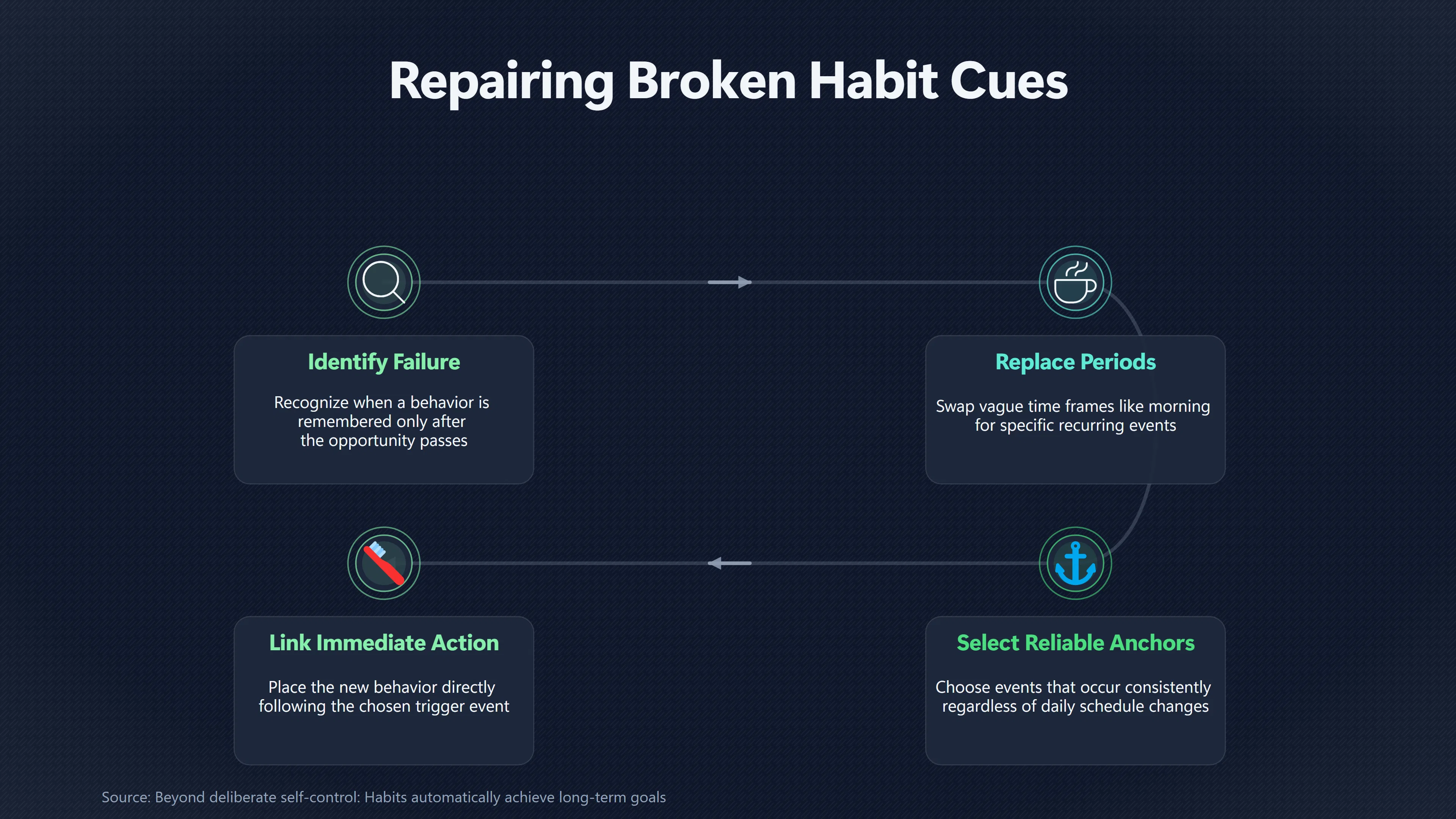
For a repeatedly forgotten habit, improve the trigger in three steps:
- Replace a period with an event. Instead of “read in the morning”, try “read when I sit down with my first drink”. Instead of “review tomorrow’s priorities at night”, use “review tomorrow’s priorities when I close my laptop”.
- Choose an event that already happens reliably. A new habit should not depend on another fragile habit for its cue. “After my daily run” is a poor anchor if running happens twice in a typical week.
- Put the action immediately after the cue where possible. “When I finish brushing my teeth, I floss” creates a tighter relationship than “brushing my teeth reminds me to floss sometime before bed”.
The underlying distinction resembles findings from prospective-memory research — the study of remembering to perform intended actions later. Time-based intentions often require people to monitor time, whereas event-based intentions can be retrieved when an external event appears.[PubMed Central (PMC)]pmc.ncbi.nlm.nih.govOpen source on nih.gov. This does not establish that event cues always produce stronger habits; indeed, the randomised habit-formation trial found routine- and time-based planning similarly effective overall.[PubMed]pubmed.ncbi.nlm.nih.govHabit formation following routine-based versus time-based cue planning: A randomized controlled trial - PubMedJanuary 6, 2021… It does explain why a conspicuous event can be easier to notice than an imprecise instruction such as “later this evening”.
The best replacement cue is therefore not necessarily the cleverest one. It is the event with the strongest combination of specificity, regularity, visibility and immediate opportunity to act.

Test the cue before changing the habit
Cue troubleshooting becomes much easier if the next few failures are treated as observations rather than as evidence that the entire routine is defective. When the intended behaviour does not happen, ask what happened at the trigger.
Did the cue occur? Did you notice it? Did the behaviour come to mind? Could you act immediately?
Those questions separate cue failure from neighbouring problems. If the cue occurred and the behaviour came to mind but you repeatedly chose something else, the trigger is probably not the main bottleneck. If you started but stopped because the action was too demanding, changing the cue will not solve that problem either. But if the cue never occurred, went unnoticed or consistently failed to retrieve the intended action, redesigning it is directly targeted at the failure.
There is also no need to treat one missed repetition as proof that a cue is broken. Habit formation is variable between individuals, and even successful formation trajectories contain irregularities. In the 84-day nutrition study, repeated enactment in response to the planned cue — rather than flawless daily performance — was the important predictor of increasing automaticity.[DOI]doi.orgOpen source on doi.org.
The aim is therefore not to engineer a reminder that can never be missed. It is to create a context-behaviour pairing reliable enough to be repeated many times. Stable context supports that learning, and repeated successful enactment strengthens it.[PubMed Central (PMC)]pmc.ncbi.nlm.nih.govPubMed Central (PMC)Context Stability in Habit Building Increases Automaticity and Goal Attainment - PMCJune 10, 2022…
The practical test for a reliable cue
A strong cue should eventually reduce the amount of remembering the habit requires. Before committing to a replacement trigger, ask whether it passes four simple tests: Will this event actually happen most days? Will I clearly recognise it when it happens? Am I normally able to begin the behaviour then? Can I repeat roughly the same cue-response pairing over time?
That standard captures the central lesson from habit research without demanding artificial rigidity. Automaticity develops more readily when behaviour repeatedly meets a sufficiently stable context, while changing contexts can disrupt established cue-response associations.[PubMed Central (PMC)]pmc.ncbi.nlm.nih.govPubMed Central (PMC)Context Stability in Habit Building Increases Automaticity and Goal Attainment - PMCJune 10, 2022…
When a habit repeatedly never comes to mind, then, the useful intervention is often surprisingly small. Do not redesign the whole self-improvement system first. Replace “when I remember”, “sometime tonight” or an unstable part of the day with a concrete event that reliably occurs where action is possible. Then repeat the intended response when that event appears. The cue’s job is not merely to describe when you hoped to act; it is to become the recognisable doorway through which the behaviour reliably starts.
Amazon book picks
Further Reading
Books and field guides related to Why Your Habit Cue Keeps Failing. Use these as the next step if you want deeper reading beyond the article.
Atomic Habits
Rating: 3.5/5 from 7 Google Books ratings
The #1 New York Times bestseller. Over 25 million copies sold! Translated into 60+ languages! Tiny Changes, Remarkable Results No matter...
The Power of Habit
Rating: 4.0/5 from 145 Google Books ratings
Duhigg takes us to the edge of scientific discoveries that explain why habits exist and how they can be changed. Distilling information i...
Tiny Habits
Improving your life is much easier than you think. Whether it’s losing weight, sleeping more, or restoring your work/life balance – the s...
Good Habits, Bad Habits
'The world's leading expert on habits' - Matthew Syed, bestselling author of Black Box Thinking and Rebel IdeasWhat if you could harness...
eBay marketplace picks
Marketplace Samples
Live-tested eBay searches with available results related to this page.
Selected fromhabit tracker board oneBay.co.uk.


Endnotes
1.
Source: sciencedirect.com
Link:https://www.sciencedirect.com/science/article/pii/S002210311100254X
Source snippet
How do habits guide behavior? Perceived and actual triggers of habits in daily life - ScienceDirect...
2.
Source: doi.org
Link:https://doi.org/10.1111/bjhp.12504
3.
Source: sciencedirect.com
Link:https://www.sciencedirect.com/science/article/abs/pii/S002210310600028X
4.
Source: sciencedirect.com
Link:https://www.sciencedirect.com/science/chapter/bookseries/abs/pii/S0065260106380021
5.
Source: sciencedirect.com
Title: Beyond deliberate [self-control]({{ ‘self-control/’ | relative_url }}): Habits automatically achieve long-term goals
Link:https://www.sciencedirect.com/science/article/pii/S2352250X24000939
6.
Source: sciencedirect.com
Link:https://www.sciencedirect.com/science/article/abs/pii/S0885201420301520
7.
Source: sciencedirect.com
Link:https://www.sciencedirect.com/science/article/pii/S0165178115000360
8.
Source: sciencedirect.com
Link:https://www.sciencedirect.com/science/article/abs/pii/S0065260106380021
9.
Source: doi.org
Link:https://doi.org/10.1007/978
10.
Source: journals.sagepub.com
Title: Sage Journals Habits—A Repeat Performance
Link:https://journals.sagepub.com/doi/10.1111/j.1467-8721.2006.00435.x
Source snippet
Sage JournalsHabits—A Repeat Performance - David T. Neal, Wendy Wood, Jeffrey M. Quinn, 2006...
11.
Source: pubmed.ncbi.nlm.nih.gov
Title: Pub Med Psychology of Habit
Link:https://pubmed.ncbi.nlm.nih.gov/26361052/
Source snippet
Psychology of Habit - PubMed...
12.
Source: pmc.ncbi.nlm.nih.gov
Link:https://pmc.ncbi.nlm.nih.gov/articles/PMC9226889/
Source snippet
PubMed Central (PMC)Context Stability in Habit Building Increases Automaticity and Goal Attainment - PMCJune 10, 2022...
Published: June 10, 2022
13.
Source: pubmed.ncbi.nlm.nih.gov
Link:https://pubmed.ncbi.nlm.nih.gov/35756236/
Source snippet
Context Stability in Habit Building Increases Automaticity and Goal Attainment - PubMed...
14.
Source: pubmed.ncbi.nlm.nih.gov
Title: Pub Med A new look at habits and the habit-goal interface
Link:https://pubmed.ncbi.nlm.nih.gov/17907866/
Source snippet
A new look at habits and the habit-goal interface - PubMed...
15.
Source: pubmed.ncbi.nlm.nih.gov
Title: Pub Med Changing circumstances, disrupting habits
Link:https://pubmed.ncbi.nlm.nih.gov/15982113/
Source snippet
Changing circumstances, disrupting habits - PubMed...
16.
Source: pmc.ncbi.nlm.nih.gov
Link:https://pmc.ncbi.nlm.nih.gov/articles/PMC4566897/
Source snippet
PubMed Central (PMC)A review and analysis of the use of ‘habit’ in understanding, predicting and influencing health-related behaviour - PMC...
17.
Source: pubmed.ncbi.nlm.nih.gov
Link:https://pubmed.ncbi.nlm.nih.gov/33405284/
Source snippet
Habit formation following routine-based versus time-based cue planning: A randomized controlled trial - PubMedJanuary 6, 2021...
Published: January 6, 2021
18.
Source: psychologicalscience.org
Link:https://www.psychologicalscience.org/journals/current-directions/09637214241246480/
19.
Source: pubmed.ncbi.nlm.nih.gov
Link:https://pubmed.ncbi.nlm.nih.gov/27120333/
20.
Source: pubmed.ncbi.nlm.nih.gov
Link:https://pubmed.ncbi.nlm.nih.gov/18096108/
21.
Source: pmc.ncbi.nlm.nih.gov
Link:https://pmc.ncbi.nlm.nih.gov/articles/PMC9274250/
22.
Source: pmc.ncbi.nlm.nih.gov
Link:https://pmc.ncbi.nlm.nih.gov/articles/PMC6869434/
23.
Source: pmc.ncbi.nlm.nih.gov
Link:https://pmc.ncbi.nlm.nih.gov/articles/PMC13114073/
24.
Source: pmc.ncbi.nlm.nih.gov
Link:https://pmc.ncbi.nlm.nih.gov/articles/PMC12589293/
25.
Source: pmc.ncbi.nlm.nih.gov
Link:https://pmc.ncbi.nlm.nih.gov/articles/PMC11574773/
26.
Source: pubmed.ncbi.nlm.nih.gov
Link:https://pubmed.ncbi.nlm.nih.gov/39496905/
27.
Source: pubmed.ncbi.nlm.nih.gov
Link:https://pubmed.ncbi.nlm.nih.gov/39225981/
28.
Source: pubmed.ncbi.nlm.nih.gov
Link:https://pubmed.ncbi.nlm.nih.gov/38047612/
29.
Source: pubmed.ncbi.nlm.nih.gov
Link:https://pubmed.ncbi.nlm.nih.gov/37504049/
30.
Source: pmc.ncbi.nlm.nih.gov
Link:https://pmc.ncbi.nlm.nih.gov/articles/PMC9372943/
31.
Source: pmc.ncbi.nlm.nih.gov
Link:https://pmc.ncbi.nlm.nih.gov/articles/PMC12318445/
32.
Source: pubmed.ncbi.nlm.nih.gov
Link:https://pubmed.ncbi.nlm.nih.gov/34753411/
33.
Source: pubmed.ncbi.nlm.nih.gov
Link:https://pubmed.ncbi.nlm.nih.gov/33220048/
34.
Source: pmc.ncbi.nlm.nih.gov
Link:https://pmc.ncbi.nlm.nih.gov/articles/PMC8149892/
35.
Source: pubmed.ncbi.nlm.nih.gov
Link:https://pubmed.ncbi.nlm.nih.gov/34054628/
36.
Source: pmc.ncbi.nlm.nih.gov
Link:https://pmc.ncbi.nlm.nih.gov/articles/PMC9207816/
37.
Source: pmc.ncbi.nlm.nih.gov
Link:https://pmc.ncbi.nlm.nih.gov/articles/PMC7969808/
38.
Source: pubmed.ncbi.nlm.nih.gov
Link:https://pubmed.ncbi.nlm.nih.gov/33502088/
39.
Source: bpspsychub.onlinelibrary.wiley.com
Link:https://bpspsychub.onlinelibrary.wiley.com/doi/abs/10.1111/bjhp.12504
40.
Source: pubmed.ncbi.nlm.nih.gov
Link:https://pubmed.ncbi.nlm.nih.gov/32730052/
41.
Source: pmc.ncbi.nlm.nih.gov
Link:https://pmc.ncbi.nlm.nih.gov/articles/PMC7407167/
42.
Source: pmc.ncbi.nlm.nih.gov
Link:https://pmc.ncbi.nlm.nih.gov/articles/PMC7042030/
43.
Source: pmc.ncbi.nlm.nih.gov
Link:https://pmc.ncbi.nlm.nih.gov/articles/PMC7020232/
44.
Source: pmc.ncbi.nlm.nih.gov
Link:https://pmc.ncbi.nlm.nih.gov/articles/PMC6474621/
45.
Source: pubmed.ncbi.nlm.nih.gov
Link:https://pubmed.ncbi.nlm.nih.gov/30520271/
46.
Source: pmc.ncbi.nlm.nih.gov
Link:https://pmc.ncbi.nlm.nih.gov/articles/PMC6239140/
47.
Source: pmc.ncbi.nlm.nih.gov
Link:https://pmc.ncbi.nlm.nih.gov/articles/PMC6105188/
48.
Source: pmc.ncbi.nlm.nih.gov
Link:https://pmc.ncbi.nlm.nih.gov/articles/PMC5730820/
49.
Source: pmc.ncbi.nlm.nih.gov
Link:https://pmc.ncbi.nlm.nih.gov/articles/PMC5476069/
50.
Source: pmc.ncbi.nlm.nih.gov
Link:https://pmc.ncbi.nlm.nih.gov/articles/4975085/
51.
Source: pubmed.ncbi.nlm.nih.gov
Link:https://pubmed.ncbi.nlm.nih.gov/26892502/
52.
Source: pmc.ncbi.nlm.nih.gov
Link:https://pmc.ncbi.nlm.nih.gov/articles/PMC4806399/
53.
Source: pubmed.ncbi.nlm.nih.gov
Link:https://pubmed.ncbi.nlm.nih.gov/26236214/
54.
Source: pubmed.ncbi.nlm.nih.gov
Link:https://pubmed.ncbi.nlm.nih.gov/25965276/
55.
Source: pubmed.ncbi.nlm.nih.gov
Link:https://pubmed.ncbi.nlm.nih.gov/25639373/
56.
Source: pubmed.ncbi.nlm.nih.gov
Link:https://pubmed.ncbi.nlm.nih.gov/25099386/
57.
Source: pmc.ncbi.nlm.nih.gov
Link:https://pmc.ncbi.nlm.nih.gov/articles/PMC3505409/
58.
Source: pmc.ncbi.nlm.nih.gov
Link:https://pmc.ncbi.nlm.nih.gov/articles/PMC4407997/
59.
Source: pubmed.ncbi.nlm.nih.gov
Link:https://pubmed.ncbi.nlm.nih.gov/22032198/
60.
Source: pmc.ncbi.nlm.nih.gov
Link:https://pmc.ncbi.nlm.nih.gov/articles/PMC2691905/
61.
Source: pubmed.ncbi.nlm.nih.gov
Link:https://pubmed.ncbi.nlm.nih.gov/19130080/
62.
Source: pubmed.ncbi.nlm.nih.gov
Link:https://pubmed.ncbi.nlm.nih.gov/18604955/
63.
Source: pubmed.ncbi.nlm.nih.gov
Link:https://pubmed.ncbi.nlm.nih.gov/20658824/
64.
Source: pubmed.ncbi.nlm.nih.gov
Link:https://pubmed.ncbi.nlm.nih.gov/27981506/
65.
Source: pubmed.ncbi.nlm.nih.gov
Link:https://pubmed.ncbi.nlm.nih.gov/11760131/
66.
Source: pubmed.ncbi.nlm.nih.gov
Link:https://pubmed.ncbi.nlm.nih.gov/27008360/
67.
Source: pmc.ncbi.nlm.nih.gov
Link:https://pmc.ncbi.nlm.nih.gov/articles/PMC13193246/
68.
Source: pubmed.ncbi.nlm.nih.gov
Link:https://pubmed.ncbi.nlm.nih.gov/15647140/
69.
Source: pubmed.ncbi.nlm.nih.gov
Link:https://pubmed.ncbi.nlm.nih.gov/12088128/
70.
Source: pubmed.ncbi.nlm.nih.gov
Link:https://pubmed.ncbi.nlm.nih.gov/24591064/
71.
Source: pubmed.ncbi.nlm.nih.gov
Link:https://pubmed.ncbi.nlm.nih.gov/17295981/
72.
Source: psychologicalscience.org
Title: Habits—A Repeat Performance
Link:https://www.psychologicalscience.org/journals/current-directions/j.1467-8721.2006.00435.x/
73.
Source: psychologicalscience.org
Title: Implementation Intentions and Facilitation of Prospective Memory
Link:https://www.psychologicalscience.org/journals/psychological-science/1467-9280.00385/
74.
Source: journals.sagepub.com
Title: j.1467 8721.2006.00435.x
Link:https://journals.sagepub.com/doi/abs/10.1111/j.1467-8721.2006.00435.x
75.
Source: journals.sagepub.com
Title: 1467 9280.00385
Link:https://journals.sagepub.com/doi/10.1111/1467-9280.00385
Additional References
76.
Source: youtube.com
Title: The Power of Habit: Why We Do What We Do in Life and Business
Link:https://www.youtube.com/watch?v=szgoDIkimNU
Source snippet
"Habit stacking" prompts cues triggers Is Habit Stacking The Key to Unstoppable Productivity?...
77.
Source: youtube.com
Title: Habit Expert, Wendy Wood, Breaks Down the Three Bases of Habit Formation
Link:https://www.youtube.com/watch?v=SihwUFcKAwk
Source snippet
The Power of Habit: Charles Duhigg at TEDxTeachersCollege...
78.
Source: youtube.com
Title: Forget Big Change, Start with a Tiny Habit | BJ Fogg | TEDx Fremont
Link:https://www.youtube.com/watch?v=AdKUJxjn-R8
Source snippet
The Power of Habit: Why We Do What We Do in Life and Business...
79.
Source: youtube.com
Title: The Science of Making & Breaking Habits
Link:https://www.youtube.com/watch?v=Wcs2PFz5q6g
Source snippet
Forget Big Change, Start with a Tiny Habit | BJ Fogg | TEDxFremont...
80.
Source: researchgate.net
Link:https://www.researchgate.net/publication/348328187_Habit_formation_following_routine-based_versus_time-based_cue_planning_A_randomized_controlled_trial
81.
Source: researchgate.net
Link:https://www.researchgate.net/publication/37367696_Implementation_Intentions_and_Goal_Achievement_A_Meta-Analysis_of_Effects_and_Processes
82.
Source: frontiersin.org
Link:https://www.frontiersin.org/journals/psychology/articles/10.3389/fpsyg.2022.883795/full
83.
Source: frontiersin.org
Link:https://www.frontiersin.org/journals/psychology/articles/10.3389/fpsyg.2020.00167/full
84.
Source: frontiersin.org
Link:https://www.frontiersin.org/journals/psychology/articles/10.3389/fpsyg.2022.883795/full?infclid=98ed75048fad41069048c53e63b2394c
85.
Source: frontiersin.org
Link:https://www.frontiersin.org/journals/psychology/articles/10.3389/fpsyg.2022.905860/full