Within Missed Days
Repeatedly Missing the Same Habit? Change the Setup
Recurring misses in the same circumstances are more useful as diagnostic clues than as reasons to declare the entire habit lost.
On this page
- How to distinguish isolated disruption from a pattern
- Finding recurring trouble spots in timing and context
- Adjusting the cue or effort without pretending misses did not happen
Page outline Jump by section
Introduction
A missed habit is not automatically a failed habit. But when the same miss keeps happening under the same conditions, it becomes useful information about the routine itself. Repeatedly skipping exercise after late meetings, forgetting a supplement on weekends, or abandoning a study session whenever it is scheduled for the evening suggests more than random disruption: the cue, timing, setting or required effort may be poorly matched to everyday life.
Habit research supports treating that pattern diagnostically rather than wiping progress back to zero. A single missed opportunity did not materially derail habit formation in Phillippa Lally and colleagues’ influential 12-week study, while greater consistency was associated with stronger habit-development trajectories. More recent research likewise finds that repetition and stable contexts matter for automaticity.[Wiley Online Library]onlinelibrary.wiley.comWiley Online LibraryHow are habits formed: Modelling habit formation in the real world - Lally - 2010 - European Journal of Social Psycho…
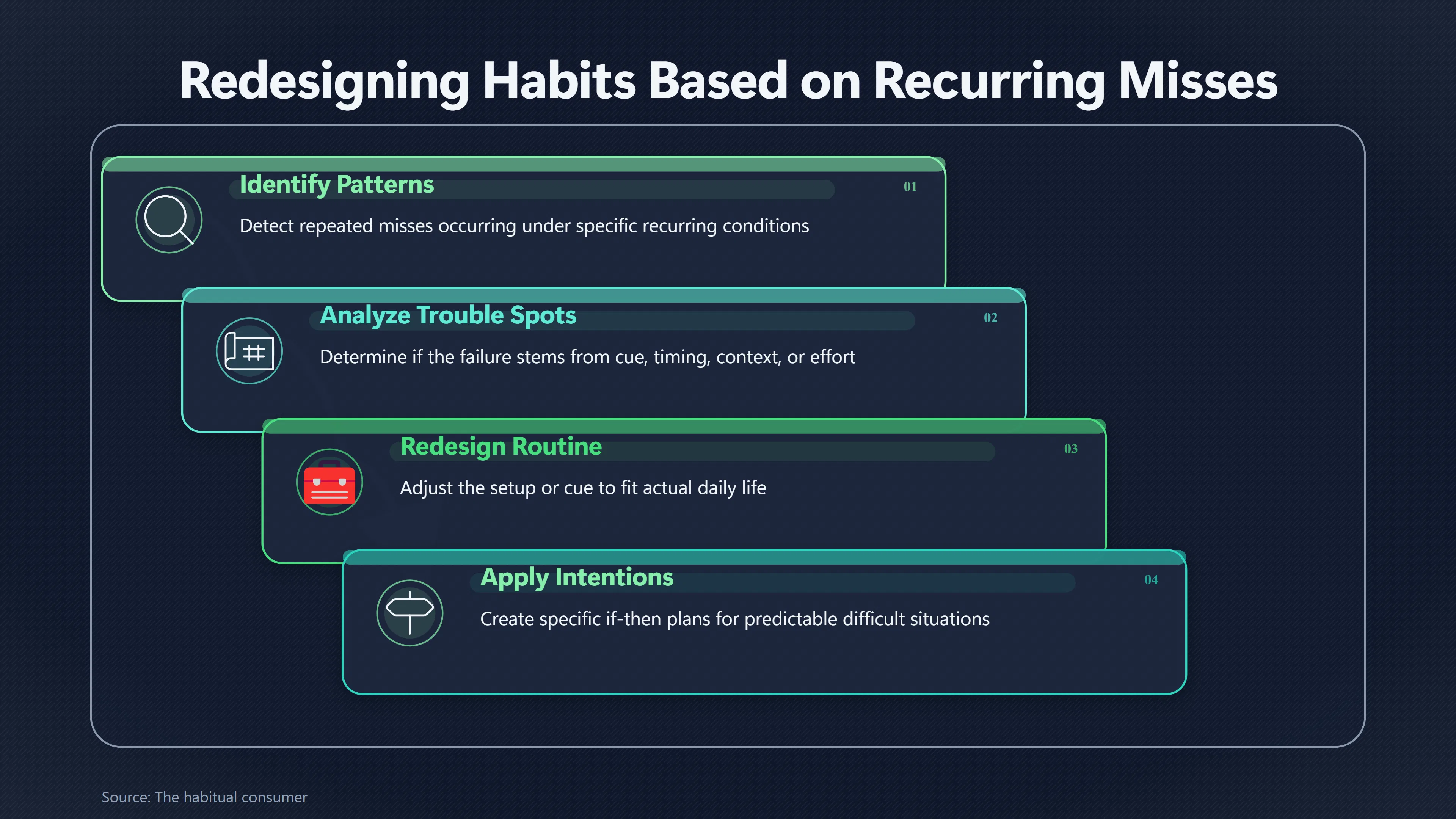
The practical response to recurring misses is therefore neither “start again from day one” nor “the misses do not matter”. Keep the progress already made, identify what repeatedly prevents the behaviour, and redesign that part of the routine.
When does a miss become a pattern?
There is no scientifically established rule saying that two, three or five missed days require a redesign. Habit-formation research varies substantially across behaviours and people, and a 2024 systematic review of 20 studies involving 2,601 participants concluded that the necessary degree of consistency remains uncertain.[PubMed Central (PMC)]pmc.ncbi.nlm.nih.govOpen source on nih.gov.
A more useful distinction is therefore situational recurrence rather than a fixed number of misses. An isolated disruption has an obvious exceptional cause: illness, an emergency, travel or an unusually demanding day. A pattern appears when failures repeatedly cluster around a condition that is actually part of ordinary life.
Suppose someone intends to walk for 30 minutes after lunch. Missing because of one unexpected appointment says little about the design. But if the walk disappears whenever lunch runs late, whenever the person works from home, or every Friday when the afternoon schedule changes, those misses identify a recurring weak point.
This interpretation fits what researchers know about context-dependent habits. Habits develop as repeated responses become associated with recurring contextual cues; changing those circumstances can disrupt habitual behaviour. In research on students moving between universities, established behaviours such as exercising and newspaper reading were more likely to survive the move when relevant aspects of their performance context remained stable.[PubMed]pubmed.ncbi.nlm.nih.govPub Med Changing circumstances, disrupting habitsChanging circumstances, disrupting habits - PubMed…
A small qualitative habit-formation study provides an especially concrete illustration. Participants often established behaviours in their working-week routines, but weekends and holidays removed the cues associated with work and temporarily disrupted performance. The behaviours could return when the participants returned to their normal working context.[PubMed]pubmed.ncbi.nlm.nih.govPub Med Experiences of habit formation: a qualitative studyExperiences of habit formation: a qualitative study - PubMedAugust 1, 2011… That is precisely why recurring weekend misses should not automatically be interpreted as evidence that someone “lacks discipline”. They may indicate that a habit has a workable weekday cue but no equivalent weekend setup.
Look for the trouble spot, not a character flaw
When misses cluster, the most useful question is “What is reliably different on the days this does not happen?” That shifts attention from judging motivation to finding a repeatable obstacle.
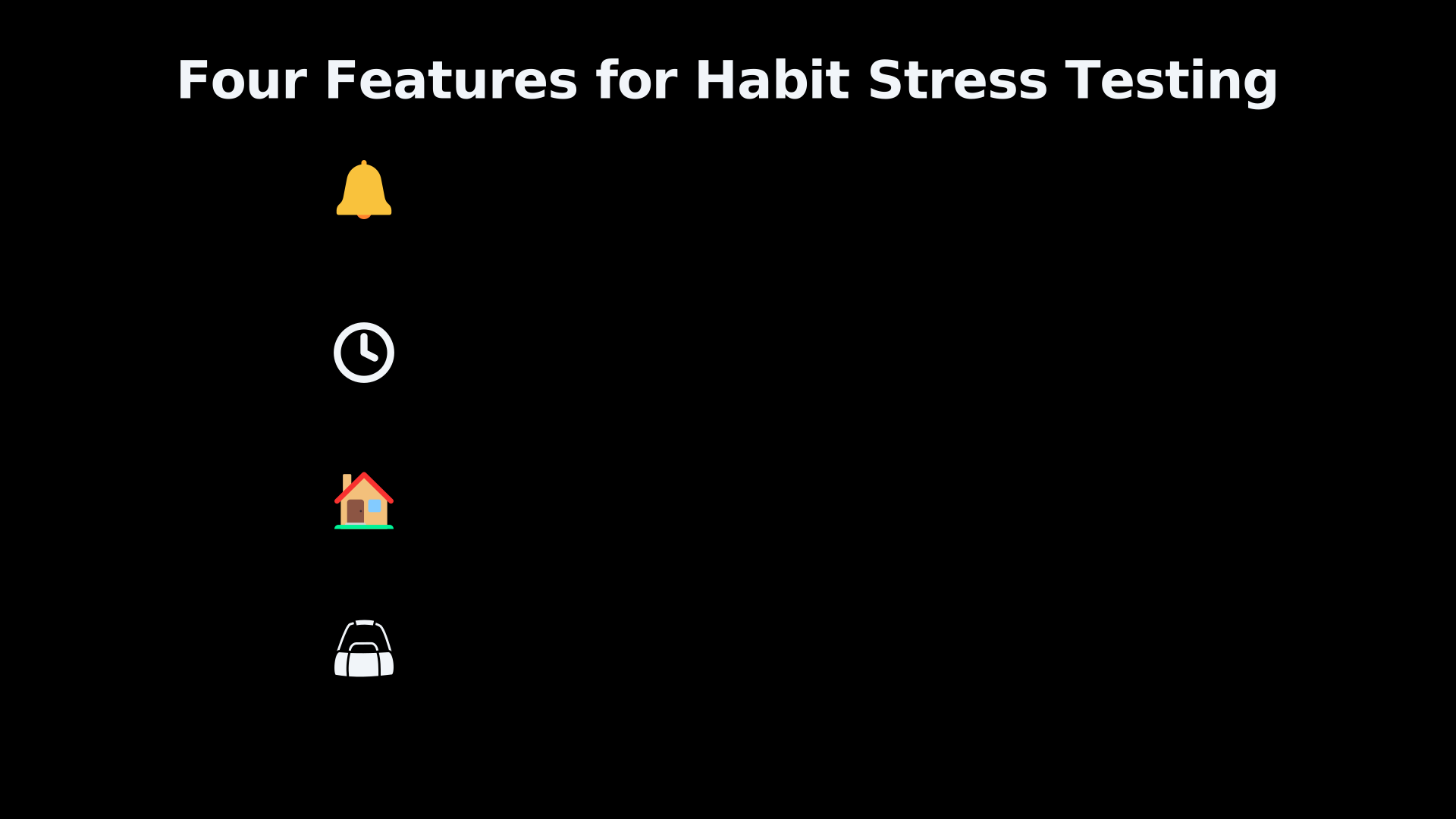
Four features deserve particular scrutiny:
- Cue: Does the intended trigger reliably occur, and is it noticeable? “After I put my breakfast plate away” may provide a clearer event than “sometime in the morning”.
- Timing: Does the selected moment regularly collide with meetings, childcare, commuting, fatigue or other predictable demands?
- Context: Is the routine dependent on one place or schedule that disappears on weekends, travel days or work-from-home days?
- Effort: Does starting require too many preparatory steps — finding equipment, changing clothes, travelling somewhere, choosing what to do or setting everything up?
Cue selection is not trivial. In a qualitative study in which 39 participants attempted to establish daily vitamin C use, researchers found that people did not necessarily choose effective cues. Participants often selected cues partly to minimise effort, for example by keeping relevant objects visible or close at hand.[PubMed]pubmed.ncbi.nlm.nih.govWhat influences the selection of contextual cues when starting a new routine behaviour? An exploratory study - PubMedMarch 30, 2020…
That makes repeated misses a kind of informal stress test. If a routine works only when the day is unusually orderly, the routine may have been designed around an ideal day rather than the person’s normal environment.
Context stability is particularly important. In a 2022 study, researchers examined intentional habit building in two datasets. One involved 95 university students and 2,482 study-habit repetitions; another covered 308 habits and 2,368 repetitions recorded by app users. More stable performance contexts predicted greater automaticity and better attainment of repetition goals.[Frontiers]frontiersin.orgFrontiersFrontiers | Context Stability in Habit Building Increases Automaticity and Goal AttainmentJune 10, 2022…
Other longitudinal work points in the same direction. In a study of flossing and vitamin C use, greater context stability — measured in terms of location and point within an existing routine — was associated with more frequent repetition, although some effects differed between the two behaviours.[PubMed Central (PMC)]pmc.ncbi.nlm.nih.govPubMed Central (PMC)Exploratory study of the impact of perceived reward on habit formation - PMCDecember 20, 2018… The important practical point is not that every behaviour must occur at precisely the same minute and location. It is that a cue needs enough regularity to become a dependable opportunity to act.
Redesign the cue before abandoning the habit
Once a recurring failure condition is visible, the smallest useful intervention is usually to change the setup around the behaviour, rather than replacing the goal.
Imagine a person repeatedly intends to read for 20 minutes at 9 pm but rarely does so because that is also when household tasks accumulate. Restarting a streak on Monday leaves the underlying collision untouched. A redesign might attach reading to finishing dinner, to getting into bed, or to another event that occurs more reliably.
Research suggests there is some flexibility in what kind of cue can work. In a randomised controlled trial involving 192 adults, participants linked a nutrition behaviour either to an everyday routine or to a specific time. Both approaches increased automaticity and plan enactment, with no significant group-level advantage for one cue type over the other. Repeated enactment of the planned behaviour was the important predictor of automaticity.[PubMed]pubmed.ncbi.nlm.nih.govOpen source on nih.gov.
That means a repeatedly failing clock-time cue need not be defended merely because it was the original plan. A routine-linked cue can replace it, and the reverse is also possible.
A useful redesign follows the evidence revealed by the misses:
If the cue is unreliable, make it concrete. Replace “exercise this evening” with a recognisable event such as changing out of work clothes.
If the time repeatedly conflicts with life, move the opportunity. The objective is not to prove that the original schedule can be conquered through willpower; it is to create conditions in which repetition can actually occur.
If contexts differ predictably, design for both. A weekday routine triggered by arriving at the office may need a separate weekend or home-working cue rather than expecting an absent office cue somehow to function at home.
If starting is consistently too demanding, reduce the setup burden. Put required materials where the behaviour happens, decide the activity beforehand, or reduce the number of preliminary actions. Research on behavioural complexity also cautions against assuming that every part of a complex activity will become effortless: more complex behaviours continue to draw on deliberate self-regulation even when their initiation has become habitual.[PubMed Central (PMC)]pmc.ncbi.nlm.nih.govOpen source on nih.gov.
The redesign should preserve the identity of the behaviour where possible. Moving a walk from after dinner to after lunch is a scheduling repair. Putting dental floss beside the toothbrush is an environmental repair. Creating a ten-minute version of a planned study session for overloaded evenings is an effort repair. None requires declaring previous successful repetitions meaningless.
Make the new response specific enough to happen
Recognising a pattern is useful only if it changes what happens when the difficult situation returns. This is where implementation intentions — plans specifying the situation in which a response will occur — can help bridge the gap between intention and action.
A classic meta-analysis of 94 independent tests found that implementation intentions improved goal attainment overall, in part by making specified opportunities more mentally accessible and strengthening links between situations and intended responses.[ScienceDirect]sciencedirect.comOpen source on sciencedirect.com. A much larger 2024 review covering 642 independent tests found beneficial effects across cognitive, emotional and behavioural outcomes, with stronger effects when plans used a contingent if–then format, when people were motivated to pursue the goal and when plans were rehearsed.[DOI]doi.orgOpen source on doi.org.
For repeated habit misses, the valuable part is specificity. Instead of reacting afterwards with “I need to try harder”, the person can pre-decide what will happen at the trouble spot:
If my lunchtime walk is blocked by a meeting, I will walk immediately after the meeting ends.
Or, when the original cue simply does not exist:
On office days I will stretch after arriving at my desk; on home-working days I will stretch after making my first drink.
These are not guarantees, and implementation-intention research is broader than habit formation specifically. But the principle fits the problem: recurring failures reveal a predictable situation, and predictable situations can be planned for in advance rather than repeatedly rediscovered.
Reduce effort without making the record dishonest
Making a routine easier is not the same as pretending the original behaviour happened. That distinction matters when adjusting a habit after repeated misses.
Suppose the target is a 30-minute workout and the person discovers that this repeatedly fails on late-working days. Introducing a ten-minute fallback can be a sensible redesign because it preserves an opportunity to begin and repeat the routine under difficult conditions. But a ten-minute session should not retrospectively be recorded as the same thing as completing the original 30-minute target unless that was genuinely the defined criterion.
The useful policy is: change future rules explicitly rather than rewriting past results.
That keeps two kinds of information intact. The record still shows that the previous design produced recurring misses, which is valuable diagnostic evidence. At the same time, the redesigned version can now be evaluated on its own terms.
There is also reason not to assume that sheer determination can compensate indefinitely for an awkward setup. Habit formation initially requires deliberate effort, while automaticity tends to increase through repeated enactment.[PubMed]pubmed.ncbi.nlm.nih.govPub Med Experiences of habit formation: a qualitative studyExperiences of habit formation: a qualitative study - PubMedAugust 1, 2011… Research on implementation intentions similarly shows why intending strongly to achieve something and having an actionable cue-response plan are not equivalent.[ScienceDirect]sciencedirect.comOpen source on sciencedirect.com.
The goal of reducing effort is therefore not to make self-improvement trivial. It is to remove unnecessary friction that repeatedly prevents the intended behaviour from being practised at all.
What a successful redesign looks like
A redesign has succeeded when the previously troublesome situation stops producing the same predictable miss often enough for repetition to resume. It does not need to produce a flawless streak.
This preserves the central lesson from missed-day research without misusing it. Lally and colleagues found that one missed opportunity did not materially affect the habit-formation process, but greater behavioural consistency was associated with better-fitting automaticity trajectories.[Wiley Online Library]onlinelibrary.wiley.comWiley Online LibraryHow are habits formed: Modelling habit formation in the real world - Lally - 2010 - European Journal of Social Psycho… The later systematic review likewise identifies repetition, timing, implementation planning, routine creation and context stability among factors associated with habit development, while emphasising considerable variation between people and behaviours.[PubMed Central (PMC)]pmc.ncbi.nlm.nih.govOpen source on nih.gov.
So the appropriate response changes with the pattern. An exceptional missed day calls mainly for resuming the behaviour. A recurring miss under recognisable circumstances calls for something more informative: resume, but alter the conditions that keep producing the failure.
That is the difference between preserving habit progress and ignoring evidence. Previous repetitions still count as learning; missed repetitions still count as data. When the same days keep going wrong, the most productive use of that data is to change the cue, timing, context or effort required until the routine fits the life in which it actually has to operate.
Amazon book picks
Further Reading
Books and field guides related to Repeatedly Missing the Same Habit? Change the Setup. Use these as the next step if you want deeper reading beyond the article.
Tiny Habits
Improving your life is much easier than you think. Whether it’s losing weight, sleeping more, or restoring your work/life balance – the s...
How to Change
Wall Street Journal bestseller “A welcome revelation.” --The Financial Times Award-winning Wharton Professor and Choiceology podcast host...
Atomic Habits
Rating: 3.5/5 from 7 Google Books ratings
The #1 New York Times bestseller. Over 25 million copies sold! Translated into 60+ languages! Tiny Changes, Remarkable Results No matter...
Good Habits, Bad Habits
'The world's leading expert on habits' - Matthew Syed, bestselling author of Black Box Thinking and Rebel IdeasWhat if you could harness...
eBay marketplace picks
Marketplace Samples
Live-tested eBay searches with available results related to this page.
Selected fromself improvement wall art oneBay.co.uk.

Current eBay listing
Self Improvement Quote Framed Wall Art Poster Canvas Print Picture

Current eBay listing
Self improvement Framed Wall Art Poster Canvas Print Picture

Endnotes
1.
Source: onlinelibrary.wiley.com
Link:https://onlinelibrary.wiley.com/doi/10.1002/ejsp.674
Source snippet
Wiley Online LibraryHow are habits formed: Modelling habit formation in the real world - Lally - 2010 - European Journal of Social Psycho...
2.
Source: doi.org
Link:https://doi.org/10.1111/bjhp.12504
3.
Source: compass.onlinelibrary.wiley.com
Link:https://compass.onlinelibrary.wiley.com/doi/10.1111/spc3.12975
4.
Source: sciencedirect.com
Link:https://www.sciencedirect.com/science/chapter/bookseries/abs/pii/S0065260106380021
5.
Source: sciencedirect.com
Link:https://www.sciencedirect.com/science/article/abs/pii/S002210310600028X
6.
Source: doi.org
Link:https://doi.org/10.1080/10463283.2024.2334563
7.
Source: sciencedirect.com
Link:https://www.sciencedirect.com/science/article/pii/S1369847825001044
8.
Source: compass.onlinelibrary.wiley.com
Link:https://compass.onlinelibrary.wiley.com/doi/full/10.1111/spc3.12975
9.
Source: doi.org
Link:https://doi.org/10.1111/jopy.12926
10.
Source: sciencedirect.com
Link:https://www.sciencedirect.com/science/article/pii/S0191886919304258
11.
Source: sciencedirect.com
Link:https://www.sciencedirect.com/science/article/pii/S019188691730274X
12.
Source: doi.org
Link:https://doi.org/10.1080/17437199.2011.603640%C2%A0
13.
Source: myscp.onlinelibrary.wiley.com
Link:https://myscp.onlinelibrary.wiley.com/doi/10.1016/j.jcps.2009.08.003
14.
Source: sciencedirect.com
Title: The habitual consumer
Link:https://www.sciencedirect.com/science/article/pii/S1057740809001065
15.
Source: onlinelibrary.wiley.com
Link:https://onlinelibrary.wiley.com/doi/abs/10.1002/ejsp.674?source=content_type%3Areact%7Cfirst_level_url%3Aarticle%7Csection%3Amain_content%7Cbutton%3Abody_link
16.
Source: onlinelibrary.wiley.com
Link:https://onlinelibrary.wiley.com/doi/abs/10.1002/ejsp.674?MixPanelId=15e3fe314440-0468d8411-64220f54-100000-15e3fe314460
17.
Source: onlinelibrary.wiley.com
Link:https://onlinelibrary.wiley.com/doi/abs/10.1002/ejsp.674
18.
Source: onlinelibrary.wiley.com
Link:https://onlinelibrary.wiley.com/doi/abs/10.1002/ejsp.674?cf_chl_jschl_tk=pmd_EwcJDaCFBR9OVEL1O_0qjioww0Gc86ZzpBvCBFhrDcE-1635261061-0-gqNtZGzNAjujcnBszQi9
19.
Source: onlinelibrary.wiley.com
Link:https://onlinelibrary.wiley.com/doi/abs/10.1002/ejsp.674?msockid=038ed114f43667dd0790c4bef5146634
20.
Source: sciencedirect.com
Link:https://www.sciencedirect.com/science/article/pii/S0191886926001820
21.
Source: sciencedirect.com
Link:https://www.sciencedirect.com/science/article/abs/pii/S0065260106380021
22.
Source: doi.org
Link:https://doi.org/10.1007/978
23.
Source: bpspsychub.onlinelibrary.wiley.com
Link:https://bpspsychub.onlinelibrary.wiley.com/doi/epdf/10.1111/bjhp.12637
24.
Source: pmc.ncbi.nlm.nih.gov
Link:https://pmc.ncbi.nlm.nih.gov/articles/PMC11641623/
25.
Source: pubmed.ncbi.nlm.nih.gov
Title: Pub Med Changing circumstances, disrupting habits
Link:https://pubmed.ncbi.nlm.nih.gov/15982113/
Source snippet
Changing circumstances, disrupting habits - PubMed...
26.
Source: pubmed.ncbi.nlm.nih.gov
Title: Pub Med Psychology of Habit
Link:https://pubmed.ncbi.nlm.nih.gov/26361052/
Source snippet
Psychology of Habit - PubMed...
27.
Source: pubmed.ncbi.nlm.nih.gov
Title: Pub Med Experiences of habit formation: a qualitative study
Link:https://pubmed.ncbi.nlm.nih.gov/21749245/
Source snippet
Experiences of habit formation: a qualitative study - PubMedAugust 1, 2011...
Published: August 1, 2011
28.
Source: pubmed.ncbi.nlm.nih.gov
Link:https://pubmed.ncbi.nlm.nih.gov/32228721/
Source snippet
What influences the selection of contextual cues when starting a new routine behaviour? An exploratory study - PubMedMarch 30, 2020...
Published: March 30, 2020
29.
Source: frontiersin.org
Link:https://www.frontiersin.org/journals/psychology/articles/10.3389/fpsyg.2022.883795/full
Source snippet
FrontiersFrontiers | Context Stability in Habit Building Increases Automaticity and Goal AttainmentJune 10, 2022...
Published: June 10, 2022
30.
Source: pubmed.ncbi.nlm.nih.gov
Link:https://pubmed.ncbi.nlm.nih.gov/35756236/
Source snippet
Context Stability in Habit Building Increases Automaticity and Goal Attainment - PubMed...
31.
Source: pmc.ncbi.nlm.nih.gov
Link:https://pmc.ncbi.nlm.nih.gov/articles/PMC6302524/
Source snippet
PubMed Central (PMC)Exploratory study of the impact of perceived reward on habit formation - PMCDecember 20, 2018...
Published: December 20, 2018
32.
Source: pubmed.ncbi.nlm.nih.gov
Link:https://pubmed.ncbi.nlm.nih.gov/33405284/
33.
Source: pmc.ncbi.nlm.nih.gov
Link:https://pmc.ncbi.nlm.nih.gov/articles/PMC11891988/
34.
Source: pmc.ncbi.nlm.nih.gov
Link:https://pmc.ncbi.nlm.nih.gov/articles/PMC13257896/
35.
Source: pmc.ncbi.nlm.nih.gov
Link:https://pmc.ncbi.nlm.nih.gov/articles/PMC13114073/
36.
Source: pmc.ncbi.nlm.nih.gov
Link:https://pmc.ncbi.nlm.nih.gov/articles/PMC11893630/
37.
Source: pubmed.ncbi.nlm.nih.gov
Link:https://pubmed.ncbi.nlm.nih.gov/39606189/
38.
Source: pmc.ncbi.nlm.nih.gov
Link:https://pmc.ncbi.nlm.nih.gov/articles/PMC11161714/
39.
Source: pubmed.ncbi.nlm.nih.gov
Link:https://pubmed.ncbi.nlm.nih.gov/38047612/
40.
Source: pmc.ncbi.nlm.nih.gov
Link:https://pmc.ncbi.nlm.nih.gov/articles/PMC10498635/
41.
Source: pmc.ncbi.nlm.nih.gov
Link:https://pmc.ncbi.nlm.nih.gov/articles/PMC10578412/
42.
Source: pmc.ncbi.nlm.nih.gov
Link:https://pmc.ncbi.nlm.nih.gov/articles/PMC10151500/
43.
Source: pmc.ncbi.nlm.nih.gov
Link:https://pmc.ncbi.nlm.nih.gov/articles/PMC9372943/
44.
Source: pmc.ncbi.nlm.nih.gov
Link:https://pmc.ncbi.nlm.nih.gov/articles/PMC9226889/
45.
Source: pmc.ncbi.nlm.nih.gov
Link:https://pmc.ncbi.nlm.nih.gov/articles/PMC12318445/
46.
Source: pmc.ncbi.nlm.nih.gov
Link:https://pmc.ncbi.nlm.nih.gov/articles/PMC8800991/
47.
Source: pmc.ncbi.nlm.nih.gov
Link:https://pmc.ncbi.nlm.nih.gov/articles/PMC8149892/
48.
Source: pmc.ncbi.nlm.nih.gov
Link:https://pmc.ncbi.nlm.nih.gov/articles/PMC9207816/
49.
Source: pmc.ncbi.nlm.nih.gov
Link:https://pmc.ncbi.nlm.nih.gov/articles/7218590/
50.
Source: pmc.ncbi.nlm.nih.gov
Link:https://pmc.ncbi.nlm.nih.gov/articles/PMC7106637/
51.
Source: pmc.ncbi.nlm.nih.gov
Link:https://pmc.ncbi.nlm.nih.gov/articles/PMC6895142/
52.
Source: pubmed.ncbi.nlm.nih.gov
Link:https://pubmed.ncbi.nlm.nih.gov/31420033/
53.
Source: pmc.ncbi.nlm.nih.gov
Link:https://pmc.ncbi.nlm.nih.gov/articles/PMC6667662/
54.
Source: pmc.ncbi.nlm.nih.gov
Link:https://pmc.ncbi.nlm.nih.gov/articles/PMC6777541/
55.
Source: pubmed.ncbi.nlm.nih.gov
Link:https://pubmed.ncbi.nlm.nih.gov/30572936/
56.
Source: pubmed.ncbi.nlm.nih.gov
Link:https://pubmed.ncbi.nlm.nih.gov/28734026/
57.
Source: pmc.ncbi.nlm.nih.gov
Link:https://pmc.ncbi.nlm.nih.gov/articles/PMC4847906/
58.
Source: pubmed.ncbi.nlm.nih.gov
Link:https://pubmed.ncbi.nlm.nih.gov/26361052/?dopt=Abstract
59.
Source: pubmed.ncbi.nlm.nih.gov
Link:https://pubmed.ncbi.nlm.nih.gov/25965276/
60.
Source: pmc.ncbi.nlm.nih.gov
Link:https://pmc.ncbi.nlm.nih.gov/articles/PMC3505409/
61.
Source: pmc.ncbi.nlm.nih.gov
Link:https://pmc.ncbi.nlm.nih.gov/articles/3505409/
62.
Source: pubmed.ncbi.nlm.nih.gov
Link:https://pubmed.ncbi.nlm.nih.gov/22935297/
63.
Source: pubmed.ncbi.nlm.nih.gov
Link:https://pubmed.ncbi.nlm.nih.gov/21513547/
64.
Source: pmc.ncbi.nlm.nih.gov
Link:https://pmc.ncbi.nlm.nih.gov/articles/3096582/
65.
Source: pubmed.ncbi.nlm.nih.gov
Link:https://pubmed.ncbi.nlm.nih.gov/20658824/
66.
Source: surrey.ac.uk
Title: phillippa lally
Link:https://www.surrey.ac.uk/people/phillippa-lally
Additional References
67.
Source: youtube.com
Title: How To Change with Prof. Katy Milkman
Link:https://www.youtube.com/watch?v=crdFZHA_z1U
Source snippet
Behavioral scientist BJ Fogg on building lasting habits Stanford · 15K views Forget big change, start with a tiny habit: BJ Fogg at TEDxF...
68.
Source: youtube.com
Title: Forget big change, start with a tiny habit: BJ Fogg at TEDx Fremont
Link:https://www.youtube.com/watch?v=AdKUJxjn-R8
Source snippet
A Sticky Situation: With Guests Richard Thaler, Wendy Wood & Susan Budowski...
69.
Source: nature.com
Link:https://www.nature.com/articles/s44271-026-00455-2
70.
Source: rti.org
Title: International Experiences of habit formation | RTI
Link:https://www.rti.org/publication/experiences-habit-formation-qualitative-study
Source snippet
RTI InternationalExperiences of habit formation | RTI...
71.
Source: youtube.com
Title: Behavioral scientist BJ Fogg on building lasting habits
Link:https://www.youtube.com/watch?v=h35hy4LcVFw
Source snippet
Forget big change, start with a tiny habit: BJ Fogg at TEDxFremont...
72.
Source: youtube.com
Title: PAN Podcast #6 | Dr. Phillippa Lally | Habits and Health
Link:https://www.youtube.com/watch?v=7A5AgZLd5bY
Source snippet
Behavioral scientist BJ Fogg on building lasting habits...
73.
Source: researchgate.net
Link:https://www.researchgate.net/publication/362509175_Habit_and_behavioural_complexity_habitual_instigation_and_execution_as_predictors_of_simple_and_complex_behaviours
74.
Source: researchgate.net
Link:https://www.researchgate.net/publication/37367696_Implementation_Intentions_and_Goal_Achievement_A_Meta-Analysis_of_Effects_and_Processes
75.
Source: doaj.org
Link:https://doaj.org/article/5e28c7cd6cc848099ff7ce3a555ff69f
76.
Source: researchgate.net
Link:https://www.researchgate.net/publication/51485779_Experiences_of_habit_formation_A_qualitative_study