Within Useful Feedback
When Tracking Tells You What to Do Next
Feedback becomes more useful when it links what happened to a realistic action you can take next.
On this page
- From recorded behaviour to a useful comparison
- What makes a recommendation genuinely actionable
- Turning repeated shortfalls into small experiments
Page outline Jump by section
Introduction
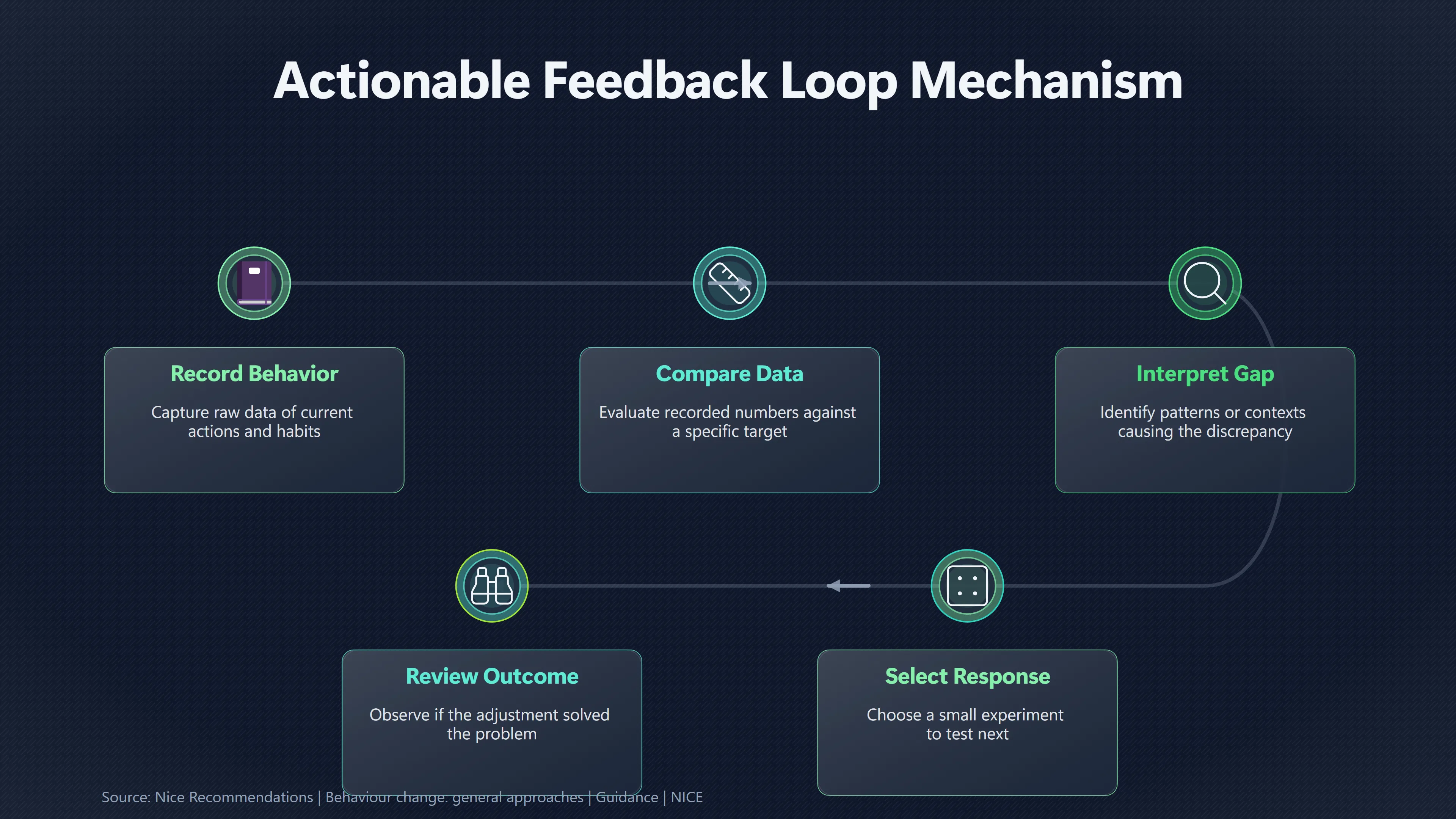
Tracking becomes actionable when it does more than report a number. Useful feedback compares what actually happened with a meaningful reference point, identifies a gap or pattern that can still be changed, and turns that information into a realistic next action. In other words, the mechanism is not simply record → notice but record → compare → interpret → act → review.

That distinction matters because monitoring alone can improve goal attainment, but feedback is not automatically helpful. A meta-analysis of 138 studies found that interventions increasing progress monitoring improved goal attainment, particularly when progress was physically recorded or reported to someone else. Yet research on feedback also shows substantial variation: poorly targeted feedback can distract, discourage or leave people knowing they are off course without knowing how to respond.[PubMed]pubmed.ncbi.nlm.nih.govDoes monitoring goal progress promote goal attainment? A meta-analysis of the experimental evidence - PubMedFebruary 1, 2016…
The practical aim, then, is not to extract ever more information from a tracker. It is to make the next decision easier.
From recorded behaviour to a useful comparison
A record becomes feedback when it is interpreted against something. “6,200 steps today” is data. “6,200 steps against my 7,500-step target” introduces a discrepancy. “Most of the missing 1,300 steps occur on days when I work from home” makes the discrepancy diagnostically useful. “On my next home-working day, I will walk for 15 minutes after lunch” turns it into an action.
This comparison process sits at the heart of self-regulation accounts of behaviour. Monitoring allows people to detect differences between current behaviour and a goal or standard; that discrepancy can then prompt an adjustment. Modern behaviour-change taxonomies therefore distinguish self-monitoring from techniques such as drawing attention to a discrepancy, reviewing goals and changing the strategy in response to progress.[PubMed Central (PMC)]pmc.ncbi.nlm.nih.govPubMed Central (PMC)Linking behaviour change techniques to mechanisms of action: Using the Theory and Techniques Tool alongside the Behav…
The reference point matters. A useful comparison might be against:
- a behavioural target, such as completing four planned study sessions this week;
- your own recent baseline, such as averaging 20 minutes more sleep than last month;
- an action plan, such as whether the intended lunchtime walk actually happened;
- a recurring context, such as consistently spending more on takeaway food on late-working days.
The important point is that the comparison should reveal something a person can influence. A broad outcome can be too distant from the behaviour producing it. If someone wants to write a book, for example, repeatedly seeing “manuscript unfinished” offers little guidance. Tracking whether three protected writing sessions happened this week creates a much shorter path from feedback to correction.
This is also why feedback should usually stay close to the task rather than becoming a judgement about the person. Kluger and DeNisi’s influential meta-analysis of 607 feedback effects found that feedback improved performance on average, but more than a third of effects were negative. Their Feedback Intervention Theory proposed that feedback becomes less useful when attention shifts away from the task towards self-focused concerns. The result is an important warning for self-improvement: “you missed three sessions” and “your plan is failing at this particular point” contain information that can be acted on; “you lack discipline” does not.[EBSCO OpenURL]openurl.ebsco.comEBSCO OpenURLThe effects of feedback interventions on performance: A historical review, a meta-analysis, and a preliminary feedback inter…
What makes a recommendation genuinely actionable
“Do better tomorrow” is technically a recommendation, but it does not reduce uncertainty about what to do. Actionable feedback needs to specify a response that can be performed in the person’s real circumstances.
A systematic review of 31 just-in-time diet and physical-activity interventions illustrates how often this ingredient is missing. Although 97% used personalised feedback and 78% used goal-oriented feedback, only 16% provided feedback classified as actionable. Just nine studies directly tested feedback’s effect on behaviour, and four reported significant improvements; continuously available, goal-oriented or actionable feedback appeared in three of those four successful studies. The authors treated these characteristics as promising rather than proof of a uniquely effective formula because the studies were too heterogeneous to isolate their individual effects.[PubMed Central (PMC)]pmc.ncbi.nlm.nih.govOpen source on nih.gov.
That evidence suggests a useful test: after reading the feedback, could you say what you will actually do differently? If not, the feedback probably stops too early.
Consider three versions of feedback from the same study log:
Record: “You studied for 2 hours this week.”
Comparison: “Your plan was 4 hours, so you completed half of the intended study time.”
Actionable feedback: “Both missed sessions were planned for late evenings. For the next week, test one 30-minute session immediately after dinner on Tuesday and Thursday instead.”
Only the third version converts the shortfall into a change that can be tried and subsequently measured. Crucially, it does not pretend to know that evening timing caused the missed sessions. It treats the pattern as a hypothesis worth testing.
Make the action specific enough to start
A strong next step usually answers some combination of what, when, where and under what circumstances. NICE guidance on individual behaviour change similarly recommends combining feedback and monitoring with goals and planning, including action plans that specify the situation or time in which behaviour will occur. It also recommends reviewing behavioural goals in light of experience and making further plans according to previous progress.[Nice]nice.org.ukRecommendations | Behaviour change: individual approaches | Guidance | NICEJanuary 2, 2014…
“If–then” plans are one particularly well-studied way of closing this gap. Instead of “I will exercise more”, an implementation intention might say: “If I finish work before 6.30 pm on Monday, Wednesday or Friday, then I will walk for 20 minutes before going home.” A 2006 meta-analysis of 94 independent tests found a medium-to-large overall effect of implementation intentions on goal attainment. A much larger 2024 synthesis covering 642 independent tests found positive effects across behavioural, cognitive and affective outcomes, with stronger effects when plans used a contingent if–then structure, when people were highly motivated and when plans were rehearsed.[ScienceDirect]sciencedirect.comOpen source on sciencedirect.com.
Tracking can make these plans more intelligent because it supplies the “if”. Rather than inventing a trigger arbitrarily, repeated observations can reveal where behaviour actually breaks down: after late meetings, on unstructured weekends, during travel, or when a planned task has no fixed starting cue.
Keep the recommendation proportional to the evidence
Personalisation is useful only when the data justify it. A single missed workout may be noise; four weeks of consistently missing the same Friday session is a pattern worth investigating. The tracker should therefore support decisions without encouraging false precision.
Evidence on feedback formats reinforces that caution. A corrected systematic review and meta-analysis of 19 self-monitoring studies involving 3,261 adults examined feedback about diet, physical activity and weight. It found evidence that adding feedback could improve some outcomes, but comparisons among different feedback-generation and presentation approaches were mixed. There is not good evidence for a universal “best” personalised message, dashboard or algorithm that can automatically prescribe the right response for everyone.[DOI]doi.orgOpen source on doi.org.
The safer and often more useful role for feedback is narrower: identify a credible discrepancy, point to the behaviour or context most closely connected with it, and propose a feasible adjustment that can itself be evaluated.
Turning repeated shortfalls into small experiments
Repeated failure to hit a target should not simply produce a louder version of the same message. If “you are below target” appears every week and nothing changes, the feedback has ceased to provide new information. The next useful question is why the existing plan repeatedly fails in practice.
That changes the function of tracking. Instead of acting as a scoreboard, it becomes a way to run small experiments.
Suppose someone intends to read for 30 minutes every evening but their log shows that they succeed only twice a week. Several explanations are possible: the session is too long, the timing conflicts with family responsibilities, the book is not readily available when the opportunity appears, or evenings are simply a poor fit. Tracking alone cannot establish which explanation is correct. It can, however, support a sequence of modest tests:
- Locate the recurring shortfall. Look for a repeatable pattern rather than treating every miss as the same problem.
- Choose one plausible obstacle. For example, the planned session may start too late.
- Change one controllable feature. Move reading to a 15-minute slot immediately after lunch for one week.
- Track the new plan. Record whether the session actually starts, not merely whether the larger reading goal is eventually achieved.
- Review and adapt. Keep the change if adherence improves; modify or discard it if the predicted improvement does not appear.
This approach closely matches the pairing of monitoring with problem solving and action planning found in behaviour-change research. A systematic review of 52 planning interventions for physical activity and diet in people with chronic conditions identified self-monitoring, problem solving, instruction and environmental changes among the features associated with longer-term facilitation of planning interventions. Because interventions contained multiple components, however, such findings should not be read as proof that any single technique caused the outcome.[BMJ Open]bmjopen.bmj.comOpen source on bmj.com.
The same logic prevents an important mistake: assuming every discrepancy means the person must try harder. Sometimes the better next step is to change the plan. NICE guidance explicitly treats behavioural goals as something to review in light of experience, rather than as fixed standards that must always be defended. Its guidance also emphasises small, manageable changes to routines and rehearsed plans for predictable setbacks.[Nice]nice.org.ukRecommendations | Behaviour change: individual approaches | Guidance | NICEJanuary 2, 2014…
A consistently missed 60-minute workout might therefore lead to a 20-minute version; an untouched morning to-do list might lead to moving the priority task to the afternoon; a weekly budget repeatedly disrupted by one category might lead to changing the spending rule or environment rather than merely renewing the same intention. The adjustment is not an excuse for abandoning the larger goal. It is a test of a more workable route towards it.

The feedback loop should end with another observation
The most useful next step is one that creates information for the next decision. This is what makes actionable feedback a mechanism rather than a one-off piece of advice.
A practical loop is:
Track the behaviour → compare it with the intended behaviour → locate the meaningful discrepancy → choose a small response → perform it in a specified situation → track what happens → keep, modify or replace the response.
That final review is essential. Without it, a recommendation can become just another rule. With it, the person learns not only whether they reached the original target but whether the attempted adjustment solved the problem it was designed to solve.
This is also a more realistic interpretation of the wider evidence on self-regulation. A meta-review of 66 meta-analyses found support for techniques including self-monitoring, goal setting and personalised feedback in some behaviours and populations, but no component worked consistently across every setting. Only a small proportion of the underlying meta-analyses directly tested whether changes in the proposed self-regulation mechanism actually explained changes in behaviour.[PubMed Central (PMC)]pmc.ncbi.nlm.nih.govOpen source on nih.gov.
Actionable feedback therefore should not be treated as an infallible prescription generated from personal data. Its value is more practical: it reduces the distance between noticing a pattern and testing a sensible response. The tracker tells you what happened; the comparison tells you where the plan and reality diverged; the recommendation gives you something small enough to try; and the next round of tracking tells you whether that change was worth keeping.
Amazon book picks
Further Reading
Books and field guides related to When Tracking Tells You What to Do Next. Use these as the next step if you want deeper reading beyond the article.
Atomic Habits
Rating: 3.5/5 from 7 Google Books ratings
The #1 New York Times bestseller. Over 25 million copies sold! Translated into 60+ languages! Tiny Changes, Remarkable Results No matter...
Thanks for the Feedback
We get feedback every day of our lives, from friends and family, colleagues, customers, and bosses, teachers, doctors, and strangers. We...
The Coaching Habit
Coaching is an essential skill for leaders. But for most busy, overworked managers, coaching employees is done badly, or not at all. They...

The Power of Habit
Rating: 4.0/5 from 145 Google Books ratings
Duhigg takes us to the edge of scientific discoveries that explain why habits exist and how they can be changed. Distilling information i...
eBay marketplace picks
Marketplace Samples
Live-tested eBay searches with available results related to this page.
Selected fromhabit tracker calendar oneBay.co.uk.




Endnotes
1.
Source: openurl.ebsco.com
Link:https://openurl.ebsco.com/contentitem/pdh%3A1996-02773-003?crl=c&id=ebsco%3Apdh%3A1996-02773-003&sid=ebsco%3Aplink%3Ascholar
Source snippet
EBSCO OpenURLThe effects of feedback interventions on performance: A historical review, a meta-analysis, and a preliminary feedback inter...
2.
Source: sciencedirect.com
Link:https://www.sciencedirect.com/science/article/abs/pii/S0065260106380021
3.
Source: doi.org
Link:https://doi.org/10.1080/10463283.2024.2334563
4.
Source: doi.org
Link:https://doi.org/10.1186/s12966-023-01555-6
5.
Source: bmjopen.bmj.com
Link:https://bmjopen.bmj.com/content/12/8/e058229
6.
Source: doi.org
Link:https://doi.org/10.1080/00461520.2025.2533232
7.
Source: doi.org
Link:https://doi.org/10.1080%2F00461520.2025.2533232
8.
Source: sciencedirect.com
Link:https://www.sciencedirect.com/org/science/article/pii/S1438887124006885
9.
Source: sciencedirect.com
Link:https://www.sciencedirect.com/science/article/abs/pii/S0361476X23000620
10.
Source: sciencedirect.com
Link:https://www.sciencedirect.com/org/science/article/pii/S2291522222001966
11.
Source: sciencedirect.com
Link:https://www.sciencedirect.com/org/science/article/pii/S1438887118000900
12.
Source: bmjopen.bmj.com
Link:https://bmjopen.bmj.com/content/8/2/e018974
13.
Source: doi.org
Link:https://doi.org/10.1186/1748
14.
Source: doi.org
Link:https://doi.org/10.1080/08870440902866902
15.
Source: sciencedirect.com
Link:https://www.sciencedirect.com/science/article/pii/S0747563215302946
16.
Source: sciencedirect.com
Link:https://www.sciencedirect.com/science/chapter/bookseries/abs/pii/S0065260106380021
17.
Source: sciencedirect.com
Link:https://www.sciencedirect.com/science/article/abs/pii/S2352550925000260
18.
Source: sciencedirect.com
Link:https://www.sciencedirect.com/science/article/abs/pii/S2215091919300148
19.
Source: sciencedirect.com
Link:https://www.sciencedirect.com/science/chapter/bookseries/pii/S2215091919300148
20.
Source: pubmed.ncbi.nlm.nih.gov
Link:https://pubmed.ncbi.nlm.nih.gov/26479070/
Source snippet
Does monitoring goal progress promote goal attainment? A meta-analysis of the experimental evidence - PubMedFebruary 1, 2016...
Published: February 1, 2016
21.
Source: pmc.ncbi.nlm.nih.gov
Link:https://pmc.ncbi.nlm.nih.gov/articles/PMC12596556/
Source snippet
PubMed Central (PMC)Linking behaviour change techniques to mechanisms of action: Using the Theory and Techniques Tool alongside the Behav...
22.
Source: pmc.ncbi.nlm.nih.gov
Link:https://pmc.ncbi.nlm.nih.gov/articles/PMC3303967/
Source snippet
PubMed Central (PMC)Feedback as a Strategy to Change Behavior: The Devil Is in the Details - PMC...
23.
Source: pmc.ncbi.nlm.nih.gov
Link:https://pmc.ncbi.nlm.nih.gov/articles/PMC5887039/
24.
Source: pubmed.ncbi.nlm.nih.gov
Link:https://pubmed.ncbi.nlm.nih.gov/29567638/
Source snippet
Just-in-Time Feedback in Diet and Physical Activity Interventions: Systematic Review and Practical Design Framework - PubMed...
25.
Source: nice.org.uk
Link:https://www.nice.org.uk/Guidance/PH49/chapter/recommendations
Source snippet
Recommendations | Behaviour change: individual approaches | Guidance | NICEJanuary 2, 2014...
Published: January 2, 2014
26.
Source: pmc.ncbi.nlm.nih.gov
Link:https://pmc.ncbi.nlm.nih.gov/articles/PMC10765525/
27.
Source: nice.org.uk
Title: Nice Recommendations | Behaviour change: general approaches | Guidance | NICE
Link:https://www.nice.org.uk/guidance/ph6/chapter/recommendations
28.
Source: pmc.ncbi.nlm.nih.gov
Link:https://pmc.ncbi.nlm.nih.gov/articles/PMC7571594/
29.
Source: pubmed.ncbi.nlm.nih.gov
Link:https://pubmed.ncbi.nlm.nih.gov/31662031/
30.
Source: pubmed.ncbi.nlm.nih.gov
Link:https://www.pubmed.ncbi.nlm.nih.gov/42301903/
31.
Source: pmc.ncbi.nlm.nih.gov
Link:https://pmc.ncbi.nlm.nih.gov/articles/PMC13299259/
32.
Source: pmc.ncbi.nlm.nih.gov
Link:https://pmc.ncbi.nlm.nih.gov/articles/PMC13015917/
33.
Source: pubmed.ncbi.nlm.nih.gov
Link:https://pubmed.ncbi.nlm.nih.gov/41784001/
34.
Source: pmc.ncbi.nlm.nih.gov
Link:https://pmc.ncbi.nlm.nih.gov/articles/PMC12454610/
35.
Source: pubmed.ncbi.nlm.nih.gov
Link:https://pubmed.ncbi.nlm.nih.gov/38178230/
36.
Source: pmc.ncbi.nlm.nih.gov
Link:https://pmc.ncbi.nlm.nih.gov/articles/PMC10621082/
37.
Source: pmc.ncbi.nlm.nih.gov
Link:https://pmc.ncbi.nlm.nih.gov/articles/PMC10562972/
38.
Source: pmc.ncbi.nlm.nih.gov
Link:https://pmc.ncbi.nlm.nih.gov/articles/PMC9403139/
39.
Source: pubmed.ncbi.nlm.nih.gov
Link:https://pubmed.ncbi.nlm.nih.gov/35995541/
40.
Source: pmc.ncbi.nlm.nih.gov
Link:https://pmc.ncbi.nlm.nih.gov/articles/PMC9261070/
41.
Source: pmc.ncbi.nlm.nih.gov
Link:https://pmc.ncbi.nlm.nih.gov/articles/PMC9223740/
42.
Source: pubmed.ncbi.nlm.nih.gov
Link:https://pubmed.ncbi.nlm.nih.gov/35742582/
43.
Source: ncbi.nlm.nih.gov
Link:https://www.ncbi.nlm.nih.gov/books/NBK580336/
44.
Source: pmc.ncbi.nlm.nih.gov
Link:https://pmc.ncbi.nlm.nih.gov/articles/PMC8962081/
45.
Source: pmc.ncbi.nlm.nih.gov
Link:https://pmc.ncbi.nlm.nih.gov/articles/PMC8922140/
46.
Source: pmc.ncbi.nlm.nih.gov
Link:https://pmc.ncbi.nlm.nih.gov/articles/PMC8554677/
47.
Source: pmc.ncbi.nlm.nih.gov
Link:https://pmc.ncbi.nlm.nih.gov/articles/PMC8149892/
48.
Source: pubmed.ncbi.nlm.nih.gov
Link:https://pubmed.ncbi.nlm.nih.gov/34054628/
49.
Source: pmc.ncbi.nlm.nih.gov
Link:https://pmc.ncbi.nlm.nih.gov/articles/PMC7855429/
50.
Source: pmc.ncbi.nlm.nih.gov
Link:https://pmc.ncbi.nlm.nih.gov/articles/PMC8020562/
51.
Source: pmc.ncbi.nlm.nih.gov
Link:https://pmc.ncbi.nlm.nih.gov/articles/PMC7170595/
52.
Source: pmc.ncbi.nlm.nih.gov
Link:https://pmc.ncbi.nlm.nih.gov/articles/PMC7429262/
53.
Source: pmc.ncbi.nlm.nih.gov
Link:https://pmc.ncbi.nlm.nih.gov/articles/PMC6235272/
54.
Source: ncbi.nlm.nih.gov
Link:https://www.ncbi.nlm.nih.gov/books/NBK501960/
55.
Source: pmc.ncbi.nlm.nih.gov
Link:https://pmc.ncbi.nlm.nih.gov/articles/PMC6796229/
56.
Source: pubmed.ncbi.nlm.nih.gov
Link:https://pubmed.ncbi.nlm.nih.gov/28244173/
57.
Source: pmc.ncbi.nlm.nih.gov
Link:https://pmc.ncbi.nlm.nih.gov/articles/PMC5999061/
58.
Source: pmc.ncbi.nlm.nih.gov
Link:https://pmc.ncbi.nlm.nih.gov/articles/PMC4812832/
59.
Source: pubmed.ncbi.nlm.nih.gov
Link:https://pubmed.ncbi.nlm.nih.gov/25965276/
60.
Source: pmc.ncbi.nlm.nih.gov
Link:https://pmc.ncbi.nlm.nih.gov/articles/PMC4201916/
61.
Source: pmc.ncbi.nlm.nih.gov
Link:https://pmc.ncbi.nlm.nih.gov/articles/PMC4147713/
62.
Source: pubmed.ncbi.nlm.nih.gov
Link:https://pubmed.ncbi.nlm.nih.gov/24999905/
63.
Source: pmc.ncbi.nlm.nih.gov
Link:https://pmc.ncbi.nlm.nih.gov/articles/PMC3896824/
64.
Source: nice.org.uk
Link:https://www.nice.org.uk/Guidance/PH49
65.
Source: pmc.ncbi.nlm.nih.gov
Link:https://pmc.ncbi.nlm.nih.gov/articles/PMC3878579/
66.
Source: pmc.ncbi.nlm.nih.gov
Link:https://pmc.ncbi.nlm.nih.gov/articles/PMC4145404/
67.
Source: pmc.ncbi.nlm.nih.gov
Link:https://pmc.ncbi.nlm.nih.gov/articles/PMC4114510/
68.
Source: pubmed.ncbi.nlm.nih.gov
Link:https://pubmed.ncbi.nlm.nih.gov/19433147/
69.
Source: nice.org.uk
Link:https://www.nice.org.uk/guidance/ph6/chapter/Considerations
70.
Source: pubmed.ncbi.nlm.nih.gov
Link:https://pubmed.ncbi.nlm.nih.gov/29189034/
71.
Source: ncbi.nlm.nih.gov
Link:https://www.ncbi.nlm.nih.gov/books/NBK327618/?report=printable
72.
Source: pubmed.ncbi.nlm.nih.gov
Link:https://pubmed.ncbi.nlm.nih.gov/23456214/
73.
Source: ncbi.nlm.nih.gov
Link:https://www.ncbi.nlm.nih.gov/books/NBK540937/
74.
Source: pubmed.ncbi.nlm.nih.gov
Link:https://pubmed.ncbi.nlm.nih.gov/24591064/
75.
Source: ncbi.nlm.nih.gov
Link:https://www.ncbi.nlm.nih.gov/books/NBK540937/?report=printable
76.
Source: pubmed.ncbi.nlm.nih.gov
Link:https://pubmed.ncbi.nlm.nih.gov/12219864/
77.
Source: pubmed.ncbi.nlm.nih.gov
Link:https://pubmed.ncbi.nlm.nih.gov/21154012/
Additional References
78.
Source: cris.huji.ac.il
Link:https://cris.huji.ac.il/en/publications/the-effects-of-feedback-interventions-on-performance-a-historical/
Source snippet
The Hebrew University of JerusalemThe effects of feedback interventions on performance: A historical review, a meta-analysis, and a preli...
79.
Source: youtube.com
Title: How to Track Habits Without Perfectionism
Link:https://www.youtube.com/watch?v=LPPXx1G77u4
Source snippet
This video on habit tracking and goal progress monitoring is directly relevant because it explores how systematic tracking provides the n...
80.
Source: youtube.com
Title: How Does Habit Tracking Relate To Goal Progress Monitoring?
Link:https://www.youtube.com/watch?v=pdJN9xV9nLI
Source snippet
Why an Empty Cell Made Her Run: Psychology of Self-Monitoring...
81.
Source: youtube.com
Title: Why an Empty Cell Made Her Run: Psychology of Self-Monitoring
Link:https://www.youtube.com/watch?v=qNRdQqmC58Y
Source snippet
What is Self Regulation Theory? (Easiest Explanation)...
82.
Source: researchgate.net
Link:https://www.researchgate.net/publication/37367696_Implementation_Intentions_and_Goal_Achievement_A_Meta-Analysis_of_Effects_and_Processes
83.
Source: researchgate.net
Link:https://www.researchgate.net/publication/232458848_The_Effects_of_Feedback_Interventions_on_Performance_A_Historical_Review_a_Meta-Analysis_and_a_Preliminary_Feedback_Intervention_Theory
84.
Source: researchgate.net
Link:https://www.researchgate.net/publication/378870694_The_When_and_How_of_Planning_Meta-Analysis_of_the_Scope_and_Components_of_Implementation_Intentions_in_642_Tests
85.
Source: mdpi.com
Link:https://www.mdpi.com/2076-328X/15/11/1448
86.
Source: ehps.net
Link:https://ehps.net/ehp/index.php/contents/article/view/2882
87.
Source: mdpi.com
Link:https://www.mdpi.com/1660-4601/23/6/703