Within Automaticity
Why Practised Habits Survive When Attention Is Busy
Practised cue-response associations can help behaviour hold up when attention is stretched and deliberate control becomes harder.
On this page
- What cognitive load reveals about automatic responding
- How practice strengthened cue response associations in experiments
- Where automaticity can reduce reliance on deliberate control
Page outline Jump by section
Introduction
Practised habits can be especially useful when attention is occupied. If a familiar cue has repeatedly been followed by the same response, encountering that cue can begin to activate the response directly, reducing the need to hold a goal in working memory, reconsider what to do and consciously retrieve each step. That is why a well-rehearsed routine may keep moving when someone is distracted, hurried or simultaneously dealing with another task. Reviews of habit research describe this rapid cue-driven activation as a defining feature of habit memory.[PubMed]pubmed.ncbi.nlm.nih.govPub Med Habits and Goals in Human Behavior: Separate but Interacting SystemsHabits and Goals in Human Behavior: Separate but Interacting Systems - PubMedMarch 1, 2022…

A particularly revealing experiment tested this idea by having people practise a 16-step virtual sushi-making task and then repeat it while simultaneously attending to a distracting secondary task. More practice strengthened objectively measured cue–response associations, and stronger associations predicted more successful performance under this cognitive load. The important point for self-improvement is not that habits make distraction harmless. It is narrower and more useful: practice can shift some of the work of initiating a familiar response away from moment-to-moment deliberation and towards cues that are already present.[Wiley Online Library]onlinelibrary.wiley.comOnline Library Measuring context–response associations that drive habitsWiley Online LibraryMeasuring context–response associations that drive habits - Labrecque - 2024 - Journal of the Experimental Analysis o…
What cognitive load reveals about automatic responding
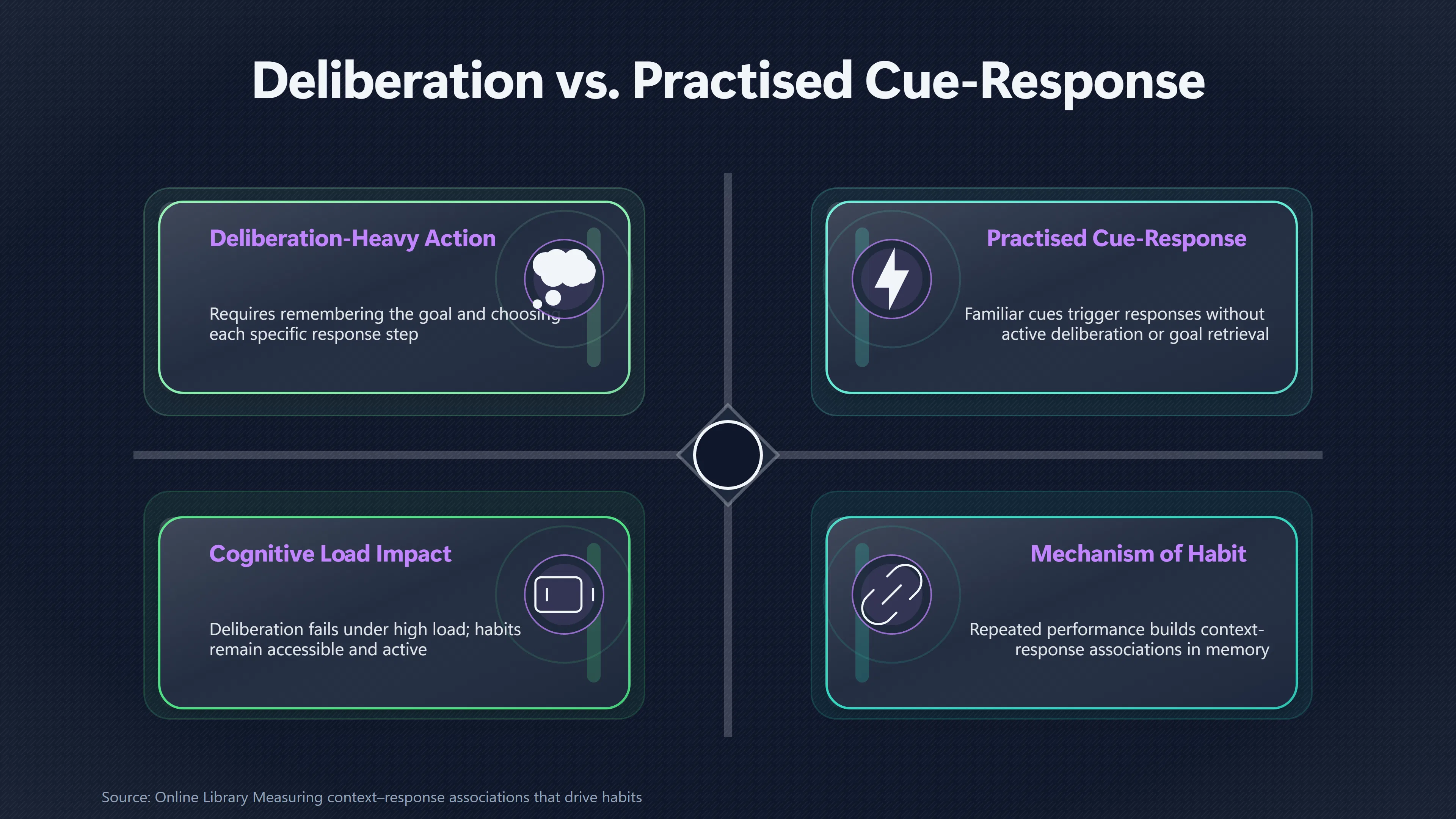
Mental distraction provides a useful test of automaticity because deliberate control has limited capacity. Imagine trying to perform a familiar routine while also keeping track of a conversation, remembering an instruction or monitoring something else. The secondary task competes for attention and working memory that could otherwise be used to recall the goal, work out the next action and check each choice.
A genuinely well-practised response has an advantage in that situation. Habit theories propose that repeated performance builds associations in memory between features of the context and particular responses. Once those associations are sufficiently accessible, seeing the relevant cue can rapidly bring the associated response to mind. Wood, Mazar and Neal characterise habit memory in part by this rapid activation: habitual responses can be activated irrespective of whether a person is currently deliberating about the goal that originally motivated them.[PubMed]pubmed.ncbi.nlm.nih.govPub Med Habits and Goals in Human Behavior: Separate but Interacting SystemsHabits and Goals in Human Behavior: Separate but Interacting Systems - PubMedMarch 1, 2022…
This creates an important contrast:
Deliberation-heavy action: cue → remember the goal → retrieve or choose the response → act.
Practised cue-response action: familiar cue → practised response becomes accessible → act.
Real behaviour rarely falls perfectly into either category. Complex activities can combine deliberate decisions with highly practised components. Nor does automaticity necessarily mean complete unconsciousness. The useful distinction is how much online cognitive work is required to produce the next appropriate response. Practice can make some of those computations less demanding even while conscious supervision remains possible. A review by Adrian Haith and John Krakauer therefore cautions against treating skill, habit and reduced cognitive load as exactly the same phenomenon: practice can affect all three, but they can be partly dissociable.[PubMed Central (PMC)]pmc.ncbi.nlm.nih.govPubMed Central (PMC)The multiple effects of practice: skill, habit and reduced cognitive load - PMCMarch 1, 2018…
This distinction also explains why distraction can expose the difference between knowing what to do and having a response that is readily triggered. A person may understand a routine perfectly when concentrating on it yet fail to retrieve the right action when attention is divided. A stronger cue–response association provides another route to performance, one less dependent on reconstructing the plan at that moment.
How practice strengthened cue-response associations in experiments
Labrecque, Lee and Wood’s 2024 experiments offer unusually direct evidence because they did not simply ask participants whether a behaviour felt habitual. Participants learnt a computerised sushi-making sequence containing 16 steps. Some received little practice; others repeated the sequence roughly ten times. The researchers then separately measured how quickly participants could identify the correct response after seeing a cue from the sequence. Faster correct responses served as an objective indicator of stronger cue–response associations.[Wiley Online Library]onlinelibrary.wiley.comOnline Library Measuring context–response associations that drive habitsWiley Online LibraryMeasuring context–response associations that drive habits - Labrecque - 2024 - Journal of the Experimental Analysis o…
The final test deliberately made thoughtful retrieval harder. Participants had to reproduce the sushi sequence without the earlier instructions while a second screen played attention-grabbing university football highlights. They were required to listen for the announcer’s calls of a touchdown and remember the total, creating a genuine dual-task demand rather than merely telling participants to hurry.[Wiley Online Library]onlinelibrary.wiley.comOnline Library Measuring context–response associations that drive habitsWiley Online LibraryMeasuring context–response associations that drive habits - Labrecque - 2024 - Journal of the Experimental Analysis o…
More practice strengthened the measured cue–response associations. Crucially, those stronger associations predicted better reproduction of the practised sequence under cognitive load even after the analyses accounted for the amount of practice and participants’ intentions to perform correctly. The researchers also examined other possible motivational explanations, including perceived ease, enjoyment, attitudes and fluency. Their central conclusion was that repetition aided performance by creating associations through which recurring contextual cues could activate practised responses, rather than simply making participants more determined to succeed.[Wiley Online Library]onlinelibrary.wiley.comOnline Library Measuring context–response associations that drive habitsWiley Online LibraryMeasuring context–response associations that drive habits - Labrecque - 2024 - Journal of the Experimental Analysis o…
The study also contains a useful caution against oversimplification. In the second experiment, stronger cue–response associations were associated with better performance on the distracting secondary task as well, consistent with the idea that automaticity freed some capacity; that relationship did not appear in the first experiment. The evidence therefore supports reduced dependence on deliberation more strongly than a sweeping claim that habits always release a predictable quantity of spare attention.[Wiley Online Library]onlinelibrary.wiley.comOnline Library Measuring context–response associations that drive habitsWiley Online LibraryMeasuring context–response associations that drive habits - Labrecque - 2024 - Journal of the Experimental Analysis o…
The experimental task was also far simpler and shorter-lived than most important self-improvement behaviours. Participants were university students practising a computerised sequence in controlled conditions. Ten repetitions of a sushi game cannot establish how much rehearsal is required to make exercise, studying or household routines robust to distraction. What the experiments contribute is a cleaner demonstration of the mechanism: repeated cue–response pairings can become measurable associations, and those associations can support performance when deliberate processing is deliberately burdened.[Wiley Online Library]onlinelibrary.wiley.comOnline Library Measuring context–response associations that drive habitsWiley Online LibraryMeasuring context–response associations that drive habits - Labrecque - 2024 - Journal of the Experimental Analysis o…
Where automaticity can reduce reliance on deliberate control
The practical implication is to automate the parts of a useful behaviour that should remain predictable when life becomes cognitively crowded. A person who wants to read every evening, for example, gains relatively little protection from distraction by repeatedly deciding, “I should read tonight.” A more habit-compatible arrangement repeatedly puts the same response after a recognisable event: after putting a particular evening drink down, open the book already placed beside the chair. The valuable learning is not simply repetition of reading; it is repetition of this cue followed by this response.
This suggests three implementation priorities.
- Practise under a recognisable cue. Repetition is most useful for cue-driven automaticity when the context contains recurring features capable of retrieving the response. Stable performance contexts are therefore important to both forming and expressing habits.[ScienceDirect]sciencedirect.comBeyond deliberate self-control: Habits automatically achieve long-term goals - ScienceDirectDecember 1, 2024…
- Make the first response unambiguous. “Work on my fitness” leaves substantial choice for a distracted mind. “After I put on my morning clothes, put on my trainers and go outside” gives the recurring situation a more specific response to retrieve. The point is not that every later action must be rigidly scripted, but that initiation need not require a fresh decision.
- Rehearse the association before depending on it under pressure. Automaticity is a product of learning. A new routine that still requires careful remembering cannot reasonably be expected to perform like an established habit merely because the cue has been chosen well. Labrecque and colleagues found stronger cue–response associations after greater practice, not simply after participants were instructed to memorise the sequence carefully.[Wiley Online Library]onlinelibrary.wiley.comOnline Library Measuring context–response associations that drive habitsWiley Online LibraryMeasuring context–response associations that drive habits - Labrecque - 2024 - Journal of the Experimental Analysis o…
A related technique, an implementation intention — an explicit “if situation X occurs, then I will perform response Y” plan — illustrates how deliberately linking cues and responses can support efficient action initiation. Classic experiments found that implementation intentions could help participants initiate specified responses even under experimentally imposed cognitive load, and the US National Cancer Institute’s review of this literature describes the process as strategically delegating behavioural control to preselected situational cues.[PubMed]pubmed.ncbi.nlm.nih.govPub Med Implementation intentions and efficient action initiationPub Med Implementation intentions and efficient action initiation These plans are not identical to habits acquired through repeated behaviour, however. Research has found important differences and limitations, including evidence that implementation intentions can sometimes impair flexibility or fail to produce the same effects under very high cognitive demands.[PubMed Central (PMC)]pmc.ncbi.nlm.nih.govOpen source on nih.gov.
Under load, habits preserve the response you actually practised
Automaticity is not inherently beneficial. Cognitive load does not selectively protect good routines; it can also make established unwanted responses harder to override. Reviews of everyday habit performance conclude that pressures such as distraction, fatigue, stress and time pressure can interfere with slower goal-directed control while leaving familiar habitual responses comparatively intact.[My SCP]myscp.onlinelibrary.wiley.comMy SCPThe habitual consumerMy SCPThe habitual consumer
That creates a practical asymmetry. Suppose someone has repeatedly responded to a difficult work transition by opening a distracting website. On an unusually calm day, a deliberate intention to concentrate may be sufficient to suppress that response. During a hectic day, however, reduced capacity for deliberate control can leave the old cue–response pathway relatively advantaged. Conversely, if the repeated response to the same transition has become opening the next task document and working for five minutes, cognitive load can favour something useful. The protective property belongs to the learned association, not to the virtue of the behaviour.
There is also a trade-off between efficiency and flexibility. Rapid activation is valuable when the familiar cue still calls for the familiar response. It becomes a liability when circumstances change. Research on habit and goal systems emphasises that habit memories are not only quick to activate but relatively resistant to change, while experimental work on deliberately strengthened cue–response plans has likewise raised concerns about reduced behavioural flexibility.[PubMed]pubmed.ncbi.nlm.nih.govPub Med Habits and Goals in Human Behavior: Separate but Interacting SystemsHabits and Goals in Human Behavior: Separate but Interacting Systems - PubMedMarch 1, 2022…
For self-improvement, the best candidates for strong automaticity are therefore usually small, repeatable responses whose usefulness remains fairly stable: beginning a routine, carrying out a standard preparation step, putting an object back in its designated place or starting a familiar shutdown procedure. Decisions that genuinely require changing information, judgement or trade-offs should retain deliberate control.
The central advantage of practice under distraction is consequently modest but powerful. A good habit does not give someone more working memory, eliminate interruptions or guarantee correct behaviour when overloaded. It changes what the mind must accomplish with the attention that remains. Instead of repeatedly remembering and reconstructing a familiar response, the person can increasingly allow a stable cue to call up something already practised. That is where cue–response learning earns its place in self-improvement: prepare useful defaults while attention is available, so that fewer decisions have to be rebuilt when it is not.[PubMed]pubmed.ncbi.nlm.nih.govPub Med Measuring context-response associations that drive habitsMeasuring context-response associations that drive habits - PubMed…

Amazon book picks
Further Reading
Books and field guides related to Why Practised Habits Survive When Attention Is Busy. Use these as the next step if you want deeper reading beyond the article.
Good Habits, Bad Habits
'The world's leading expert on habits' - Matthew Syed, bestselling author of Black Box Thinking and Rebel IdeasWhat if you could harness...
The Power of Habit
Rating: 4.0/5 from 145 Google Books ratings
Duhigg takes us to the edge of scientific discoveries that explain why habits exist and how they can be changed. Distilling information i...
Atomic Habits
Rating: 3.5/5 from 7 Google Books ratings
The #1 New York Times bestseller. Over 25 million copies sold! Translated into 60+ languages! Tiny Changes, Remarkable Results No matter...
Thinking, Fast and Slow
Why is there more chance we'll believe something if it's in a bold type face? Why are judges more likely to deny parole before lunch? Why...
eBay marketplace picks
Marketplace Samples
Live-tested eBay searches with available results related to this page.
Selected fromfocus desk sign oneBay.co.uk.

Endnotes
1.
Source: onlinelibrary.wiley.com
Title: Online Library Measuring context–response associations that drive habits
Link:https://onlinelibrary.wiley.com/doi/full/10.1002/jeab.893
Source snippet
Wiley Online LibraryMeasuring context–response associations that drive habits - Labrecque - 2024 - Journal of the Experimental Analysis o...
2.
Source: onlinelibrary.wiley.com
Title: Online Library Measuring context–response associations that drive habits
Link:https://onlinelibrary.wiley.com/doi/abs/10.1002/jeab.893
Source snippet
Wiley Online LibraryMeasuring context–response associations that drive habits - Labrecque - 2024 - Journal of the Experimental Analysis o...
3.
Source: sciencedirect.com
Link:https://www.sciencedirect.com/science/article/pii/S2352250X24000939
Source snippet
Beyond deliberate [self-control]({{ 'self-control/' | relative_url }}): Habits automatically achieve long-term goals - ScienceDirectDecember 1, 2024...
Published: December 1, 2024
4.
Source: sciencedirect.com
Link:https://www.sciencedirect.com/science/article/abs/pii/S2352250X24000939
Source snippet
Beyond deliberate self-control: Habits automatically achieve long-term goals - ScienceDirect...
5.
Source: cancercontrol.cancer.gov
Link:https://cancercontrol.cancer.gov/brp/research/constructs/implementation-intentions
6.
Source: myscp.onlinelibrary.wiley.com
Title: My SCPThe habitual consumer
Link:https://myscp.onlinelibrary.wiley.com/doi/10.1016/j.jcps.2009.08.003
7.
Source: bpspsychub.onlinelibrary.wiley.com
Link:https://bpspsychub.onlinelibrary.wiley.com/doi/10.1111/joop.12540
8.
Source: onlinelibrary.wiley.com
Link:https://onlinelibrary.wiley.com/doi/10.1111/ejn.16456
9.
Source: compass.onlinelibrary.wiley.com
Link:https://compass.onlinelibrary.wiley.com/doi/epdf/10.1111/spc3.12975
10.
Source: onlinelibrary.wiley.com
Link:https://onlinelibrary.wiley.com/doi/10.1002/jeab.889
11.
Source: sciencedirect.com
Title: Habitual versus goal-driven attention
Link:https://www.sciencedirect.com/science/article/abs/pii/S0010945217302071
12.
Source: sciencedirect.com
Link:https://www.sciencedirect.com/science/article/pii/S0001691816303626
13.
Source: myscp.onlinelibrary.wiley.com
Link:https://myscp.onlinelibrary.wiley.com/doi/abs/10.1016/j.jcps.2009.08.003
14.
Source: myscp.onlinelibrary.wiley.com
Link:https://myscp.onlinelibrary.wiley.com/doi/pdf/10.1016/j.jcps.2009.08.003
15.
Source: onlinelibrary.wiley.com
Link:https://onlinelibrary.wiley.com/doi/10.1080/00207594.2008.10108483
16.
Source: sciencedirect.com
Title: TH E AUTOMATIC ACTIVATION OF GOAL-DIRECTED BEHAVIOUR: THE CASE OF TRAVEL HABIT
Link:https://www.sciencedirect.com/science/article/pii/S0272494499901561
17.
Source: bpspsychub.onlinelibrary.wiley.com
Link:https://bpspsychub.onlinelibrary.wiley.com/doi/epdf/10.1111/joop.12540
18.
Source: sciencedirect.com
Title: The multiple effects of practice: skill, habit and reduced cognitive load
Link:https://www.sciencedirect.com/science/article/abs/pii/S2352154617301018
19.
Source: sciencedirect.com
Title: TH E AUTOMATIC ACTIVATION OF GOAL-DIRECTED BEHAVIOUR: THE CASE OF TRAVEL HABIT
Link:https://www.sciencedirect.com/science/article/abs/pii/S0272494499901561
20.
Source: sciencedirect.com
Link:https://www.sciencedirect.com/science/article/abs/pii/S2352154617301195
21.
Source: pubmed.ncbi.nlm.nih.gov
Title: Pub Med Habits and Goals in Human Behavior: Separate but Interacting Systems
Link:https://pubmed.ncbi.nlm.nih.gov/34283681/
Source snippet
Habits and Goals in Human Behavior: Separate but Interacting Systems - PubMedMarch 1, 2022...
Published: March 1, 2022
22.
Source: pubmed.ncbi.nlm.nih.gov
Title: Pub Med Measuring context-response associations that drive habits
Link:https://pubmed.ncbi.nlm.nih.gov/38047612/
Source snippet
Measuring context-response associations that drive habits - PubMed...
23.
Source: pmc.ncbi.nlm.nih.gov
Link:https://pmc.ncbi.nlm.nih.gov/articles/PMC6443249/
Source snippet
PubMed Central (PMC)The multiple effects of practice: skill, habit and reduced cognitive load - PMCMarch 1, 2018...
Published: March 1, 2018
24.
Source: pubmed.ncbi.nlm.nih.gov
Title: Pub Med Implementation intentions and efficient action initiation
Link:https://pubmed.ncbi.nlm.nih.gov/11708569/
25.
Source: pmc.ncbi.nlm.nih.gov
Link:https://pmc.ncbi.nlm.nih.gov/articles/PMC10585941/
26.
Source: pubmed.ncbi.nlm.nih.gov
Link:https://pubmed.ncbi.nlm.nih.gov/37504049/
27.
Source: pubmed.ncbi.nlm.nih.gov
Link:https://pubmed.ncbi.nlm.nih.gov/41677967/
28.
Source: doi.org
Link:https://doi.org/10.1038/s41562-025-02340-0
29.
Source: pmc.ncbi.nlm.nih.gov
Link:https://pmc.ncbi.nlm.nih.gov/articles/PMC12395250/
30.
Source: pmc.ncbi.nlm.nih.gov
Link:https://pmc.ncbi.nlm.nih.gov/articles/PMC11885360/
31.
Source: pmc.ncbi.nlm.nih.gov
Link:https://pmc.ncbi.nlm.nih.gov/articles/PMC11081634/
32.
Source: ifp.nyu.edu
Title: jeab 893
Link:https://ifp.nyu.edu/2024/journal-article-abstracts/jeab-893/
33.
Source: pmc.ncbi.nlm.nih.gov
Link:https://pmc.ncbi.nlm.nih.gov/articles/PMC10842199/
34.
Source: pmc.ncbi.nlm.nih.gov
Link:https://pmc.ncbi.nlm.nih.gov/articles/PMC10375946/
35.
Source: pubmed.ncbi.nlm.nih.gov
Link:https://pubmed.ncbi.nlm.nih.gov/36976901/
36.
Source: pmc.ncbi.nlm.nih.gov
Link:https://pmc.ncbi.nlm.nih.gov/articles/PMC12318445/
37.
Source: pmc.ncbi.nlm.nih.gov
Link:https://pmc.ncbi.nlm.nih.gov/articles/PMC8602149/
38.
Source: doi.org
Link:https://doi.org/10.3758%2Fs13420-021-00488-z
39.
Source: doi.org
Link:https://doi.org/10.1007/S13164-021-00529-6
40.
Source: doi.org
Title: Full article: A definition of habit for socio-economics
Link:https://doi.org/10.1080/00346764.2019.1630668
41.
Source: pubmed.ncbi.nlm.nih.gov
Link:https://pubmed.ncbi.nlm.nih.gov/30944847/
42.
Source: pmc.ncbi.nlm.nih.gov
Link:https://pmc.ncbi.nlm.nih.gov/articles/PMC5473478/
43.
Source: doi.org
Link:https://doi.org/10.1016/j.paid.2017.04.024
44.
Source: pubmed.ncbi.nlm.nih.gov
Link:https://pubmed.ncbi.nlm.nih.gov/28185097/
45.
Source: ncbi.nlm.nih.gov
Link:https://www.ncbi.nlm.nih.gov/books/NBK401984/
46.
Source: ncbi.nlm.nih.gov
Link:https://www.ncbi.nlm.nih.gov/books/NBK402000/
47.
Source: pmc.ncbi.nlm.nih.gov
Link:https://pmc.ncbi.nlm.nih.gov/articles/PMC5008760/
48.
Source: pmc.ncbi.nlm.nih.gov
Link:https://pmc.ncbi.nlm.nih.gov/articles/PMC4653221/
49.
Source: pmc.ncbi.nlm.nih.gov
Link:https://pmc.ncbi.nlm.nih.gov/articles/PMC4500900/
50.
Source: pmc.ncbi.nlm.nih.gov
Link:https://pmc.ncbi.nlm.nih.gov/articles/PMC3163829/
51.
Source: pubmed.ncbi.nlm.nih.gov
Link:https://pubmed.ncbi.nlm.nih.gov/17425900/
52.
Source: pubmed.ncbi.nlm.nih.gov
Link:https://pubmed.ncbi.nlm.nih.gov/30091396/
53.
Source: pubmed.ncbi.nlm.nih.gov
Link:https://pubmed.ncbi.nlm.nih.gov/36224462/
Additional References
54.
Source: psychologicalscience.org
Link:https://www.psychologicalscience.org/journals/perspectives/1745691621994226/
Source snippet
Association for Psychological ScienceHabits and Goals in Human Behavior: Separate but Interacting Systems - Perspectives on Psychological...
55.
Source: journals.sagepub.com
Link:https://journals.sagepub.com/doi/full/10.1177/1745691621994226
Source snippet
Sage JournalsHabits and Goals in Human Behavior: Separate but Interacting Systems - Wendy Wood, Asaf Mazar, David T. Neal, 2022...
56.
Source: youtube.com
Title: The Psychology of the Subconscious Mind
Link:https://www.youtube.com/watch?v=DL61hsqmkjo
Source snippet
Learn how automated mental associations bypass deliberate working memory under cognitive load in What is a habit?, which reviews how cont...
57.
Source: youtube.com
Title: The Science of Making & Breaking Habits | Huberman Lab Podcast #53
Link:https://www.youtube.com/watch?v=Wcs2PFz5q6g
Source snippet
The Science of Good and Bad Habits with Dr. Wendy Wood | The Brainy Business podcast ep 428...
58.
Source: youtube.com
Link:https://www.youtube.com/watch?v=h71_r9ocI3A
Source snippet
Good Habits, Bad Habits: Wendy Wood, PhD...
59.
Source: nature.com
Link:https://www.nature.com/articles/s41386
60.
Source: nature.com
Link:https://www.nature.com/articles/s41562
61.
Source: researchgate.net
Link:https://www.researchgate.net/publication/316878367_Do_Habits_Make_Us_Inattentive_to_Media_Content_The_Relation_between_Repetitive_and_Automatically_Initiated_Media_Use_to_Attention_to_the_Content_During_Reception
62.
Source: researchgate.net
Link:https://www.researchgate.net/publication/408160031_The_Cognitive_Friction_Threshold_A_Digital_Anthropology_of_the_AI_Era-How_Reducing_Cognitive_Friction_Changes_Human_Behavior_Before_It_Changes_Organizations
63.
Source: researchgate.net
Link:https://www.researchgate.net/publication/259526970_The_Embeddedness_of_Information_Systems_Habits_in_Organizational_and_Individual_Level_Routines_Development_and_Disruption