Within Goal Difficulty
When Does a Stretch Goal Become Too Extreme?
A goal designed to seem nearly impossible can push people away from proven methods and make risky shortcuts more attractive.
On this page
- How extreme stretch goals differ from ordinary challenge
- Why impossible looking targets can encourage risky exploration
- Deciding whether radical ambition fits your situation
Page outline Jump by section
Introduction
A stretch goal becomes too extreme when reaching it no longer looks like a matter of applying a proven method with greater effort, but instead requires a large, uncertain leap beyond your present capabilities. That distinction matters because an ordinary difficult goal can focus effort and persistence, whereas a seemingly impossible goal can force you to search for entirely new methods — and expose you to the costs of experiments that fail. Research on stretch goals therefore treats extreme difficulty and radical novelty as important distinguishing features, rather than simply describing stretch goals as unusually ambitious targets.[PubsOnline]pubsonline.informs.orgUsing Stretch Goals for Idea Generation Among Employees: One Size Does Not Fit All! | Organization ScienceJune 30, 2021…
For self-improvement, the lesson is not that radical ambition is inherently bad. It is that ambition changes character once the reliable route disappears. At that point, the relevant question is no longer simply, “How hard am I willing to work?” It becomes, “Can I afford the experimentation, failure and risk that this target may require?” The evidence suggests that extreme goals are most defensible when there is room to experiment safely, and least defensible when failure is costly or resources are already strained.[Academy of Management Journals]journals.aom.orgOpen source on aom.org.
How extreme stretch goals differ from ordinary challenge
The conventional evidence for challenging goals should not be confused with evidence that the most extreme possible goal is always best. Goal-setting research generally finds benefits from specific, difficult goals when people have the ability, commitment, feedback and resources needed to pursue them. Goals can direct attention, increase effort, extend persistence and encourage the development of strategies.[DOI]doi.orgNew Directions in Goal-Setting TheoryNew Directions in Goal-Setting Theory - Edwin A. Locke, Gary P. Latham, 2006…
A genuine stretch goal goes further. Research by Sim Sitkin and colleagues defines these goals around targets that appear practically unattainable with current capabilities. Later research emphasises two connected features: extreme difficulty in the desired outcome and extreme novelty in the means needed to reach it. If current methods could plausibly produce the result simply by being applied more consistently or intensely, the target may be difficult without being a true stretch goal.[Academy of Management Journals]journals.aom.orgOpen source on aom.org.
Imagine, for example, that you reliably complete two hours of focused study each weekday. Raising that to two-and-a-half hours may require better scheduling and more discipline, but the underlying method remains familiar. By contrast, deciding that you must somehow achieve in three months an outcome that normally takes several years may create a completely different problem. Your established methods cannot plausibly close the gap, so the goal implicitly demands that you discover a breakthrough.
That difference explains both the attraction and the danger of extreme stretch goals. They can disrupt complacency precisely because they make existing routines look inadequate. Sitkin and colleagues argue that such targets can provoke exploratory search rather than incremental improvement. But exploration is intrinsically uncertain: abandoning a known route for an untested one creates the possibility of unusually large gains and unusually poor outcomes.[Academy of Management Journals]journals.aom.orgOpen source on aom.org.
This is why “10% better” and “10 times better” should not automatically be treated as points on the same motivational scale. The latter may require a different strategy, different resources and different tolerance for failure. Once a goal demands invention rather than merely improved execution, increasing difficulty is no longer equivalent to increasing productive challenge.
Why impossible-looking targets can encourage risky exploration
The central problem with an extreme stretch goal is not simply that you might miss it. Missing a harmless aspirational target may be perfectly acceptable. The more important concern is that an apparently impossible target can change which actions seem reasonable while you are pursuing it.
When conventional methods obviously cannot produce the required outcome, continuing to use them appears pointless. That can make unusually speculative alternatives attractive. The stretch-goal literature describes this as a move towards exploratory search: the target can push decision-makers away from familiar routines and towards radically different possibilities. That mechanism is exactly what proponents hope will generate breakthroughs, but it also increases uncertainty.[Academy of Management Journals]journals.aom.orgOpen source on aom.org.
Experimental work using management simulations gives the concern some empirical support. Researchers studying moderate, stretch and seemingly impossible goals found that increasing goal difficulty was associated with greater perceived risk-taking, lower goal commitment, reduced self-efficacy and greater anxiety. Moderate and stretch goals did not produce significantly different financial performance in that study, while seemingly impossible goals reduced performance.[Academy of Management Journals]journals.aom.orgAcademy of Management JournalsManagerial Responses at the Interface between Stretch Goals and Organizational Performance | Academy of Man…
The risk can become especially important when a target is treated as mandatory rather than aspirational. Research on goal setting more broadly has warned that tightly specified goals can narrow attention, distort risk preferences and encourage people to neglect consequences that the goal itself does not measure. Ordóñez and colleagues argued that these effects mean goals should be treated as interventions with potential side effects rather than automatically beneficial motivational devices.[Harvard Kennedy School]hks.harvard.eduHarvard Kennedy SchoolGoals Gone Wild: The Systematic Side Effects of Overprescribing Goal Setting | Harvard Kennedy School…
There is also experimental evidence that an unmet target can affect ethical decisions. In a laboratory study by Maurice Schweitzer, Lisa Ordóñez and Bambi Douma, participants with unmet goals were more likely to behave unethically than people instructed simply to do their best; the relationship appeared with and without financial incentives and was particularly strong among people who fell just short of their target.[Academy of Management Journals]journals.aom.orgOpen source on aom.org.
That does not establish that ambitious personal goals generally cause unethical behaviour, nor does it mean every extreme goal produces reckless decisions. The broader critique of goal setting has itself been disputed. Goal-setting researchers Edwin Locke and Gary Latham argued that some prominent criticisms relied too heavily on anecdotes, used unrepresentative evidence and presented known limitations of goal setting as if they undermined the theory as a whole.[Academy of Management Journals]journals.aom.orgOpen source on aom.org.
The sensible conclusion is narrower. Extreme goals deserve additional scrutiny because they can create circumstances in which ordinary methods seem inadequate, while the pressure to reach the outcome remains. The larger the gap between the target and proven methods, the more important it becomes to decide in advance which risks are acceptable rather than allowing desperation near the deadline to make that decision for you.
When experimentation is useful — and when it is expensive
Radical exploration is not automatically a mistake. Sometimes abandoning the familiar method is exactly the point. A person experimenting with a new creative technique, business model or way of learning may deliberately choose a target that cannot be reached through routine improvement. If the experiments are cheap, reversible and informative, failure can generate useful knowledge rather than serious damage.
This helps explain an important result from the organisational stretch-goal literature. A multi-method investigation reported that strong recent performance and unabsorbed slack resources — resources available for discretionary use — were important conditions for positive learning and performance outcomes from stretch goals. The researchers concluded that stretch goals were typically negative but could be beneficial in some circumstances.[Academy of Management Journals]journals.aom.orgOpen source on aom.org.
The logic translates cautiously to personal development. Someone with spare time, financial reserves, strong baseline performance and several workable alternatives can afford more experimentation than someone already struggling to maintain basic commitments. A failed attempt at an unconventional study method is relatively cheap if you have months before an examination; it is considerably more consequential if you abandon a method that works three days before the exam because an extraordinary target suddenly makes normal progress feel insufficient.
That creates a paradox. People and organisations performing poorly may be particularly attracted to a dramatic goal because incremental improvement feels too slow. Yet Sitkin and colleagues argue that stretch goals are most seductive to organisations least equipped to absorb their risks. Their framework instead predicts better prospects when strong recent performance and slack resources provide both confidence and room for experimentation.[Academy of Management Journals]journals.aom.orgOpen source on aom.org.
For self-improvement, this suggests a useful inversion of the usual motivational message: the worse your position, the less automatically sensible a radical target becomes. When time, money, health, reputation or other important resources are already under pressure, preserving reliable methods may matter more than forcing a breakthrough.

Do you need more effort or a new method?
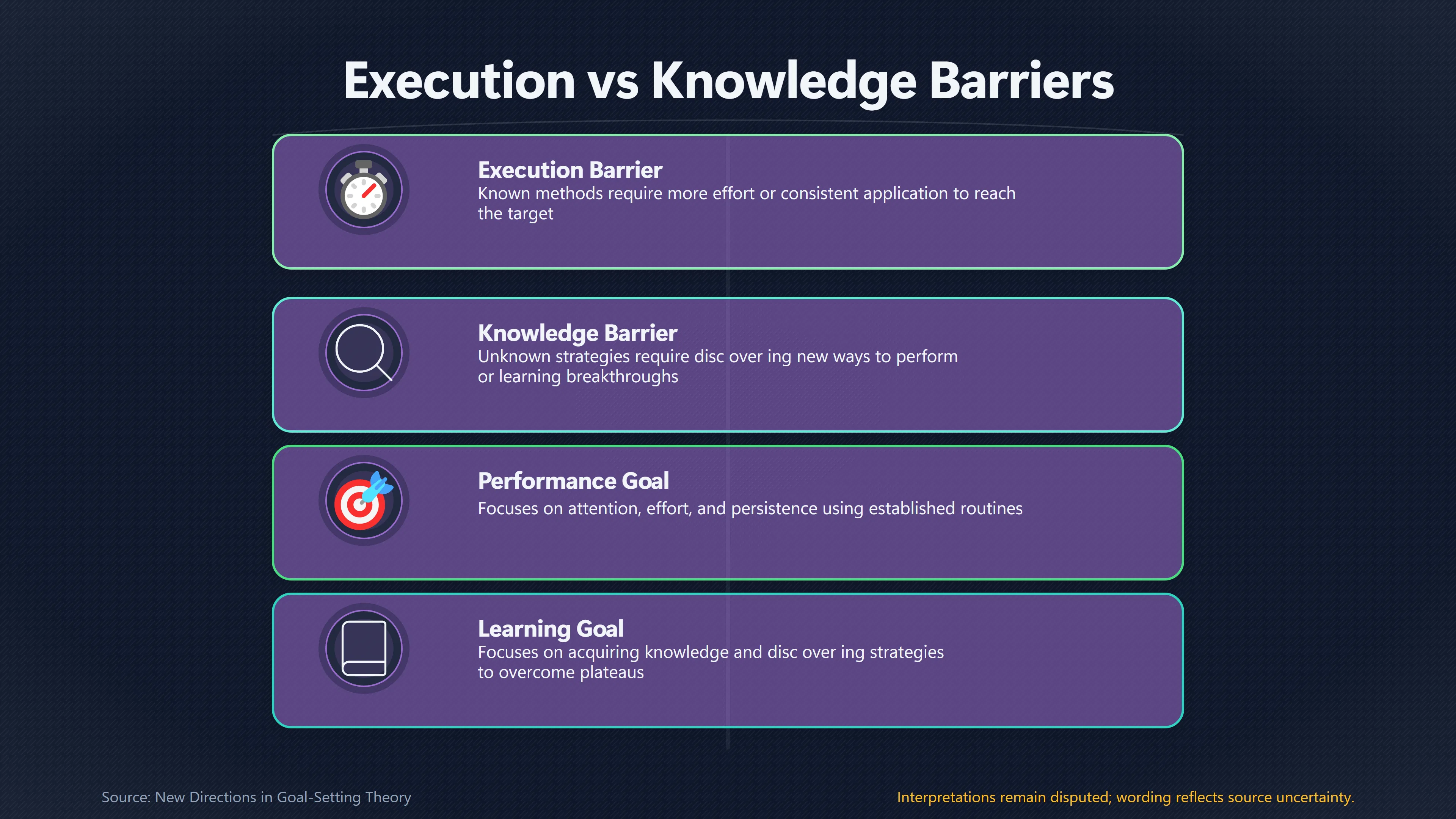
One practical way to test a proposed stretch goal is to ask what actually prevents you from reaching it.
If the limiting factor is mainly execution, a difficult performance goal may be appropriate. You know what works; the challenge is doing enough of it, doing it consistently or performing it at a higher standard. Traditional goal-setting mechanisms — attention, effort and persistence — have something useful to act on.[DOI]doi.orgNew Directions in Goal-Setting TheoryNew Directions in Goal-Setting Theory - Edwin A. Locke, Gary P. Latham, 2006…
If the limiting factor is knowledge, however, an extreme outcome target can misdiagnose the problem. You do not yet know which behaviour will produce the result. Research comparing performance and learning goals has found that when a task primarily requires acquiring knowledge and discovering strategies, a challenging learning goal can outperform a challenging outcome goal. In one experiment involving a complex scheduling task, participants assigned a learning goal performed better and used more effective task strategies than those given an outcome goal or told to do their best.[Academy of Management Journals]journals.aom.orgOpen source on aom.org.
That leads to a safer way of preserving ambition. Instead of weakening the long-term aspiration, temporarily change what you measure.
Suppose your eventual ambition requires a dramatic improvement in a skill, but you cannot currently identify a credible method for achieving it. Rather than demanding the final result immediately, you could set a challenging goal to test several plausible strategies, collect feedback, identify why current performance plateaus and establish which approach deserves further investment. The ambition remains; the immediate goal shifts from proving that you can already achieve the breakthrough to learning how a breakthrough might be achieved.[Academy of Management Journals]journals.aom.orgOpen source on aom.org.
That distinction is particularly valuable because repeated failure is not always evidence that you need greater determination. It may be evidence that the target has outrun your current strategy.
Deciding whether radical ambition fits your situation
An extreme stretch goal is easier to justify when the downside of experimentation is deliberately bounded. Before adopting one, it helps to examine not only the potential payoff but what the goal will pressure you to do when ordinary progress proves insufficient.
A practical assessment can centre on five questions:
- Is there already a credible route? If established methods can plausibly reach the target, you may simply have a hard goal rather than a true stretch goal. If no known route can do so, expect experimentation rather than merely greater effort.[PubsOnline]pubsonline.informs.orgUsing Stretch Goals for Idea Generation Among Employees: One Size Does Not Fit All! | Organization ScienceJune 30, 2021…
- Can you afford failed experiments? Spare time, money, energy and alternative options make exploratory failure more survivable. Evidence from organisational research similarly points to slack resources as an important condition for benefiting from stretch goals.[Academy of Management Journals]journals.aom.orgOpen source on aom.org.
- Is the downside reversible? Trying an unusual practice routine for a week is different from taking an irreversible financial, physical or professional gamble. The same level of ambition does not justify the same level of exposure.
- Will missing the number create pressure for shortcuts? Research has linked unmet goals with changes in risk-taking and, under experimental conditions, unethical behaviour. A goal becomes more dangerous when success is treated as compulsory regardless of how it is obtained.[Academy of Management Journals]journals.aom.orgOpen source on aom.org.
- Are you trying to perform or trying to discover how to perform? When the missing ingredient is knowledge or strategy, learning goals can be more appropriate than escalating an outcome target.[Academy of Management Journals]journals.aom.orgOpen source on aom.org.
These questions produce a more useful definition of “too extreme” than any fixed percentage increase. A goal is not excessive merely because outsiders think it sounds audacious. Nor is it automatically sensible because it feels inspiring. The crucial issue is the relationship between the target, your current capabilities, the methods available and the consequences of experimentation.
Keep the ambition, limit the exposure
The strongest case for a stretch goal is not “failure is impossible”. It is almost the opposite: failure is affordable enough that you can search intelligently for a breakthrough. When experiments can be contained, feedback arrives quickly and setbacks do not destroy resources needed for another attempt, radical ambition can create useful pressure to question assumptions and discover better methods. Research on stretch goals leaves room for exactly that possibility.[Academy of Management Journals]journals.aom.orgOpen source on aom.org.
When failure would carry serious consequences, however, an impossible-looking target can turn healthy challenge into unnecessary exposure. The danger is greatest when the target eliminates credible conventional routes while simultaneously making attainment feel non-negotiable. In that situation, the goal may reward precisely the wrong response: abandoning reliable methods, escalating commitment to uncertain ones or accepting risks that would look unreasonable without the target.
For self-improvement that works, the better principle is therefore not to avoid ambitious goals, but to separate ambition in destination from recklessness in method. Stretch radically where experimentation is cheap and informative. Where the downside is substantial, use difficult but credible milestones, protect proven methods and make learning itself the immediate goal when you do not yet know the route forward.
Amazon book picks
Further Reading
Books and field guides related to When Does a Stretch Goal Become Too Extreme?. Use these as the next step if you want deeper reading beyond the article.
Smarter Faster Better: The Secrets of Being Productive in Lif...
In the international bestseller The Power of Habit, Pulitzer Prize-winning journalist Charles Duhigg explained why we do what we do. In S...

The Power of Habit
Rating: 4.0/5 from 145 Google Books ratings
In The Power of Habit, award-winning business reporter Charles Duhigg takes us to the thrilling edge of scientific discoveries that expla...
Thinking in Bets: Making Smarter Decisions When You Don't Hav...
Wall Street Journal bestseller! Poker champion turned business consultant Annie Duke teaches you how to get comfortable with uncertainty...
Range: Why Generalists Triumph in a Specialized World
The #1 New York Times bestseller that has all America talking: as seen/heard on CNN's Fareed Zakaria GPS, Morning Joe, CBS This Morning,...
eBay marketplace picks
Marketplace Samples
Live-tested eBay searches with available results related to this page.
Selected frommotivational wall art oneBay.co.uk.




Endnotes
1.
Source: doi.org
Title: New Directions in Goal-Setting Theory
Link:https://doi.org/10.1111/j.1467-8721.2006.00449.x
Source snippet
New Directions in Goal-Setting Theory - Edwin A. Locke, Gary P. Latham, 2006...
2.
Source: hks.harvard.edu
Link:https://www.hks.harvard.edu/publications/goals-gone-wild-systematic-side-effects-overprescribing-goal-setting
Source snippet
Harvard Kennedy SchoolGoals Gone Wild: The Systematic Side Effects of Overprescribing Goal Setting | Harvard Kennedy School...
3.
Source: doi.org
Title: Learning Goals May Prevent “Goals Gone Wild” | AJPH | Vol. 104 Issue 12
Link:https://doi.org/10.2105/AJPH.2014.302264
4.
Source: pubsonline.informs.org
Link:https://pubsonline.informs.org/doi/10.1287/orsc.2021.1462
Source snippet
Using Stretch Goals for Idea Generation Among Employees: One Size Does Not Fit All! | Organization ScienceJune 30, 2021...
Published: June 30, 2021
5.
Source: journals.aom.org
Link:https://journals.aom.org/doi/pdf/10.5465/amr.2008.0038
6.
Source: journals.aom.org
Link:https://journals.aom.org/doi/full/10.5465/AMBPP.2020.20446abstract
7.
Source: journals.aom.org
Link:https://journals.aom.org/doi/10.5465/ambpp.2015.18197abstract
8.
Source: journals.aom.org
Link:https://journals.aom.org/doi/10.5465/ambpp.2017.14512abstract
Source snippet
Academy of Management JournalsManagerial Responses at the Interface between Stretch Goals and Organizational Performance | Academy of Man...
9.
Source: journals.aom.org
Link:https://journals.aom.org/doi/10.5465/AMP.2009.37007999
Source snippet
Academy of Management JournalsGoals Gone Wild: The Systematic Side Effects of Overprescribing Goal Setting | Academy of Management Perspe...
10.
Source: journals.aom.org
Link:https://journals.aom.org/doi/10.5465/20159591
11.
Source: journals.aom.org
Link:https://journals.aom.org/doi/10.5465/amp.2009.37008000
12.
Source: journals.aom.org
Link:https://journals.aom.org/doi/10.5465/AMP.2009.43479265
13.
Source: journals.aom.org
Link:https://journals.aom.org/doi/10.5465/ame.2005.15841964
14.
Source: journals.aom.org
Link:https://journals.aom.org/doi/abs/10.5465/AMBPP.2020.20446abstract
15.
Source: pubsonline.informs.org
Link:https://pubsonline.informs.org/doi/abs/10.1287/orsc.2017.1131
16.
Source: journals.aom.org
Link:https://journals.aom.org/doi/full/10.5465/amr.2016.0225
17.
Source: journals.aom.org
Link:https://journals.aom.org/doi/abs/10.5465/amr.2008.0038
18.
Source: journals.aom.org
Link:https://journals.aom.org/doi/abs/10.5465/amr.2008.0038?source=post_page—————————
19.
Source: journals.aom.org
Link:https://journals.aom.org/doi/10.5465/amp.2009.43479266
20.
Source: journals.aom.org
Link:https://journals.aom.org/doi/abs/10.5465/amp.2009.37007999?rss=1&ssource=mfc
21.
Source: journals.aom.org
Link:https://journals.aom.org/toc/amp/23/1
22.
Source: journals.aom.org
Link:https://journals.aom.org/doi/pdf/10.5465/amp.2009.37008000
23.
Source: journals.aom.org
Link:https://journals.aom.org/doi/10.5465/amj.2008.30767373
24.
Source: journals.aom.org
Link:https://journals.aom.org/doi/pdf/10.5465/ame.2005.15841964
25.
Source: journals.aom.org
Link:https://journals.aom.org/doi/abs/10.5465/apbpp.2002.7517522
26.
Source: researchgate.net
Link:https://www.researchgate.net/profile/Edwin-Locke
27.
Source: duke.academia.edu
Title: Sim Sitkin
Link:https://duke.academia.edu/SimSitkin
Additional References
28.
Source: academic.oup.com
Title: Academic Goal Setting | Oxford Bibliographies in Management | Oxford Academic
Link:https://academic.oup.com/reference/62383/reference-article-abstract/555049396
Source snippet
OUP AcademicGoal Setting | Oxford Bibliographies in Management | Oxford Academic...
29.
Source: youtube.com
Title: The Dark Side of Goal Setting (Nobody Talks About)
Link:https://www.youtube.com/watch?v=T_rj2zhaBc4
Source snippet
"Stretch goals" "Sim Sitkin" OR "Goals Gone Wild" OR "unintended consequences of goal setting" The Stretch Goal Paradox...
30.
Source: youtube.com
Title: Research for Entrepreneurs: When & How to Pursue Stretch Goals
Link:https://www.youtube.com/watch?v=RhXZjSDqt9w
Source snippet
The Dark Side of Stretch Goals: Why Aiming Too High Can Backfire...
31.
Source: youtube.com
Title: The Dark Side of Stretch Goals: Why Aiming Too High Can Backfire
Link:https://www.youtube.com/watch?v=Y8ndEsM7-4U
Source snippet
The Dark Side of Goal Setting (Nobody Talks About)...
32.
Source: researchgate.net
Link:https://www.researchgate.net/publication/37318904360th_birthday_of%27A_Behavioral_Theory_of_the_Firm%27_a_review_of_the_relational_concepts_and_recommendations_for_future_research
33.
Source: researchgate.net
Link:https://www.researchgate.net/publication/280687748_Goals_Gone_Wild_The_Systematic_Side_Effects_of_Overprescribing_Goal_Setting?_tp=eyJjb250ZXh0Ijp7InBhZ2UiOiJzY2llbnRpZmljQ29udHJpYnV0aW9ucyIsInByZXZpb3VzUGFnZSI6bnVsbCwic3ViUGFnZSI6bnVsbH19
34.
Source: researchgate.net
Link:https://www.researchgate.net/publication/280687748_Goals_Gone_Wild_The_Systematic_Side_Effects_of_Overprescribing_Goal_Setting
35.
Source: researchgate.net
Link:https://www.researchgate.net/publication/228371925_Has_Goal_Setting_Gone_Wild_or_Have_Its_Attackers_Abandoned_Good_Scholarship
36.
Source: researchgate.net
Link:https://www.researchgate.net/publication/282712862_Leader_Longevity_Cognitive_Inertia_and_Performance_in_Organizations_with_Stretch_Goals_Evidence_from_La_Royale_and_its_Ambition_to_Gain_Naval_Supremacy_Between_1689_and_1783
37.
Source: researchgate.net
Link:https://www.researchgate.net/publication/397453923_Meeting_stretch_goals_via_incentive_compensation_Evidence_from_two_emerging-country_organizations