Within Sleep Foundation
Why Tired Brains Fail in Brief, Costly Lapses
Sleep loss often makes performance unstable, producing brief lapses and unusually slow responses rather than uniform slowing.
On this page
- What unstable attention looks like under sleep loss
- Why vigilance tasks reveal lapses so clearly
- How brief lapses disrupt studying, work and routine transitions
Page outline Jump by section
Introduction
Sleep loss does not simply make attention uniformly slower. Its more distinctive effect is to make attention unstable. A tired person can respond normally for many moments, then suddenly produce an unusually slow response, miss an obvious signal or briefly lose the thread of what they are doing. Sustained attention — the ability to keep responding reliably over time — is therefore one of the cognitive abilities most consistently disrupted by insufficient sleep.[PubMed Central (PMC)]pmc.ncbi.nlm.nih.govPubMed Central (PMC)Sleep deprivation, vigilant attention, and brain function: a review - PMCJune 8, 2019…
That distinction matters for self-improvement because consistency, not peak capability, often determines whether intentions become actions. Someone may still be perfectly capable of understanding a lecture, writing good code or completing an administrative task after poor sleep. The problem is that this capability becomes less dependable from one moment to the next. Experiments describe this pattern as state instability: normal or near-normal performance becomes increasingly interspersed with brief failures as pressure for sleep competes with the effort to remain awake and engaged.[PubMed]pubmed.ncbi.nlm.nih.govSustained attention performance during sleep deprivation: evidence of state instability - PubMed…
What unstable attention looks like under sleep loss
The clearest signature of sleep loss is found not just in average reaction time but in the shape of people’s responses. When well rested, healthy young adults performing a vigilance task tend to produce a relatively concentrated distribution of reaction times. After sleep loss, that distribution develops a long tail: the slowest responses become dramatically slower and lapses become more numerous, while many of the fastest and ordinary responses remain comparatively intact.[PubMed Central (PMC)]pmc.ncbi.nlm.nih.govPubMed Central (PMC)Sleep deprivation, vigilant attention, and brain function: a review - PMCJune 8, 2019…
This means that describing a tired person as simply “20% slower”, for example, would miss much of what is happening. They may be nearly as quick as usual on one trial and exceptionally slow on the next. In a classic experiment that repeatedly tested people during 88 hours without sleep, both average reaction time and within-person variability increased markedly. Participants continued to produce timely responses, but these were increasingly mixed with omissions and premature responses. The researchers described the resulting condition as an unstable state that could fluctuate over seconds.[PubMed]pubmed.ncbi.nlm.nih.govSustained attention performance during sleep deprivation: evidence of state instability - PubMed…
The phenomenon is not restricted to extraordinary periods without sleep. In the influential Van Dongen laboratory experiment, healthy adults given either four, six or eight hours in bed per night for 14 days showed a dose-dependent pattern. Attention lapses accumulated progressively in the four- and six-hour conditions, whereas they remained comparatively uncommon with eight hours in bed. Crucially, subjective sleepiness did not deteriorate in parallel with objective vigilance performance. People could therefore become progressively worse at maintaining attention without feeling proportionately worse.[PubMed]pubmed.ncbi.nlm.nih.govThe cumulative cost of additional wakefulness: dose-response effects on neurobehavioral functions and sleep physiology from chronic…
There is an important qualification. Very mild restriction does not inevitably produce a measurable vigilance deficit in every experiment. A randomised study of 93 healthy young adults that removed one hour from habitual sleep for six nights found an effect on working-memory capacity but not on its sustained-attention measure. Sleep loss exists on a continuum, and the detectable effect depends on its severity, duration, timing, the task used and individual susceptibility.[PubMed]pubmed.ncbi.nlm.nih.govCumulative mild partial sleep deprivation negatively impacts working memory capacity but not sustained attention, response inhibiti…
Why vigilance tasks expose lapses so clearly
Much of what researchers know about this instability comes from the psychomotor vigilance test (PVT). The standard version lasts about ten minutes. A visual stimulus appears after unpredictable intervals, and the participant responds as quickly as possible. Traditionally, a reaction taking more than 500 milliseconds is counted as an attentional lapse.[PubMed Central (PMC)]pmc.ncbi.nlm.nih.govPubMed Central (PMC)Sleep deprivation, vigilant attention, and brain function: a review - PMCJune 8, 2019…
The task sounds almost absurdly easy, and that is part of its value. It demands little specialist knowledge, has little learning effect and gives people few strategic tricks with which to disguise deteriorating alertness. The challenge is simply to remain ready for the next unpredictable signal. Sleep loss reliably produces slower responses, more lapses, more false starts and a larger time-on-task effect — performance becomes less reliable as the test continues.[PubMed Central (PMC)]pmc.ncbi.nlm.nih.govPubMed Central (PMC)Maximizing Sensitivity of the Psychomotor Vigilance Test (PVT) to Sleep Loss - PMCMay 1, 2011…
This helps separate sleep-related vigilance failure from a broader claim that a tired brain becomes equally bad at everything. It does not. Some complex tasks permit people to compensate temporarily through strategy, motivation, extra effort or prior skill. The repetitive PVT strips much of that away and exposes whether attention can remain continuously available. Reviews consequently describe vigilant attention as especially sensitive to sleep deprivation.[Nature]nature.comSleep deprivation, vigilant attention, and brain function: a review | NeuropsychopharmacologyJune 8, 2019…
Nor are PVT lapses merely an artefact of staring at a screen until the eyes close. Experiments comparing visual and auditory versions found broadly similar sleep-loss effects in both modalities, including increased variability, slowing and lapses. The findings indicate that the problem extends beyond visual distraction or eyelid closure to a more general instability in maintaining responsiveness.[PubMed Central (PMC)]pmc.ncbi.nlm.nih.govOpen source on nih.gov.
There is another reason vigilance tests are revealing: sleep pressure and time on task can compound one another. Maintaining attention becomes harder during a prolonged task even when rested, but sleep deprivation magnifies that vigilance decrement. A person can therefore begin a monotonous activity reasonably well and become substantially less dependable as it continues.[PubMed]pubmed.ncbi.nlm.nih.govPub Med Sleep deprivation, vigilant attention, and brain function: a reviewSleep deprivation, vigilant attention, and brain function: a review - PubMed…
What happens during a lapse
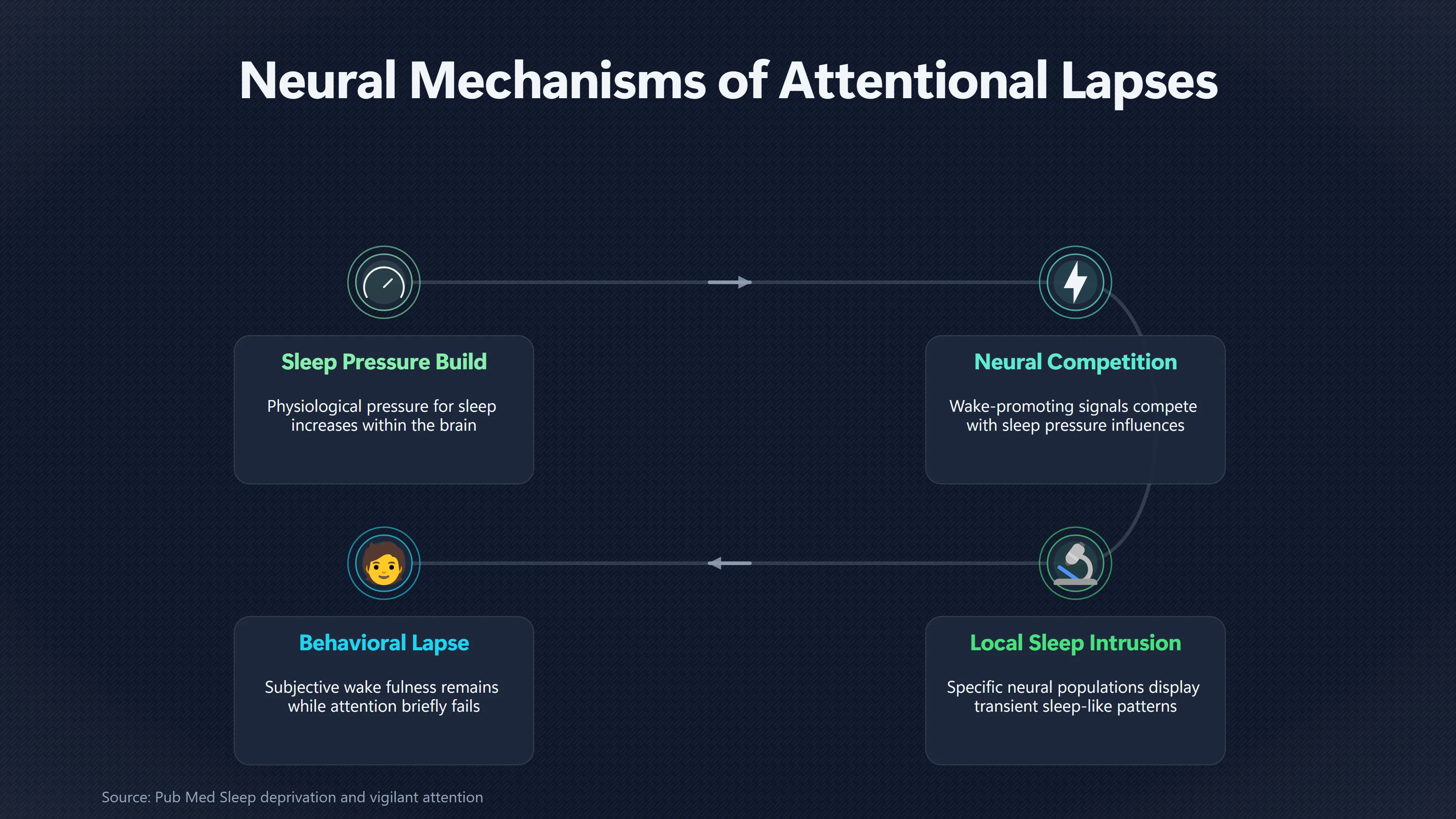
The older “lapse hypothesis” treated these failures as brief reductions in arousal. Later work produced a more detailed picture. Sleep deprivation increases the physiological pressure for sleep, but wake-promoting circadian signals and deliberate effort are still operating. Performance can consequently oscillate as these influences compete. The result is not necessarily a clean switch from awake to asleep; it is unstable wakefulness in which successful responses and failures alternate.[PubMed Central (PMC)]pmc.ncbi.nlm.nih.govPubMed Central (PMC)Sleep deprivation, vigilant attention, and brain function: a review - PMCJune 8, 2019…
Brain-imaging and electrophysiological studies suggest that this instability can reach surprisingly local levels. In one unusual experiment, researchers recorded individual neurons through intracranial electrodes in 12 patients undergoing monitoring for epilepsy surgery. Participants performed a visual categorisation vigilance task before and after sleep deprivation. Immediately around the slowest behavioural responses, neurons in the medial temporal lobe responded more weakly, later and for longer than they did during fast trials. Local electrical activity also showed increased slow/theta activity associated with those degraded responses.[Nature]nature.comOpen source on nature.com.
This contributes to a developing account of local sleep-like activity: while the person remains behaviourally awake, particular neural populations can transiently display patterns associated with sleep. High-density electroencephalography (EEG) research has likewise found local slow waves associated with behavioural lapses and with subjective reports of mind wandering and mind blanking. The precise interpretation of local sleep remains an active research area, so it should not be reduced to the catchy claim that “part of the brain literally falls asleep”. The stronger conclusion is that sleep-like local neural events can intrude into wakefulness and are associated with momentary failures of attention.[PubMed Central (PMC)]pmc.ncbi.nlm.nih.govPub Med Central (PMC)Predicting lapses of attention with sleep-like slow wavesPub Med Central (PMC)Predicting lapses of attention with sleep-like slow waves
Recent evidence adds another layer. A 2025 Nature Neuroscience study found that, even while sleep-deprived participants were confirmed awake with their eyes open, attentional lapses and missed responses coincided with larger low-frequency cerebrospinal-fluid fluctuations and widespread haemodynamic changes. These findings support the idea that a lapse can involve a transient shift in brain state rather than merely a conscious decision to stop trying.[Nature]nature.comOpen source on nature.com.
A lapse can be distraction, blankness or a missed response
Not every attention failure feels the same from the inside. Sometimes attention migrates to unrelated thoughts; sometimes the mind seems blank; sometimes the person notices nothing unusual until they discover that they missed something.
Sleep deprivation appears capable of making these internal failures more frequent while simultaneously weakening awareness of them. In an experiment using thought probes during a visual-search task, sleep-deprived participants reported more task-unrelated thoughts but less awareness that their minds had wandered. Increasing perceptual demands reduced mind wandering in rested participants but not in the same way after sleep deprivation, consistent with poorer regulation of attention according to the demands of the task.[PubMed]pubmed.ncbi.nlm.nih.govOpen source on nih.gov.
A 2026 study provides evidence that the phenomenon also appears after partial rather than total sleep deprivation. Thirty-four healthy adults slept an average of about 1.7 hours less than normal for three consecutive nights. Greater sleep loss was associated with more mind wandering, more mind blanking and greater behavioural variability. The study is small and should not be treated as establishing a universal threshold, but its moment-to-moment measurements fit the broader picture of increasingly unstable attention under insufficient sleep.[PubMed]pubmed.ncbi.nlm.nih.govOpen source on nih.gov.
The practical danger is therefore not simply distraction. Meta-awareness can also deteriorate. A person who immediately notices “I stopped paying attention” can return to the task. A person who spends an interval off-task without noticing may continue reading, typing or moving through a routine while failing to process what matters.
Why brief lapses disrupt studying, work and routine transitions
A half-second lapse sounds trivial until the task is considered. The consequences depend less on the duration of the failure than on what happened during it.
During studying, an attentional lapse can occur when a definition, qualification or causal step appears. The reader may continue moving their eyes across the page, yet the later material now has to be interpreted without a piece of the argument. Repeated lapses can make a study session look productive by clock time while reducing how continuously information is actually processed. Sleep restriction can impair memory encoding through mechanisms beyond vigilance alone, so attention lapses should not be treated as the complete explanation for poorer learning; they are one particularly immediate route by which tired studying becomes unreliable.[PubMed]pubmed.ncbi.nlm.nih.govOpen source on nih.gov.
At work, the same instability can create an uneven error profile. Routine actions may proceed normally for long stretches, encouraging confidence that performance is intact. A lapse at the wrong instant, however, can mean overlooking a field in a form, failing to notice an incoming message, missing a change in a display or losing one’s place during a multistep procedure. The important variable is therefore not only average performance but the probability of an unusually poor moment. Reviews of sleep deprivation emphasise precisely this unpredictability when explaining why vigilance impairment matters in safety-critical environments.[PubMed Central (PMC)]pmc.ncbi.nlm.nih.govPub Med Central (PMC)The sleep-deprived human brainPub Med Central (PMC)The sleep-deprived human brain
Routine transitions pose a related problem for self-improvement. “Finish work, put on running clothes and leave” or “clear dinner, open the textbook and start” sounds like one intention, but behaviour unfolds through a chain of cues and responses. Sustained attention keeps the intended next action available while competing stimuli arrive. A brief disengagement at the transition point can allow email, a notification, television or an unrelated thought to capture behaviour instead. Laboratory PVT results cannot establish that every abandoned workout or procrastinated study session is caused by an attention lapse, but they reveal a relevant constraint: under sleep loss, moment-to-moment responsiveness to the intended target becomes less dependable.[PubMed Central (PMC)]pmc.ncbi.nlm.nih.govPubMed Central (PMC)Sleep deprivation, vigilant attention, and brain function: a review - PMCJune 8, 2019…
Feeling functional is not the same as being consistently attentive
One reason sleep-related lapses are easy to underestimate is that they coexist with competent behaviour. A tired person may hold a fluent conversation, complete difficult work and respond quickly most of the time. Those successes are genuine. They simply do not demonstrate that attention is stable.
Repeated sleep restriction makes this distinction particularly important. In controlled experiments, objective vigilance impairment can continue accumulating while subjective sleepiness changes much less. The person may become accustomed to the feeling of restricted sleep without showing comparable adaptation in attention.[PubMed Central (PMC)]pmc.ncbi.nlm.nih.govPubMed Central (PMC)Sleep deprivation, vigilant attention, and brain function: a review - PMCJune 8, 2019…
People also differ substantially in vulnerability. Laboratory studies have found large, reasonably stable individual differences in how much sustained attention deteriorates during sleep loss. In repeated deprivation experiments, people who were relatively vulnerable on one exposure tended to be relatively vulnerable again, and later work has found similar stability across total and partial sleep-loss conditions.[PubMed]pubmed.ncbi.nlm.nih.govOpen source on nih.gov.
That does not provide a reliable licence for identifying oneself as a “good short sleeper”. Baseline performance alone does not perfectly predict who will remain resilient: one study attempting to classify vulnerability from rested PVT characteristics achieved roughly 65–76% accuracy. Individual resilience is real, but difficult to infer confidently from ordinary subjective experience.[PubMed Central (PMC)]pmc.ncbi.nlm.nih.govOpen source on nih.gov.
For self-improvement, the useful shift is therefore from asking “Can I still perform when tired?” to asking “How reliably can I keep performing from one moment to the next?” Sleep loss can leave ability visibly present while making access to that ability intermittent. That is why a tired brain may appear competent for minutes at a time yet still miss the one cue, sentence, transition or signal on which successful follow-through depends.
Amazon book picks
Further Reading
Books and field guides related to Why Tired Brains Fail in Brief, Costly Lapses. Use these as the next step if you want deeper reading beyond the article.
Why We Sleep
"Sleep is one of the most important but least understood aspects of our life, wellness, and longevity ... An explosion of scientific disc...
The Sleep Solution
With cutting-edge sleep science and time-tested techniques, The Sleep Solution will help anyone achieve healthy sleep and eliminate pills...
The Promise of Sleep
Sleep better, live longer with the groundbreaking information and step-by-step program in this revolutionary book. Healthful sleep has be...
Peak Mind
***NATIONAL BESTSELLER*** STOP FOR A MOMENT. Are you here right now? Is your focus on this page? Or is it roaming elsewhere, to the past...
eBay marketplace picks
Marketplace Samples
Live-tested eBay searches with available results related to this page.
Selected fromsleep accessories oneBay.co.uk.

Endnotes
1.
Source: nature.com
Link:https://www.nature.com/articles/s41386
Source snippet
Sleep deprivation, vigilant attention, and brain function: a review | NeuropsychopharmacologyJune 8, 2019...
Published: June 8, 2019
2.
Source: nature.com
Link:https://www.nature.com/articles/nm.4433
3.
Source: nature.com
Link:https://www.nature.com/articles/s41593-025-02098-8
4.
Source: nature.com
Link:https://www.nature.com/articles/s41467-021-23890-7
5.
Source: nature.com
Link:https://www.nature.com/articles/s41598-019-48280-4
6.
Source: nature.com
Link:https://www.nature.com/articles/s41598-017-16165-z
7.
Source: nature.com
Link:https://www.nature.com/articles/s41598-017-14006-7
8.
Source: nature.com
Link:https://www.nature.com/articles/nn1851
9.
Source: pmc.ncbi.nlm.nih.gov
Link:https://pmc.ncbi.nlm.nih.gov/articles/PMC6879580/
Source snippet
PubMed Central (PMC)Sleep deprivation, vigilant attention, and brain function: a review - PMCJune 8, 2019...
Published: June 8, 2019
10.
Source: pubmed.ncbi.nlm.nih.gov
Link:https://pubmed.ncbi.nlm.nih.gov/35034695/
Source snippet
A systematic review of sleep deprivation and neurobehavioral function in young adults - PubMed...
11.
Source: pubmed.ncbi.nlm.nih.gov
Link:https://pubmed.ncbi.nlm.nih.gov/11330205/
Source snippet
Sustained attention performance during sleep deprivation: evidence of state instability - PubMed...
12.
Source: pubmed.ncbi.nlm.nih.gov
Title: Pub Med Sleep deprivation and vigilant attention
Link:https://pubmed.ncbi.nlm.nih.gov/18591490/
Source snippet
Sleep deprivation and vigilant attention - PubMed...
13.
Source: pubmed.ncbi.nlm.nih.gov
Link:https://pubmed.ncbi.nlm.nih.gov/12683469/
Source snippet
The cumulative cost of additional wakefulness: dose-response effects on neurobehavioral functions and sleep physiology from chronic...
14.
Source: pubmed.ncbi.nlm.nih.gov
Title: Pub Med Sleep deprivation, vigilant attention, and brain function: a review
Link:https://pubmed.ncbi.nlm.nih.gov/31176308/
Source snippet
Sleep deprivation, vigilant attention, and brain function: a review - PubMed...
15.
Source: pubmed.ncbi.nlm.nih.gov
Link:https://pubmed.ncbi.nlm.nih.gov/30670158/
Source snippet
Cumulative mild partial sleep deprivation negatively impacts working memory capacity but not sustained attention, response inhibiti...
16.
Source: pmc.ncbi.nlm.nih.gov
Link:https://pmc.ncbi.nlm.nih.gov/articles/PMC3079937/
Source snippet
PubMed Central (PMC)Maximizing Sensitivity of the Psychomotor Vigilance Test (PVT) to Sleep Loss - PMCMay 1, 2011...
Published: May 1, 2011
17.
Source: pmc.ncbi.nlm.nih.gov
Link:https://pmc.ncbi.nlm.nih.gov/articles/PMC3603691/
18.
Source: pmc.ncbi.nlm.nih.gov
Link:https://pmc.ncbi.nlm.nih.gov/articles/PMC5720899/
19.
Source: pmc.ncbi.nlm.nih.gov
Title: Pub Med Central (PMC)Predicting lapses of attention with sleep-like slow waves
Link:https://pmc.ncbi.nlm.nih.gov/articles/PMC8241869/
20.
Source: pmc.ncbi.nlm.nih.gov
Link:https://pmc.ncbi.nlm.nih.gov/articles/PMC6753166/
21.
Source: pubmed.ncbi.nlm.nih.gov
Link:https://pubmed.ncbi.nlm.nih.gov/27359128/
22.
Source: pubmed.ncbi.nlm.nih.gov
Link:https://pubmed.ncbi.nlm.nih.gov/42166996/
23.
Source: pubmed.ncbi.nlm.nih.gov
Link:https://pubmed.ncbi.nlm.nih.gov/28677325/
24.
Source: pmc.ncbi.nlm.nih.gov
Title: Pub Med Central (PMC)The sleep-deprived human brain
Link:https://pmc.ncbi.nlm.nih.gov/articles/PMC6143346/
25.
Source: pubmed.ncbi.nlm.nih.gov
Link:https://pubmed.ncbi.nlm.nih.gov/15164894/
26.
Source: pmc.ncbi.nlm.nih.gov
Link:https://pmc.ncbi.nlm.nih.gov/articles/PMC8152927/
27.
Source: pmc.ncbi.nlm.nih.gov
Link:https://pmc.ncbi.nlm.nih.gov/articles/PMC6702200/
28.
Source: pmc.ncbi.nlm.nih.gov
Link:https://pmc.ncbi.nlm.nih.gov/articles/PMC11601381/
29.
Source: pubmed.ncbi.nlm.nih.gov
Link:https://pubmed.ncbi.nlm.nih.gov/38759474/
30.
Source: pmc.ncbi.nlm.nih.gov
Link:https://pmc.ncbi.nlm.nih.gov/articles/PMC10108643/
31.
Source: pubmed.ncbi.nlm.nih.gov
Link:https://pubmed.ncbi.nlm.nih.gov/35992930/
32.
Source: pubmed.ncbi.nlm.nih.gov
Link:https://pubmed.ncbi.nlm.nih.gov/34624897/
33.
Source: pmc.ncbi.nlm.nih.gov
Link:https://pmc.ncbi.nlm.nih.gov/articles/PMC8766996/
34.
Source: pmc.ncbi.nlm.nih.gov
Link:https://pmc.ncbi.nlm.nih.gov/articles/PMC8754491/
35.
Source: pubmed.ncbi.nlm.nih.gov
Link:https://pubmed.ncbi.nlm.nih.gov/34188023/
36.
Source: pmc.ncbi.nlm.nih.gov
Link:https://pmc.ncbi.nlm.nih.gov/articles/PMC7204874/
37.
Source: pubmed.ncbi.nlm.nih.gov
Link:https://pubmed.ncbi.nlm.nih.gov/31572112/
38.
Source: pmc.ncbi.nlm.nih.gov
Link:https://pmc.ncbi.nlm.nih.gov/articles/PMC9036851/
39.
Source: pubmed.ncbi.nlm.nih.gov
Link:https://pubmed.ncbi.nlm.nih.gov/30489101/
40.
Source: pubmed.ncbi.nlm.nih.gov
Link:https://pubmed.ncbi.nlm.nih.gov/29784810/
41.
Source: pmc.ncbi.nlm.nih.gov
Link:https://pmc.ncbi.nlm.nih.gov/articles/PMC6003377/
42.
Source: pubmed.ncbi.nlm.nih.gov
Link:https://pubmed.ncbi.nlm.nih.gov/29106402/
43.
Source: pmc.ncbi.nlm.nih.gov
Link:https://pmc.ncbi.nlm.nih.gov/articles/PMC6084743/
44.
Source: pmc.ncbi.nlm.nih.gov
Link:https://pmc.ncbi.nlm.nih.gov/articles/PMC3649821/
45.
Source: pmc.ncbi.nlm.nih.gov
Link:https://pmc.ncbi.nlm.nih.gov/articles/PMC3454374/
46.
Source: pmc.ncbi.nlm.nih.gov
Link:https://pmc.ncbi.nlm.nih.gov/articles/3454374/
47.
Source: pubmed.ncbi.nlm.nih.gov
Link:https://pubmed.ncbi.nlm.nih.gov/22942500/
48.
Source: pmc.ncbi.nlm.nih.gov
Link:https://pmc.ncbi.nlm.nih.gov/articles/PMC3397820/
49.
Source: pubmed.ncbi.nlm.nih.gov
Link:https://pubmed.ncbi.nlm.nih.gov/22851812/
50.
Source: pmc.ncbi.nlm.nih.gov
Link:https://pmc.ncbi.nlm.nih.gov/articles/PMC3022081/
51.
Source: pmc.ncbi.nlm.nih.gov
Link:https://pmc.ncbi.nlm.nih.gov/articles/PMC2883887/
52.
Source: pmc.ncbi.nlm.nih.gov
Link:https://pmc.ncbi.nlm.nih.gov/articles/PMC3290659/
53.
Source: pubmed.ncbi.nlm.nih.gov
Link:https://pubmed.ncbi.nlm.nih.gov/19742409/
54.
Source: pmc.ncbi.nlm.nih.gov
Link:https://pmc.ncbi.nlm.nih.gov/articles/PMC6671517/
55.
Source: pubmed.ncbi.nlm.nih.gov
Link:https://pubmed.ncbi.nlm.nih.gov/18495886/
56.
Source: pmc.ncbi.nlm.nih.gov
Link:https://pmc.ncbi.nlm.nih.gov/articles/PMC6670628/
57.
Source: pmc.ncbi.nlm.nih.gov
Link:https://pmc.ncbi.nlm.nih.gov/articles/PMC2638746/
58.
Source: pmc.ncbi.nlm.nih.gov
Link:https://pmc.ncbi.nlm.nih.gov/articles/PMC2077929/
59.
Source: pmc.ncbi.nlm.nih.gov
Link:https://pmc.ncbi.nlm.nih.gov/articles/PMC1978335/
60.
Source: pubmed.ncbi.nlm.nih.gov
Link:https://pubmed.ncbi.nlm.nih.gov/17803017/
61.
Source: periodicos.capes.gov.br
Title: capes.gov.br Behavioral and Physiological Consequences of Sleep Restriction
Link:https://www.periodicos.capes.gov.br/index.php/acervo/buscador.html?id=W84689042&source=all&task=detalhes
62.
Source: pmc.ncbi.nlm.nih.gov
Link:https://pmc.ncbi.nlm.nih.gov/articles/PMC2865224/
63.
Source: pubmed.ncbi.nlm.nih.gov
Link:https://pubmed.ncbi.nlm.nih.gov/16581292/
64.
Source: pubmed.ncbi.nlm.nih.gov
Link:https://pubmed.ncbi.nlm.nih.gov/16676792/
65.
Source: pubmed.ncbi.nlm.nih.gov
Link:https://pubmed.ncbi.nlm.nih.gov/12405615/
66.
Source: pmc.ncbi.nlm.nih.gov
Link:https://pmc.ncbi.nlm.nih.gov/articles/PMC3564638/
67.
Source: pmc.ncbi.nlm.nih.gov
Link:https://pmc.ncbi.nlm.nih.gov/articles/PMC2656292/
68.
Source: pubmed.ncbi.nlm.nih.gov
Link:https://pubmed.ncbi.nlm.nih.gov/20438143/
69.
Source: pubmed.ncbi.nlm.nih.gov
Link:https://pubmed.ncbi.nlm.nih.gov/21854967/
70.
Source: pubmed.ncbi.nlm.nih.gov
Link:https://pubmed.ncbi.nlm.nih.gov/20636207/
71.
Source: pubmed.ncbi.nlm.nih.gov
Link:https://pubmed.ncbi.nlm.nih.gov/18607201/
Additional References
72.
Source: youtube.com
Title: Dangers of Sleep Deprivation, Alertness, and Microsleeps
Link:https://www.youtube.com/watch?v=ShSVU1lYZO8
Source snippet
This PEBL Psychomotor Vigilance Task demonstration illustrates the primary experimental paradigm used in sleep research to measure reacti...
73.
Source: youtube.com
Title: Study Uncovers How Mental Fatigue Causes the Brain to Zone Out
Link:https://www.youtube.com/watch?v=NCrseyxdguA
Source snippet
Is ADHD a Sleep Problem? State Instability and Attentional Lapses...
74.
Source: youtube.com
Title: Is ADHD a Sleep Problem? State Instability and Attentional Lapses
Link:https://www.youtube.com/watch?v=r3UxlJmxmbk
Source snippet
What Sleep Deprivation Does to Your Brain—Hour by Hour...
75.
Source: youtube.com
Title: What Sleep Deprivation Does to Your Brain—Hour by Hour
Link:https://www.youtube.com/watch?v=NY4oNQd-xeY
Source snippet
Dangers of Sleep Deprivation, Alertness, and Microsleeps...
76.
Source: sciencedirect.com
Link:https://www.sciencedirect.com/science/article/pii/S2352721818301748
77.
Source: frontiersin.org
Link:https://www.frontiersin.org/articles/10.3389/fnins.2021.660365/full
78.
Source: frontiersin.org
Link:https://www.frontiersin.org/journals/neuroscience/articles/10.3389/fnins.2019.00949/full
79.
Source: frontiersin.org
Link:https://www.frontiersin.org/journals/environmental-health/articles/10.3389/fenvh.2024.1362755/full
80.
Source: sciencedirect.com
Link:https://www.sciencedirect.com/science/article/pii/S1053811905025139
81.
Source: sciencedirect.com
Link:https://www.sciencedirect.com/science/article/abs/pii/S1053811910001990