Within Study Systems
When Moving Your Phone Actually Helps Studying
Moving a phone away can be useful when habitual checking is the real obstacle, even though mere phone presence does not always impair learning.
On this page
- What experiments say about phone presence and memory
- Why active checking matters more than simple proximity
- Who is most likely to benefit from putting the phone farther away
Page outline Jump by section
Introduction
Moving a phone farther away can help studying, but the strongest reason is more practical than the familiar claim that a nearby phone automatically “drains” the brain. Research on the mere presence of smartphones is mixed: some experiments find small costs to working memory, while preregistered replications and meta-analyses find little or no reliable effect across many cognitive tasks.[doi.org]doi.orgBrain Drain: The Mere Presence of One’s Own Smartphone Reduces Available Cognitive Capacity | Journal of the Association for Consumer…
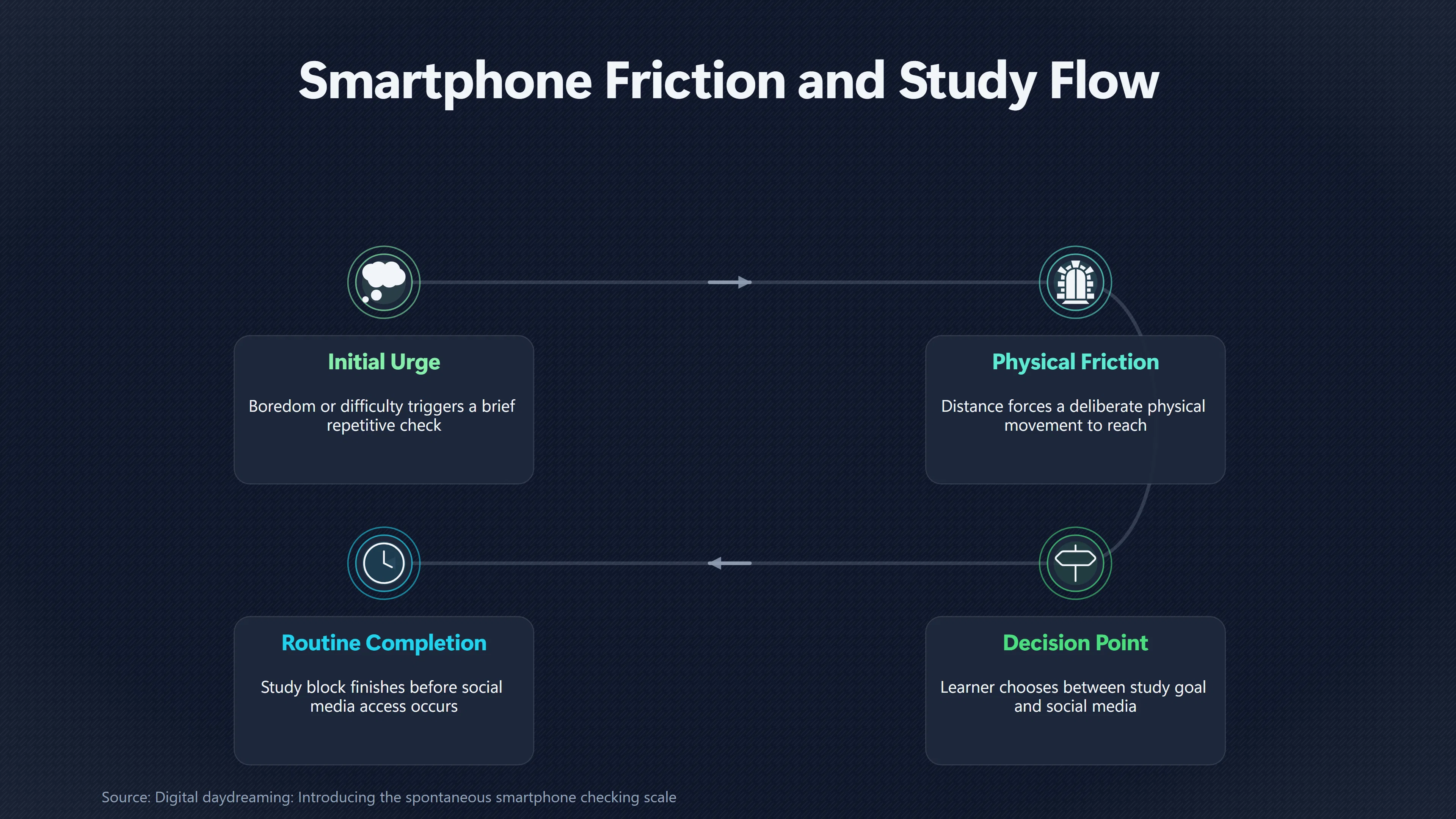
The clearer case for distance is behavioural. Smartphone checking can become a brief, repetitive habit triggered with little deliberate thought, and notifications or actual phone use can interrupt attention and memory.[doi.org]doi.orgHabits make smartphone use more pervasive | Personal and Ubiquitous Computing | Springer Nature LinkJune 16, 2011… Putting the phone across the room, in a bag that is not beside the chair, or outside the study space therefore works best as a precommitment: it changes the environment before the urge to check arrives. For a routine built around studying before social media, that distinction matters. Distance is useful not because every visible phone necessarily damages cognition, but because an inaccessible phone cannot be picked up automatically at the first moment of boredom.
What experiments say about phone presence and memory
The influential case for physical distance came from a 2017 study by Adrian Ward and colleagues. Participants were randomly assigned to keep their smartphones on the desk, in a pocket or bag, or in another room while completing cognitive tests. In the first experiment, the other-room group performed better than the desk group on a combined measure involving working memory and fluid intelligence, with results following a desk-to-pocket/bag-to-other-room gradient. The researchers argued that inhibiting attention to a salient personal device might itself consume some limited cognitive capacity.[DOI]doi.orgBrain Drain: The Mere Presence of One’s Own Smartphone Reduces Available Cognitive Capacity | Journal of the Association for Consumer…
That finding produced the memorable “brain drain” idea, but subsequent evidence makes a universal version of the claim difficult to defend. A preregistered direct replication published in 2022 reproduced the desk, pocket/bag and outside-the-room conditions and also varied whether phones were switched on or off. It found no significant difference between phone-location conditions on working-memory or response-inhibition performance.[ScienceDirect]sciencedirect.comReexamining the “brain drain” effect: A replication of Ward et al. (2017) - ScienceDirect… Another laboratory study using mobile eye tracking similarly failed to find a performance cost from having a smartphone present; participants rarely looked at it during the tasks, although the device attracted more attention during breaks and transitions.[ScienceDirect]sciencedirect.comDoes a smartphone on the desk drain our brain? No evidence of cognitive costs due to smartphone presence in a short-term and…
Meta-analyses reflect the same uncertainty rather than resolving it into a simple rule. A 2023 systematic review and set of six meta-analyses covered 56 effects and 7,093 participants. It found a statistically significant pooled mere-presence effect for working-memory capacity, but null summary effects for the other cognitive functions examined.[Taylor & Francis Online]tandfonline.comOpen source on tandfonline.com. A separate meta-analysis reported an overall negative smartphone presence/use effect but also substantial heterogeneity across cognitive domains and studies.[PubMed Central (PMC)]pmc.ncbi.nlm.nih.govPub Med Central (PMC)Does the Brain Drain Effect Really Exist? A Meta-AnalysisPub Med Central (PMC)Does the Brain Drain Effect Really Exist? A Meta-Analysis
The practical interpretation is narrower than “always put your phone in another room because seeing it makes you less intelligent”. The presence effect appears sensitive to what is being measured and how the experiment is conducted. Distance may sometimes reduce cognitive interference, particularly for working memory, but that benefit is not sufficiently consistent to make brain drain the main justification for a phone-distance rule.
For studying, this distinction prevents an environmental tactic from being oversold. A student who can leave a silent phone on the desk for 40 minutes without touching it should not assume that moving it three metres away will produce a large improvement in memory. A student who repeatedly unlocks the same phone without consciously deciding to do so has a much stronger reason to move it.
Why active checking matters more than simple proximity
Actual interaction with a phone presents a different evidential picture because it introduces attention switching rather than merely the possibility of distraction. A 2025 meta-analysis synthesising 27 experiments on mobile-phone distraction during learning concluded that mobile multitasking had a negative, medium-sized effect on young adults’ immediate recall. The relevant mechanism is straightforward: attention must be divided or switched between learning and an unrelated mobile activity.[ScienceDirect]sciencedirect.comMobile multitasking in learning: A meta-analysis of effects of mobilephone distraction on young adults’ immediate recall - S…
Even an interruption that stops short of opening the phone can matter. In a controlled experiment, receiving a mobile-phone notification disrupted performance on an attention-demanding task even when participants did not interact with the device.[PubMed]pubmed.ncbi.nlm.nih.govPub Med The attentional cost of receiving a cell phone notificationThe attentional cost of receiving a cell phone notification - PubMed… Experiments on memory have likewise found increasing disruption as participants moved from receiving no notifications, to dismissing notifications, to reading them.[PubMed]pubmed.ncbi.nlm.nih.govOpen source on nih.gov. Another study of 105 undergraduates found that notifications slowed performance on an attention task while mere phone presence did not — a particularly useful contrast when deciding what a distance rule is actually meant to accomplish.[ERIC]eric.ed.govOpen source on ed.gov.
Not every interruption experiment produces worse test scores. In one study, students periodically played a short smartphone game while reading, and neither the game interruptions nor notifications produced significant differences in quiz scores or reading time.[Springer Link]link.springer.comOpen source on springer.com. In a related brief-lecture experiment, however, participants who played after receiving push notifications performed worse than the no-game control group, while the notification-free gaming group did not differ significantly from controls.[ScienceDirect]sciencedirect.comOpen source on sciencedirect.com. The mixed individual experiments are another reason to avoid claiming that every glance has a predictable numerical cost.
What distance can do more reliably is remove the opportunity for an effortless check. Long before current debates over “brain drain”, researchers examining logged smartphone behaviour described a characteristic checking habit: brief, repetitive inspections of readily updated information. Their field work suggested that quickly available informational rewards can reinforce these checks and that an initial check can become a gateway to additional phone activity.[DOI]doi.orgHabits make smartphone use more pervasive | Personal and Ubiquitous Computing | Springer Nature LinkJune 16, 2011…
That makes physical distance a form of friction. Consider two versions of the same opening study block. With the phone beside the textbook, a moment of uncertainty in a difficult problem can be followed almost immediately by reach, unlock and feed. With the phone in another room, the same sequence requires standing up, leaving the study position and deliberately retrieving it. The intervention does not eliminate the desire to check; it inserts enough action between urge and behaviour for the original study intention to remain competitive.
This is why the tactic fits particularly well at the start of a study-before-social-media routine. The aim is not necessarily to remain unreachable all day. It is to protect the period in which one quick check could reverse the intended sequence from “study, then social media” to “social media, then try to stop”.

Distance works best as precommitment, not punishment
A useful phone-distance policy is decided before studying begins. Waiting until distraction has already started — noticing that ten minutes have disappeared into a feed and then deciding to hide the phone — requires self-control at exactly the point when the competing behaviour has already won access to attention.
Precommitment reverses that sequence. The learner decides in advance where the phone will be during a defined study block. The intervention can be proportionate to the actual checking problem:
- Phone on the desk, notifications disabled may be enough for someone who rarely reaches for it and mainly reacts to alerts.
- Phone zipped inside a bag or placed across the room adds friction for someone whose hand tends to reach for the device during pauses.
- Phone outside the study room is the stronger option when checks happen almost automatically or one check routinely becomes several minutes of social media.
- A planned retrieval point — for example, after the first 25- or 40-minute block — makes the restriction finite rather than turning it into an indefinite test of abstinence.
The important outcome to observe is therefore not simply whether the learner felt more focused. It is whether unwanted pickups disappeared and whether the intended opening block actually happened before social media. Research using objective smartphone measures has highlighted checking frequency and short, fragmented interactions as useful behavioural indicators of habitual use, rather than relying solely on estimates of total screen time.[PubMed Central (PMC)]pmc.ncbi.nlm.nih.govOpen source on nih.gov.
This approach also avoids confusing distance with a treatment for every kind of digital distraction. If the student needs the phone for authentication, a timer, accessibility support or genuinely study-related communication, extreme separation may create new friction in the wrong direction. Conversely, keeping a phone face down within arm’s reach may change very little for someone whose checking is internally cued by boredom or anticipation rather than by visible notifications. A 2026 classroom study illustrates this problem: hiding notifications altered patterns of phone use, but internally driven smartphone vigilance remained relevant, and both frequent checks and longer use episodes were associated with poorer learning through greater mental effort.[National Taiwan Normal University]scholar.lib.ntnu.edu.twOpen source on edu.tw.
Distance should therefore target a diagnosed behaviour: “When studying becomes uncomfortable, I pick up my phone before I realise I have decided to.” For that problem, changing reachability is more directly matched to the mechanism than simply telling oneself to concentrate harder.
Who benefits most from putting the phone farther away
The best candidate is not necessarily the person with the highest daily screen-time total. It is the learner whose phone use repeatedly breaks the boundary at the beginning of study.
One sign is automaticity: discovering the phone in your hand without remembering making a clear decision to pick it up. Another is gateway checking: opening the device for a supposedly tiny purpose — checking the time, one message or one notification — and then moving into social media or other unrelated apps. Both fit the checking-habit pattern described in behavioural smartphone research.[DOI]doi.orgHabits make smartphone use more pervasive | Personal and Ubiquitous Computing | Springer Nature LinkJune 16, 2011…
A second sign is sensitivity to external cues. If vibrations, banners or screen illumination reliably produce checks, notification suppression may solve much of the problem without requiring another-room separation. Notifications themselves can impose attentional costs, so turning them off is not merely cosmetic.[PubMed]pubmed.ncbi.nlm.nih.govPub Med The attentional cost of receiving a cell phone notificationThe attentional cost of receiving a cell phone notification - PubMed…
A third is difficulty maintaining a boundary once online access becomes available. Evidence from a much stronger intervention supports the general principle that changing access can alter behaviour and attention. In a 2025 randomised controlled trial, researchers blocked mobile internet on participants’ smartphones for two weeks while leaving calls, texts and internet access on other devices available. The intervention improved objectively measured sustained attention as well as reported wellbeing and mental health.[OUP Academic]academic.oup.comOpen source on oup.com. That experiment does not prove that putting a phone across the room for 30 minutes will produce the same effects; the intervention and timescale were very different. It does, however, reinforce the broader idea that reducing immediate access can be more consequential than merely intending to use a connected device less.
The people least likely to gain much from physical separation are those who already leave the phone untouched throughout study, those whose principal distractions occur on the computer they are studying with, or those for whom moving the phone creates substantial practical costs. For them, another-room rules can become ritual without addressing the real bottleneck.

A sensible rule for the first study block
The evidence supports a deliberately modest policy: move the phone only as far away as necessary to stop unplanned checking during the opening study block. If silent, face-down desk placement reliably prevents checking, there is little reason to insist that another room has special cognitive powers. If desk placement repeatedly turns into pickups, increase the distance until checking requires an unmistakably deliberate action.
This framing also makes the intervention testable. For several study sessions, choose a fixed opening block and record only two things: whether social media remained unopened until the block ended, and whether there were any unintended phone pickups. If moving the phone out of reach sharply reduces those failures, distance is serving a useful behavioural function. If nothing changes because the phone was never the source of interruption, the routine needs a different intervention rather than stricter separation.
That is the useful lesson from a research literature that is less dramatic than popular “phone brain drain” claims suggest. Smartphone proximity by itself does not reliably impair every learner or every cognitive task.[Taylor & Francis Online]tandfonline.comOpen source on tandfonline.com. But habitual checking, notifications and actual mobile multitasking create more concrete routes to interruption.[PubMed]pubmed.ncbi.nlm.nih.govPub Med The attentional cost of receiving a cell phone notificationThe attentional cost of receiving a cell phone notification - PubMed… For someone trying to make studying happen before social media, phone distance earns its place not as a universal concentration hack, but as a simple environmental commitment: make the unwanted first action harder to perform before the moment arrives when you are tempted to perform it.
Amazon book picks
Further Reading
Books and field guides related to When Moving Your Phone Actually Helps Studying. Use these as the next step if you want deeper reading beyond the article.
Indistractable
*As heard on Steven Bartlett's Diary of a CEO* 'A must-read' Mark Manson We are living through a crisis of distraction. Plans get sidetra...
Digital Minimalism
A New York Times, Wall Street Journal, Publishers Weekly, and USA Today bestseller "Newport is making a bid to be the Marie Kondo of tech...
Deep Work
Trade paperback. Professor and popular blogger Cal Newport reveals the new key to achieving success and true meaning in professional life...
Atomic Habits
Rating: 3.5/5 from 7 Google Books ratings
The #1 New York Times bestseller. Over 25 million copies sold! Translated into 60+ languages! Tiny Changes, Remarkable Results No matter...
eBay marketplace picks
Marketplace Samples
Live-tested eBay searches with available results related to this page.
Selected fromstudy poster oneBay.co.uk.




Endnotes
1.
Source: doi.org
Link:https://doi.org/10.1086/691462
Source snippet
Brain Drain: The Mere Presence of One’s Own Smartphone Reduces Available Cognitive Capacity | Journal of the Association for Consumer...
2.
Source: sciencedirect.com
Link:https://www.sciencedirect.com/science/article/pii/S0001691822002323
Source snippet
Reexamining the “brain drain” effect: A replication of Ward et al. (2017) - ScienceDirect...
3.
Source: doi.org
Link:https://doi.org/10.1007/s00779
Source snippet
Habits make smartphone use more pervasive | Personal and Ubiquitous Computing | Springer Nature LinkJune 16, 2011...
Published: June 16, 2011
4.
Source: sciencedirect.com
Link:https://www.sciencedirect.com/science/article/pii/S0747563224003005
Source snippet
Mobile multitasking in learning: A meta-analysis of effects of mobilephone distraction on young adults’ immediate recall - S...
5.
Source: sciencedirect.com
Link:https://www.sciencedirect.com/science/article/pii/S1053810020301975
Source snippet
Does a smartphone on the desk drain our brain? No evidence of cognitive costs due to smartphone presence in a short-term and...
6.
Source: link.springer.com
Link:https://link.springer.com/article/10.1007/s10639-021-10764-0
7.
Source: sciencedirect.com
Link:https://www.sciencedirect.com/science/article/pii/S2451958822000045
8.
Source: link.springer.com
Link:https://link.springer.com/article/10.1007/s11251-026-09794-3
9.
Source: academic.oup.com
Link:https://academic.oup.com/pnasnexus/article/4/2/pgaf017/8016017
10.
Source: sciencedirect.com
Link:https://www.sciencedirect.com/science/article/pii/S0747563226001305
11.
Source: doi.org
Link:https://doi.org/10.1016/j.ssaho.2026.102569
12.
Source: doi.org
Link:https://doi.org/10.1111/jora.70118
13.
Source: doi.org
Link:https://doi.org/10.1080/0144929X.2025.2574368
14.
Source: sciencedirect.com
Link:https://www.sciencedirect.com/science/article/abs/pii/S0306460325000917
15.
Source: doi.org
Link:https://doi.org/10.1177/20501579251323246
16.
Source: link.springer.com
Link:https://link.springer.com/article/10.1186/s12916-025-03944-z
17.
Source: doi.org
Link:https://doi.org/10.1186/s12916-025-03944-z
18.
Source: sciencedirect.com
Link:https://www.sciencedirect.com/science/article/pii/S1438887124007921
19.
Source: doi.org
Link:https://doi.org/10.1145/3613904.3642790
20.
Source: link.springer.com
Link:https://link.springer.com/article/10.1186/s40359-024-01611-1
21.
Source: link.springer.com
Link:https://link.springer.com/article/10.1007/s10389-023-01832-5
22.
Source: doi.org
Link:https://doi.org/10.1007/s10389-023-01832-5
23.
Source: link.springer.com
Link:https://link.springer.com/article/10.1007/s41347-023-00304-7
24.
Source: doi.org
Title: Digital daydreaming: Introducing the spontaneous smartphone checking scale
Link:https://doi.org/10.1002/acp.4034
25.
Source: link.springer.com
Link:https://link.springer.com/article/10.3758/s13428-021-01585-7
26.
Source: doi.org
Title: Cell phone usage and academic performance: An experiment
Link:https://doi.org/10.1016%2Fj.compedu.2017.10.006
27.
Source: academic.oup.com
Link:https://academic.oup.com/jcmc/article/20/2/119/4067530
28.
Source: sciencedirect.com
Link:https://www.sciencedirect.com/science/article/pii/S0747563218301912
29.
Source: sciencedirect.com
Link:https://www.sciencedirect.com/science/article/abs/pii/S0747563218301912
30.
Source: sciencedirect.com
Link:https://www.sciencedirect.com/science/article/pii/S0747563216304915
31.
Source: sciencedirect.com
Link:https://www.sciencedirect.com/science/article/pii/S0747563217300754
32.
Source: sciencedirect.com
Link:https://www.sciencedirect.com/science/article/pii/S0747563219302948
33.
Source: sciencedirect.com
Link:https://www.sciencedirect.com/science/article/abs/pii/S0747563214007626
34.
Source: sciencedirect.com
Link:https://www.sciencedirect.com/science/article/pii/S2352853219301865
35.
Source: sciencedirect.com
Link:https://www.sciencedirect.com/science/article/pii/S000169182400372X
36.
Source: sciencedirect.com
Link:https://www.sciencedirect.com/science/article/pii/S0747563214001460
37.
Source: sciencedirect.com
Link:https://www.sciencedirect.com/science/article/pii/S0747563220301047
38.
Source: sciencedirect.com
Link:https://www.sciencedirect.com/science/article/abs/pii/S0747563216308445
39.
Source: doi.org
Link:https://doi.org/10.1016/j.chb.2021.107078
40.
Source: academic.oup.com
Title: selected highlights 2025
Link:https://academic.oup.com/pnasnexus/pages/selected-highlights-2025
41.
Source: tandfonline.com
Link:https://www.tandfonline.com/doi/full/10.1080/15213269.2023.2286647
42.
Source: pubmed.ncbi.nlm.nih.gov
Title: Pub Med The attentional cost of receiving a cell phone notification
Link:https://pubmed.ncbi.nlm.nih.gov/26121498/
Source snippet
The attentional cost of receiving a cell phone notification - PubMed...
43.
Source: pubmed.ncbi.nlm.nih.gov
Link:https://pubmed.ncbi.nlm.nih.gov/36007374/
Source snippet
Reexamining the "brain drain" effect: A replication of Ward et al. (2017) - PubMed...
44.
Source: pmc.ncbi.nlm.nih.gov
Title: Pub Med Central (PMC)Does the Brain Drain Effect Really Exist? A Meta-Analysis
Link:https://pmc.ncbi.nlm.nih.gov/articles/PMC10525686/
45.
Source: pubmed.ncbi.nlm.nih.gov
Link:https://pubmed.ncbi.nlm.nih.gov/36089897/
46.
Source: eric.ed.gov
Link:https://eric.ed.gov/?id=EJ1353187
47.
Source: pmc.ncbi.nlm.nih.gov
Link:https://pmc.ncbi.nlm.nih.gov/articles/PMC7244920/
48.
Source: scholar.lib.ntnu.edu.tw
Link:https://scholar.lib.ntnu.edu.tw/en/publications/external-and-internal-smartphone-distractions-effects-on-phone-us/
49.
Source: pmc.ncbi.nlm.nih.gov
Link:https://pmc.ncbi.nlm.nih.gov/articles/PMC11834938/
50.
Source: pmc.ncbi.nlm.nih.gov
Link:https://pmc.ncbi.nlm.nih.gov/articles/PMC13234400/
51.
Source: researchonline.jcu.edu.au
Link:https://researchonline.jcu.edu.au/91280/
52.
Source: pubmed.ncbi.nlm.nih.gov
Link:https://pubmed.ncbi.nlm.nih.gov/41801197/
53.
Source: pubmed.ncbi.nlm.nih.gov
Link:https://pubmed.ncbi.nlm.nih.gov/41271999/
54.
Source: pmc.ncbi.nlm.nih.gov
Link:https://pmc.ncbi.nlm.nih.gov/articles/PMC13082690/
55.
Source: pubmed.ncbi.nlm.nih.gov
Link:https://pubmed.ncbi.nlm.nih.gov/41994419/
56.
Source: pmc.ncbi.nlm.nih.gov
Link:https://pmc.ncbi.nlm.nih.gov/articles/PMC11846175
58.
Source: pubmed.ncbi.nlm.nih.gov
Link:https://pubmed.ncbi.nlm.nih.gov/39967678/
59.
Source: pmc.ncbi.nlm.nih.gov
Link:https://pmc.ncbi.nlm.nih.gov/articles/PMC11758673/
60.
Source: pubmed.ncbi.nlm.nih.gov
Link:https://pubmed.ncbi.nlm.nih.gov/39276445/
61.
Source: pmc.ncbi.nlm.nih.gov
Link:https://pmc.ncbi.nlm.nih.gov/articles/PMC11004883/
62.
Source: tandfonline.com
Link:https://www.tandfonline.com/doi/abs/10.1080/15213269.2023.2286647
63.
Source: pubmed.ncbi.nlm.nih.gov
Link:https://pubmed.ncbi.nlm.nih.gov/37754029/
64.
Source: pmc.ncbi.nlm.nih.gov
Link:https://pmc.ncbi.nlm.nih.gov/articles/PMC9974409/
65.
Source: pubmed.ncbi.nlm.nih.gov
Link:https://pubmed.ncbi.nlm.nih.gov/36785655/
66.
Source: pmc.ncbi.nlm.nih.gov
Link:https://pmc.ncbi.nlm.nih.gov/articles/PMC9909154/
67.
Source: pmc.ncbi.nlm.nih.gov
Link:https://pmc.ncbi.nlm.nih.gov/articles/PMC10008485/
68.
Source: pmc.ncbi.nlm.nih.gov
Link:https://pmc.ncbi.nlm.nih.gov/articles/PMC9358364/
69.
Source: pmc.ncbi.nlm.nih.gov
Link:https://pmc.ncbi.nlm.nih.gov/articles/PMC9175324/
70.
Source: pmc.ncbi.nlm.nih.gov
Link:https://pmc.ncbi.nlm.nih.gov/articles/PMC9112639/
71.
Source: pubmed.ncbi.nlm.nih.gov
Link:https://pubmed.ncbi.nlm.nih.gov/35389685/
72.
Source: pmc.ncbi.nlm.nih.gov
Link:https://pmc.ncbi.nlm.nih.gov/articles/PMC8700868/
73.
Source: pmc.ncbi.nlm.nih.gov
Link:https://pmc.ncbi.nlm.nih.gov/articles/PMC8863755/
74.
Source: pmc.ncbi.nlm.nih.gov
Link:https://pmc.ncbi.nlm.nih.gov/articles/8294129/
75.
Source: tandfonline.com
Link:https://www.tandfonline.com/doi/full/10.1080/23311908.2020.1869378
76.
Source: pubmed.ncbi.nlm.nih.gov
Link:https://pubmed.ncbi.nlm.nih.gov/33137560/
77.
Source: pmc.ncbi.nlm.nih.gov
Link:https://pmc.ncbi.nlm.nih.gov/articles/PMC7352115/
78.
Source: pmc.ncbi.nlm.nih.gov
Link:https://pmc.ncbi.nlm.nih.gov/articles/PMC6827987/
79.
Source: pubmed.ncbi.nlm.nih.gov
Link:https://pubmed.ncbi.nlm.nih.gov/31682619/
80.
Source: pubmed.ncbi.nlm.nih.gov
Link:https://pubmed.ncbi.nlm.nih.gov/29781716/
81.
Source: pmc.ncbi.nlm.nih.gov
Link:https://pmc.ncbi.nlm.nih.gov/articles/PMC4625000/
82.
Source: pmc.ncbi.nlm.nih.gov
Link:https://pmc.ncbi.nlm.nih.gov/articles/PMC12783947/
83.
Source: ink.library.smu.edu.sg
Link:https://ink.library.smu.edu.sg/soss_research/3918/
84.
Source: ink.library.smu.edu.sg
Link:https://ink.library.smu.edu.sg/soss_research/4186/
Additional References
85.
Source: journals.uchicago.edu
Link:https://www.journals.uchicago.edu/doi/full/10.1086/691462
Source snippet
RCNi Company LimitedBrain Drain: The Mere Presence of One’s Own Smartphone Reduces Available Cognitive Capacity | Journal of the Associat...
86.
Source: research.vu.nl
Link:https://research.vu.nl/en/publications/does-the-mere-presence-of-a-smartphone-impact-cognitive-performan/
Source snippet
Vrije Universiteit AmsterdamDoes the Mere Presence of a Smartphone Impact Cognitive Performance? A Meta-Analysis of the “Brain Drain Effe...
87.
Source: youtube.com
Link:https://www.youtube.com/watch?v=G2ocVTiVCPo
Source snippet
Why Leaving Your Phone in Another Room Feels Like Losing a Limb Huxley Dopamine Hole · 11 views...
88.
Source: youtube.com
Title: Your Phone Is Secretly Destroying Your Brain (Student Edition)
Link:https://www.youtube.com/watch?v=iUNxMSLi1Z4
Source snippet
Why You Can't Focus (It's Not Your Phone) | The Real Science of Attention Residue...
89.
Source: nature.com
Link:https://www.nature.com/articles/s41598-026-46218-1
90.
Source: youtube.com
Title: Why Leaving Your Phone in Another Room Feels Like Losing a Limb
Link:https://www.youtube.com/watch?v=3R4Pm8QqEfo
Source snippet
Psychology of People Who Put Their Phone Away During Workout...
91.
Source: youtube.com
Title: Psychology of People Who Put Their Phone Away During Workout
Link:https://www.youtube.com/watch?v=plUIFmrNcbQ
Source snippet
Your Phone Distracts You Even When It's Off...
92.
Source: youtube.com
Title: Your Phone Distracts You Even When It’s Off
Link:https://www.youtube.com/watch?v=9uJFJopL_Zg
Source snippet
Your Phone Is Secretly Destroying Your Brain (Student Edition)...
93.
Source: researchgate.net
Link:https://www.researchgate.net/publication/389106770_Blocking_mobile_internet_on_smartphones_improves_sustained_attention_mental_health_and_subjective_well-being?_tp=eyJjb250ZXh0Ijp7InBhZ2UiOiJzY2llbnRpZmljQ29udHJpYnV0aW9ucyIsInByZXZpb3VzUGFnZSI6bnVsbCwic3ViUGFnZSI6bnVsbH19
94.
Source: researchgate.net
Link:https://www.researchgate.net/publication/315966604_Brain_Drain_The_Mere_Presence_of_One%27s_Own_Smartphone_Reduces_Available_Cognitive_Capacity