Within Meal Prep
Does Pre Portioning Change What You Eat?
Dividing meals before hunger arrives removes a later serving decision, although trial evidence does not prove home portioning causes weight loss.
On this page
- Why serving decisions become harder when hungry
- What the portion controlled meal trial actually found
- What can and cannot be inferred for home meal prep
Page outline Jump by section
Introduction
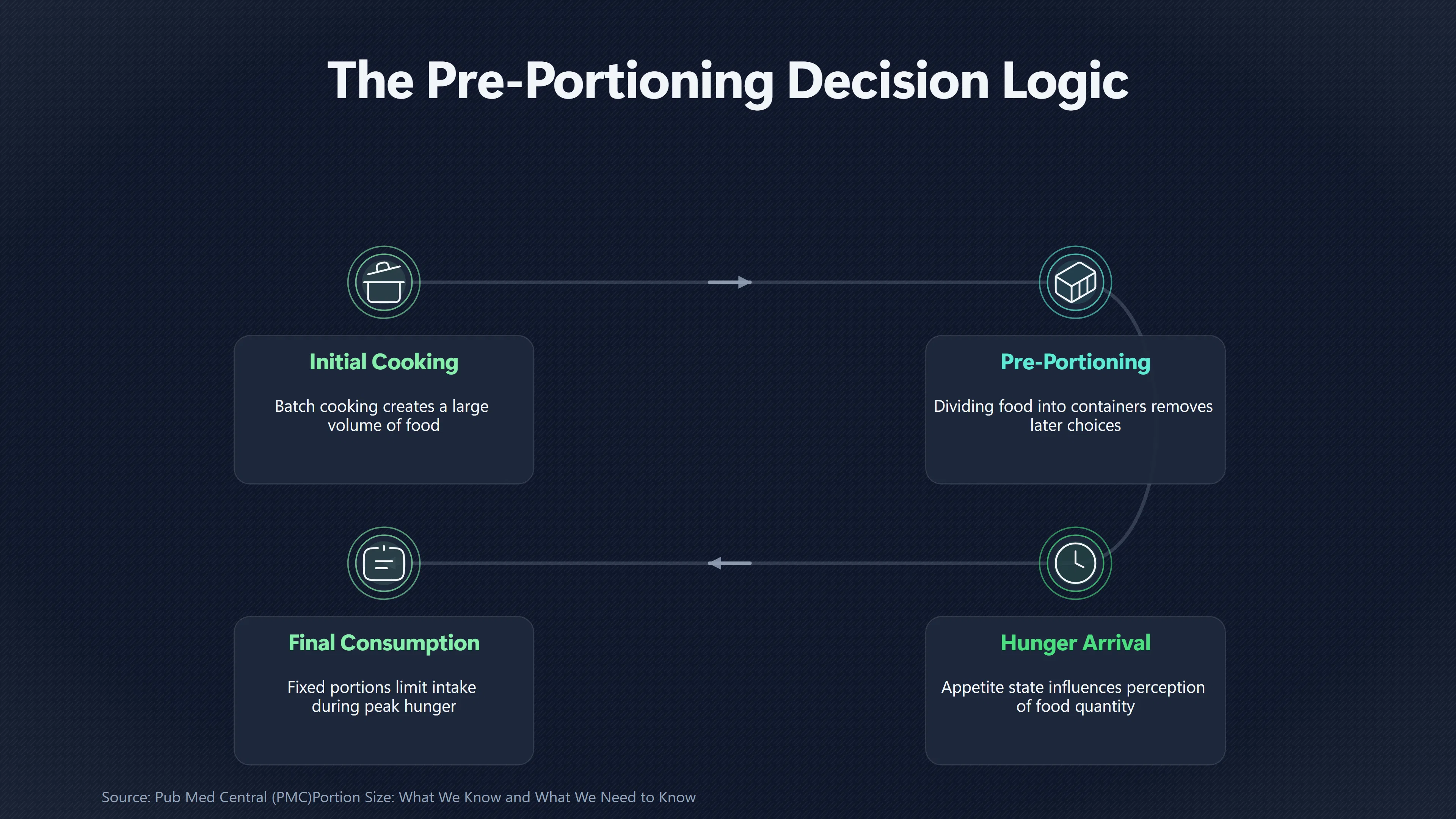
Pre-portioning a meal changes the timing of one deceptively important decision: how much food to serve. Instead of making that choice while hungry, the amount is decided earlier, when cooking or packing the meal. Research supports the underlying logic. Hunger can alter portion perception and is associated with choosing larger ideal portions, while experimental evidence shows that the amount served strongly influences how much adults actually eat.[nih.gov]pubmed.ncbi.nlm.nih.govOpen source on nih.gov.
That makes pre-portioning a plausible way to remove a vulnerable decision from the hungry moment. But the evidence needs careful interpretation. Trials of commercially pre-portioned meals show that smaller pre-portioned amounts can reduce energy intake, and one prominent weight-loss trial found better short-term results with packaged entrées. Yet the broader evidence does not establish that dividing your own batch-cooked food into containers causes weight loss. A recent systematic review concluded that the evidence linking portion strategies to body composition or obesity outcomes is too inconsistent for a firm conclusion.[PubMed Central (PMC)]pmc.ncbi.nlm.nih.govPubMed Central (PMC)Randomized Clinical Trial of Portion-Controlled Prepackaged Foods to Promote Weight Loss - PMCJune 1, 2016…
Why serving decisions become harder when hungry
A serving looks like a simple physical quantity, but before eating it is also a prediction: How much of this food will I need to feel satisfied? Research on “expected satiation” — the fullness someone expects a food to produce — suggests that such predictions play an important role in selecting meal size. In one laboratory study of 28 adults assessing 17 foods, ideal portion size was strongly associated with expected satiation: foods expected to be less filling per calorie tended to be selected in larger energy portions.[Wiley Online Library]onlinelibrary.wiley.comWiley Online LibraryHow Many Calories Are on Our Plate? Expected Fullness, Not Liking, Determines Meal‐size Selection - Brunstrom - 2009…
Current appetite can shift these judgements. In a randomised crossover study of 27 non-obese men, participants assessed eight foods and drinks after an overnight fast and after breakfast. When hungry, they estimated significantly smaller quantities as constituting a portion than when full. In other words, the same amount of food could be perceived differently depending on appetite state.[PubMed]pubmed.ncbi.nlm.nih.govOpen source on nih.gov.
A much larger pair of studies involving hundreds of participants also found hunger among the factors influencing ideal portion choices, with hungrier respondents tending to select larger ideal portions. Those studies relied partly on online judgements rather than observing actual consumption, so they should not be read as proof that hunger inevitably makes a person over-serve dinner. They do, however, reinforce the narrower proposition that serving-size decisions are not independent of the state in which they are made.[PubMed Central (PMC)]pmc.ncbi.nlm.nih.govPubMed Central (PMC)Gender, Age, Hunger, and Body Mass Index as Factors Influencing Portion Size Estimation and Ideal Portion Sizes - PMC…
That distinction makes pre-portioning interesting. Suppose a pot contains four intended dinners. Leaving it as one large pot means that each evening still contains a serving decision: How much should I put on my plate tonight? Dividing it into four containers immediately after cooking turns the later task into something closer to take one container. The amount is no longer being generated from scratch at the same moment as hunger.
This matters because serving size itself affects consumption. The US Department of Agriculture’s 2024 systematic review, prepared for the 2025 Dietary Guidelines Advisory Committee, examined 43 adult portion-size articles comprising 51 interventions. It judged the evidence strong that serving larger portions increases adults’ food and energy intake. Its separate analysis of eight randomised trials involving pre-portioned foods found that smaller pre-portioned amounts consistently produced lower energy intake, although effect sizes differed; that conclusion received a moderate evidence grade.[NCBI]ncbi.nlm.nih.govOpen source on nih.gov.
Pre-portioning therefore does more than provide a visual reminder. It fixes one of the environmental inputs that can influence consumption.
What the portion-controlled meal trial actually found
A useful concrete test comes from a 2016 randomised clinical trial led by Cheryl Rock at the University of California, San Diego. It enrolled 183 adults with overweight or obesity in a 12-week behavioural weight-loss programme. Participants were prescribed a reduced-energy diet, but the key comparison was between people receiving portion-controlled prepackaged lunch and dinner entrées and people selecting their own foods. One packaged-meal group received regular entrées and another received higher-protein versions.[PubMed Central (PMC)]pmc.ncbi.nlm.nih.govPubMed Central (PMC)Randomized Clinical Trial of Portion-Controlled Prepackaged Foods to Promote Weight Loss - PMCJune 1, 2016…
At 12 weeks, average weight loss was 8.6% of initial body weight in the regular-entrée group, 7.8% in the higher-protein entrée group and 6.0% in the self-selected-food control group. When the two packaged-meal groups were considered together, they lost significantly more weight than controls. Seventy-four per cent of intervention participants achieved at least 5% weight loss, compared with 53% of controls. Intervention participants also lost more body fat: an average 5.7 kg compared with 4.4 kg in the control group.[PubMed Central (PMC)]pmc.ncbi.nlm.nih.govPubMed Central (PMC)Randomized Clinical Trial of Portion-Controlled Prepackaged Foods to Promote Weight Loss - PMCJune 1, 2016…
The result is relevant to the hungry serving decision because the packaged entrées supplied a predetermined amount of food. Participants did not have to decide the entrée portion each time they ate lunch or dinner. The study therefore provides experimental evidence that a dietary programme incorporating predetermined portions can outperform an otherwise self-selected reduced-energy approach over a short period.[PubMed Central (PMC)]pmc.ncbi.nlm.nih.govPubMed Central (PMC)Randomized Clinical Trial of Portion-Controlled Prepackaged Foods to Promote Weight Loss - PMCJune 1, 2016…
But “pre-portioned meals caused the extra weight loss” is already a stronger statement than the experiment warrants for ordinary home meal preparation. Participants received intensive behavioural counselling, reduced-energy prescriptions and advice about physical activity. The intervention supplied commercially prepared foods free of charge, and the researchers did not collect standardised dietary recalls that could show exactly what participants ate outside the supplied entrées. The authors themselves noted that adherence to the reduced-energy prescription could not be directly linked to the observed response.[PubMed Central (PMC)]pmc.ncbi.nlm.nih.govPubMed Central (PMC)Randomized Clinical Trial of Portion-Controlled Prepackaged Foods to Promote Weight Loss - PMCJune 1, 2016…
There is also a potential conflict-of-interest consideration. The trial was funded by Nestlé USA; one author was formerly employed by Nestlé Research, and the lead author reported institutional research funding from Nestlé and Jenny Craig. The paper states that the university investigators retained responsibility for data management, analysis and publication and that the sponsor did not control the conduct, analysis or publication decision. Sponsorship does not invalidate the findings, but it is relevant context when weighing a commercially supplied-food trial.[Wiley Online Library]onlinelibrary.wiley.comOpen source on wiley.com.
Most importantly, this was not a trial in which one group cooked a large homemade meal and divided it into containers while another stored the same meal in bulk. It cannot isolate the effect of that particular meal-prep habit.
What can and cannot be inferred for home meal prep
The strongest case for home pre-portioning comes from combining two reasonably well-supported findings without pretending they answer a question that has not been directly tested.
First, portion availability affects intake. The USDA systematic review concluded with strong evidence that larger portions increase adult energy intake and moderate evidence that smaller pre-portioned amounts decrease it. The eight pre-portioning studies were all randomised trials, although samples were sometimes small, effect sizes varied and participant populations had limited demographic diversity.[nih.gov]ncbi.nlm.nih.govOpen source on nih.gov.
Second, the amount someone wants or perceives as appropriate is not fixed. Hunger is associated with portion judgements, while expected satiation helps shape pre-meal portion selection. Laboratory research also shows that changing the range of portions available can change intake even when people recognise that the selected serving is larger than usual.[nih.gov]pubmed.ncbi.nlm.nih.govOpen source on nih.gov.
Taken together, these findings make a specific behavioural inference reasonable: dividing tomorrow’s meals today can prevent tomorrow’s hunger from determining the initial serving. That is a useful form of decision removal. It does not guarantee that the predetermined amount will be eaten, that someone will not take additional food afterwards, or that total daily intake will fall.
The distinction becomes especially important when weight loss enters the claim. The USDA’s separate systematic review of portion size and body composition examined 11 adult articles, including trials of commercially or researcher-prepared portions and interventions teaching portion-control behaviours. Results were inconsistent. Of the studies specifically testing pre-portioned meals, only one produced significant between-group differences in both weight loss and body-composition outcomes; several others showed improvement within groups but no clear advantage attributable to the portion-controlled meals. The committee therefore concluded that it could not draw a conclusion about portion size and adult body composition or obesity risk.[NCBI]ncbi.nlm.nih.govOpen source on nih.gov.
A home-based randomised trial provides another caution. PortionControl@HOME enrolled 278 adults with overweight or obesity and taught portion awareness, portion-control strategies and cooking skills while encouraging a home environment conducive to portion control. Participants reported better portion-control behaviour at 3, 6 and 12 months, but the BMI advantage was statistically significant at three months only after three outliers were excluded, and it was not sustained at six or 12 months. Moreover, this was a multi-component intervention, not a clean test of putting batch-cooked meals into individual boxes.[PubMed]pubmed.ncbi.nlm.nih.govOpen source on nih.gov.
So the evidence supports a hierarchy of claims rather than a single sweeping promise:
- Well supported: the size of the portion served influences how much adults tend to eat, and smaller pre-portioned amounts can reduce energy intake.[NCBI]ncbi.nlm.nih.govOpen source on nih.gov.
- Plausible and evidence-informed: portioning a homemade meal before becoming hungry removes a later serving-size decision from a state in which appetite can influence portion judgement.[PubMed]pubmed.ncbi.nlm.nih.govOpen source on nih.gov.
- Not established: simply dividing homemade meals into individual containers, by itself, produces sustained weight loss. The available longer-term portion-control evidence is too inconsistent to support that conclusion.[NCBI]ncbi.nlm.nih.govPortion Size and Growth, Body Composition, and Risk of Obesity: A Systematic Review - NCBI Bookshelf…
The useful decision is the one made earlier
Within meal preparation, pre-portioning is best understood as decision timing, not as a weight-loss trick. Cooking in advance removes the question of what to eat; dividing that food in advance can remove a second question — how much to serve when hunger arrives.
The evidence makes that modest claim more defensible than the stronger ones. Hunger can influence portion judgement, serving size can influence consumption, and controlled studies show that smaller predetermined portions can reduce energy intake. What research has not demonstrated is that the everyday practice of splitting homemade food into boxes independently causes lasting weight loss.[frontiersin.org]frontiersin.orgOpen source on frontiersin.org.
For self-improvement that works, that boundary is useful rather than disappointing. The value of pre-portioning does not depend on promising a particular number on the scales. Its immediate function is simpler: make the serving decision while preparing the food, rather than asking your hungriest future self to make it again.
Amazon book picks
Further Reading
Books and field guides related to Does Pre Portioning Change What You Eat?. Use these as the next step if you want deeper reading beyond the article.
Mindless Eating
In this illuminating and groundbreaking new book, a food psychologist will help readers change the way they look at food, and the facts n...
The Volumetrics Eating Plan
Meal plans and recipes for "the most popular and effective diet you have never heard of" ( Newsweek ). Ranked as one of the best diet pla...
The Ultimate Volumetrics Diet
The #1 New York Times –bestselling diet. "With its emphasis on . . . high-volume, low-calorie foods, [it] promises you'll lose weight wit...
Intuitive Eating
First published in 1995, Intuitive Eating has become the go-to book on rebuilding a healthy body image and making peace with food. We've...
Endnotes
1.
Source: nesr.usda.gov
Link:https://nesr.usda.gov/2025-dietary-guidelines-advisory-committee-systematic-reviews/portion-size_energy-intake
2.
Source: ncbi.nlm.nih.gov
Link:https://www.ncbi.nlm.nih.gov/books/NBK611475/table/ch4.tab2/?report=objectonly
Source snippet
Portion Size and Growth, Body Composition, and Risk of Obesity: A Systematic Review - NCBI Bookshelf...
3.
Source: onlinelibrary.wiley.com
Link:https://onlinelibrary.wiley.com/doi/full/10.1038/oby.2009.201
Source snippet
Wiley Online LibraryHow Many Calories Are on Our Plate? Expected Fullness, Not Liking, Determines Meal‐size Selection - Brunstrom - 2009...
4.
Source: ncbi.nlm.nih.gov
Link:https://ncbi.nlm.nih.gov/books/NBK611260/
5.
Source: ncbi.nlm.nih.gov
Link:https://www.ncbi.nlm.nih.gov/books/NBK611260/table/ch4.tab7/?report=objectonly
7.
Source: onlinelibrary.wiley.com
Link:https://onlinelibrary.wiley.com/doi/full/10.1002/oby.21481
8.
Source: onlinelibrary.wiley.com
Link:https://onlinelibrary.wiley.com/doi/10.1002/oby.21481
9.
Source: ncbi.nlm.nih.gov
Link:https://www.ncbi.nlm.nih.gov/books/NBK611475/
10.
Source: nesr.usda.gov
Link:https://nesr.usda.gov/2025-dietary-guidelines-advisory-committee-systematic-reviews/portion-size_growth-obesity
11.
Source: onlinelibrary.wiley.com
Link:https://onlinelibrary.wiley.com/doi/full/10.1002/osp4.312
12.
Source: onlinelibrary.wiley.com
Link:https://onlinelibrary.wiley.com/doi/full/10.1002/oby.21641
13.
Source: onlinelibrary.wiley.com
Link:https://onlinelibrary.wiley.com/doi/10.1002/oby.21641
14.
Source: onlinelibrary.wiley.com
Link:https://onlinelibrary.wiley.com/doi/abs/10.1002/oby.21481
15.
Source: onlinelibrary.wiley.com
Link:https://onlinelibrary.wiley.com/doi/full/10.1002/oby.20589
16.
Source: onlinelibrary.wiley.com
Link:https://onlinelibrary.wiley.com/doi/full/10.1002/oby.20331
17.
Source: pubmed.ncbi.nlm.nih.gov
Link:https://pubmed.ncbi.nlm.nih.gov/21466743/
18.
Source: frontiersin.org
Link:https://www.frontiersin.org/journals/psychology/articles/10.3389/fpsyg.2022.873835/full
19.
Source: pmc.ncbi.nlm.nih.gov
Link:https://pmc.ncbi.nlm.nih.gov/articles/PMC5312668/
Source snippet
PubMed Central (PMC)Randomized Clinical Trial of Portion-Controlled Prepackaged Foods to Promote Weight Loss - PMCJune 1, 2016...
Published: June 1, 2016
20.
Source: pmc.ncbi.nlm.nih.gov
Title: Pub Med Central (PMC)Portion Size: What We Know and What We Need to Know
Link:https://pmc.ncbi.nlm.nih.gov/articles/PMC4337741/
Source snippet
PubMed Central (PMC)Portion Size: What We Know and What We Need to Know - PMC...
21.
Source: pmc.ncbi.nlm.nih.gov
Link:https://pmc.ncbi.nlm.nih.gov/articles/PMC9130823/
Source snippet
PubMed Central (PMC)Gender, Age, Hunger, and Body Mass Index as Factors Influencing Portion Size Estimation and Ideal Portion Sizes - PMC...
22.
Source: pubmed.ncbi.nlm.nih.gov
Link:https://pubmed.ncbi.nlm.nih.gov/27225596/
23.
Source: pmc.ncbi.nlm.nih.gov
Link:https://pmc.ncbi.nlm.nih.gov/articles/PMC4728005/
24.
Source: pubmed.ncbi.nlm.nih.gov
Link:https://pubmed.ncbi.nlm.nih.gov/25142041/
25.
Source: pmc.ncbi.nlm.nih.gov
Link:https://pmc.ncbi.nlm.nih.gov/articles/PMC4335123/
26.
Source: pmc.ncbi.nlm.nih.gov
Link:https://pmc.ncbi.nlm.nih.gov/articles/PMC12472955/
27.
Source: pmc.ncbi.nlm.nih.gov
Link:https://pmc.ncbi.nlm.nih.gov/articles/PMC11858461/
28.
Source: ncbi.nlm.nih.gov
Link:https://www.ncbi.nlm.nih.gov/books/NBK611260/?report=reader
29.
Source: pmc.ncbi.nlm.nih.gov
Link:https://pmc.ncbi.nlm.nih.gov/articles/PMC10790366/
30.
Source: pmc.ncbi.nlm.nih.gov
Link:https://pmc.ncbi.nlm.nih.gov/articles/PMC10181073/
31.
Source: pmc.ncbi.nlm.nih.gov
Link:https://pmc.ncbi.nlm.nih.gov/articles/PMC10030411/
32.
Source: pubmed.ncbi.nlm.nih.gov
Link:https://pubmed.ncbi.nlm.nih.gov/35964794/
33.
Source: pmc.ncbi.nlm.nih.gov
Link:https://pmc.ncbi.nlm.nih.gov/articles/PMC9546221/
34.
Source: pmc.ncbi.nlm.nih.gov
Link:https://pmc.ncbi.nlm.nih.gov/articles/PMC9391264/
35.
Source: pmc.ncbi.nlm.nih.gov
Link:https://pmc.ncbi.nlm.nih.gov/articles/PMC9975786/
36.
Source: pmc.ncbi.nlm.nih.gov
Link:https://pmc.ncbi.nlm.nih.gov/articles/PMC8288377/
37.
Source: pmc.ncbi.nlm.nih.gov
Link:https://pmc.ncbi.nlm.nih.gov/articles/PMC8229078/
38.
Source: pmc.ncbi.nlm.nih.gov
Link:https://pmc.ncbi.nlm.nih.gov/articles/PMC7816161/
39.
Source: pmc.ncbi.nlm.nih.gov
Link:https://pmc.ncbi.nlm.nih.gov/articles/PMC7268352/
40.
Source: pubmed.ncbi.nlm.nih.gov
Link:https://pubmed.ncbi.nlm.nih.gov/32487121/
41.
Source: pmc.ncbi.nlm.nih.gov
Link:https://pmc.ncbi.nlm.nih.gov/articles/PMC7258212/
42.
Source: pubmed.ncbi.nlm.nih.gov
Link:https://pubmed.ncbi.nlm.nih.gov/31812557/
43.
Source: pmc.ncbi.nlm.nih.gov
Link:https://pmc.ncbi.nlm.nih.gov/articles/PMC7017560/
44.
Source: pmc.ncbi.nlm.nih.gov
Link:https://pmc.ncbi.nlm.nih.gov/articles/PMC6714429/
45.
Source: pubmed.ncbi.nlm.nih.gov
Link:https://pubmed.ncbi.nlm.nih.gov/30820327/
46.
Source: pubmed.ncbi.nlm.nih.gov
Link:https://pubmed.ncbi.nlm.nih.gov/29311038/
47.
Source: pubmed.ncbi.nlm.nih.gov
Link:https://pubmed.ncbi.nlm.nih.gov/29381791/
48.
Source: pmc.ncbi.nlm.nih.gov
Link:https://pmc.ncbi.nlm.nih.gov/articles/PMC5681920/
49.
Source: frontiersin.org
Link:https://www.frontiersin.org/journals/nutrition/articles/10.3389/fnut.2017.00055/full
50.
Source: pmc.ncbi.nlm.nih.gov
Link:https://pmc.ncbi.nlm.nih.gov/articles/PMC5590487/
51.
Source: pubmed.ncbi.nlm.nih.gov
Link:https://pubmed.ncbi.nlm.nih.gov/28780064/
52.
Source: pmc.ncbi.nlm.nih.gov
Link:https://pmc.ncbi.nlm.nih.gov/articles/PMC5889055/
53.
Source: pubmed.ncbi.nlm.nih.gov
Link:https://pubmed.ncbi.nlm.nih.gov/29629240/
54.
Source: pubmed.ncbi.nlm.nih.gov
Link:https://pubmed.ncbi.nlm.nih.gov/27836636/
55.
Source: pubmed.ncbi.nlm.nih.gov
Link:https://pubmed.ncbi.nlm.nih.gov/28332246/
56.
Source: pmc.ncbi.nlm.nih.gov
Link:https://pmc.ncbi.nlm.nih.gov/articles/PMC5359369/
57.
Source: pmc.ncbi.nlm.nih.gov
Link:https://pmc.ncbi.nlm.nih.gov/articles/PMC4881812/
58.
Source: pmc.ncbi.nlm.nih.gov
Link:https://pmc.ncbi.nlm.nih.gov/articles/PMC4530087/
59.
Source: pmc.ncbi.nlm.nih.gov
Link:https://pmc.ncbi.nlm.nih.gov/articles/PMC4762726/
60.
Source: doi.org
Link:https://doi.org/10.1002/14651858.CD011045.PUB2
61.
Source: pubmed.ncbi.nlm.nih.gov
Link:https://pubmed.ncbi.nlm.nih.gov/26334108/
62.
Source: pmc.ncbi.nlm.nih.gov
Link:https://pmc.ncbi.nlm.nih.gov/articles/PMC4518583/
63.
Source: pubmed.ncbi.nlm.nih.gov
Link:https://pubmed.ncbi.nlm.nih.gov/25242059/
64.
Source: pmc.ncbi.nlm.nih.gov
Link:https://pmc.ncbi.nlm.nih.gov/articles/PMC4105579/
65.
Source: pubmed.ncbi.nlm.nih.gov
Link:https://pubmed.ncbi.nlm.nih.gov/23408562/
66.
Source: pubmed.ncbi.nlm.nih.gov
Link:https://pubmed.ncbi.nlm.nih.gov/22262161/
67.
Source: pubmed.ncbi.nlm.nih.gov
Link:https://pubmed.ncbi.nlm.nih.gov/25664818/
68.
Source: pubmed.ncbi.nlm.nih.gov
Link:https://pubmed.ncbi.nlm.nih.gov/25033958/
69.
Source: ncbi.nlm.nih.gov
Link:https://www.ncbi.nlm.nih.gov/sites/myncbi/cheryl.rock.1/bibliography/44364229/public/
70.
Source: pmc.ncbi.nlm.nih.gov
Link:https://pmc.ncbi.nlm.nih.gov/articles/PMC5340595/
71.
Source: ncbi.nlm.nih.gov
Link:https://www.ncbi.nlm.nih.gov/books/NBK611472/?report=reader
72.
Source: ncbi.nlm.nih.gov
Link:https://www.ncbi.nlm.nih.gov/books/NBK611258/table/ch5.tab4/?report=objectonly
73.
Source: ncbi.nlm.nih.gov
Link:https://www.ncbi.nlm.nih.gov/books/NBK611258/?report=reader
74.
Source: pubmed.ncbi.nlm.nih.gov
Link:https://pubmed.ncbi.nlm.nih.gov/28265869/
75.
Source: ncbi.nlm.nih.gov
Link:https://www.ncbi.nlm.nih.gov/books/NBK611258/table/ch5.tab9/?report=objectonly
76.
Source: ncbi.nlm.nih.gov
Link:https://www.ncbi.nlm.nih.gov/books/NBK611258/table/ch5.tab9/
77.
Source: ncbi.nlm.nih.gov
Link:https://www.ncbi.nlm.nih.gov/books/NBK611258/
78.
Source: ncbi.nlm.nih.gov
Link:https://www.ncbi.nlm.nih.gov/books/NBK611257/
79.
Source: ncbi.nlm.nih.gov
Link:https://www.ncbi.nlm.nih.gov/books/NBK611266/
80.
Source: pubmed.ncbi.nlm.nih.gov
Link:https://pubmed.ncbi.nlm.nih.gov/39836778/
82.
Source: ncbi.nlm.nih.gov
Link:https://www.ncbi.nlm.nih.gov/books/NBK611476/
83.
Source: ncbi.nlm.nih.gov
Link:https://www.ncbi.nlm.nih.gov/books/NBK611472/table/ch5.tab3/
84.
Source: ncbi.nlm.nih.gov
Link:https://www.ncbi.nlm.nih.gov/books/NBK611472/table/ch5.tab3/?report=objectonly
85.
Source: ncbi.nlm.nih.gov
Link:https://www.ncbi.nlm.nih.gov/books/NBK611472/
86.
Source: openurl.ebsco.com
Link:https://openurl.ebsco.com/results?bquery=AU+Flatt%2C+Shirley+W&link_origin=&searchDescription=Flatt%2C+Shirley+W&sid=ebsco%3Aocu%3Arecord
87.
Source: openurl.ebsco.com
Link:https://openurl.ebsco.com/results?bquery=AU+Shirley+W.+Flatt&link_origin=&searchDescription=Shirley+W.+Flatt&sid=ebsco%3Aocu%3Arecord
Additional References
88.
Source: cambridge.org
Link:https://www.cambridge.org/core/journals/public-health-nutrition/article/estimated-portion-sizes-of-snacks-and-beverages-differ-from-reference-amounts-and-are-affected-by-appetite-status-in-nonobese-men/D133D2621AA7BED9CE6C4021D07E07DC
Source snippet
Cambridge University PressEstimated portion sizes of snacks and beverages differ from reference amounts and are affected by appetite stat...
89.
Source: youtube.com
Title: How I got tricked by this one weird trick
Link:https://www.youtube.com/watch?v=1EQom7C5rzg
Source snippet
Portion Control Tips That Work | The Psychology of Eating Less & Feeling Full...
90.
Source: youtube.com
Title: Mastering Portion Control for Weight Loss Finding Your Perfect Fit
Link:https://www.youtube.com/watch?v=63Y9pHP7Yw4
Source snippet
How I got tricked by this one weird trick - eating, the Delbeouf illusion, and meta-analyses...
91.
Source: youtube.com
Title: Portion Control Tips That Work | The Psychology of Eating Less & Feeling Full
Link:https://www.youtube.com/watch?v=3yyXyTPPCfA
Source snippet
Here We Are Podcast Ep. 370 w/Hollie Raynor | Hosted by Shane Mauss...
92.
Source: nature.com
Link:https://www.nature.com/articles/s41430-025-01569-2
93.
Source: nature.com
Link:https://www.nature.com/articles/ijo2016217
94.
Source: nature.com
Link:https://www.nature.com/articles/ijo201482
95.
Source: youtube.com
Title: Here We Are Podcast Ep. 370 w/Hollie Raynor | Hosted by Shane Mauss
Link:https://www.youtube.com/watch?v=WX7Nwjy9oCg
Source snippet
Portion size effect hunger science The Basics of Portion Sizes...
96.
Source: nature.com
Link:https://www.nature.com/articles/s41598-021-90559-y
97.
Source: youtube.com
Title: Portion sizes: Am I eating the right amount?
Link:https://www.youtube.com/watch?v=RYrbnC0S-AM
Source snippet
Mastering Portion Control for Weight Loss Finding Your Perfect Fit...