Within Better Habits
What One Short Night Does to Your Attention
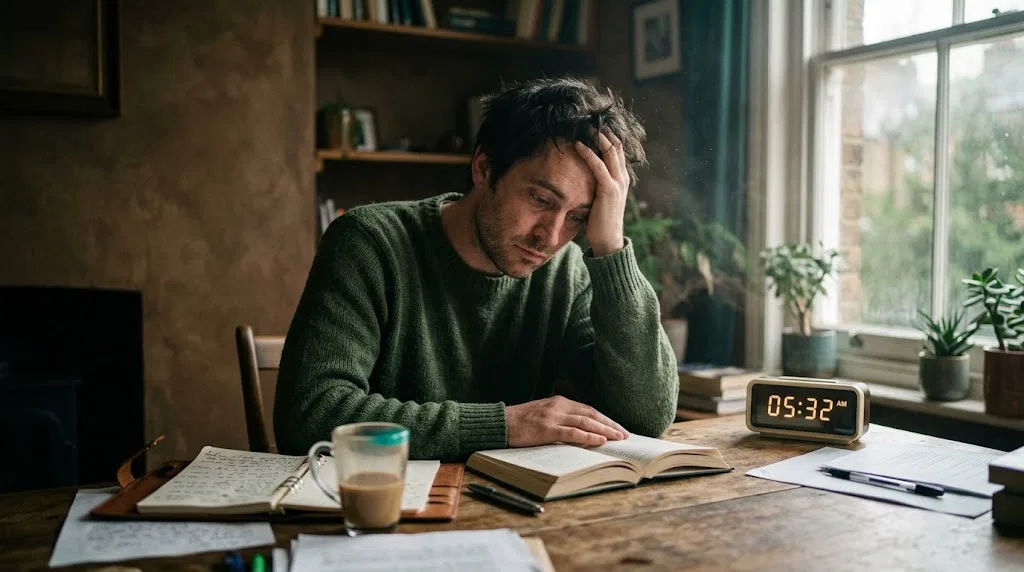
Even one short night can increase sleepiness and worsen sustained attention, slowing responses and increasing lapses.
On this page
- Findings from sleep restriction studies
- Slower responses and attentional lapses
- Why this matters for self improvement plans
Page outline Jump by section
Introduction
One short night of sleep can be enough to make attention less reliable. The strongest recent synthesis of the evidence, a 2024 systematic review and meta-analysis of 44 studies, found that restricting adults to roughly two to six hours of sleep for a single night increased subjective sleepiness and impaired sustained attention. On average, people responded more slowly and had more attentional lapses on vigilance tasks after the restricted night. The same review did not find clear impairments across every cognitive domain, which is an important distinction: sleep restriction does not simply make all thinking equally worse. Its most consistent early cost appears to be the ability to stay alert and respond reliably over time.[ScienceDirect]sciencedirect.comImpact of one night of sleep restriction on sleepiness and cognitive function: A systematic review and meta-analysis - Scien…
That matters for self-improvement because attention is a prerequisite for carrying out plans. Remembering the next step, noticing a cue, staying with a dull task and resisting the drift towards distraction all become harder when vigilance is unstable. A short night therefore creates a practical risk: a good plan can fail because the cognitive system needed to execute it is temporarily less dependable.
Findings from sleep-restriction studies
The clearest evidence comes from studies that deliberately shorten sleep and then test vigilant attention. A common tool is the psychomotor vigilance test, or PVT, a simple reaction-time task in which a person responds to visual signals appearing at unpredictable intervals. A traditional PVT lasts ten minutes and records not only average speed but also unusually slow responses, typically counting responses longer than 500 milliseconds as attentional lapses. It is widely used in sleep research because performance is highly sensitive to sleep loss and has relatively little practice effect.[PubMed Central (PMC)]pmc.ncbi.nlm.nih.govPubMed Central (PMC)Sleep deprivation, vigilant attention, and brain function: a review - PMCJune 8, 2019…
In the 2024 meta-analysis, one night of sleep restriction produced a standardised mean difference of 0.512 for slower sustained-attention reaction times and 0.489 for attentional lapses. Subjective sleepiness showed an even larger average increase, with a standardised mean difference of 0.986. These are group-level effects rather than guarantees about any particular individual, but they make the central point unusually clear: a single curtailed night can produce a measurable deterioration in vigilance by the following day.[ScienceDirect]sciencedirect.comImpact of one night of sleep restriction on sleepiness and cognitive function: A systematic review and meta-analysis - Scien…
The underlying studies are not perfectly uniform. They vary in the amount and timing of sleep restriction, the tests used and the characteristics of participants. The meta-analysis also found that the size of the sustained-attention impairment was not neatly predicted by whether the restricted sleep opportunity was at the longer or shorter end of the two-to-six-hour range. That means the evidence should not be reduced to a simplistic rule such as “four hours produces exactly twice the impairment of six”. Sleep loss interacts with factors such as time awake, circadian timing and individual vulnerability.[ScienceDirect]sciencedirect.comImpact of one night of sleep restriction on sleepiness and cognitive function: A systematic review and meta-analysis - Scien…
Individual experiments nevertheless point in the same direction. In a study of 61 healthy adults aged 20–29, a night restricted to four hours in bed increased errors on a sustained-attention task compared with a normal night. Interestingly, four prolonged night-time awakenings produced similar decrements, suggesting that attention can be disrupted by fragmented sleep as well as by simply shortening the sleep window.[ScienceDirect]sciencedirect.comEffects of one night of induced night-wakings versus sleep restriction on sustained attention and mood: a pilot study - Scie…
Slower responses and attentional lapses
Sleep restriction does not merely shift reaction time downwards by a small, uniform amount. A more characteristic pattern is instability: performance can look normal for stretches and then suddenly fail. Reviews of sleep-deprivation research describe attention becoming erratic, with periods of competent performance interrupted by markedly slow responses or failures to respond. These intermittent breakdowns are the reason lapses are often more informative than an overall average.[PubMed Central (PMC)]pmc.ncbi.nlm.nih.govPub Med Central (PMC)The sleep-deprived human brainPubMed Central (PMC)The sleep-deprived human brain - PMCMay 18, 2017…
This distinction matters in ordinary behaviour. Someone may be able to read several paragraphs efficiently and then realise they have stopped processing the words. They may follow most of a meeting but miss one instruction, or work competently on a repetitive task before overlooking a signal that would normally have been obvious. The problem is not necessarily that the person has become incapable of performing the task. It is that the ability to maintain the required level of attention has become less stable.
Repeated short nights intensify this problem. In a classic laboratory study by Van Dongen and colleagues, healthy adults were restricted to four, six or eight hours in bed for 14 consecutive nights. PVT lapses accumulated significantly in both the four- and six-hour groups, with deterioration greater under the more severe restriction. Crucially, the impairment built across days rather than resolving once participants had spent a few nights on the restricted schedule.[nih.gov]pubmed.ncbi.nlm.nih.govOpen source on nih.gov.
A separate sleep-dose study by Belenky and colleagues assigned 66 volunteers to three, five, seven or nine hours in bed each night for seven days. The three-hour group showed steadily slower PVT responses and more lapses across the week. The five- and seven-hour groups showed smaller but still measurable degradation, while the nine-hour group remained near baseline.[Wiley Online Library]onlinelibrary.wiley.comOpen source on wiley.com.
These findings are consistent with a broader meta-analysis of 61 sleep-restriction studies involving 71 study populations. Across cognitive domains, the largest average effects appeared in sustained attention, and within that category attentional lapses were especially sensitive.[ScienceDirect]sciencedirect.comOpen source on sciencedirect.com.
Feeling adapted is not the same as being unimpaired
One of the more consequential findings in chronic sleep-restriction research is that subjective adaptation and objective performance can diverge.
In the Van Dongen experiment, people initially reported becoming sleepier when their sleep was shortened, but their ratings then changed relatively little even as objective vigilance performance continued to deteriorate. After repeated nights of four or six hours in bed, participants could therefore be substantially more impaired than their own sleepiness ratings suggested.[PubMed]pubmed.ncbi.nlm.nih.govOpen source on nih.gov.
Reviews of this work describe the same mismatch: people may feel that they have “got used to” a restricted sleep schedule because the subjective sensation of sleepiness stops increasing sharply, while their sustained attention remains degraded.[PubMed Central (PMC)]pmc.ncbi.nlm.nih.govOpen source on nih.gov.
This is a particular risk for self-improvement because self-assessment is often used to decide whether a system is working. If someone sleeps less to create extra time for studying, exercise or a side project, the arrangement may initially appear efficient: they have gained an extra hour or two and may not feel progressively worse each day. Yet the attention required to use those hours effectively can continue to deteriorate.
The implication is not that people are incapable of judging their own state, nor that every short sleeper is dangerously impaired. It is narrower: subjective alertness is an imperfect proxy for sustained-attention performance during repeated sleep restriction. “I feel used to six hours” is therefore not strong evidence that vigilance has returned to baseline.
One bad night does not impair everything equally
The evidence also argues against an exaggerated account in which one restricted night makes every mental ability collapse.
The 2024 meta-analysis found clear effects on sleepiness and sustained attention, but no statistically significant overall effects on several other outcomes, including working memory, inhibitory control, cognitive throughput and choice reaction time.[ScienceDirect]sciencedirect.comImpact of one night of sleep restriction on sleepiness and cognitive function: A systematic review and meta-analysis - Scien…
A systematic review of sleep restriction in people performing cognitively demanding or safety-critical work found a similar pattern. Simple, low-stimulation vigilance tasks were especially sensitive to insufficient sleep, whereas some complex or highly engaging occupational tasks showed smaller or inconsistent deficits. High task salience can temporarily help people marshal attention, although this does not mean sleep restriction has disappeared as a risk.[PubMed]pubmed.ncbi.nlm.nih.govOpen source on nih.gov.
Time of day matters as well. In a controlled study of 90 adults undergoing chronic sleep restriction, the accumulation of PVT lapses varied over the day, with larger deterioration around 08:00 and smaller accumulation later in the afternoon and early evening. Circadian alerting can therefore partly mask or amplify the behavioural expression of sleep loss.[PubMed]pubmed.ncbi.nlm.nih.govTime of day effects on neurobehavioral performance during chronic sleep restriction - PubMed…
These qualifications strengthen rather than weaken the main conclusion. The evidence does not support the idea that sleep restriction produces a uniform “lower IQ” state. It points instead to a specific vulnerability: maintaining dependable attention over time becomes harder, and the size of the deficit depends on the task, the individual and when the task is performed.
Why this matters for self-improvement plans
Many self-improvement systems quietly assume that available time and usable attention are interchangeable. They are not.
Cutting sleep from eight hours to six may apparently create two extra hours for productive behaviour. But if the resulting day contains slower responses, more attentional lapses and greater instability, some of that nominal time can be lost through rereading, distraction, missed instructions, abandoned work or errors that need correcting. Repeated restriction can make that trade-off progressively worse.[PubMed]pubmed.ncbi.nlm.nih.govPub Med Behavioral and physiological consequences of sleep restrictionPub Med Behavioral and physiological consequences of sleep restriction
This creates several predictable failure modes.
- Study plans become harder to sustain. A learner may still be able to solve difficult problems when fully engaged but struggle to maintain attention through reading, revision or repetitive practice.
- Habit cues are easier to miss. A carefully designed reminder or implementation intention cannot trigger behaviour if attention fails at the moment the cue appears.
- Routine work becomes disproportionately vulnerable. Sustained-attention research suggests monotonous, low-salience tasks are among the most sensitive to sleep restriction.[PubMed Central (PMC)]pmc.ncbi.nlm.nih.govOpen source on nih.gov.
- Self-evaluation can become overconfident. Repeated short sleepers may feel only moderately sleepy even while objective lapses continue to accumulate.[PubMed Central (PMC)]pmc.ncbi.nlm.nih.govOpen source on nih.gov.
This is why sleep should not be treated merely as another lifestyle goal competing for time with productive habits. Within a self-improvement system, adequate sleep functions more like a supporting condition for execution. It helps preserve the attentional capacity on which planning, repetition and follow-through depend.
The practical takeaway
The most defensible conclusion is modest but important: even one short night can make sustained attention less reliable, and repeated short nights can compound the deficit. The effect is most consistently visible in slower vigilant responses and more frequent lapses rather than in a universal decline across every form of cognition.[ScienceDirect]sciencedirect.comImpact of one night of sleep restriction on sleepiness and cognitive function: A systematic review and meta-analysis - Scien…
That makes deliberate sleep sacrifice a poor default strategy for creating more “productive” time. When an improvement plan repeatedly depends on late-night work or early waking, the relevant calculation is not simply how many extra minutes become available. It is whether the following day still contains enough dependable attention to use those minutes well.
For plans that depend on remembering cues, sustaining effort and performing routine actions accurately, protecting sleep is therefore not separate from behavioural self-improvement. It helps protect the cognitive capacity needed to carry the plan out.
Amazon book picks
Further Reading
Books and field guides related to What One Short Night Does to Your Attention. Use these as the next step if you want deeper reading beyond the article.
Why We Sleep
"Sleep is one of the most important but least understood aspects of our life, wellness, and longevity ... An explosion of scientific disc...
The Sleep Solution
With cutting-edge sleep science and time-tested techniques, The Sleep Solution will help anyone achieve healthy sleep and eliminate pills...
The Power of Habit
Rating: 4.0/5 from 145 Google Books ratings
In The Power of Habit, award-winning business reporter Charles Duhigg takes us to the thrilling edge of scientific discoveries that expla...
The Promise of Sleep
Sleep better, live longer with the groundbreaking information and step-by-step program in this revolutionary book. Healthful sleep has be...
eBay marketplace picks
Marketplace Samples
Live-tested eBay searches with available results related to this page.
Selected frombedroom wall art oneBay.co.uk.


Endnotes
1.
Source: sciencedirect.com
Link:https://www.sciencedirect.com/science/article/pii/S1087079224000443
Source snippet
Impact of one night of sleep restriction on sleepiness and cognitive function: A systematic review and meta-analysis - Scien...
2.
Source: sciencedirect.com
Link:https://www.sciencedirect.com/science/article/pii/S1389945714001579
Source snippet
Effects of one night of induced night-wakings versus sleep restriction on sustained attention and mood: a pilot study - Scie...
3.
Source: academic.oup.com
Link:https://academic.oup.com/sleep/article-abstract/26/2/117/2709164
4.
Source: onlinelibrary.wiley.com
Link:https://onlinelibrary.wiley.com/doi/10.1046/j.1365-2869.2003.00337.x
5.
Source: sciencedirect.com
Link:https://www.sciencedirect.com/science/article/abs/pii/S0149763417301641
6.
Source: academic.oup.com
Link:https://academic.oup.com/sleep/article/44/7/zsab008/6092754?login=false
7.
Source: academic.oup.com
Link:https://academic.oup.com/sleep/article/48/Supplement_1/A352/8135877
8.
Source: academic.oup.com
Link:https://academic.oup.com/sleep/article/48/Supplement_1/A7/8135172
9.
Source: academic.oup.com
Link:https://academic.oup.com/sleepadvances/article/doi/10.1093/sleepadvances/zpac038/6764767
10.
Source: academic.oup.com
Link:https://academic.oup.com/sleep/article/45/4/zsac023/6516777
11.
Source: sciencedirect.com
Link:https://www.sciencedirect.com/science/article/pii/S0022399919307081
12.
Source: academic.oup.com
Link:https://academic.oup.com/sleep/article/42/5/zsz032/5307024
13.
Source: sciencedirect.com
Link:https://www.sciencedirect.com/science/article/abs/pii/S0005791617301635
14.
Source: academic.oup.com
Link:https://academic.oup.com/sleep/article/40/2/zsw042/2732007
15.
Source: sciencedirect.com
Title: Online assessment of sustained attention following sleep restriction
Link:https://www.sciencedirect.com/science/article/pii/S1389945710000900
16.
Source: nyaspubs.onlinelibrary.wiley.com
Link:https://nyaspubs.onlinelibrary.wiley.com/doi/abs/10.1196/annals.1417.002
17.
Source: onlinelibrary.wiley.com
Link:https://onlinelibrary.wiley.com/doi/pdf/10.1196/annals.1417.002
18.
Source: onlinelibrary.wiley.com
Title: j.1365 2869.2003.00337.x
Link:https://onlinelibrary.wiley.com/doi/abs/10.1046/j.1365-2869.2003.00337.x
19.
Source: academic.oup.com
Link:https://academic.oup.com/sleep/article-abstract/20/4/267/2732104
20.
Source: sciencedirect.com
Title: Psychomotor Vigilance Task
Link:https://www.sciencedirect.com/topics/medicine-and-dentistry/psychomotor-vigilance-task
21.
Source: sciencedirect.com
Title: The neurocognitive consequences of sleep restriction: A meta-analytic review
Link:https://www.sciencedirect.com/science/article/pii/S0149763417301641
22.
Source: sciencedirect.com
Link:https://www.sciencedirect.com/science/article/pii/S0094576511002256
23.
Source: sciencedirect.com
Title: Sleep debt at the community level: impact of age, sex, race/ethnicity and health
Link:https://www.sciencedirect.com/science/article/abs/pii/S2352721818300834
24.
Source: sciencedirect.com
Link:https://www.sciencedirect.com/science/article/abs/pii/S0897189721001609
25.
Source: pubmed.ncbi.nlm.nih.gov
Link:https://pubmed.ncbi.nlm.nih.gov/38759474/
Source snippet
Impact of one night of sleep restriction on sleepiness and cognitive function: A systematic review and meta-analysis - PubMed...
26.
Source: pmc.ncbi.nlm.nih.gov
Link:https://pmc.ncbi.nlm.nih.gov/articles/PMC6879580/
Source snippet
PubMed Central (PMC)Sleep deprivation, vigilant attention, and brain function: a review - PMCJune 8, 2019...
Published: June 8, 2019
27.
Source: pubmed.ncbi.nlm.nih.gov
Link:https://pubmed.ncbi.nlm.nih.gov/33709215/
Source snippet
The impact of shift work schedules on PVT performance in naturalistic settings: a systematic review - PubMed...
28.
Source: pubmed.ncbi.nlm.nih.gov
Link:https://pubmed.ncbi.nlm.nih.gov/20681233/
Source snippet
Time of day effects on neurobehavioral performance during chronic sleep restriction - PubMed...
29.
Source: pmc.ncbi.nlm.nih.gov
Title: Pub Med Central (PMC)The sleep-deprived human brain
Link:https://pmc.ncbi.nlm.nih.gov/articles/PMC6143346/
Source snippet
PubMed Central (PMC)The sleep-deprived human brain - PMCMay 18, 2017...
Published: May 18, 2017
30.
Source: pubmed.ncbi.nlm.nih.gov
Title: Pub Med Sleep deprivation, vigilant attention, and brain function: a review
Link:https://pubmed.ncbi.nlm.nih.gov/31176308/
31.
Source: pubmed.ncbi.nlm.nih.gov
Link:https://pubmed.ncbi.nlm.nih.gov/12683469/?dopt=Abstract
32.
Source: pubmed.ncbi.nlm.nih.gov
Title: Pub Med Behavioral and physiological consequences of sleep restriction
Link:https://pubmed.ncbi.nlm.nih.gov/17803017/
33.
Source: pubmed.ncbi.nlm.nih.gov
Link:https://pubmed.ncbi.nlm.nih.gov/12603781
34.
Source: pubmed.ncbi.nlm.nih.gov
Link:https://pubmed.ncbi.nlm.nih.gov/12683469/
35.
Source: pmc.ncbi.nlm.nih.gov
Link:https://pmc.ncbi.nlm.nih.gov/articles/PMC3600847/
36.
Source: pmc.ncbi.nlm.nih.gov
Link:https://pmc.ncbi.nlm.nih.gov/articles/PMC1978335/
37.
Source: pubmed.ncbi.nlm.nih.gov
Link:https://pubmed.ncbi.nlm.nih.gov/33438751/
38.
Source: pmc.ncbi.nlm.nih.gov
Link:https://pmc.ncbi.nlm.nih.gov/articles/PMC8271199/
39.
Source: pubmed.ncbi.nlm.nih.gov
Link:https://pubmed.ncbi.nlm.nih.gov/38759474/?format=pubmed
40.
Source: pubmed.ncbi.nlm.nih.gov
Link:https://pubmed.ncbi.nlm.nih.gov/37193280/
41.
Source: pubmed.ncbi.nlm.nih.gov
Link:https://pubmed.ncbi.nlm.nih.gov/35034695/
42.
Source: pmc.ncbi.nlm.nih.gov
Link:https://pmc.ncbi.nlm.nih.gov/articles/PMC6519907/
43.
Source: pmc.ncbi.nlm.nih.gov
Link:https://pmc.ncbi.nlm.nih.gov/articles/PMC6218409/
44.
Source: pubmed.ncbi.nlm.nih.gov
Link:https://pubmed.ncbi.nlm.nih.gov/29784810/
45.
Source: pubmed.ncbi.nlm.nih.gov
Link:https://pubmed.ncbi.nlm.nih.gov/28757454/
46.
Source: pmc.ncbi.nlm.nih.gov
Link:https://pmc.ncbi.nlm.nih.gov/articles/PMC5806570/
47.
Source: pmc.ncbi.nlm.nih.gov
Link:https://pmc.ncbi.nlm.nih.gov/articles/PMC4667385/
48.
Source: pmc.ncbi.nlm.nih.gov
Link:https://pmc.ncbi.nlm.nih.gov/articles/PMC3902867/
49.
Source: pubmed.ncbi.nlm.nih.gov
Link:https://pubmed.ncbi.nlm.nih.gov/24470693/
50.
Source: pmc.ncbi.nlm.nih.gov
Link:https://pmc.ncbi.nlm.nih.gov/articles/PMC3454374/
51.
Source: pubmed.ncbi.nlm.nih.gov
Link:https://pubmed.ncbi.nlm.nih.gov/22754046/
52.
Source: pmc.ncbi.nlm.nih.gov
Link:https://pmc.ncbi.nlm.nih.gov/articles/PMC3369235/
53.
Source: pmc.ncbi.nlm.nih.gov
Link:https://pmc.ncbi.nlm.nih.gov/articles/PMC3197786/
54.
Source: pmc.ncbi.nlm.nih.gov
Link:https://pmc.ncbi.nlm.nih.gov/articles/PMC3079937/
55.
Source: pmc.ncbi.nlm.nih.gov
Link:https://pmc.ncbi.nlm.nih.gov/articles/3079937/
56.
Source: pubmed.ncbi.nlm.nih.gov
Link:https://pubmed.ncbi.nlm.nih.gov/21532951/
57.
Source: pmc.ncbi.nlm.nih.gov
Link:https://pmc.ncbi.nlm.nih.gov/articles/PMC2892834/
58.
Source: doi.org
Title: Sleep debt: Theoretical and empirical issues*
Link:https://doi.org/10.1046/j.1446-9235.2003.00006.x
59.
Source: pubmed.ncbi.nlm.nih.gov
Link:https://pubmed.ncbi.nlm.nih.gov/9231952/
61.
Source: pmc.ncbi.nlm.nih.gov
Link:https://pmc.ncbi.nlm.nih.gov/articles/PMC2656292/
62.
Source: pubmed.ncbi.nlm.nih.gov
Link:https://pubmed.ncbi.nlm.nih.gov/18591490/
63.
Source: pmc.ncbi.nlm.nih.gov
Link:https://pmc.ncbi.nlm.nih.gov/articles/PMC3700596/
Additional References
64.
Source: youtube.com
Title: What Sleep Deprivation Does to Your Brain—Hour by Hour
Link:https://www.youtube.com/watch?v=NY4oNQd-xeY
Source snippet
This PEBL Psychomotor Vigilance Task demonstration shows the standard experimental tool used by sleep researchers to measure reaction tim...
65.
Source: nature.com
Link:https://www.nature.com/articles/s41386
66.
Source: youtube.com
Title: Why You Can’t Sleep (and How to Fix It) | Dr. Michael Grandner
Link:https://www.youtube.com/watch?v=AQF_eopP1ys
Source snippet
Is ADHD a Sleep Problem? Why Your ADHD Brain Shuts Off 100 Times a Day...
67.
Source: youtube.com
Title: Is ADHD a Sleep Problem? Why Your ADHD Brain Shuts Off 100 Times a Day
Link:https://www.youtube.com/watch?v=r3UxlJmxmbk
Source snippet
Sleep Science: Can You Catch up on Lost Sleep?...
68.
Source: scispace.com
Link:https://scispace.com/papers/patterns-of-performance-degradation-and-restoration-during-37o2i72ygu
69.
Source: researchgate.net
Link:https://www.researchgate.net/publication/380133638_Impact_of_one_night_of_sleep_restriction_on_sleepiness_and_cognitive_function_A_systematic_review_and_meta-analysis
70.
Source: frontiersin.org
Link:https://www.frontiersin.org/journals/behavioral-neuroscience/articles/10.3389/fnbeh.2016.00095/full
71.
Source: em-consulte.com
Link:https://www.em-consulte.com/article/1677672/impact-of-one-night-of-sleep-restriction-on-sleepi
72.
Source: em-consulte.com
Link:https://www.em-consulte.com/es/article/1677672/complements/impact-of-one-night-of-sleep-restriction-on-sleepi
73.
Source: em-consulte.com
Link:https://www.em-consulte.com/it/article/1677672/article/impact-of-one-night-of-sleep-restriction-on-sleepi