Within Sleep and Mood
Why Bad Sleep Makes Setbacks Hit Harder
A shorter-than-usual night can leave positive mood less resilient when ordinary stressors pile up the next day.
On this page
- Short sleep and next day emotional reactivity
- Stressful events and reduced positive affect
- Protecting habits on difficult days
Page outline Jump by section
Introduction
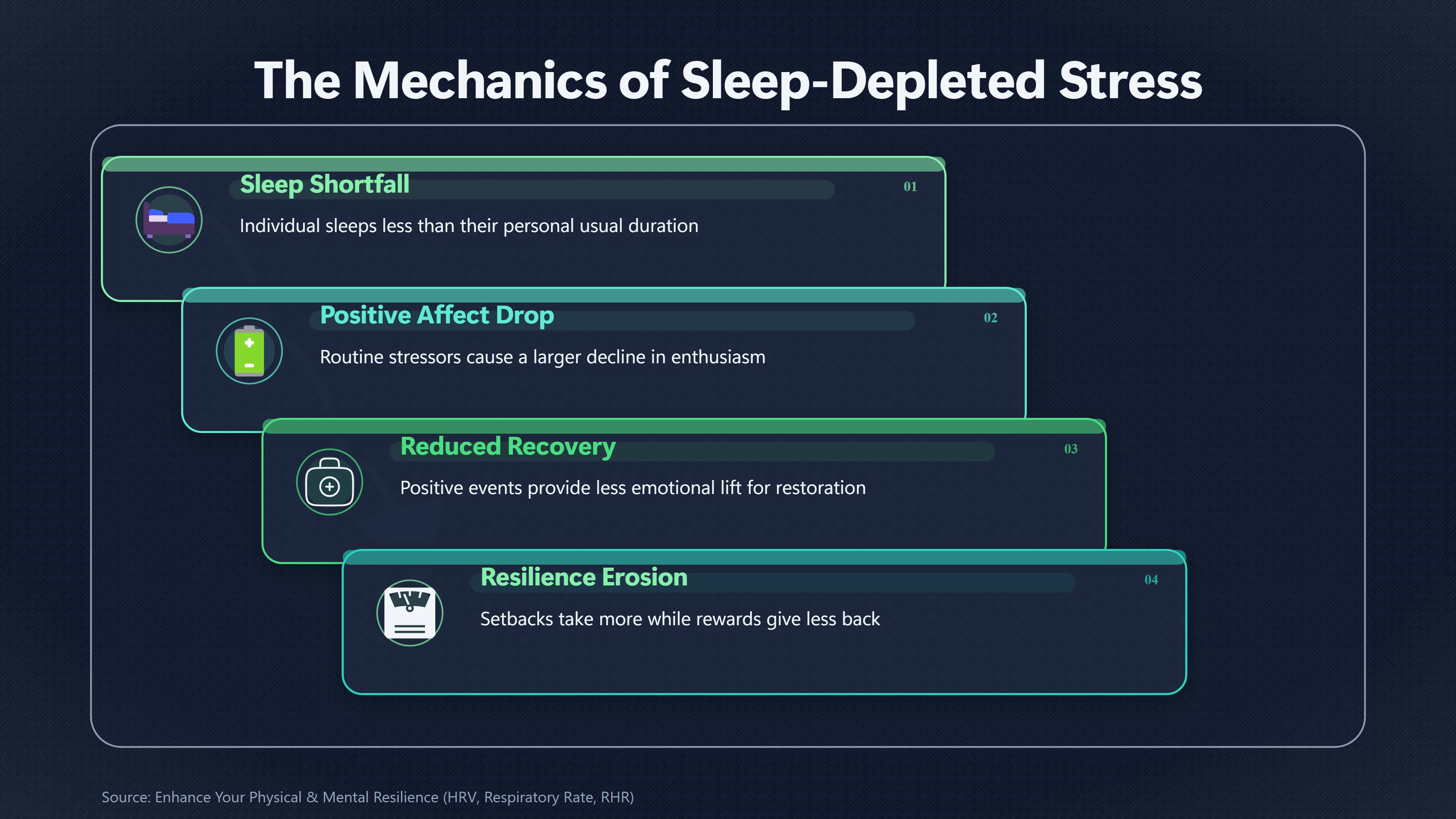
A short night can make ordinary setbacks hit harder the next day, but the effect is subtler than simply becoming irritable. Daily-life research suggests that when people sleep less than is usual for them, routine stressors are followed by a larger loss of positive affect — feelings such as enthusiasm, interest, energy and attentiveness. The same short sleep also appears to reduce the emotional lift people get from positive events.[PubMed Central (PMC)]pmc.ncbi.nlm.nih.govPubMed Central (PMC)Sleep duration and affective reactivity to stressors and positive events in daily life - PMCSeptember 7, 2020…
That combination matters during behaviour change. A delayed train, difficult meeting, argument, unexpected bill or disrupted plan does not have to become objectively more serious after poor sleep. Instead, the person may have less positive emotional capacity left once the disruption occurs, while rewarding moments do less to restore it. For a new habit that still requires deliberate effort, this is a useful definition of reduced day-to-day resilience: the setback takes more out of you, and the good parts of the day may give less back.
Short sleep changes the response to an ordinary bad day
One of the clearest demonstrations comes from the US National Study of Daily Experiences. Researchers followed 1,982 adults aged 33 to 84 for eight consecutive days, asking about nightly sleep duration, everyday stressors, positive events and emotions. Crucially, the analysis examined fluctuations within the same person. The question was therefore not merely whether habitual short sleepers differed from long sleepers, but whether someone responded differently to events after sleeping less or more than their own usual amount.[PubMed Central (PMC)]pmc.ncbi.nlm.nih.govPubMed Central (PMC)Sleep duration and affective reactivity to stressors and positive events in daily life - PMCSeptember 7, 2020…
They did. On days containing a stressor, positive affect declined. But the decline was larger when the previous night’s sleep had been shorter than usual. The researchers illustrated the difference by comparing nights one hour below and one hour above a person’s normal duration: the estimated fall in positive affect associated with a stressor was −0.17 after the shorter night versus −0.10 after the longer night on the study’s affect scale.[PubMed Central (PMC)]pmc.ncbi.nlm.nih.govPubMed Central (PMC)Sleep duration and affective reactivity to stressors and positive events in daily life - PMCSeptember 7, 2020…
The result is particularly relevant because the stressors were not extreme laboratory challenges. The study concerned naturally occurring daily experiences, including the sorts of interpersonal disagreements and work demands that routinely interfere with plans. It therefore resembles the environment in which habits actually succeed or fail far more closely than a test of behaviour under ideal conditions.[PubMed Central (PMC)]pmc.ncbi.nlm.nih.govPubMed Central (PMC)Sleep duration and affective reactivity to stressors and positive events in daily life - PMCSeptember 7, 2020…
There is an important qualification. Short sleep did not significantly alter negative-affect reactivity to stressors in this study. In other words, its distinctive finding was not that a bad night’s sleep reliably made people much more distressed by every problem. It was that stressors consumed more of their positive mood. That distinction fits broader experimental evidence: a large meta-analysis of 154 sleep-loss experiments found reductions in positive affect across total sleep deprivation, partial restriction and fragmented sleep, while effects on negative affect varied more with the form of sleep loss and study characteristics.[PubMed]pubmed.ncbi.nlm.nih.govSleep loss and emotion: A systematic review and meta-analysis of over 50 years of experimental research - PubMedDecember 21, 2023…
So the everyday experience may be less dramatic than “everything makes me angry when I am tired”. A more evidence-aligned description is: ordinary friction can leave less enthusiasm and attentiveness available for whatever comes next.
Small stressors can become disproportionately costly
Laboratory research provides a useful complement to the daily-diary evidence. In two experiments involving 53 healthy adults, researchers compared rested participants with people kept awake for a night and then exposed them to cognitive tasks whose difficulty, time pressure and performance feedback created either relatively mild or high stress.[PubMed]pubmed.ncbi.nlm.nih.govSleep deprivation and stressors: evidence for elevated negative affect in response to mild stressors when sleep deprived - PubMedFe…
After the mild-stressor condition, sleep-deprived participants reported greater stress, anxiety and anger than rested controls. Yet sleep deprivation did not selectively magnify reactions to the high-stress condition, which produced strong responses in both groups. The authors interpreted this pattern as evidence that sleep deprivation may lower the threshold at which cognitive demands are experienced as stressful.[PubMed]pubmed.ncbi.nlm.nih.govSleep deprivation and stressors: evidence for elevated negative affect in response to mild stressors when sleep deprived - PubMedFe…
That finding should not be treated as proof that a modestly shorter night has the same effect as total sleep deprivation. It does, however, help explain why sleep loss can be especially relevant to mundane friction. When rested, a minor scheduling problem or difficult task may remain background noise. When depleted, the same demand can consume a larger share of the day’s emotional resources.
Evidence from medical residents points in a similar direction under real working conditions. Researchers examined residents’ sleep alongside their emotional responses to events that either disrupted or advanced their work goals. Sleep loss intensified negative emotions and fatigue following goal-disruptive events while weakening the positive emotional response to goal-enhancing events.[PubMed]pubmed.ncbi.nlm.nih.govThe effects of sleep loss on medical residents' emotional reactions to work events: a cognitive-energy model - PubMed…
For behaviour change, that asymmetry is consequential. Imagine that the intended behaviour is an evening workout. A difficult meeting does not directly prevent exercise, but it is a goal-disruptive event elsewhere in the day. After adequate sleep, the person may absorb it and still retain enough energy and positive anticipation to train. After short sleep, the same event may extract more emotionally, leaving the workout feeling like another demand rather than the rewarding action originally planned.
Stress takes more away while good events give less back
The daily-life findings reveal a second effect that is easy to overlook. Sleep duration changed not only responses to stressors but also responses to positive events. After longer-than-usual sleep, positive events produced a larger rise in positive affect; after shorter-than-usual sleep, that emotional benefit was smaller.[PubMed Central (PMC)]pmc.ncbi.nlm.nih.govPubMed Central (PMC)Sleep duration and affective reactivity to stressors and positive events in daily life - PMCSeptember 7, 2020…
This matters because positive emotions appear to play a role in recovery from everyday stress. In a separate analysis of 1,588 adults completing eight days of diary reports, people who experienced higher-than-usual positive emotion on a stressor day showed a smaller same-day rise in negative emotion. They also reported less negative emotion the following day and were less likely to report another stressor the next day. These observational associations do not prove that deliberately producing positive emotion will cause those outcomes, but they show why losing positive affect is not a trivial side effect.[PubMed Central (PMC)]pmc.ncbi.nlm.nih.govPubMed Central (PMC)Positive Emotions Experienced on Days of Stress are Associated with Less Same-Day and Next-Day Negative Emotion - PMC…
The broader daily-stress literature also suggests that how strongly people react to routine problems can matter independently of simply counting how many problems they encounter. In 872 adults, greater stress-related reductions in positive affect were associated with higher levels of interleukin-6, an inflammatory marker, even after adjustment for several demographic, psychological, physical and behavioural factors. Because that analysis was cross-sectional, it cannot establish that emotional reactivity caused higher inflammation, but it reinforces the idea that maintaining positive affect during routine stress is a meaningful characteristic rather than mere cheerfulness.[PubMed Central (PMC)]pmc.ncbi.nlm.nih.govPubMed Central (PMC)Affective reactivity to daily stressors is associated with elevated inflammation - PMCJune 1, 2015…
The practical picture is therefore a two-sided squeeze. After short sleep, negative events can remove more positive mood, while positive events may replenish less of it. Someone changing a behaviour may consequently reach the difficult part of the day with fewer emotional resources even though nothing unusually serious has happened.
What “resilience” does — and does not — mean here
It is tempting to turn these findings into a broad claim that sleeping longer “makes you resilient”. The evidence supports something narrower.
A systematic review and meta-analysis of healthy populations found positive associations between sleep and psychological resilience, but the pooled correlation with sleep duration was small (r = 0.11). The association with sleep quality was larger (r = 0.27), and the authors emphasised that much of the evidence was correlational, with publication-bias concerns for sleep-quality studies.[PubMed]pubmed.ncbi.nlm.nih.govOpen source on nih.gov.
For the present question, the stronger evidence is therefore not a personality-level claim about becoming a resilient person. It is the within-person observation that emotional responses to the next day’s events vary with the previous night’s sleep.[PubMed Central (PMC)]pmc.ncbi.nlm.nih.govPubMed Central (PMC)Sleep duration and affective reactivity to stressors and positive events in daily life - PMCSeptember 7, 2020…
There are other reasons to keep the conclusion bounded. Much of the naturalistic evidence relies on self-reported sleep rather than experimentally assigned sleep schedules. The eight-day national study can show that shorter-than-usual sleep precedes altered next-day emotional reactivity, but it cannot eliminate every unmeasured factor that might influence both. Its participants were also predominantly White and averaged about 56 years of age, limiting simple generalisation to every population.[PubMed Central (PMC)]pmc.ncbi.nlm.nih.govPubMed Central (PMC)Sleep duration and affective reactivity to stressors and positive events in daily life - PMCSeptember 7, 2020…
Laboratory evidence strengthens the case that sleep loss itself can alter stress responding, but physiology is not perfectly consistent across experiments. One small trial found sleep deprivation associated with higher baseline cortisol and an amplified cortisol response to a social stress test, whereas another found elevated baseline cortisol but a blunted stress response. A systematic review concluded that poorer objective and subjective sleep quality tends to potentiate hypothalamic-pituitary-adrenal stress reactivity, while also documenting a heterogeneous evidence base.[PubMed]pubmed.ncbi.nlm.nih.govOpen source on nih.gov.
For everyday self-improvement, there is no need to resolve those physiological discrepancies before acting on the more directly relevant behavioural evidence. The defensible conclusion is simpler: sleep is one of the conditions that can change how much emotional impact routine events have the following day.
Protecting habits on difficult days
The implementation lesson is not that every habit should be abandoned after poor sleep. That would make sleep disruption an automatic permission slip for inconsistency. A more robust strategy is to design habits with a lower-demand version for short-sleep, high-friction days.
The evidence does not prescribe a particular reduced dose of exercise, study or practice. Rather, it supports planning for predictable variation in the emotional resources available to execute them. Because short sleep can amplify the loss of positive affect associated with stress, the crucial moment may come after the first ordinary setback rather than immediately after waking.[PubMed Central (PMC)]pmc.ncbi.nlm.nih.govPubMed Central (PMC)Sleep duration and affective reactivity to stressors and positive events in daily life - PMCSeptember 7, 2020…
A practical response has three parts:
- Separate the habit from its full-performance version. A 45-minute workout might become a short walk or abbreviated session; an hour of study might become one clearly defined task. The objective on a depleted day is to preserve the behavioural link without pretending that capacity is unchanged.
- Reduce avoidable friction before stress accumulates. Preparing clothes, food, materials or the next action in advance leaves fewer decisions competing for attention when positive mood has already fallen.
- Treat a setback after short sleep as information, not a verdict on the goal. If a routine obstacle suddenly makes the planned behaviour feel unusually unrewarding, that reaction may partly reflect the day’s sleep-and-stress combination. The feeling that the habit is “not worth it today” need not be treated as a fresh assessment of whether the habit itself is worthwhile.
This approach also avoids an important mistake: trying to compensate for a poor night by demanding more motivation. The daily-diary findings suggest that positive emotional responsiveness itself may be diminished after short sleep. Depending entirely on enthusiasm at precisely that point therefore makes the plan fragile.[PubMed Central (PMC)]pmc.ncbi.nlm.nih.govPubMed Central (PMC)Sleep duration and affective reactivity to stressors and positive events in daily life - PMCSeptember 7, 2020…

The useful signal is a change from your own normal
Perhaps the most actionable feature of the strongest daily-life study is that it compared people with themselves. “Short sleep” did not simply mean belonging to a fixed category below a universal number of hours. Researchers examined whether the previous night was shorter or longer than that individual’s usual sleep duration.[PubMed Central (PMC)]pmc.ncbi.nlm.nih.govPubMed Central (PMC)Sleep duration and affective reactivity to stressors and positive events in daily life - PMCSeptember 7, 2020…
That makes the finding unusually compatible with real behaviour change. A person does not need to diagnose themselves as a chronically poor sleeper before recognising a vulnerable day. A conspicuously shorter-than-usual night, followed by accumulating routine stress, is enough to justify using the easier version of a habit rather than waiting until motivation collapses.
Nor does one difficult day demonstrate weak willpower. The research instead points to a fluctuating person-by-situation process: sleep changes, stressors occur, and emotional responsiveness changes with them. Even broader experimental work shows that restricting sleep can selectively reduce attentiveness and other positive moods rather than simply producing a uniform increase in negative emotion.[PubMed]pubmed.ncbi.nlm.nih.govOpen source on nih.gov.
For self-improvement that survives ordinary life, this is the central lesson. Do not design a habit only for the version of yourself who is rested and having an uncomplicated day. A resilient system also needs a viable response for the morning after short sleep, when routine setbacks may drain positive mood faster and the day’s rewards may restore it less effectively.
Amazon book picks
Further Reading
Books and field guides related to Why Bad Sleep Makes Setbacks Hit Harder. Use these as the next step if you want deeper reading beyond the article.
Why We Sleep
"Sleep is one of the most important but least understood aspects of our life, wellness, and longevity ... An explosion of scientific disc...
The Sleep Solution
With cutting-edge sleep science and time-tested techniques, The Sleep Solution will help anyone achieve healthy sleep and eliminate pills...
Burnout
'This book is a gift! I've been practicing their strategies, and it's a total game-changer.' Brené Brown, PhD, author of the #1 New York...
The Upside of Stress
What if everything you thought you knew about stress was wrong? Over the years we've grown to see stress as Public Enemy No.1, responsibl...
eBay marketplace picks
Marketplace Samples
Live-tested eBay searches with available results related to this page.
Selected frommotivational poster oneBay.co.uk.

Endnotes
1.
Source: pmc.ncbi.nlm.nih.gov
Link:https://pmc.ncbi.nlm.nih.gov/articles/PMC7704897/
Source snippet
PubMed Central (PMC)Sleep duration and affective reactivity to stressors and positive events in daily life - PMCSeptember 7, 2020...
Published: September 7, 2020
2.
Source: pubmed.ncbi.nlm.nih.gov
Link:https://pubmed.ncbi.nlm.nih.gov/32897097/
Source snippet
Sleep duration and affective reactivity to stressors and positive events in daily life - PubMed...
3.
Source: pubmed.ncbi.nlm.nih.gov
Link:https://pubmed.ncbi.nlm.nih.gov/38127505/
Source snippet
Sleep loss and emotion: A systematic review and meta-analysis of over 50 years of experimental research - PubMedDecember 21, 2023...
Published: December 21, 2023
4.
Source: pubmed.ncbi.nlm.nih.gov
Link:https://pubmed.ncbi.nlm.nih.gov/22309720/
Source snippet
Sleep deprivation and stressors: evidence for elevated negative affect in response to mild stressors when sleep deprived - PubMedFe...
5.
Source: pmc.ncbi.nlm.nih.gov
Link:https://pmc.ncbi.nlm.nih.gov/articles/PMC3964364/
Source snippet
PubMed Central (PMC)Sleep Deprivation and Stressors: Evidence for Elevated Negative Affect in Response to Mild Stressors When Sleep Depri...
6.
Source: pubmed.ncbi.nlm.nih.gov
Link:https://pubmed.ncbi.nlm.nih.gov/15700720/
Source snippet
The effects of sleep loss on medical residents' emotional reactions to work events: a cognitive-energy model - PubMed...
7.
Source: pmc.ncbi.nlm.nih.gov
Link:https://pmc.ncbi.nlm.nih.gov/articles/PMC8188996/
Source snippet
PubMed Central (PMC)Positive Emotions Experienced on Days of Stress are Associated with Less Same-Day and Next-Day Negative Emotion - PMC...
8.
Source: pmc.ncbi.nlm.nih.gov
Link:https://pmc.ncbi.nlm.nih.gov/articles/PMC7741634/
Source snippet
PubMed Central (PMC)Positive Affect and Negative Emotional Responses to Daily Stressors - PMC...
9.
Source: pmc.ncbi.nlm.nih.gov
Link:https://pmc.ncbi.nlm.nih.gov/articles/PMC4666844/
Source snippet
PubMed Central (PMC)Affective reactivity to daily stressors is associated with elevated inflammation - PMCJune 1, 2015...
Published: June 1, 2015
10.
Source: pubmed.ncbi.nlm.nih.gov
Link:https://pubmed.ncbi.nlm.nih.gov/26030309/
11.
Source: pubmed.ncbi.nlm.nih.gov
Link:https://pubmed.ncbi.nlm.nih.gov/35462348/
12.
Source: pubmed.ncbi.nlm.nih.gov
Link:https://pubmed.ncbi.nlm.nih.gov/24818608/
13.
Source: pubmed.ncbi.nlm.nih.gov
Link:https://pubmed.ncbi.nlm.nih.gov/28235691/
14.
Source: pubmed.ncbi.nlm.nih.gov
Link:https://pubmed.ncbi.nlm.nih.gov/29126903/
15.
Source: pubmed.ncbi.nlm.nih.gov
Link:https://pubmed.ncbi.nlm.nih.gov/36062257/
16.
Source: pubmed.ncbi.nlm.nih.gov
Link:https://pubmed.ncbi.nlm.nih.gov/41694075/
17.
Source: pmc.ncbi.nlm.nih.gov
Link:https://pmc.ncbi.nlm.nih.gov/articles/PMC10751287/
18.
Source: pubmed.ncbi.nlm.nih.gov
Link:https://pubmed.ncbi.nlm.nih.gov/37539684/
19.
Source: pmc.ncbi.nlm.nih.gov
Link:https://pmc.ncbi.nlm.nih.gov/articles/PMC10529882/
20.
Source: pmc.ncbi.nlm.nih.gov
Link:https://pmc.ncbi.nlm.nih.gov/articles/PMC10236260/
21.
Source: pubmed.ncbi.nlm.nih.gov
Link:https://pubmed.ncbi.nlm.nih.gov/35568984/
22.
Source: pubmed.ncbi.nlm.nih.gov
Link:https://pubmed.ncbi.nlm.nih.gov/36212194/
23.
Source: pmc.ncbi.nlm.nih.gov
Link:https://pmc.ncbi.nlm.nih.gov/articles/PMC9433122/
24.
Source: pmc.ncbi.nlm.nih.gov
Link:https://pmc.ncbi.nlm.nih.gov/articles/PMC9383029/
25.
Source: pubmed.ncbi.nlm.nih.gov
Link:https://pubmed.ncbi.nlm.nih.gov/35032255/
26.
Source: pmc.ncbi.nlm.nih.gov
Link:https://pmc.ncbi.nlm.nih.gov/articles/PMC10710174/
27.
Source: pmc.ncbi.nlm.nih.gov
Link:https://pmc.ncbi.nlm.nih.gov/articles/PMC8554789/
28.
Source: pmc.ncbi.nlm.nih.gov
Link:https://pmc.ncbi.nlm.nih.gov/articles/PMC10895409/
29.
Source: pmc.ncbi.nlm.nih.gov
Link:https://pmc.ncbi.nlm.nih.gov/articles/PMC8048702/
30.
Source: pubmed.ncbi.nlm.nih.gov
Link:https://pubmed.ncbi.nlm.nih.gov/32914995/
31.
Source: pubmed.ncbi.nlm.nih.gov
Link:https://pubmed.ncbi.nlm.nih.gov/31608395/
32.
Source: pubmed.ncbi.nlm.nih.gov
Link:https://pubmed.ncbi.nlm.nih.gov/29916964/
33.
Source: pmc.ncbi.nlm.nih.gov
Link:https://pmc.ncbi.nlm.nih.gov/articles/PMC7045300/
34.
Source: pubmed.ncbi.nlm.nih.gov
Link:https://pubmed.ncbi.nlm.nih.gov/29154583/
35.
Source: pmc.ncbi.nlm.nih.gov
Link:https://pmc.ncbi.nlm.nih.gov/articles/PMC6088503/
36.
Source: pmc.ncbi.nlm.nih.gov
Link:https://pmc.ncbi.nlm.nih.gov/articles/PMC5794509/
37.
Source: pmc.ncbi.nlm.nih.gov
Link:https://pmc.ncbi.nlm.nih.gov/articles/PMC5739917/
38.
Source: pubmed.ncbi.nlm.nih.gov
Link:https://pubmed.ncbi.nlm.nih.gov/27302148/
39.
Source: pubmed.ncbi.nlm.nih.gov
Link:https://pubmed.ncbi.nlm.nih.gov/25102453/
40.
Source: pmc.ncbi.nlm.nih.gov
Link:https://pmc.ncbi.nlm.nih.gov/articles/PMC4258510/
41.
Source: pubmed.ncbi.nlm.nih.gov
Link:https://pubmed.ncbi.nlm.nih.gov/24170714/
42.
Source: pmc.ncbi.nlm.nih.gov
Link:https://pmc.ncbi.nlm.nih.gov/articles/PMC4542645/
43.
Source: pmc.ncbi.nlm.nih.gov
Link:https://pmc.ncbi.nlm.nih.gov/articles/PMC3747835/
44.
Source: pubmed.ncbi.nlm.nih.gov
Link:https://pubmed.ncbi.nlm.nih.gov/16942831/
45.
Source: pubmed.ncbi.nlm.nih.gov
Link:https://pubmed.ncbi.nlm.nih.gov/15840727/
46.
Source: pubmed.ncbi.nlm.nih.gov
Link:https://pubmed.ncbi.nlm.nih.gov/12651993/
47.
Source: pubmed.ncbi.nlm.nih.gov
Link:https://pubmed.ncbi.nlm.nih.gov/27976447/
48.
Source: pubmed.ncbi.nlm.nih.gov
Link:https://pubmed.ncbi.nlm.nih.gov/40673995/
49.
Source: ouci.dntb.gov.ua
Link:https://ouci.dntb.gov.ua/en/works/4VYJnEk7/
Additional References
50.
Source: youtube.com
Title: Enhance Your Physical & Mental Resilience (HRV, Respiratory Rate, RHR)
Link:https://www.youtube.com/watch?v=mfUO1CaEMBw
Source snippet
For a comprehensive scientific breakdown of how sleep duration directly influences daily stress resilience and emotional stability, see D...
51.
Source: youtube.com
Link:https://www.youtube.com/watch?v=qxxnRMT9C-8
Source snippet
Enhance Your Physical & Mental Resilience (HRV, Respiratory Rate, RHR)...
52.
Source: youtube.com
Title: How sleep affects your emotions | Sleeping with Science, a TED series
Link:https://www.youtube.com/watch?v=6F8wFkScnME
Source snippet
World No.1 Sleep Expert: Magnesium Isn't Helping You Sleep! This Habit Increases Heart Disease 57%...
53.
Source: youtube.com
Link:https://www.youtube.com/watch?v=S_SrHS8FvMM
Source snippet
How to Control Your Cortisol & Overcome Burnout...
54.
Source: youtube.com
Title: How to Control Your Cortisol & Overcome Burnout
Link:https://www.youtube.com/watch?v=Ibj1k3IZTNU
Source snippet
How sleep affects your emotions | Sleeping with Science, a TED series...
55.
Source: researchgate.net
Link:https://www.researchgate.net/publication/347727374_Positive_Affect_and_Negative_Emotional_Responses_to_Daily_Stressors
56.
Source: researchgate.net
Link:https://www.researchgate.net/publication/344204845_Sleep_duration_and_affective_reactivity_to_stressors_and_positive_events_in_daily_life
57.
Source: diabetesjournals.org
Link:https://diabetesjournals.org/diabetes/article/72/Supplement_1/708-P/149397/708-P-Within-Person-Relationships-of-Sleep
58.
Source: researchgate.net
Link:https://www.researchgate.net/publication/8031493_The_Effects_of_sleep_loss_on_medical_residents%27_emotional_reactions_to_work_events_A_cognitive-energy_model_vol_28_pg
59.
Source: sciencedirect.com
Link:https://www.sciencedirect.com/science/article/abs/pii/S0301051106001657