Within Useful Feedback
Does Feedback Work Better Before the Moment Passes?
Feedback may be most useful when it arrives while there is still time to change the behaviour it is tracking.
On this page
- Why delayed summaries can miss the decision window
- What just in time intervention studies have found
- Balancing immediacy with useful recommendations
Page outline Jump by section
Introduction
Just-in-time feedback is most useful when it reaches a person before the opportunity to change the tracked behaviour has closed. A daily activity summary at bedtime can explain why a step goal was missed; a prompt in mid-afternoon, when walking is still possible, can potentially change the result. That distinction turns feedback from retrospective information into an intervention.
Digital trackers make this possible because phones and wearables can repeatedly measure behaviour, compare it with a target and deliver support within the same decision window. Research on these systems is promising but not definitive. Reviews of just-in-time adaptive interventions (JITAIs) find evidence of behaviour change, particularly for physical activity and sedentary behaviour, while also finding small studies, inconsistent designs and substantial uncertainty about which timing rules work best.[PubMed Central (PMC)]pmc.ncbi.nlm.nih.govOpen source on nih.gov.
The practical implication is narrower than “faster feedback is always better”. Effective timing means finding a moment when three things overlap: the tracker has detected something worth changing, an actionable opportunity still exists, and the person is sufficiently receptive to do something about it.[OUP Academic]academic.oup.comOUP AcademicJust-in-Time Adaptive Interventions (JITAIs) in Mobile Health: Key Components and Design Principles for Ongoing Health Behavi…
Why delayed summaries can miss the decision window
Self-monitoring data have different useful lifetimes. Some information remains actionable for weeks: a monthly spending pattern can inform next month’s budget. Other information becomes obsolete quickly. A warning that someone has been sitting continuously can prompt them to stand now; the same observation tomorrow cannot interrupt yesterday’s sitting. Similarly, discovering at 10 pm that only 4,000 of an intended 8,000 steps have been completed leaves fewer realistic options than discovering the shortfall at 3 pm.
Researchers therefore distinguish ordinary feedback from genuinely just-in-time support. A 2018 systematic review of diet and physical-activity interventions defined just-in-time feedback as feedback provided from within one minute to no more than one day after assessment, depending on the behaviour and goal. Weekly summaries were explicitly outside its definition. The important principle was not a universal number of minutes, but matching the feedback interval to the period in which the behaviour could still usefully be influenced.[PubMed Central (PMC)]pmc.ncbi.nlm.nih.govOpen source on nih.gov.
More developed JITAIs go further. Instead of merely displaying an up-to-date number, they repeatedly reach decision points at which the system decides whether support is currently warranted. Information such as recent activity, location or other contextual signals can become “tailoring variables”, which determine whether a prompt is sent and what it recommends. The goal is to recognise temporary states of vulnerability — such as prolonged sitting — or opportunity, such as a convenient chance to walk.[PubMed Central (PMC)]pmc.ncbi.nlm.nih.govPubMed Central (PMC)Just-in-Time Adaptive Interventions (JITAIs) in Mobile Health: Key Components and Design Principles for Ongoing Healt…
This changes the role of self-monitoring. Consider three versions of feedback about the same low-activity day:
- Retrospective: “You walked 5,200 steps yesterday.”
- Current but non-actionable: “You have walked 5,200 steps today.”
- Just-in-time and actionable: “You are 1,800 steps short and have time for a 15-minute walk before dinner.”
The final message does something the first two do not: it connects monitoring to an available response. The precise recommendation is illustrative, but the distinction is supported by the research literature. In the 2018 review of 31 diet and physical-activity studies, 30 provided personalised feedback and 24 provided goal-oriented feedback, yet only five provided what the reviewers classified as actionable feedback.[PubMed]pubmed.ncbi.nlm.nih.govJust-in-Time Feedback in Diet and Physical Activity Interventions: Systematic Review and Practical Design Framework - PubMedMarch 2…
That scarcity matters. Speed without direction can simply deliver uncertainty more quickly. A vibration announcing that activity is low does not necessarily tell someone what to do, while a recommendation that arrives after the relevant opportunity has disappeared is actionable in wording but not in practice. Good just-in-time feedback therefore depends on both content and timing.
What just-in-time intervention studies have found
Evidence that this approach can change behaviour has accumulated, although the certainty of that evidence needs careful qualification.
The 2018 systematic review provides an early snapshot. Among 31 just-in-time diet and physical-activity studies, only nine specifically tested whether providing feedback changed behaviour, and four of those nine reported significant improvements. Three of those four successful studies used feedback that was continuously available, goal-oriented or actionable. The reviewers regarded these features as promising, but the studies were too heterogeneous for a meta-analysis and did not allow them to determine which feedback characteristic was responsible for the results.[PubMed Central (PMC)]pmc.ncbi.nlm.nih.govOpen source on nih.gov.
A 2019 systematic review applied a stricter definition of JITAI: support had to respond to a real-time need, adapt its content or timing using information collected by the system, and be system-triggered. It identified 14 distinct physical-activity JITAIs, six evaluated in randomised studies. Typical interventions either prompted people after sedentary periods or suggested activity when an opportunity arose. Acceptability was generally encouraging, but behavioural results were mixed, and none of the randomised studies was adequately powered to detect intervention effects reliably. Sensor reliability and getting messages to people at the intended time were themselves implementation problems.[PubMed Central (PMC)]pmc.ncbi.nlm.nih.govPubMed Central (PMC)A systematic review of just-in-time adaptive interventions (JITAIs) to promote physical activity - PMCApril 3, 2019…
Later evidence is more encouraging but still calls for restraint. A 2023 meta-analysis pooled 21 effect sizes from studies involving 592 participants and reported a medium overall effect on objectively measured behaviour, with Hedges’ g of 0.77 (95% confidence interval 0.32 to 1.22). The authors nevertheless emphasised that JITAI evaluation remained at an early stage and called for better randomised trials and better information about non-adherence.[PubMed]pubmed.ncbi.nlm.nih.govUsing a complexity science approach to evaluate the effectiveness of just-in-time adaptive interventions: A meta-analysis - PubMed…
A broader 2024 systematic review identified 45 JITAI studies concerned with physiological health outcomes, mostly physical activity and sedentary behaviour. Designs varied enormously: systems made intervention decisions at intervals ranging from roughly a minute to a day, and tailoring could depend on sensor measurements, self-reports or combinations of contextual information. The authors judged overall study quality to be mainly weak, but found frequent decision points, device measurements supplemented by user input, user-tailored intervention options and relatively simple decision rules among the more promising design features.[JMIR]jmir.orgJournal of Medical Internet ResearchJournal of Medical Internet Research - Just-in-Time Adaptive Interventions for Behavior Change in Physiological Health Outcomes and t…
Together, these findings support a useful distinction. There is reasonable evidence that just-in-time approaches can influence behaviour. There is much less evidence that researchers have discovered the universally optimal moment, frequency or form of feedback. The implementation problem is therefore not solved simply by switching notifications to “instant”.
HeartSteps shows why the moment matters
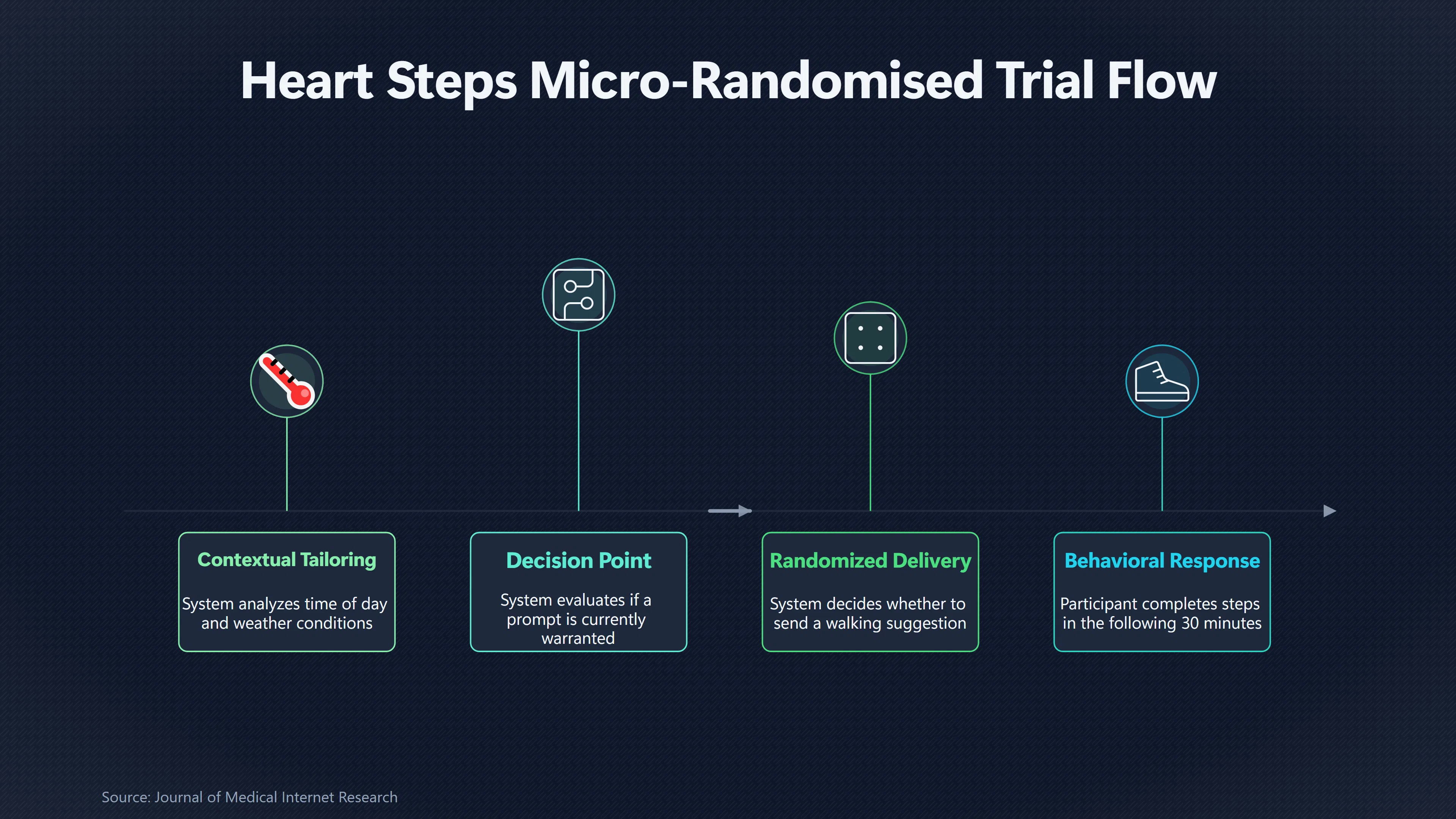
One of the clearest demonstrations comes from HeartSteps, a mobile intervention designed to encourage walking. In a six-week micro-randomised trial, 44 adults could receive contextually tailored activity suggestions at as many as five decision points per day. Instead of assigning each participant permanently to a treatment or control group, the researchers repeatedly randomised whether a suggestion was delivered at individual decision points. This allowed them to test the immediate effect of a message on behaviour during the next 30 minutes.[PubMed]pubmed.ncbi.nlm.nih.govOpen source on nih.gov.
HeartSteps also illustrates that “just in time” requires some moments to be deliberately left alone. The system did not randomise a prompt when a participant was already active, had just completed activity, was driving or was offline. Suggestions were tailored using factors including time of day, weekday versus weekend, location and weather.[GOV.UK]GOV.UKMicro-randomised trialMicro-randomised trial
Across the study, delivering any activity suggestion rather than none was associated with a 14% higher step count over the following 30 minutes, although that overall result narrowly missed conventional statistical significance (p=0.06). Walking-specific suggestions performed better: averaged over the study, they increased 30-minute step counts by 24%, equivalent to about 59 additional steps over the observed 253-step average. Anti-sedentary suggestions did not produce a detectable effect on that outcome.[PubMed]pubmed.ncbi.nlm.nih.govOpen source on nih.gov.
The particularly instructive result was what happened over time. At the beginning of the trial, a walking suggestion was associated with 271 additional steps in the subsequent 30 minutes — a 107% increase over the average — but its effect declined as the weeks passed and was no longer detectable by around day 29.[PubMed Central (PMC)]pmc.ncbi.nlm.nih.govOpen source on nih.gov.
That decay demonstrates an important limitation of immediate feedback. A message can arrive at an objectively appropriate moment and still lose behavioural power through repetition. Just-in-time systems therefore face two timing problems at once: when is there an opportunity to act, and when is an intervention worth spending on that opportunity?
The best time is not necessarily the earliest time
A notification sent the instant a tracker detects a deviation may seem ideal, but human receptivity complicates the picture. JITAI researchers define receptivity as a person’s temporary ability or willingness to receive, process and use support. It can change rapidly with circumstances. Someone in a meeting might be able to glance at a short text but unable to take a walk; someone outdoors in heavy rain may have time to exercise but little use for a suggestion to walk outside.[OUP Academic]academic.oup.comOUP AcademicJust-in-Time Adaptive Interventions (JITAIs) in Mobile Health: Key Components and Design Principles for Ongoing Health Behavi…
This means that a technically immediate message can be behaviourally late, early or simply badly placed. The useful target is not minimum transmission delay. It is the overlap between need, opportunity and receptivity.
Repeated interruption also has a cost. The JITAI design literature explicitly treats intervention burden as part of the timing decision because excessive recommendations can contribute to disengagement or intervention fatigue. A valid decision at one moment can also affect later decisions: sending a prompt now may make a person less willing to respond to another prompt later.[PubMed Central (PMC)]pmc.ncbi.nlm.nih.govPubMed Central (PMC)Just-in-Time Adaptive Interventions (JITAIs) in Mobile Health: Key Components and Design Principles for Ongoing Healt…
This explains why “no feedback now” can itself be a good intervention policy. HeartSteps, for example, included no-message conditions at its decision points rather than treating every detected opportunity as grounds for interruption. Micro-randomised trials can compare these moment-by-moment alternatives, allowing researchers to investigate not merely whether an intervention works, but when delivering it adds more value than withholding it.[GOV.UK]GOV.UKMicro-randomised trialMicro-randomised trial
There is also a measurement problem. If sensors mistake driving for inactivity, fail to detect that somebody has already started exercising, or synchronise too slowly, a theoretically well-designed rule can produce a badly timed message. The 2019 physical-activity review specifically identified sensor reliability and the timeliness of message delivery as feasibility challenges.[PubMed Central (PMC)]pmc.ncbi.nlm.nih.govPubMed Central (PMC)A systematic review of just-in-time adaptive interventions (JITAIs) to promote physical activity - PMCApril 3, 2019… A just-in-time policy is consequently only as good as the information used to decide that “now” is the right time.

Balancing immediacy with useful recommendations
For self-monitoring, the most defensible design principle is therefore actionable timeliness rather than maximum immediacy. Feedback should arrive early enough to preserve a realistic choice, but only when the information can support a useful response.
Three implementation questions follow from the evidence.
Is there still something the person can do? Feedback should be scheduled around the natural decision window of the behaviour. For breaking up sedentary time, minutes may matter. For achieving a daily walking target, several checks across the day may be sufficient. The literature reflects this variation: modern JITAIs use decision intervals ranging from minutes to a full day rather than imposing one universal definition of “real time”.[JMIR]jmir.orgJournal of Medical Internet ResearchJournal of Medical Internet Research - Just-in-Time Adaptive Interventions for Behavior Change in Physiological Health Outcomes and t…
Can the feedback suggest a feasible next move? Merely reporting that performance is below target preserves awareness but may leave the user to solve the difficult part. The 2018 review’s finding that only five of 31 interventions supplied actionable feedback shows how often digital systems stopped short of converting measurement into a recommendation.[PubMed Central (PMC)]pmc.ncbi.nlm.nih.govOpen source on nih.gov. A useful intervention might respond differently to the same step deficit depending on whether the person is at home, at work, already moving or unable to act.
Is this a good moment to interrupt? Context should sometimes suppress feedback rather than personalise it. Driving is an obvious example; repeated recent notifications or incompatible circumstances are subtler ones. JITAI frameworks consequently treat both vulnerability or opportunity and receptivity as inputs to intervention decisions.[PubMed Central (PMC)]pmc.ncbi.nlm.nih.govPubMed Central (PMC)Just-in-Time Adaptive Interventions (JITAIs) in Mobile Health: Key Components and Design Principles for Ongoing Healt…
These principles also show why an end-of-day or weekly summary is not inherently inferior. Delayed feedback can be useful for reflection, recognising patterns and planning future behaviour. It simply serves a different function. When the goal is to change this day’s behaviour, however, a summary delivered after the day’s choices have finished cannot recover the missed opportunity.
What “right timing” should mean in practice
The strongest conclusion from current research is not that self-improvement apps should send more notifications. It is that feedback has greater practical potential when its timing is designed around the remaining opportunity to act.
A well-designed tracker therefore needs to do more than measure continuously. It needs a policy for deciding when measurement warrants intervention: identify a meaningful departure from the goal, determine whether a useful response is still possible, account for the person’s likely receptivity, offer a concrete response where appropriate, and sometimes remain silent.
The evidence does not yet justify precise universal rules about how many prompts to send or exactly how quickly feedback must arrive. The 2019 review found mixed effects and underpowered trials; the 2023 meta-analysis found a positive pooled effect but called for stronger randomised evidence; and the 2024 review found promising design characteristics amid generally weak study quality.[PubMed]pubmed.ncbi.nlm.nih.govA systematic review of just-in-time adaptive interventions (JITAIs) to promote physical activity - PubMed…
What the research does clarify is the underlying implementation principle. Feedback has a decision window. Before that window closes, tracking can become guidance: the person can still walk, stand, change course or make a different choice. After it closes, the same data become primarily a record for reflection and future planning. For self-monitoring intended to improve behaviour in the moment, that difference between information delivered in time to act and information delivered after the fact is the central value of right timing.
Amazon book picks
Further Reading
Books and field guides related to Does Feedback Work Better Before the Moment Passes?. Use these as the next step if you want deeper reading beyond the article.
Tiny Habits
The world's leading expert on habit formation shows how you can have a happier, healthier life: by starting small. Myth: Change is hard....
Atomic Habits
Rating: 3.5/5 from 7 Google Books ratings
The #1 New York Times bestseller. Over 25 million copies sold! Translated into 60+ languages! Tiny Changes, Remarkable Results No matter...
Nudge
Rating: 3.5/5 from 29 Google Books ratings
Thaler and Sunstein offer a groundbreaking discussion of how to apply the science of choice to nudge people toward decisions that can imp...
The Power of Habit
Rating: 4.0/5 from 145 Google Books ratings
Duhigg takes us to the edge of scientific discoveries that explain why habits exist and how they can be changed. Distilling information i...
eBay marketplace picks
Marketplace Samples
Example marketplace items related to this page. Use the search link to explore similar finds on eBay.
Selected fromgoal tracking board oneBay.co.uk.


Endnotes
1.
Source: academic.oup.com
Link:https://academic.oup.com/abm/article/52/6/446/4733473
Source snippet
OUP AcademicJust-in-Time Adaptive Interventions (JITAIs) in Mobile Health: Key Components and Design Principles for Ongoing Health Behavi...
2.
Source: jmir.org
Title: Journal of Medical Internet Research
Link:https://www.jmir.org/2018/3/e106/
Source snippet
Journal of Medical Internet Research - Just-in-Time Feedback in Diet and Physical Activity Interventions: Systematic Review and Pract...
3.
Source: jmir.org
Title: Journal of Medical Internet Research
Link:https://www.jmir.org/2024/1/e54119
Source snippet
Journal of Medical Internet Research - Just-in-Time Adaptive Interventions for Behavior Change in Physiological Health Outcomes and t...
4.
Source: GOV.UK
Title: Micro-randomised trial
Link:https://www.gov.uk/guidance/micro-randomised-trial
6.
Source: academic.oup.com
Link:https://academic.oup.com/tbm/article/11/5/1037/5934751
7.
Source: jmir.org
Title: Journal of Medical Internet Research
Link:https://www.jmir.org/2020/5/e17572/
8.
Source: jmir.org
Title: Journal of Medical Internet Research
Link:https://www.jmir.org/2020/4/e17342/
9.
Source: jmir.org
Title: Journal of Medical Internet Research
Link:https://www.jmir.org/2020/3/e15033/
10.
Source: academic.oup.com
Link:https://academic.oup.com/abm/article/53/6/573/5091257
12.
Source: jmir.org
Title: Journal of Medical Internet Research
Link:https://www.jmir.org/2018/3/e106/citations
13.
Source: jmir.org
Title: Journal of Medical Internet Research
Link:https://www.jmir.org/2018/3/e106/authors
14.
Source: preprints.jmir.org
Link:https://preprints.jmir.org/preprint/8701
15.
Source: pmc.ncbi.nlm.nih.gov
Link:https://pmc.ncbi.nlm.nih.gov/articles/PMC5887039/
16.
Source: pubmed.ncbi.nlm.nih.gov
Link:https://pubmed.ncbi.nlm.nih.gov/37521518/
Source snippet
Using a complexity science approach to evaluate the effectiveness of just-in-time adaptive interventions: A meta-analysis - PubMed...
17.
Source: pmc.ncbi.nlm.nih.gov
Link:https://pmc.ncbi.nlm.nih.gov/articles/PMC5364076/
Source snippet
PubMed Central (PMC)Just-in-Time Adaptive Interventions (JITAIs) in Mobile Health: Key Components and Design Principles for Ongoing Healt...
18.
Source: pubmed.ncbi.nlm.nih.gov
Link:https://pubmed.ncbi.nlm.nih.gov/29567638/
Source snippet
Just-in-Time Feedback in Diet and Physical Activity Interventions: Systematic Review and Practical Design Framework - PubMedMarch 2...
19.
Source: pmc.ncbi.nlm.nih.gov
Link:https://pmc.ncbi.nlm.nih.gov/articles/PMC6448257/
Source snippet
PubMed Central (PMC)A systematic review of just-in-time adaptive interventions (JITAIs) to promote physical activity - PMCApril 3, 2019...
Published: April 3, 2019
20.
Source: pubmed.ncbi.nlm.nih.gov
Link:https://pubmed.ncbi.nlm.nih.gov/30943983/
Source snippet
A systematic review of just-in-time adaptive interventions (JITAIs) to promote physical activity - PubMed...
21.
Source: pmc.ncbi.nlm.nih.gov
Link:https://pmc.ncbi.nlm.nih.gov/articles/PMC10373115/
22.
Source: pmc.ncbi.nlm.nih.gov
Link:https://pmc.ncbi.nlm.nih.gov/articles/PMC11470223/
23.
Source: pubmed.ncbi.nlm.nih.gov
Link:https://pubmed.ncbi.nlm.nih.gov/30192907/
24.
Source: pmc.ncbi.nlm.nih.gov
Link:https://pmc.ncbi.nlm.nih.gov/articles/PMC6401341/
25.
Source: pmc.ncbi.nlm.nih.gov
Link:https://pmc.ncbi.nlm.nih.gov/articles/PMC4732268/
26.
Source: pmc.ncbi.nlm.nih.gov
Link:https://pmc.ncbi.nlm.nih.gov/articles/PMC5995647/
27.
Source: pmc.ncbi.nlm.nih.gov
Link:https://pmc.ncbi.nlm.nih.gov/articles/PMC13374797/
28.
Source: pubmed.ncbi.nlm.nih.gov
Link:https://pubmed.ncbi.nlm.nih.gov/41499773/
29.
Source: pubmed.ncbi.nlm.nih.gov
Link:https://pubmed.ncbi.nlm.nih.gov/41343702/
30.
Source: pubmed.ncbi.nlm.nih.gov
Link:https://pubmed.ncbi.nlm.nih.gov/41027677/?dopt=Abstract
31.
Source: pubmed.ncbi.nlm.nih.gov
Link:https://pubmed.ncbi.nlm.nih.gov/40724199/
32.
Source: pubmed.ncbi.nlm.nih.gov
Link:https://pubmed.ncbi.nlm.nih.gov/40418819/
33.
Source: pmc.ncbi.nlm.nih.gov
Link:https://pmc.ncbi.nlm.nih.gov/articles/PMC11811111/
34.
Source: pmc.ncbi.nlm.nih.gov
Link:https://pmc.ncbi.nlm.nih.gov/articles/PMC11648022/
35.
Source: pubmed.ncbi.nlm.nih.gov
Link:https://pubmed.ncbi.nlm.nih.gov/39331951/
36.
Source: pubmed.ncbi.nlm.nih.gov
Link:https://pubmed.ncbi.nlm.nih.gov/38663855/
37.
Source: pmc.ncbi.nlm.nih.gov
Link:https://pmc.ncbi.nlm.nih.gov/articles/PMC11272684/
38.
Source: pubmed.ncbi.nlm.nih.gov
Link:https://pubmed.ncbi.nlm.nih.gov/37027185/
39.
Source: pmc.ncbi.nlm.nih.gov
Link:https://pmc.ncbi.nlm.nih.gov/articles/PMC8872509/
40.
Source: pmc.ncbi.nlm.nih.gov
Link:https://pmc.ncbi.nlm.nih.gov/articles/PMC8943689/
41.
Source: pubmed.ncbi.nlm.nih.gov
Link:https://pubmed.ncbi.nlm.nih.gov/35080498/
42.
Source: pmc.ncbi.nlm.nih.gov
Link:https://pmc.ncbi.nlm.nih.gov/articles/PMC9276848/
43.
Source: pmc.ncbi.nlm.nih.gov
Link:https://pmc.ncbi.nlm.nih.gov/articles/PMC8691411/
44.
Source: pmc.ncbi.nlm.nih.gov
Link:https://pmc.ncbi.nlm.nih.gov/articles/PMC8663593/
45.
Source: pubmed.ncbi.nlm.nih.gov
Link:https://pubmed.ncbi.nlm.nih.gov/34806995/?dopt=Abstract
46.
Source: pmc.ncbi.nlm.nih.gov
Link:https://pmc.ncbi.nlm.nih.gov/articles/PMC7951936/
47.
Source: pmc.ncbi.nlm.nih.gov
Link:https://pmc.ncbi.nlm.nih.gov/articles/PMC8550316/
48.
Source: pubmed.ncbi.nlm.nih.gov
Link:https://pubmed.ncbi.nlm.nih.gov/36159209/
49.
Source: pmc.ncbi.nlm.nih.gov
Link:https://pmc.ncbi.nlm.nih.gov/articles/PMC7293059/
50.
Source: pmc.ncbi.nlm.nih.gov
Link:https://pmc.ncbi.nlm.nih.gov/articles/PMC7186866/
51.
Source: pmc.ncbi.nlm.nih.gov
Link:https://pmc.ncbi.nlm.nih.gov/articles/PMC7103204/
52.
Source: pubmed.ncbi.nlm.nih.gov
Link:https://pubmed.ncbi.nlm.nih.gov/31488002/
53.
Source: pmc.ncbi.nlm.nih.gov
Link:https://pmc.ncbi.nlm.nih.gov/articles/PMC6713230/
54.
Source: pubmed.ncbi.nlm.nih.gov
Link:https://pubmed.ncbi.nlm.nih.gov/30497999/
55.
Source: pmc.ncbi.nlm.nih.gov
Link:https://pmc.ncbi.nlm.nih.gov/articles/PMC6293241/
56.
Source: pmc.ncbi.nlm.nih.gov
Link:https://pmc.ncbi.nlm.nih.gov/articles/PMC5870794/
57.
Source: pubmed.ncbi.nlm.nih.gov
Link:https://pubmed.ncbi.nlm.nih.gov/29184889/
58.
Source: pmc.ncbi.nlm.nih.gov
Link:https://pmc.ncbi.nlm.nih.gov/articles/PMC5466696/
59.
Source: pmc.ncbi.nlm.nih.gov
Link:https://pmc.ncbi.nlm.nih.gov/articles/PMC4681309/
60.
Source: pmc.ncbi.nlm.nih.gov
Link:https://pmc.ncbi.nlm.nih.gov/articles/PMC4721268/
61.
Source: pmc.ncbi.nlm.nih.gov
Link:https://pmc.ncbi.nlm.nih.gov/articles/PMC2800172/
62.
Source: pubmed.ncbi.nlm.nih.gov
Link:https://pubmed.ncbi.nlm.nih.gov/19646331/
63.
Source: pubmed.ncbi.nlm.nih.gov
Link:https://pubmed.ncbi.nlm.nih.gov/26651467/
Additional References
64.
Source: youtube.com
Title: Wearable Tech in Healthcare | Dr. Susan Murphy | Talks at Google
Link:https://www.youtube.com/watch?v=0FdN8gLHGNQ
Source snippet
"Just-in-time adaptive interventions" OR "JITAI" behavior change Video 1: Introduction to JITAI with Susan Murphy...
65.
Source: youtube.com
Link:https://www.youtube.com/watch?v=dxz7b5oMxWU
Source snippet
Webinar - Potentials of Just-in-time Adaptive Interventions (JITAIs)...
66.
Source: youtube.com
Link:https://www.youtube.com/watch?v=Ad4q04y_CWg
Source snippet
Develop Effective Just-in-Time Adaptive Interventions: From Proof-of-Concept to Optimization Studies...
67.
Source: youtube.com
Link:https://www.youtube.com/watch?v=B9fCBS-ytq8
Source snippet
Wearable Tech in Healthcare | Dr. Susan Murphy | Talks at Google...
68.
Source: nature.com
Link:https://www.nature.com/articles/s41562-026-02427-2
69.
Source: nature.com
Link:https://www.nature.com/articles/s41746-025-02054-7
70.
Source: youtube.com
Title: Video 1
Link:https://www.youtube.com/watch?v=c2owFV6o7os
Source snippet
A Counselor in Your Pocket Just in Time Adaptive Interventions for Health Behavior Change...
71.
Source: scispace.com
Link:https://scispace.com/papers/efficacy-of-contextually-tailored-suggestions-for-physical-46pn26fji2
72.
Source: sciencedirect.com
Link:https://www.sciencedirect.com/science/article/pii/B9780323900454000125
73.
Source: mdpi.com
Link:https://www.mdpi.com/1660-4601/19/4/2267