Within The Idea That Inconsistent People Simply Need “more...
Self Control Depends on What You Keep Encountering
Successful restraint depends partly on which temptations appear, how often they appear, and what other people are doing around us.
On this page
- Why exposure matters alongside personal capacity
- What daily life desire studies reveal
- Reducing repeated encounters with the same temptation
Page outline Jump by section
Introduction
Self-control does not operate in a vacuum. Whether a person sticks to a goal depends partly on what they have to resist in the first place: how often a temptation appears, how visible and accessible it is, and whether the people around them make indulging seem normal. This changes the usual picture of willpower. Two people with similar intentions can face very different self-control problems because one encounters a tempting cue once while the other encounters it repeatedly.

Daily-life research supports that distinction. Temptations are common, but their consequences vary with the situation, and people who are effective at self-control appear to do more than simply win difficult internal battles. They also avoid or alter situations that generate those battles.[nih.gov]pubmed.ncbi.nlm.nih.govEveryday temptations: an experience sampling study of desire, conflict, and self-control - PubMed…
For self-improvement, the implication is practical rather than fatalistic: reducing unnecessary encounters with temptation can be a form of self-control itself. A system that makes the unwanted option less frequent, less salient or less socially reinforced can reduce the number of moments in which willpower has to rescue the goal.
Why exposure matters alongside personal capacity
Imagine two people trying to concentrate for an hour. One leaves their phone in another room. The other keeps it beside the keyboard, sees incoming notifications and repeatedly notices the possibility of checking messages. If both eventually complete the work, the second person has had to negotiate more potential conflicts to achieve the same result.
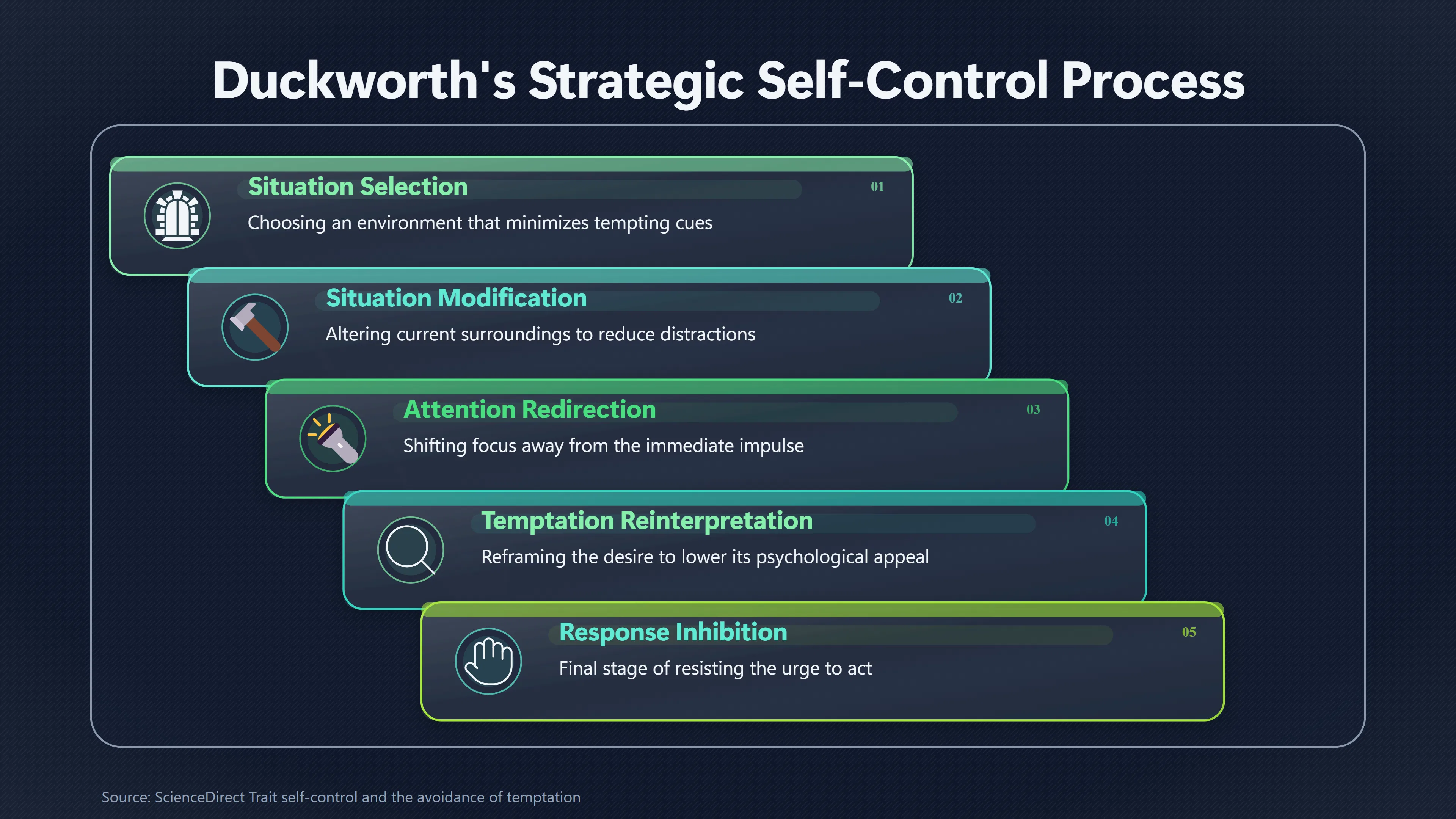
That distinction between resisting temptation and reducing exposure to temptation is central to contemporary models of self-control. Duckworth, Gendler and Gross’s process model argues that people can intervene at different points as an impulse develops. They can select a different situation, modify the situation they are already in, redirect attention, reinterpret the temptation or, at the final stage, inhibit their response. Earlier strategies can be valuable precisely because they prevent a strong impulse from developing.[PubMed Central (PMC)]pmc.ncbi.nlm.nih.govPub Med Central (PMC)Situational Strategies for Self-ControlPubMed Central (PMC)Situational Strategies for Self-Control - PMCJanuary 1, 2016…
This makes exposure an important part of the denominator in everyday self-control. A person who successfully resists nine temptations out of ten still experiences one lapse; somebody whose environment produces only two comparable temptations may need far less successful inhibition to achieve the same or better result. The numbers are illustrative, but the principle matters: behavioural outcomes reflect both what happens when temptation occurs and how often a person encounters it.
Research on trait self-control fits this interpretation. Michael Ent, Roy Baumeister and Dianne Tice found that people higher in trait self-control reported more behaviours aimed at minimising temptation. In experimental studies, they were also more likely to choose a distraction-free working environment over a more distracting alternative. High self-control, in other words, was associated not simply with greater resistance but with greater avoidance of situations requiring resistance.[ScienceDirect]sciencedirect.comScienceDirect Trait self-control and the avoidance of temptationTrait self-control and the avoidance of temptation - ScienceDirect…
This helps explain an initially counter-intuitive observation from experience-sampling research: people high in trait self-control do not necessarily report constantly exercising more moment-to-moment resistance. A review of situational self-control research notes that they instead tend to encounter fewer problematic desires. What looks from the outside like effortless discipline may therefore partly reflect better positioning before the decisive moment arrives.[PubMed Central (PMC)]pmc.ncbi.nlm.nih.govPub Med Central (PMC)Situational Strategies for Self-ControlPubMed Central (PMC)Situational Strategies for Self-Control - PMCJanuary 1, 2016…
What daily-life desire studies reveal
Laboratory tasks can isolate self-control mechanisms, but everyday life poses a different question: what actually happens as people move through ordinary environments?
A landmark experience-sampling study by Wilhelm Hofmann and colleagues followed 205 adults for a week. Participants responded to prompts about their desires, eventually producing 7,827 reports. The study found that desire was a recurring feature of daily life and varied considerably in strength, conflict with other goals, resistance and enactment. Crucially for understanding temptation exposure, outcomes were associated not just with personality but with characteristics of the immediate situation.[PubMed]pubmed.ncbi.nlm.nih.govEveryday temptations: an experience sampling study of desire, conflict, and self-control - PubMed…
The social findings are particularly revealing. The mere presence of other people generally inhibited the enactment of desires. But when those other people were already doing the thing the participant wanted to do — effectively modelling the tempting behaviour — resistance was lower and enactment became more likely. Thus, “being around people” was not a uniform influence. What those people were doing changed the self-control context.[Carlson School of Management]carlsonschool.umn.eduCarlson School of Management Journal of Personality and Social PsychologyCarlson School of ManagementJournal of Personality and Social PsychologyAugust 19, 2024…
More recent research strengthens the case that social context can affect temptation before a person reaches the stage of deliberate resistance. Across five main studies with 5,488 participants, researchers examined how social norms shape which behaviours come to mind. In one study, people trying to eat more healthily judged the same unhealthy foods as less tempting when eating them would violate the norm of the situation. In a classroom field study, establishing a norm against laptop use reduced both temptation to multitask and actual multitasking over the term; simply encouraging students to exercise individual self-control did not produce the same result.[PubMed]pubmed.ncbi.nlm.nih.govPub Med Social norms govern what behaviors come to mind-And what do notSocial norms govern what behaviors come to mind-And what do not - PubMedNovember 17, 2022…
That is a deeper point than saying that peer pressure matters. A context can change the subjective problem itself. If an option feels abnormal or is barely considered, there may be less temptation to overcome. If everyone around you is doing it, the same action can become more psychologically available and easier to justify.
Repeated temptation can matter more than repeated resistance
Another strand of daily-life evidence challenges the assumption that the important variable is how hard somebody fights once a temptation has appeared.
Marina Milyavskaya and Michael Inzlicht followed university students using experience sampling, nightly reports and longer-term measures of progress towards personally chosen goals. Their results linked goal attainment to the experience of temptation rather than to the amount of effortful self-control participants reported exerting. Experiencing more temptation was also associated with greater feelings of depletion, which in turn predicted poorer goal attainment.[Sage Journals]journals.sagepub.comSage Journals What’s So Great About Self-Control?Examining the Importance of Effortful Self-Control and Temptation in Predicting Real-Life Depletion and Goal Attainment - Marina Milyavsk…
The study does not prove that resisting temptation is useless. In a particular moment, resistance can plainly prevent an unwanted action. Nor does an observational association establish that removing cues will automatically solve every self-control problem. People may encounter more temptation partly because of their goals, preferences, routines or environments, and these influences are difficult to separate perfectly outside the laboratory.
But the findings alter where attention should go. If repeated encounters themselves predict poorer progress, evaluating a self-improvement system solely by asking “Did I resist successfully?” misses an important variable. A better question is “Why did this goal require so many acts of resistance today?”
Related research on motivation points in the same direction. Across several methods, Milyavskaya and colleagues found that goals pursued because people genuinely wanted to pursue them were associated with weaker attraction to goal-disrupting temptations and fewer perceived obstacles. The advantage was not simply greater effortful control once conflict occurred.[PubMed]pubmed.ncbi.nlm.nih.govOpen source on nih.gov.
Exposure, motivation and context therefore interact. The same object or activity need not produce an identical self-control conflict for everyone or in every setting. What matters is not merely whether a tempting option physically exists, but whether the situation repeatedly brings it into attention and makes it attractive, appropriate and easy to enact.
Context can change the strength of the battle
It is tempting to reduce environment design to the slogan “out of sight, out of mind”. The evidence supports a broader idea. Situations influence several stages between a potential temptation and behaviour.
A cue can first make an option noticeable. The setting can then affect how appealing or appropriate it seems. Social behaviour can strengthen or weaken permission to act. Physical or digital accessibility can determine how much friction separates desire from action. By the time somebody consciously says “I need willpower”, several contextual influences may already have pushed the decision in one direction.
This is why early intervention features so prominently in research on strategic self-control. In field experiments with students, Duckworth and colleagues compared strategies used at different points in the self-control process. High-school students instructed to modify their situations were more likely to meet academic goals during the following week than those assigned to response modulation or no strategy. In a college sample, situation modification again improved goal success, with reduced feelings of temptation partly accounting for the effect.[DOI]doi.orgA stitch in time: Strategic self-control in high school and college studentsA stitch in time: Strategic self-control in high school and college students
Daily-life studies by Laverl Williamson and Benjamin Wilkowski likewise found that planning self-control in advance predicted initiating it, while antecedent-focused strategies — including situation selection and modification — independently predicted progress towards goals. Direct response inhibition produced less consistent associations with progress.[PubMed]pubmed.ncbi.nlm.nih.govNipping Temptation in the Bud: Examining Strategic Self-Control in Daily Life - PubMed…
None of this establishes a universal hierarchy in which environmental strategies always beat internal ones. Contexts differ, some temptations cannot reasonably be avoided, and later strategies such as distraction or reappraisal can be useful. Even in the financial domain, for example, a meta-analysis of 29 studies found benefits from self-control strategies overall without finding that proactive strategies uniformly outperformed reactive ones.[PLOS]journals.plos.orgOpen source on plos.org.
The safer conclusion is narrower and more useful: waiting until a temptation is strong is not the only point at which self-control can occur. Choosing and changing situations can prevent some conflicts from becoming difficult enough to require heroic resistance.
Reducing repeated encounters with the same temptation
For self-improvement, exposure becomes especially useful when the same conflict keeps recurring. A one-off temptation may simply require a decision. A temptation encountered twenty times a day invites a systems question.
Suppose somebody repeatedly abandons focused work to check a social platform. They could treat every check as a fresh test of discipline. But if the phone remains visible, alerts repeatedly appear and access requires one tap, the system continuously regenerates the same conflict. Moving the device, disabling non-essential alerts or signing out does not guarantee concentration. It changes something more basic: the frequency and immediacy with which the competing behaviour enters the choice set.
The same reasoning applies beyond screens. Someone trying to limit discretionary spending may reduce exposure to promotional notifications and saved shopping baskets. Someone trying to establish a study routine may work in a location where the activities that normally compete with studying are unavailable. Someone whose social setting repeatedly normalises the behaviour they are trying to change may find that choosing a different setting changes how often deliberate resistance is required. These are examples of situation selection and modification, not claims that any single tactic works universally.[PubMed Central (PMC)]pmc.ncbi.nlm.nih.govPub Med Central (PMC)Situational Strategies for Self-ControlPubMed Central (PMC)Situational Strategies for Self-Control - PMCJanuary 1, 2016…
A useful way to diagnose repeated self-control failures is therefore to look upstream:
- Frequency: How many times does the tempting option appear during an ordinary day?
- Salience: Does the environment keep bringing it back into attention?
- Accessibility: Once the urge appears, how many steps separate wanting from doing?
- Social modelling: Are other people abstaining, indifferent or visibly doing the same tempting behaviour?
- Repeatability: Is this genuinely a difficult isolated choice, or is the same avoidable conflict being recreated by the routine?
The aim is not to eliminate every temptation. That would often be unrealistic and can become counterproductive if avoidance prevents people from functioning normally. The narrower goal is to identify unnecessary repeated exposure: situations in which a person keeps asking moment-to-moment inhibition to solve a predictable problem that could partly be changed upstream.
Better self-control can look like less self-control
The willpower myth is compelling partly because effort is visible. Resisting dessert while everyone else eats it, ignoring a phone buzzing on the desk or refusing an impulse purchase feels unmistakably like self-control. Leaving the phone elsewhere or never opening the shopping site produces no dramatic internal struggle, so it can look as though no self-control occurred.
Research on situational strategies reverses that interpretation. Avoiding or modifying a temptation-producing situation can itself be deliberate self-regulation. Indeed, Duckworth and colleagues argue that such strategies may be systematically underappreciated precisely because successful prevention removes the struggle by which people normally recognise self-control.[Association for Psychological Science]psychologicalscience.orgAssociation for Psychological Science Situational Strategies for Self-ControlAssociation for Psychological Science Situational Strategies for Self-Control
That distinction is important for “self improvement that works”. Personal capacity still matters, and situations do not mechanically dictate behaviour. But outcomes cannot be read straightforwardly as measures of character when people face different numbers and kinds of temptations.
The more useful standard is not how often someone proves they can win an internal fight. It is whether their ordinary context makes goal-consistent behaviour reasonably likely. When the same temptation keeps returning, changing its frequency, visibility, accessibility or social reinforcement can be more than a convenience. It can change how much self-control the day demands in the first place.
Amazon book picks
Further Reading
Books and field guides related to Self Control Depends on What You Keep Encountering. Use these as the next step if you want deeper reading beyond the article.
The Willpower Instinct
Based on Stanford University psychologist Kelly McGonigal's wildly popular course "The Science of Willpower," The Willpower Instinct is t...
Good Habits, Bad Habits
'The world's leading expert on habits' - Matthew Syed, bestselling author of Black Box Thinking and Rebel IdeasWhat if you could harness...
Indistractable
*As heard on Steven Bartlett's Diary of a CEO* 'A must-read' Mark Manson We are living through a crisis of distraction. Plans get sidetra...
How to Change
Wall Street Journal bestseller “A welcome revelation.” --The Financial Times Award-winning Wharton Professor and Choiceology podcast host...
eBay marketplace picks
Marketplace Samples
Live-tested eBay searches with available results related to this page.
Selected frommotivational desk sign oneBay.co.uk.




Endnotes
1.
Source: sciencedirect.com
Title: ScienceDirect Trait self-control and the avoidance of temptation
Link:https://www.sciencedirect.com/science/article/pii/S0191886914005339
Source snippet
Trait self-control and the avoidance of temptation - ScienceDirect...
2.
Source: doi.org
Title: A stitch in time: Strategic self-control in high school and college students
Link:https://doi.org/10.1037/edu0000062
3.
Source: journals.plos.org
Link:https://journals.plos.org/plosone/article?id=10.1371%2Fjournal.pone.0253938
4.
Source: doi.org
Link:https://doi.org/10.1007/s11097-024-09989-4
5.
Source: sciencedirect.com
Link:https://www.sciencedirect.com/science/article/pii/S0191886921008266
6.
Source: doi.org
Link:https://doi.org/10.1073/pnas.2018726118
7.
Source: doi.org
Link:https://doi.org/10.1371%2Fjournal.pone.0253938
8.
Source: doi.org
Link:https://doi.org/10.1016%2Fj.abrep.2016.09.002
9.
Source: sciencedirect.com
Link:https://www.sciencedirect.com/science/article/pii/S0195666316301465
10.
Source: sciencedirect.com
Link:https://www.sciencedirect.com/science/article/abs/pii/S0195666316301465
11.
Source: sciencedirect.com
Link:https://www.sciencedirect.com/science/article/abs/pii/S0191886916301477
12.
Source: doi.org
Title: Situational Strategies for Self-Control
Link:https://doi.org/10.1177/1745691615623247%C2%A0
13.
Source: sciencedirect.com
Link:https://www.sciencedirect.com/science/article/pii/S0191886915006224
14.
Source: sciencedirect.com
Title: A review of visual cues associated with food on food acceptance and consumption
Link:https://www.sciencedirect.com/science/article/pii/S1471015313001451
15.
Source: sciencedirect.com
Title: A review of visual cues associated with food on food acceptance and consumption
Link:https://www.sciencedirect.com/science/article/abs/pii/S1471015313001451
16.
Source: sciencedirect.com
Link:https://www.sciencedirect.com/science/article/pii/S0092656618301752
17.
Source: sciencedirect.com
Link:https://www.sciencedirect.com/science/article/pii/S0950329326000431
18.
Source: sciencedirect.com
Title: How history and convention create norms: An experimental study
Link:https://www.sciencedirect.com/science/article/pii/S0167487010000759
19.
Source: sciencedirect.com
Link:https://www.sciencedirect.com/science/article/abs/pii/S0092656618301752
20.
Source: sciencedirect.com
Link:https://www.sciencedirect.com/science/article/pii/S2451958825002970
21.
Source: pubmed.ncbi.nlm.nih.gov
Link:https://pubmed.ncbi.nlm.nih.gov/22149456/
Source snippet
Everyday temptations: an experience sampling study of desire, conflict, and self-control - PubMed...
22.
Source: pubmed.ncbi.nlm.nih.gov
Link:https://pubmed.ncbi.nlm.nih.gov/31658876/
Source snippet
Nipping Temptation in the Bud: Examining Strategic Self-Control in Daily Life - PubMed...
23.
Source: pmc.ncbi.nlm.nih.gov
Title: Pub Med Central (PMC)Situational Strategies for Self-Control
Link:https://pmc.ncbi.nlm.nih.gov/articles/PMC4736542/
Source snippet
PubMed Central (PMC)Situational Strategies for Self-Control - PMCJanuary 1, 2016...
Published: January 1, 2016
24.
Source: pubmed.ncbi.nlm.nih.gov
Title: Pub Med Situational Strategies for Self-Control
Link:https://pubmed.ncbi.nlm.nih.gov/26817725/
Source snippet
Situational Strategies for Self-Control - PubMed...
25.
Source: pmc.ncbi.nlm.nih.gov
Title: Pub Med Central (PMC)Situational Strategies for Self-Control
Link:https://pmc.ncbi.nlm.nih.gov/articles/4736542/
Source snippet
PubMed Central (PMC)Situational Strategies for Self-Control - PMCJanuary 1, 2016...
Published: January 1, 2016
26.
Source: journals.sagepub.com
Link:https://journals.sagepub.com/doi/10.1177/0956797612437426
Source snippet
Sage JournalsWhat People Desire, Feel Conflicted About, and Try to Resist in Everyday Life - Wilhelm Hofmann, Kathleen D. Vohs, Roy F. Ba...
27.
Source: carlsonschool.umn.edu
Title: Carlson School of Management Journal of Personality and Social Psychology
Link:https://carlsonschool.umn.edu/sites/carlsonschool.umn.edu/files/2019-04/hofmann_baumeister_forster_vohs_2012_jpsp.pdf
Source snippet
Carlson School of ManagementJournal of Personality and Social PsychologyAugust 19, 2024...
Published: August 19, 2024
28.
Source: pubmed.ncbi.nlm.nih.gov
Title: Pub Med Social norms govern what behaviors come to mind-And what do not
Link:https://pubmed.ncbi.nlm.nih.gov/36395038/
Source snippet
Social norms govern what behaviors come to mind-And what do not - PubMedNovember 17, 2022...
Published: November 17, 2022
29.
Source: journals.sagepub.com
Title: Sage Journals What’s So Great About Self-Control?
Link:https://journals.sagepub.com/doi/10.1177/1948550616679237
Source snippet
Examining the Importance of Effortful Self-Control and Temptation in Predicting Real-Life Depletion and Goal Attainment - Marina Milyavsk...
30.
Source: pubmed.ncbi.nlm.nih.gov
Link:https://pubmed.ncbi.nlm.nih.gov/25984785/
31.
Source: journals.sagepub.com
Link:https://journals.sagepub.com/doi/10.1177/0146167219883606
32.
Source: psychologicalscience.org
Title: Association for Psychological Science Situational Strategies for Self-Control
Link:https://www.psychologicalscience.org/journals/perspectives/1745691615623247/
33.
Source: pmc.ncbi.nlm.nih.gov
Link:https://pmc.ncbi.nlm.nih.gov/articles/PMC10354841/
34.
Source: pmc.ncbi.nlm.nih.gov
Link:https://pmc.ncbi.nlm.nih.gov/articles/PMC13021067/
35.
Source: pmc.ncbi.nlm.nih.gov
Link:https://pmc.ncbi.nlm.nih.gov/articles/PMC10033625/
36.
Source: pmc.ncbi.nlm.nih.gov
Link:https://pmc.ncbi.nlm.nih.gov/articles/PMC8266115/
37.
Source: pubmed.ncbi.nlm.nih.gov
Link:https://pubmed.ncbi.nlm.nih.gov/34237109/
38.
Source: pmc.ncbi.nlm.nih.gov
Link:https://pmc.ncbi.nlm.nih.gov/articles/PMC8668847/
39.
Source: journals.sagepub.com
Link:https://journals.sagepub.com/doi/abs/10.1177/0146167219883606
40.
Source: pmc.ncbi.nlm.nih.gov
Link:https://pmc.ncbi.nlm.nih.gov/articles/PMC6710643/
41.
Source: pmc.ncbi.nlm.nih.gov
Link:https://pmc.ncbi.nlm.nih.gov/articles/PMC6614438/
42.
Source: psychologicalscience.org
Title: beyond willpower strategies for reducing failures of self control
Link:https://www.psychologicalscience.org/publications/beyond-willpower-strategies-for-reducing-failures-of-self-control.html
43.
Source: journals.sagepub.com
Link:https://journals.sagepub.com/doi/abs/10.1177/1948550616679237
44.
Source: pmc.ncbi.nlm.nih.gov
Link:https://pmc.ncbi.nlm.nih.gov/articles/PMC4902773/
45.
Source: journals.sagepub.com
Link:https://journals.sagepub.com/doi/10.1177/1745691615623247
46.
Source: journals.sagepub.com
Link:https://journals.sagepub.com/doi/abs/10.1177/1745691615623247
47.
Source: pmc.ncbi.nlm.nih.gov
Link:https://pmc.ncbi.nlm.nih.gov/articles/PMC4214912/
48.
Source: pubmed.ncbi.nlm.nih.gov
Link:https://pubmed.ncbi.nlm.nih.gov/24064190/
49.
Source: pmc.ncbi.nlm.nih.gov
Link:https://pmc.ncbi.nlm.nih.gov/articles/PMC3784634/
50.
Source: journals.sagepub.com
Link:https://journals.sagepub.com/doi/10.1177/0963721412453587
51.
Source: pmc.ncbi.nlm.nih.gov
Link:https://pmc.ncbi.nlm.nih.gov/articles/PMC3444249/
52.
Source: pubmed.ncbi.nlm.nih.gov
Link:https://pubmed.ncbi.nlm.nih.gov/22547657/
53.
Source: journals.sagepub.com
Link:https://journals.sagepub.com/doi/pdf/10.1177/0956797612437426
54.
Source: journals.sagepub.com
Link:https://journals.sagepub.com/doi/abs/10.1177/0956797612437426
55.
Source: journals.sagepub.com
Link:https://journals.sagepub.com/doi/10.1177/1948550611435136
56.
Source: pubmed.ncbi.nlm.nih.gov
Link:https://pubmed.ncbi.nlm.nih.gov/26386000/
57.
Source: pubmed.ncbi.nlm.nih.gov
Link:https://pubmed.ncbi.nlm.nih.gov/16418755/
58.
Source: pubmed.ncbi.nlm.nih.gov
Link:https://pubmed.ncbi.nlm.nih.gov/12071691/
59.
Source: experts.umn.edu
Title: everyday temptations an experience sampling study of desire confl
Link:https://experts.umn.edu/en/publications/everyday-temptations-an-experience-sampling-study-of-desire-confl/
Additional References
60.
Source: youtube.com
Link:https://www.youtube.com/watch?v=kwkGr62qHm8
Source snippet
In the lecture Matter Over Mind: Situational Strategies for Self-Control, psychologist Angela Duckworth and emotion researcher James Gros...
61.
Source: youtube.com
Link:https://www.youtube.com/watch?v=_6p8aq4zU8Y
Source snippet
Playing the Long Game: The Power of Self-Control...
62.
Source: youtube.com
Title: The TRUTH about Self Control (Behavioural Science)
Link:https://www.youtube.com/watch?v=rjai7nQzod0
Source snippet
How to Break Unwanted Habits and How to Create New Desired Ones with Adam Grant and Wendy Wood...
63.
Source: nature.com
Link:https://www.nature.com/articles/0803217
64.
Source: youtube.com
Title: Angela Duckworth: Self-Control Strategies for School-Age Children
Link:https://www.youtube.com/watch?v=X1euhGUKIRc
Source snippet
The TRUTH about Self Control (Behavioural Science)...
65.
Source: youtube.com
Title: Playing the Long Game: The Power of Self-Control
Link:https://www.youtube.com/watch?v=df6ZCqkKWp8
Source snippet
Angela Duckworth: Self-Control Strategies for School-Age Children...
66.
Source: researchgate.net
Link:https://www.researchgate.net/publication/51859926_Everyday_temptations_An_experience_sampling_study_of_desire_conflict_and_self-control
67.
Source: researchgate.net
Link:https://www.researchgate.net/publication/399875023_Religious_Culture_as_Informal_Governance_in_Public_Schools_Rethinking_Normativity_Institutional_Neutrality_and_Everyday_Regulation
68.
Source: researchgate.net
Link:https://www.researchgate.net/publication/369347724_The_Social_Psychology_of_Everyday_Life
69.
Source: researchgate.net
Link:https://www.researchgate.net/publication/224871266_What_People_Desire_Feel_Conflicted_About_and_Try_to_Resist_in_Everyday_Life