Within Goal Difficulty
How Hard Should Your Goal Actually Be?
A useful stretch goal demands more than your normal performance without making success implausible at your present skill level.
On this page
- Why the same target can be easy, challenging or impossible
- Using recent performance to set a credible stretch
- Warning signs that difficulty is badly calibrated
Page outline Jump by section
Introduction
The right goal is not simply “hard”. It is hard relative to you. A target can be routine for someone who already performs near that level, a useful stretch for someone a little below it, and effectively impossible for a beginner. Research on goal setting therefore makes most practical sense when difficulty is judged against current ability, recent performance, available resources and understanding of the task—not against an impressive-looking number in isolation. A meta-analysis of 78 goal-setting studies found that both prior performance and ability were significantly related to the goals people set for themselves.[Sage Journals]journals.sagepub.comSage JournalsMeta-Analysis of the Antecedents of Personal Goal Level and of the Antecedents and Consequences of Goal Commitment - J. C. W…

For self-improvement, that points to a practical rule: use your recent demonstrated performance as the starting point, then choose a target that requires a credible improvement. When your performance changes, recalibrate. And when you do not yet know how to perform the task well, the problem may be skill acquisition rather than insufficient ambition.
Why the same target can be easy, challenging or impossible
Numbers hide an important distinction between goal level and goal difficulty. Goal level is the objective target: running five kilometres in 25 minutes, completing 20 press-ups, writing 1,000 words or scoring 80% on an examination. Goal difficulty is what achieving that number demands from a particular person.
Suppose three people set a target of running five kilometres in 25 minutes. One currently runs it in 24 minutes, another in 27 minutes and the third cannot yet run five kilometres continuously. They have identical targets but very different goals in practical terms. The first person has little stretch at all. The second needs a meaningful but potentially credible improvement. The third may first need to develop basic endurance before a 25-minute performance target becomes useful.
This distinction appears directly in research comparing uniform and ability-adjusted goals. In a laboratory study of 138 university students, researchers compared an “ability-based” approach with assigning everybody the same performance target. Ability-based goals produced better results overall, with particularly clear benefits for lower-ability participants; lower- and moderate-ability participants given the common target also showed larger performance declines in later rounds.[Taylor & Francis Online]tandfonline.comTaylor & Francis OnlineThe Performance Effects of an Ability-Based Approach to Goal Assignment: Journal of Organizational Behavior Manage…
The implication is not that people with lower current performance should permanently receive easier goals. It is that a stretch should start from where performance actually is. Once ability improves, the appropriate target should move with it.
That also explains why copying another person’s goal can be misleading. “Read 50 books this year”, “run a sub-four-hour marathon” or “practise for two hours every day” says little about appropriate difficulty without knowing the person’s starting point, relevant skills, time and constraints. Difficulty has to be calibrated rather than borrowed.
Use recent performance to set a credible stretch
The most useful benchmark is usually not what you believe you ought to be capable of. It is what you have recently demonstrated under reasonably representative conditions. Evidence on self-efficacy reinforces the value of this approach. A meta-analysis examining changes within individuals found that previous performance was a stronger predictor of subsequent self-efficacy than self-efficacy was of subsequent performance. In other words, confidence partly follows evidence of what you have actually managed to do.[DOI]doi.orgA Meta‐Analytic Investigation of the Within‐Person Self‐Efficacy Domain: Is Self‐Efficacy a Product of Past Performance or a Driver of…
Start by collecting a small baseline. Depending on the goal, that might mean your last several runs rather than your lifetime personal best, the number of focused study sessions you actually complete in a normal week, or the amount of uninterrupted practice you can currently sustain. A single unusually good or bad day is a weak calibration point; recent repeatable performance gives you a better picture of present capacity.
Then ask what improvement would require you to change your behaviour without requiring an unexplained leap in ability. Research illustrates why that distinction matters. In a muscular-endurance study involving secondary-school students, participants received goals ranging from no specific target through improvements of 10%, 20% and 40%. The 20% target was designed as difficult but realistic, while 40% was treated as improbable or unattainable. Across practice periods, the difficult-but-realistic group showed the largest gains; the improbable group performed substantially worse than that group after four and six weeks, although the difference was no longer present after eight weeks.[PubMed]pubmed.ncbi.nlm.nih.govEffect of goal difficulty, goal specificity and duration of practice time intervals on muscular endurance performance - PubMed…
That does not establish 20% as a universal formula. The percentage came from one task and population. Indeed, experiments examining different ways of defining difficulty have found that results depend partly on whether goals are expressed as absolute performance levels or improvements over previous performance.[ScienceDirect]sciencedirect.comThe Effects of Varying Goal Difficulty Operationalizations on Goal Setting Outcomes and Processes - ScienceDirectJanuary 1… The useful lesson is the method: anchor the target to evidence about current performance rather than adopting a fixed percentage that supposedly works for everybody.
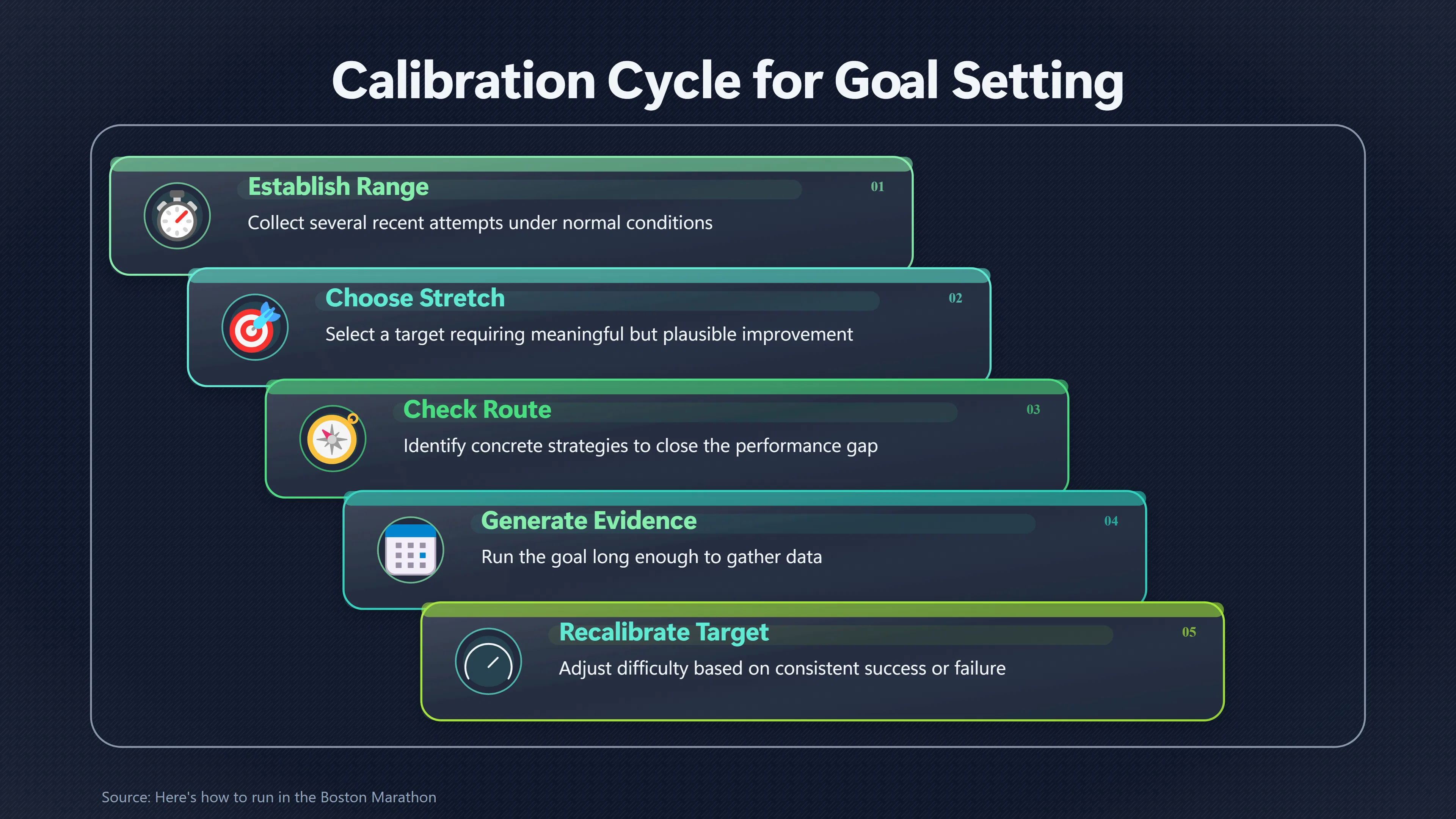
A simple calibration cycle is:
- Establish your current range. Look at several recent attempts under normal conditions.
- Choose a genuine stretch. The target should demand more than your normal performance, not merely formalise something you already do.
- Check the route to improvement. You should be able to identify plausible changes—more practice, better consistency, improved technique or another concrete strategy—that could close the gap.
- Run the goal long enough to generate evidence. One miss does not prove that a goal is excessive, just as one exceptional success does not prove that it is too easy.
- Recalibrate from the new evidence. Consistent success is a reason to raise the challenge; persistent failure despite appropriate effort is a reason to examine the target, strategy or skill gap.
The point is adaptive difficulty. A well-calibrated goal is temporary because your ability should not remain fixed.
Attainability matters without requiring easy goals
“Attainable” can sound like permission to avoid ambitious targets, but that is not what the evidence implies. The useful distinction is between a goal whose difficulty stimulates extra effort and one whose distance from current performance makes the target cease to function as a credible guide.
A revealing real-world example comes from Boston Marathon qualifying standards. Researchers analysed marathon performances from 1970 to 2015 and exploited changes in the qualifying times runners faced as they entered different age categories. After accounting for previous performance, runners tended to improve when the Boston qualifying target became more attainable; where it became more challenging, performance declined. The study therefore provided evidence that attainability itself can influence performance rather than merely reflecting who happens to be a stronger runner.[ScienceDirect]sciencedirect.comGoal attainability and performance: Evidence from Boston marathon qualifying standards - ScienceDirectFebruary 1, 2017…
The case is especially useful because the qualifying target is objectively identical for everyone in an age-and-sex category but subjectively very different depending on previous race times. A runner whose recent marathon is only slightly outside a qualifying mark faces a different motivational problem from someone who is an hour away from it. The official Boston Athletic Association still uses age-based qualifying standards, illustrating how even a prominent external benchmark recognises that equivalent absolute standards would not represent equivalent difficulty across populations.[Boston Athletic Association]baa.orgBoston Athletic Association QualifyBoston Athletic Association Qualify
There is nevertheless no well-established universal probability—such as “choose a goal you have a 70% chance of achieving”—that defines the ideal stretch across self-improvement activities. Goal-setting research varies considerably in tasks, populations and definitions of difficulty. Treat precise universal difficulty ratios with caution.
A better test is whether the target is demanding but explainable. If you are currently at A and want to reach B, can you describe a plausible route between them using skills and resources you possess or can reasonably acquire during the goal period? If the only explanation is “I will somehow try much harder”, the target may be aspiration rather than calibration.
Current ability includes knowing what to do
Ability is not limited to strength, intelligence or experience. It also includes the knowledge and strategies required to perform the task. This becomes particularly important when somebody is attempting something new.
Research on moderately and highly complex tasks has repeatedly qualified the usual advice to set difficult performance goals. In one experiment using a class-scheduling task in which participants had to acquire knowledge to perform well, a specific difficult learning goal produced better performance than being told to do their best. Yet a specific difficult outcome goal performed worse than the do-your-best condition.[Wiley Online Library]onlinelibrary.wiley.comOpen source on wiley.com. Seijts and Latham consequently argue that where people primarily need to acquire knowledge and skill, learning goals should direct attention towards discovering effective strategies rather than prematurely demanding a particular outcome.[Academy of Management Journals]journals.aom.orgOpen source on aom.org.
This changes how “match the goal to your ability” should be implemented. Imagine that you want to give confident presentations but have barely presented before. “Deliver a flawless 30-minute presentation without notes next month” may be measurable and ambitious, but it assumes that you already know how to organise the material, rehearse effectively, control pacing and respond to an audience. A better-calibrated stretch might initially concern learning and practice: rehearse a five-minute section repeatedly, test two ways of structuring an opening, record yourself and identify specific improvements, or practise answering likely questions.
The same principle has recently been incorporated into an expert statement on goal setting for exercise and physical activity: challenging performance goals are most appropriate when the person has the necessary ability, whereas people still acquiring knowledge or skills may benefit more from learning-oriented or more open goals.[PubMed Central (PMC)]pmc.ncbi.nlm.nih.govOpen source on nih.gov.
So a target can be “too hard” in two different ways. You may know exactly what to do but lack enough current capacity to hit the number, or you may not yet know how to produce the desired result. The second problem is not solved simply by lowering the outcome number. It may require changing what the goal asks you to accomplish.

Warning signs that difficulty is badly calibrated
No questionnaire can tell you the perfect difficulty in advance. Calibration is better treated as an ongoing judgement based on behaviour and performance. Several patterns are particularly informative.
The goal is probably too easy when success is nearly automatic. If you repeatedly hit the target without extra concentration, effort, preparation or improvement in strategy, it is functioning more as a minimum standard than a stretch goal. Difficult goals generally have their advantage precisely because they can direct attention, increase effort and persistence, and encourage useful strategies.[Sage Journals]journals.sagepub.comSage Journals New Directions in Goal-Setting TheorySage Journals New Directions in Goal-Setting Theory
The goal may be too hard when misses are large and repetitive despite serious, appropriate effort. Missing a stretch target occasionally is not evidence of failure; a genuine stretch permits misses. More revealing is a stable pattern in which performance remains far below the target and the gap does not narrow. Research on muscular endurance provides one concrete example: the improbable 40% improvement target initially produced smaller gains than the difficult-but-realistic 20% target.[PubMed]pubmed.ncbi.nlm.nih.govEffect of goal difficulty, goal specificity and duration of practice time intervals on muscular endurance performance - PubMed…
Difficulty is suspect when the goal requires abilities you have not yet acquired. If you repeatedly respond to failure with “I don’t know what else to try”, the limiting factor may be strategy or knowledge rather than motivation. On complex tasks, simply increasing performance pressure can be counterproductive; learning goals are better suited to discovering how the task works.[Academy of Management Journals]journals.aom.orgOpen source on aom.org.
Emotional strain is information, but not a complete difficulty gauge. Harder goals can increase pressure. One perceptual-motor experiment found that progressively more difficult goals were accompanied by increased cognitive anxiety and reduced self-confidence, while very hard goals also produced better performance than a do-your-best instruction.[PubMed]pubmed.ncbi.nlm.nih.govPub Med Goal difficulty, anxiety and performancePub Med Goal difficulty, anxiety and performance Feeling challenged therefore does not automatically mean a goal is excessive. The more useful question is whether strain is accompanied by adaptation and improving performance or by persistent breakdown.
A target that was appropriate can become outdated. Improving ability makes the same number easier. Conversely, losing practice time or encountering new constraints can turn yesterday’s stretch into today’s implausible demand. This is why feedback is part of calibration rather than merely a score at the end. Recent experiments on sustained attention, for example, have successfully used goals that become progressively harder over time rather than assuming one difficulty level should remain appropriate throughout practice.[PubMed]pubmed.ncbi.nlm.nih.govPub Med Effects of goal-setting on sustained attention and attention lapsesPub Med Effects of goal-setting on sustained attention and attention lapses
The practical test: stretch from evidence, not aspiration
A useful stretch goal sits just beyond normal performance for the person attempting it now. That definition deliberately leaves out a universal percentage or success probability because the research does not justify one across different tasks and populations.
The strongest practical approach is therefore iterative. Establish what you can currently do, set a target that requires a meaningful but plausible improvement, observe what actually happens, and adjust. Research showing links between prior performance, ability and personal goal levels supports starting from demonstrated capacity, while experiments with ability-adjusted goals show why imposing the same target on people with different starting points can produce inferior results.[Sage Journals]journals.sagepub.comSage JournalsMeta-Analysis of the Antecedents of Personal Goal Level and of the Antecedents and Consequences of Goal Commitment - J. C. W…
The crucial distinction is between stretching an existing capability and demanding a capability that does not yet exist. If you possess the necessary skill and repeatedly reach the goal without much additional effort, raise the difficulty. If you understand the task and are moving closer despite occasional misses, the stretch may be about right. If serious effort produces repeated large misses, reduce or restructure the target. And if you do not yet know how to improve, make learning the immediate goal before demanding a harder outcome.
That is what matching difficulty to ability looks like in practice: not lowering expectations, but placing the next challenge where it can actually change what you are capable of doing.
Amazon book picks
Further Reading
Books and field guides related to How Hard Should Your Goal Actually Be?. Use these as the next step if you want deeper reading beyond the article.
Peak: Secrets from the New Science of Expertise
El mayor experto mundial en rendimiento y desarrollo de habilidades, Anders Ericsson, nos enseña los secretos para conseguir ser el mejor...
The Power of Habit
Rating: 4.0/5 from 145 Google Books ratings
In The Power of Habit, award-winning business reporter Charles Duhigg takes us to the thrilling edge of scientific discoveries that expla...
Atomic Habits
Rating: 3.5/5 from 7 Google Books ratings
The #1 New York Times bestseller. Over 25 million copies sold! Translated into 60+ languages! Tiny Changes, Remarkable Results No matter...
Mindset: The New Psychology of Success
From the renowned psychologist who introduced the world to “growth mindset” comes this updated edition of the million-copy bestseller—fea...
eBay marketplace picks
Marketplace Samples
Live-tested eBay searches with available results related to this page.
Selected fromgoal setting poster oneBay.co.uk.
Current eBay listing
Goal Setting Definition Framed Wall Art Poster Canvas Print Picture
Current eBay listing
Goal Setting Quote Framed Wall Art Poster Canvas Print Picture

Current eBay listing
Goal Setting Definition Framed Wall Art Poster Canvas Print Picture
Endnotes
1.
Source: doi.org
Link:https://doi.org/10.1111/peps.12035
Source snippet
A Meta‐Analytic Investigation of the Within‐Person Self‐Efficacy Domain: Is Self‐Efficacy a Product of Past Performance or a Driver of...
2.
Source: onlinelibrary.wiley.com
Link:https://onlinelibrary.wiley.com/doi/10.1111/peps.12035
Source snippet
Wiley Online LibraryA Meta‐Analytic Investigation of the Within‐Person Self‐Efficacy Domain: Is Self‐Efficacy a Product of Past Performan...
3.
Source: sciencedirect.com
Link:https://www.sciencedirect.com/science/article/abs/pii/S0749597885710035
Source snippet
The Effects of Varying Goal Difficulty Operationalizations on Goal Setting Outcomes and Processes - ScienceDirectJanuary 1...
4.
Source: sciencedirect.com
Link:https://www.sciencedirect.com/science/article/pii/S0749597885710035
Source snippet
The Effects of Varying Goal Difficulty Operationalizations on Goal Setting Outcomes and Processes - ScienceDirect...
5.
Source: sciencedirect.com
Link:https://www.sciencedirect.com/science/article/abs/pii/S0167487016303063
Source snippet
Goal attainability and performance: Evidence from Boston marathon qualifying standards - ScienceDirectFebruary 1, 2017...
Published: February 1, 2017
6.
Source: onlinelibrary.wiley.com
Link:https://onlinelibrary.wiley.com/doi/10.1002/job.70
7.
Source: boston.com
Title: Here’s how to run in the Boston Marathon
Link:https://www.boston.com/sports/boston-marathon/2025/04/14/heres-how-to-run-in-the-boston-marathon/
8.
Source: sciencedirect.com
Link:https://www.sciencedirect.com/science/article/pii/S104160801730211X
9.
Source: onlinelibrary.wiley.com
Link:https://onlinelibrary.wiley.com/doi/abs/10.1111/peps.12035
10.
Source: doi.org
Link:https://doi.org/10.1080/15416518.2012.708850
11.
Source: onlinelibrary.wiley.com
Link:https://onlinelibrary.wiley.com/doi/pdf/10.1002/9781119206422.ch9
12.
Source: sciencedirect.com
Link:https://www.sciencedirect.com/science/article/abs/pii/S0749597802000171
13.
Source: onlinelibrary.wiley.com
Link:https://onlinelibrary.wiley.com/doi/pdf/10.1002/job.70
14.
Source: sciencedirect.com
Title: Determinants, process, and consequences of personal goals and performance
Link:https://www.sciencedirect.com/science/article/abs/pii/S0149206300000829
15.
Source: onlinelibrary.wiley.com
Link:https://onlinelibrary.wiley.com/doi/10.1002/%28SICI%291099-1379%28199907%2920%3A4%3C421%3A%3AAID-JOB896%3E3.0.CO%3B2-%23
16.
Source: sciencedirect.com
Title: Goal Setting Effects on Implicit and Explicit Learning of Complex Tasks
Link:https://www.sciencedirect.com/science/article/pii/S0749597896900023
17.
Source: sciencedirect.com
Title: Achievement goals and self-efficacy: A meta-analysis
Link:https://www.sciencedirect.com/science/article/pii/S1747938X1630029X
18.
Source: sciencedirect.com
Link:https://www.sciencedirect.com/science/article/abs/pii/0149206395900349
19.
Source: sciencedirect.com
Link:https://www.sciencedirect.com/science/article/pii/S0749597813000423
20.
Source: sciencedirect.com
Link:https://www.sciencedirect.com/science/article/pii/0030507380900380
21.
Source: sciencedirect.com
Link:https://www.sciencedirect.com/science/article/pii/1053482292900028
22.
Source: sciencedirect.com
Link:https://www.sciencedirect.com/science/article/abs/pii/S0092656616300605
23.
Source: sciencedirect.com
Link:https://www.sciencedirect.com/science/article/pii/S0149763425002611
24.
Source: onlinelibrary.wiley.com
Link:https://onlinelibrary.wiley.com/doi/abs/10.1002/hrdq.3920040206
25.
Source: doi.org
Title: New Directions in Goal-Setting Theory
Link:https://doi.org/10.1111/j.1467-8721.2006.00449.x
26.
Source: journals.sagepub.com
Link:https://journals.sagepub.com/doi/10.1177/014920639201800309
Source snippet
Sage JournalsMeta-Analysis of the Antecedents of Personal Goal Level and of the Antecedents and Consequences of Goal Commitment - J. C. W...
27.
Source: tandfonline.com
Link:https://www.tandfonline.com/doi/abs/10.1080/01608061.2012.698116
Source snippet
Taylor & Francis OnlineThe Performance Effects of an Ability-Based Approach to Goal Assignment: Journal of Organizational Behavior Manage...
28.
Source: pubmed.ncbi.nlm.nih.gov
Link:https://pubmed.ncbi.nlm.nih.gov/9258843/
Source snippet
Effect of goal difficulty, goal specificity and duration of practice time intervals on muscular endurance performance - PubMed...
29.
Source: baa.org
Title: Boston Athletic Association Qualify
Link:https://www.baa.org/races/boston-marathon/qualify/
30.
Source: journals.aom.org
Link:https://journals.aom.org/doi/10.5465/ame.2005.15841964
31.
Source: pmc.ncbi.nlm.nih.gov
Link:https://pmc.ncbi.nlm.nih.gov/articles/PMC13018065/
32.
Source: journals.sagepub.com
Title: Sage Journals New Directions in Goal-Setting Theory
Link:https://journals.sagepub.com/doi/pdf/10.1111/j.1467-8721.2006.00449.x
33.
Source: pubmed.ncbi.nlm.nih.gov
Link:https://pubmed.ncbi.nlm.nih.gov/1920065/
34.
Source: pubmed.ncbi.nlm.nih.gov
Title: Pub Med Goal difficulty, anxiety and performance
Link:https://pubmed.ncbi.nlm.nih.gov/9118936/
35.
Source: pubmed.ncbi.nlm.nih.gov
Title: Pub Med Effects of goal-setting on sustained attention and [attention lapses]({{ ‘attention-lapses/’ | relative_url }})
Link:https://pubmed.ncbi.nlm.nih.gov/37872435/
36.
Source: pmc.ncbi.nlm.nih.gov
Link:https://pmc.ncbi.nlm.nih.gov/articles/PMC12678593/
37.
Source: pmc.ncbi.nlm.nih.gov
Link:https://pmc.ncbi.nlm.nih.gov/articles/PMC12932095/
38.
Source: baa.org
Link:https://www.baa.org/news/reminder-qualifier-registration-130th-boston-marathon-presented-bank-america-begins-september-8/
39.
Source: baa.org
Title: 2026 and 2027 registration updates boston marathon presented bank america
Link:https://www.baa.org/news/2026-and-2027-registration-updates-boston-marathon-presented-bank-america/
40.
Source: pubmed.ncbi.nlm.nih.gov
Link:https://pubmed.ncbi.nlm.nih.gov/40372890/
41.
Source: baa.org
Link:https://www.baa.org/news/2025-boston-marathon-presented-bank-america-registration-update-2026-qualifier-standards-adjustment/
42.
Source: tandfonline.com
Link:https://www.tandfonline.com/doi/full/10.1080/17521882.2024.2397380
43.
Source: pmc.ncbi.nlm.nih.gov
Link:https://pmc.ncbi.nlm.nih.gov/articles/PMC11007134/
44.
Source: pmc.ncbi.nlm.nih.gov
Link:https://pmc.ncbi.nlm.nih.gov/articles/PMC10136923/
45.
Source: pmc.ncbi.nlm.nih.gov
Link:https://pmc.ncbi.nlm.nih.gov/articles/PMC9849896/
46.
Source: pmc.ncbi.nlm.nih.gov
Link:https://pmc.ncbi.nlm.nih.gov/articles/PMC8671316/
47.
Source: pmc.ncbi.nlm.nih.gov
Link:https://pmc.ncbi.nlm.nih.gov/articles/PMC6637833/
48.
Source: pmc.ncbi.nlm.nih.gov
Link:https://pmc.ncbi.nlm.nih.gov/articles/PMC6579810/
49.
Source: dictionary.apa.org
Title: goal setting
Link:https://dictionary.apa.org/goal-setting
50.
Source: journals.aom.org
Link:https://journals.aom.org/doi/pdf/10.5465/20159574
51.
Source: journals.aom.org
Link:https://journals.aom.org/doi/pdf/10.5465/255489
52.
Source: journals.aom.org
Link:https://journals.aom.org/doi/full/10.5465/256014
53.
Source: pmc.ncbi.nlm.nih.gov
Link:https://pmc.ncbi.nlm.nih.gov/articles/PMC6796229/
54.
Source: pmc.ncbi.nlm.nih.gov
Link:https://pmc.ncbi.nlm.nih.gov/articles/PMC3974764/
55.
Source: pmc.ncbi.nlm.nih.gov
Link:https://pmc.ncbi.nlm.nih.gov/articles/PMC4288988/
56.
Source: tandfonline.com
Link:https://www.tandfonline.com/toc/worg20/32/3?nav=tocList
57.
Source: pmc.ncbi.nlm.nih.gov
Link:https://pmc.ncbi.nlm.nih.gov/articles/PMC3588684/
58.
Source: pubmed.ncbi.nlm.nih.gov
Link:https://pubmed.ncbi.nlm.nih.gov/21744940/
59.
Source: tandfonline.com
Link:https://www.tandfonline.com/doi/full/10.1080/08959285.2011.580807
60.
Source: tandfonline.com
Link:https://www.tandfonline.com/doi/abs/10.1080/08959285.2011.580807
61.
Source: pubmed.ncbi.nlm.nih.gov
Link:https://pubmed.ncbi.nlm.nih.gov/20167413/
62.
Source: tandfonline.com
Link:https://www.tandfonline.com/doi/abs/10.1080/08959289909539863
63.
Source: pubmed.ncbi.nlm.nih.gov
Link:https://pubmed.ncbi.nlm.nih.gov/17227156/
64.
Source: journals.sagepub.com
Link:https://journals.sagepub.com/doi/10.1177/0146167205281128
65.
Source: journals.aom.org
Link:https://journals.aom.org/doi/abs/10.5465/ame.2005.15841964
66.
Source: pubmed.ncbi.nlm.nih.gov
Link:https://pubmed.ncbi.nlm.nih.gov/12495244/
67.
Source: journals.aom.org
Link:https://journals.aom.org/doi/10.5465/ambpp.1984.4978779
68.
Source: pubmed.ncbi.nlm.nih.gov
Link:https://pubmed.ncbi.nlm.nih.gov/11519645/
69.
Source: pubmed.ncbi.nlm.nih.gov
Link:https://pubmed.ncbi.nlm.nih.gov/12675397/
70.
Source: pubmed.ncbi.nlm.nih.gov
Link:https://pubmed.ncbi.nlm.nih.gov/12650232/
71.
Source: pubmed.ncbi.nlm.nih.gov
Link:https://pubmed.ncbi.nlm.nih.gov/16254093/
72.
Source: pubmed.ncbi.nlm.nih.gov
Link:https://pubmed.ncbi.nlm.nih.gov/1429347/
73.
Source: pubmed.ncbi.nlm.nih.gov
Link:https://pubmed.ncbi.nlm.nih.gov/10665017/
74.
Source: pmc.ncbi.nlm.nih.gov
Link:https://pmc.ncbi.nlm.nih.gov/articles/PMC1479782/
75.
Source: baa.org
Title: Info for Athletes
Link:https://www.baa.org/races/boston-marathon/info-for-athletes/
76.
Source: journals.sagepub.com
Link:https://journals.sagepub.com/doi/10.1177/014920639502100104
77.
Source: journals.sagepub.com
Link:https://journals.sagepub.com/doi/10.1177/1059601196212007
78.
Source: journals.sagepub.com
Title: j.1467 8721.2006.00449.x
Link:https://journals.sagepub.com/doi/10.1111/j.1467-8721.2006.00449.x
Additional References
79.
Source: youtube.com
Link:https://www.youtube.com/watch?v=yy3PVOKGRjE
Source snippet
The discussion in Why Most Goals Fail directly addresses how calibrating goal difficulty to current capability and distinguishing perform...
80.
Source: research.monash.edu
Link:https://research.monash.edu/en/publications/the-performance-effects-of-an-ability-based-approach-to-goal-assi/
Source snippet
Monash UniversityThe performance effects of an ability-based approach to goal assignment - Monash University...
81.
Source: youtube.com
Title: A Science Based Rule to Stay Motivated in Life | The Goldilocks Rule
Link:https://www.youtube.com/watch?v=q0M737AYhdc
Source snippet
How can Managers use Locke and Latham's Goal Setting Theory to Motivate Employees?...
82.
Source: youtube.com
Title: Why Most Goals Fail (and How to Set Goals That Actually Stick)
Link:https://www.youtube.com/watch?v=ydCM-rV6Ag4
Source snippet
How to Set & Achieve Goals | Huberman Lab Essentials...
83.
Source: youtube.com
Title: Jordan B Peterson Clips
Link:https://www.youtube.com/watch?v=Bf9Wen-j5Zw
Source snippet
This NEW SETTING CHANGES EVERYTHING! - League of Legends Skill Capped Challenger LoL Guides...
84.
Source: researchgate.net
Link:https://www.researchgate.net/publication/264479041_A_Meta-Analytic_Investigation_of_the_Within-Person_Self-Efficacy_Domain_Is_Self-Efficacy_a_Product_of_Past_Performance_or_a_Driver_of_Future_Performance
85.
Source: researchgate.net
Link:https://www.researchgate.net/publication/320609499_Goal_Setting_and_Goal_Orientation_An_Integration_of_Two_Different_yet_Related_Literatures
86.
Source: researchgate.net
Link:https://www.researchgate.net/publication/284621413_Learning_versus_performance_goals_When_should_each_be_used
87.
Source: researchgate.net
Link:https://www.researchgate.net/publication/247399303_New_Developments_in_and_Directions_for_Goal-Setting_Research
88.
Source: researchgate.net
Link:https://www.researchgate.net/publication/280081888_Task_Complexity_as_a_Moderator_of_Goal_Effects_A_Meta-Analysis