Within Fix the System
How to Restart a Habit After You Miss
One missed opportunity usually does not destroy habit formation, but repeated interruptions need a clear rule for how the routine restarts.
On this page
- Why one missed day is different from a failure pattern
- Creating a simple recovery rule
- Diagnosing repeated disruptions instead of resetting
Page outline Jump by section
Introduction
Missing a day does not usually mean a habit has been erased. In one of the best-known real-world habit-formation studies, participants repeated a chosen behaviour in a stable daily context for 12 weeks, and missing a single opportunity did not materially alter the habit-formation process. What mattered more was repetition over time. Habit strength also developed at very different rates between individuals, rather than according to a universal deadline.[Wiley Online Library]Treat an isolated miss as a miss, not a reset.Open source on wiley.com.
The more important problem begins when an interruption becomes a pattern: one missed run becomes a week without running, or every late meeting breaks an evening study routine. At that point, “starting again” is not primarily a test of motivation. It is a troubleshooting problem. A useful recovery system distinguishes an isolated lapse from evidence that the original cue, time or behaviour no longer fits real life, then specifies exactly what happens at the next workable opportunity.[PubMed]nih.govPub Med Context Stability in Habit Building Increases Automaticity and Goal AttainmentPubMedContext Stability in Habit Building Increases Automaticity and Goal Attainment - PubMedJune 10, 2022
Why One Missed Day Is Different From a Failure Pattern
Habit formation is better understood as repeated learning than as maintaining a perfect streak. Phillippa Lally and colleagues followed 96 people who selected an eating, drinking or activity behaviour and attempted it in the same context each day. Among participants for whom an automaticity curve could be modelled, the estimated time to reach 95% of their eventual automaticity ranged from 18 to 254 days. The study therefore offers little support for treating an arbitrary streak length as the mechanism that makes behaviour habitual.[Wiley Online Library]Treat an isolated miss as a miss, not a reset.Open source on wiley.com.
This matters after a missed day because the intuitive response — “I have broken the habit, so I must start from zero” — overstates what happened. A missed opportunity removes one repetition; it does not necessarily undo all the learning produced by previous repetitions. Lally’s study specifically compared changes in automaticity around performed and missed opportunities and concluded that one omission did not materially disrupt formation.[Wiley Online Library]Treat an isolated miss as a miss, not a reset.Open source on wiley.com.
That finding should not be stretched into the stronger claim that missed days never matter. The same study found that more consistent performance was associated with better-fitting habit-development trajectories. More broadly, research characterises habits as responses acquired through repetition in recurring contexts. Repeated interruptions therefore matter because they reduce opportunities for reinforcement and may reveal that the supposedly recurring context is not actually stable enough to support the routine.[Wiley Online Library]onlinelibrary.wiley.comWiley Online LibraryHow are habits formed: Modelling habit formation in the real world - Lally - 2010 - European Journal of Social Psycho…
The practical distinction is consequently between a lapse and a systematic disruption. Missing Tuesday because of an exceptional emergency is mostly a recovery event. Missing most Tuesdays because work always finishes late is evidence about the design of the routine. The first calls for resumption; the second calls for diagnosis.
Create a Recovery Rule Before You Need It
The strongest recovery rule is usually simple enough that there is little to decide after the miss. Rather than promising vaguely to “get back on track”, specify the next cue and the action attached to it.
For example:
- Exercise: “If I miss my planned Monday session, I do my normal session at Wednesday’s scheduled opportunity.”
- Reading: “If bedtime reading is lost to a late night, I resume after getting into bed the following night.”
- Study: “If today’s study block becomes impossible, I start with the first five minutes of tomorrow’s scheduled block rather than trying to repay today’s time.”
- Walking: “If bad weather prevents my lunchtime walk, the next normal lunchtime is the restart point.”
This approach is consistent with research on implementation intentions: plans that connect a recognisable situation with a specified response — essentially, “if X happens, then I will do Y”. A major meta-analysis covering 94 independent tests found that implementation intentions improved goal attainment overall and helped with problems including initiating action and protecting goal pursuit from disruption.[ScienceDirect]sciencedirect.comImplementation Intentions and Goal Achievement: A Meta‐analysis of Effects and Processes - ScienceDirect…
For recovery, the useful adaptation is to plan not only for success but for interruption: “If the planned opportunity is missed, then at the next normal cue I resume.” Research on action and coping planning supports this distinction. Action plans specify when, where and how behaviour happens; coping plans anticipate obstacles and specify responses to them. In a randomised study of cardiac rehabilitation patients, participants given both action and coping planning subsequently reported more exercise than those receiving action planning alone or standard care.[PubMed]nih.govPub Med Action plans and coping plans for physical exercise: A longitudinal intervention study in cardiac rehabilitationPubMedAction plans and coping plans for physical exercise: A longitudinal intervention study in cardiac rehabilitation - PubMed
The recovery rule should generally restore the ordinary routine rather than create a punishment for missing it. Doubling tomorrow’s workout, reading twice as many pages or studying for two hours because yesterday’s hour was missed changes the cost of restarting. It can turn a manageable habit into an accumulating debt. The evidence for implementation intentions supports specifying an actionable response to the obstacle; it does not imply that missed repetitions have to be repaid.[ScienceDirect]sciencedirect.comImplementation Intentions and Goal Achievement: A Meta‐analysis of Effects and Processes - ScienceDirect…
Restart at the Next Useful Cue
“Tomorrow” is sometimes an unnecessarily vague restart point. Habits are associated with contexts: places, preceding actions, times and other recurring circumstances that become linked to behaviour through repetition. Wendy Wood and Dennis Rünger describe habits as responses formed through repeatedly acting in particular contexts, while experimental and observational work has found that greater context stability predicts stronger automaticity and better repetition of intended habits.[PubMed]pubmed.ncbi.nlm.nih.govPub Med Psychology of HabitPsychology of Habit - PubMed…
That makes the next useful cue a better unit of recovery than the calendar streak. Suppose the habit is “floss after brushing my teeth at night”. If Tuesday is missed, the most straightforward recovery opportunity is Wednesday’s night-time brushing cue. There is little reason to floss at an unusual time on Wednesday morning merely to repair the streak if doing so weakens the relationship between the intended behaviour and its normal context.
The same principle explains why travel, illness, holidays and schedule changes can be unusually disruptive. Research on students transferring universities found that established behaviours such as exercise and newspaper reading were more likely to survive when relevant aspects of their performance context remained stable. When the usual context changed, habitual performance was disrupted.[PubMed]pubmed.ncbi.nlm.nih.govPub Med Changing circumstances, disrupting habitsPub Med Changing circumstances, disrupting habits Large-scale UK research has similarly found evidence that changes such as moving home can temporarily weaken the influence of existing habits.[PubMed Central (PMC)]pmc.ncbi.nlm.nih.govOpen source on nih.gov.
After several missed days caused by an exceptional interruption, then, the first repair to try is often deliberately reconstructing the old cue: put the running shoes back beside the door, reopen the book at the usual chair, or return the medication organiser to its established location. The goal is not to manufacture motivation but to make the familiar cue–response relationship available again.

When Repeated Misses Mean the System Needs Changing
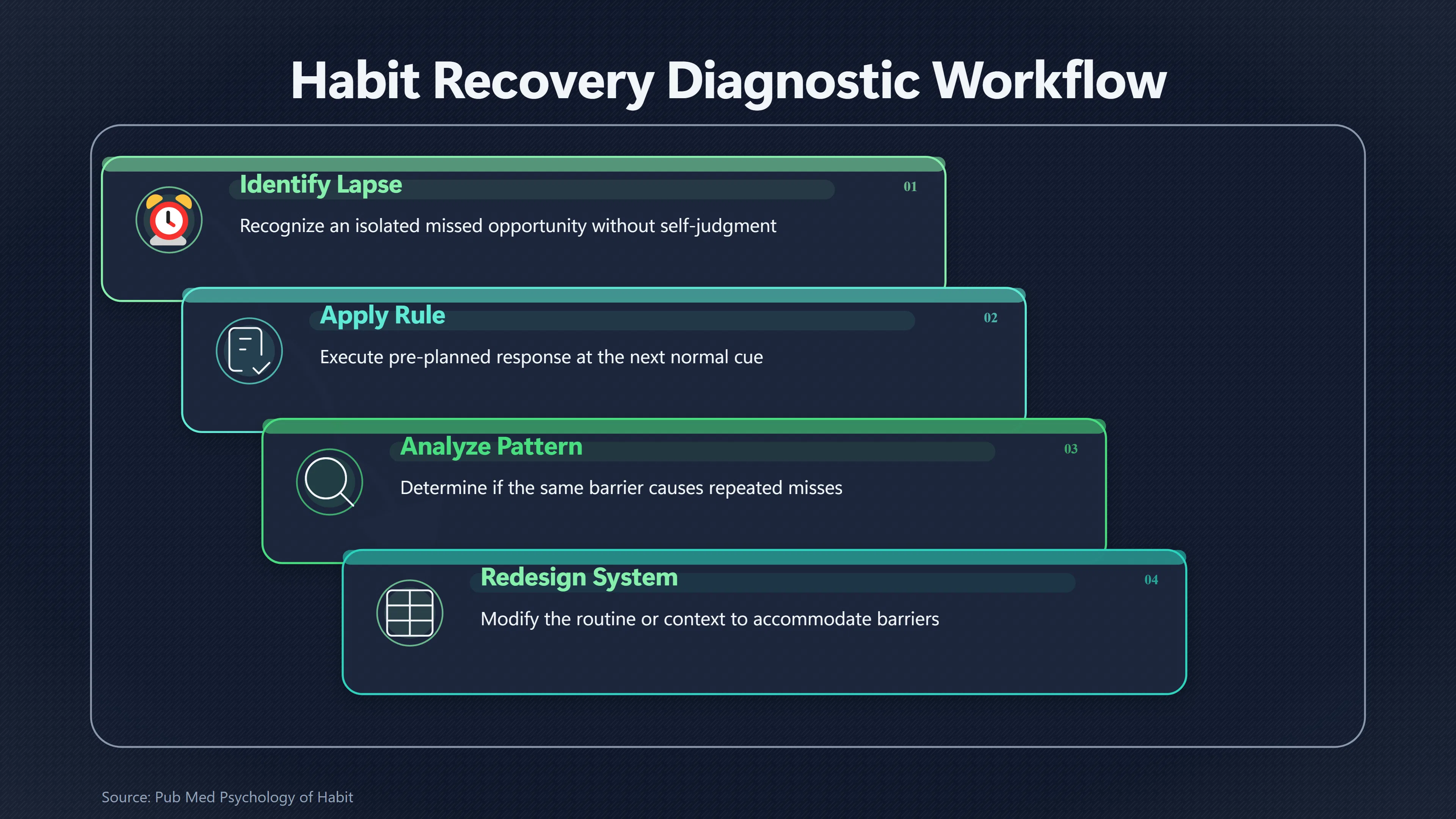
A recovery rule becomes especially useful because it creates a diagnostic test. If the habit resumes easily at its next normal opportunity, the interruption was probably just that: an interruption. If the recovery rule repeatedly fails, continuing to “restart” the identical arrangement is unlikely to reveal anything new.
Look at the sequence of missed opportunities instead:
One unusual miss → resume.
A train cancellation, exceptional deadline or one bad night’s sleep does not by itself justify redesigning the routine.
The same circumstance causes several misses → plan for that circumstance.
If exercise repeatedly disappears on days with late meetings, the useful recovery plan might move those sessions to mornings or establish an alternative short session for meeting days. Coping-planning research is particularly relevant here because anticipating barriers appears useful for behavioural maintenance, including when competing goals interfere with physical activity.[PubMed]pubmed.ncbi.nlm.nih.govOpen source on nih.gov.
Many different circumstances cause misses → inspect the basic demand.
A routine that survives only on unusually calm, energetic days may simply require more time, effort or preparation than everyday life reliably provides. Recovery should then mean changing the routine rather than repeatedly recommitting to the same failing specification.
The old context has disappeared → establish a new stable context.
A new job, house, timetable or caregiving responsibility can remove the cues that previously supported automatic behaviour. Research on habit discontinuity shows why merely remembering the old intention may be insufficient when the performance environment has changed.[PubMed]pubmed.ncbi.nlm.nih.govOpen source on nih.gov.
This distinction prevents “restart” from becoming an endless reset button. If someone has promised for six consecutive Mondays to restart an evening workout and work has prevented it every time, Monday number seven is not simply another motivational opportunity. Six repetitions of the same failure have produced evidence that the chosen time is unreliable.
Do Not Turn a Lapse Into a Verdict
There is also a psychological reason to separate the missed behaviour from the judgement made about it. Research on goal lapses suggests that self-critical responses can make constructive recovery harder, while self-compassion — responding to difficulty without excessive self-judgement — is associated with more adaptive responses to setbacks. A prospective study found that people who held more negative beliefs about self-compassion were less willing and less likely to respond compassionately to goal lapses.[PubMed]pubmed.ncbi.nlm.nih.govOpen source on nih.gov.
That does not mean that simply telling yourself to “be kind” guarantees better adherence. A 2023 experiment found that teaching participants about self-compassion changed some beliefs about it but did not produce evidence of greater self-compassionate responding to a recalled goal lapse. Knowledge alone was insufficient.[White Rose Research Online]eprints.whiterose.ac.ukOpen source on whiterose.ac.uk.
For habit recovery, the more concrete lesson is to replace moral interpretation with useful information. “I missed three workouts because I’m lazy” provides no obvious repair. “All three misses occurred when I arrived home after 7.30 pm” identifies a condition that can be designed around.
That is what makes recovery part of a self-improvement system rather than an exception to it. A good habit is not one whose owner never encounters disruption. It is one whose design contains a route back from disruption — and whose repeated failures trigger a change in the system rather than another attempt to force the same system to work.
A Practical Restart Rule
A compact recovery procedure can therefore be built around three decisions:
-
Treat an isolated miss as a miss, not a reset. Resume at the next appropriate opportunity rather than waiting for Monday, next month or another symbolic fresh start. The evidence does not support the idea that one missed opportunity destroys habit formation. Wiley Online Library
-
Return to the normal cue where possible. Re-establish the context in which the behaviour was being learned instead of inventing an elaborate catch-up routine. Stable contexts are associated with greater repetition and automaticity. PubMed
-
Escalate repeated misses from recovery to diagnosis. If the same barrier keeps producing lapses, create a coping plan or change the cue, timing or demand. Planning research indicates that anticipating barriers can support maintenance rather than relying on intention alone. PubMed
The useful measure of recovery is therefore not whether a streak remains visually unbroken. It is how reliably the behaviour returns after ordinary life interrupts it. Occasional misses are compatible with habit formation; repeated misses are data. The first needs a clear route back. The second needs a better-designed route forward.
Amazon book picks
Further Reading
Books and field guides related to How to Restart a Habit After You Miss. Use these as the next step if you want deeper reading beyond the article.
Atomic Habits
Rating: 3.5/5 from 7 Google Books ratings
The #1 New York Times bestseller. Over 25 million copies sold! Translated into 60+ languages! Tiny Changes, Remarkable Results No matter...
Tiny Habits
Improving your life is much easier than you think. Whether it’s losing weight, sleeping more, or restoring your work/life balance – the s...
The Power of Habit
Rating: 4.0/5 from 145 Google Books ratings
Duhigg takes us to the edge of scientific discoveries that explain why habits exist and how they can be changed. Distilling information i...
How to Change
Wall Street Journal bestseller “A welcome revelation.” --The Financial Times Award-winning Wharton Professor and Choiceology podcast host...
eBay marketplace picks
Marketplace Samples
Live-tested eBay searches with available results related to this page.
Selected frommotivational wall art oneBay.co.uk.



Endnotes
2.
Source: onlinelibrary.wiley.com
Link:https://onlinelibrary.wiley.com/doi/10.1002/ejsp.674
Source snippet
Wiley Online LibraryHow are habits formed: Modelling habit formation in the real world - Lally - 2010 - European Journal of Social Psycho...
3.
Source: sciencedirect.com
Link:https://www.sciencedirect.com/science/article/abs/pii/S0065260106380021
Source snippet
Implementation Intentions and Goal Achievement: A Meta‐analysis of Effects and Processes - ScienceDirect...
4.
Source: sciencedirect.com
Link:https://www.sciencedirect.com/science/chapter/bookseries/abs/pii/S0065260106380021
Source snippet
Implementation Intentions and Goal Achievement: A Meta‐analysis of Effects and Processes - ScienceDirect...
5.
Source: compass.onlinelibrary.wiley.com
Link:https://compass.onlinelibrary.wiley.com/doi/full/10.1111/spc3.12975
6.
Source: sciencedirect.com
Link:https://www.sciencedirect.com/org/science/article/pii/S1438887124002619
7.
Source: compass.onlinelibrary.wiley.com
Link:https://compass.onlinelibrary.wiley.com/doi/epdf/10.1111/spc3.12975
8.
Source: sciencedirect.com
Link:https://www.sciencedirect.com/science/article/abs/pii/S0191886918303611
9.
Source: sciencedirect.com
Link:https://www.sciencedirect.com/science/article/abs/pii/S0167629618301991
10.
Source: onlinelibrary.wiley.com
Link:https://onlinelibrary.wiley.com/doi/abs/10.1002/ejsp.674
11.
Source: onlinelibrary.wiley.com
Link:https://onlinelibrary.wiley.com/doi/10.1002/ejsp.674?538fcd4b_page=1&947f74f7page=3&=%2Fen-gt%2Four-commitment%23kI3HdLdDj7HLFW4BJlUYoy23RoHF9sl3JcIXrw%3D%3D
12.
Source: onlinelibrary.wiley.com
Link:https://onlinelibrary.wiley.com/doi/abs/10.1002/ejsp.674?aff_id=24772
13.
Source: onlinelibrary.wiley.com
Link:https://onlinelibrary.wiley.com/doi/abs/10.1002/ejsp.674?MixPanelId=15e3fe314440-0468d8411-64220f54-100000-15e3fe314460
14.
Source: onlinelibrary.wiley.com
Link:https://onlinelibrary.wiley.com/doi/abs/10.1002/ejsp.674?source=content_type%3Areact%7Cfirst_level_url%3Aarticle%7Csection%3Amain_content%7Cbutton%3Abody_link
15.
Source: onlinelibrary.wiley.com
Link:https://onlinelibrary.wiley.com/doi/abs/10.1002/ejsp.674?cf_chl_jschl_tk=pmd_EwcJDaCFBR9OVEL1O_0qjioww0Gc86ZzpBvCBFhrDcE-1635261061-0-gqNtZGzNAjujcnBszQi9
16.
Source: onlinelibrary.wiley.com
Link:https://onlinelibrary.wiley.com/doi/abs/10.1002/ejsp.674?msockid=17570258034862e732eb114c02616368
17.
Source: onlinelibrary.wiley.com
Link:https://onlinelibrary.wiley.com/doi/abs/10.1002/ejsp.674?msockid=038ed114f43667dd0790c4bef5146634
18.
Source: onlinelibrary.wiley.com
Link:https://onlinelibrary.wiley.com/doi/abs/10.1002/ejsp.674?538fcd4b_page=6&947f74f7_page=5
19.
Source: onlinelibrary.wiley.com
Link:https://onlinelibrary.wiley.com/doi/full/10.1002/ejsp.674
20.
Source: sciencedirect.com
Link:https://www.sciencedirect.com/science/article/pii/S0167629618301991
21.
Source: sciencedirect.com
Link:https://www.sciencedirect.com/science/article/abs/pii/S002210310600028X
23.
Source: pubmed.ncbi.nlm.nih.gov
Title: Pub Med Psychology of Habit
Link:https://pubmed.ncbi.nlm.nih.gov/26361052/
Source snippet
Psychology of Habit - PubMed...
25.
Source: pubmed.ncbi.nlm.nih.gov
Title: Pub Med Changing circumstances, disrupting habits
Link:https://pubmed.ncbi.nlm.nih.gov/15982113/
26.
Source: pmc.ncbi.nlm.nih.gov
Link:https://pmc.ncbi.nlm.nih.gov/articles/PMC4847906/
27.
Source: pubmed.ncbi.nlm.nih.gov
Link:https://pubmed.ncbi.nlm.nih.gov/17553212/
28.
Source: pubmed.ncbi.nlm.nih.gov
Link:https://pubmed.ncbi.nlm.nih.gov/26174696/
29.
Source: pubmed.ncbi.nlm.nih.gov
Link:https://pubmed.ncbi.nlm.nih.gov/27120333/
30.
Source: pubmed.ncbi.nlm.nih.gov
Link:https://pubmed.ncbi.nlm.nih.gov/35262948/
31.
Source: eprints.whiterose.ac.uk
Link:https://eprints.whiterose.ac.uk/id/eprint/184697/
32.
Source: eprints.whiterose.ac.uk
Link:https://eprints.whiterose.ac.uk/id/eprint/205561/
33.
Source: pubmed.ncbi.nlm.nih.gov
Link:https://pubmed.ncbi.nlm.nih.gov/42352822/
34.
Source: pmc.ncbi.nlm.nih.gov
Link:https://pmc.ncbi.nlm.nih.gov/articles/PMC13295560/
35.
Source: pmc.ncbi.nlm.nih.gov
Link:https://pmc.ncbi.nlm.nih.gov/articles/PMC13114073/
36.
Source: pmc.ncbi.nlm.nih.gov
Link:https://pmc.ncbi.nlm.nih.gov/articles/PMC11920387/
37.
Source: pubmed.ncbi.nlm.nih.gov
Link:https://pubmed.ncbi.nlm.nih.gov/39679978/
38.
Source: pmc.ncbi.nlm.nih.gov
Link:https://pmc.ncbi.nlm.nih.gov/articles/PMC11641623/
39.
Source: pubmed.ncbi.nlm.nih.gov
Link:https://pubmed.ncbi.nlm.nih.gov/39685110/
40.
Source: pmc.ncbi.nlm.nih.gov
Link:https://pmc.ncbi.nlm.nih.gov/articles/PMC11574773/
41.
Source: pmc.ncbi.nlm.nih.gov
Link:https://pmc.ncbi.nlm.nih.gov/articles/PMC11586801/
42.
Source: pubmed.ncbi.nlm.nih.gov
Link:https://pubmed.ncbi.nlm.nih.gov/39424408/
43.
Source: pmc.ncbi.nlm.nih.gov
Link:https://pmc.ncbi.nlm.nih.gov/articles/PMC11635918/
44.
Source: pmc.ncbi.nlm.nih.gov
Link:https://pmc.ncbi.nlm.nih.gov/articles/PMC11652125/
45.
Source: pmc.ncbi.nlm.nih.gov
Link:https://pmc.ncbi.nlm.nih.gov/articles/PMC11161714/
46.
Source: pmc.ncbi.nlm.nih.gov
Link:https://pmc.ncbi.nlm.nih.gov/articles/PMC11733102/
47.
Source: pubmed.ncbi.nlm.nih.gov
Link:https://pubmed.ncbi.nlm.nih.gov/37619622/
48.
Source: pmc.ncbi.nlm.nih.gov
Link:https://pmc.ncbi.nlm.nih.gov/articles/PMC10543633/
49.
Source: pubmed.ncbi.nlm.nih.gov
Link:https://pubmed.ncbi.nlm.nih.gov/37667612/
50.
Source: pmc.ncbi.nlm.nih.gov
Link:https://pmc.ncbi.nlm.nih.gov/articles/PMC10578412/
51.
Source: pmc.ncbi.nlm.nih.gov
Link:https://pmc.ncbi.nlm.nih.gov/articles/PMC10151500/
52.
Source: pmc.ncbi.nlm.nih.gov
Link:https://pmc.ncbi.nlm.nih.gov/articles/PMC10585941/
53.
Source: pmc.ncbi.nlm.nih.gov
Link:https://pmc.ncbi.nlm.nih.gov/articles/PMC10305802/
54.
Source: pmc.ncbi.nlm.nih.gov
Link:https://pmc.ncbi.nlm.nih.gov/articles/PMC10087560/
55.
Source: pubmed.ncbi.nlm.nih.gov
Link:https://pubmed.ncbi.nlm.nih.gov/35742582/
56.
Source: pmc.ncbi.nlm.nih.gov
Link:https://pmc.ncbi.nlm.nih.gov/articles/PMC9223740/
57.
Source: pubmed.ncbi.nlm.nih.gov
Link:https://pubmed.ncbi.nlm.nih.gov/35436232/
58.
Source: pmc.ncbi.nlm.nih.gov
Link:https://pmc.ncbi.nlm.nih.gov/articles/PMC12318445/
59.
Source: pubmed.ncbi.nlm.nih.gov
Link:https://pubmed.ncbi.nlm.nih.gov/34702786/
60.
Source: pmc.ncbi.nlm.nih.gov
Link:https://pmc.ncbi.nlm.nih.gov/articles/PMC8149892/
61.
Source: pmc.ncbi.nlm.nih.gov
Link:https://pmc.ncbi.nlm.nih.gov/articles/PMC8774291/
62.
Source: pmc.ncbi.nlm.nih.gov
Link:https://pmc.ncbi.nlm.nih.gov/articles/PMC7429262/
63.
Source: pmc.ncbi.nlm.nih.gov
Link:https://pmc.ncbi.nlm.nih.gov/articles/PMC6533136/
64.
Source: pmc.ncbi.nlm.nih.gov
Link:https://pmc.ncbi.nlm.nih.gov/articles/PMC6440859/
65.
Source: pmc.ncbi.nlm.nih.gov
Link:https://pmc.ncbi.nlm.nih.gov/articles/PMC6235272/
66.
Source: pubmed.ncbi.nlm.nih.gov
Link:https://pubmed.ncbi.nlm.nih.gov/30336306/
67.
Source: pubmed.ncbi.nlm.nih.gov
Link:https://pubmed.ncbi.nlm.nih.gov/29580155/
68.
Source: pubmed.ncbi.nlm.nih.gov
Link:https://pubmed.ncbi.nlm.nih.gov/26361052/?dopt=Abstract
69.
Source: pubmed.ncbi.nlm.nih.gov
Link:https://pubmed.ncbi.nlm.nih.gov/25587901/
70.
Source: pubmed.ncbi.nlm.nih.gov
Link:https://pubmed.ncbi.nlm.nih.gov/24446685/
71.
Source: pmc.ncbi.nlm.nih.gov
Link:https://pmc.ncbi.nlm.nih.gov/articles/PMC4566897/
72.
Source: pmc.ncbi.nlm.nih.gov
Link:https://pmc.ncbi.nlm.nih.gov/articles/PMC3505409/
73.
Source: pubmed.ncbi.nlm.nih.gov
Link:https://pubmed.ncbi.nlm.nih.gov/21749245/
74.
Source: doi.org
Link:https://doi.org/10.1111/j.1467-6486.2009.00821.x
75.
Source: pmc.ncbi.nlm.nih.gov
Link:https://pmc.ncbi.nlm.nih.gov/articles/PMC2613403/
76.
Source: pubmed.ncbi.nlm.nih.gov
Link:https://pubmed.ncbi.nlm.nih.gov/34851220/
77.
Source: pubmed.ncbi.nlm.nih.gov
Link:https://pubmed.ncbi.nlm.nih.gov/17678574/
78.
Source: pubmed.ncbi.nlm.nih.gov
Link:https://pubmed.ncbi.nlm.nih.gov/21985115/
79.
Source: pmc.ncbi.nlm.nih.gov
Link:https://pmc.ncbi.nlm.nih.gov/articles/PMC7872013/
80.
Source: pubmed.ncbi.nlm.nih.gov
Link:https://pubmed.ncbi.nlm.nih.gov/22107076/
81.
Source: pubmed.ncbi.nlm.nih.gov
Link:https://pubmed.ncbi.nlm.nih.gov/17953497/
82.
Source: pubmed.ncbi.nlm.nih.gov
Link:https://pubmed.ncbi.nlm.nih.gov/20063934/
83.
Source: pubmed.ncbi.nlm.nih.gov
Link:https://pubmed.ncbi.nlm.nih.gov/20205020/
84.
Source: pubmed.ncbi.nlm.nih.gov
Link:https://pubmed.ncbi.nlm.nih.gov/20186639/
85.
Source: pmc.ncbi.nlm.nih.gov
Link:https://pmc.ncbi.nlm.nih.gov/articles/PMC13193246/
86.
Source: doi.org
Link:https://doi.org/10.1007/978
Additional References
87.
Source: scispace.com
Title: how are habits formed modelling habit formation in the real 4iq5e623zp
Link:https://scispace.com/papers/how-are-habits-formed-modelling-habit-formation-in-the-real-4iq5e623zp
Source snippet
SciSpace(PDF) How are habits formed: Modelling habit formation in the real world (2010) | Phillippa Lally | 1734 Citations...
88.
Source: youtube.com
Title: How to Get Back on Track (Without Guilt or Starting Over)
Link:https://www.youtube.com/watch?v=Pt6BuJXSMCc
Source snippet
For a direct breakdown of how to handle lapses without losing momentum, watch The Two Day Rule by Matt D'Avella. It explains the practica...
89.
Source: psychologicalscience.org
Link:https://www.psychologicalscience.org/conventions/archive/2022annual/paper/39997/
90.
Source: youtube.com
Title: How To Get Back On Track Instantly (after falling off your routine)
Link:https://www.youtube.com/watch?v=jAfs6pdlgMA
Source snippet
Get Back On Track With Your Goals & Habits (Practical Guide)...
91.
Source: youtube.com
Title: Get Back On Track With Your Goals & Habits (Practical Guide)
Link:https://www.youtube.com/watch?v=lhCLmhqggSg
Source snippet
The Real Reason You Can't Stay Consistent (Even When You Try)...
92.
Source: youtube.com
Title: The Real Reason You Can’t Stay Consistent (Even When You Try)
Link:https://www.youtube.com/watch?v=2-y3n3Hppno
Source snippet
How to Get Back on Track (Without Guilt or Starting Over)...
93.
Source: researchgate.net
Link:https://www.researchgate.net/publication/37367696_Implementation_Intentions_and_Goal_Achievement_A_Meta-Analysis_of_Effects_and_Processes
94.
Source: scapps.org
Link:https://www.scapps.org/jems/index.php/1/en/article/view/1183
95.
Source: frontiersin.org
Link:https://www.frontiersin.org/journals/psychology/articles/10.3389/fpsyg.2022.883795/full
96.
Source: tandfonline.com
Link:https://www.tandfonline.com/doi/full/10.1080/08870446.2025.2509070