Within Fewer Decisions
Why Good Intentions Vanish at the Crucial Moment
A plan can fail even when motivation is intact because the intended action never comes to mind when the opportunity appears.
On this page
- How prospective memory differs from forming an intention
- Why recognizable cues make intended actions easier to retrieve
- Ways to design action moments that are harder to miss
Page outline Jump by section
Introduction
A self-improvement plan can fail even when the goal is still wanted and motivation has not disappeared. The failure may occur because, when the opportunity to act finally arrives, the intention simply does not come to mind. Psychologists call the capacity to remember and carry out a previously formed future intention prospective memory. It is what allows “I must do that later” to become action at the appropriate moment.[ScienceDirect]sciencedirect.comThe effect of implementation intention on prospective memory: A systematic and meta-analytic review - ScienceDirectMarch 30…

This distinction matters because remembering an intention is not the same as remembering to retrieve it. You can know perfectly well that you planned to stretch after lunch, send a message when you reach the office or prepare tomorrow’s lunch before leaving the kitchen, yet miss the relevant opportunity while absorbed in something else. Research suggests that prospective remembering improves when the action is attached to a recognisable cue, when that cue fits naturally with what will already command attention, and when reminders make the action moment difficult to overlook.[Taylor & Francis Online]tandfonline.comTaylor & Francis OnlineImplementation intentions forge a strong cue–response link and boost prospective memory performance: Journal of Co…
Forming an intention is not remembering to act
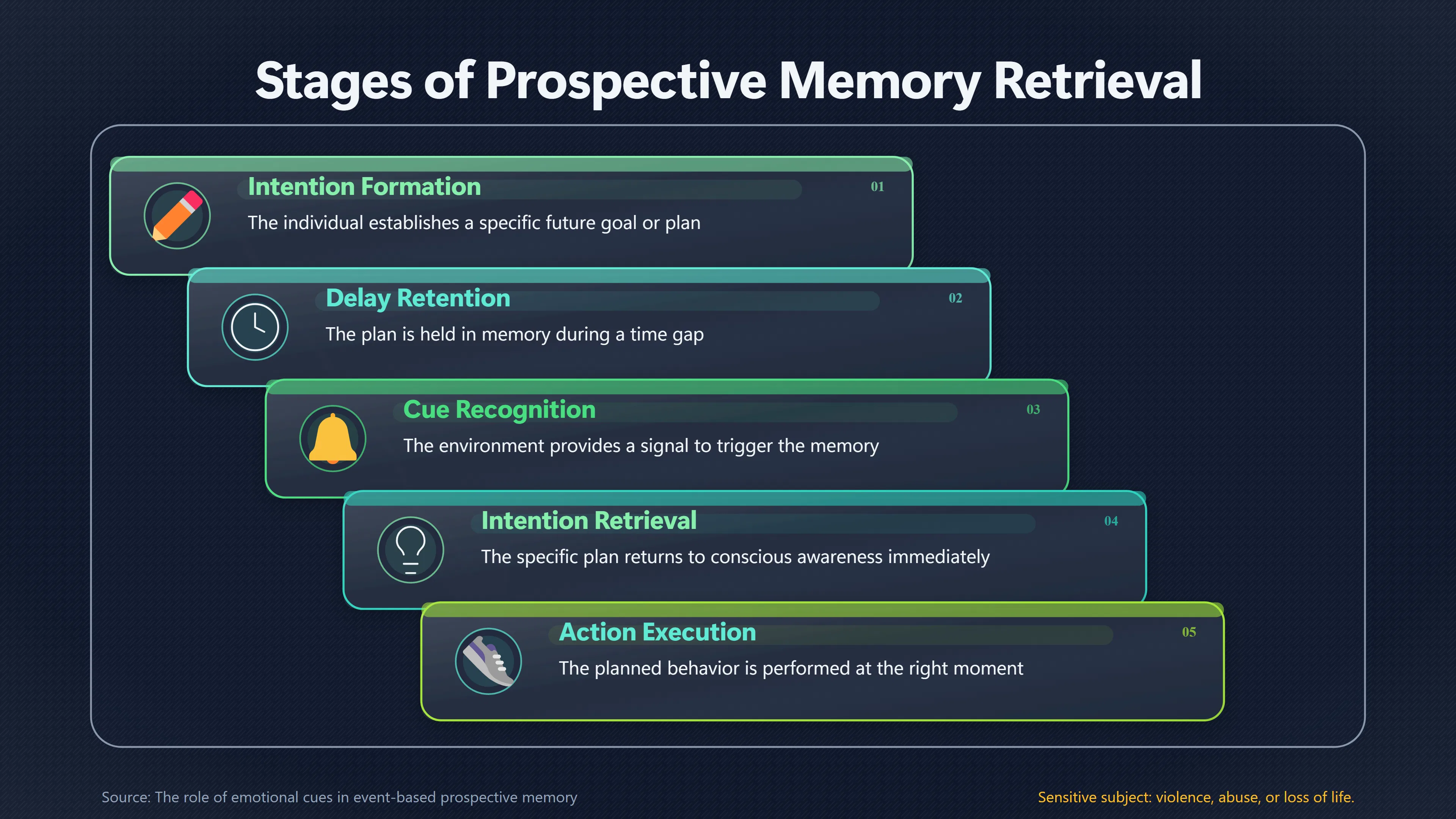
Ordinary memory is often discussed as though the main problem were retaining information. Prospective memory poses an additional problem: something must prompt retrieval at the right time. Researchers commonly distinguish several stages, including forming an intention, retaining it during a delay, recognising the relevant cue, retrieving the intention and executing it. A breakdown at the retrieval stage can therefore produce an odd but familiar experience: the intention returns to mind perfectly clearly, but only after its useful moment has passed.[ScienceDirect]sciencedirect.comThe effect of implementation intention on prospective memory: A systematic and meta-analytic review - ScienceDirectMarch 30…
That is why strengthening motivation or repeatedly thinking about a goal at planning time does not necessarily solve this particular failure. In one experiment comparing prospective-memory strategies, participants using an if/when–then implementation intention performed better than controls, whereas ordinary rehearsal of the same cue and response did not produce a significant benefit. Because the content was held constant, the result points towards the importance of how the future cue and action are linked rather than mere repetition of the intention.[Taylor & Francis Online]tandfonline.comTaylor & Francis OnlineImplementation intentions forge a strong cue–response link and boost prospective memory performance: Journal of Co…
An earlier experiment with older adults illustrates the distinction particularly well. Participants who formed detailed implementation intentions were more than twice as likely to initiate an intended behaviour than people who had merely received or rehearsed the instruction. Yet implementation intentions did not improve another task in which the necessary response was already prompted by salient cues. The planning intervention was especially useful where remembering depended on self-initiation.[Association for Psychological Science]psychologicalscience.orgAssociation for Psychological ScienceImplementation Intentions and Facilitation of Prospective Memory - Psychological Science - APS…
This reframes some apparently motivational failures. Suppose you sincerely decide in the morning that, when you get home, you will put your running shoes on before sitting down. At 18:15 you enter the house while reading a message, put your bag away, walk into the kitchen and begin making dinner. At 21:00 you remember the plan. Nothing about that sequence demonstrates that you secretly preferred not to exercise. The more immediate failure occurred earlier: the intention was not retrieved while the opportunity to begin was available.
Why recognisable cues make intentions easier to retrieve
The most useful distinction for designing these moments is between focal and nonfocal cues. A cue is relatively focal when noticing its relevant feature is already part of what you are doing. A classic laboratory example is looking for a particular word while performing a task that already requires processing words. A nonfocal cue asks you to notice a feature that the ongoing activity does not naturally make you process — for example, detecting a particular syllable while concentrating on the meaning of words.[PubMed Central (PMC)]pmc.ncbi.nlm.nih.govPubMed Central (PMC)Prospective Memory and Aging: Evidence for Preserved Spontaneous Retrieval with Exact but Not Related Cues - PMC…
This seemingly technical distinction maps neatly onto everyday plans. “When I finish brushing my teeth, I will take my medication” provides an event that is already being processed because you are performing it. “At some point while getting ready, remember the medication” supplies much less retrieval support. Likewise, “when I put my lunch plate in the sink, I will fill my water bottle” has a concrete encounter built into it; “drink more water this afternoon” largely leaves remembering to you.
Experimental findings suggest why this matters. Research supporting the multiprocess account of prospective memory finds that focal cues can sometimes trigger relatively spontaneous retrieval, whereas nonfocal cues tend to require more deliberate monitoring. In experiments comparing the two, participants showed interference with their ongoing activity when watching for nonfocal cues but could perform well with focal cues even without comparable evidence of continuous monitoring.[PubMed Central (PMC)]pmc.ncbi.nlm.nih.govPubMed Central (PMC)Focal/Nonfocal Cue Effects in Prospective Memory: Monitoring Difficulty or Different Retrieval Processes? - PMC… A neuroimaging meta-analysis likewise found different patterns of brain activity for focal and nonfocal prospective-memory demands, consistent with nonfocal retrieval placing greater reliance on top-down processes.[PubMed Central (PMC)]pmc.ncbi.nlm.nih.govPubMed Central (PMC)Effects of cue focality on the neural mechanisms of prospective memory: A meta-analysis of neuroimaging studies - PMC…
A 2026 systematic review of 34 electroencephalography studies adds further detail. It found evidence for multiple stages — including preparatory attention, cue detection, intention retrieval and post-retrieval control — rather than a single prospective-memory mechanism. Nonfocal cues were associated with greater retrieval-related and post-retrieval control activity, while early effects were also influenced by how perceptually salient a cue was.[ScienceDirect]sciencedirect.comHow do we remember the future? A systematic review of ERP components in focal and nonfocal prospective memory tasks - Scienc…
The practical implication is not simply “make cues noticeable”. A bright cue can attract attention, but a good action cue also needs to retrieve the correct intention. The useful design question is: What event will I reliably encounter at the moment when this action becomes possible, and will encountering it naturally make the plan relevant?
Make the cue retrieve the action
Implementation intentions apply this principle deliberately. Instead of encoding only an outcome such as “exercise today”, the person specifies a future situation and response: when situation Y occurs, I will perform action X. The point is to make Y function as a retrieval route to X.
Laboratory evidence supports that interpretation. Research has found that implementation intentions can increase the accessibility of the specified cue and strengthen its association with the planned response. In one study designed to separate these processes from simple familiarity and rehearsal, implementation-intention participants responded more quickly to the critical cue and showed evidence of a strengthened cue–response link.[PubMed Central (PMC)]pmc.ncbi.nlm.nih.govOpen source on nih.gov. Another prospective-memory experiment similarly found that the if/when–then format strengthened cue–response links and improved later performance when compared with ordinary rehearsal and control conditions.[Taylor & Francis Online]tandfonline.comTaylor & Francis OnlineImplementation intentions forge a strong cue–response link and boost prospective memory performance: Journal of Co…
Across studies, the effect is meaningful rather than guaranteed. A systematic review and meta-analysis containing 36 comparisons estimated an overall improvement in prospective-memory performance of about d = 0.51. Among healthy young adults the estimated effect was d = 0.45, while combined verbal-and-imagery implementation intentions produced a somewhat larger estimate of d = 0.59.[ScienceDirect]sciencedirect.comThe effect of implementation intention on prospective memory: A systematic and meta-analytic review - ScienceDirectMarch 30…
The evidence does not justify treating if–then plans as an automatic switch. One series of experiments found that implementation-intention encoding improved prospective memory but did not reliably protect performance when cognitive demands became high; in one experiment, behavioural practice performed better under high demand.[DOI]doi.orgOpen source on doi.org. Other experiments have reported stronger resilience under attentional demands, illustrating that the precise boundary conditions remain more complicated than the popular claim that an implementation intention makes behaviour automatic.[PubMed]pubmed.ncbi.nlm.nih.govOpen source on nih.gov.
For self-improvement, the safer conclusion is therefore that a well-specified cue improves the odds that the intended action will be retrieved. It does not make distraction, competing goals or demanding environments irrelevant.
Time is a weaker cue when nobody makes you notice it
Some intentions have a naturally occurring event attached to them: when the meeting ends, send the notes; when the kettle boils, prepare the medication; when you close the laptop, pack the gym kit. Others are time-based: call at 15:00, leave at 17:30, practise for ten minutes at 20:00.
Time-based prospective memory creates a particular problem because time passing does not necessarily interrupt whatever currently occupies attention. Unless something external signals the target time, people have to monitor it. Research commonly finds a roughly J-shaped pattern of clock checking: relatively little checking earlier in the interval and increasingly frequent checking as the target approaches. Checks made strategically near the deadline are associated with better prospective-memory performance.[PubMed Central (PMC)]pmc.ncbi.nlm.nih.govOpen source on nih.gov.
That monitoring is not free. A recent review notes that adding a time-based prospective-memory demand can slow performance on the ongoing task, and longer delays make sustained monitoring harder.[PubMed Central (PMC)]pmc.ncbi.nlm.nih.govOpen source on nih.gov. In a 2024 naturalistic study requiring participants to send a text after delays ranging from one to six days, prospective-memory performance declined between one-day and multi-day delays. Explicit reminders several hours before the required response improved performance relative to implicit reminders.[PubMed]pubmed.ncbi.nlm.nih.govOpen source on nih.gov.
For a planned behaviour, “do it at 16:00” therefore leaves an important question unanswered: what will cause 16:00 to enter awareness? A calendar alert, alarm or other external prompt can supply the missing event. Without one, the plan may quietly depend on periodically remembering that there is something you are supposed to remember.
Design action moments that are harder to miss
The practical aim is not to keep every intention continuously active in your head. That would compete with whatever else you need to do. Instead, make the environment carry more of the retrieval burden.
Research on external reminders supports this approach. In a laboratory study involving younger and older adults, both self-generated and experimenter-provided reminders improved prospective-memory performance compared with having no reminders.[PubMed]pubmed.ncbi.nlm.nih.govOpen source on nih.gov. Experimental work on cognitive offloading — placing information into the environment rather than retaining it internally — has likewise found that setting reminders can improve fulfilment of delayed intentions, with people tending to use them more when memory load or the likelihood of distraction rises.[Sage Journals]journals.sagepub.comOpen source on sagepub.com. More recent research confirms that people are particularly inclined to consult reminders under higher prospective-memory load, although they become less willing to do so when checking carries greater effort or time costs.[PubMed Central (PMC)]pmc.ncbi.nlm.nih.govOpen source on nih.gov.
For an action you genuinely intend to perform but repeatedly forget, four design choices follow from this evidence:
- Choose an encounter, not a vague period. “After I put my breakfast bowl in the dishwasher, I take the vitamin” gives memory a recognisable event. “Take it in the morning” gives it a broad window.
- Put the cue where attention will already be. Attach the intention to an event or object that is naturally processed during the relevant activity rather than requiring yourself to scan continually for an unrelated signal. This is the everyday advantage suggested by focal-cue research.[PubMed Central (PMC)]pmc.ncbi.nlm.nih.govPubMed Central (PMC)Focal/Nonfocal Cue Effects in Prospective Memory: Monitoring Difficulty or Different Retrieval Processes? - PMC…
- Specify the first observable action. “When I close my work laptop, I put my trainers on” creates a tighter cue–response relation than “after work, I should exercise”. The implementation-intention evidence indicates that linking a specified situation to a specified response is part of what improves prospective remembering.[Taylor & Francis Online]tandfonline.comTaylor & Francis OnlineImplementation intentions forge a strong cue–response link and boost prospective memory performance: Journal of Co…
- Externalise fragile intentions. If the action depends on an arbitrary time, a long delay or a moment likely to be crowded by other demands, use a reminder that appears close enough to the actionable moment to prompt the intended behaviour. Experimental and naturalistic research both show benefits from reminders, although their effectiveness depends on their design and context.[PubMed]pubmed.ncbi.nlm.nih.govOpen source on nih.gov.
These techniques fit the broader principle of reducing decisions at moments when action matters, but their specific value is different. They do not merely answer what should I do? They help ensure that the answer comes to mind at all.
The crucial diagnostic question
When an intended behaviour repeatedly fails, it is tempting to conclude that the goal was insufficiently important. Prospective-memory research suggests a more precise diagnosis. Ask what actually happened at the critical moment.
If you remembered the plan and deliberately chose something else, the problem lies elsewhere. If you remembered but became stuck deciding how to start, reducing decisions may help. But if the relevant opportunity passed and the plan returned to mind only afterwards, the immediate failure was prospective remembering.
That distinction changes the intervention. More enthusiasm at goal-setting time does not directly repair a missing retrieval cue. A better response is to redesign the action moment: identify an event you will reliably encounter, link that event explicitly to the first action, and add an external reminder when the natural cue is weak or the timing is arbitrary.
Effective self-improvement therefore depends partly on designing for a mind that will later be busy thinking about something else. A good intention tells your present self what you mean to do. A good prospective-memory design gives your future self a recognisable reason to remember it precisely when doing it becomes possible.
Amazon book picks
Further Reading
Books and field guides related to Why Good Intentions Vanish at the Crucial Moment. Use these as the next step if you want deeper reading beyond the article.
Getting Things Done
The personal productivity guru (Fast Company) delivers powerful methods that vastly increase your efficiency and creative results-at work...
Atomic Habits
Rating: 3.5/5 from 7 Google Books ratings
The #1 New York Times bestseller. Over 25 million copies sold! Translated into 60+ languages! Tiny Changes, Remarkable Results No matter...
The Organized Mind
'Thought-provoking and practical ... Good advice based on sound neuroscientific principles' Sunday Times In The Organized Mind, New York...
Make Time
'If you want to achieve more (without going nuts), read this book.' - Charles Duhigg, bestselling author of The Power of Habit and Smarte...
eBay marketplace picks
Marketplace Samples
Live-tested eBay searches with available results related to this page.
Selected fromdesk reminder sign oneBay.co.uk.


Endnotes
1.
Source: sciencedirect.com
Link:https://www.sciencedirect.com/science/article/pii/S0165178115000360
Source snippet
The effect of implementation intention on prospective memory: A systematic and meta-analytic review - ScienceDirectMarch 30...
2.
Source: sciencedirect.com
Link:https://www.sciencedirect.com/science/article/pii/S030105112600147X
Source snippet
How do we remember the future? A systematic review of ERP components in focal and nonfocal prospective memory tasks - Scienc...
3.
Source: doi.org
Link:https://doi.org/10.3758/MC.38.2.221
4.
Source: sciencedirect.com
Title: The role of emotional cues in event-based prospective memory
Link:https://www.sciencedirect.com/science/article/pii/S0304394023002926
5.
Source: sciencedirect.com
Title: Multisensory processing in event-based prospective memory
Link:https://www.sciencedirect.com/science/article/pii/S0001691818301823
6.
Source: sciencedirect.com
Link:https://www.sciencedirect.com/science/article/abs/pii/S0001691817301580
7.
Source: sciencedirect.com
Link:https://www.sciencedirect.com/science/article/pii/S0278262616301749
8.
Source: sciencedirect.com
Title: Forming implementation intentions improves prospective memory in early psychosis
Link:https://www.sciencedirect.com/science/article/abs/pii/S0165178115004199
9.
Source: sciencedirect.com
Link:https://www.sciencedirect.com/science/article/abs/pii/S0165178115000360
10.
Source: doi.org
Link:https://doi.org/10.3758/BF03206383
11.
Source: sciencedirect.com
Link:https://www.sciencedirect.com/science/article/pii/S0885201400000162
12.
Source: sciencedirect.com
Link:https://www.sciencedirect.com/science/article/abs/pii/S002210310600028X
13.
Source: sciencedirect.com
Link:https://www.sciencedirect.com/science/article/abs/pii/S1053810020300179
14.
Source: sciencedirect.com
Title: Prospective Memory
Link:https://www.sciencedirect.com/topics/social-sciences/prospective-memory
15.
Source: sciencedirect.com
Link:https://www.sciencedirect.com/science/article/pii/S0885201416300442
16.
Source: sciencedirect.com
Link:https://www.sciencedirect.com/science/article/pii/S0149763415000524
17.
Source: sciencedirect.com
Link:https://www.sciencedirect.com/science/article/abs/pii/S0278262616301749
18.
Source: pubmed.ncbi.nlm.nih.gov
Link:https://pubmed.ncbi.nlm.nih.gov/32239191/
Source snippet
Instruments Measuring Prospective Memory: A Systematic and Meta-Analytic Review - PubMed...
19.
Source: tandfonline.com
Link:https://www.tandfonline.com/doi/full/10.1080/20445911.2014.975816
Source snippet
Taylor & Francis OnlineImplementation intentions forge a strong cue–response link and boost prospective memory performance: Journal of Co...
20.
Source: pmc.ncbi.nlm.nih.gov
Link:https://pmc.ncbi.nlm.nih.gov/articles/PMC2864946/
Source snippet
PubMed Central (PMC)Focal/Nonfocal Cue Effects in Prospective Memory: Monitoring Difficulty or Different Retrieval Processes? - PMC...
21.
Source: psychologicalscience.org
Link:https://www.psychologicalscience.org/journals/psychological-science/1467-9280.00385/
Source snippet
Association for Psychological ScienceImplementation Intentions and Facilitation of Prospective Memory - Psychological Science - APS...
22.
Source: pmc.ncbi.nlm.nih.gov
Link:https://pmc.ncbi.nlm.nih.gov/articles/PMC12327648/
Source snippet
PubMed Central (PMC)Prospective Memory and Aging: Evidence for Preserved Spontaneous Retrieval with Exact but Not Related Cues - PMC...
23.
Source: pmc.ncbi.nlm.nih.gov
Link:https://pmc.ncbi.nlm.nih.gov/articles/PMC4868976/
Source snippet
PubMed Central (PMC)Effects of cue focality on the neural mechanisms of prospective memory: A meta-analysis of neuroimaging studies - PMC...
24.
Source: pubmed.ncbi.nlm.nih.gov
Link:https://pubmed.ncbi.nlm.nih.gov/42364798/
Source snippet
How do we remember the future? A systematic review of ERP components in focal and nonfocal prospective memory tasks - PubMed...
25.
Source: pmc.ncbi.nlm.nih.gov
Link:https://pmc.ncbi.nlm.nih.gov/articles/PMC4500900/
26.
Source: pubmed.ncbi.nlm.nih.gov
Link:https://pubmed.ncbi.nlm.nih.gov/25639373/
27.
Source: pubmed.ncbi.nlm.nih.gov
Link:https://pubmed.ncbi.nlm.nih.gov/18604955/
28.
Source: pmc.ncbi.nlm.nih.gov
Link:https://pmc.ncbi.nlm.nih.gov/articles/PMC12916548/
29.
Source: pmc.ncbi.nlm.nih.gov
Link:https://pmc.ncbi.nlm.nih.gov/articles/PMC10585947/
30.
Source: pubmed.ncbi.nlm.nih.gov
Link:https://pubmed.ncbi.nlm.nih.gov/38968418/
31.
Source: pubmed.ncbi.nlm.nih.gov
Link:https://pubmed.ncbi.nlm.nih.gov/22489707/
32.
Source: journals.sagepub.com
Link:https://journals.sagepub.com/doi/10.1080/17470218.2014.972963
33.
Source: pmc.ncbi.nlm.nih.gov
Link:https://pmc.ncbi.nlm.nih.gov/articles/PMC12305806/
34.
Source: pubmed.ncbi.nlm.nih.gov
Title: Pub Med Cost avoidance underlies decisions to use prospective memory reminders
Link:https://pubmed.ncbi.nlm.nih.gov/39930086/
35.
Source: pubmed.ncbi.nlm.nih.gov
Link:https://pubmed.ncbi.nlm.nih.gov/36201804/
36.
Source: pmc.ncbi.nlm.nih.gov
Link:https://pmc.ncbi.nlm.nih.gov/articles/PMC13269919/
37.
Source: pmc.ncbi.nlm.nih.gov
Link:https://pmc.ncbi.nlm.nih.gov/articles/PMC11927240/
38.
Source: pubmed.ncbi.nlm.nih.gov
Link:https://pubmed.ncbi.nlm.nih.gov/40080255/
39.
Source: pmc.ncbi.nlm.nih.gov
Link:https://pmc.ncbi.nlm.nih.gov/articles/PMC10821954/
40.
Source: pubmed.ncbi.nlm.nih.gov
Link:https://pubmed.ncbi.nlm.nih.gov/38280894/
41.
Source: pubmed.ncbi.nlm.nih.gov
Link:https://pubmed.ncbi.nlm.nih.gov/36988201/
42.
Source: pubmed.ncbi.nlm.nih.gov
Link:https://pubmed.ncbi.nlm.nih.gov/36945870/
43.
Source: pmc.ncbi.nlm.nih.gov
Link:https://pmc.ncbi.nlm.nih.gov/articles/PMC9366850/
44.
Source: pmc.ncbi.nlm.nih.gov
Link:https://pmc.ncbi.nlm.nih.gov/articles/PMC9274250/
45.
Source: pubmed.ncbi.nlm.nih.gov
Link:https://pubmed.ncbi.nlm.nih.gov/35653723/
46.
Source: pmc.ncbi.nlm.nih.gov
Link:https://pmc.ncbi.nlm.nih.gov/articles/PMC8821124/
47.
Source: pmc.ncbi.nlm.nih.gov
Link:https://pmc.ncbi.nlm.nih.gov/articles/PMC8818949/
48.
Source: pmc.ncbi.nlm.nih.gov
Link:https://pmc.ncbi.nlm.nih.gov/articles/PMC8381742/
49.
Source: pubmed.ncbi.nlm.nih.gov
Link:https://pubmed.ncbi.nlm.nih.gov/34786698/
50.
Source: pubmed.ncbi.nlm.nih.gov
Link:https://pubmed.ncbi.nlm.nih.gov/34753411/
51.
Source: pubmed.ncbi.nlm.nih.gov
Link:https://pubmed.ncbi.nlm.nih.gov/34029293/
52.
Source: pubmed.ncbi.nlm.nih.gov
Link:https://pubmed.ncbi.nlm.nih.gov/33594521/
53.
Source: pubmed.ncbi.nlm.nih.gov
Link:https://pubmed.ncbi.nlm.nih.gov/30957661/
54.
Source: journals.sagepub.com
Link:https://journals.sagepub.com/doi/10.1177/1747021819845622
55.
Source: pmc.ncbi.nlm.nih.gov
Link:https://pmc.ncbi.nlm.nih.gov/articles/PMC6070398/
56.
Source: pmc.ncbi.nlm.nih.gov
Link:https://pmc.ncbi.nlm.nih.gov/articles/PMC5991366/
57.
Source: pubmed.ncbi.nlm.nih.gov
Link:https://pubmed.ncbi.nlm.nih.gov/29318922/
58.
Source: journals.sagepub.com
Link:https://journals.sagepub.com/doi/10.1080/17470218.2017.1307867
59.
Source: pubmed.ncbi.nlm.nih.gov
Link:https://pubmed.ncbi.nlm.nih.gov/28145153/
60.
Source: pubmed.ncbi.nlm.nih.gov
Link:https://pubmed.ncbi.nlm.nih.gov/27643953/
61.
Source: pubmed.ncbi.nlm.nih.gov
Link:https://pubmed.ncbi.nlm.nih.gov/27185531/
62.
Source: pubmed.ncbi.nlm.nih.gov
Link:https://pubmed.ncbi.nlm.nih.gov/26142837/
63.
Source: pmc.ncbi.nlm.nih.gov
Link:https://pmc.ncbi.nlm.nih.gov/articles/PMC4513235/
64.
Source: pmc.ncbi.nlm.nih.gov
Link:https://pmc.ncbi.nlm.nih.gov/articles/PMC4500919/
65.
Source: pmc.ncbi.nlm.nih.gov
Link:https://pmc.ncbi.nlm.nih.gov/articles/PMC4654698/
66.
Source: pmc.ncbi.nlm.nih.gov
Link:https://pmc.ncbi.nlm.nih.gov/articles/PMC4314352/
67.
Source: pubmed.ncbi.nlm.nih.gov
Link:https://pubmed.ncbi.nlm.nih.gov/25704073/
68.
Source: pubmed.ncbi.nlm.nih.gov
Link:https://pubmed.ncbi.nlm.nih.gov/25625598/
69.
Source: tandfonline.com
Link:https://www.tandfonline.com/doi/full/10.3109/02699052.2014.1002109
70.
Source: pmc.ncbi.nlm.nih.gov
Link:https://pmc.ncbi.nlm.nih.gov/articles/PMC4448673/
71.
Source: tandfonline.com
Link:https://www.tandfonline.com/doi/abs/10.1080/20445911.2014.975816
72.
Source: pubmed.ncbi.nlm.nih.gov
Link:https://pubmed.ncbi.nlm.nih.gov/24613075/
73.
Source: pubmed.ncbi.nlm.nih.gov
Link:https://pubmed.ncbi.nlm.nih.gov/24056203/
74.
Source: journals.sagepub.com
Link:https://journals.sagepub.com/doi/10.1080/17470218.2011.651091
75.
Source: journals.sagepub.com
Link:https://journals.sagepub.com/doi/pdf/10.1080/17470218.2011.651091
76.
Source: tandfonline.com
Link:https://www.tandfonline.com/doi/full/10.1080/17470218.2011.651091
77.
Source: pmc.ncbi.nlm.nih.gov
Link:https://pmc.ncbi.nlm.nih.gov/articles/PMC3244302/
78.
Source: pmc.ncbi.nlm.nih.gov
Link:https://pmc.ncbi.nlm.nih.gov/articles/PMC3095717/
79.
Source: pmc.ncbi.nlm.nih.gov
Link:https://pmc.ncbi.nlm.nih.gov/articles/PMC3033399/
80.
Source: pubmed.ncbi.nlm.nih.gov
Link:https://pubmed.ncbi.nlm.nih.gov/21304905/
81.
Source: tandfonline.com
Link:https://www.tandfonline.com/doi/full/10.1080/17470211003770920
82.
Source: pubmed.ncbi.nlm.nih.gov
Link:https://pubmed.ncbi.nlm.nih.gov/20053054/
83.
Source: pubmed.ncbi.nlm.nih.gov
Link:https://pubmed.ncbi.nlm.nih.gov/19130080/
84.
Source: pubmed.ncbi.nlm.nih.gov
Link:https://pubmed.ncbi.nlm.nih.gov/17576150/
85.
Source: journals.sagepub.com
Title: 1467 9280.00385
Link:https://journals.sagepub.com/doi/pdf/10.1111/1467-9280.00385
86.
Source: pubmed.ncbi.nlm.nih.gov
Link:https://pubmed.ncbi.nlm.nih.gov/18361667/
87.
Source: pubmed.ncbi.nlm.nih.gov
Link:https://pubmed.ncbi.nlm.nih.gov/11760131/
88.
Source: pubmed.ncbi.nlm.nih.gov
Link:https://pubmed.ncbi.nlm.nih.gov/20173194/
89.
Source: pubmed.ncbi.nlm.nih.gov
Link:https://pubmed.ncbi.nlm.nih.gov/24364398/
90.
Source: pubmed.ncbi.nlm.nih.gov
Link:https://pubmed.ncbi.nlm.nih.gov/27981506/
91.
Source: pubmed.ncbi.nlm.nih.gov
Link:https://pubmed.ncbi.nlm.nih.gov/12109759/
92.
Source: pubmed.ncbi.nlm.nih.gov
Link:https://pubmed.ncbi.nlm.nih.gov/20438269/
93.
Source: pubmed.ncbi.nlm.nih.gov
Link:https://pubmed.ncbi.nlm.nih.gov/15250185/
94.
Source: pubmed.ncbi.nlm.nih.gov
Link:https://pubmed.ncbi.nlm.nih.gov/33393805/
95.
Source: journals.sagepub.com
Title: 1467 9280.00385
Link:https://journals.sagepub.com/doi/10.1111/1467-9280.00385
96.
Source: cancercontrol.cancer.gov
Title: implementation intentions
Link:https://cancercontrol.cancer.gov/brp/research/constructs/implementation-intentions
Additional References
97.
Source: youtube.com
Title: “Remembering to Remember”: Exploring Prospective Memory with TMS
Link:https://www.youtube.com/watch?v=FzJBdV1HcSg
Source snippet
Explore why planned intentions fail at the execution stage and how external cues support retrieval in Remembering to remember: prospectiv...
98.
Source: nature.com
Link:https://www.nature.com/articles/s41599-026-07063-9
99.
Source: youtube.com
Title: Prospective Memory: Remembering to do stuff (and how to improve it)
Link:https://www.youtube.com/watch?v=YCvpLMyigtQ
Source snippet
The Shape of Forgetting | Professor Johannes Haushofer...
100.
Source: youtube.com
Title: Why Your Ancestors’ Brains Weren’t Built for To-Do Lists
Link:https://www.youtube.com/watch?v=VIVGHXTy4XM
Source snippet
“Remembering to Remember”: Exploring Prospective Memory with TMS...
101.
Source: youtube.com
Title: The Shape of Forgetting | Professor Johannes Haushofer
Link:https://www.youtube.com/watch?v=sRNBZm1p9hM
Source snippet
Why Your Ancestors' Brains Weren't Built for To-Do Lists...
102.
Source: youtube.com
Title: Remembering to remember: prospective memory
Link:https://www.youtube.com/watch?v=mRrcNfRrmmE
Source snippet
Prospective Memory: Remembering to do stuff (and how to improve it)...
103.
Source: researchgate.net
Link:https://www.researchgate.net/publication/271021248_The_effect_of_implementation_intention_on_prospective_memory_A_systematic_and_meta-analytic_review
104.
Source: link.springer.com
Link:https://link.springer.com/article/10.3758/s13423-025-02822-2
105.
Source: folia.unifr.ch
Link:https://folia.unifr.ch/global/documents/210988
106.
Source: hub.hku.hk
Link:https://hub.hku.hk/handle/10722/367628