Within The Idea That Inconsistent People Simply Need “more...
Does Willpower Really Run Out Like a Tank?
Large preregistered replications found little support for a strong, general ego-depletion effect, though the scientific debate remains open.
On this page
- Why the ego depletion idea became influential
- What large preregistered replications found
- Why the debate is not fully settled
Page outline Jump by section
Introduction
Ego depletion is the claim that exerting self-control now temporarily reduces the capacity available for self-control later. It gave psychology one of its most memorable metaphors: willpower behaves like a limited tank or muscle, so resisting one temptation leaves less strength for the next. For years, experiments and an influential meta-analysis appeared to support that picture.
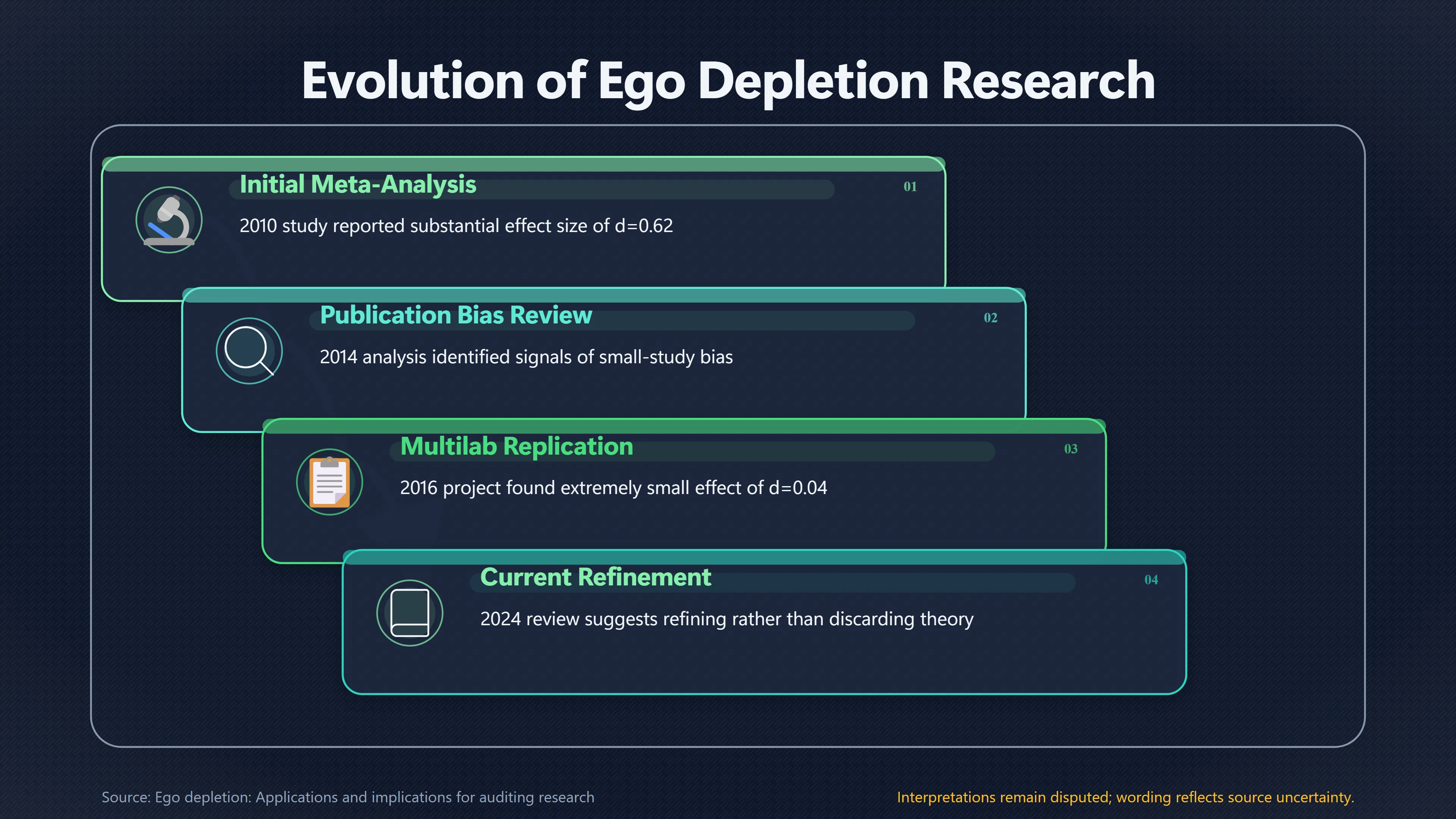
The strongest later evidence makes the simple version much harder to defend. A 23-laboratory preregistered replication found an effect of only d = 0.04, with its confidence interval spanning zero. A subsequent 36-site preregistered project likewise found no significant confirmatory effect (d = 0.06). Another multilab study did find depletion, but the effect was small (d = 0.10).[PubMed]pubmed.ncbi.nlm.nih.govPub Med A Multilab Preregistered Replication of the Ego-Depletion EffectA Multilab Preregistered Replication of the Ego-Depletion Effect - PubMed…
That does not establish that demanding self-control can never impair later performance. It does mean there is weak support for the stronger everyday story in which ordinary acts of restraint reliably drain a single, general-purpose reservoir of willpower. The useful distinction is between feeling mentally fatigued, which is real, and assuming that fatigue proves an underlying self-control resource has literally been used up.
Why the willpower-tank idea became so influential
The classic ego-depletion experiment uses a sequential-task paradigm. Participants first perform either a task requiring self-control or a comparatively undemanding control task. They then complete a different task assumed to require self-control. If the first group subsequently performs worse, the difference is interpreted as depletion.
This design produced an appealing result because it appeared to travel across domains. In principle, suppressing an habitual response on one task could make someone less persistent, attentive or restrained on an apparently unrelated second task. That fitted the proposed “strength model”: different acts of self-control were thought to draw upon the same finite resource.[PubMed]pubmed.ncbi.nlm.nih.govPub Med Ego depletion and the strength model of self-control: a meta-analysisEgo depletion and the strength model of self-control: a meta-analysis - PubMedJuly 1, 2010…
The case seemed particularly strong after Martin Hagger and colleagues published a 2010 meta-analysis covering 83 studies. It reported a significant ego-depletion effect and concluded that the findings offered preliminary support for the strength model. The effect subsequently cited from that literature was substantial, around d = 0.62.[PubMed]pubmed.ncbi.nlm.nih.govPub Med Ego depletion and the strength model of self-control: a meta-analysisEgo depletion and the strength model of self-control: a meta-analysis - PubMedJuly 1, 2010…
That result helped turn a laboratory hypothesis into an intuitive account of everyday behaviour. If resisting biscuits, concentrating through a tedious meeting and remaining patient with an irritating colleague all consume the same scarce resource, then failure late in the day seems straightforward: the tank is approaching empty.
But the metaphor was always more precise than the underlying mechanism. Saying that self-control has been “used up” raises an obvious question: what exactly has been consumed? Researchers at one point proposed glucose as a physiological substrate. Later analyses did not support the crucial predictions of that account. A 2016 meta-analysis found no support for the claims that self-control exertion meaningfully lowered glucose, that remaining glucose predicted subsequent self-control, or that ingesting glucose restored depleted control. A separate analysis concluded that the glucose literature had weak evidential value and showed possible publication or reporting bias.[PubMed]pubmed.ncbi.nlm.nih.govPub Med Testing the role of glucose in self-control: A meta-analysisTesting the role of glucose in self-control: A meta-analysis - PubMedDecember 1, 2016…
The failure of the glucose explanation does not by itself disprove ego depletion. A psychological effect can exist even when an early explanation for it is wrong. But it removes one seemingly concrete reason to interpret willpower as a consumable fuel.
What large preregistered replications found
The bigger problem emerged when researchers reconsidered how strong the basic behavioural effect actually was.
In 2014, Evan Carter and Michael McCullough reanalysed the earlier meta-analytic evidence using methods intended to detect small-study and publication biases. Whereas the previous literature suggested a robust medium-sized effect, their analyses found strong signals of publication bias and estimates compatible with no depletion effect. A more extensive 2015 series of meta-analytic tests by Carter and colleagues again challenged the limited-resource interpretation.[PubMed]pubmed.ncbi.nlm.nih.govPublication bias and the limited strength model of self-control: has the evidence for ego depletion been overestimated? - PubMedJul…
This mattered because a published literature can exaggerate an effect even without misconduct. Small experiments produce noisy estimates; positive findings may be more likely to be published than null findings; researchers may have flexibility in analytical decisions; and an accumulation of individually significant studies can therefore look more decisive than the underlying phenomenon really is.
Preregistration offered a stronger test. Researchers specify important hypotheses and analyses before seeing the results, reducing opportunities for hindsight-driven analytical choices. Multilaboratory projects add another advantage: instead of asking whether one research team can obtain an effect in one setting, the same hypothesis is tested across many sites and much larger samples.
The first major result was striking. In 2016, 23 laboratories with 2,141 participants followed a standardised ego-depletion protocol. The estimated effect was:
d = 0.04, 95% CI [−0.07, 0.15].
In other words, the estimated difference was extremely small and the confidence interval included zero. The project therefore failed to provide reliable evidence for the predicted depletion effect.[PubMed]pubmed.ncbi.nlm.nih.govPub Med A Multilab Preregistered Replication of the Ego-Depletion EffectA Multilab Preregistered Replication of the Ego-Depletion Effect - PubMed…
That replication immediately generated an important objection: perhaps the chosen task did not induce depletion effectively enough. The project used a version of an “e-crossing” task in which participants had to follow rules about responding to words containing the letter e. Critics argued that the particular implementation might not have created the habitual response that participants were subsequently required to override strongly enough.[Frontiers]frontiersin.orgOpen source on frontiersin.org.
Researchers therefore had good reason not to treat one unsuccessful protocol as the final word.
A later preregistered project approached the problem differently. Thirty-six laboratories and 3,531 participants used one of two procedures intended to manipulate self-control. Importantly, the manipulation did change participants’ experience: those in depletion conditions reported greater effort, frustration and fatigue. Yet the preregistered confirmatory analysis again found no significant downstream performance effect:
d = 0.06, 95% CI [−0.02, 0.14].
A Bayesian analysis using the researchers’ informed alternative hypothesis found the observations approximately four times more likely under the null model. An exploratory analysis that ignored preregistered exclusion criteria did yield a statistically significant effect, but it was still only d = 0.08.[PubMed Central (PMC)]pmc.ncbi.nlm.nih.govOpen source on nih.gov.
That combination is especially informative. Making people feel more effortful and fatigued did not reliably produce the substantial loss of subsequent self-control predicted by a strong depletion account. Subjective fatigue and a general-purpose loss of control capacity are therefore not interchangeable concepts.
A small effect has appeared under other protocols
The replication record is not simply a sequence of null results.
Junhua Dang and colleagues conducted another preregistered multilaboratory replication using a Stroop task followed by an antisaccade task. Across 12 laboratories and 1,775 participants, they obtained a statistically significant ego-depletion effect of d = 0.10. After excluding participants who might have been responding randomly on the outcome task, the estimate increased to d = 0.16.[PubMed Central (PMC)]pmc.ncbi.nlm.nih.govPub Med Central (PMC)A Multilab Replication of the Ego Depletion EffectPubMed Central (PMC)A Multilab Replication of the Ego Depletion Effect - PMC…
This is important for two reasons. First, it prevents the clean claim that “ego depletion has been disproved”. At least some rigorous, preregistered evidence is compatible with a real effect.
Second, however, the magnitude changes the practical interpretation. An effect around d = 0.10 is far removed from the roughly d = 0.62 estimate associated with the influential earlier literature. Even if a small depletion effect occurs under some circumstances, that does not vindicate the popular image of willpower routinely collapsing because a substantial common resource has been drained.
The replication projects therefore point towards a narrower question than the original debate suggested. Rather than simply asking “Is ego depletion real?”, researchers need to establish which demanding activities impair which later behaviours, under what conditions, by how much, and through what mechanism.
Why the debate is not fully settled
There is a genuine methodological difficulty here: ego depletion is a theoretical construct, not something that can be directly switched on and measured like a physical quantity. Experiments have used many different tasks as both the alleged depletion manipulation and the subsequent test of self-control. A failed replication can therefore provoke the argument that the first task was not sufficiently depleting; a successful study can provoke the counterargument that something other than depleted self-control caused poorer performance.
This creates a difficult validation problem. Critics have noted that the field lacks sufficiently independent evidence establishing that many commonly used tasks specifically measure or manipulate a shared self-control capacity. Without that validation, disagreements about whether a replication used the “right” task can become difficult to resolve.[PubMed Central (PMC)]pmc.ncbi.nlm.nih.govOpen source on nih.gov.
There is also evidence that demanding cognitive activity unquestionably changes how people feel. In the 36-site study, depletion manipulations successfully increased perceived effort, frustration and fatigue despite failing to produce the preregistered performance effect. Exploratory results suggested larger depletion effects among people reporting greater fatigue, although such post-hoc findings require further confirmation.[PubMed Central (PMC)]pmc.ncbi.nlm.nih.govOpen source on nih.gov.
Alternative theories consequently treat the consequences of sustained control less like fuel consumption and more like changes in psychological state. Inzlicht and Schmeichel’s process model, for example, proposed that initial self-control can shift motivation and attention, making continued control less attractive and rewarding alternatives more salient. That account does not require a mysterious resource literally to approach empty.[Association for Psychological Science]psychologicalscience.orgOpen source on psychologicalscience.org.
Meanwhile, proponents of limited-willpower theories have not abandoned depletion. In a 2024 review, Roy Baumeister and colleagues argued that the theory should be refined rather than discarded. Their updated account puts more emphasis on conserving remaining capacity rather than literal exhaustion and argues that longer, stronger manipulations provide better evidence for depletion than some of the brief tasks used in replication attempts.[ScienceDirect]sciencedirect.comOpen source on sciencedirect.com.
That argument keeps the scientific question open, but it also illustrates how far the theory has moved from its simplest popular form. A model involving fatigue intensity, conservation, motivation, task choice, recovery and situational moderators is no longer well represented by the claim that every act of restraint simply removes another fixed quantity from a common tank.
What the evidence means for self-improvement
The safest conclusion is neither “willpower is a finite fuel” nor “mental effort never affects later self-control”.
People plainly experience fatigue, frustration and changes in motivation after demanding work. Some preregistered research also finds small downstream depletion effects. But the large replication literature provides little support for treating a strong, general ego-depletion effect as a dependable law of behaviour.[nih.gov]pubmed.ncbi.nlm.nih.govPub Med A Multilab Preregistered Replication of the Ego-Depletion EffectA Multilab Preregistered Replication of the Ego-Depletion Effect - PubMed…
That distinction matters when interpreting personal failures. Suppose someone spends a difficult morning concentrating at work and then abandons an intended workout that evening. Ego depletion supplies a compelling retrospective story: the morning consumed the willpower required for exercise. The evidence does not justify confidently inferring that mechanism from the sequence alone. Fatigue, motivation, reward, expectations, competing goals and the specific circumstances surrounding the later decision can all matter without requiring an emptied reservoir.
Nor does scepticism about ego depletion imply that people should deliberately maximise temptation because resistance is cost-free. The point is narrower: the scientific case for a single willpower tank is substantially weaker than the metaphor suggests. Even subjective exhaustion does not necessarily mean that the capacity for subsequent self-control has been mechanically exhausted.
For self-improvement, that removes an unnecessary assumption. There is no need to build a behaviour system around the idea that every earlier act of discipline predictably subtracts from a fixed daily allowance. It remains sensible to reduce unnecessary struggles and account for fatigue, but not because research has established that willpower functions like petrol in a tank.
The enduring lesson of the ego-depletion controversy is therefore methodological as well as practical. A psychologically convincing metaphor can feel explanatory long before its mechanism and effect size are secure. The original studies made a depleted resource seem like an elegant explanation for why self-control sometimes becomes harder. Large preregistered replications show that the phenomenon is smaller, less general and more dependent on how it is tested than that simple story implied. The debate over a modest or conditional depletion effect remains open; the strong everyday “empty tank” interpretation should be treated with considerably more caution.[PubMed Central (PMC)]pmc.ncbi.nlm.nih.govOpen source on nih.gov.
Amazon book picks
Further Reading
Books and field guides related to Does Willpower Really Run Out Like a Tank?. Use these as the next step if you want deeper reading beyond the article.
Willpower
One of the world's most esteemed and influential psychologists, Roy F. Baumeister, teams with New York Times science writer John Tierney...
The Willpower Instinct
Based on Stanford University psychologist Kelly McGonigal's wildly popular course "The Science of Willpower," The Willpower Instinct is t...
The Marshmallow Test
Renowned psychologist Walter Mischel, designer of the famous Marshmallow Test, explains what self-control is and how to master it. A chil...
Thinking, Fast and Slow
Why is there more chance we'll believe something if it's in a bold type face? Why are judges more likely to deny parole before lunch? Why...
eBay marketplace picks
Marketplace Samples
Live-tested eBay searches with available results related to this page.
Selected frommotivational wall art oneBay.co.uk.




Endnotes
1.
Source: sciencedirect.com
Link:https://www.sciencedirect.com/science/article/pii/S2352250X24000952
2.
Source: sciencedirect.com
Link:https://www.sciencedirect.com/science/article/pii/S2352250X24000927
3.
Source: sciencedirect.com
Link:https://www.sciencedirect.com/science/article/pii/S0195666314005054
4.
Source: sciencedirect.com
Link:https://www.sciencedirect.com/science/article/abs/pii/S0195666314005078
5.
Source: sciencedirect.com
Title: Ego depletion: Applications and implications for auditing research
Link:https://www.sciencedirect.com/science/article/pii/S0737460715000154
6.
Source: sciencedirect.com
Link:https://www.sciencedirect.com/science/article/pii/S027249441400053X
7.
Source: sciencedirect.com
Title: Do people avoid mental effort after facing a highly demanding task?
Link:https://www.sciencedirect.com/science/article/abs/pii/S0022103120303486
8.
Source: sciencedirect.com
Title: No ego-depletion effect without a good control task
Link:https://www.sciencedirect.com/science/article/am/pii/S1469029221001515
9.
Source: sciencedirect.com
Title: Effects of Stroop task duration on subsequent cognitive and physical performance
Link:https://www.sciencedirect.com/science/article/pii/S1469029223000833
10.
Source: sciencedirect.com
Link:https://www.sciencedirect.com/science/article/pii/S2211266919300209
11.
Source: sciencedirect.com
Title: Does self-control depletion affect risk attitudes?
Link:https://www.sciencedirect.com/science/article/abs/pii/S001429211730168X
12.
Source: pubmed.ncbi.nlm.nih.gov
Title: Pub Med A Multilab Preregistered Replication of the Ego-Depletion Effect
Link:https://pubmed.ncbi.nlm.nih.gov/27474142/
Source snippet
A Multilab Preregistered Replication of the Ego-Depletion Effect - PubMed...
13.
Source: pubmed.ncbi.nlm.nih.gov
Title: Pub Med A Multisite Preregistered Paradigmatic Test of the Ego-Depletion Effect
Link:https://pubmed.ncbi.nlm.nih.gov/34520296/
Source snippet
A Multisite Preregistered Paradigmatic Test of the Ego-Depletion Effect - PubMed...
14.
Source: pmc.ncbi.nlm.nih.gov
Title: Pub Med Central (PMC)A Multilab Replication of the Ego Depletion Effect
Link:https://pmc.ncbi.nlm.nih.gov/articles/PMC8186735/
Source snippet
PubMed Central (PMC)A Multilab Replication of the Ego Depletion Effect - PMC...
15.
Source: pubmed.ncbi.nlm.nih.gov
Title: Pub Med Ego depletion and the strength model of self-control: a meta-analysis
Link:https://pubmed.ncbi.nlm.nih.gov/20565167/
Source snippet
Ego depletion and the strength model of self-control: a meta-analysis - PubMedJuly 1, 2010...
Published: July 1, 2010
16.
Source: frontiersin.org
Link:https://www.frontiersin.org/journals/psychology/articles/10.3389/fpsyg.2014.00823/full
Source snippet
FrontiersFrontiers | Publication bias and the limited strength model of self-control: has the evidence for ego depletion been overestimated?...
17.
Source: pubmed.ncbi.nlm.nih.gov
Title: Pub Med Testing the role of glucose in self-control: A meta-analysis
Link:https://pubmed.ncbi.nlm.nih.gov/27492453/
Source snippet
Testing the role of glucose in self-control: A meta-analysis - PubMedDecember 1, 2016...
Published: December 1, 2016
18.
Source: pubmed.ncbi.nlm.nih.gov
Link:https://pubmed.ncbi.nlm.nih.gov/27485134/
Source snippet
The Bitter Truth About Sugar and Willpower: The Limited Evidential Value of the Glucose Model of Ego Depletion - PubMed...
19.
Source: pubmed.ncbi.nlm.nih.gov
Link:https://pubmed.ncbi.nlm.nih.gov/25126083/
Source snippet
Publication bias and the limited strength model of self-control: has the evidence for ego depletion been overestimated? - PubMedJul...
20.
Source: pubmed.ncbi.nlm.nih.gov
Link:https://pubmed.ncbi.nlm.nih.gov/26076043/
Source snippet
A series of meta-analytic tests of the depletion effect: Self-control does not seem to rely on a limited resource - PubMed...
21.
Source: frontiersin.org
Link:https://www.frontiersin.org/journals/psychology/articles/10.3389/fpsyg.2016.01155/full
22.
Source: pmc.ncbi.nlm.nih.gov
Link:https://pmc.ncbi.nlm.nih.gov/articles/PMC4971805/
23.
Source: pmc.ncbi.nlm.nih.gov
Link:https://pmc.ncbi.nlm.nih.gov/articles/PMC12422598/
24.
Source: psychologicalscience.org
Link:https://www.psychologicalscience.org/journals/psychological-science/0956797621989733/
25.
Source: pubmed.ncbi.nlm.nih.gov
Title: Pub Med A Multilab Replication of the Ego Depletion Effect
Link:https://pubmed.ncbi.nlm.nih.gov/34113424/
26.
Source: pmc.ncbi.nlm.nih.gov
Link:https://pmc.ncbi.nlm.nih.gov/articles/PMC5394171/
27.
Source: psychologicalscience.org
Link:https://www.psychologicalscience.org/journals/perspectives/1745691612454134/
28.
Source: pubmed.ncbi.nlm.nih.gov
Link:https://pubmed.ncbi.nlm.nih.gov/26168503/
29.
Source: pubmed.ncbi.nlm.nih.gov
Link:https://pubmed.ncbi.nlm.nih.gov/39278166/
30.
Source: pmc.ncbi.nlm.nih.gov
Link:https://pmc.ncbi.nlm.nih.gov/articles/PMC12738931/
31.
Source: frontiersin.org
Link:https://www.frontiersin.org/journals/psychology/articles/10.3389/fpsyg.2025.1569692/full
32.
Source: pmc.ncbi.nlm.nih.gov
Link:https://pmc.ncbi.nlm.nih.gov/articles/PMC12206732/
33.
Source: pubmed.ncbi.nlm.nih.gov
Link:https://pubmed.ncbi.nlm.nih.gov/40452478/
34.
Source: pmc.ncbi.nlm.nih.gov
Link:https://pmc.ncbi.nlm.nih.gov/articles/PMC11588117/
35.
Source: pubmed.ncbi.nlm.nih.gov
Link:https://pubmed.ncbi.nlm.nih.gov/37384732/
36.
Source: pmc.ncbi.nlm.nih.gov
Link:https://pmc.ncbi.nlm.nih.gov/articles/PMC10307977/
37.
Source: frontiersin.org
Link:https://www.frontiersin.org/journals/psychology/articles/10.3389/fpsyg.2023.1208299/full
38.
Source: pmc.ncbi.nlm.nih.gov
Link:https://pmc.ncbi.nlm.nih.gov/articles/PMC8725925/
39.
Source: pmc.ncbi.nlm.nih.gov
Link:https://pmc.ncbi.nlm.nih.gov/articles/PMC8134656/
40.
Source: frontiersin.org
Link:https://www.frontiersin.org/journals/human-neuroscience/articles/10.3389/fnhum.2021.658890/full
41.
Source: pmc.ncbi.nlm.nih.gov
Link:https://pmc.ncbi.nlm.nih.gov/articles/PMC7238509/
42.
Source: pubmed.ncbi.nlm.nih.gov
Link:https://pubmed.ncbi.nlm.nih.gov/29591537/
43.
Source: pubmed.ncbi.nlm.nih.gov
Link:https://pubmed.ncbi.nlm.nih.gov/30845243/
44.
Source: pmc.ncbi.nlm.nih.gov
Link:https://pmc.ncbi.nlm.nih.gov/articles/PMC6124090/
45.
Source: pmc.ncbi.nlm.nih.gov
Link:https://pmc.ncbi.nlm.nih.gov/articles/PMC6016937/
46.
Source: pmc.ncbi.nlm.nih.gov
Link:https://pmc.ncbi.nlm.nih.gov/articles/PMC5962787/
47.
Source: pubmed.ncbi.nlm.nih.gov
Link:https://pubmed.ncbi.nlm.nih.gov/29314092/
48.
Source: pmc.ncbi.nlm.nih.gov
Link:https://pmc.ncbi.nlm.nih.gov/articles/PMC5622938/
49.
Source: pubmed.ncbi.nlm.nih.gov
Link:https://pubmed.ncbi.nlm.nih.gov/29018390/
50.
Source: frontiersin.org
Link:https://www.frontiersin.org/journals/psychology/articles/10.3389/fpsyg.2017.01672/full
51.
Source: pmc.ncbi.nlm.nih.gov
Link:https://pmc.ncbi.nlm.nih.gov/articles/PMC5491132/
52.
Source: pmc.ncbi.nlm.nih.gov
Link:https://pmc.ncbi.nlm.nih.gov/articles/PMC6013521/
53.
Source: pubmed.ncbi.nlm.nih.gov
Link:https://pubmed.ncbi.nlm.nih.gov/28391367/
54.
Source: pmc.ncbi.nlm.nih.gov
Link:https://pmc.ncbi.nlm.nih.gov/articles/PMC5329006/
55.
Source: frontiersin.org
Link:https://www.frontiersin.org/journals/psychology/articles/10.3389/fpsyg.2017.00273/full
56.
Source: pmc.ncbi.nlm.nih.gov
Link:https://pmc.ncbi.nlm.nih.gov/articles/PMC5306285/
57.
Source: frontiersin.org
Link:https://www.frontiersin.org/journals/psychology/articles/10.3389/fpsyg.2017.00197/full
58.
Source: pubmed.ncbi.nlm.nih.gov
Link:https://pubmed.ncbi.nlm.nih.gov/27826272/
59.
Source: pmc.ncbi.nlm.nih.gov
Link:https://pmc.ncbi.nlm.nih.gov/articles/PMC5079083/
60.
Source: frontiersin.org
Link:https://www.frontiersin.org/journals/psychology/articles/10.3389/fpsyg.2016.01639/full
61.
Source: pubmed.ncbi.nlm.nih.gov
Link:https://pubmed.ncbi.nlm.nih.gov/27758050/
62.
Source: pmc.ncbi.nlm.nih.gov
Link:https://pmc.ncbi.nlm.nih.gov/articles/PMC4900619/
63.
Source: frontiersin.org
Link:https://www.frontiersin.org/journals/psychology/articles/10.3389/fpsyg.2016.00621/full
64.
Source: frontiersin.org
Link:https://www.frontiersin.org/journals/psychology/articles/10.3389/fpsyg.2016.00136/full
65.
Source: pmc.ncbi.nlm.nih.gov
Link:https://pmc.ncbi.nlm.nih.gov/articles/PMC5621751/
66.
Source: pubmed.ncbi.nlm.nih.gov
Link:https://pubmed.ncbi.nlm.nih.gov/25450895/
67.
Source: pubmed.ncbi.nlm.nih.gov
Link:https://pubmed.ncbi.nlm.nih.gov/25450894/
68.
Source: frontiersin.org
Title: Frontiers | Trait approach motivation moderates the aftereffects of self-control
Link:https://www.frontiersin.org/journals/psychology/articles/10.3389/fpsyg.2014.01112/full
69.
Source: pmc.ncbi.nlm.nih.gov
Link:https://pmc.ncbi.nlm.nih.gov/articles/PMC4115664/
70.
Source: pmc.ncbi.nlm.nih.gov
Link:https://pmc.ncbi.nlm.nih.gov/articles/PMC3989757/
71.
Source: frontiersin.org
Link:https://www.frontiersin.org/journals/psychology/articles/10.3389/fpsyg.2014.00298/full
72.
Source: pubmed.ncbi.nlm.nih.gov
Link:https://pubmed.ncbi.nlm.nih.gov/24304793/
73.
Source: psychologicalscience.org
Title: A Multilab Preregistered Replication of the Ego-Depletion Effect
Link:https://www.psychologicalscience.org/journals/perspectives/1745691616652873/
Additional References
74.
Source: journals.sagepub.com
Title: Sage Journals A Multilab Preregistered Replication of the Ego-Depletion Effect
Link:https://journals.sagepub.com/doi/10.1177/1745691616652873
Source snippet
S. Hagger, N. L. D. Chatzisarantis, H. Alberts, C. O. Anggono, C. Batailler, A. R. Birt, R. Brand, M. J. Brandt, G. Brewer, S. Bruyneel...
75.
Source: youtube.com
Title: Baumeister’s “Ego Depletion Theory”
Link:https://www.youtube.com/watch?v=HD-dxUZxMcs
Source snippet
The Problem with Willpower and Self-Control | A Psychology Experiment...
76.
Source: youtube.com
Title: The Problem with Willpower and Self-Control | A Psychology Experiment
Link:https://www.youtube.com/watch?v=2MDNvKXdLEM
Source snippet
Michael Inzlicht: Self-Control, Gratification Delay, Ego-Depletion, And The Replication Crisis...
77.
Source: youtube.com
Link:https://www.youtube.com/watch?v=fuA1l7bL954
Source snippet
Episode 26: Willpower and Ego Depletion with Roy Baumeister...
78.
Source: youtube.com
Title: The Replication Crisis with Michael Inzlicht
Link:https://www.youtube.com/watch?v=U-Ay25nth4U
Source snippet
"Ego depletion" "replication" psychology Baumeister's "Ego Depletion Theory" - affected by the replication crisis in psychology?...
79.
Source: nature.com
Link:https://www.nature.com/articles/s41598-024-68043-0
80.
Source: youtube.com
Title: Episode 26: Willpower and Ego Depletion with Roy Baumeister
Link:https://www.youtube.com/watch?v=WPILInhrtK4
Source snippet
The Replication Crisis with Michael Inzlicht...
81.
Source: researchgate.net
Link:https://www.researchgate.net/publication/259200658_Beyond_simple_utility_in_predicting_self-control_fatigue_A_proximate_alternative_to_the_opportunity_cost_model
82.
Source: researchgate.net
Link:https://www.researchgate.net/publication/257835702_What_Is_Ego_Depletion_Toward_a_Mechanistic_Revision_of_the_Resource_Model_of_Self-Control
83.
Source: researchgate.net
Link:https://www.researchgate.net/publication/383833997_Self-Control_and_Limited_Willpower_Current_Status_of_Ego_Depletion_Theory_and_Research