Within Sleep Foundation
Can You Feel Fine and Still Be Sleep Deprived?
People can get used to feeling sleepy while their objective attention and reaction performance continue to deteriorate.
On this page
- Why subjective sleepiness can level off
- How objective vigilance keeps worsening
- Why self assessment is a weak test of adequate sleep
Page outline Jump by section
Introduction
Yes. You can feel reasonably alert while repeated short nights are making your attention and reaction performance progressively less reliable. The important distinction is between subjective adaptation and performance adaptation. In controlled sleep-restriction studies, people often report a sharp increase in sleepiness at first, followed by relatively little further change. Objective measures of vigilant attention, however, can continue to deteriorate across subsequent days.[PubMed]pubmed.ncbi.nlm.nih.govThe cumulative cost of additional wakefulness: dose-response effects on neurobehavioral functions and sleep physiology from chronic…

That mismatch matters because “I feel fine” is an intuitively appealing but weak test of whether someone is adequately rested for dependable performance. The problem is not necessarily overwhelming drowsiness. It can instead appear as occasional slow reactions, missed signals and unstable attention amid long stretches in which the person feels and functions normally. For self-improvement, that creates a hidden failure mode: someone may conclude that they have successfully adapted to less sleep just as their capacity for consistent follow-through is declining.
Why subjective sleepiness can level off
The clearest demonstration comes from a landmark laboratory experiment led by Hans Van Dongen. Forty-eight healthy adults were studied under controlled conditions. Groups were given four, six or eight hours of time in bed per night for 14 consecutive days, while another experiment examined total sleep deprivation. Participants repeatedly rated their own sleepiness and completed objective cognitive tests.[PubMed]pubmed.ncbi.nlm.nih.govThe cumulative cost of additional wakefulness: dose-response effects on neurobehavioral functions and sleep physiology from chronic…
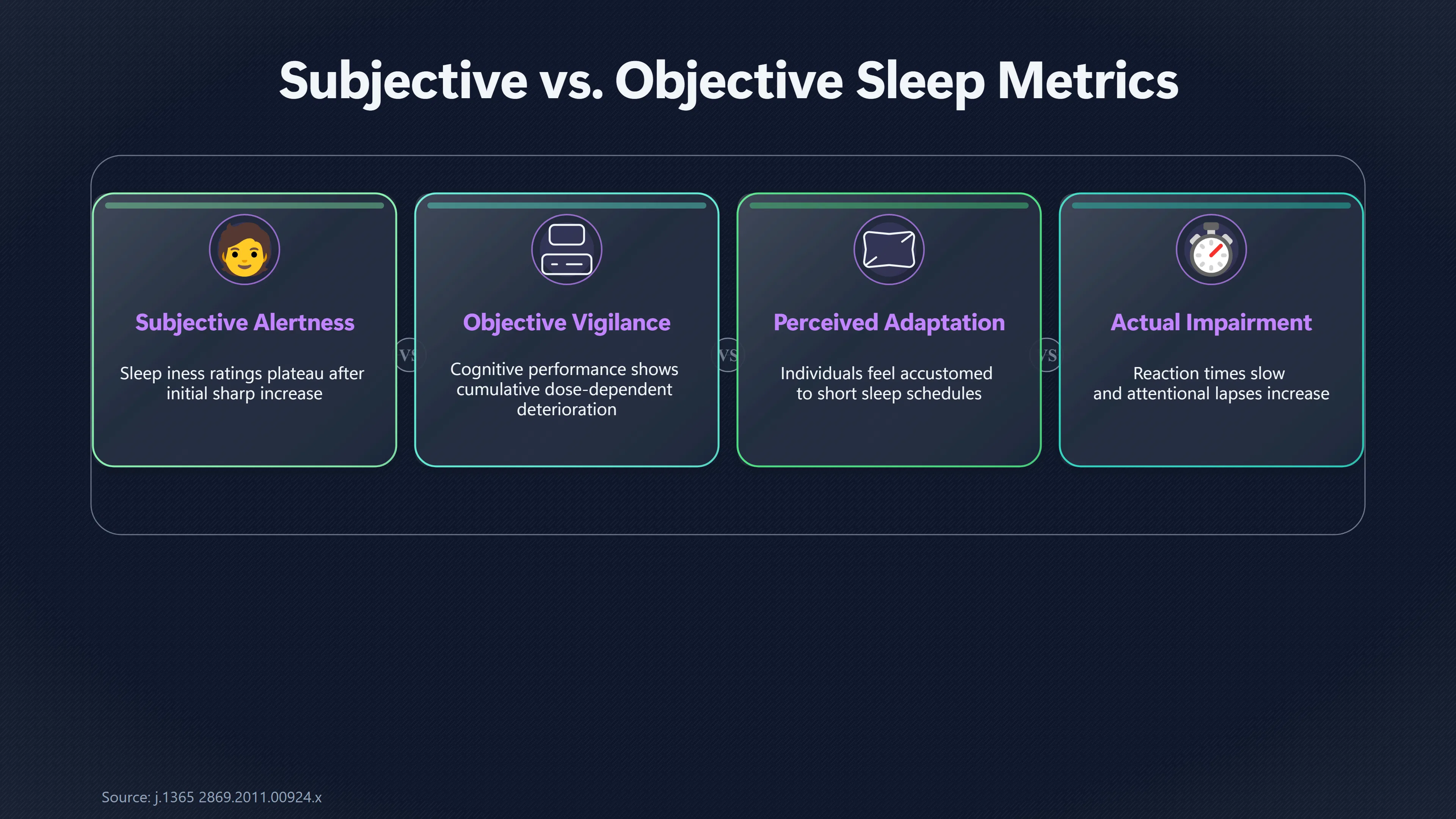
The subjective and objective measures followed strikingly different trajectories. People restricted to four or six hours initially felt sleepier, but their sleepiness ratings subsequently increased only modestly. The ratings also failed to distinguish clearly between the four-hour and six-hour conditions. Objective cognitive performance, by contrast, showed cumulative, dose-dependent deterioration.[PubMed]pubmed.ncbi.nlm.nih.govThe cumulative cost of additional wakefulness: dose-response effects on neurobehavioral functions and sleep physiology from chronic…
A later review of these experiments describes the divergence particularly clearly: after a week or two of restricted sleep, participants could be substantially impaired while reporting only moderate or slight sleepiness. In other words, what appeared to adapt was largely the subjective experience, not the underlying capacity being tested.[PubMed Central (PMC)]pmc.ncbi.nlm.nih.govPubMed Central (PMC)Behavioral and Physiological Consequences of Sleep Restriction - PMCAugust 15, 2007…
This is easy to misinterpret in everyday life. If the first few short nights feel unpleasant but the same schedule becomes subjectively easier after several days, the natural conclusion is that the body has “got used to” six hours of sleep. The laboratory evidence shows why that inference can fail. Feeling less bothered by a state does not demonstrate that the performance consequences of that state have disappeared. Reviews of sleep-loss research continue to distinguish the plateau seen in self-reported sleepiness from the accumulating deficits found in vigilant attention.[PubMed Central (PMC)]pmc.ncbi.nlm.nih.govPubMed Central (PMC)Predicting and mitigating fatigue effects due to sleep deprivation: A review - PMCAugust 5, 2022…
Nor should “subjective” be taken to mean useless. Sleepiness and alertness ratings contain genuine information about a person’s current state. The narrower point is that their relationship with performance is imperfect and changes under sleep restriction. A person may correctly recognise that they are somewhat tired while still failing to appreciate how impaired their attention has become.[PLOS]journals.plos.orgPrediction of Vigilant Attention and Cognitive Performance Using Self-Reported Alertness, Circadian Phase, Hours since Awakening, and…
How objective vigilance keeps worsening
The contrast is especially visible on the psychomotor vigilance test (PVT), a simple reaction-time task widely used in sleep research. Signals appear at unpredictable intervals and the participant responds as quickly as possible. Because the task repeatedly demands sustained attention, sleep loss tends to show up not merely as uniformly slower performance but as an increasing number of unusually slow responses or attentional lapses.[PubMed Central (PMC)]pmc.ncbi.nlm.nih.govPubMed Central (PMC)Behavioral and Physiological Consequences of Sleep Restriction - PMCAugust 15, 2007…
In Van Dongen’s 14-day experiment, these vigilance deficits accumulated steadily in the four- and six-hour sleep conditions even though subjective sleepiness did not accumulate in parallel. Reviews of the experiment report that two weeks at six hours of time in bed produced deficits on cognitive measures comparable to roughly one night of total sleep deprivation, while four-hour nights produced still larger impairment. The eight-hour condition remained comparatively stable.[PubMed]pubmed.ncbi.nlm.nih.govThe cumulative cost of additional wakefulness: dose-response effects on neurobehavioral functions and sleep physiology from chronic…
That general dose-response pattern is not confined to one experiment. In another controlled study, Gregory Belenky and colleagues assigned 66 participants to three, five, seven or nine hours of time in bed for seven days. PVT performance deteriorated most dramatically in the three-hour group; the five- and seven-hour groups also showed impaired performance, although some measures reached a reduced plateau. The nine-hour group remained around baseline.[Wiley Online Library]onlinelibrary.wiley.comWiley Online LibraryPatterns of performance degradation and restoration during sleep restriction and subsequent recovery: a sleep dose‐re…
More unusually designed research has helped separate chronic short sleep from the simple effect of staying awake for an exceptionally long stretch. In a 32-day inpatient experiment, participants experiencing chronic sleep restriction were never scheduled to remain awake for more than 15.33 hours at once. Despite avoiding unusually long individual bouts of wakefulness, chronic short sleep still increased attentional lapses roughly fivefold and substantially degraded reaction-time performance, without uniformly reducing participants’ reported alertness.[PubMed]pubmed.ncbi.nlm.nih.govChronic sleep curtailment, even without extended (>16-h) wakefulness, degrades human vigilance performance - PubMedJune 5, 2018…
This is why the phrase “I can still function” sets a low bar. Sleep-restricted performance is not necessarily a continuous state of obvious incompetence. Much of the time a person may respond normally. What becomes less dependable is the ability to sustain that performance without intermittent failures. Sleep-loss research describes increased lapses of sustained attention as one of its most robust neurobehavioural effects.[PubMed Central (PMC)]pmc.ncbi.nlm.nih.govPub Med Central (PMC)Sleep Deprivation and Neurobehavioral DynamicsPub Med Central (PMC)Sleep Deprivation and Neurobehavioral Dynamics
For attention and follow-through, reliability is precisely what matters. Reading nine paragraphs successfully does not cancel losing the thread on the tenth. Answering most messages correctly does not make the overlooked attachment harmless. Completing most steps of a routine does not compensate for repeatedly missing the transition at which action was required. These examples are illustrations rather than direct experimental outcomes, but they capture the practical significance of a vigilance deficit: average competence can coexist with less consistent performance.

The mismatch can change across the day
Feeling fine is especially unreliable when circadian timing and accumulated sleep loss interact. The body’s circadian system changes alertness and performance across the biological day and night, so the same amount of prior sleep does not produce identical functioning at every hour.[PubMed Central (PMC)]pmc.ncbi.nlm.nih.govPub Med Central (PMC)Circadian Rhythms, Sleep Deprivation, and Human PerformancePub Med Central (PMC)Circadian Rhythms, Sleep Deprivation, and Human Performance
Xuan Zhou and colleagues tested this directly using a “forced desynchrony” protocol, an experimental schedule designed to separate circadian effects from time spent awake. Under sleep restriction, objective PVT performance deteriorated more than participants’ subjective alertness suggested. Crucially, the discrepancy was greatest during the biological night. The researchers concluded that sleep-restricted participants were liable to underestimate their neurobehavioural impairment particularly at that circadian phase.[PubMed]pubmed.ncbi.nlm.nih.govOpen source on nih.gov.
That result adds an important qualification to everyday self-assessment. “I don’t feel that tired” does not have a fixed relationship with “my attention is performing normally”. The relationship depends partly on sleep history, time awake and circadian phase. Research modelling those factors found that subjective alertness was informative, but alertness alone was not an accurate predictor of PVT performance. Predictions improved when accumulated sleep loss, circadian phase and time since awakening were also considered.[PLOS]journals.plos.orgPrediction of Vigilant Attention and Cognitive Performance Using Self-Reported Alertness, Circadian Phase, Hours since Awakening, and…
The hidden impairment therefore has two dimensions. Across repeated short nights, subjective sleepiness can flatten while objective impairment accumulates; within a day, circadian timing can further alter the gap between perceived and measured capacity. This helps explain why a person’s confidence in being “used to” short sleep should not be treated as equivalent to evidence that their performance has adapted.
Why self-assessment is a weak test of adequate sleep
The central mistake is using an internal sensation to answer a performance question it cannot answer reliably. “How sleepy do I feel?” and “How consistently can I sustain attention?” are related questions, but they are not interchangeable measurements. In chronic sleep restriction, their trajectories can actively diverge.[PubMed]pubmed.ncbi.nlm.nih.govThe cumulative cost of additional wakefulness: dose-response effects on neurobehavioral functions and sleep physiology from chronic…
This also explains why isolated successes are poor evidence of adaptation. A person can still hold a conversation, finish a workout, meet a deadline or perform well during an engaging period while carrying an elevated risk of attentional lapses. Objective vigilance tests are useful precisely because they repeatedly sample performance and expose instability that a person’s overall impression of the day can conceal.[PubMed Central (PMC)]pmc.ncbi.nlm.nih.govPubMed Central (PMC)Sleep deprivation, vigilant attention, and brain function: a review - PMC…
There is also meaningful individual variation: some people show greater performance vulnerability to sleep loss than others. That does not rescue intuition as a measuring instrument. The existence of individual differences means that population averages cannot precisely predict one person’s impairment; it does not establish that individuals can accurately identify their own vulnerability simply from how tired they feel. Reviews report stable differences in susceptibility alongside the broader finding that subjective ratings can underestimate accumulating impairment.[PubMed Central (PMC)]pmc.ncbi.nlm.nih.govPubMed Central (PMC)Behavioral and Physiological Consequences of Sleep Restriction - PMCAugust 15, 2007…
The evidence should not be stretched into the claim that nobody can ever judge their own impairment. Research on total sleep deprivation, for example, has found circumstances in which participants could monitor some aspects of deteriorating performance reasonably well, while misjudging others.[PubMed]pubmed.ncbi.nlm.nih.govOpen source on nih.gov. The stronger, better-supported conclusion for repeated sleep restriction is narrower: subjective alertness by itself does not reliably reveal the full magnitude of objective performance loss.
That makes sleep duration and sleep history useful external checks on the seductive feeling that everything is fine. Expert consensus from the American Academy of Sleep Medicine and Sleep Research Society recommends that healthy adults obtain at least seven hours of sleep per night regularly, while recognising individual variation in sleep need.[PubMed Central (PMC)]pmc.ncbi.nlm.nih.govOpen source on nih.gov. The recommendation is not a personalised performance test, but it illustrates the broader principle: adequate sleep should not be inferred solely from the absence of conspicuous sleepiness.
The self-improvement lesson is about calibration
The distinctive danger of chronic sleep restriction is not simply that it makes people tired. If tiredness always rose in lockstep with impairment, it would provide a convenient warning signal. The more troublesome finding is that the warning can become muted while the performance cost continues accumulating.[PubMed Central (PMC)]pmc.ncbi.nlm.nih.govPubMed Central (PMC)Sleep deprivation, vigilant attention, and brain function: a review - PMC…
That changes how “adaptation” should be judged. Becoming accustomed to the sensation of a short-sleep schedule is evidence that the schedule feels more familiar; it is not evidence that sustained attention has returned to baseline. Likewise, getting through an ordinary day without feeling exhausted does not establish that reaction speed, vigilance or resistance to attentional lapses is unimpaired.
For self-improvement built around attention and reliable follow-through, this is a calibration problem. A plan that repeatedly takes time from sleep may appear sustainable because its most accessible feedback signal — subjective tiredness — stops getting much worse. Meanwhile, the capacity needed to execute that plan consistently can continue moving in the opposite direction. Controlled experiments make that mismatch unusually clear: people can adapt to how sleep restriction feels without equivalently adapting to what sleep restriction does to their performance.[nih.gov]pubmed.ncbi.nlm.nih.govThe cumulative cost of additional wakefulness: dose-response effects on neurobehavioral functions and sleep physiology from chronic…
Amazon book picks
Further Reading
Books and field guides related to Can You Feel Fine and Still Be Sleep Deprived?. Use these as the next step if you want deeper reading beyond the article.
Why We Sleep
"Sleep is one of the most important but least understood aspects of our life, wellness, and longevity ... An explosion of scientific disc...
The Promise of Sleep
Sleep better, live longer with the groundbreaking information and step-by-step program in this revolutionary book. Healthful sleep has be...
The Sleep Solution
With cutting-edge sleep science and time-tested techniques, The Sleep Solution will help anyone achieve healthy sleep and eliminate pills...
The Sleep Fix
From Emmy Award-winning ABC News anchor/correspondent and former insomniac Diane Macedo comes a practical, user-friendly guide to getting...
eBay marketplace picks
Marketplace Samples
Live-tested eBay searches with available results related to this page.
Selected fromsleep accessories oneBay.co.uk.

Endnotes
1.
Source: journals.plos.org
Link:https://journals.plos.org/plosone/article?id=10.1371%2Fjournal.pone.0151770
Source snippet
Prediction of Vigilant Attention and Cognitive Performance Using Self-Reported Alertness, Circadian Phase, Hours since Awakening, and...
2.
Source: onlinelibrary.wiley.com
Link:https://onlinelibrary.wiley.com/doi/full/10.1046/j.1365-2869.2003.00337.x?sid=nlm%3Apubmed
Source snippet
Wiley Online LibraryPatterns of performance degradation and restoration during sleep restriction and subsequent recovery: a sleep dose‐re...
3.
Source: onlinelibrary.wiley.com
Link:https://onlinelibrary.wiley.com/doi/10.1111/j.1365-2869.2011.00924.x
4.
Source: onlinelibrary.wiley.com
Link:https://onlinelibrary.wiley.com/doi/full/10.1111/jsr.14117
5.
Source: journals.plos.org
Link:https://journals.plos.org/plosone/article?id=10.1371%2Fjournal.pone.0128273
6.
Source: journals.plos.org
Link:https://journals.plos.org/plosone/article?id=10.1371%2Fjournal.pone.0045987
7.
Source: onlinelibrary.wiley.com
Title: j.1365 2869.2011.00924.x
Link:https://onlinelibrary.wiley.com/doi/abs/10.1111/j.1365-2869.2011.00924.x
8.
Source: onlinelibrary.wiley.com
Title: j.1365 2869.2010.00823.x
Link:https://onlinelibrary.wiley.com/doi/10.1111/j.1365-2869.2010.00823.x
9.
Source: journals.plos.org
Link:https://journals.plos.org/plosone/article?id=10.1371%2Fjournal.pone.0005874
10.
Source: journals.plos.org
Link:https://journals.plos.org/plosone/article?id=10.1371%2Fjournal.pone.0001233
11.
Source: onlinelibrary.wiley.com
Title: j.1365 2869.2003.00337.x
Link:https://onlinelibrary.wiley.com/doi/abs/10.1046/j.1365-2869.2003.00337.x
12.
Source: onlinelibrary.wiley.com
Title: j.1446 9235.2003.00006.x
Link:https://onlinelibrary.wiley.com/doi/pdf/10.1046/j.1446-9235.2003.00006.x
13.
Source: journals.plos.org
Link:https://journals.plos.org/plosone/article/citation?id=10.1371%2Fjournal.pone.0151770
14.
Source: pubmed.ncbi.nlm.nih.gov
Link:https://pubmed.ncbi.nlm.nih.gov/12683469/
Source snippet
The cumulative cost of additional wakefulness: dose-response effects on neurobehavioral functions and sleep physiology from chronic...
15.
Source: pmc.ncbi.nlm.nih.gov
Link:https://pmc.ncbi.nlm.nih.gov/articles/PMC6879580/
Source snippet
PubMed Central (PMC)Sleep deprivation, vigilant attention, and brain function: a review - PMC...
16.
Source: pmc.ncbi.nlm.nih.gov
Link:https://pmc.ncbi.nlm.nih.gov/articles/PMC1978335/
Source snippet
PubMed Central (PMC)Behavioral and Physiological Consequences of Sleep Restriction - PMCAugust 15, 2007...
Published: August 15, 2007
17.
Source: pmc.ncbi.nlm.nih.gov
Link:https://pmc.ncbi.nlm.nih.gov/articles/PMC9389006/
Source snippet
PubMed Central (PMC)Predicting and mitigating fatigue effects due to sleep deprivation: A review - PMCAugust 5, 2022...
Published: August 5, 2022
18.
Source: pmc.ncbi.nlm.nih.gov
Title: Pub Med Central (PMC)The sleep-deprived human brain
Link:https://pmc.ncbi.nlm.nih.gov/articles/PMC6143346/
Source snippet
PubMed Central (PMC)The sleep-deprived human brain - PMC...
19.
Source: pmc.ncbi.nlm.nih.gov
Title: Pub Med Central (PMC)Neurocognitive Consequences of Sleep Deprivation
Link:https://pmc.ncbi.nlm.nih.gov/articles/PMC3564638/
Source snippet
PubMed Central (PMC)Neurocognitive Consequences of Sleep Deprivation - PMC...
20.
Source: pubmed.ncbi.nlm.nih.gov
Link:https://pubmed.ncbi.nlm.nih.gov/29784810/
Source snippet
Chronic sleep curtailment, even without extended (>16-h) wakefulness, degrades human vigilance performance - PubMedJune 5, 2018...
Published: June 5, 2018
21.
Source: pmc.ncbi.nlm.nih.gov
Title: Pub Med Central (PMC)Sleep Deprivation and Neurobehavioral Dynamics
Link:https://pmc.ncbi.nlm.nih.gov/articles/PMC3700596/
22.
Source: pmc.ncbi.nlm.nih.gov
Title: Pub Med Central (PMC)Circadian Rhythms, Sleep Deprivation, and Human Performance
Link:https://pmc.ncbi.nlm.nih.gov/articles/PMC3963479/
23.
Source: pubmed.ncbi.nlm.nih.gov
Link:https://pubmed.ncbi.nlm.nih.gov/21564364/
24.
Source: pubmed.ncbi.nlm.nih.gov
Link:https://pubmed.ncbi.nlm.nih.gov/27019198/
25.
Source: pubmed.ncbi.nlm.nih.gov
Link:https://pubmed.ncbi.nlm.nih.gov/29159907/
26.
Source: pmc.ncbi.nlm.nih.gov
Link:https://pmc.ncbi.nlm.nih.gov/articles/PMC4434546/
27.
Source: pubmed.ncbi.nlm.nih.gov
Link:https://pubmed.ncbi.nlm.nih.gov/41757508
28.
Source: pubmed.ncbi.nlm.nih.gov
Link:https://pubmed.ncbi.nlm.nih.gov/38759474/
29.
Source: pubmed.ncbi.nlm.nih.gov
Link:https://pubmed.ncbi.nlm.nih.gov/38759474/?format=pubmed
30.
Source: pubmed.ncbi.nlm.nih.gov
Link:https://pubmed.ncbi.nlm.nih.gov/38219041/
31.
Source: pubmed.ncbi.nlm.nih.gov
Link:https://pubmed.ncbi.nlm.nih.gov/37193402/
32.
Source: pmc.ncbi.nlm.nih.gov
Link:https://pmc.ncbi.nlm.nih.gov/articles/PMC10108940/
33.
Source: pubmed.ncbi.nlm.nih.gov
Link:https://pubmed.ncbi.nlm.nih.gov/34461582/
34.
Source: pmc.ncbi.nlm.nih.gov
Link:https://pmc.ncbi.nlm.nih.gov/articles/PMC8286723/
35.
Source: pubmed.ncbi.nlm.nih.gov
Link:https://pubmed.ncbi.nlm.nih.gov/31176308/
36.
Source: pmc.ncbi.nlm.nih.gov
Link:https://pmc.ncbi.nlm.nih.gov/articles/PMC6003377/
37.
Source: pubmed.ncbi.nlm.nih.gov
Link:https://pubmed.ncbi.nlm.nih.gov/29563066/
38.
Source: pubmed.ncbi.nlm.nih.gov
Link:https://pubmed.ncbi.nlm.nih.gov/28923267/
39.
Source: pmc.ncbi.nlm.nih.gov
Link:https://pmc.ncbi.nlm.nih.gov/articles/PMC4809494/
40.
Source: GOV.UK
Title: www.gov.uk Miscellaneous conditions: assessing fitness to drive
Link:https://www.gov.uk/guidance/miscellaneous-conditions-assessing-fitness-to-drive
41.
Source: pmc.ncbi.nlm.nih.gov
Link:https://pmc.ncbi.nlm.nih.gov/articles/PMC4513271/
42.
Source: pubmed.ncbi.nlm.nih.gov
Link:https://pubmed.ncbi.nlm.nih.gov/25979105/
43.
Source: pmc.ncbi.nlm.nih.gov
Link:https://pmc.ncbi.nlm.nih.gov/articles/PMC4442216/
44.
Source: doi.org
Link:https://doi.org/10.5664/jcsm.4758
45.
Source: pubmed.ncbi.nlm.nih.gov
Link:https://pubmed.ncbi.nlm.nih.gov/26039963/
46.
Source: pmc.ncbi.nlm.nih.gov
Link:https://pmc.ncbi.nlm.nih.gov/articles/4434546/
47.
Source: pubmed.ncbi.nlm.nih.gov
Link:https://pubmed.ncbi.nlm.nih.gov/24955033/
48.
Source: pubmed.ncbi.nlm.nih.gov
Link:https://pubmed.ncbi.nlm.nih.gov/22851812/
49.
Source: pmc.ncbi.nlm.nih.gov
Link:https://pmc.ncbi.nlm.nih.gov/articles/PMC3197786/
50.
Source: pmc.ncbi.nlm.nih.gov
Link:https://pmc.ncbi.nlm.nih.gov/articles/3079937/
51.
Source: pubmed.ncbi.nlm.nih.gov
Link:https://pubmed.ncbi.nlm.nih.gov/20471003/
52.
Source: pubmed.ncbi.nlm.nih.gov
Link:https://pubmed.ncbi.nlm.nih.gov/15124731/
53.
Source: pubmed.ncbi.nlm.nih.gov
Link:https://pubmed.ncbi.nlm.nih.gov/12683469/?dopt=Abstract
54.
Source: pubmed.ncbi.nlm.nih.gov
Link:https://pubmed.ncbi.nlm.nih.gov/21564364/?dopt=Abstract
55.
Source: pmc.ncbi.nlm.nih.gov
Link:https://pmc.ncbi.nlm.nih.gov/articles/PMC2656292/
56.
Source: pubmed.ncbi.nlm.nih.gov
Link:https://pubmed.ncbi.nlm.nih.gov/20681233/
57.
Source: ncbi.nlm.nih.gov
Link:https://www.ncbi.nlm.nih.gov/books/NBK2645/table/ch40.t7/
58.
Source: pubmed.ncbi.nlm.nih.gov
Link:https://pubmed.ncbi.nlm.nih.gov/20175403/
59.
Source: pubmed.ncbi.nlm.nih.gov
Link:https://pubmed.ncbi.nlm.nih.gov/9231952/
60.
Source: ncbi.nlm.nih.gov
Link:https://www.ncbi.nlm.nih.gov/sites/books/NBK19958/
Additional References
61.
Source: youtube.com
Title: Sleep Is Your Superpower | Matt Walker | TED
Link:https://www.youtube.com/watch?v=5MuIMqhT8DM
Source snippet
In Hans Van Dongen: Individual differences in sleep and wake performance, lead researcher Hans Van Dongen explores the scientific finding...
62.
Source: youtube.com
Title: Fatigue as a challenge in 24/7 operations
Link:https://www.youtube.com/watch?v=-K3Kkpy73xw
Source snippet
Hans Van Dongen on how fatigue and sleep loss lead to cognitive deficits...
63.
Source: youtube.com
Title: Hans Van Dongen on how fatigue and sleep loss lead to cognitive deficits
Link:https://www.youtube.com/watch?v=2fVOu_dzt04
Source snippet
The Science & Practice of Perfecting Your Sleep | Dr. Matt Walker...
64.
Source: youtube.com
Title: Hans Van Dongen: Individual differences in sleep and wake performance
Link:https://www.youtube.com/watch?v=IuiVKB7QGg8
Source snippet
Fatigue as a challenge in 24/7 operations - how to survive and thrive...
65.
Source: nhtsa.gov
Link:https://www.nhtsa.gov/book/countermeasures-that-work/drowsy-driving/countermeasures/unproven-further-evaluation
66.
Source: nhtsa.gov
Link:https://www.nhtsa.gov/book/countermeasures-that-work/drowsy-driving/data-surveillance
67.
Source: nhtsa.gov
Link:https://www.nhtsa.gov/document/drowsy-driving-and-automobile-crashes
68.
Source: nhtsa.gov
Link:https://www.nhtsa.gov/book/countermeasures-that-work/drowsy-driving
69.
Source: nhtsa.gov
Link:https://www.nhtsa.gov/book/countermeasures-that-work/drowsy-driving/countermeasures/unproven-further-evaluation/medical
70.
Source: nhtsa.gov
Link:https://www.nhtsa.gov/book/countermeasures-that-work/drowsy-driving/understanding-problem