Within Fewer Decisions
When Fewer Choices Help and When They Do Not
More options are not automatically harmful; reducing choice helps most when uncertainty or complexity interferes with an action already chosen.
On this page
- Why large choice sets do not always reduce performance
- The conditions that make choice overload more likely
- Separating useful exploration from poorly timed reconsideration
Page outline Jump by section
Introduction
Choice overload is real, but the popular rule that “fewer choices are better” is not. Research instead points to a conditional effect: large choice sets become most troublesome when the options are difficult to compare, the chooser is unsure what they want, the decision itself is demanding, or the immediate goal is to finish rather than explore. When those conditions are absent, additional options can be harmless or positively useful.[OUP Academic]academic.oup.comOUP AcademicCan There Ever Be Too Many Options? A Meta-Analytic Review of Choice Overload | Journal of Consumer Research | Oxford Academi…
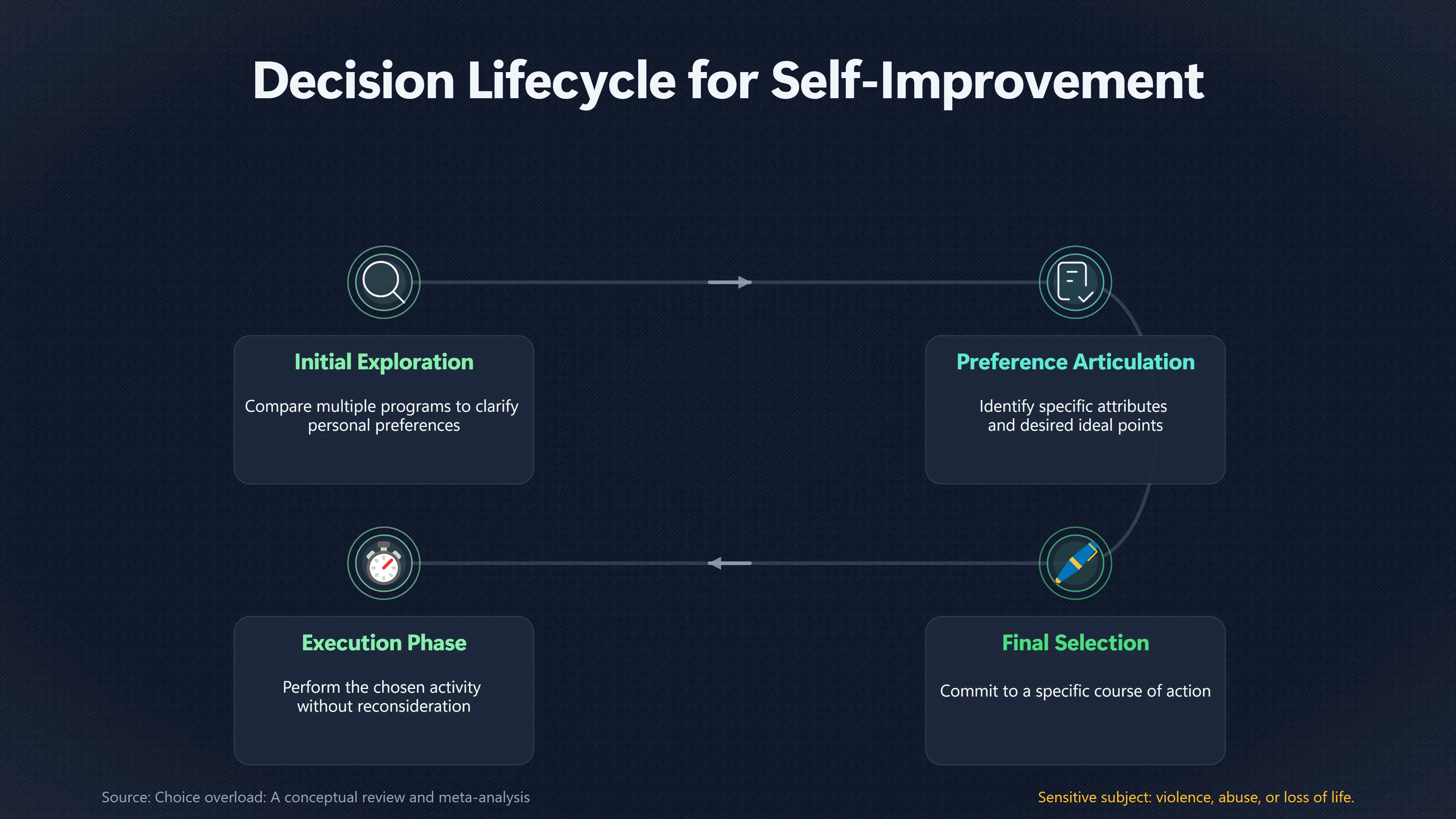
That distinction matters for self-improvement. Reducing choices is most defensible not as a general lifestyle principle, but as a way of protecting execution once a direction has already been chosen. Exploring several exercise programmes while deciding what suits you may be useful. Reopening that comparison when it is time for today’s workout may simply reintroduce uncertainty at the point where action matters. The research therefore supports a narrower principle: preserve useful choice during exploration, but reduce unnecessary reconsideration during execution.
Why large choice sets do not always reduce performance
The modern choice-overload debate is often traced to Sheena Iyengar and Mark Lepper’s 2000 experiments. In their well-known field study, shoppers encountered a display containing either six or 24 varieties of jam. Across the paper’s three experiments, smaller sets were associated with greater likelihood of acting or completing an optional task, and in some settings with greater satisfaction afterwards. The findings challenged the appealing assumption that adding options must make people better off.[PubMed]pubmed.ncbi.nlm.nih.govPub Med When choice is demotivating: can one desire too much of a good thing?When choice is demotivating: can one desire too much of a good thing? - PubMed…
But subsequent research made the story substantially less universal.
A 2010 meta-analysis by Benjamin Scheibehenne, Rainer Greifeneder and Peter Todd assembled 63 experimental conditions from 50 published and unpublished experiments, involving 5,036 participants. Its average choice-overload effect was virtually zero. Importantly, however, effects varied considerably between studies. Some experiments showed overload; others showed no meaningful disadvantage from greater choice, and some found benefits from having more alternatives.[OUP Academic]academic.oup.comOUP AcademicCan There Ever Be Too Many Options? A Meta-Analytic Review of Choice Overload | Journal of Consumer Research | Oxford Academi…
That result changes the question. Instead of asking whether six choices are inherently better than 24, it is more useful to ask what the chooser has to do with those choices.
A later meta-analysis by Alexander Chernev, Ulf Böckenholt and Joseph Goodman addressed precisely that issue. It analysed 99 observations from 53 studies involving 7,202 participants and concluded that the effect of assortment size depended systematically on four factors: choice-set complexity, decision-task difficulty, preference uncertainty and the chooser’s decision goal. Once those moderators were considered, the authors found evidence for an overall overload effect, in contrast with the virtually zero average reported by the earlier meta-analysis.[DOI]doi.orgChoice overload: A conceptual review and meta‐analysisChoice overload: A conceptual review and meta‐analysis - Chernev - 2015 - Journal of Consumer Psychology - Wiley Online Library…
The two meta-analyses are therefore less contradictory than they first appear. The 2010 result warns against treating option count itself as a reliable cause of poor decisions. The later analysis argues that overload becomes more predictable once the conditions surrounding the choice are taken seriously. Together they support a conditional rather than universal account: the number of alternatives matters partly because of what those alternatives require from the person choosing among them.
When fewer choices are most likely to help
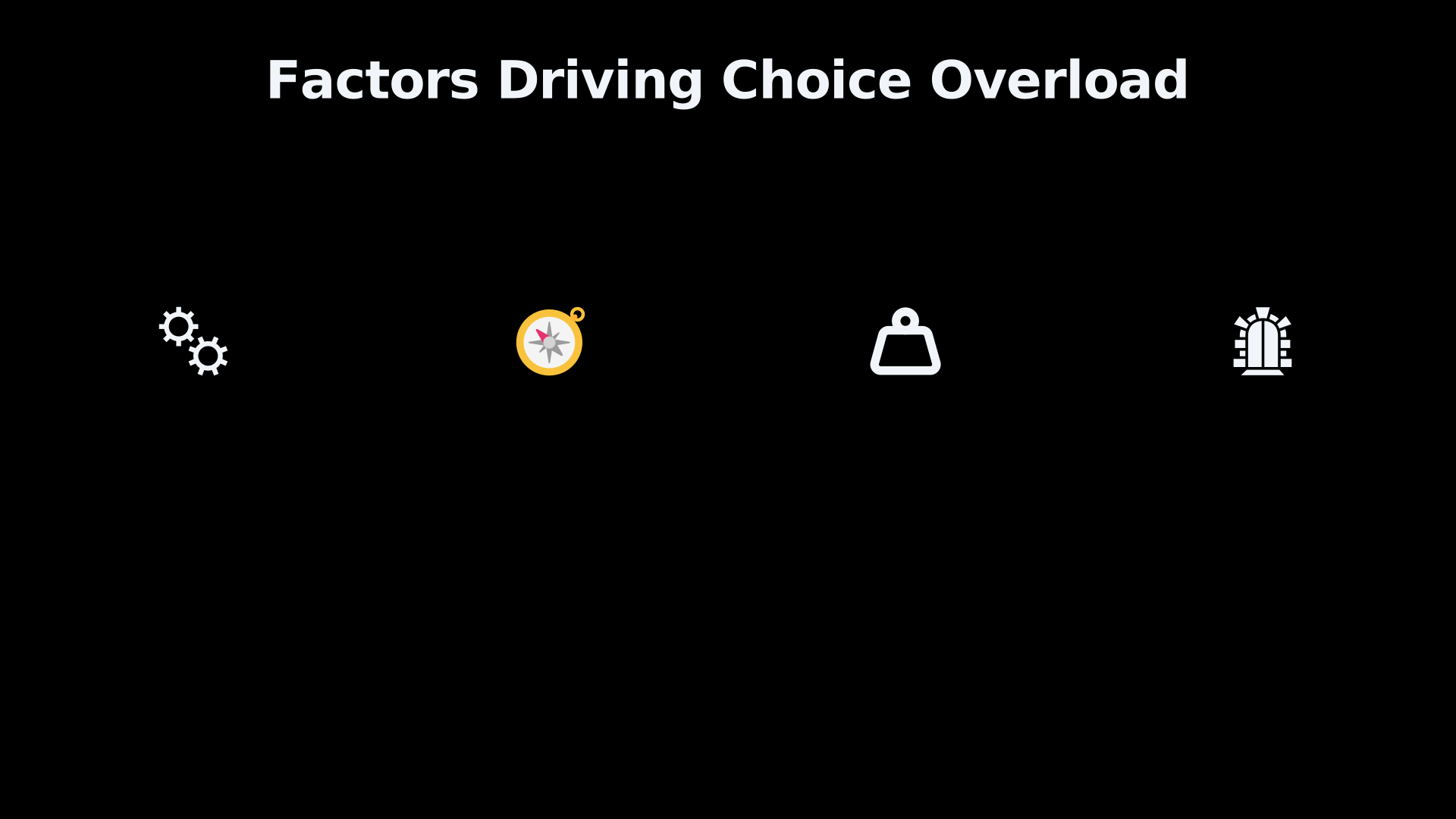
The 2015 meta-analysis provides a particularly useful framework for deciding when reduction is worth attempting. All four of its proposed moderators were statistically significant: overload became more likely as the choice set became more complex, the decision became more difficult, preferences became less certain and an effort-minimising goal became more prominent.[DOI]doi.orgChoice overload: A conceptual review and meta‐analysisChoice overload: A conceptual review and meta‐analysis - Chernev - 2015 - Journal of Consumer Psychology - Wiley Online Library…
Complex options create more trouble than merely numerous ones. Ten alternatives that can be compared on one familiar dimension may be easier to handle than five alternatives involving several awkward trade-offs. Greifeneder, Scheibehenne and Kleber experimentally investigated this distinction and argued that choice complexity reflects not only the number of alternatives but also the number and structure of attributes distinguishing them.[ScienceDirect]sciencedirect.comLess may be more when choosing is difficult: Choice complexity and too much choice - ScienceDirect…
Gourville and Soman demonstrated a related distinction between alignable and non-alignable assortments. An alignable set might contain otherwise similar products differing mainly along one comparable dimension. A non-alignable set instead forces trade-offs across different features. Across three studies, they found evidence that larger non-alignable assortments could increase effort and anticipated regret, whereas larger alignable assortments could accommodate diverse preferences without producing the same penalty. Simplifying the information presentation could reduce or eliminate the overchoice effect.[PubsOnline]pubsonline.informs.orgOverchoice and Assortment Type: When and Why Variety Backfires | Marketing ScienceAugust 1, 2005…
That is important because simply counting options can mistake the symptom for the mechanism. Consider choosing a running route. Six routes presented only by distance — 2 km, 3 km, 4 km and so on — impose a relatively straightforward comparison. Six workout programmes varying simultaneously in duration, equipment, intensity, progression, training philosophy and weekly frequency pose a qualitatively different decision. Cutting the first list from six to three may accomplish little. Curating the second can materially reduce the comparison problem.
Uncertain preferences make large sets harder to exploit. Chernev’s experiments found that people with an articulated “ideal point” — a clearer idea of the attributes they wanted — were more likely to prefer larger assortments. When people know what they are seeking, additional options increase the chance of finding a close match and can therefore become an advantage rather than a burden.[PubMed]pubmed.ncbi.nlm.nih.govPub Med Product assortment and individual decision processesProduct assortment and individual decision processes - PubMedJuly 1, 2003…
This produces an important limit on choice-reduction advice. A large library of books is not necessarily overwhelming to someone who knows they want a short history of nineteenth-century Britain. The same library is a different decision environment for someone whose criterion is merely “I ought to read something useful”. The latter problem is not simply an excess of books; it is an excess of alternatives combined with an underspecified preference.
Task difficulty changes the value of variety. The harder it is to compare alternatives, obtain the relevant information or make the necessary trade-offs, the more likely additional choice is to impose costs. Evidence from healthcare illustrates the general mechanism. In an experiment involving hypothetical selection of primary-care doctors, increasing decision complexity could reduce decision quality, with consumer skills and decision-making style explaining only part of the deterioration.[PubMed]pubmed.ncbi.nlm.nih.govOpen source on nih.gov.
The practical implication is not that important decisions should be stripped of legitimate alternatives. Indeed, doing so can remove the option that best fits someone’s needs. A better response to difficult choice can sometimes be decision support rather than choice elimination: organise the options, expose the dimensions that matter and help the chooser filter them. Reviews of behavioural-economic policy similarly distinguish reducing the number of options from providing tools that make a larger set easier to navigate.[PubMed Central (PMC)]pmc.ncbi.nlm.nih.govOpen source on nih.gov.
More options can be useful when preferences are still being formed
Choice reduction has an opportunity cost: removing alternatives can make it less likely that the set contains an option well matched to an individual’s needs. This is why “simplify everything” is a poor translation of the evidence.
Large sets have obvious informational value during genuine exploration. They can reveal possibilities a person had not considered and help clarify which attributes matter. Someone selecting a form of exercise for the first time might learn, through comparison, that schedule flexibility matters more to them than maximum efficiency, or that social contact matters more than exercising at home. Prematurely reducing the set could conceal those trade-offs rather than simplify them.
Chernev’s ideal-point findings capture the other side of the same process. Once preferences become sufficiently articulated, a larger assortment can become easier to navigate because the chooser possesses a filtering rule. Rather than evaluating every option globally, they can look for alternatives close to the attributes they already value.[OUP Academic]academic.oup.comOpen source on oup.com.
Nor does the number of available options necessarily determine how many people seriously use. Research using records from more than half a million participants in over 600 US retirement plans found that although plans offered between four and 59 funds, participants typically allocated their contributions across only three or four. The number actually used was relatively insensitive to the number offered. That does not prove that huge menus never create difficulty, but it shows why “available options” and “options actively processed” should not automatically be treated as the same quantity.[Wiley Online Library]onlinelibrary.wiley.comOpen source on wiley.com.
The retirement evidence also demonstrates why causal claims deserve care. A frequently cited analysis of nearly 800,000 employees found lower participation in 401(k) pension plans as the number of available funds increased. Yet a review by the US Department of Labor’s Clearinghouse for Labor Evaluation and Research rated the study’s causal evidence as low, noting that employees were not randomly assigned to plans with different menu sizes and that other characteristics could therefore account for some of the association.[Pension Research Council]pensionresearchcouncil.wharton.upenn.eduOpen source on upenn.edu.
The lesson is not that overload disappears. It is that large observational examples should not be converted into a universal psychological law when the experimental literature itself shows substantial variation.
Separating useful exploration from poorly timed reconsideration
For self-improvement, the most useful distinction is therefore temporal: when is choice occurring?
During exploration, uncertainty is part of the job. If someone has not decided whether running, swimming or strength training fits their circumstances, comparing those alternatives is productive deliberation. Cutting the menu too aggressively may produce a faster decision at the expense of a better match.
Execution is different. Suppose that person has already concluded that strength training three times a week is suitable, selected a programme and scheduled today’s session. At the scheduled time, searching again for “the best beginner workout” is no longer performing the same useful function. The original uncertainty has largely been resolved; reopening the choice recreates a demanding comparison immediately before the behaviour is supposed to begin.
The research does not directly establish a universal rule that reopening decisions causes procrastination. What it does establish is the set of conditions under which overload becomes more plausible: uncertain preferences, complicated alternatives, difficult comparison and a desire to minimise decision effort.[DOI]doi.orgChoice overload: A conceptual review and meta‐analysisChoice overload: A conceptual review and meta‐analysis - Chernev - 2015 - Journal of Consumer Psychology - Wiley Online Library… The execution-stage example follows from applying those conditions carefully rather than from claiming that every additional decision consumes a fixed quantity of mental energy.
This suggests three different responses to a large choice set:
- Keep exploring when the underlying goal or relevant preferences remain genuinely unclear and additional alternatives could materially improve the eventual match.
- Structure rather than eliminate choice when the options need to remain available but comparison is unnecessarily difficult. Filters, categories, common attributes and shortlists can reduce complexity without pretending there is only one legitimate answer. Research on non-alignable assortments is especially relevant here because simplifying presentation can reduce overload without necessarily shrinking the underlying set.[PubsOnline]pubsonline.informs.orgOverchoice and Assortment Type: When and Why Variety Backfires | Marketing ScienceAugust 1, 2005…
- Stop reopening the choice when the important decision has already been made, the selected option is good enough to execute, and renewed comparison mainly delays a planned action. In that situation, reducing the live menu is less about finding the objectively perfect option and more about preventing solved uncertainty from returning at the wrong time.
This also explains why a preselected routine can help one person while frustrating another. Someone still learning what they value may need meaningful alternatives. Someone who has already selected a suitable course of action may benefit from having today’s next step made obvious.

The useful rule is conditional, not numerical
There is no research-backed magic number of choices that works across decisions. Six options were useful in famous experiments, but “six” is not a psychological threshold. The meta-analytic record shows too much variation for such a rule.[PubMed]pubmed.ncbi.nlm.nih.govPub Med When choice is demotivating: can one desire too much of a good thing?When choice is demotivating: can one desire too much of a good thing? - PubMed…
A better test is to ask what adding another option would accomplish. If it meaningfully increases the chance of finding a better fit, reveals information needed to form a preference or preserves an important difference between people’s needs, variety has value. If it mostly adds difficult comparisons to a decision whose purpose and acceptable solution are already clear, reduction becomes more attractive.
That yields a restrained principle for decision reduction at moments when action matters: do not minimise choice everywhere; minimise unresolved choice where it is obstructing execution. The strongest choice-overload evidence does not support organising life around the fear of making too many decisions. It supports matching the amount and structure of choice to the stage of the task — broad enough to learn and choose well, narrow enough to act once the useful choosing is done.
Amazon book picks
Further Reading
Books and field guides related to When Fewer Choices Help and When They Do Not. Use these as the next step if you want deeper reading beyond the article.
The Paradox of Choice
Rating: 3.5/5 from 13 Google Books ratings
Whether we’re buying a pair of jeans, ordering a cup of coffee, purchasing shampoo from the drug store, selecting a long-distance carrier...
Atomic Habits
Rating: 3.5/5 from 7 Google Books ratings
The #1 New York Times bestseller. Over 25 million copies sold! Translated into 60+ languages! Tiny Changes, Remarkable Results No matter...
The Art Of Choosing
Every day we make choices. Coke or Pepsi? Save or spend? Stay or go? Whether mundane or life-altering, these choices define us and shape...
Nudge
Rating: 3.5/5 from 29 Google Books ratings
Thaler and Sunstein offer a groundbreaking discussion of how to apply the science of choice to nudge people toward decisions that can imp...
eBay marketplace picks
Marketplace Samples
Live-tested eBay searches with available results related to this page.
Selected fromself improvement poster oneBay.co.uk.


Current eBay listing
Self Improvement Quote Framed Wall Art Poster Canvas Print Picture
Current eBay listing
Self improvement Framed Wall Art Poster Canvas Print Picture
Endnotes
1.
Source: academic.oup.com
Link:https://academic.oup.com/jcr/article-abstract/37/3/409/1827647
Source snippet
OUP AcademicCan There Ever Be Too Many Options? A Meta-Analytic Review of Choice Overload | Journal of Consumer Research | Oxford Academi...
2.
Source: doi.org
Title: Choice overload: A conceptual review and meta‐analysis
Link:https://doi.org/10.1016/j.jcps.2014.08.002
Source snippet
Choice overload: A conceptual review and meta‐analysis - Chernev - 2015 - Journal of Consumer Psychology - Wiley Online Library...
3.
Source: sciencedirect.com
Title: ScienceDirect Choice overload: A conceptual review and meta-analysis
Link:https://www.sciencedirect.com/science/article/pii/S1057740814000916
Source snippet
Choice overload: A conceptual review and meta-analysis - ScienceDirect...
4.
Source: myscp.onlinelibrary.wiley.com
Title: Online Library Choice overload: A conceptual review and meta‐analysis
Link:https://myscp.onlinelibrary.wiley.com/doi/full/10.1016/j.jcps.2014.08.002
Source snippet
Wiley Online LibraryChoice overload: A conceptual review and meta‐analysis - Chernev - 2015 - Journal of Consumer Psychology - Wiley Onli...
5.
Source: sciencedirect.com
Link:https://www.sciencedirect.com/science/article/pii/S000169180900119X
Source snippet
Less may be more when choosing is difficult: Choice complexity and too much choice - ScienceDirect...
6.
Source: academic.oup.com
Link:https://academic.oup.com/jcr/article-abstract/30/2/170/1831629
7.
Source: onlinelibrary.wiley.com
Link:https://onlinelibrary.wiley.com/doi/pdf/10.1111/j.1540-6261.2006.00854.x
8.
Source: doi.org
Link:https://doi.org/10.1073/pnas.2107346118
9.
Source: doi.org
Link:https://doi.org/10.1080/02699931.2021.1945538
10.
Source: sciencedirect.com
Link:https://www.sciencedirect.com/science/article/pii/S0969698920313941
11.
Source: academic.oup.com
Link:https://academic.oup.com/jrssig/article/15/6/38/7037731
12.
Source: sciencedirect.com
Link:https://www.sciencedirect.com/science/article/pii/S0148296315006049
13.
Source: sciencedirect.com
Title: Choice overload: A conceptual review and meta-analysis
Link:https://www.sciencedirect.com/science/article/abs/pii/S1057740814000916?np=y
14.
Source: myscp.onlinelibrary.wiley.com
Link:https://myscp.onlinelibrary.wiley.com/doi/10.1016/j.jcps.2014.08.002
15.
Source: myscp.onlinelibrary.wiley.com
Link:https://myscp.onlinelibrary.wiley.com/doi/epdf/10.1016/j.jcps.2014.08.002
16.
Source: myscp.onlinelibrary.wiley.com
Link:https://myscp.onlinelibrary.wiley.com/doi/abs/10.1016/j.jcps.2014.08.002
17.
Source: doi.org
Title: Choice overload: A conceptual review and meta‐analysis
Link:https://doi.org/10.1016/j.jcps.2014.08.002?urlappend=%3Futm_source%3Dresearchgate.net%26utm_medium%3Darticle
18.
Source: academic.oup.com
Link:https://academic.oup.com/jcr/article-abstract/37/3/409/1827647?login=false
19.
Source: academic.oup.com
Link:https://academic.oup.com/book/36222/chapter-abstract/315665311
20.
Source: academic.oup.com
Link:https://academic.oup.com/book/36222/chapter-abstract/315665311?login=false
21.
Source: sciencedirect.com
Title: Choice overload: A conceptual review and meta-analysis
Link:https://www.sciencedirect.com/science/article/abs/pii/S1057740814000916
22.
Source: sciencedirect.com
Link:https://www.sciencedirect.com/science/article/pii/S0167268121001888
23.
Source: sciencedirect.com
Link:https://www.sciencedirect.com/author/7003790494/ulf-bockenholt
24.
Source: sciencedirect.com
Link:https://www.sciencedirect.com/science/article/abs/pii/S0747563217302522
25.
Source: sciencedirect.com
Title: The effect of available choice on the cognitive processing of pictures
Link:https://www.sciencedirect.com/science/article/pii/S0747563207000404
26.
Source: sciencedirect.com
Title: The joint effects of choice assortment and regulatory focus on choice behavior
Link:https://www.sciencedirect.com/science/article/pii/S0167811612000249
27.
Source: sciencedirect.com
Title: How much to save? Decision costs and retirement plan participation
Link:https://www.sciencedirect.com/science/article/pii/S0047272720301110
28.
Source: pubmed.ncbi.nlm.nih.gov
Title: Pub Med When choice is demotivating: can one desire too much of a good thing?
Link:https://pubmed.ncbi.nlm.nih.gov/11138768/
Source snippet
When choice is demotivating: can one desire too much of a good thing? - PubMed...
29.
Source: pubsonline.informs.org
Link:https://pubsonline.informs.org/doi/10.1287/mksc.1040.0109
Source snippet
Overchoice and Assortment Type: When and Why Variety Backfires | Marketing ScienceAugust 1, 2005...
Published: August 1, 2005
30.
Source: pubsonline.informs.org
Link:https://pubsonline.informs.org/doi/pdf/10.1287/mksc.1040.0109
31.
Source: pubmed.ncbi.nlm.nih.gov
Title: Pub Med Product assortment and individual decision processes
Link:https://pubmed.ncbi.nlm.nih.gov/12872891/
Source snippet
Product assortment and individual decision processes - PubMedJuly 1, 2003...
Published: July 1, 2003
32.
Source: pubmed.ncbi.nlm.nih.gov
Link:https://pubmed.ncbi.nlm.nih.gov/23999489/
33.
Source: pmc.ncbi.nlm.nih.gov
Link:https://pmc.ncbi.nlm.nih.gov/articles/PMC4265800/
34.
Source: pensionresearchcouncil.wharton.upenn.edu
Link:https://pensionresearchcouncil.wharton.upenn.edu/publications/papers-2018/how-much-choice-is-too-much-contributions-to-401k-retirement-plans/
35.
Source: pubmed.ncbi.nlm.nih.gov
Link:https://pubmed.ncbi.nlm.nih.gov/38784631/
36.
Source: pmc.ncbi.nlm.nih.gov
Link:https://pmc.ncbi.nlm.nih.gov/articles/PMC11111947/
37.
Source: pubmed.ncbi.nlm.nih.gov
Link:https://pubmed.ncbi.nlm.nih.gov/36746011/
38.
Source: pubmed.ncbi.nlm.nih.gov
Link:https://pubmed.ncbi.nlm.nih.gov/34423744/
39.
Source: pubmed.ncbi.nlm.nih.gov
Link:https://pubmed.ncbi.nlm.nih.gov/35592271/
40.
Source: GOV.UK
Link:https://www.gov.uk/government/publications/online-choice-architecture-how-digital-design-can-harm-competition-and-consumers/evidence-review-of-online-choice-architecture-and-consumer-and-competition-harm
41.
Source: pmc.ncbi.nlm.nih.gov
Link:https://pmc.ncbi.nlm.nih.gov/articles/PMC10704390/
42.
Source: pmc.ncbi.nlm.nih.gov
Link:https://pmc.ncbi.nlm.nih.gov/articles/PMC7994916/
43.
Source: pubmed.ncbi.nlm.nih.gov
Link:https://pubmed.ncbi.nlm.nih.gov/32659154/
44.
Source: pubmed.ncbi.nlm.nih.gov
Link:https://pubmed.ncbi.nlm.nih.gov/30652607/
45.
Source: pmc.ncbi.nlm.nih.gov
Link:https://pmc.ncbi.nlm.nih.gov/articles/PMC5739328
46.
Source: pmc.ncbi.nlm.nih.gov
Link:https://pmc.ncbi.nlm.nih.gov/articles/PMC3992693/
47.
Source: pubmed.ncbi.nlm.nih.gov
Link:https://pubmed.ncbi.nlm.nih.gov/22465484/
48.
Source: pmc.ncbi.nlm.nih.gov
Link:https://pmc.ncbi.nlm.nih.gov/articles/PMC3891777/
49.
Source: pmc.ncbi.nlm.nih.gov
Link:https://pmc.ncbi.nlm.nih.gov/articles/PMC3385021/
50.
Source: pmc.ncbi.nlm.nih.gov
Link:https://pmc.ncbi.nlm.nih.gov/articles/PMC3293470/
51.
Source: pmc.ncbi.nlm.nih.gov
Link:https://pmc.ncbi.nlm.nih.gov/articles/PMC3157937/
52.
Source: pubmed.ncbi.nlm.nih.gov
Link:https://pubmed.ncbi.nlm.nih.gov/19766972/
53.
Source: pmc.ncbi.nlm.nih.gov
Link:https://pmc.ncbi.nlm.nih.gov/articles/PMC2798815/
54.
Source: pmc.ncbi.nlm.nih.gov
Link:https://pmc.ncbi.nlm.nih.gov/articles/PMC3993927/
55.
Source: pubmed.ncbi.nlm.nih.gov
Link:https://pubmed.ncbi.nlm.nih.gov/17107293/
56.
Source: pubmed.ncbi.nlm.nih.gov
Link:https://pubmed.ncbi.nlm.nih.gov/8511635/
57.
Source: pubmed.ncbi.nlm.nih.gov
Link:https://pubmed.ncbi.nlm.nih.gov/8768489/
58.
Source: pubmed.ncbi.nlm.nih.gov
Link:https://pubmed.ncbi.nlm.nih.gov/17925141/
59.
Source: pubmed.ncbi.nlm.nih.gov
Link:https://pubmed.ncbi.nlm.nih.gov/12804407/
60.
Source: pmc.ncbi.nlm.nih.gov
Link:https://pmc.ncbi.nlm.nih.gov/articles/PMC2690155/
61.
Source: behaviouralbydesign.com
Link:https://www.behaviouralbydesign.com/24-pathways/choice-overload
Additional References
62.
Source: youtube.com
Title: Choice Overload Explained | The Paradox of More
Link:https://www.youtube.com/watch?v=AYwZOhadR0I
Source snippet
In her classic presentation, Sheena Iyengar: How to make choosing easier examines the mechanisms of choice overload and outlines concrete...
63.
Source: youtube.com
Title: Spoiled For Choice
Link:https://www.youtube.com/watch?v=Ci3H2Ekt9oA
Source snippet
Episode 88: Barry Schwartz - The Paradox of Choice...
64.
Source: youtube.com
Title: Episode 027: Too Many Choices with Dr. Sheena Iyengar
Link:https://www.youtube.com/watch?v=c0aeQu032S0
Source snippet
Spoiled For Choice - Behavioral Economics Series | Academy 4 Social Change...
65.
Source: ssa.gov
Link:https://www.ssa.gov/policy/docs/ssb/v65n2/v65n2p59.html
66.
Source: congress.gov
Link:https://www.congress.gov/crs-product/R46441
67.
Source: beta.dol.gov
Title: how much choice too much contributions 401 k retirement plans iyengar et al 2003
Link:https://beta.dol.gov/research-data/clear/studies/how-much-choice-too-much-contributions-401-k-retirement-plans-iyengar-et-al-2003
68.
Source: researchgate.net
Link:https://www.researchgate.net/publication/24099205_When_More_Is_Less_and_Less_Is_More_The_Role_of_Ideal_Point_Availability_and_Assortment_in_Consumer_Choice
69.
Source: stellae.design
Link:https://www.stellae.design/en/ux/choice-architecture
70.
Source: jonathanmall.com
Link:https://jonathanmall.com/en/choice-overload-jam-study-twin-test/
71.
Source: studylib.net
Link:https://studylib.net/doc/28205034/how-much-choice-is-too-much-contributions-to-401k-