Within No Magic Formula
Why There Is No Universal Habit Timeline
Habit formation follows a familiar pattern, but the time needed for automaticity can vary dramatically from person to person.
On this page
- What the 12 week habit study actually measured
- Why automaticity develops at different speeds
- How to use habit timelines without chasing magic numbers
Page outline Jump by section
Introduction
There is no scientifically established number of days after which a new behaviour suddenly becomes a habit. The famous 18-to-254-day range comes from a real-world study by Phillippa Lally and colleagues, who followed people attempting to establish everyday eating, drinking and activity behaviours. Their central finding was not that everyone should aim for 66 days, or even that every habit must fall between 18 and 254 days. It was that habit automaticity developed at markedly different speeds in different people and behaviours.[Wiley Online Library]onlinelibrary.wiley.comWiley Online LibraryHow are habits formed: Modelling habit formation in the real world - Lally - 2010 - European Journal of Social Psycho…
That distinction matters for self-improvement. A fixed deadline can turn normal variation into apparent failure: if a behaviour still requires effort after three weeks, or even three months, that does not by itself mean the strategy has failed. The more useful question is whether repeated behaviour in a sufficiently consistent context is becoming progressively easier and more automatic.
What the 12-week study actually measured
The study behind the numbers, How are habits formed: Modelling habit formation in the real world, recruited 96 volunteers. Each chose an eating, drinking or activity behaviour and attempted to perform it every day in the same context for 12 weeks — for example, doing something after breakfast. Participants recorded whether they had performed the behaviour and completed daily measures of its automaticity. Eighty-two supplied enough data to be included in the main analysis.[Wiley Online Library]onlinelibrary.wiley.comWiley Online LibraryHow are habits formed: Modelling habit formation in the real world - Lally - 2010 - European Journal of Social Psycho…
This is important because the researchers were not simply counting consecutive successful days and declaring a habit complete. They were interested in automaticity: the extent to which the behaviour came to occur with less conscious deliberation. In contemporary habit research, habitual behaviour is generally understood as behaviour that becomes automatically activated by associated contextual cues through learning and repetition.[Compass]compass.onlinelibrary.wiley.comWhat is habit and how can it be used to change real‐world behaviour? Narrowing the theory‐reality gap - Gardner - 2024 - Social an…
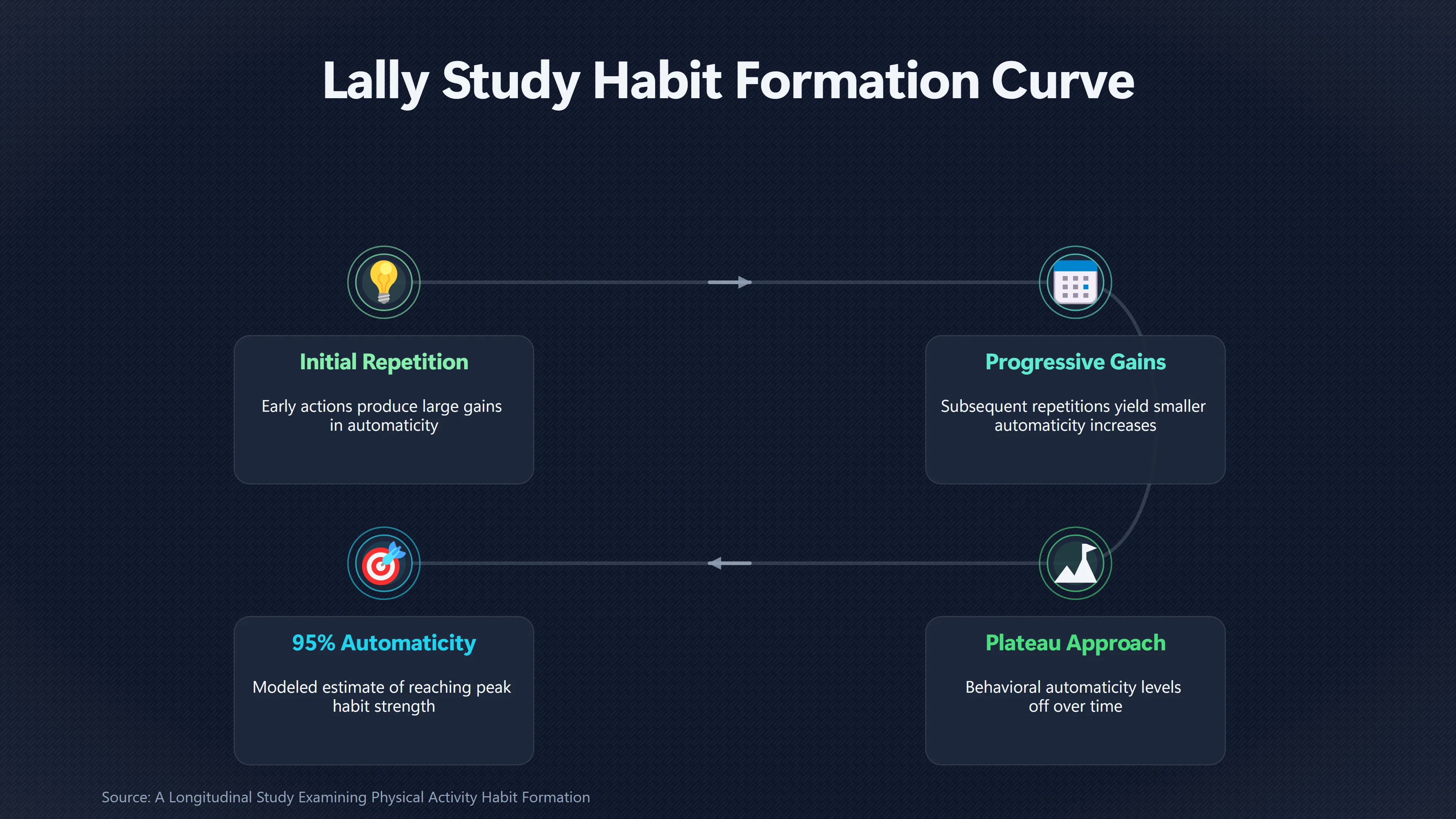
The researchers modelled each participant’s changing automaticity using an asymptotic curve. In plain English, this means they expected early repetitions to produce relatively large gains in automaticity, followed by progressively smaller gains as the person approached a plateau. Later research continues to describe this as a useful model of habit development: repetition does not necessarily add the same amount of habit strength every day.[BPS Psych Hub]bpspsychub.onlinelibrary.wiley.comBPS Psych HubHabit formation following routine‐based versus time‐based cue planning: A randomized controlled trial - Keller - 2021 - Brit…
For participants whose data could be modelled this way, the researchers estimated when each person reached 95% of their eventual automaticity plateau. The resulting estimates ranged from 18 to 254 days, with a central estimate of about 66 days.[Wiley Online Library]onlinelibrary.wiley.comWiley Online LibraryHow are habits formed: Modelling habit formation in the real world - Lally - 2010 - European Journal of Social Psycho…
That makes “66 days to form a habit” a misleading simplification. Lally herself has subsequently stressed that the figure should not be interpreted as a universal deadline.[University of Surrey]surrey.ac.ukUniversity of SurreyDoes it really take 66 days to form a habit? We asked the expert, Dr Pippa Lally | University of SurreyJanuary 21, 2026…
There is another easily missed limitation. The study ran for only 84 days, yet some fitted curves projected that participants would need considerably longer than that to reach 95% of their plateau. In other words, 254 days was a modelled estimate rather than 254 days of directly observed habit formation for that individual. Moreover, the asymptotic model did not adequately represent everyone: later methodological discussion notes poor model fit for 43 of the 82 participants with sufficient data.[BPS Psych Hub]bpspsychub.onlinelibrary.wiley.comBPS Psych HubHabit formation following routine‐based versus time‐based cue planning: A randomized controlled trial - Keller - 2021 - Brit…
So the study is better understood as evidence for a variable process than as a stopwatch for habits.
Why automaticity develops at different speeds
The enormous gap between 18 and 254 days makes more sense once habit formation is treated as learning rather than calendar accumulation. What matters is not simply that another midnight has passed. The person has another opportunity to perform a particular response in the presence of a sufficiently consistent cue, strengthening the association between that situation and the behaviour.
The original study found that consistent performance was associated with better-fitting habit-formation curves. It also found something practically reassuring: missing one opportunity did not materially derail the automaticity-building process. Habit formation therefore appears more forgiving than “never break the chain” advice implies.[Wiley Online Library]onlinelibrary.wiley.comWiley Online LibraryHow are habits formed: Modelling habit formation in the real world - Lally - 2010 - European Journal of Social Psycho…
Several factors help explain why the number of calendar days can differ so much.
The behaviour itself matters. Drinking a glass of water is a relatively simple action; an exercise routine demands more steps, time and effort. A later clinical explanation of the original findings notes that automaticity peaked more quickly for simple actions such as drinking water than for more elaborate routines.[PubMed Central (PMC)]pmc.ncbi.nlm.nih.govOpen source on nih.gov.
The context matters. Habit learning depends on associations between situations and responses, so repetition under stable circumstances should be different from performing the same nominal behaviour amid constantly changing cues. A 2022 study tested this more directly and found, across both an experimental student sample and observational app data, that greater context stability predicted greater automaticity as well as better attainment of repetition goals.[Frontiers]frontiersin.orgOpen source on frontiersin.org.
People matter too. Individuals differ in what they choose, how consistently they perform it and how their daily environments support repetition. A 2024 systematic review found that habit development was associated with factors including behaviour type, frequency, timing, personal choice and behavioural regulation. The evidence base remains relatively small, however, so these should not be converted into another rigid formula.[PubMed Central (PMC)]pmc.ncbi.nlm.nih.govOpen source on nih.gov.
Later studies reinforce the central point rather than narrowing everything to 66 days. The 2024 systematic review found four studies reporting time-to-habit estimates. Median estimates included 59 and 66 days, while reported means in other studies ranged from 106 to 154 days. Across the evidence reviewed, individual estimates extended from 4 to 335 days. The authors also cautioned that much of the underlying literature had a high risk of bias and that comparatively few studies directly estimated formation time.[PubMed Central (PMC)]pmc.ncbi.nlm.nih.govOpen source on nih.gov.
The 18-to-254-day result should therefore not be interpreted as defining the minimum and maximum possible human habit-formation times. It is the observed/modelled range from one influential dataset, not a biological boundary.

The curve matters more than the deadline
The most useful part of the Lally study may be the shape of the learning curve rather than any particular number printed beside it. Automaticity increased strongly at first and then accumulated more slowly as it approached a plateau.[MDPI]mdpi.comTime to Form a Habit: A Systematic Review and Meta-Analysis of Health Behaviour Habit Formation and Its Determinants…
That changes how progress should be interpreted. Imagine two people trying to establish the same morning behaviour. After 40 repetitions, one may already perform it with little thought; the other may still need reminders. Counting days makes the second person look “behind”. A learning-curve perspective instead asks whether the cue-response relationship is strengthening.
It also explains why a single missed day need not reset anything. The association learnt during previous repetitions does not disappear merely because one opportunity was missed. The original study specifically found that one missed opportunity did not materially affect the formation process. What would be more concerning is a persistent pattern in which the behaviour is rarely repeated in its intended context, because there are then fewer consistent learning experiences from which automaticity can develop.[Wiley Online Library]onlinelibrary.wiley.comWiley Online LibraryHow are habits formed: Modelling habit formation in the real world - Lally - 2010 - European Journal of Social Psycho…
There is a further distinction between performing a behaviour regularly and having a strong habit. Frequency is visible; automaticity is the psychological process the study was trying to track. Modern reviews consequently warn against treating “habit” as merely another word for something done often. A behaviour can be frequent because a person is deliberately making themselves do it, whereas the theoretical advantage of habit is that an associated context increasingly prompts action without requiring the same degree of conscious motivation.[Compass]compass.onlinelibrary.wiley.comWhat is habit and how can it be used to change real‐world behaviour? Narrowing the theory‐reality gap - Gardner - 2024 - Social an…
How to use habit timelines without chasing magic numbers
The 18-to-254-day finding supports a personalised behaviour system precisely because it makes rigid deadlines difficult to defend. It does not imply that timing is irrelevant. It means elapsed time should be treated as feedback rather than a pass-or-fail threshold.
A more evidence-aligned approach is to watch three things together:
- Repetition: Is the behaviour actually happening often enough to be learnt?
- Context: Is it occurring in a recognisable, reasonably stable situation or after a reliable cue?
- Automaticity: Is starting or performing it gradually requiring less conscious prompting?
That framing follows the mechanism studied in the original research — repeated behaviour in a consistent context producing increasing automaticity — without pretending that researchers can tell an individual in advance exactly when their curve will plateau.[Wiley Online Library]onlinelibrary.wiley.comWiley Online LibraryHow are habits formed: Modelling habit formation in the real world - Lally - 2010 - European Journal of Social Psycho…
It also suggests a different response when progress is slow. Rather than concluding on day 21, 30 or 66 that the person “cannot build habits”, examine the system. A complicated behaviour might be simplified; an unreliable cue might be replaced with a more stable one; or the behaviour might be attached to a part of the day in which repetition is realistically sustainable. Context-stability research provides independent support for paying attention to those conditions rather than merely accumulating days.[Frontiers]frontiersin.orgOpen source on frontiersin.org.
At the same time, there is no evidence-based reason to treat occasional imperfection as a reset. The original dataset explicitly undermines that interpretation: one missed opportunity was not enough to materially disrupt formation.[Wiley Online Library]onlinelibrary.wiley.comWiley Online LibraryHow are habits formed: Modelling habit formation in the real world - Lally - 2010 - European Journal of Social Psycho…
The practical lesson from 18 to 254 days is therefore not “give every habit 254 days”, just as the lesson from the central estimate is not “stop after 66”. It is that habit formation is an individual learning trajectory. The calendar can record how long you have been practising, but it cannot determine when your behaviour has become automatic. For self-improvement that works, the more useful target is a repeatable behaviour in a stable enough context, followed long enough for your own automaticity curve to develop.
Amazon book picks
Further Reading
Books and field guides related to Why There Is No Universal Habit Timeline. Use these as the next step if you want deeper reading beyond the article.
Good Habits, Bad Habits
'The world's leading expert on habits' - Matthew Syed, bestselling author of Black Box Thinking and Rebel IdeasWhat if you could harness...
Atomic Habits
Rating: 3.5/5 from 7 Google Books ratings
The #1 New York Times bestseller. Over 25 million copies sold! Translated into 60+ languages! Tiny Changes, Remarkable Results No matter...
Tiny Habits
Improving your life is much easier than you think. Whether it’s losing weight, sleeping more, or restoring your work/life balance – the s...
The Power of Habit
NEW YORK TIMES BESTSELLER • MORE THAN 3 MILLION COPIES SOLD • This instant classic explores how we can change our lives by changing our h...
eBay marketplace picks
Marketplace Samples
Live-tested eBay searches with available results related to this page.
Selected frommotivational poster oneBay.co.uk.


Current eBay listing
Gym Motivational Posters Work Out Insperational Quotes Wall Art

Current eBay listing
Motivational Quotes Framed Wall Art Poster Canvas Print Picture
Endnotes
1.
Source: onlinelibrary.wiley.com
Link:https://onlinelibrary.wiley.com/doi/full/10.1002/ejsp.674
Source snippet
Wiley Online LibraryHow are habits formed: Modelling habit formation in the real world - Lally - 2010 - European Journal of Social Psycho...
2.
Source: bpspsychub.onlinelibrary.wiley.com
Link:https://bpspsychub.onlinelibrary.wiley.com/doi/abs/10.1111/bjhp.12504
Source snippet
BPS Psych HubHabit formation following routine‐based versus time‐based cue planning: A randomized controlled trial - Keller - 2021 - Brit...
3.
Source: onlinelibrary.wiley.com
Link:https://onlinelibrary.wiley.com/doi/pdf/10.1002/ejsp.674
Source snippet
Wiley Online LibraryHow are habits formed: Modelling habit formation in the real world - Lally - 2010 - European Journal of Social Psycho...
4.
Source: compass.onlinelibrary.wiley.com
Link:https://compass.onlinelibrary.wiley.com/doi/full/10.1111/spc3.12975
Source snippet
What is habit and how can it be used to change real‐world behaviour? Narrowing the theory‐reality gap - Gardner - 2024 - Social an...
5.
Source: mdpi.com
Link:https://www.mdpi.com/2227-9032/12/23/2488
Source snippet
Time to Form a Habit: A Systematic Review and Meta-Analysis of Health Behaviour Habit Formation and Its Determinants...
6.
Source: onlinelibrary.wiley.com
Link:https://onlinelibrary.wiley.com/doi/abs/10.1002/ejsp.674
Source snippet
Wiley Online LibraryHow are habits formed: Modelling habit formation in the real world - Lally - 2010 - European Journal of Social Psycho...
7.
Source: mdpi.com
Title: A Longitudinal Study Examining [Physical Activity]({{ ‘physical-capacity/’ | relative_url }}) Habit Formation
Link:https://www.mdpi.com/2076-328X/16/4/535
8.
Source: mdpi.com
Link:https://www.mdpi.com/2227-9032/12/23/2488?_bhlid=47dee3946db8c7e6d3a6e92da693cbc5a7439e28
9.
Source: onlinelibrary.wiley.com
Link:https://onlinelibrary.wiley.com/doi/10.1002/ejsp.674
10.
Source: onlinelibrary.wiley.com
Link:https://onlinelibrary.wiley.com/doi/abs/10.1002/ejsp.674?msockid=17570258034862e732eb114c02616368
11.
Source: onlinelibrary.wiley.com
Link:https://onlinelibrary.wiley.com/doi/10.1002/ejsp.674?2d235898_page=2&538fcd4b_page=6&d2101103_page=8&d73ad837_page=2
12.
Source: onlinelibrary.wiley.com
Link:https://onlinelibrary.wiley.com/doi/abs/10.1002/ejsp.674?msockid=038ed114f43667dd0790c4bef5146634
13.
Source: onlinelibrary.wiley.com
Link:https://onlinelibrary.wiley.com/doi/abs/10.1002/ejsp.674?MixPanelId=15e3fe314440-0468d8411-64220f54-100000-15e3fe314460
14.
Source: onlinelibrary.wiley.com
Link:https://onlinelibrary.wiley.com/doi/abs/10.1002/ejsp.674?538fcd4b_page=6&947f74f7_page=5
15.
Source: onlinelibrary.wiley.com
Link:https://onlinelibrary.wiley.com/doi/abs/10.1002/ejsp.674?cf_chl_jschl_tk=pmd_EwcJDaCFBR9OVEL1O_0qjioww0Gc86ZzpBvCBFhrDcE-1635261061-0-gqNtZGzNAjujcnBszQi9
16.
Source: onlinelibrary.wiley.com
Link:https://onlinelibrary.wiley.com/doi/abs/10.1002/ejsp.674?trk=article-ssr-frontend-pulse_little-text-block
17.
Source: onlinelibrary.wiley.com
Link:https://onlinelibrary.wiley.com/doi/abs/10.1002/ejsp.674?source=content_type%3Areact%7Cfirst_level_url%3Aarticle%7Csection%3Amain_content%7Cbutton%3Abody_link
18.
Source: onlinelibrary.wiley.com
Link:https://onlinelibrary.wiley.com/doi/abs/10.1002/ejsp.674?aff_id=24772
19.
Source: onlinelibrary.wiley.com
Link:https://onlinelibrary.wiley.com/doi/10.1002/ejsp.674?947f74f7_page=5&b158b201_page=5
20.
Source: bpspsychub.onlinelibrary.wiley.com
Link:https://bpspsychub.onlinelibrary.wiley.com/share/SFKV2IDZIZUZFJF4X9N2?target=10.1111%2Fbjhp.12504
21.
Source: fit.edu
Title: Minutes | Florida Tech Image: High-tech visualization of a brain MINUTES #499
Link:https://www.fit.edu/psychology/about-sop/psychology-science-minute/minutes/name-135395-en.php
22.
Source: pmc.ncbi.nlm.nih.gov
Link:https://pmc.ncbi.nlm.nih.gov/articles/PMC4566897/
Source snippet
PubMed Central (PMC)A review and analysis of the use of ‘habit’ in understanding, predicting and influencing health-related behaviour - PMC...
23.
Source: surrey.ac.uk
Link:https://www.surrey.ac.uk/news/does-it-really-take-66-days-form-habit-we-asked-expert-dr-pippa-lally
Source snippet
University of SurreyDoes it really take 66 days to form a habit? We asked the expert, Dr Pippa Lally | University of SurreyJanuary 21, 2026...
Published: January 21, 2026
24.
Source: pmc.ncbi.nlm.nih.gov
Link:https://pmc.ncbi.nlm.nih.gov/articles/PMC3505409/
25.
Source: frontiersin.org
Link:https://www.frontiersin.org/journals/psychology/articles/10.3389/fpsyg.2022.883795/full
26.
Source: pmc.ncbi.nlm.nih.gov
Link:https://pmc.ncbi.nlm.nih.gov/articles/PMC9226889/
27.
Source: pmc.ncbi.nlm.nih.gov
Link:https://pmc.ncbi.nlm.nih.gov/articles/PMC11641623/
28.
Source: pubmed.ncbi.nlm.nih.gov
Link:https://pubmed.ncbi.nlm.nih.gov/42053513/
29.
Source: pmc.ncbi.nlm.nih.gov
Link:https://pmc.ncbi.nlm.nih.gov/articles/PMC12190898/
30.
Source: pubmed.ncbi.nlm.nih.gov
Link:https://pubmed.ncbi.nlm.nih.gov/39685110/
31.
Source: doi.org
Link:https://doi.org/10.3390/healthcare12232488
32.
Source: doi.org
Link:https://doi.org/10.1111/bjhp.12637
33.
Source: pmc.ncbi.nlm.nih.gov
Link:https://pmc.ncbi.nlm.nih.gov/articles/PMC12318445/
34.
Source: pmc.ncbi.nlm.nih.gov
Link:https://pmc.ncbi.nlm.nih.gov/articles/PMC8355237/
35.
Source: doi.org
Link:https://doi.org/10.1111/bjhp.12504
36.
Source: doi.org
Link:https://doi.org/10.1080/17437199.2011.603640%C2%A0
37.
Source: pubmed.ncbi.nlm.nih.gov
Link:https://pubmed.ncbi.nlm.nih.gov/36437536/
38.
Source: zendy.io
Link:https://zendy.io/title/10.1002/ejsp.674
39.
Source: 123dok.com
Link:https://123dok.com/id/article/discussion-predicting-context-sensitivity-behavior-field-data.10407160
40.
Source: limitlessretreats.de
Title: How are habits formed: Modelling habit formation in the real world
Link:https://limitlessretreats.de/en-US/research/papers/habit-formation-modelling-2010
Additional References
41.
Source: scispace.com
Title: how are habits formed modelling habit formation in the real 4iq5e623zp
Link:https://scispace.com/papers/how-are-habits-formed-modelling-habit-formation-in-the-real-4iq5e623zp
Source snippet
SciSpace(PDF) How are habits formed: Modelling habit formation in the real world (2010) | Phillippa Lally | 1734 Citations...
42.
Source: youtube.com
Title: How to stop failing at forming new habits | Rob Stein | TEDx Westminster
Link:https://www.youtube.com/watch?v=3AXFhVrw3UE
Source snippet
For an in-depth conversation directly with the lead researcher of the 18-to-254-day habit study, watch PAN Podcast #6 | Dr. Phillippa Lal...
43.
Source: youtube.com
Title: How to develop good habits and get rid of bad habits with Wendy Wood
Link:https://www.youtube.com/watch?v=CZ6rQJRHUXo
Source snippet
How to stop failing at forming new habits | Rob Stein | TEDxWestminster...
44.
Source: youtube.com
Title: The Science of Making & Breaking Habits | Huberman Lab Essentials
Link:https://www.youtube.com/watch?v=HXuj7wAt7u8
Source snippet
How to develop good habits and get rid of bad habits with Wendy Wood...
45.
Source: youtube.com
Title: How Long Does It Take to Build a Habit? HINT: It’s NOT 21 Days
Link:https://www.youtube.com/watch?v=cJ2gxIsScmk
Source snippet
The Science of Making & Breaking Habits | Huberman Lab Essentials...
46.
Source: youtube.com
Title: PAN Podcast #6 | Dr. Phillippa Lally | Habits and Health
Link:https://www.youtube.com/watch?v=7A5AgZLd5bY
Source snippet
How Long Does It Take to Build a Habit? HINT: It's NOT 21 Days...
47.
Source: researchgate.net
Link:https://www.researchgate.net/publication/303871340_A_workplace_intervention_designed_to_interrupt_prolonged_occupational_sitting_Self-reported_perceptions_of_health_from_a_cohort_of_desk-based_employees_over_26_weeks
48.
Source: researchgate.net
Link:https://www.researchgate.net/publication/389052244_Using_Action_Research_to_Explore_Transfer-Informed_Practice_at_the_Battle_Back_Centre
49.
Source: carolinecrotty.ie
Link:https://carolinecrotty.ie/category/blog/
50.
Source: tandfonline.com
Link:https://www.tandfonline.com/doi/abs/10.1080/08870446.2021.2003362