Within Motivation Limits
Why Motivation Feels Different From Day to Day
Motivation can rise and fall within the same person, changing how rewarding an effortful action feels from one moment to the next.
On this page
- How motivation fluctuates within one person
- Why rewards and effort feel different across moments
- Why plans that require enthusiasm are fragile
Page outline Jump by section
Introduction
Motivation is not a fixed amount of willingness that a person carries from one day to the next. It fluctuates within the same person, and those fluctuations can change whether an effortful action seems worth doing. A workout, difficult piece of study or demanding household task can therefore look attractive at one moment and disproportionately burdensome at another even when the objective task and payoff have barely changed.
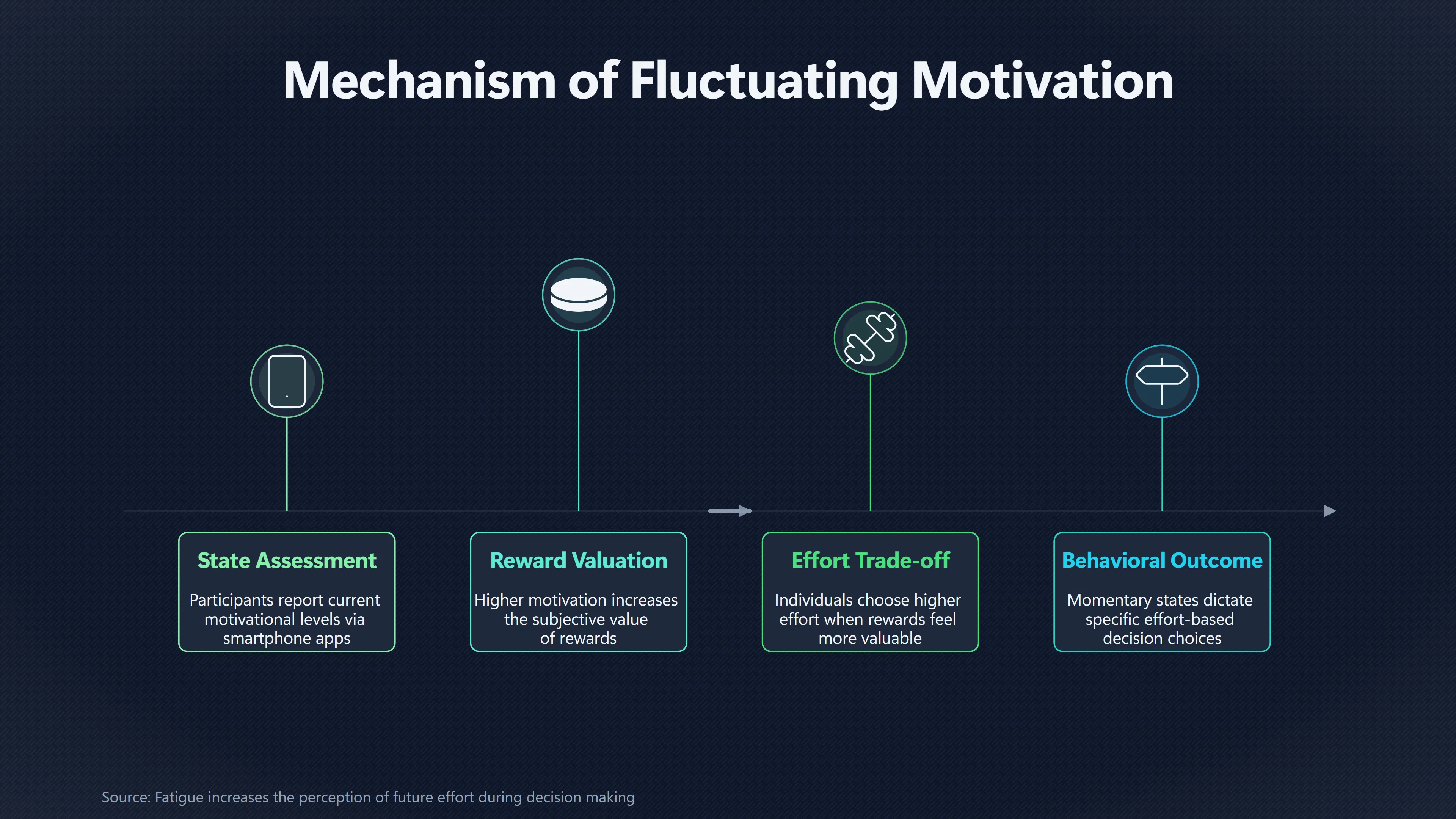
Recent real-world research provides unusually direct evidence for this mechanism. Repeated smartphone measurements found that when people felt more motivated than usual for themselves, they were more willing to choose greater effort for greater reward. Computational analysis suggested something more specific than a general feeling that effort had become easier: higher motivation made the prospective reward more valuable.[PubMed Central (PMC)]pmc.ncbi.nlm.nih.govPubMed Central (PMC)Day-to-day fluctuations in motivation drive effort-based decision-making - PMCMarch 25, 2025…
That distinction matters for long-term self-improvement. A plan built around what seems worthwhile during a motivational high is being designed under conditions that will not reliably persist.
How motivation fluctuates within one person
Much motivation research has traditionally compared people: one person is described as highly motivated, another as less motivated. For behaviour change, however, there is another important comparison — you today versus you at another moment.
Hewitt and colleagues examined precisely this issue in a 15-day microlongitudinal study. Participants repeatedly reported their current state through their smartphones and periodically completed a game in which they chose between routes offering different combinations of monetary reward and physical effort. The published analysis included 129 participants after exclusions, 3,344 momentary state assessments and 845 decision-making games. This dense sampling made it possible to distinguish relatively stable differences between people from fluctuations occurring within each person.[PubMed Central (PMC)]pmc.ncbi.nlm.nih.govPubMed Central (PMC)Day-to-day fluctuations in motivation drive effort-based decision-making - PMCMarch 25, 2025…
Those within-person changes were substantial and meaningful. At times when participants reported greater motivation than was normal for them, they were more likely to select options requiring greater physical effort in exchange for greater reward. This relationship remained after accounting for stable individual differences and other covariates. In other words, the result was not merely that generally energetic people both said they were motivated and acted motivated. The same individual’s effort choices shifted alongside their changing motivational state.[PubMed Central (PMC)]pmc.ncbi.nlm.nih.govPubMed Central (PMC)Day-to-day fluctuations in motivation drive effort-based decision-making - PMCMarch 25, 2025…
Motivation also moved alongside other everyday states. Within individuals, it was positively associated with happiness and the previous night’s sleep quality and negatively associated with fatigue. Yet motivation was not simply interchangeable with feeling happy: the researchers found that effort-based choices were specifically coupled with motivational state rather than happiness after modelling the relevant variables.[PubMed Central (PMC)]pmc.ncbi.nlm.nih.govPubMed Central (PMC)Day-to-day fluctuations in motivation drive effort-based decision-making - PMCMarch 25, 2025…
That makes daily variability more than background noise. Someone can genuinely value an exercise goal, writing project or course while experiencing sizeable changes in how willing they are to pay the immediate effort required to pursue it.
The finding should not be stretched too far. The study involved adults aged 18–45 and used a short, gamified physical-effort task rather than months of exercise, studying or dieting. It demonstrates a mechanism of fluctuating effort-based choice, not a precise prediction of how much any particular habit will vary. The broader effort-discounting literature is also methodologically heterogeneous: researchers use different definitions and manipulations of physical and cognitive effort, limiting simple generalisations across tasks.[Cambridge University Press]cambridge.orgCambridge University PressA systematic review of effort discounting research in humans: Current knowledge, recommendations, and future di…
Why rewards and effort feel different across moments
An effortful choice can be understood as a trade-off. The brain is not evaluating a reward in isolation; it is evaluating something closer to reward minus the subjective cost of obtaining it. This phenomenon is commonly studied as effort discounting: as required effort rises, the subjective value of a prospective reward generally falls. Research has demonstrated this with both physical and cognitive demands.[Cambridge University Press]cambridge.orgCambridge University PressA systematic review of effort discounting research in humans: Current knowledge, recommendations, and future di…
That creates two obvious ways motivation could fluctuate. On a low-motivation day, the same task might seem more costly: the workout feels harder. Alternatively, its payoff might carry less weight: finishing the workout does not seem worth much right now. Both routes could produce the same observable behaviour — choosing the easier option — while arising from different underlying valuations.
The 2025 longitudinal study was able to separate these possibilities computationally. Higher momentary motivation predicted greater reward sensitivity, whereas the evidence did not support a corresponding change in effort sensitivity. In practical terms, when participants were more motivated, the rewards available in the task carried more subjective value, tipping choices towards the high-effort option.[PubMed Central (PMC)]pmc.ncbi.nlm.nih.govPubMed Central (PMC)Day-to-day fluctuations in motivation drive effort-based decision-making - PMCMarch 25, 2025…
The temporal results strengthen that interpretation, although they do not establish causation. Higher state motivation preceded increased reward sensitivity at a later assessment, suggesting that motivation was not merely a label participants applied after making an energetic choice. Because motivation itself was not experimentally manipulated, the authors appropriately stop short of claiming definitive causal proof.[PubMed Central (PMC)]pmc.ncbi.nlm.nih.govPubMed Central (PMC)Day-to-day fluctuations in motivation drive effort-based decision-making - PMCMarch 25, 2025…
This provides a useful way to understand a familiar self-improvement experience. Imagine that running for 30 minutes produces roughly the same long-term benefits on Tuesday and Thursday. On Tuesday, those benefits — satisfaction afterwards, fitness progress or keeping a promise to yourself — may feel sufficiently valuable to justify getting changed and going outside. On Thursday, the distant payoff may carry less motivational weight. Nothing about the long-term goal needs to have changed. The momentary valuation has.
Effort itself is dynamic too. Laboratory work on persistence shows that fatigue accumulating during physical work can alter subsequent effort-based decisions. Müller and colleagues modelled two fatigue processes: one rose with effort and could partly recover during rest, while another accumulated more gradually as work continued. Both reduced willingness to work for reward.[Nature]nature.comNeural and computational mechanisms of momentary fatigue and persistence in effort-based choice | Nature CommunicationsJuly 28, 2021…
Sleep can alter the equation as well, although not necessarily uniformly. In a small controlled crossover study of 24 healthy young adults, three nights restricted to three hours’ sleep reduced willingness to undertake cognitive effort for reward compared with three nine-hour sleep opportunities, while willingness to undertake physical effort was not significantly reduced.[PubMed Central (PMC)]pmc.ncbi.nlm.nih.govPubMed Central (PMC)Sleep Restriction Reduces Cognitive but Not Physical Motivation - PMCNovember 4, 2022…
These findings caution against imagining a single internal “motivation battery” that simply rises and falls. Different states can affect different components and kinds of effort.
Indeed, fatigue findings are not completely uniform. A 2025 experiment involving 22 healthy men induced perceived fatigue through upper-body exercise but found no significant change in subsequent choices involving lower-body physical effort. Participants did, however, become slower in deciding and less confident that they could perform highly effortful actions.[ScienceDirect]sciencedirect.comPerceived fatigue does not alter effort-based decision making but does undermine confidence in the ability to perform physic… That result is useful precisely because it complicates the simple story: feeling tired does not automatically make every effortful option less valuable in every setting.
Why plans that require enthusiasm are fragile
The practical problem with motivational fluctuation appears when decisions made in one state must be executed in another.
During a motivational peak, a demanding routine can look perfectly reasonable: exercise for an hour before work, study every evening or work on a personal project after dinner. At that moment, the future payoff carries enough subjective value to justify the inconvenience. The plan can therefore feel realistic rather than ambitious.
But the person who must execute it tomorrow is likely to encounter a different motivational state. If the reward then carries less weight, the identical requirement can lose the effort–reward contest. The resulting hesitation does not necessarily show that the original goal was insincere. The research suggests that the valuation underlying the choice itself can move.[PubMed Central (PMC)]pmc.ncbi.nlm.nih.govPubMed Central (PMC)Day-to-day fluctuations in motivation drive effort-based decision-making - PMCMarch 25, 2025…
This exposes a particular weakness in self-improvement strategies based on repeatedly generating enthusiasm. They require two things to coincide: the opportunity to perform the behaviour and a motivational state strong enough to make its reward outweigh its costs. Long-term repetition creates many opportunities for those conditions to come apart.
The vulnerability becomes greater as the required action becomes more demanding. Across effort-discounting research, larger effort requirements generally reduce the subjective value of rewards, although the precise form of that relationship differs between studies and effort domains.[Cambridge University Press]cambridge.orgCambridge University PressA systematic review of effort discounting research in humans: Current knowledge, recommendations, and future di… A routine that requires a large discretionary effort every time consequently leaves more room for a downward swing in motivation to reverse the choice.
This also explains why simply remembering the benefits of a goal may sometimes feel surprisingly ineffective. If motivational state changes reward sensitivity, the issue is not necessarily that the person has forgotten that exercise improves fitness or that studying helps an exam result. They can know those facts perfectly well while the benefits carry less weight at the decision moment.
The implication is not that difficult goals should only be pursued when motivation is high. Scheduling especially demanding discretionary work for predictable motivational peaks can be sensible, and the researchers themselves note the potential value of learning one’s fluctuations.[University College London]ucl.ac.ukOpen source on ucl.ac.uk. But a long-term system that requires a peak is inherently exposed to ordinary variation.
A more robust standard is therefore to judge a recurring behaviour not only by whether it seems achievable while motivation is strong, but by what happens when its subjective reward temporarily fades. Reducing the amount of effort demanded by the minimum acceptable version, removing repeated choices about when to begin, or arranging immediate rewards can all make execution less dependent on winning a fresh motivational calculation. Those approaches belong to the broader design of sustainable behaviour change; the mechanism here explains why they are needed.
The useful lesson from an unstable state
Daily motivation swings should change how inconsistency is interpreted. A person’s behaviour on one unusually productive or unproductive day is a poor basis for estimating what they will reliably do for months. Stable goals coexist with variable motivational states, and effortful choices can move with those states.[PubMed Central (PMC)]pmc.ncbi.nlm.nih.govPubMed Central (PMC)Day-to-day fluctuations in motivation drive effort-based decision-making - PMCMarch 25, 2025…
The most important recent finding is also the least intuitive one. Lower motivation does not necessarily mean that the required work itself suddenly looks dramatically worse. In the longitudinal evidence, the clearer shift was on the other side of the calculation: the reward lost subjective value. The same payoff bought less willingness to work for it.[PubMed Central (PMC)]pmc.ncbi.nlm.nih.govPubMed Central (PMC)Day-to-day fluctuations in motivation drive effort-based decision-making - PMCMarch 25, 2025…
That makes motivation useful but unreliable infrastructure for long-term self-improvement. High-motivation periods can help people start difficult actions and tackle unusually demanding work. They are less suitable as an assumption built into every repetition of a behaviour. A routine designed only for the version of you who finds its rewards compelling today has not yet solved the problem posed by the version of you who must choose again tomorrow.

Amazon book picks
Further Reading
Books and field guides related to Why Motivation Feels Different From Day to Day. Use these as the next step if you want deeper reading beyond the article.
Atomic Habits
Rating: 3.5/5 from 7 Google Books ratings
The #1 New York Times bestseller. Over 25 million copies sold! Translated into 60+ languages! Tiny Changes, Remarkable Results No matter...
Drive
A book that will change how you think and transform how you live Forget everything you thought you knew about how to motivate people - at...
The Motivation Myth
From Inc.com's most popular columnist, a counterintuitive--but highly practical--guide to finding and maintaining the motivation to achie...
Tiny Habits
Improving your life is much easier than you think. Whether it’s losing weight, sleeping more, or restoring your work/life balance – the s...
eBay marketplace picks
Marketplace Samples
Live-tested eBay searches with available results related to this page.
Selected frommotivational wall art oneBay.co.uk.




Endnotes
1.
Source: cambridge.org
Link:https://www.cambridge.org/core/journals/judgment-and-decision-making/article/systematic-review-of-effort-discounting-research-in-humans-current-knowledge-recommendations-and-future-directions/F2E2339CB6115F92558ED543012932F2
Source snippet
Cambridge University PressA systematic review of effort discounting research in humans: Current knowledge, recommendations, and future di...
2.
Source: nature.com
Link:https://www.nature.com/articles/s41467-021-24927-7
Source snippet
Neural and computational mechanisms of momentary fatigue and persistence in effort-based choice | Nature CommunicationsJuly 28, 2021...
Published: July 28, 2021
3.
Source: sciencedirect.com
Link:https://www.sciencedirect.com/science/article/pii/S0031938424003408
Source snippet
Perceived fatigue does not alter effort-based decision making but does undermine confidence in the ability to perform physic...
4.
Source: sciencedirect.com
Link:https://www.sciencedirect.com/science/article/pii/S0306460325003053
5.
Source: sciencedirect.com
Link:https://www.sciencedirect.com/science/article/abs/pii/S0031938424003408
6.
Source: nature.com
Link:https://www.nature.com/articles/s41598-021-01287-2
7.
Source: sciencedirect.com
Link:https://www.sciencedirect.com/science/article/pii/S0959475216302055
8.
Source: nature.com
Link:https://www.nature.com/articles/srep16880
9.
Source: sciencedirect.com
Title: Fatigue increases the perception of future effort during decision making
Link:https://www.sciencedirect.com/science/article/pii/S1469029217301279
10.
Source: sciencedirect.com
Link:https://www.sciencedirect.com/science/article/pii/S146902922300047X
11.
Source: sciencedirect.com
Link:https://www.sciencedirect.com/science/article/pii/S1041608026000099
12.
Source: sciencedirect.com
Link:https://www.sciencedirect.com/science/article/pii/S1389945723003611
13.
Source: sciencedirect.com
Link:https://www.sciencedirect.com/science/article/pii/S2667174326000935
14.
Source: sciencedirect.com
Link:https://www.sciencedirect.com/science/article/pii/S0079612316300553
15.
Source: sciencedirect.com
Title: Effort-based decision making and motivational deficits in stroke patients
Link:https://www.sciencedirect.com/science/article/abs/pii/S0278262623001823
16.
Source: sciencedirect.com
Link:https://www.sciencedirect.com/science/article/pii/S0191886916301477
17.
Source: sciencedirect.com
Link:https://www.sciencedirect.com/science/article/pii/S0001879122001245
18.
Source: pmc.ncbi.nlm.nih.gov
Link:https://pmc.ncbi.nlm.nih.gov/articles/PMC11962463/
Source snippet
PubMed Central (PMC)Day-to-day fluctuations in motivation drive effort-based decision-making - PMCMarch 25, 2025...
Published: March 25, 2025
19.
Source: pubmed.ncbi.nlm.nih.gov
Title: Pub Med Day-to-day fluctuations in motivation drive effort-based decision-making
Link:https://pubmed.ncbi.nlm.nih.gov/40096607/
Source snippet
Day-to-day fluctuations in motivation drive effort-based decision-making - PubMed...
20.
Source: pubmed.ncbi.nlm.nih.gov
Link:https://pubmed.ncbi.nlm.nih.gov/26586084/
Source snippet
The role of cognitive effort in subjective reward devaluation and risky decision-making - PubMed...
21.
Source: pubmed.ncbi.nlm.nih.gov
Link:https://pubmed.ncbi.nlm.nih.gov/34321478/
Source snippet
Neural and computational mechanisms of momentary fatigue and persistence in effort-based choice - PubMed...
22.
Source: pmc.ncbi.nlm.nih.gov
Link:https://pmc.ncbi.nlm.nih.gov/articles/PMC9642807/
Source snippet
PubMed Central (PMC)[Sleep Restriction]({{ 'mental-habits/' | relative_url }}) Reduces Cognitive but Not Physical Motivation - PMCNovember 4, 2022...
Published: November 4, 2022
23.
Source: pubmed.ncbi.nlm.nih.gov
Title: Pub Med Sleep Restriction Reduces Cognitive but Not Physical Motivation
Link:https://pubmed.ncbi.nlm.nih.gov/36394069/
Source snippet
Sleep Restriction Reduces Cognitive but Not Physical Motivation - PubMed...
24.
Source: pubmed.ncbi.nlm.nih.gov
Link:https://pubmed.ncbi.nlm.nih.gov/39730065/
25.
Source: ucl.ac.uk
Link:https://www.ucl.ac.uk/brain-sciences/news/2025/mar/study-suggests-day-day-fluctuations-mental-health-influence-decision-making
26.
Source: pubmed.ncbi.nlm.nih.gov
Title: Pub Med Response effort discounts the subjective value of rewards
Link:https://pubmed.ncbi.nlm.nih.gov/25150069/
27.
Source: pubmed.ncbi.nlm.nih.gov
Link:https://pubmed.ncbi.nlm.nih.gov/42027104/
28.
Source: pubmed.ncbi.nlm.nih.gov
Link:https://pubmed.ncbi.nlm.nih.gov/41637496/
29.
Source: pmc.ncbi.nlm.nih.gov
Link:https://pmc.ncbi.nlm.nih.gov/articles/PMC12871445/
30.
Source: pubmed.ncbi.nlm.nih.gov
Link:https://pubmed.ncbi.nlm.nih.gov/41282752/
31.
Source: pmc.ncbi.nlm.nih.gov
Link:https://pmc.ncbi.nlm.nih.gov/articles/PMC12527505/
32.
Source: pmc.ncbi.nlm.nih.gov
Link:https://pmc.ncbi.nlm.nih.gov/articles/PMC12160390/
33.
Source: pubmed.ncbi.nlm.nih.gov
Link:https://pubmed.ncbi.nlm.nih.gov/40181076/
34.
Source: pubmed.ncbi.nlm.nih.gov
Link:https://pubmed.ncbi.nlm.nih.gov/40096607/?dopt=Abstract
35.
Source: pmc.ncbi.nlm.nih.gov
Link:https://pmc.ncbi.nlm.nih.gov/articles/PMC11865449/
36.
Source: pmc.ncbi.nlm.nih.gov
Link:https://pmc.ncbi.nlm.nih.gov/articles/PMC11275777/
37.
Source: pubmed.ncbi.nlm.nih.gov
Link:https://pubmed.ncbi.nlm.nih.gov/39071329/
38.
Source: pmc.ncbi.nlm.nih.gov
Link:https://pmc.ncbi.nlm.nih.gov/articles/PMC11452193/
39.
Source: pmc.ncbi.nlm.nih.gov
Link:https://pmc.ncbi.nlm.nih.gov/articles/PMC11098016/
40.
Source: pmc.ncbi.nlm.nih.gov
Link:https://pmc.ncbi.nlm.nih.gov/articles/PMC10993123/
41.
Source: pubmed.ncbi.nlm.nih.gov
Link:https://pubmed.ncbi.nlm.nih.gov/38108114/
42.
Source: pmc.ncbi.nlm.nih.gov
Link:https://pmc.ncbi.nlm.nih.gov/articles/PMC10336650/
43.
Source: pubmed.ncbi.nlm.nih.gov
Link:https://pubmed.ncbi.nlm.nih.gov/36270628/
44.
Source: pmc.ncbi.nlm.nih.gov
Link:https://pmc.ncbi.nlm.nih.gov/articles/PMC8593117/
45.
Source: pmc.ncbi.nlm.nih.gov
Link:https://pmc.ncbi.nlm.nih.gov/articles/PMC8319292/
46.
Source: pmc.ncbi.nlm.nih.gov
Link:https://pmc.ncbi.nlm.nih.gov/articles/PMC8286723/
47.
Source: pmc.ncbi.nlm.nih.gov
Link:https://pmc.ncbi.nlm.nih.gov/articles/PMC7529845/
48.
Source: pmc.ncbi.nlm.nih.gov
Link:https://pmc.ncbi.nlm.nih.gov/articles/PMC7989786/
49.
Source: pubmed.ncbi.nlm.nih.gov
Link:https://pubmed.ncbi.nlm.nih.gov/33778106/
50.
Source: pmc.ncbi.nlm.nih.gov
Link:https://pmc.ncbi.nlm.nih.gov/articles/PMC6520500/
51.
Source: pubmed.ncbi.nlm.nih.gov
Link:https://pubmed.ncbi.nlm.nih.gov/26994467/
52.
Source: pubmed.ncbi.nlm.nih.gov
Link:https://pubmed.ncbi.nlm.nih.gov/26690644/
53.
Source: pmc.ncbi.nlm.nih.gov
Link:https://pmc.ncbi.nlm.nih.gov/articles/PMC4653618/
54.
Source: pubmed.ncbi.nlm.nih.gov
Link:https://pubmed.ncbi.nlm.nih.gov/25028961/
55.
Source: pmc.ncbi.nlm.nih.gov
Link:https://pmc.ncbi.nlm.nih.gov/articles/PMC4100728/
56.
Source: pmc.ncbi.nlm.nih.gov
Link:https://pmc.ncbi.nlm.nih.gov/articles/PMC3377184/
57.
Source: pmc.ncbi.nlm.nih.gov
Link:https://pmc.ncbi.nlm.nih.gov/articles/PMC3386853/
58.
Source: pmc.ncbi.nlm.nih.gov
Link:https://pmc.ncbi.nlm.nih.gov/articles/PMC2744387/
59.
Source: pubmed.ncbi.nlm.nih.gov
Link:https://pubmed.ncbi.nlm.nih.gov/12753348/
60.
Source: pubmed.ncbi.nlm.nih.gov
Link:https://pubmed.ncbi.nlm.nih.gov/19246324/
Additional References
61.
Source: youtube.com
Title: Andrew Westbrook
Link:https://www.youtube.com/watch?v=vr8x2PmlVV8
Source snippet
Effort discounting motivation decision making neuroscience Andrew Westbrook - Dopamine Promotes Cognitive Effort...
62.
Source: youtube.com
Link:https://www.youtube.com/watch?v=VPi_eWiaqdg
Source snippet
Striatal dopamine and the costs and benefits of cognitive effort...
63.
Source: youtube.com
Title: Controlling Your Dopamine For Motivation, Focus & Satisfaction
Link:https://www.youtube.com/watch?v=QmOF0crdyRU
Source snippet
How Dopamine & Serotonin Shape Decisions, Motivation & Learning | Dr. Read Montague...
64.
Source: youtube.com
Title: Striatal dopamine and the costs and benefits of cognitive effort
Link:https://www.youtube.com/watch?v=aTQLKSoIg-I
Source snippet
The Neuroscience of Pleasure, Effort & Motivation | Michael Treadway...
65.
Source: youtube.com
Title: The Neuroscience of Pleasure, Effort & Motivation | Michael Treadway
Link:https://www.youtube.com/watch?v=LBAOJNN6RJw
Source snippet
Andrew Westbrook - Dopamine Promotes Cognitive Effort...
66.
Source: researchgate.net
Link:https://www.researchgate.net/publication/394943470_A_systematic_review_of_effort_discounting_research_in_humans_Current_knowledge_recommendations_and_future_directions
67.
Source: researchgate.net
Link:https://www.researchgate.net/publication/360552591_Objective_measures_of_reward_sensitivity_and_motivation_in_people_with_high_v_low_anhedonia
68.
Source: researchgate.net
Link:https://www.researchgate.net/publication/383074610_Real-world_fluctuations_in_motivation_drive_effort-based_choices
69.
Source: visualize.jove.com
Link:https://visualize.jove.com/39730065-perceived-fatigue-does-not-alter-effort-based-decision-making-but-does-undermine-confidence-in-the-ability-to-perform-physical-actions
70.
Source: doaj.org
Link:https://doaj.org/article/e70da2c00fba41a0b53b85828b0d4c5e