Within Accountability
Should You Tell People Your Goals or Your Progress?
Announcing an aspiration and reporting completed work are different social acts, and research gives good reason not to treat them as interchangeable.
On this page
- Why public intentions can create premature recognition
- What newer goal disclosure studies add
- Turning aspiration announcements into evidence based check ins
Page outline Jump by section
Introduction
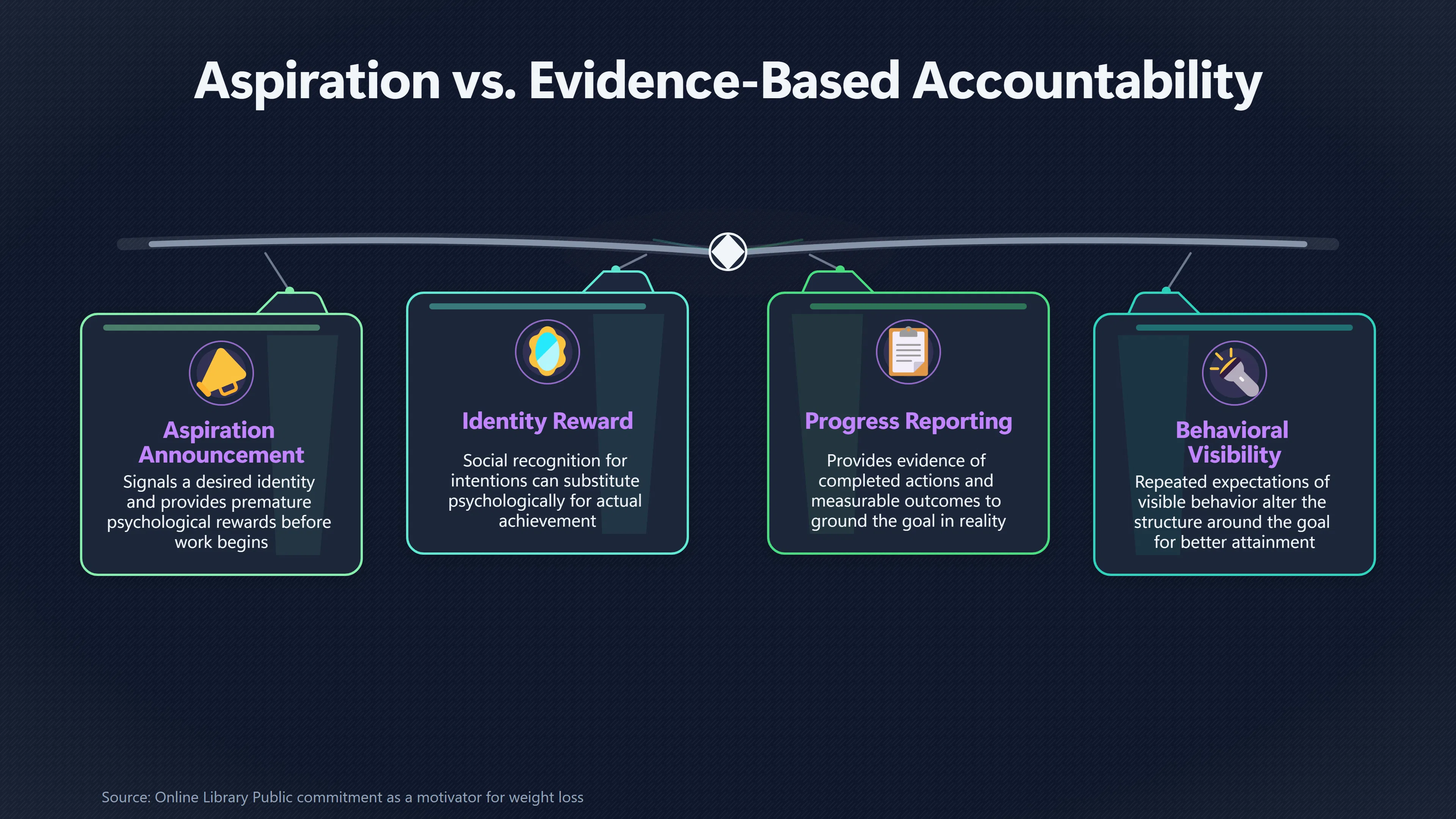
Telling people what you intend to do and telling them what you have actually done are not the same form of accountability. An aspiration announcement — “I’m going to become a writer”, “I’m training for a marathon”, “I’m starting a business” — can create commitment or attract useful support. But in some circumstances, especially when the announcement itself signals a desired identity, social recognition may provide part of the psychological reward before the work has happened. A classic series of experiments found exactly that pattern for identity-related intentions.[Association for Psychological Science]psychologicalscience.orgAssociation for Psychological Science When Intentions Go PublicAssociation for Psychological ScienceWhen Intentions Go Public - Psychological Science - APS…
Reporting completed behaviour works differently. “I wrote 3,200 words this week” or “I completed three of my four planned runs” puts evidence into the social interaction. A large meta-analysis found that deliberately increasing progress monitoring improved goal attainment, with larger effects when monitoring outcomes were reported to others or made public.[PubMed]pubmed.ncbi.nlm.nih.govDoes monitoring goal progress promote goal attainment? A meta-analysis of the experimental evidence - PubMedFebruary 1, 2016…
The practical lesson is therefore more precise than either “tell everyone your goals” or “keep your goals secret”. Use disclosure when it creates useful commitment or support, but make ongoing accountability revolve around evidence of action rather than recognition for an intended future.
Why public intentions can create premature recognition
The strongest reason for caution about announcing goals comes from Peter Gollwitzer and colleagues’ 2009 paper When Intentions Go Public. Across four experiments, the researchers studied identity-related behavioural intentions: actions connected with becoming the sort of person participants wanted to be. Their examples included law students intending to undertake activities associated with becoming successful lawyers.[Association for Psychological Science]psychologicalscience.orgAssociation for Psychological Science When Intentions Go PublicAssociation for Psychological ScienceWhen Intentions Go Public - Psychological Science - APS…
When other people noticed these identity-relevant intentions, strongly committed participants subsequently acted on them less intensively than participants whose intentions had effectively gone unnoticed. The pattern appeared both in a week-long field study and in laboratory experiments measuring whether people seized opportunities to work towards the identity. A fourth experiment supported the proposed mechanism: social acknowledgement of the intention produced a premature sense of possessing the desired identity.[Association for Psychological Science]psychologicalscience.orgAssociation for Psychological Science When Intentions Go PublicAssociation for Psychological ScienceWhen Intentions Go Public - Psychological Science - APS…
That mechanism matters because it explains why some announcements may feel suspiciously satisfying. Suppose someone wants to become a novelist. Saying “I’m writing a novel” does more than communicate a plan: listeners may begin treating that person as a writer. If being recognised as a writer was part of the reward the goal promised, some of that reward has arrived without another page being written.
The result is often popularised too broadly as “science says never tell anyone your goals”. That is not what the experiments established. The 2009 research concerned identity-related intentions, and the detrimental effect was found among participants strongly committed to the relevant identity goal. It does not demonstrate that every disclosed target — losing five kilograms, saving £2,000 or completing a course — automatically becomes less likely to happen.[Association for Psychological Science]psychologicalscience.orgAssociation for Psychological Science When Intentions Go PublicAssociation for Psychological ScienceWhen Intentions Go Public - Psychological Science - APS…
That limitation is crucial because other research has found beneficial effects from public commitment. A weight-loss study, for example, reported that making commitments public was associated with greater motivation and better weight-loss outcomes.[Wiley Online Library]onlinelibrary.wiley.comOnline Library Public commitment as a motivator for weight lossWiley Online LibraryPublic commitment as a motivator for weight loss - Nyer - 2010 - Psychology & Marketing - Wiley Online LibraryDecembe… The research literature is therefore less contradictory once the social acts being studied are separated: receiving recognition for an identity, making yourself accountable for a target, recruiting support and reporting subsequent performance can produce different consequences.
What newer goal-disclosure studies add
Later work makes it difficult to defend a simple rule that goals should remain secret. In a four-study investigation published in 2020, Howard Klein and colleagues found that the status of the audience influenced the consequences of disclosure. Sharing goals with someone perceived as higher in status increased commitment more than disclosure to a lower-status audience, and that greater commitment could translate into better performance.[PubMed]pubmed.ncbi.nlm.nih.govWhen goals are known: The effects of audience relative status on goal commitment and performance - PubMed…
This suggests that an announcement can sometimes create a genuine reputational stake rather than merely premature satisfaction. Telling a respected supervisor that you intend to submit a piece of work by Friday, for example, is psychologically different from broadcasting “big things coming” to followers who reward the aspiration itself. The content may concern the same future goal, but the audience and expected consequences differ.
An even newer set of studies complicates the story further. Johanna Peetz, Roger Buehler and Tayler Wells followed 1,035 participants across four longitudinal studies of personally important goals. Rather than concentrating on artificial laboratory targets, they examined ordinary goals and disclosure to other people, including close relationships. People who shared goals tended to report receiving more support and investing more effort; experimental instructions to share also produced evidence that increased support could contribute to greater pursuit effort.[DOI]doi.orgGoals Out Loud: Telling Others About a Goal Increases Support Received and Facilitates Goal Pursuit - Johanna Peetz, Roger Buehler, Ta…
The findings were not uniformly dramatic. In one preregistered study, being assigned to share rather than keep a goal private increased reported support but produced no significant direct difference in effort or subjective progress. There was, however, an indirect association between the sharing condition and effort through increased support.[DOI]doi.orgGoals Out Loud: Telling Others About a Goal Increases Support Received and Facilitates Goal Pursuit - Johanna Peetz, Roger Buehler, Ta… This is useful precisely because it resists the tempting headline that merely saying a goal aloud makes it happen.
The newer research also identifies a mechanism absent from the “premature recognition” story: other people can actually help. Once someone knows that you are trying to run a marathon, finish a qualification or change career, they can remind you, encourage you, provide information or resources, and respond to setbacks. In the Peetz studies, participants were particularly likely to report receiving support from people to whom they had disclosed the goal.[DOI]doi.orgGoals Out Loud: Telling Others About a Goal Increases Support Received and Facilitates Goal Pursuit - Johanna Peetz, Roger Buehler, Ta…
So the historical comparison is not “old research says disclosure is bad; new research says it is good”. The better reading is that goal disclosure is not one psychological treatment. Its effect depends on what is being disclosed, to whom, what social response follows and whether that response rewards an identity, increases commitment, supplies support or creates future accountability.
Why reporting completed work is a different social act
Progress reporting moves the centre of attention from a proposed future to an observable past. That difference makes it particularly relevant to social accountability.
The most substantial evidence comes from Benjamin Harkin and colleagues’ meta-analysis of 138 experimental studies involving 19,951 participants. Interventions that increased progress monitoring strongly increased the frequency with which people monitored themselves and produced a more moderate improvement in eventual goal attainment, with an average effect of d = 0.40. Importantly for social accountability, the effects on attainment were larger when monitoring outcomes were reported to somebody else or made public, and when progress was physically recorded.[PubMed]pubmed.ncbi.nlm.nih.govDoes monitoring goal progress promote goal attainment? A meta-analysis of the experimental evidence - PubMedFebruary 1, 2016…
That evidence does not directly pit “announcing a goal” against “reporting progress” in a single experiment, so it would be too strong to claim that progress reports have been definitively proved superior to all goal announcements. What it does establish is that progress reporting has its own evidence base. It should not be treated as merely another version of public intention-setting.
Consider the informational difference:
- Aspiration: “I’m going to get fit this year.”
- Commitment: “I will exercise four times each week.”
- Progress report: “I planned four sessions this week and completed three.”
- Outcome report: “My 5 km time has fallen from 30:10 to 28:45.”
Only the last two reveal whether behaviour or results have actually changed. They also make repeated comparison possible. Next week there will be another number, another record or another completed action to discuss.
Field research on savings gives a vivid example of accountability built around behaviour rather than motivational declarations. Randomised experiments involving 2,687 Chilean microentrepreneurs found large increases in saving among participants using peer self-help groups; a second experiment produced effects of a similar magnitude through feedback text messages designed to hold participants accountable, without requiring group meetings or peer pressure.[National Bureau of Economic Research]nber.orgOpen source on nber.org. The useful social ingredient need not therefore be applause, publicity or a large audience. A repeated expectation that behaviour will become visible can be enough to alter the structure around the goal.
Turning aspiration announcements into evidence-based check-ins
The research does not require secrecy. It suggests changing what the social interaction rewards.
If announcing “I’m becoming a runner” reliably produces congratulations, questions about future races and recognition as a committed athlete, the announcement itself carries social rewards. A stronger accountability arrangement quickly moves past that identity claim and towards behaviour: “I’m aiming for three runs each week; every Sunday I’ll tell you how many I actually completed.”
That design also fits the supportive-accountability model developed by David Mohr and colleagues. Their framework proposes that accountability works best when expectations are clear and process-oriented, and when the person receiving the reports is viewed as trustworthy, benevolent and appropriately knowledgeable. The point is not simply to create surveillance; it is to establish an agreed expectation that performance will be observed within a useful relationship.[JMIR]jmir.orgJournal of Medical Internet ResearchJournal of Medical Internet Research
For self-improvement, that suggests three practical shifts. First, announce enough to recruit the right person, not necessarily the largest audience. Disclosure can be valuable when the listener will provide support or when their opinion creates meaningful commitment. The findings on audience status and close-other support both indicate that who knows can matter as much as how many people know.[PubMed]pubmed.ncbi.nlm.nih.govWhen goals are known: The effects of audience relative status on goal commitment and performance - PubMed…
Second, define what evidence will be reported before relying on accountability. “Ask whether I’m working on my book” is easy to answer impressionistically. “Every Sunday I’ll send you the number of writing sessions completed and words drafted” produces a record. This follows the progress-monitoring evidence, in which recording and reporting were associated with stronger effects on attainment.[PubMed]pubmed.ncbi.nlm.nih.govDoes monitoring goal progress promote goal attainment? A meta-analysis of the experimental evidence - PubMedFebruary 1, 2016…
Third, make the next social reward follow behaviour rather than aspiration. The first conversation can establish the goal, but subsequent conversations should concentrate on completed actions, obstacles and the next controllable step. This retains the potential advantages of disclosure — commitment, practical help and encouragement — while reducing reliance on the gratifying social identity that an announcement can create.
The distinction that resolves the apparent contradiction
Research on public goals looks inconsistent when every instance of “telling someone” is placed in the same category. Once the social acts are separated, a more coherent picture emerges.
Gollwitzer and colleagues showed that acknowledgement of identity-related intentions can sometimes substitute psychologically for action, producing premature feelings of identity completion.[Association for Psychological Science]psychologicalscience.orgAssociation for Psychological Science When Intentions Go PublicAssociation for Psychological ScienceWhen Intentions Go Public - Psychological Science - APS… Klein and colleagues showed that disclosure can instead increase commitment, particularly when the audience matters to the goal setter.[PubMed]pubmed.ncbi.nlm.nih.govWhen goals are known: The effects of audience relative status on goal commitment and performance - PubMed… Peetz and colleagues found that sharing personally important goals can recruit interpersonal support and facilitate pursuit effort, while also showing that experimentally prompting disclosure does not guarantee large direct gains in progress.[DOI]doi.orgGoals Out Loud: Telling Others About a Goal Increases Support Received and Facilitates Goal Pursuit - Johanna Peetz, Roger Buehler, Ta… And the much broader progress-monitoring literature shows that recording what happens and reporting it to others can strengthen goal attainment.[PubMed]pubmed.ncbi.nlm.nih.govDoes monitoring goal progress promote goal attainment? A meta-analysis of the experimental evidence - PubMedFebruary 1, 2016…
For social accountability, therefore, the useful question is not simply “Should I tell people my goals?” It is what will they know about me afterwards? If they merely know the person you hope to become, disclosure may offer recognition before achievement. If they know what you committed to do and will later see what you actually did, the conversation has become accountability.
That makes a simple rule possible without pretending the evidence is simpler than it is: share aspirations selectively; report progress concretely. A goal announcement can open the social loop. Evidence of completed work is what keeps it anchored to reality.
Amazon book picks
Further Reading
Books and field guides related to Should You Tell People Your Goals or Your Progress?. Use these as the next step if you want deeper reading beyond the article.
Finish
Year after year, readers pulled me aside at events and said, “I’ve never had a problem starting. I’ve started a million things, but I nev...
The 12 Week Year
The guide to shortening your execution cycle down from one year to twelve weeks Most organizations and individuals work in the context of...
Rethinking Positive Thinking
“The solution isn’t to do away with dreaming and positive thinking. Rather, it’s making the most of our fantasies by brushing them up aga...
Atomic Habits
Rating: 3.5/5 from 7 Google Books ratings
The #1 New York Times bestseller. Over 25 million copies sold! Translated into 60+ languages! Tiny Changes, Remarkable Results No matter...
eBay marketplace picks
Marketplace Samples
Live-tested eBay searches with available results related to this page.
Selected frommotivational poster oneBay.co.uk.




Endnotes
1.
Source: onlinelibrary.wiley.com
Title: Online Library Public commitment as a motivator for weight loss
Link:https://onlinelibrary.wiley.com/doi/pdf/10.1002/mar.20316
Source snippet
Wiley Online LibraryPublic commitment as a motivator for weight loss - Nyer - 2010 - Psychology & Marketing - Wiley Online LibraryDecembe...
2.
Source: onlinelibrary.wiley.com
Title: Online Library Public commitment as a motivator for weight loss
Link:https://onlinelibrary.wiley.com/doi/abs/10.1002/mar.20316
Source snippet
Wiley Online LibraryPublic commitment as a motivator for weight loss - Nyer - 2010 - Psychology & Marketing - Wiley Online Library...
3.
Source: doi.org
Link:https://doi.org/10.1177/01461672251382271
Source snippet
Goals Out Loud: Telling Others About a Goal Increases Support Received and Facilitates Goal Pursuit - Johanna Peetz, Roger Buehler, Ta...
4.
Source: jmir.org
Title: Journal of Medical Internet Research
Link:https://www.jmir.org/2011/1/e30/
5.
Source: compass.onlinelibrary.wiley.com
Link:https://compass.onlinelibrary.wiley.com/doi/10.1111/spc3.70138
6.
Source: doi.org
Link:https://doi.org/10.1080/09546634.2024.2351493
7.
Source: onlinelibrary.wiley.com
Link:https://onlinelibrary.wiley.com/doi/full/10.1111/rego.12430
8.
Source: doi.org
Title: Frontiers | Life Crafting as a Way to Find Purpose and Meaning in Life
Link:https://doi.org/10.3389/fpsyg.2019.02778?urlappend=%3Futm_source%3Dresearchgate.net%26utm_medium%3Darticle
9.
Source: jmir.org
Title: Journal of Medical Internet Research
Link:https://www.jmir.org/2011/1/E30/metrics
10.
Source: jmir.org
Title: Journal of Medical Internet Research
Link:https://www.jmir.org/2011/1/e30/authors
12.
Source: jmir.org
Title: Journal of Medical Internet Research
Link:https://www.jmir.org/2011/1/e30/citations
13.
Source: jmir.org
Title: Journal of Medical Internet Research
Link:https://www.jmir.org/2011/1/e30/tweetations
14.
Source: psychologicalscience.org
Title: Association for Psychological Science When Intentions Go Public
Link:https://www.psychologicalscience.org/journals/psychological-science/j.1467-9280.2009.02336.x/
Source snippet
Association for Psychological ScienceWhen Intentions Go Public - Psychological Science - APS...
15.
Source: pubmed.ncbi.nlm.nih.gov
Link:https://pubmed.ncbi.nlm.nih.gov/19389130/
Source snippet
When intentions go public: does social reality widen the intention-behavior gap? - PubMed...
16.
Source: pubmed.ncbi.nlm.nih.gov
Link:https://pubmed.ncbi.nlm.nih.gov/26479070/
Source snippet
Does monitoring goal progress promote goal attainment? A meta-analysis of the experimental evidence - PubMedFebruary 1, 2016...
Published: February 1, 2016
17.
Source: pubmed.ncbi.nlm.nih.gov
Link:https://pubmed.ncbi.nlm.nih.gov/31414830/
Source snippet
When goals are known: The effects of audience relative status on goal commitment and performance - PubMed...
18.
Source: pubmed.ncbi.nlm.nih.gov
Link:https://pubmed.ncbi.nlm.nih.gov/41143471/
Source snippet
Goals Out Loud: Telling Others About a Goal Increases Support Received and Facilitates Goal Pursuit - PubMed...
19.
Source: nber.org
Link:https://www.nber.org/papers/w18417
20.
Source: pubmed.ncbi.nlm.nih.gov
Link:https://pubmed.ncbi.nlm.nih.gov/21393123/
21.
Source: pmc.ncbi.nlm.nih.gov
Link:https://pmc.ncbi.nlm.nih.gov/articles/PMC11349508/
22.
Source: pmc.ncbi.nlm.nih.gov
Link:https://pmc.ncbi.nlm.nih.gov/articles/PMC10275329/
23.
Source: pmc.ncbi.nlm.nih.gov
Link:https://pmc.ncbi.nlm.nih.gov/articles/PMC8810278/
24.
Source: pmc.ncbi.nlm.nih.gov
Link:https://pmc.ncbi.nlm.nih.gov/articles/PMC8524131/
25.
Source: pmc.ncbi.nlm.nih.gov
Link:https://pmc.ncbi.nlm.nih.gov/articles/PMC7518619/
26.
Source: pmc.ncbi.nlm.nih.gov
Link:https://pmc.ncbi.nlm.nih.gov/articles/PMC6923189/
27.
Source: pmc.ncbi.nlm.nih.gov
Link:https://pmc.ncbi.nlm.nih.gov/articles/PMC6723314/
28.
Source: pmc.ncbi.nlm.nih.gov
Link:https://pmc.ncbi.nlm.nih.gov/articles/PMC6685574/
29.
Source: pmc.ncbi.nlm.nih.gov
Link:https://pmc.ncbi.nlm.nih.gov/articles/PMC6591991/
30.
Source: sweetstudy.com
Title: Response | Human Resource Management homework help
Link:https://www.sweetstudy.com/files/-interpersonalskillsinorganizations-pdf-6634813
31.
Source: pmc.ncbi.nlm.nih.gov
Link:https://pmc.ncbi.nlm.nih.gov/articles/PMC5892435/
32.
Source: pmc.ncbi.nlm.nih.gov
Link:https://pmc.ncbi.nlm.nih.gov/articles/PMC5360394/
33.
Source: pmc.ncbi.nlm.nih.gov
Link:https://pmc.ncbi.nlm.nih.gov/articles/PMC4405502/
34.
Source: pubmed.ncbi.nlm.nih.gov
Link:https://pubmed.ncbi.nlm.nih.gov/21933431/
35.
Source: pmc.ncbi.nlm.nih.gov
Link:https://pmc.ncbi.nlm.nih.gov/articles/PMC3221353/
36.
Source: nber.org
Link:https://www.nber.org/papers/w20239
Additional References
37.
Source: journals.sagepub.com
Title: Sage Journals When Intentions Go Public
Link:https://journals.sagepub.com/doi/10.1111/j.1467-9280.2009.02336.x
Source snippet
Sage JournalsWhen Intentions Go Public - Peter M. Gollwitzer, Paschal Sheeran, Verena Michalski, Andrea E. Seifert, 2009...
38.
Source: youtube.com
Title: How To Actually Get Things Done (implementation intentions)
Link:https://www.youtube.com/watch?v=DUAB-BW-gZ8
Source snippet
Peter Gollwitzer when intentions go public Psychology of Smart People Who Stay Quiet About Their Goals...
39.
Source: youtube.com
Link:https://www.youtube.com/watch?v=H1bDIREguok
Source snippet
How To Actually Get Things Done (implementation intentions)...
40.
Source: youtube.com
Title: Tools for Setting & Achieving Goals | Dr. Emily Balcetis
Link:https://www.youtube.com/watch?v=7YGZZcXqKxE
Source snippet
What to Do & Not Do When Setting Goals | Dr. Emily Balcetis & Dr. Andrew Huberman...
41.
Source: youtube.com
Title: How Talking About Your Goals is (secretly) Destroying Your Success
Link:https://www.youtube.com/watch?v=rN76CGsENeI
Source snippet
Tools for Setting & Achieving Goals | Dr. Emily Balcetis...
42.
Source: youtube.com
Title: Keep your goals to yourself | Derek Sivers
Link:https://www.youtube.com/watch?v=NHopJHSlVo4
Source snippet
How Talking About Your Goals is (secretly) Destroying Your Success...
43.
Source: researchgate.net
Link:https://www.researchgate.net/publication/291335719_Does_Monitoring_Goal_Progress_Promote_Goal_Attainment_A_Meta-Analysis_of_the_Experimental_Evidence
44.
Source: researchgate.net
Link:https://www.researchgate.net/publication/376609411_Goal-Setting_Interventions_in_Sports_Public_Goal_Monitoring_Improves_Swimmers%27_Motivation_and_Performance
45.
Source: researchgate.net
Link:https://www.researchgate.net/publication/350708116_Tourists%27_Goal-Directed_Behaviors_The_Influences_of_Goal_Disclosure_Goal_Commitment_and_Temporal_Distance
46.
Source: researchgate.net
Link:https://www.researchgate.net/publication/335194311_When_goals_are_known_The_effects_of_audience_relative_status_on_goal_commitment_and_performance