Within Adapt the Plan
Build a Backup Routine for Days That Go Wrong
A reduced version of a routine can preserve continuity when time or energy collapses without replacing the normal standard.
On this page
- How to define a reduced version that still counts
- When fallback routines protect continuity
- How to stop the fallback from becoming the permanent default
Page outline Jump by section
Introduction
A fallback routine is a preplanned, deliberately reduced version of a normal routine for days when time, energy or circumstances make the full version unrealistic. Its purpose is not to redefine success downwards. It is to preserve a workable link between the usual cue and the intended behaviour until normal conditions return.
That distinction matters because robust routines need to survive ordinary disruption. Behaviour-change research supports planning for obstacles and relapse rather than assuming motivation and circumstances will remain constant. At the same time, there is little direct experimental evidence for the popular claim that doing an extremely tiny version of a habit is uniquely powerful because it “keeps the streak alive”. The stronger evidence concerns coping plans, implementation intentions, manageable changes and repetition in stable contexts. A sensible fallback system therefore uses a reduced routine as a practical application of those findings — while retaining a clear route back to the normal standard.[nice.org.uk]nice.org.ukRecommendations | Behaviour change: individual approaches | Guidance | NICEJanuary 2, 2014…
Define a reduced version that still counts
The most useful fallback is not simply “do less”. It specifies in advance what happens when a recognisable obstacle makes the normal routine impractical. In behaviour-change research, this resembles coping planning: anticipating barriers and deciding how to respond to them. NICE guidance similarly recommends explicit coping strategies for situations likely to undermine behaviour change and well-rehearsed action plans that can be used when relapse threatens.[Nice]nice.org.ukRecommendations | Behaviour change: individual approaches | Guidance | NICEJanuary 2, 2014…
A fallback can therefore be designed as a simple conditional rule:
If the normal routine is blocked by a predictable bad-day condition, I will do this smaller version instead.
For example, someone whose normal routine is a 40-minute home workout might decide that an exceptionally late finish triggers a ten-minute routine requiring no equipment. Someone normally studying for 45 minutes might use one focused 15-minute review when an unavoidable disruption consumes the evening. A writer expecting 1,000 words could switch to outlining the next section and writing one paragraph during a genuinely compressed day.
The important design test is whether the reduced action preserves something meaningful about the original behaviour. “Open the textbook” may be too trivial if it involves no studying; “review ten flashcards” actually performs the target behaviour. Conversely, demanding 80 per cent of the normal routine defeats the purpose if the fallback remains too difficult under precisely the conditions for which it was created.
Research does not establish a universal percentage or duration that makes a fallback effective. That threshold has to depend on the behaviour, the person and the disruption. NICE explicitly recommends tailoring behaviour-change interventions to people’s capabilities and physical, economic and social environments rather than treating one prescription as universally appropriate.[Nice]nice.org.ukRecommendations | Behaviour change: individual approaches | Guidance | NICEJanuary 2, 2014…
This produces a useful three-part definition:
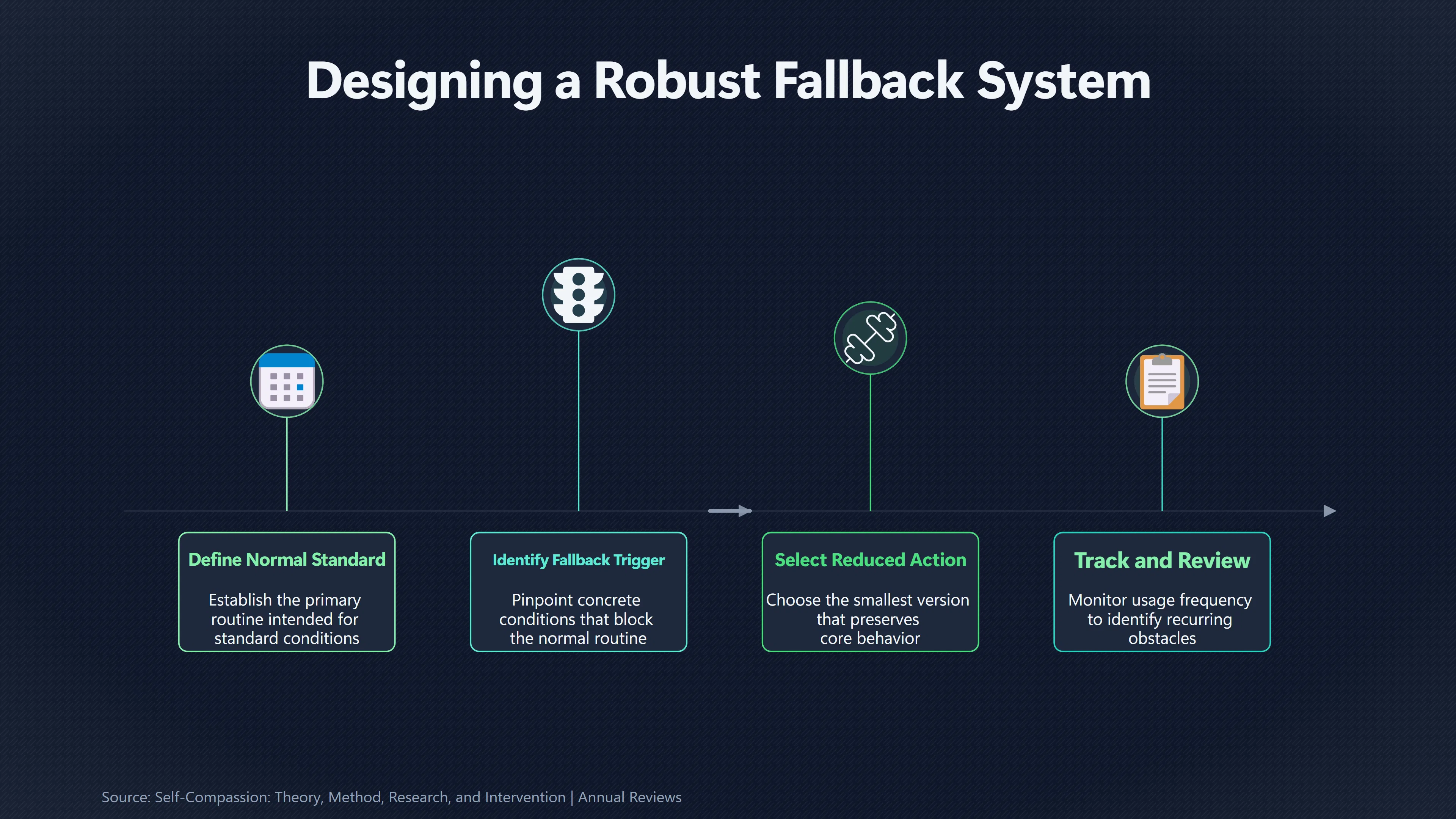
- Normal standard: what you ordinarily intend to do.
- Fallback trigger: a concrete condition that genuinely interferes with that standard, such as an unusually late work finish, travel or a severely compressed schedule.
- Reduced action: the smallest practical version that still contains meaningful performance of the intended behaviour.
The trigger is particularly important. Without one, “fallback” can quietly become a choice made whenever the normal routine feels inconvenient.
When fallback routines protect continuity
The strongest case for fallback mode arises when disruption is predictable enough to plan for but temporary enough that abandoning the routine altogether would be unnecessary. This is why coping planning is relevant. A systematic review of randomised trials found that prompting people to develop coping plans could support health-related behaviour change, particularly when participants received support in forming those plans, although effects varied between studies.[Taylor & Francis Online]tandfonline.comTaylor & Francis OnlineDoes planning how to cope with anticipated barriers facilitate health-related behaviour change? A systematic revie…
A broader meta-analysis of planning and physical-activity interventions found a small-to-medium overall benefit across 35 trials involving 5,439 participants, while also reporting substantial variation between studies. The lesson is not that a fallback guarantees adherence, but that specifying how behaviour will happen — including around obstacles — is more defensible than relying on an intention such as “I will try to exercise even when I am busy”.[PubMed Central (PMC)]pmc.ncbi.nlm.nih.govPubMed Central (PMC)The Effectiveness of Planning Interventions for Improving Physical Activity in the General Population: A Systematic R…
Implementation-intention research strengthens that case. A 2024 meta-analysis covering 642 independent tests found benefits across behavioural, cognitive and affective outcomes, with stronger effects when plans used a contingent if–then structure, when motivation for the underlying goal was high and when plans were rehearsed. That makes “If my evening is unexpectedly compressed, then I will do my ten-minute version” closer to the evidence than the vague instruction “do something, however small”.[DOI]doi.orgThe when and how of planning: Meta-analysis of the scope and components of implementation intentions in 642 tests: European Review of…
Fallbacks can be especially useful in three situations. First, there are temporary resource shortages: less time, access or usable attention than normal. Second, there are recurring high-risk situations already visible in experience — for example, the routine repeatedly disappears on late-shift days. Third, there are transitional disruptions, such as travel, when the ordinary setting or equipment is temporarily unavailable.
The underlying principle is adaptation rather than perfection. Recent work on self-regulatory flexibility describes successful regulation partly in terms of having a repertoire of strategies and matching them to the situation rather than expecting one strategy to work everywhere. A 2026 meta-analytic review of goal adjustment likewise characterises goal-striving flexibility as openness to modifying how one pursues a goal to fit capabilities, resources and situational demands, although the authors rate the accumulated evidence on goal adjustment as only low to moderate overall because of heterogeneity and heavy reliance on cross-sectional research.[PubMed]pubmed.ncbi.nlm.nih.govPub Med Self-regulatory flexibilitySelf-regulatory flexibility - PubMedSeptember 2, 2024…
Continuity does not require a perfect streak
One common justification for fallback routines deserves qualification: the idea that a single missed day will “break” a habit. Evidence does not support such a brittle model.
In a well-known real-world habit-formation study, 96 participants chose an eating, drinking or activity behaviour and attempted it in a consistent daily context for 12 weeks. Automaticity generally increased with repeated performance, but the time required varied greatly between people. Importantly, missing one opportunity to perform the behaviour did not materially disrupt the habit-formation process.[Wiley Online Library]onlinelibrary.wiley.comWiley Online LibraryHow are habits formed: Modelling habit formation in the real world - Lally - 2010 - European Journal of Social Psycho…
That finding changes the purpose of fallback mode. The goal need not be to protect an immaculate numerical streak at any cost. If someone has a fever, a genuine emergency or another circumstance in which the behaviour is inappropriate, skipping it can be entirely reasonable. A token action performed solely to prevent a counter in an app returning to zero is not necessarily useful self-regulation.
Habit theory instead emphasises repetition in recurring contexts. Habits develop as cue–response associations through context-consistent repetition, but a recent state-of-the-field review also warns against treating habit as the sole determinant of sustained behaviour. Intentions, circumstances and other influences continue to matter.[Compass]compass.onlinelibrary.wiley.comWhat is habit and how can it be used to change real‐world behaviour? Narrowing the theory‐reality gap - Gardner - 2024 - Social an…
A fallback is therefore best understood as continuity insurance, not streak insurance. It gives the routine another viable route through a predictable obstacle. Missing once is not catastrophic; repeatedly having no workable response to the same obstacle is the more useful design problem to solve.
Stop fallback mode becoming the permanent default
The main risk of a backup routine is obvious: because it is easier, it can become more attractive than the behaviour it was designed to protect. A ten-minute workout that substitutes for a 40-minute session during a crisis is adaptive. The same substitution made every evening for three months may indicate that the supposed fallback is now the real routine.
That is not automatically bad. It may reveal that the original standard was unrealistic. But the change should be recognised and evaluated rather than hidden behind the label “bad day”. NICE recommends reviewing behavioural goals in light of experience and making further plans according to previous progress. It also recommends tailoring support and explicitly planning for maintenance and relapse.[Nice]nice.org.ukRecommendations | Behaviour change: individual approaches | Guidance | NICEJanuary 2, 2014…
Three safeguards help preserve the distinction.
Use objective triggers where possible. “If I arrive home after 9 pm” creates a clearer boundary than “if I do not feel up to it”. Not every routine permits such a clean rule, but triggers should describe the obstacle rather than merely the desire to avoid effort.
Keep the normal version visible. Record whether an attempt was normal, fallback or missed rather than treating all three as equivalent. Five fallback days in a fortnight contain useful diagnostic information even if every day technically “counts”.
Review repeated fallback use. If the backup appears frequently under the same conditions, the problem has moved beyond emergency continuity. Either the obstacle needs a more durable adjustment, or the normal standard itself needs redesigning.
That final point connects fallback mode to adaptive self-improvement. The reduced routine is not only a rescue mechanism; its use generates information. If late meetings trigger fallback exercise once a month, the system is probably doing its job. If they trigger it three times every week, “exceptional disruption” is actually part of the normal environment. The next adjustment might be moving exercise to mornings, changing its location or formally adopting a shorter routine that can be sustained.
A fallback should be easier, not meaningless
The hardest judgement is choosing how much to reduce. There is a tension between two errors.
At one extreme is false continuity: an action is made so small that it retains the label but almost none of the function. Reading one sentence is unlikely to substitute meaningfully for a planned study session. Putting on running shoes and immediately taking them off may rehearse a cue or starting sequence, but it should not be represented as equivalent to exercising.
At the other extreme is failed reduction: the fallback remains sufficiently demanding that the same obstacle defeats it. A 50-minute workout reduced to 40 minutes is not much of a contingency for a day on which only 15 minutes are available.
Evidence on small, manageable changes supports modesty rather than theatrical minimalism. NICE notes that small, manageable changes to daily routines are most likely to be maintained, while its guidance in specific health contexts recommends achievable, sustainable short-term goals and graded tasks that increase in difficulty over time.[Nice]nice.org.ukRecommendations | Behaviour change: individual approaches | Guidance | NICEJanuary 2, 2014…
The right question is consequently not “What is the tiniest action I can count?” but “What is the smallest version that still advances or meaningfully rehearses this behaviour under the constraint I actually face?”
For exercise, that might mean a shorter safe session. For learning, it might mean retrieval practice on existing material instead of beginning a demanding new chapter. For writing, it might mean editing one substantive passage or drafting a short section rather than merely opening the document. The fallback preserves the core action while shedding duration, complexity, setup or optional components.
Know when not to use fallback mode
A backup routine should not override information that calls for stopping altogether. Some disruptions are not ordinary adherence problems. Illness, injury, dangerous fatigue or circumstances in which performing the behaviour would be unsafe require appropriate judgement rather than loyalty to a routine.
Nor should fallback mode be used to maintain a goal that has ceased to make sense. Research on goal adjustment distinguishes flexible pursuit from endless persistence. When a goal becomes genuinely unattainable or excessively costly, disengaging from it or redirecting effort can itself be adaptive. A 2026 review covering 235 studies found distinct associations between goal disengagement, re-engagement, flexibility and various wellbeing, functional and goal-related outcomes, while stressing limitations in the evidence base.[Nature]nature.comOpen source on nature.com.
This creates a useful boundary. A fallback changes how much or how you perform a still-valid routine during a temporary constraint. A redesign changes the normal routine because recurring evidence says its structure is wrong. Goal adjustment goes further when the underlying target itself no longer deserves the same commitment.
The practical standard: survive disruption, then return
A robust fallback system is deliberately asymmetric. It should be easy to enter when a specified obstacle occurs and equally clear that the ordinary routine resumes when that obstacle disappears.
That makes a good fallback less like a second, easier goal and more like an emergency operating mode. It preserves meaningful action without pretending that reduced performance is identical to normal performance. It also avoids the opposite mistake of treating every disrupted day as evidence that the whole self-improvement effort has failed.
The most defensible design is therefore simple: define the normal routine, identify the recurring conditions that genuinely threaten it, assign a meaningful reduced action to those conditions, and track when the fallback is used. Coping-planning and implementation-intention research provide evidence for anticipating obstacles and specifying responses; habit research shows that continuity need not mean perfection; and self-regulation research supports adapting strategies to circumstances rather than persisting rigidly with a poor fit.[tandfonline.com]tandfonline.comTaylor & Francis OnlineDoes planning how to cope with anticipated barriers facilitate health-related behaviour change? A systematic revie…
The final safeguard is the most important: a fallback that is repeatedly needed is feedback. Occasional use keeps a routine alive through bad days. Persistent use means the bad-day conditions have become part of ordinary life, and the normal routine should be adjusted accordingly.
Amazon book picks
Further Reading
Books and field guides related to Build a Backup Routine for Days That Go Wrong. Use these as the next step if you want deeper reading beyond the article.
Tiny Habits
Improving your life is much easier than you think. Whether it’s losing weight, sleeping more, or restoring your work/life balance – the s...
Atomic Habits
Rating: 3.5/5 from 7 Google Books ratings
The #1 New York Times bestseller. Over 25 million copies sold! Translated into 60+ languages! Tiny Changes, Remarkable Results No matter...
How to Change
Wall Street Journal bestseller “A welcome revelation.” --The Financial Times Award-winning Wharton Professor and Choiceology podcast host...
eBay marketplace picks
Marketplace Samples
Live-tested eBay searches with available results related to this page.
Selected frommotivational poster oneBay.co.uk.



Current eBay listing
Motivational Quotes Framed Wall Art Poster Canvas Print Picture

Current eBay listing
Gym Motivational Posters Work Out Insperational Quotes Wall Art
Endnotes
1.
Source: doi.org
Link:https://doi.org/10.1080/10463283.2024.2334563
Source snippet
The when and how of planning: Meta-analysis of the scope and components of implementation intentions in 642 tests: European Review of...
2.
Source: onlinelibrary.wiley.com
Link:https://onlinelibrary.wiley.com/doi/10.1002/ejsp.674
Source snippet
Wiley Online LibraryHow are habits formed: Modelling habit formation in the real world - Lally - 2010 - European Journal of Social Psycho...
3.
Source: compass.onlinelibrary.wiley.com
Link:https://compass.onlinelibrary.wiley.com/doi/full/10.1111/spc3.12975
Source snippet
What is habit and how can it be used to change real‐world behaviour? Narrowing the theory‐reality gap - Gardner - 2024 - Social an...
4.
Source: nature.com
Link:https://www.nature.com/articles/s41562-025-02312-4
5.
Source: nature.com
Link:https://www.nature.com/articles/s44271-026-00432-9
6.
Source: compass.onlinelibrary.wiley.com
Link:https://compass.onlinelibrary.wiley.com/doi/10.1111/spc3.12975?af=R
7.
Source: compass.onlinelibrary.wiley.com
Link:https://compass.onlinelibrary.wiley.com/doi/abs/10.1111/spc3.12975
8.
Source: compass.onlinelibrary.wiley.com
Link:https://compass.onlinelibrary.wiley.com/doi/epdf/10.1111/spc3.12975
9.
Source: doi.org
Title: Self-Compassion: Theory, Method, Research, and Intervention | Annual Reviews
Link:https://doi.org/10.1146/annurev-psych-032420-031047
10.
Source: doi.org
Link:https://doi.org/10.1111/bjhp.12504
11.
Source: iaap-journals.onlinelibrary.wiley.com
Link:https://iaap-journals.onlinelibrary.wiley.com/doi/10.1111/aphw.12017
12.
Source: doi.org
Link:https://doi.org/10.1080/17437199.2011.603640%C2%A0
13.
Source: onlinelibrary.wiley.com
Link:https://onlinelibrary.wiley.com/doi/abs/10.1002/ejsp.674?MixPanelId=15e3fe314440-0468d8411-64220f54-100000-15e3fe314460
14.
Source: onlinelibrary.wiley.com
Link:https://onlinelibrary.wiley.com/doi/abs/10.1002/ejsp.674?msockid=17570258034862e732eb114c02616368
15.
Source: onlinelibrary.wiley.com
Link:https://onlinelibrary.wiley.com/doi/abs/10.1002/ejsp.674?msockid=038ed114f43667dd0790c4bef5146634
16.
Source: doi.org
Link:https://doi.org/10.1111/j.1467-6494.2006.00426.x
17.
Source: nice.org.uk
Link:https://www.nice.org.uk/Guidance/PH49/chapter/recommendations
Source snippet
Recommendations | Behaviour change: individual approaches | Guidance | NICEJanuary 2, 2014...
Published: January 2, 2014
18.
Source: tandfonline.com
Link:https://www.tandfonline.com/doi/abs/10.1080/17437199.2013.766832
Source snippet
Taylor & Francis OnlineDoes planning how to cope with anticipated barriers facilitate health-related behaviour change? A systematic revie...
19.
Source: nice.org.uk
Title: Nice Recommendations | Behaviour change: general approaches | Guidance | NICE
Link:https://www.nice.org.uk/guidance/ph6/chapter/recommendations
20.
Source: pmc.ncbi.nlm.nih.gov
Link:https://pmc.ncbi.nlm.nih.gov/articles/PMC9223740/
Source snippet
PubMed Central (PMC)The Effectiveness of Planning Interventions for Improving Physical Activity in the General Population: A Systematic R...
21.
Source: pubmed.ncbi.nlm.nih.gov
Title: Pub Med Self-regulatory flexibility
Link:https://pubmed.ncbi.nlm.nih.gov/39276461/
Source snippet
Self-regulatory flexibility - PubMedSeptember 2, 2024...
Published: September 2, 2024
22.
Source: pmc.ncbi.nlm.nih.gov
Link:https://pmc.ncbi.nlm.nih.gov/articles/PMC12932095/
Source snippet
PubMed Central (PMC)A meta-analytic review and conceptual model of the antecedents and outcomes of goal adjustment in response to strivin...
23.
Source: tandfonline.com
Link:https://www.tandfonline.com/doi/full/10.1080/17437199.2011.603640
24.
Source: nice.org.uk
Link:https://www.nice.org.uk/guidance/ph38/chapter/recommendations
25.
Source: pmc.ncbi.nlm.nih.gov
Link:https://pmc.ncbi.nlm.nih.gov/articles/PMC13295370/
26.
Source: pubmed.ncbi.nlm.nih.gov
Link:https://pubmed.ncbi.nlm.nih.gov/41233533/
27.
Source: pmc.ncbi.nlm.nih.gov
Link:https://pmc.ncbi.nlm.nih.gov/articles/PMC11613413/
28.
Source: pubmed.ncbi.nlm.nih.gov
Link:https://pubmed.ncbi.nlm.nih.gov/39628965/
29.
Source: pubmed.ncbi.nlm.nih.gov
Link:https://pubmed.ncbi.nlm.nih.gov/39225981/
30.
Source: tandfonline.com
Link:https://www.tandfonline.com/doi/abs/10.1080/10463283.2024.2334563
31.
Source: pmc.ncbi.nlm.nih.gov
Link:https://pmc.ncbi.nlm.nih.gov/articles/PMC10543633/
32.
Source: pmc.ncbi.nlm.nih.gov
Link:https://pmc.ncbi.nlm.nih.gov/articles/PMC9403139/
33.
Source: nice.org.uk
Link:https://www.nice.org.uk/guidance/ng222/chapter/recommendations
34.
Source: pubmed.ncbi.nlm.nih.gov
Link:https://pubmed.ncbi.nlm.nih.gov/35742582/
35.
Source: pmc.ncbi.nlm.nih.gov
Link:https://pmc.ncbi.nlm.nih.gov/articles/PMC9226889/
36.
Source: pubmed.ncbi.nlm.nih.gov
Link:https://pubmed.ncbi.nlm.nih.gov/35262948/
37.
Source: pmc.ncbi.nlm.nih.gov
Link:https://pmc.ncbi.nlm.nih.gov/articles/PMC8734923/
38.
Source: pubmed.ncbi.nlm.nih.gov
Link:https://pubmed.ncbi.nlm.nih.gov/34713424/
39.
Source: pmc.ncbi.nlm.nih.gov
Link:https://pmc.ncbi.nlm.nih.gov/articles/PMC8314334/
40.
Source: pubmed.ncbi.nlm.nih.gov
Link:https://pubmed.ncbi.nlm.nih.gov/33405284/
41.
Source: nice.org.uk
Link:https://www.nice.org.uk/guidance/ng183/chapter/recommendations
42.
Source: pubmed.ncbi.nlm.nih.gov
Link:https://pubmed.ncbi.nlm.nih.gov/32525446/
43.
Source: tandfonline.com
Link:https://www.tandfonline.com/doi/full/10.1080/09602011.2020.1774397
44.
Source: pubmed.ncbi.nlm.nih.gov
Link:https://pubmed.ncbi.nlm.nih.gov/31131441/
45.
Source: pmc.ncbi.nlm.nih.gov
Link:https://pmc.ncbi.nlm.nih.gov/articles/PMC6235272/
46.
Source: pmc.ncbi.nlm.nih.gov
Link:https://pmc.ncbi.nlm.nih.gov/articles/PMC5421328/
47.
Source: pmc.ncbi.nlm.nih.gov
Link:https://pmc.ncbi.nlm.nih.gov/articles/PMC4847906/
48.
Source: pubmed.ncbi.nlm.nih.gov
Link:https://pubmed.ncbi.nlm.nih.gov/27120333/
49.
Source: nice.org.uk
Link:https://www.nice.org.uk/Guidance/PH54/chapter/recommendations
50.
Source: pmc.ncbi.nlm.nih.gov
Link:https://pmc.ncbi.nlm.nih.gov/articles/PMC4566897/
51.
Source: nice.org.uk
Link:https://www.nice.org.uk/Guidance/PH49
52.
Source: pmc.ncbi.nlm.nih.gov
Link:https://pmc.ncbi.nlm.nih.gov/articles/PMC4145404/
53.
Source: tandfonline.com
Link:https://www.tandfonline.com/doi/full/10.1080/17437199.2013.766832
54.
Source: pmc.ncbi.nlm.nih.gov
Link:https://pmc.ncbi.nlm.nih.gov/articles/PMC3505409/
55.
Source: tandfonline.com
Link:https://www.tandfonline.com/doi/abs/10.1080/17437199.2011.603640
56.
Source: pubmed.ncbi.nlm.nih.gov
Link:https://pubmed.ncbi.nlm.nih.gov/21749245/
57.
Source: nice.org.uk
Title: Quality statement 3 Preventing relapse
Link:https://www.nice.org.uk/guidance/qs8/chapter/Quality-statement-3-Preventing-relapse
58.
Source: pubmed.ncbi.nlm.nih.gov
Link:https://pubmed.ncbi.nlm.nih.gov/19102817/
59.
Source: nice.org.uk
Link:https://www.nice.org.uk/guidance/ph6/chapter/Considerations
60.
Source: nice.org.uk
Link:https://www.nice.org.uk/guidance/ph6/evidence
61.
Source: sciencedirect.com
Title: Coping Planning
Link:https://www.sciencedirect.com/topics/psychology/coping-planning
62.
Source: pubmed.ncbi.nlm.nih.gov
Link:https://pubmed.ncbi.nlm.nih.gov/24591064/
63.
Source: ncbi.nlm.nih.gov
Link:https://www.ncbi.nlm.nih.gov/books/NBK248456/
64.
Source: pubmed.ncbi.nlm.nih.gov
Link:https://pubmed.ncbi.nlm.nih.gov/23730907/
65.
Source: pubmed.ncbi.nlm.nih.gov
Link:https://pubmed.ncbi.nlm.nih.gov/22995814/
66.
Source: pmc.ncbi.nlm.nih.gov
Link:https://pmc.ncbi.nlm.nih.gov/articles/PMC11920387/
67.
Source: cancercontrol.cancer.gov
Title: implementation intentions
Link:https://cancercontrol.cancer.gov/brp/research/constructs/implementation-intentions
68.
Source: durmonski.com
Title: implementation intentions
Link:https://durmonski.com/psychology/implementation-intentions/
Additional References
69.
Source: psychologicalscience.org
Link:https://www.psychologicalscience.org/conventions/archive/2022annual/paper/39997/
70.
Source: researchgate.net
Link:https://www.researchgate.net/publication/381044449_What_is_habit_and_how_can_it_be_used_to_change_real-world_behaviour_Narrowing_the_theory-reality_gap
71.
Source: researchgate.net
Link:https://www.researchgate.net/publication/378870694_The_when_and_how_of_planning_Meta-analysis_of_the_scope_and_components_of_implementation_intentions_in_642_tests
72.
Source: sciencedirect.com
Link:https://www.sciencedirect.com/science/article/abs/pii/S2215091919300148
73.
Source: sciencedirect.com
Link:https://www.sciencedirect.com/science/chapter/bookseries/pii/S2215091919300148
74.
Source: eprints.whiterose.ac.uk
Link:https://eprints.whiterose.ac.uk/id/eprint/225167/1/British%20J%20Health%20Psychol%20-%202025%20-%20Divine%20-%20Reinforcing%20implementation%20intentions%20with%20imagery%20increases%20physical%20activity.pdf
75.
Source: sciencedirect.com
Link:https://www.sciencedirect.com/science/article/abs/pii/S0191886918303611
76.
Source: ehps.net
Link:https://ehps.net/ehp/index.php/contents/article/view/2882
77.
Source: scapps.org
Link:https://www.scapps.org/jems/index.php/1/en/article/view/1183
78.
Source: mdpi.com
Link:https://www.mdpi.com/1020550