Within Study Systems
Can Notifications Hurt Learning Without You Noticing?
Notifications can disrupt learning even when students do not accurately notice how much their performance has suffered.
On this page
- What notification experiments found about learning performance
- Why subjective focus can miss objective disruption
- Practical ways to silence interruptions during the first study block
Page outline Jump by section
Introduction
Push notifications can hurt learning before a student ever opens the app that sent them. Experimental research shows that the sound, vibration or appearance of an incoming alert can redirect attention, slow performance and interfere with memory. More strikingly, students may not accurately notice the loss: in one university experiment, participants exposed to push-notification-driven interruptions learnt less from a short lecture but did not rate their own performance correspondingly lower.[ScienceDirect]sciencedirect.comReceiving push-notifications from smartphone games reduces students learning performance in a brief lecture: An experimental…
That makes notifications particularly relevant to a study routine that begins before social media. The problem is not simply that an alert might tempt someone into spending ten minutes on a feed. An interruption can impose a cognitive cost even when the phone is not subsequently used. For the first focused study block, therefore, silencing notifications is less about demonstrating self-control than about removing events that can compete for attention in the first place.
What notification experiments found about learning
One unusually direct experiment was conducted by Katharina Graben, Bettina Doering and Antonia Barke with 93 students. Participants watched a video designed to mimic a brief university lecture. A control group simply watched it, while two other groups periodically played a simple smartphone game for 20 seconds at two-minute intervals. Crucially, one gaming group was prompted by push notifications, while the other played without those notifications. Afterwards, everyone completed multiple-choice questions about the lecture.[ScienceDirect]sciencedirect.comReceiving push-notifications from smartphone games reduces students learning performance in a brief lecture: An experimental…
Students in the push-notification condition performed worse than the control group, with a reported standardised effect size of d = 0.51. The researchers did not find the same significant difference between the no-notification gaming group and the control group. This does not establish that every notification causes a fixed amount of lost learning, but it provides experimental evidence that the way an interruption is initiated matters: an externally generated alert can impose costs beyond the mere availability of a phone.[ScienceDirect]sciencedirect.comReceiving push-notifications from smartphone games reduces students learning performance in a brief lecture: An experimental…
The finding also needs an important qualification. The same researchers conducted another experiment in which 93 students read material rather than watched a lecture, again comparing gaming, push-notification and control conditions. That study found no significant differences in quiz performance or reading time. The authors suggested that characteristics of the task and interruption may matter. Taken together, the two experiments argue against the simplistic claim that every notification inevitably damages every learning activity.[Springer Nature]link.springer.comSpringer NaturePlaying smartphone games while studying: an experimental study on reading interruptions by a smartphone game | Education a…
A broader evidence base nevertheless supports the underlying attentional mechanism. In a 2015 experiment, Cary Stothart and colleagues found that receiving mobile-phone call or text notifications disrupted performance on an attention-demanding task even though participants did not interact with the phone. The researchers concluded that the notifications themselves could generate task-irrelevant thoughts and attentional disruption.[PubMed]pubmed.ncbi.nlm.nih.govPub Med The attentional cost of receiving a cell phone notificationThe attentional cost of receiving a cell phone notification - PubMed…
Later laboratory work has added physiological evidence. An experiment measuring event-related potentials — electrical brain responses associated with information processing — found slower responses when participants heard smartphone notification sounds rather than control sounds. The neural measurements were also consistent with notification sounds requiring additional cognitive control. In other words, ignoring an alert is itself something the cognitive system may have to do.[PubMed Central (PMC)]pmc.ncbi.nlm.nih.govPubMed Central (PMC)The hidden cost of a smartphone: The effects of smartphone notifications on cognitive control from a behavioral and e…
Memory experiments point in the same direction. Across a pilot study and two experiments, researchers compared people receiving no simulated phone notifications with people who had to dismiss or read them while memorising categorised word lists. Memory disruption increased with the degree of notification interaction. Merely dismissing notifications particularly interfered with memory for relationships among the studied items, while reading them disrupted both relational and individual-item processing.[PubMed]pubmed.ncbi.nlm.nih.govIndividual differences in memory disruption caused by simulated cellphone notifications - PubMedSeptember 12, 2022…
The wider literature concerns mobile-phone distraction rather than notifications alone, so it should not be treated as notification-specific evidence. Still, a 2025 meta-analysis synthesising 27 experiments concluded that mobile-phone distraction during learning produced a medium-sized negative effect on young adults’ immediate recall. That broader result is consistent with the idea that repeatedly switching attention between learning and phone-related information has measurable costs.[ScienceDirect]sciencedirect.comOpen source on sciencedirect.com.
Why feeling focused can be misleading
The most useful result from the Graben experiment may not be the lower quiz score by itself. Participants also estimated how well they thought they had performed. Those subjective estimates did not significantly differ between experimental conditions, even though objective learning performance was poorer in the push-notification group than in the uninterrupted control group.[ScienceDirect]sciencedirect.comReceiving push-notifications from smartphone games reduces students learning performance in a brief lecture: An experimental…
That creates a practical problem for self-improvement. A student can use an apparently reasonable test — “I still feel focused” — and reach the wrong conclusion about whether notifications are harmless.
The mismatch makes sense when the interruption is tiny. A notification does not necessarily feel like abandoning a study session. The student hears a buzz, perhaps notices who sent something, dismisses it and immediately returns to the page. From the learner’s point of view, almost the entire period was spent studying. But the relevant cognitive event is not measured simply in seconds of phone use. Attention had to orient towards the unexpected stimulus, decide what it meant or whether it deserved action, suppress or pursue the response, and then continue processing the learning material. Experimental work showing slower responses to notification sounds and disrupted attention without phone interaction supports this interpretation.[PubMed]pubmed.ncbi.nlm.nih.govPub Med The attentional cost of receiving a cell phone notificationThe attentional cost of receiving a cell phone notification - PubMed…
This is why “I never reply while studying” is not quite the same protection as “notifications cannot interrupt this block”. The first strategy relies on resisting an interruption after it has occurred. The second prevents many externally generated interruptions from entering the study environment.
There is another complication: not every phone-related distraction comes from an actual alert. A 2026 study of 84 Taiwanese undergraduates compared settings in which smartphone notifications were revealed or hidden. Visible notifications were associated with more frequent checking among students experiencing heightened “smartphone vigilance” — an ongoing mental orientation towards the phone. But hiding notifications did not simply eliminate distraction: students in the hidden-notification condition tended towards longer individual phone-use episodes when vigilance was high. Both patterns were associated with greater mental effort and poorer learning performance, and overall performance did not significantly differ between the two notification-setting groups.[Springer Nature]link.springer.comOpen source on springer.com.
That result draws a useful boundary around the advice. Silencing notifications removes an external trigger; it does not automatically remove the learnt urge to check the phone. If a student continues wondering whether messages have arrived, keeping the device immediately accessible may still invite internally initiated checking. The researchers therefore concluded that simply hiding notifications may be insufficient when the smartphone remains readily available.[Springer Nature]link.springer.comOpen source on springer.com.
Evidence concerning notification-like cues is also not perfectly uniform. Three experiments published in Experimental Psychology examined social-media logos and notification badges during a visual working-memory task. Notification badges impaired performance in one experiment but not the other two, leading the authors to conclude that social-media cues did not consistently interfere with visual working memory. That is another reason to avoid claiming that any red badge or notification inevitably damages cognition. Effects depend on the cue, task and circumstances.[PubMed]pubmed.ncbi.nlm.nih.govPub Med Are Social Media Notifications Distracting?Pub Med Are Social Media Notifications Distracting?
Silence the interruption before the first study block
For a routine built around studying before social media, the evidence suggests a simple design principle: configure the environment before concentration is required. Do not begin the study block with notifications active and make “ignore them” part of the task.
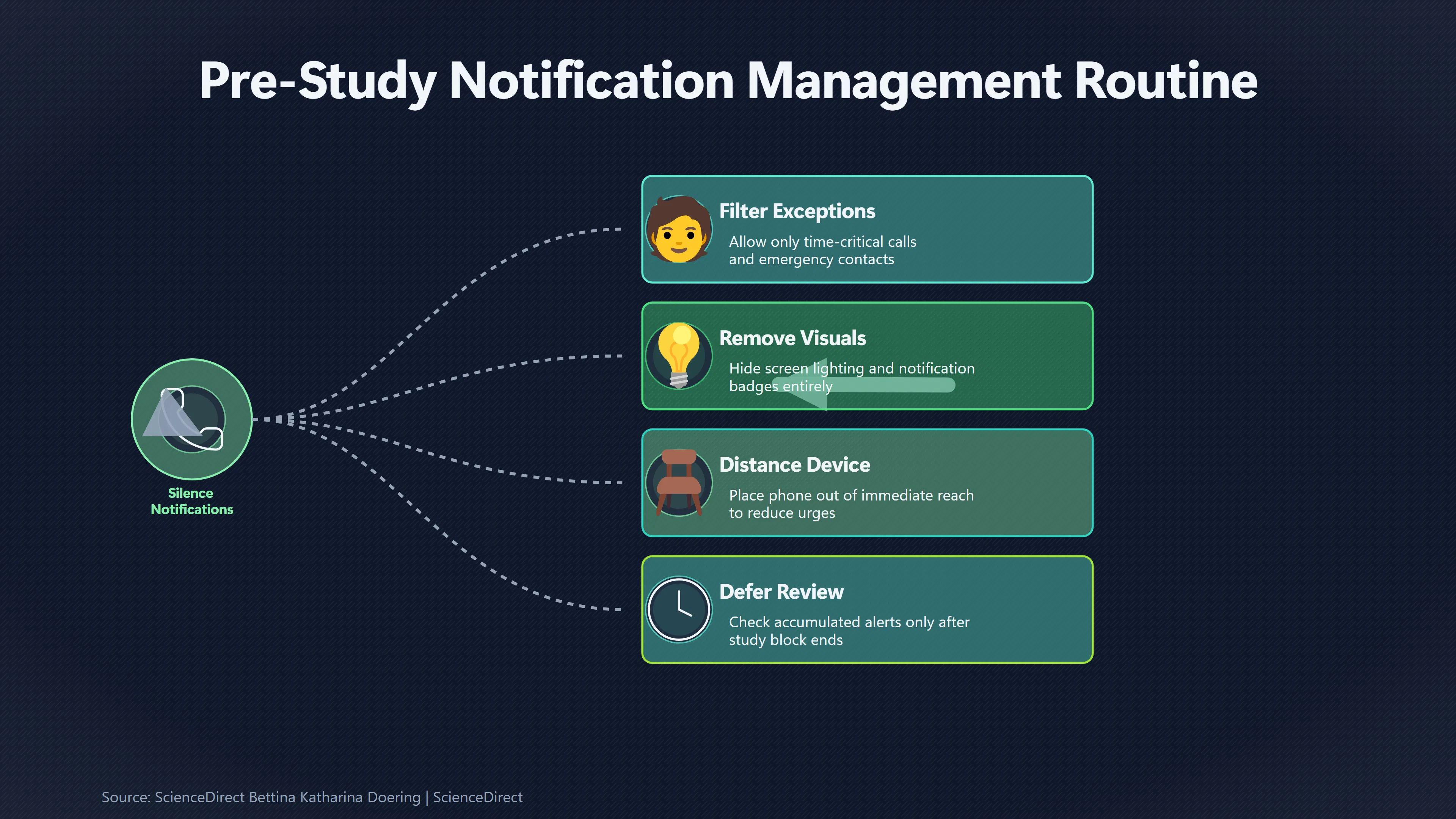
A practical opening routine can be deliberately small:
- Silence non-essential notifications before starting. Use the phone’s Focus or Do Not Disturb system rather than relying only on willpower after each alert arrives.
- Keep genuine exceptions narrow. Calls from selected people, alarms or other genuinely time-critical communications can remain available without allowing every social, shopping, news and entertainment app through.
- Remove visual alerts as well as sounds. A silent screen lighting up beside the notebook still supplies information capable of competing for attention.
- Put the phone out of immediate reach when checking remains habitual. This addresses the internally generated urge to check that notification settings alone cannot eliminate.
- Finish the defined study block before reviewing accumulated alerts. Notifications have not disappeared; they have been deferred to a deliberate transition point rather than allowed to choose that point themselves.
Modern phones already provide the necessary controls. Apple’s Focus system can temporarily silence notifications while allowing selected people and apps through, and it can be scheduled automatically. Android’s Do Not Disturb and custom modes likewise allow users to filter people, apps, alarms and other interruptions and to set time-based rules.[Apple Support]support.apple.comSupport Allow or silence notifications for a Focus on i PhoneSupport Allow or silence notifications for a Focus on i Phone
That selectivity matters. The evidence does not imply that students should become unreachable whenever they study. Someone who needs to receive a call from a child, parent or carer can preserve that channel while suppressing low-priority app alerts. On iPhone, for example, Focus can allow particular contacts and emergency contacts; Android similarly provides notification filters and options for selected people and repeat callers.[Apple Support]support.apple.comSupport Allow or silence notifications for a Focus on i PhoneSupport Allow or silence notifications for a Focus on i Phone
Automation is especially useful because it moves the intervention earlier in the behavioural sequence. If a morning study block reliably starts at the same time, scheduling a study-focused notification mode means there is no repeated decision about whether today’s messages are important enough to leave enabled. The routine becomes: sit down, begin the prepared learning task, complete the first block, then reconnect.
The useful lesson is smaller than “phones ruin studying”
The experimental evidence supports a narrower and more defensible conclusion. Notifications are capable of disrupting attention, memory and learning, sometimes without producing an equally strong subjective feeling that performance has suffered.[nih.gov]pubmed.ncbi.nlm.nih.govPub Med The attentional cost of receiving a cell phone notificationThe attentional cost of receiving a cell phone notification - PubMed… At the same time, experiments do not find harm in every task or every notification condition, and newer classroom research shows that hiding alerts cannot necessarily eliminate internally driven phone checking.[springer.com]link.springer.comSpringer NaturePlaying smartphone games while studying: an experimental study on reading interruptions by a smartphone game | Education a…
For self-improvement that works, this distinction is valuable. There is little reason to spend the first study block repeatedly testing one’s ability to resist deliberately attention-catching signals. Silence the unnecessary ones before studying begins, preserve the few channels that genuinely need immediate access, and make checking something that happens at a chosen boundary.
The hidden cost of a notification is therefore not merely the time spent answering it. It is the possibility that attention has already been redirected before the learner decides that the interruption “didn’t distract me”.
Amazon book picks
Further Reading
Books and field guides related to Can Notifications Hurt Learning Without You Noticing?. Use these as the next step if you want deeper reading beyond the article.
The Organized Mind
'Thought-provoking and practical ... Good advice based on sound neuroscientific principles' Sunday Times In The Organized Mind, New York...
Deep Work
Trade paperback. Professor and popular blogger Cal Newport reveals the new key to achieving success and true meaning in professional life...
Stolen Focus
THE SUNDAY TIMES AND NEW YORK TIMES BESTSELLER A SPECTATOR AND FINANCIAL TIMES BEST BOOK OF 2022 'If you read just one book about how the...
Atomic Habits
Rating: 3.5/5 from 7 Google Books ratings
The #1 New York Times bestseller. Over 25 million copies sold! Translated into 60+ languages! Tiny Changes, Remarkable Results No matter...
eBay marketplace picks
Marketplace Samples
Live-tested eBay searches with available results related to this page.
Selected fromstudy poster oneBay.co.uk.




Endnotes
1.
Source: sciencedirect.com
Link:https://www.sciencedirect.com/science/article/pii/S2451958822000045
Source snippet
Receiving push-notifications from smartphone games reduces students learning performance in a brief lecture: An experimental...
2.
Source: link.springer.com
Link:https://link.springer.com/article/10.1007/s10639-021-10764-0
Source snippet
Springer NaturePlaying smartphone games while studying: an experimental study on reading interruptions by a smartphone game | Education a...
3.
Source: sciencedirect.com
Link:https://www.sciencedirect.com/science/article/pii/S0747563224003005
4.
Source: sciencedirect.com
Title: ScienceDirect Bettina Katharina Doering | ScienceDirect
Link:https://www.sciencedirect.com/author/36061700200/bettina-katharina-doering
5.
Source: link.springer.com
Link:https://link.springer.com/article/10.1007/s11251-026-09794-3
6.
Source: support.apple.com
Title: Support Allow or silence notifications for a Focus on i Phone
Link:https://support.apple.com/guide/iphone/allow-or-silence-notifications-for-a-focus-iph21d43af5b/ios
7.
Source: support.apple.com
Title: Support Set up a Focus on i Phone – Apple Support (UK)
Link:https://support.apple.com/en-gb/guide/iphone/iphd6288a67f/ios
8.
Source: support.apple.com
Link:https://support.apple.com/en-nz/105112
9.
Source: support.apple.com
Title: en euro
Link:https://support.apple.com/en-euro/105112
10.
Source: link.springer.com
Link:https://link.springer.com/article/10.1007/s11409-026-09466-0
11.
Source: support.apple.com
Link:https://support.apple.com/en-gb/108384
12.
Source: link.springer.com
Link:https://link.springer.com/article/10.1186/s41235-026-00714-0
13.
Source: support.apple.com
Link:https://support.apple.com/en-sg/108274
14.
Source: support.apple.com
Title: en mide
Link:https://support.apple.com/en-mide/108274
15.
Source: sciencedirect.com
Link:https://www.sciencedirect.com/science/article/pii/S0001691825006870
16.
Source: link.springer.com
Link:https://link.springer.com/article/10.1007/s11423-025-10550-6
17.
Source: sciencedirect.com
Link:https://www.sciencedirect.com/science/article/pii/S1041608025000172
18.
Source: nature.com
Link:https://www.nature.com/articles/s41539-024-00253-7
19.
Source: support.apple.com
Title: en lamr
Link:https://support.apple.com/en-lamr/108384
20.
Source: sciencedirect.com
Link:https://www.sciencedirect.com/science/article/abs/pii/S0301051123002454
21.
Source: link.springer.com
Link:https://link.springer.com/article/10.1007/s11409-023-09361-y
22.
Source: link.springer.com
Link:https://link.springer.com/article/10.1186/s41239-020-00230-1
23.
Source: support.apple.com
Link:https://support.apple.com/en-gb/guide/iphone/iph1fbe7d2b9/ios
24.
Source: support.apple.com
Link:https://support.apple.com/en-asia/guide/iphone/iph5c3f5b77b/ios
25.
Source: support.apple.com
Link:https://support.apple.com/en-au/guide/iphone/iph21d43af5b/18.0/ios/18.0
26.
Source: support.apple.com
Link:https://support.apple.com/en-gb/guide/ipad/ipadeb91a1c3/ipados
27.
Source: sciencedirect.com
Link:https://www.sciencedirect.com/science/article/abs/pii/S0360131519301319
28.
Source: sciencedirect.com
Title: Towards attention-aware adaptive notification on smart phones
Link:https://www.sciencedirect.com/science/article/abs/pii/S1574119215001881
29.
Source: sciencedirect.com
Link:https://www.sciencedirect.com/author/25635341200/antonia-barke
30.
Source: sciencedirect.com
Title: The effects of smartphone addiction on learning: A meta-analysis
Link:https://www.sciencedirect.com/science/article/pii/S2451958821000622
31.
Source: sciencedirect.com
Link:https://www.sciencedirect.com/org/science/article/pii/S1462373026000519
32.
Source: sciencedirect.com
Link:https://www.sciencedirect.com/science/article/pii/S0001691825009588
33.
Source: pubmed.ncbi.nlm.nih.gov
Title: Pub Med The attentional cost of receiving a cell phone notification
Link:https://pubmed.ncbi.nlm.nih.gov/26121498/
Source snippet
The attentional cost of receiving a cell phone notification - PubMed...
34.
Source: pmc.ncbi.nlm.nih.gov
Link:https://pmc.ncbi.nlm.nih.gov/articles/PMC9671478
Source snippet
PubMed Central (PMC)The hidden cost of a smartphone: The effects of smartphone notifications on cognitive control from a behavioral and e...
35.
Source: pubmed.ncbi.nlm.nih.gov
Link:https://pubmed.ncbi.nlm.nih.gov/36089897/
Source snippet
Individual differences in memory disruption caused by simulated cellphone notifications - PubMedSeptember 12, 2022...
Published: September 12, 2022
36.
Source: pubmed.ncbi.nlm.nih.gov
Title: Pub Med Are Social Media Notifications Distracting?
Link:https://pubmed.ncbi.nlm.nih.gov/39552411/
37.
Source: pubmed.ncbi.nlm.nih.gov
Link:https://pubmed.ncbi.nlm.nih.gov/40795445/
38.
Source: pubmed.ncbi.nlm.nih.gov
Link:https://pubmed.ncbi.nlm.nih.gov/40432618/
39.
Source: pmc.ncbi.nlm.nih.gov
Link:https://pmc.ncbi.nlm.nih.gov/articles/PMC11220804/
40.
Source: pubmed.ncbi.nlm.nih.gov
Link:https://pubmed.ncbi.nlm.nih.gov/38669081/
41.
Source: pmc.ncbi.nlm.nih.gov
Link:https://pmc.ncbi.nlm.nih.gov/articles/PMC7982468/
42.
Source: pubmed.ncbi.nlm.nih.gov
Link:https://pubmed.ncbi.nlm.nih.gov/27366147/
43.
Source: ouci.dntb.gov.ua
Link:https://ouci.dntb.gov.ua/en/works/4kdNg2Gl/
44.
Source: ouci.dntb.gov.ua
Link:https://ouci.dntb.gov.ua/en/works/4NkJvpmx/
45.
Source: ouci.dntb.gov.ua
Link:https://ouci.dntb.gov.ua/en/works/lDpy6JMl/
46.
Source: ouci.dntb.gov.ua
Link:https://ouci.dntb.gov.ua/en/works/45JQMdZl/
47.
Source: ouci.dntb.gov.ua
Title: 7q Xnpy J9
Link:https://ouci.dntb.gov.ua/en/works/7qXnpyJ9/
Additional References
48.
Source: doaj.org
Link:https://doaj.org/article/fb81c1ffb8824959bf7e52a003df26c4
Source snippet
Directory of Open Access JournalsReceiving push-notifications from smartphone games reduces students learning performance in a brief lect...
49.
Source: journals.plos.org
Link:https://journals.plos.org/plosone/article?id=10.1371%2Fjournal.pone.0277220
Source snippet
The hidden cost of a smartphone: The effects of smartphone notifications on cognitive control from a behavioral and electrophysiologi...
50.
Source: edoc.ku.de
Link:https://edoc.ku.de/id/eprint/33014/
Source snippet
KU.edoc: Receiving push-notifications from smartphone games reduces students learning performance in a brief lecture: an experimenta...
51.
Source: tandfonline.com
Link:https://www.tandfonline.com/doi/full/10.1080/09658211.2022.2120203
52.
Source: youtube.com
Link:https://www.youtube.com/watch?v=2ldLwkj4dRc
Source snippet
Phone notifications distraction cognitive cost attention learning How Smartphones Sabotage Your Brain's Ability to Focus | WSJ...
53.
Source: youtube.com
Link:https://www.youtube.com/watch?v=jqqTInqdGCE
Source snippet
How to Get Your Brain to Focus | Chris Bailey | TEDxManchester...
54.
Source: youtube.com
Title: How Smartphones Sabotage Your Brain’s Ability to Focus | WSJ
Link:https://www.youtube.com/watch?v=Ig6I3prnlnE
Source snippet
The New Science of Finding Focus & Fighting Distraction | Gloria Mark | Talks at Google...
55.
Source: youtube.com
Title: What Happens To Your Brain When You Mindlessly Scroll?
Link:https://www.youtube.com/watch?v=aNvvOQMx0jY
Source snippet
Smartphones: It’s Time to Confront Our Global Addiction | Dr. Justin Romano | TEDxOmaha...
56.
Source: eric.ed.gov
Link:https://eric.ed.gov/?id=EJ1332607
Source snippet
EJ1332607 - Playing Smartphone Games While Studying: An Experimental Study on Reading Interruptions by a Smartphone Game, Education and I...
57.
Source: youtube.com
Title: How to Get Your Brain to Focus | Chris Bailey | TEDx Manchester
Link:https://www.youtube.com/watch?v=Hu4Yvq-g7_Y
Source snippet
What Happens To Your Brain When You Mindlessly Scroll?...