Within Useful Feedback
How Much Does Feedback Add to Activity Tracking?
Trials suggest that adding feedback to activity tracking produces a modest improvement beyond recording behaviour by itself.
On this page
- What feedback versus monitoring trials actually tested
- The corrected estimate for added physical activity
- Why the effect is meaningful but not large
Page outline Jump by section
Introduction
Physical activity research provides an unusually direct test of whether feedback adds anything to self-monitoring. A wearable can record movement for everyone while researchers vary what participants are shown or told about those records. That makes it possible to compare tracking plus feedback with tracking that is otherwise similar but receives no additional feedback.
The best focused synthesis suggests that feedback does add something, but considerably less than an early version of the evidence implied. A corrected 2024 meta-analysis estimated a small positive effect on physical activity, Cohen’s d = 0.29 (95% CI 0.16 to 0.43), when feedback was added to self-monitoring.[Springer Link]link.springer.comSpringer LinkCorrection: Impact of feedback generation and presentation on self-monitoring behaviors, dietary intake, physical activity… Individual trials help make that abstract result tangible: points-based app feedback has produced extra moderate-to-vigorous activity, while a more recent wearable experiment found about 7% more activity during feedback periods.[PubMed]pubmed.ncbi.nlm.nih.govA smartphone "app"-delivered randomized factorial trial targeting physical activity in adults - PubMedMarch 2, 2017…
The useful conclusion is therefore restrained. Recording activity is not the whole intervention. Making those records visible, interpretable or evaluative can improve behaviour further, but the average incremental benefit is modest rather than transformative.
What Feedback-Versus-Monitoring Trials Actually Tested
The critical comparison is easy to lose in the much larger literature on fitness trackers. A study showing that people given a wearable become more active than people receiving usual care cannot tell us whether feedback itself is responsible: the wearable may simultaneously introduce self-monitoring, goals, reminders, rewards and other behaviour-change techniques.
The 2024 review by Rebecca Krukowski, Andrea Denton and Laura König was designed to deal with this problem. It included randomised controlled trials in which participants self-monitored diet, physical activity or weight and researchers either added feedback or compared different forms of feedback. Across the full review, 24 articles representing 19 studies and 3,261 participants met the eligibility criteria. Crucially, intervention groups had to differ in feedback rather than in a whole package of unrelated treatment components.[PubMed Central (PMC)]pmc.ncbi.nlm.nih.govPubMed Central (PMC)Impact of feedback generation and presentation on self-monitoring behaviors, dietary intake, physical activity, and w…
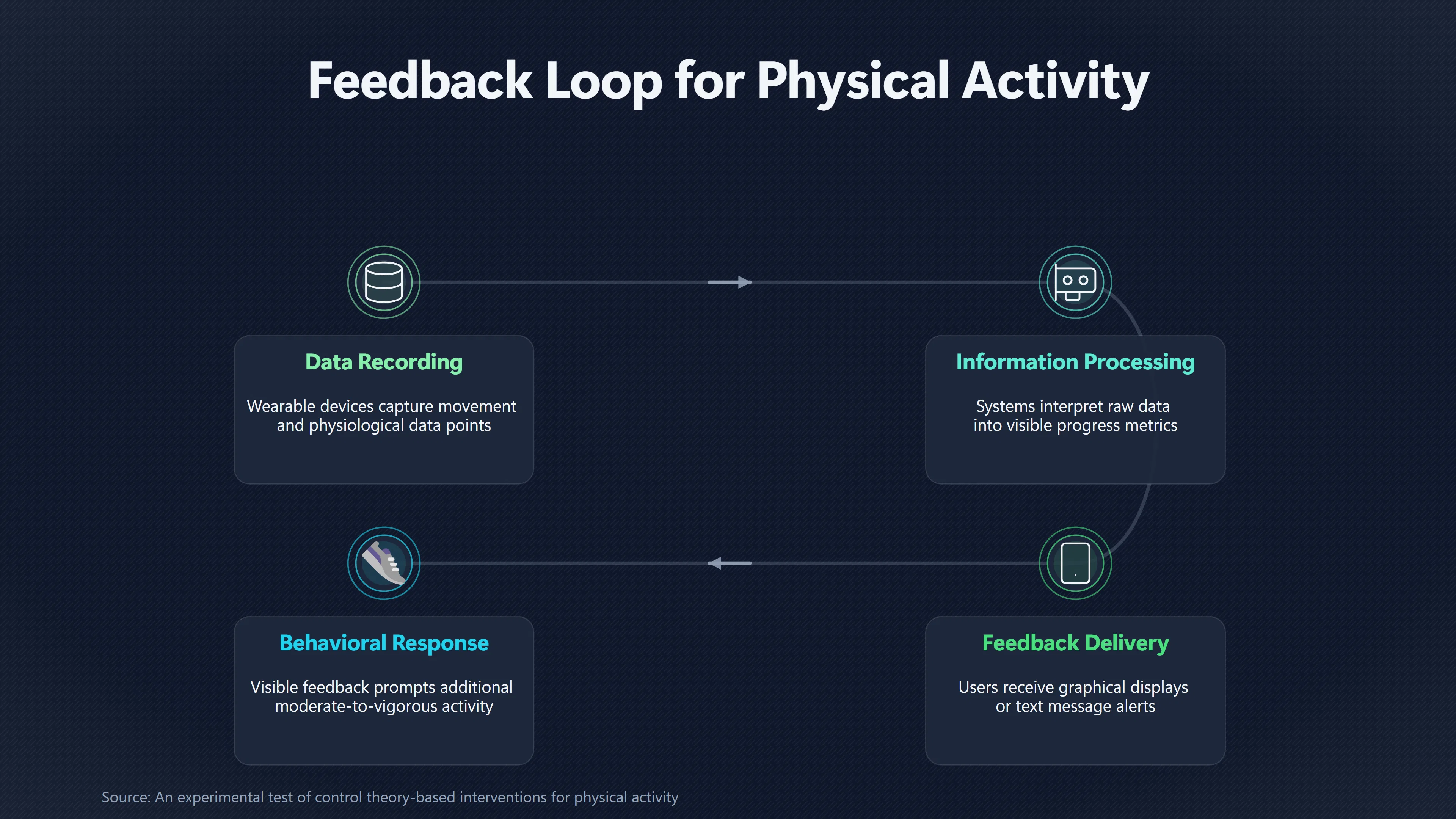
For physical activity, the review could pool nine comparisons from six studies that provided sufficiently comparable data. The feedback itself was not one standard treatment. Depending on the trial, it could mean graphical displays, website feedback, text messages, computer-generated reports or other responses to the participant’s recorded behaviour.[PubMed Central (PMC)]pmc.ncbi.nlm.nih.govPubMed Central (PMC)Impact of feedback generation and presentation on self-monitoring behaviors, dietary intake, physical activity, and w…
That variation matters. “Feedback” can describe anything from seeing progress plotted against a target to receiving a message interpreting that progress. For example, a 2016 UK experiment randomised 124 insufficiently active participants to goal setting alone, goal setting plus self-monitoring, or goal setting plus self-monitoring and feedback. The last group received feedback on recorded activity; objectively measured activity was higher than in the goal-setting-only group and marginally higher than in the self-monitoring group. The direct feedback-versus-self-monitoring contrast was d = 0.33, although its 95% confidence interval of −0.13 to 0.78 crossed zero.[DOI]doi.orgAn experimental test of control theory‐based interventions for physical activityAn experimental test of control theory‐based interventions for physical activity - Prestwich - 2016 - British Journal of Health Psycho…
A different 12-week factorial trial involving 116 low-active adults tested a smartphone self-monitoring app with optional goal-setting and points-based feedback modules. Everyone increased moderate-to-vigorous physical activity by more than 11 minutes per day, but participants receiving points-based feedback achieved still higher activity and more favourable app-use and psychosocial outcomes.[PubMed]pubmed.ncbi.nlm.nih.govA smartphone "app"-delivered randomized factorial trial targeting physical activity in adults - PubMedMarch 2, 2017… This is an important distinction: the question is not whether tracking can work, but whether a feedback layer can produce an incremental gain when tracking is already present.
The Corrected Estimate for Added Physical Activity
The central numerical result needs particular care because the published estimate was corrected shortly after publication.
The original January 2024 article reported a pooled feedback effect of d = 0.73, suggesting a fairly substantial advantage. In February, the authors issued a correction after discovering that two standard errors had been treated as standard deviations in the meta-analysis. Recalculation reduced the pooled effect to d = 0.29, with a 95% confidence interval from 0.16 to 0.43 and p< 0.001.[Springer Link]link.springer.comSpringer LinkCorrection: Impact of feedback generation and presentation on self-monitoring behaviors, dietary intake, physical activity…
That correction changes the interpretation substantially. A Cohen’s d of 0.29 represents a small standardised difference: people receiving feedback were, on average, more active than comparable people monitoring their behaviour without that added feedback, but the two groups still overlapped considerably. The revised analysis also produced low statistical heterogeneity (I² = 9.07%), rather than the very high heterogeneity reported in the erroneous calculation. A trim-and-fill analysis did not identify missing studies suggestive of publication bias, although that diagnostic is necessarily limited with such a small evidence base.[Springer Link]link.springer.comSpringer LinkCorrection: Impact of feedback generation and presentation on self-monitoring behaviors, dietary intake, physical activity…
The review’s study-by-study findings reinforce the need for modest language. Six studies across its wider set of feedback-versus-no-feedback comparisons reported benefits of feedback on outcomes such as physical activity, diet goals, self-monitoring or weight, but benefits were not universal. For physical activity specifically, the authors noted that only about half of the relevant studies individually reported a significant advantage from adding feedback.[PubMed Central (PMC)]pmc.ncbi.nlm.nih.govPubMed Central (PMC)Impact of feedback generation and presentation on self-monitoring behaviors, dietary intake, physical activity, and w…
There is also a useful complementary benchmark from a broader 2022 systematic review asking what happens when anything is added to physical-activity self-monitoring. Across 75 studies included in its post-intervention meta-analysis, additional components produced about 926 extra steps per day compared with self-monitoring controls; at follow-up, the difference was 413 steps per day. Human counselling and prescribed goals were associated with larger differences than some app-, website- and print-based additions.[PubMed Central (PMC)]pmc.ncbi.nlm.nih.govA systematic review and meta-analysis - PMCSeptember 7, 2022… Those figures should not be treated as the effect of feedback alone, because the added components included goals, counselling, incentives, texts, websites and structured exercise. They nevertheless support the same broader point: self-monitoring can be a useful base, and additional behaviour-change components can yield further gains.
A Cleaner Wearable Test Shows the Same Direction
A 2024 field experiment provides an unusually concrete complement to the meta-analysis. Researchers used two wrist-worn devices: a Fitbit Versa, which supplied physical-activity feedback and allowed participants to monitor their progress, and a research-grade GENEActiv accelerometer, which measured activity without supplying feedback. Participants aged 50 or over experienced both conditions in different sequences, helping researchers separate the behavioural response to visible feedback from passive measurement.[PubMed Central (PMC)]pmc.ncbi.nlm.nih.govPubMed Central (PMC)Does feedback from physical activity measurement devices influence physical activity? Evidence from a randomized cont…
Among the 81 participants with valid complete data, physical activity was about 7% higher on days when participants wore the feedback-providing device than when they wore the no-feedback device; the difference was statistically significant at p< 0.001 and remained after adjustment for other factors considered by the researchers.[PubMed Central (PMC)]pmc.ncbi.nlm.nih.govPubMed Central (PMC)Does feedback from physical activity measurement devices influence physical activity? Evidence from a randomized cont…
This finding is especially interesting because feedback is normally treated as a desirable feature of consumer wearables, whereas the researchers approached it partly as a measurement problem. If seeing your activity changes your activity, a device displaying progress is not a neutral measuring instrument. For behaviour change, that reactivity is precisely the feature of interest: information generated by monitoring feeds back into what the person subsequently does.
But this single experiment should not be read as proving that every activity display reliably causes a 7% increase. It involved only 81 complete cases, people were aged 50 or above, the intervention periods were short, and the feedback and no-feedback conditions used different devices.[PubMed Central (PMC)]pmc.ncbi.nlm.nih.govPubMed Central (PMC)Does feedback from physical activity measurement devices influence physical activity? Evidence from a randomized cont… Its value is that it supplies a fairly direct demonstration of the phenomenon that the wider meta-analysis estimates more generally.
Why the Effect Is Meaningful but Not Large
A small average effect is compatible with feedback being genuinely useful. Self-monitoring already supplies some information: a person who can see today’s step count is not starting from an informational vacuum. Feedback is being asked to improve on an intervention that may itself prompt reflection and behaviour change. The relevant question is therefore not “does information motivate people?” but “how much more does an additional feedback process achieve once monitoring is already happening?”
The trials also show that feedback is not a single active ingredient with a fixed dose. The 2024 review found interventions ranging from continuously available device displays to daily texts, weekly website feedback and much less frequent reports. Some feedback was graphical, some verbal, some personalised and some generic. Because studies varied substantially in what they delivered, the review could not establish a generally superior feedback format or pool the comparisons between human- and algorithm-generated feedback.[PubMed Central (PMC)]pmc.ncbi.nlm.nih.govPubMed Central (PMC)Impact of feedback generation and presentation on self-monitoring behaviors, dietary intake, physical activity, and w…
Nor does displaying more information automatically produce more movement. In a five-week randomised Apple Watch study involving 162 adults before exclusions and attrition, participants first experienced a week without step-count feedback and were then assigned to accurate, inflated or deflated step displays, with a fourth group receiving accurate feedback plus a mindset intervention. Simply displaying accurate step counts did not produce a detectable increase in steps or other measured physical activity; even substantially deflating the displayed count did not make participants compensate by becoming more active.[PubMed Central (PMC)]pmc.ncbi.nlm.nih.govOpen source on nih.gov.
That null result is useful rather than contradictory. It shows why the pooled estimate should not be translated into “seeing your numbers makes you exercise more”. Feedback can supply a comparison, reward, prompt or interpretation, but whether that signal changes behaviour depends on what it communicates and what the recipient can do with it.
There are even plausible cases where feedback can weaken effort. In the 2016 control-theory experiment, feedback improved objectively measured activity most clearly among participants who began with weaker intentions, but self-reported data also suggested a risk of early “coasting” — easing off after believing sufficient progress had already been made.[DOI]doi.orgAn experimental test of control theory‐based interventions for physical activityAn experimental test of control theory‐based interventions for physical activity - Prestwich - 2016 - British Journal of Health Psycho… The broader review likewise cautioned that feedback can sometimes be experienced as demotivating rather than engaging, and found no clear retention advantage in the studies that examined whether feedback kept participants in an intervention.[PubMed Central (PMC)]pmc.ncbi.nlm.nih.govPubMed Central (PMC)Impact of feedback generation and presentation on self-monitoring behaviors, dietary intake, physical activity, and w…
What the Activity Evidence Supports
Taken narrowly, the physical-activity evidence supports three conclusions.
First, feedback appears to improve physical activity beyond self-monitoring alone on average. The best directly relevant pooled estimate is small but statistically distinguishable from zero: d = 0.29 (95% CI 0.16 to 0.43).[Springer Link]link.springer.comSpringer LinkCorrection: Impact of feedback generation and presentation on self-monitoring behaviors, dietary intake, physical activity…
Second, that number is more credible than the much larger d = 0.73 figure that may still appear in older summaries, database records or citations of the original January 2024 publication. The authors explicitly corrected the calculation after identifying the standard-error/standard-deviation mistake. The corrected figure should therefore be used when describing the evidence.[Springer Link]link.springer.comSpringer LinkCorrection: Impact of feedback generation and presentation on self-monitoring behaviors, dietary intake, physical activity…
Third, the evidence does not justify claiming that one particular feedback design is best. Human versus automated feedback, graphical versus textual presentation, feedback frequency and personalisation remain much less securely resolved because direct comparisons are fewer and heterogeneous.[DOI]doi.orgOpen source on doi.org.
For self-improvement, that is a more useful result than a sweeping endorsement of fitness trackers. Measurement can already influence behaviour, and adding feedback seems capable of improving it further. But the incremental advantage is best thought of as a small extra push in a feedback loop, not as a dramatic effect produced merely by showing someone their data. Physical activity trials make the distinction unusually visible: tracking tells a person what happened; well-designed feedback has the potential to make that observation more consequential for what happens next.
Amazon book picks
Further Reading
Books and field guides related to How Much Does Feedback Add to Activity Tracking?. Use these as the next step if you want deeper reading beyond the article.
Atomic Habits
Rating: 3.5/5 from 7 Google Books ratings
The #1 New York Times bestseller. Over 25 million copies sold! Translated into 60+ languages! Tiny Changes, Remarkable Results No matter...
Tiny Habits
The world's leading expert on habit formation shows how you can have a happier, healthier life: by starting small. Myth: Change is hard....
The Power of Habit
Rating: 4.0/5 from 145 Google Books ratings
Duhigg takes us to the edge of scientific discoveries that explain why habits exist and how they can be changed. Distilling information i...
Nudge
Rating: 3.5/5 from 29 Google Books ratings
Thaler and Sunstein offer a groundbreaking discussion of how to apply the science of choice to nudge people toward decisions that can imp...
eBay marketplace picks
Marketplace Samples
Live-tested eBay searches with available results related to this page.
Selected fromfitness tracker band oneBay.co.uk.
Endnotes
1.
Source: link.springer.com
Link:https://link.springer.com/article/10.1186/s12966-024-01569-8
Source snippet
Springer LinkCorrection: Impact of feedback generation and presentation on self-monitoring behaviors, dietary intake, physical activity...
2.
Source: link.springer.com
Link:https://link.springer.com/article/10.1186/s12966-023-01555-6
Source snippet
Springer LinkImpact of feedback generation and presentation on self-monitoring behaviors, dietary intake, physical activity, and weight...
3.
Source: doi.org
Title: An experimental test of control theory‐based interventions for physical activity
Link:https://doi.org/10.1111/BJHP.12198
Source snippet
An experimental test of control theory‐based interventions for physical activity - Prestwich - 2016 - British Journal of Health Psycho...
4.
Source: doi.org
Link:https://doi.org/10.1186/s12966-023-01555-6
5.
Source: doi.org
Link:https://doi.org/10.1016/j.physio.2025.101776
6.
Source: doi.org
Link:https://doi.org/10.1038/s41598-024-59539-w
7.
Source: doi.org
Title: JMI R Formative Research
Link:https://doi.org/10.2196/34232
8.
Source: link.springer.com
Link:https://link.springer.com/article/10.1007/s00464-021-08365-6
9.
Source: pmc.ncbi.nlm.nih.gov
Link:https://pmc.ncbi.nlm.nih.gov/articles/PMC10765525/
Source snippet
PubMed Central (PMC)Impact of feedback generation and presentation on self-monitoring behaviors, dietary intake, physical activity, and w...
10.
Source: pubmed.ncbi.nlm.nih.gov
Link:https://pubmed.ncbi.nlm.nih.gov/28255750/
Source snippet
A smartphone "app"-delivered randomized factorial trial targeting physical activity in adults - PubMedMarch 2, 2017...
Published: March 2, 2017
11.
Source: pmc.ncbi.nlm.nih.gov
Link:https://pmc.ncbi.nlm.nih.gov/articles/PMC12165456/
Source snippet
PubMed Central (PMC)Does feedback from physical activity measurement devices influence physical activity? Evidence from a randomized cont...
12.
Source: pubmed.ncbi.nlm.nih.gov
Link:https://pubmed.ncbi.nlm.nih.gov/27169809/
Source snippet
An experimental test of control theory-based interventions for physical activity - PubMed...
13.
Source: pmc.ncbi.nlm.nih.gov
Link:https://pmc.ncbi.nlm.nih.gov/articles/PMC10885474/
Source snippet
PubMed Central (PMC)Correction: Impact of feedback generation and presentation on self-monitoring behaviors, dietary intake, physical act...
14.
Source: pmc.ncbi.nlm.nih.gov
Link:https://pmc.ncbi.nlm.nih.gov/articles/PMC9685716/
Source snippet
A systematic review and meta-analysis - PMCSeptember 7, 2022...
Published: September 7, 2022
15.
Source: pmc.ncbi.nlm.nih.gov
Link:https://pmc.ncbi.nlm.nih.gov/articles/PMC9909519/
16.
Source: pubmed.ncbi.nlm.nih.gov
Link:https://pubmed.ncbi.nlm.nih.gov/41356754/
17.
Source: pubmed.ncbi.nlm.nih.gov
Link:https://pubmed.ncbi.nlm.nih.gov/40682922/
18.
Source: valegas.sedes.ma.gov.br
Title: sedes.ma.gov.br9+ Gross Motor Imitation Targets: Skills Checklist
Link:https://valegas.sedes.ma.gov.br/gross-motor-imitation-targets/
19.
Source: pubmed.ncbi.nlm.nih.gov
Link:https://pubmed.ncbi.nlm.nih.gov/40520246/
20.
Source: pubmed.ncbi.nlm.nih.gov
Link:https://pubmed.ncbi.nlm.nih.gov/39494368/
21.
Source: pmc.ncbi.nlm.nih.gov
Link:https://pmc.ncbi.nlm.nih.gov/articles/PMC11514409/
22.
Source: pubmed.ncbi.nlm.nih.gov
Link:https://pubmed.ncbi.nlm.nih.gov/38395892/
23.
Source: pubmed.ncbi.nlm.nih.gov
Link:https://pubmed.ncbi.nlm.nih.gov/38178230/
24.
Source: pubmed.ncbi.nlm.nih.gov
Link:https://pubmed.ncbi.nlm.nih.gov/37841889/
25.
Source: pubmed.ncbi.nlm.nih.gov
Link:https://pubmed.ncbi.nlm.nih.gov/37433730/
26.
Source: pubmed.ncbi.nlm.nih.gov
Link:https://pubmed.ncbi.nlm.nih.gov/37330398/
27.
Source: pubmed.ncbi.nlm.nih.gov
Link:https://pubmed.ncbi.nlm.nih.gov/36991806/
28.
Source: pubmed.ncbi.nlm.nih.gov
Link:https://pubmed.ncbi.nlm.nih.gov/36696172/
29.
Source: pmc.ncbi.nlm.nih.gov
Link:https://pmc.ncbi.nlm.nih.gov/articles/PMC8923101/
30.
Source: pmc.ncbi.nlm.nih.gov
Link:https://pmc.ncbi.nlm.nih.gov/articles/PMC8928046/
31.
Source: pmc.ncbi.nlm.nih.gov
Link:https://pmc.ncbi.nlm.nih.gov/articles/PMC8791066/
32.
Source: pubmed.ncbi.nlm.nih.gov
Link:https://pubmed.ncbi.nlm.nih.gov/35337611/
33.
Source: pmc.ncbi.nlm.nih.gov
Link:https://pmc.ncbi.nlm.nih.gov/articles/PMC8149892/
34.
Source: pmc.ncbi.nlm.nih.gov
Link:https://pmc.ncbi.nlm.nih.gov/articles/PMC10939590/
35.
Source: pubmed.ncbi.nlm.nih.gov
Link:https://pubmed.ncbi.nlm.nih.gov/33355160/
36.
Source: pubmed.ncbi.nlm.nih.gov
Link:https://pubmed.ncbi.nlm.nih.gov/33226348/
37.
Source: pmc.ncbi.nlm.nih.gov
Link:https://pmc.ncbi.nlm.nih.gov/articles/PMC7664696/
38.
Source: pmc.ncbi.nlm.nih.gov
Link:https://pmc.ncbi.nlm.nih.gov/articles/PMC6444212/
39.
Source: pmc.ncbi.nlm.nih.gov
Link:https://pmc.ncbi.nlm.nih.gov/articles/PMC5897945/
40.
Source: pmc.ncbi.nlm.nih.gov
Link:https://pmc.ncbi.nlm.nih.gov/articles/PMC5372290/
41.
Source: pmc.ncbi.nlm.nih.gov
Link:https://pmc.ncbi.nlm.nih.gov/articles/PMC5225122/
42.
Source: pubmed.ncbi.nlm.nih.gov
Link:https://pubmed.ncbi.nlm.nih.gov/28008136/
43.
Source: bpspsychub.onlinelibrary.wiley.com
Link:https://bpspsychub.onlinelibrary.wiley.com/doi/abs/10.1111/bjhp.12198
44.
Source: pmc.ncbi.nlm.nih.gov
Link:https://pmc.ncbi.nlm.nih.gov/articles/PMC4483716/
45.
Source: pmc.ncbi.nlm.nih.gov
Link:https://pmc.ncbi.nlm.nih.gov/articles/PMC4580142/
46.
Source: pubmed.ncbi.nlm.nih.gov
Link:https://pubmed.ncbi.nlm.nih.gov/24349392/
47.
Source: pmc.ncbi.nlm.nih.gov
Link:https://pmc.ncbi.nlm.nih.gov/articles/PMC3774634/
48.
Source: pubmed.ncbi.nlm.nih.gov
Link:https://pubmed.ncbi.nlm.nih.gov/18021411/
49.
Source: pmc.ncbi.nlm.nih.gov
Link:https://pmc.ncbi.nlm.nih.gov/articles/PMC1874722/
50.
Source: pubmed.ncbi.nlm.nih.gov
Link:https://pubmed.ncbi.nlm.nih.gov/20063934/
Additional References
51.
Source: youtube.com
Link:https://www.youtube.com/watch?v=CdVbhjwjJ9o
Source snippet
Physical activity self [monitoring feedback]({{ 'useful-feedback/' | relative_url }}) behavior change How to tailor exercise programs to your client...
52.
Source: youtube.com
Link:https://www.youtube.com/watch?v=TJXUkSPNihc
Source snippet
Using ABA to Build Better Health and Fitness Habits: Session 303 with Michal Pollack...
53.
Source: science.gov
Link:https://www.science.gov/topicpages/w/walking%2Bbrisk%2Bwalking
54.
Source: youtube.com
Link:https://www.youtube.com/watch?v=L7YfgDozRAU
Source snippet
BCT workshop 2021 Session 1: The Behaviour Change Technique Taxonomy (BCTTv1)...
55.
Source: youtube.com
Title: SMART Goals are not Smart: They Don’t Increase Physical Activity
Link:https://www.youtube.com/watch?v=UIfMz-T4Vrg
Source snippet
How to tailor exercise programs to your client...
56.
Source: researchgate.net
Link:https://www.researchgate.net/publication/378437640_Correction_Impact_of_feedback_generation_and_presentation_on_self-monitoring_behaviors_dietary_intake_physical_activity_and_weight_a_systematic_review_and_meta-analysis
57.
Source: researchgate.net
Link:https://www.researchgate.net/publication/392738226_Does_feedback_from_physical_activity_measurement_devices_influence_physical_activity_Evidence_from_a_randomized_controlled_trial
58.
Source: researchgate.net
Link:https://www.researchgate.net/publication/408277537_Evaluating_the_Effectiveness_of_FMS-Based_Corrective_Exercises_on_Dynamic_Balance_and_Mobility_in_Youth_Elite_Taekwondo_Athletes
59.
Source: researchgate.net
Link:https://www.researchgate.net/publication/377155498_Impact_of_feedback_generation_and_presentation_on_self-monitoring_behaviors_dietary_intake_physical_activity_and_weight_a_systematic_review_and_meta-analysis
60.
Source: researchgate.net
Link:https://www.researchgate.net/publication/268695129_The_socioeconomic_gradient_in_physical_inactivity_Evidence_from_one_million_adults_in_England