Within No Magic Formula
When Does Feedback Help Instead of Distract?
Feedback can improve follow-through, but its value depends on timing, format, behaviour and whether the person can act on it.
On this page
- What feedback adds to self monitoring
- Why no single feedback format wins everywhere
- How to test whether feedback is changing behaviour
Page outline Jump by section
Introduction
Feedback helps self-improvement when it makes a useful gap visible and helps a person decide what to do next. But that does not mean that more feedback, more often, is automatically better. Across research on goal pursuit, health behaviour, learning and performance, the recurring finding is conditional effectiveness: feedback works differently depending on what it measures, when it arrives, where it directs attention and whether the recipient can translate it into action.[nih.gov]nih.govPub Med Does monitoring goal progress promote goal attainment? A meta-analysis of the experimental evidencePubMedDoes monitoring goal progress promote goal attainment? A meta-analysis of the experimental evidence - PubMedFebruary 1, 2016
That distinction matters for personalised behaviour systems. A step counter, weekly review, coach, progress graph or app notification is not valuable merely because it produces information. The useful question is whether the feedback changes the next relevant behaviour. Sometimes a simple signal is enough. Sometimes detailed guidance helps. Sometimes additional feedback merely repeats what the person already knows, arrives too late to be useful or pulls attention away from the task itself. The evidence therefore supports designing feedback around fit and actionability rather than maximum volume.
What feedback adds to self-monitoring
Self-monitoring and feedback perform related but different jobs. Monitoring tells you what happened: how many workouts you completed, how long you studied or whether you kept to a planned behaviour. Feedback interprets that information against some standard, goal or previous performance. In a useful feedback loop, the comparison exposes a discrepancy that can influence the next action.
There is strong evidence for the first part of that loop. A meta-analysis of 138 studies involving 19,951 participants found that interventions designed to increase monitoring of goal progress substantially increased monitoring itself and produced a moderate improvement in goal attainment. The effect on attainment was larger when progress was physically recorded and when outcomes were reported or made public. Crucially, increased monitoring statistically mediated the improvement in goal attainment.[PubMed]nih.govPub Med Does monitoring goal progress promote goal attainment? A meta-analysis of the experimental evidencePubMedDoes monitoring goal progress promote goal attainment? A meta-analysis of the experimental evidence - PubMedFebruary 1, 2016
Adding feedback can provide further value, but the evidence is more qualified. A 2024 systematic review of feedback added to self-monitoring in diet, physical activity and weight interventions identified 19 studies involving 3,261 participants. For physical activity, feedback produced a small additional benefit over self-monitoring alone, with a standardised effect size of 0.29. Yet results concerning different ways of generating and presenting feedback were mixed, and heterogeneity prevented comparable meta-analyses for many of the other questions. Many included studies also had a high risk of bias.[DOI]doi.orgImpact of feedback generation and presentation on self-monitoring behaviors, dietary intake, physical activity, and weight: a systemat…
That combination of findings is more useful than either “feedback works” or “feedback is overrated”. Making progress visible is a well-supported behaviour-change mechanism; adding interpretation can help, but the design of that interpretation matters.
Consider a person trying to walk more. A daily step count already answers one useful question: what did I do? A message saying “6,800 steps” adds little if the person can already see that number. “You are 1,200 steps short of today’s target” makes the discrepancy clearer. “A 12-minute walk after lunch would close most of that gap” goes further by connecting the discrepancy to a feasible response. These are all technically forms of information about performance, but they impose very different demands on the recipient.
Research on just-in-time diet and physical-activity interventions illustrates the distinction. A systematic review of 31 studies found that almost all used personalised feedback and most linked feedback to goals, but only five supplied what the researchers classified as actionable feedback — explicit guidance about when, where or how to perform the desired behaviour. Among the relatively small subset of studies that directly tested behavioural efficacy, successful interventions commonly featured continuously available, goal-oriented or actionable feedback. The review could not establish a universal winning combination, but it highlighted a practical weakness of many systems: they describe performance without necessarily helping the person alter it.[PubMed Central (PMC)]pmc.ncbi.nlm.nih.govOpen source on nih.gov.
Why no single feedback format wins everywhere
The strongest warning against a “more is better” approach comes from the broader performance literature. In a landmark meta-analysis covering 607 effect sizes and 23,663 observations, Avraham Kluger and Angelo DeNisi found that feedback interventions improved performance on average, with an effect size of 0.41. Yet more than one-third of the feedback interventions reduced performance.[DOI]doi.orgThe effects of feedback interventions on performance: A historical review, a meta-analysis, and a preliminary feedback intervention th…
Their Feedback Intervention Theory proposed an important mechanism for this variation: feedback changes where attention goes. Feedback focused on the task can help someone learn what needs correcting. Feedback that pushes attention towards the self — one’s competence, identity or feelings about being evaluated — can divert cognitive resources from doing the task. In their analysis, feedback became less effective as attention moved away from task processes and towards self-related processes.[DOI]doi.orgThe effects of feedback interventions on performance: A historical review, a meta-analysis, and a preliminary feedback intervention th…
That helps explain why feedback should not be treated as a substance for which a larger dose must produce a larger benefit. Its effect depends partly on what the message makes salient. “Your last three practice attempts missed because you started too quickly” supplies task-relevant information. A judgement that mainly communicates “you are doing badly” may create a discrepancy without providing a useful route for closing it.
Frequency is not a universal dial
It is tempting to solve feedback design by choosing an ideal frequency: instantaneous, daily, weekly or after every attempt. Research does not justify such a universal rule.
Motor-learning research provides a particularly clear caution. One influential idea held that giving feedback after every practice attempt might improve performance during practice while creating dependence that harms later learning. A 2022 meta-analysis of 61 papers, however, found no significant overall advantage for reduced feedback frequency and substantial unexplained heterogeneity. The researchers concluded that robust evidence for a general reduced-frequency principle was lacking.[ScienceDirect]sciencedirect.comScienceDirect Meta-analysis of the reduced relative feedback frequency effect on motor learning and performanceScienceDirectMeta-analysis of the reduced relative feedback frequency effect on motor learning and performance - ScienceDirect
Other tasks can favour very frequent feedback. A systematic review and meta-analysis of resistance training, for example, found beneficial effects of feedback on several acute performance measures and reported that higher-frequency feedback, including feedback after each repetition, could benefit immediate performance.[PubMed Central (PMC)]pmc.ncbi.nlm.nih.govOpen source on nih.gov.
The apparent contradiction is exactly the point. The right frequency depends on what someone is trying to accomplish. Immediate information about bar velocity during a strength-training session has a different function from repeated notifications about a long-term lifestyle goal. One supplies information that can immediately modify the next repetition; the other may simply keep interrupting the recipient without creating a new opportunity to act.
Even in computer-assisted learning, timing refuses to collapse into a simple rule. A 2026 meta-analysis covering 51 studies and 160 effect sizes found essentially no average difference between immediate and delayed feedback on learning outcomes, while finding substantial variation between studies and evidence that factors such as educational level and learning domain mattered.[DOI]doi.orgOpen source on doi.org. Earlier research similarly found that immediate feedback tended to perform better in some classroom settings while delayed feedback sometimes performed better under different experimental conditions.[Sage Journals]journals.sagepub.comSage Journals Timing of Feedback and Verbal LearningSage Journals Timing of Feedback and Verbal Learning
The practical lesson is not that timing is irrelevant. It is that timing has to be interpreted in relation to the behaviour and the opportunity for correction.
When useful information becomes distracting information
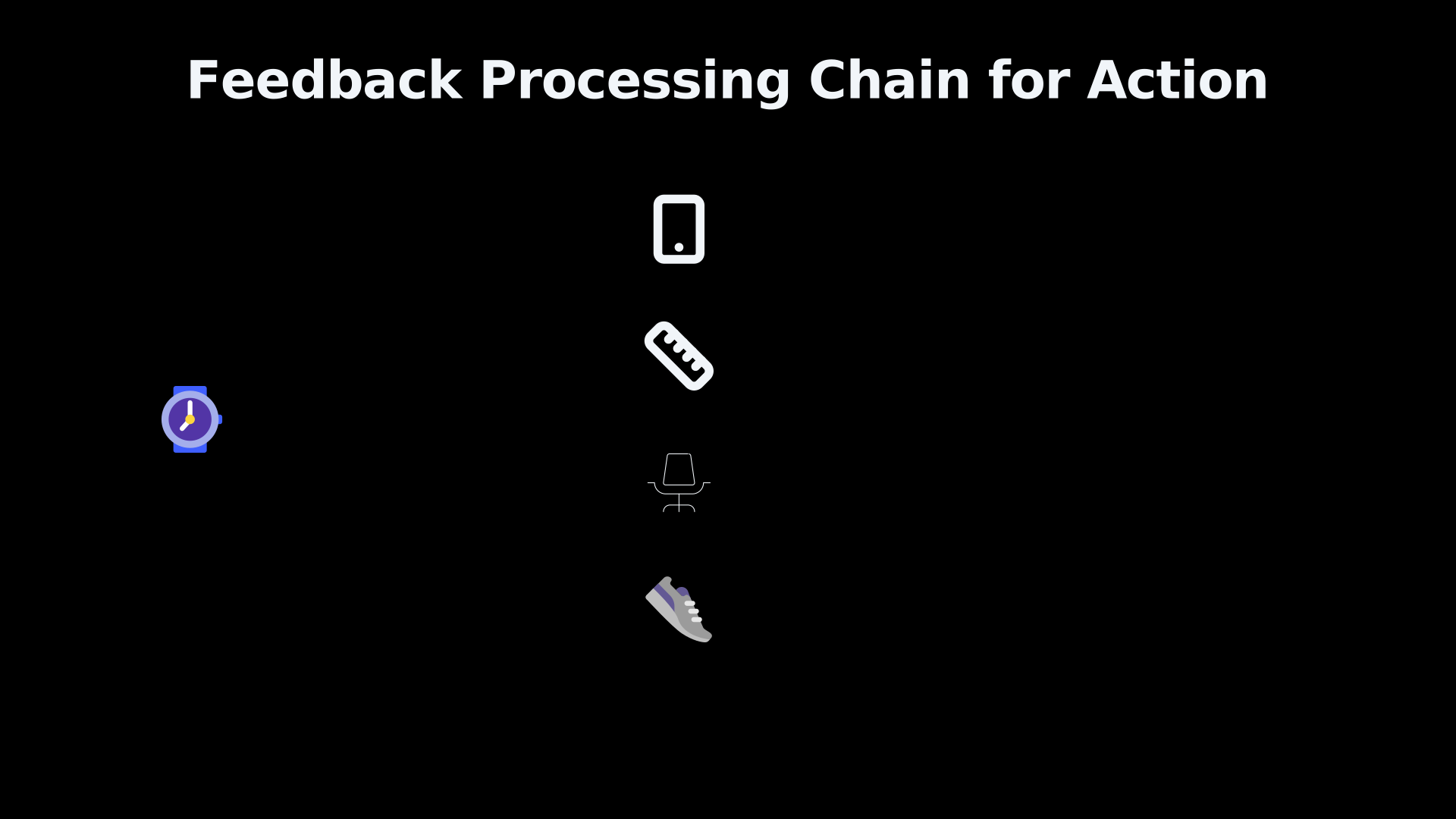
A personalised behaviour system can fail even while measuring the right thing accurately. The failure occurs when the feedback does not survive the journey from measurement → attention → interpretation → decision → action.
Research on clinical performance feedback makes this chain unusually visible because researchers can observe whether professionals actually change practice after receiving performance data. A theory developed from a synthesis of 65 papers evaluating 73 feedback interventions concluded that feedback operates through a sequence of processes; failure at one stage can interrupt the entire cycle.[Springer]link.springer.comOpen source on springer.com.
A major Cochrane review of audit and feedback in healthcare likewise found wide variation in effects across 292 studies. Feedback tended to work better when it helped recipients identify and act on high-priority issues, addressed areas with meaningful room for improvement, provided relevant individual-level information and included specific advice for improvement. Intriguingly, exploratory analyses did not show that simply repeating feedback more often produced larger effects; repeated delivery was associated with a lower effect size in those analyses. The reviewers caution that such moderator findings require further confirmation, but they directly challenge the assumption that adding another feedback cycle is inherently beneficial.[Cochrane]cochrane.orgAudit and feedback: effects on professional practice | CochraneAudit and feedback: effects on professional practice | Cochrane
This suggests several ways “more” can become “worse” without requiring feedback itself to be harmful.
It can add no new decision-relevant information. If today’s message leads to exactly the same decision as yesterday’s, greater frequency may increase exposure without improving control.
It can compete for attention. Feedback is an intervention into attention, not just a neutral stream of data. The classic performance research suggests that directing attention away from the mechanics of the task and towards self-evaluation can undermine performance.[DOI]doi.orgThe effects of feedback interventions on performance: A historical review, a meta-analysis, and a preliminary feedback intervention th…
It can identify a problem without supplying a workable response. Knowing that performance is below target is different from knowing what feasible action will improve it. Reviews of technology-supported behaviour change and electronic audit systems repeatedly highlight the importance of actionable, role-relevant information and embedded action planning.[JMIR]jmir.orgJournal of Medical Internet ResearchJournal of Medical Internet Research - Just-in-Time Feedback in Diet and Physical Activity Interventions: Systematic Review and Pract…
It can arrive outside the useful action window. In computerised clinical feedback systems, timely data were associated with greater engagement and actionability; stale feedback could be experienced as extra work occurring outside normal workflow.[PubMed Central (PMC)]pmc.ncbi.nlm.nih.govOpen source on nih.gov. Yet the learning literature shows why “therefore make everything instantaneous” would be an overreach: optimal timing varies by task and context.[DOI]doi.orgOpen source on doi.org.
The common thread is not minimalism for its own sake. It is decision relevance. The best feedback is enough information, at an appropriate moment, to improve the next controllable action.
Personalised does not automatically mean effective
Personalisation can make feedback more relevant, but attaching an individual’s name, history or statistics to a message does not guarantee that it changes behaviour.
A systematic meta-review of self-regulation mechanisms in health behaviour found conflicting evidence about personalised feedback. Some higher-quality reviews reported benefits in particular populations or for particular outcomes, while another meta-analysis found that personalised feedback did not improve physical activity more than interventions without it unless it was combined with another effective component such as goal setting. Results across lower-quality reviews were similarly mixed.[PubMed Central (PMC)]pmc.ncbi.nlm.nih.govOpen source on nih.gov.
Remotely delivered diet interventions tell a similar story. A meta-analysis of 26 studies involving 21,262 participants found a small improvement in dietary behaviour from interventions containing self-monitoring or tailored feedback, but results were substantially heterogeneous and most studies had unclear or high risk of bias.[ScienceDirect]sciencedirect.comOpen source on sciencedirect.com.
So the useful form of personalisation is not simply “more data about me”. It is feedback adapted to the part of the behaviour that can actually change. A person who already understands their problem may need less explanation and a better cue to act. Someone learning a new skill may need detailed corrective information. Someone whose environment prevents the intended action may gain little from another progress graph because the binding constraint is not awareness.
This is where personalised behaviour systems differ from magic formulas. Personalisation is not the formula. It is a process for discovering which information changes this person’s behaviour under these conditions.
How to test whether feedback is changing behaviour
The cleanest practical test is to judge feedback by what happens after it, rather than by how informative or sophisticated it appears. A useful feedback system should create an observable improvement in the behavioural loop: better decisions, more consistent follow-through, faster correction of errors or more reliable progress towards the chosen goal.
A simple test can be run without turning everyday life into a complicated experiment:
- Choose one behaviour and one useful measure. Track something sufficiently close to action — sessions completed, bedtime achieved, pages practised, planned meals prepared — rather than collecting every available metric.
-
Establish what self-monitoring alone does. Before adding elaborate feedback, see whether simply recording the behaviour already improves consistency. Progress-monitoring research suggests that recording itself can be behaviourally potent. PubMed
- Add one feedback feature with a clear purpose. That might be a comparison with the target, a weekly trend, immediate technique feedback or one concrete suggestion for the next attempt. The feature should answer a specific question that the raw measurement cannot.
- Look for changed action, not increased attention to the tracker. Opening an app, reading a report or checking a dashboard is engagement with feedback; it is not necessarily progress. The relevant outcome is whether the target behaviour changes.
- Reduce or redesign feedback that repeatedly produces no different action. If a daily message is ignored but a weekly review consistently leads to a useful adjustment, the weekly review may be the better system. If feedback arrives after the opportunity to correct behaviour has passed, move it closer to the decision point. If it creates self-criticism rather than a task-level correction, change its content.
- Re-test when the behaviour changes. The feedback required while learning something may not be the feedback required once it becomes routine. Evidence from different domains shows that feedback effects depend heavily on task, context and delivery rather than obeying a stable universal frequency rule. ScienceDirect
This approach preserves the strongest finding in the literature — monitoring and feedback can genuinely improve self-regulation — without turning that finding into another rigid self-improvement prescription. PubMed
The useful target is feedback fit
“More feedback” sounds like greater support, but feedback is only useful insofar as it improves regulation of behaviour. The research does not reveal one universally superior combination of immediate versus delayed, human versus automated, frequent versus occasional or highly detailed versus simple feedback. In several areas, the evidence explicitly shows substantial variation that those labels alone cannot explain. PubMed Central (PMC)+2ScienceDirect
A better principle for self-improvement is therefore feedback fit. Feedback should reveal something the person needs to know, direct attention towards a controllable part of the task and arrive when there is a realistic opportunity to respond. Where possible, it should make the next useful action clearer rather than merely producing another judgement about past performance. Research on actionable feedback, just-in-time interventions and audit-and-feedback systems repeatedly points towards this connection between information and action. PubMed Central (PMC)+2JMIR
That makes feedback a component to tune rather than maximise. The personalised system is not the one that measures the most, sends the most reminders or generates the richest dashboard. It is the one in which the feedback that survives has demonstrated a useful job: helping the person behave differently when behaving differently is still possible.
Amazon book picks
Further Reading
Books and field guides related to When Does Feedback Help Instead of Distract?. Use these as the next step if you want deeper reading beyond the article.
How to Change
Wall Street Journal bestseller “A welcome revelation.” --The Financial Times Award-winning Wharton Professor and Choiceology podcast host...
Atomic Habits
Rating: 3.5/5 from 7 Google Books ratings
The #1 New York Times bestseller. Over 25 million copies sold! Translated into 60+ languages! Tiny Changes, Remarkable Results No matter...
The Progress Principle
Explains how to foster progress, shows how to remove obstacles, including meaningless tasks and toxic relationships that disrupt employee...
Peak
For the first time in decades of groundbreaking research, the inventor of the 10,000-hour rule explains his techniques for developing mas...
eBay marketplace picks
Marketplace Samples
Live-tested eBay searches with available results related to this page.
Selected fromhabit tracker board oneBay.co.uk.

Endnotes
1.
Source: doi.org
Link:https://doi.org/10.1186/s12966-023-01555-6
Source snippet
Impact of feedback generation and presentation on self-monitoring behaviors, dietary intake, physical activity, and weight: a systemat...
2.
Source: doi.org
Link:https://doi.org/10.1037/0033-2909.119.2.254
Source snippet
The effects of feedback interventions on performance: A historical review, a meta-analysis, and a preliminary feedback intervention th...
3.
Source: jmir.org
Title: Journal of Medical Internet Research
Link:https://www.jmir.org/2018/3/e106
Source snippet
Journal of Medical Internet Research - Just-in-Time Feedback in Diet and Physical Activity Interventions: Systematic Review and Pract...
5.
Source: doi.org
Link:https://doi.org/10.1007/s10648-026-10117-8?urlappend=%3Futm_source%3Dresearchgate.net%26utm_medium%3Darticle
6.
Source: link.springer.com
Link:https://link.springer.com/article/10.1186/s13012
7.
Source: cochrane.org
Title: Audit and feedback: effects on professional practice | Cochrane
Link:https://www.cochrane.org/evidence/CD000259_audit-and-feedback-effects-professional-practice
8.
Source: sciencedirect.com
Link:https://www.sciencedirect.com/science/article/pii/S0002916522027861
9.
Source: cochrane.org
Title: Audit and feedback: effects on professional practice | Cochrane
Link:https://www.cochrane.org/CD000259/EPOC_audit-and-feedback-effects-on-professional-practice-andpatient-outcomes
10.
Source: link.springer.com
Link:https://link.springer.com/article/10.1007/s10984-024-09501-4
11.
Source: link.springer.com
Link:https://link.springer.com/article/10.1186/s12966-024-01569-8
12.
Source: link.springer.com
Link:https://link.springer.com/article/10.1186/s12966-023-01555-6
13.
Source: link.springer.com
Link:https://link.springer.com/article/10.1007/s40279-023-01877-2
14.
Source: mhealth.jmir.org
Link:https://mhealth.jmir.org/2023/1/e38342
16.
Source: sciencedirect.com
Link:https://www.sciencedirect.com/org/science/article/pii/S2291522223000657
17.
Source: jmir.org
Title: Journal of Medical Internet Research
Link:https://www.jmir.org/2020/12/e23369/
18.
Source: doi.org
Link:https://doi.org/10.3389/fpsyg.2019.03087
19.
Source: sciencedirect.com
Link:https://www.sciencedirect.com/org/science/article/pii/S2291522218000657
21.
Source: sciencedirect.com
Link:https://www.sciencedirect.com/org/science/article/pii/S1438887118000900
22.
Source: link.springer.com
Link:https://link.springer.com/article/10.1186/s13012-017-0590-z
23.
Source: doi.org
Link:https://doi.org/10.1146/annurev-orgpsych-032516-113108
24.
Source: jmir.org
Title: Journal of Medical Internet Research
Link:https://www.jmir.org/2014/3/e93/
25.
Source: doi.org
Link:https://doi.org/10.1093/ajcn/nqx048
26.
Source: sciencedirect.com
Link:https://www.sciencedirect.com/science/article/pii/S0747563215302946
27.
Source: sciencedirect.com
Title: Performance Feedback
Link:https://www.sciencedirect.com/topics/social-sciences/performance-feedback
28.
Source: sciencedirect.com
Link:https://www.sciencedirect.com/science/article/pii/S0749597811000513
29.
Source: sciencedirect.com
Link:https://www.sciencedirect.com/science/article/pii/S2211335518301177
30.
Source: sciencedirect.com
Link:https://www.sciencedirect.com/science/article/pii/S2666920X22000352
31.
Source: sciencedirect.com
Link:https://www.sciencedirect.com/science/article/pii/S1469029222001455
33.
Source: pmc.ncbi.nlm.nih.gov
Link:https://pmc.ncbi.nlm.nih.gov/articles/PMC10765525/
Source snippet
PubMed Central (PMC)Impact of feedback generation and presentation on self-monitoring behaviors, dietary intake, physical activity, and w...
34.
Source: pmc.ncbi.nlm.nih.gov
Link:https://pmc.ncbi.nlm.nih.gov/articles/PMC5887039/
35.
Source: pmc.ncbi.nlm.nih.gov
Link:https://pmc.ncbi.nlm.nih.gov/articles/PMC10432365/
36.
Source: journals.sagepub.com
Title: Sage Journals Timing of Feedback and Verbal Learning
Link:https://journals.sagepub.com/doi/10.3102/00346543058001079
37.
Source: pmc.ncbi.nlm.nih.gov
Link:https://pmc.ncbi.nlm.nih.gov/articles/PMC9093027/
38.
Source: pmc.ncbi.nlm.nih.gov
Link:https://pmc.ncbi.nlm.nih.gov/articles/PMC7571594/
39.
Source: pmc.ncbi.nlm.nih.gov
Link:https://pmc.ncbi.nlm.nih.gov/articles/PMC3303967/
40.
Source: pubmed.ncbi.nlm.nih.gov
Link:https://pubmed.ncbi.nlm.nih.gov/42325158/
41.
Source: pmc.ncbi.nlm.nih.gov
Link:https://pmc.ncbi.nlm.nih.gov/articles/PMC12887546/
42.
Source: pubmed.ncbi.nlm.nih.gov
Link:https://pubmed.ncbi.nlm.nih.gov/41636128/
43.
Source: researchgate.net
Link:https://www.researchgate.net/publication/400083464_A_Meta-Analysis_of_the_Impact_of_Feedback_Timing_on_Learning_Outcomes_in_Computer-Assisted_Learning
44.
Source: pmc.ncbi.nlm.nih.gov
Link:https://pmc.ncbi.nlm.nih.gov/articles/PMC12467369/
45.
Source: pmc.ncbi.nlm.nih.gov
Link:https://pmc.ncbi.nlm.nih.gov/articles/PMC11934852/
46.
Source: researchgate.net
Link:https://www.researchgate.net/publication/381484661_A_meta-analysis_of_the_effects_of_context_content_and_task_factors_of_digitally_delivered_instructional_feedback_on_learning_performance
47.
Source: pubmed.ncbi.nlm.nih.gov
Link:https://pubmed.ncbi.nlm.nih.gov/38178230/
48.
Source: pubmed.ncbi.nlm.nih.gov
Link:https://pubmed.ncbi.nlm.nih.gov/37410360/
49.
Source: pmc.ncbi.nlm.nih.gov
Link:https://pmc.ncbi.nlm.nih.gov/articles/PMC10337295/
50.
Source: pubmed.ncbi.nlm.nih.gov
Link:https://pubmed.ncbi.nlm.nih.gov/37294612/
51.
Source: pmc.ncbi.nlm.nih.gov
Link:https://pmc.ncbi.nlm.nih.gov/articles/PMC9995700/
52.
Source: pmc.ncbi.nlm.nih.gov
Link:https://pmc.ncbi.nlm.nih.gov/articles/PMC8935530/
53.
Source: journals.sagepub.com
Link:https://journals.sagepub.com/doi/10.3102/00346543211042426
54.
Source: pmc.ncbi.nlm.nih.gov
Link:https://pmc.ncbi.nlm.nih.gov/articles/PMC8234624/
55.
Source: pmc.ncbi.nlm.nih.gov
Link:https://pmc.ncbi.nlm.nih.gov/articles/PMC8016245/
56.
Source: pubmed.ncbi.nlm.nih.gov
Link:https://pubmed.ncbi.nlm.nih.gov/33306026/
57.
Source: journals.sagepub.com
Link:https://journals.sagepub.com/doi/pdf/10.1177/0890207020962330
58.
Source: journals.sagepub.com
Link:https://journals.sagepub.com/doi/10.1177/0890207020962330
59.
Source: pmc.ncbi.nlm.nih.gov
Link:https://pmc.ncbi.nlm.nih.gov/articles/PMC7691059/
60.
Source: pmc.ncbi.nlm.nih.gov
Link:https://pmc.ncbi.nlm.nih.gov/articles/PMC6987456/
61.
Source: pubmed.ncbi.nlm.nih.gov
Link:https://pubmed.ncbi.nlm.nih.gov/32038429/
62.
Source: researchgate.net
Title: (PDF) A Meta-Analysis of Negative Feedback on Intrinsic Motivation
Link:https://www.researchgate.net/publication/326834164_A_Meta-Analysis_of_Negative_Feedback_on_Intrinsic_Motivation
63.
Source: pmc.ncbi.nlm.nih.gov
Link:https://pmc.ncbi.nlm.nih.gov/articles/PMC6080195/
64.
Source: pubmed.ncbi.nlm.nih.gov
Link:https://pubmed.ncbi.nlm.nih.gov/30109172/
65.
Source: pubmed.ncbi.nlm.nih.gov
Link:https://pubmed.ncbi.nlm.nih.gov/29567638/
66.
Source: pubmed.ncbi.nlm.nih.gov
Link:https://pubmed.ncbi.nlm.nih.gov/28494799/
67.
Source: researchgate.net
Link:https://www.researchgate.net/publication/291335719_Does_Monitoring_Goal_Progress_Promote_Goal_Attainment_A_Meta-Analysis_of_the_Experimental_Evidence
68.
Source: pmc.ncbi.nlm.nih.gov
Link:https://pmc.ncbi.nlm.nih.gov/articles/PMC4284968/
69.
Source: researchgate.net
Link:https://www.researchgate.net/publication/272923307_Effects_of_Feedback_in_a_Computer-Based_Learning_Environment_on_Students
70.
Source: pubmed.ncbi.nlm.nih.gov
Link:https://pubmed.ncbi.nlm.nih.gov/25506654/
71.
Source: pmc.ncbi.nlm.nih.gov
Link:https://pmc.ncbi.nlm.nih.gov/articles/PMC4238192/
72.
Source: pubmed.ncbi.nlm.nih.gov
Link:https://pubmed.ncbi.nlm.nih.gov/24667840/
73.
Source: pmc.ncbi.nlm.nih.gov
Link:https://pmc.ncbi.nlm.nih.gov/articles/PMC4013925/
74.
Source: pubmed.ncbi.nlm.nih.gov
Link:https://pubmed.ncbi.nlm.nih.gov/22128773/
75.
Source: pubmed.ncbi.nlm.nih.gov
Link:https://pubmed.ncbi.nlm.nih.gov/22696318/
76.
Source: pmc.ncbi.nlm.nih.gov
Link:https://pmc.ncbi.nlm.nih.gov/articles/PMC11338587/
77.
Source: pmc.ncbi.nlm.nih.gov
Link:https://pmc.ncbi.nlm.nih.gov/articles/PMC4170834/
78.
Source: pubmed.ncbi.nlm.nih.gov
Link:https://pubmed.ncbi.nlm.nih.gov/16625533/
79.
Source: researchgate.net
Title: (PDF) The speed of goal pursuit
Link:https://www.researchgate.net/publication/37367750_The_speed_of_goal_pursuit
80.
Source: researchgate.net
Link:https://www.researchgate.net/publication/232458848_The_Effects_of_Feedback_Interventions_on_Performance_A_Historical_Review_a_Meta-Analysis_and_a_Preliminary_Feedback_Intervention_Theory
81.
Source: researchgate.net
Link:https://www.researchgate.net/publication/355263800_Meta-analysis_of_reduced_relative_feedback_frequency_effect_on_motor_learning_and_performance
82.
Source: researchgate.net
Link:https://www.researchgate.net/publication/358950702_Meta-analysis_of_the_reduced_relative_feedback_frequency_effect_on_motor_learning_and_performance
83.
Source: pubmed.ncbi.nlm.nih.gov
Link:https://pubmed.ncbi.nlm.nih.gov/29189034/
84.
Source: pubmed.ncbi.nlm.nih.gov
Link:https://pubmed.ncbi.nlm.nih.gov/12917891/
85.
Source: pubmed.ncbi.nlm.nih.gov
Link:https://pubmed.ncbi.nlm.nih.gov/24965281/
86.
Source: pmc.ncbi.nlm.nih.gov
Link:https://pmc.ncbi.nlm.nih.gov/articles/PMC2464905/
87.
Source: pubmed.ncbi.nlm.nih.gov
Link:https://pubmed.ncbi.nlm.nih.gov/17142594/
88.
Source: pubmed.ncbi.nlm.nih.gov
Link:https://pubmed.ncbi.nlm.nih.gov/10589297/
89.
Source: pubmed.ncbi.nlm.nih.gov
Link:https://pubmed.ncbi.nlm.nih.gov/18298272/
90.
Source: bjsm.bmj.com
Link:https://bjsm.bmj.com/content/56/23/1366
91.
Source: bjsm.bmj.com
Link:https://bjsm.bmj.com/content/55/8/422
Additional References
92.
Source: cris.huji.ac.il
Link:https://cris.huji.ac.il/en/publications/the-effects-of-feedback-interventions-on-performance-a-historical/
Source snippet
The Hebrew University of JerusalemThe effects of feedback interventions on performance: A historical review, a meta-analysis, and a preli...
93.
Source: eprints.whiterose.ac.uk
Link:https://eprints.whiterose.ac.uk/id/eprint/91437/
Source snippet
White Rose Research OnlineDoes Monitoring Goal Progress Promote Goal Attainment? A Meta-Analysis of the Experimental Evidence - White Ros...
94.
Source: youtube.com
Title: The Power of Performance Feedback
Link:https://www.youtube.com/watch?v=FSOaB4wTlxU
Source snippet
For a deeper look into the cognitive limits of critique and why standard feedback interventions frequently backfire, check out Why Feedba...
95.
Source: youtube.com
Title: Thanks for the Feedback | Doug Stone & Sheila Heen | Talks at Google
Link:https://www.youtube.com/watch?v=SggjK0Gm3I4
Source snippet
Why Feedback Feels Threatening (And How to Respond Calmly)...
96.
Source: youtube.com
Title: Why Feedback Is Making You Worse (And What to Do Instead) | Adam Grant
Link:https://www.youtube.com/watch?v=rwSg2uXIqBM
Source snippet
Helpful vs. Unhelpful Ways to Give Feedback...
97.
Source: youtube.com
Title: Why Feedback Feels Threatening (And How to Respond Calmly)
Link:https://www.youtube.com/watch?v=ImxN2MmVFbg
Source snippet
The Power of Performance Feedback - Amber Vanderburg...
98.
Source: youtube.com
Title: Helpful vs. Unhelpful Ways to Give Feedback
Link:https://www.youtube.com/watch?v=MmkTKE5B7Q4
Source snippet
Thanks for the Feedback | Doug Stone & Sheila Heen | Talks at Google...
99.
Source: ajcn.nutrition.org
Link:https://ajcn.nutrition.org/article/S0002-9165%2822%2902786-1/fulltext
100.
Source: 1library.net
Link:https://1library.net/document/rz3x7o7z-does-monitoring-progress-promote-attainment-analysis-experimental-evidence.html
101.
Source: eurekamag.com
Link:https://eurekamag.com/research/057/653/057653112.php