Within Meal Prep
Healthy Eating Without Cooking Everything Yourself
Frozen vegetables, tinned pulses and pre-cooked staples can support a good diet when they make an acceptable meal easier to assemble.
On this page
- Why more home cooking is not always better
- Convenience foods that reduce preparation without opening the decision
- Building a minimum prep meal system that still covers dietary basics
Page outline Jump by section
Introduction
Healthy eating does not require cooking every meal from basic ingredients. Frozen vegetables, tinned pulses, microwaveable wholegrains, plain yoghurt, tinned fish, prepared salads and similar foods can remove most of the chopping, cooking and washing-up while still supplying the building blocks of a balanced diet. The useful distinction is not simply between “home-made” and “convenient”, but between convenience foods that make nutritious foods easier to eat and products whose convenience comes with an unfavourable nutritional profile.
A particularly revealing analysis of UK adults found that some people maintained high-quality diets despite obtaining relatively little energy from home-prepared food. Their diets were not identical to those of people who prepared more food at home: they contained somewhat more sugar and sodium, but also more fruit and low-fat dairy and less red meat.[PubMed Central (PMC)]pmc.ncbi.nlm.nih.govPubMed Central (PMC)Comparison of individuals with low versus high consumption of home-prepared food in a group with universally high die…
For a meal system designed to remove the daily food decision, that is an important finding. The target need not be maximum cooking. It can be minimum preparation consistent with a good overall diet.
Why more home cooking is not always better
There is a genuine association between home preparation and diet quality, but it is easy to turn that association into a stronger rule than the evidence supports. An analysis of 6,364 adults in the UK National Diet and Nutrition Survey for 2008–16 found that, on average, only 26.5% of participants’ dietary energy came from food classified as home-prepared. Each 10-percentage-point increase in home-prepared food was associated with 1.2 times the odds of being in the highest fifth for adherence to the Dietary Approaches to Stop Hypertension (DASH) dietary pattern. Because the study was cross-sectional, however, it could not establish that cooking itself caused the better diet.[PubMed Central (PMC)]pmc.ncbi.nlm.nih.govPubMed Central (PMC)Home-prepared food, dietary quality and socio-demographic factors: a cross-sectional analysis of the UK National Diet…
The more revealing comparison came from the same survey data. Researchers selected 1,063 adults who already had high-quality diets and divided them according to their reliance on home-prepared food. Of these, 442 combined high diet quality with low home preparation, while 621 combined high diet quality with high home preparation. After adjustment for demographic differences, the researchers found no significant difference between the groups in DASH diet-quality score, reported energy intake or prevalence of obesity.[PubMed Central (PMC)]pmc.ncbi.nlm.nih.govPubMed Central (PMC)Comparison of individuals with low versus high consumption of home-prepared food in a group with universally high die…
That comparison matters because it separates two questions that are often treated as one. “Do people who cook more tend to eat better?” and “Must someone cook a great deal to eat well?” are not equivalent. The survey evidence supports an association for the first proposition but contradicts the idea that extensive home preparation is a necessary condition for the second. The authors explicitly concluded that home food preparation should not be presented as a prerequisite for a high-quality diet.[PubMed Central (PMC)]pmc.ncbi.nlm.nih.govPubMed Central (PMC)Comparison of individuals with low versus high consumption of home-prepared food in a group with universally high die…
Nor does “home-made” guarantee a nutritionally superior meal. A 2012 BMJ study compared 100 supermarket ready meals with 100 main-course recipes from five bestselling books by UK television chefs. Neither group met all the nutritional recommendations used by the researchers, but the chef recipes contained more energy, fat and saturated fat and less fibre per portion than the ready meals. Ready meals performed particularly poorly on sodium. The study was a comparison of selected products and recipes, not proof that ready meals are generally healthier than home cooking, but it demonstrates why preparation method is a poor nutritional shortcut: what the meal contains matters more than whether somebody cooked it from scratch.[BMJ]bmj.comNutritional content of supermarket ready meals and recipes by television chefs in the United Kingdom: cross sectional study | The BMJD…
This is especially relevant when self-improvement advice inadvertently makes healthy eating harder. Someone who believes a proper dinner requires peeling, chopping, cooking and cleaning may abandon the intended meal when time or energy is scarce. A person willing to microwave frozen vegetables, open a tin of chickpeas and heat a pre-cooked grain has a much shorter route from intention to eating.
Convenience foods can remove preparation without removing nutrition
“Processed” and “convenient” cover foods with radically different nutritional characteristics. Freezing peas and manufacturing a confectionery bar both involve food processing, but treating them as nutritionally equivalent because neither is completely unprocessed is not useful.
The NOVA processing classification itself places plain frozen fruit and vegetables, grains and pulses among unprocessed or minimally processed foods; tinned vegetables and legumes made with added salt fall into its processed category. More complex industrial formulations can fall into the ultra-processed category. Whatever one thinks of using processing classifications to predict health, the categories illustrate a simple point: freezing, cooking, canning and packaging do not automatically turn a useful staple into nutritionally poor food.[PubMed Central (PMC)]pmc.ncbi.nlm.nih.govPubMed Central (PMC)The UN Decade of Nutrition, the NOVA food classification and the trouble with ultra-processing - PMCMarch 21, 2017…
Frozen vegetables are a particularly strong example. The NHS explicitly counts fresh, frozen and tinned fruit and vegetables towards the recommended five portions a day. An 80 g serving of fresh, tinned or frozen fruit or vegetables counts as a portion.[nhs.uk]nhs.ukEating a balanced dietJune 30, 2026… Research comparing fresh, frozen and “fresh-stored” produce has also challenged the assumption that fresh produce is invariably nutritionally superior: in a two-year analysis, some nutrients declined during five days of refrigerated storage, and frozen produce sometimes compared favourably with the fresh-stored equivalent.[ScienceDirect]sciencedirect.comOpen source on sciencedirect.com.
Tinned pulses solve a different preparation problem. Dried chickpeas and beans can be inexpensive and nutritious, but they require soaking or substantial cooking time. A tin turns the same basic food category into something that can go directly into a salad, soup, grain bowl or microwave meal. Pulses provide protein and fibre and are specifically included among the protein foods recommended by the NHS.[nhs.uk]nhs.ukEating a balanced dietJune 30, 2026… Where sodium is a concern, choosing lower-salt versions helps; research on canned beans has also found that draining and then rinsing them significantly reduces sodium.[Taylor & Francis Online]tandfonline.comOpen source on tandfonline.com.
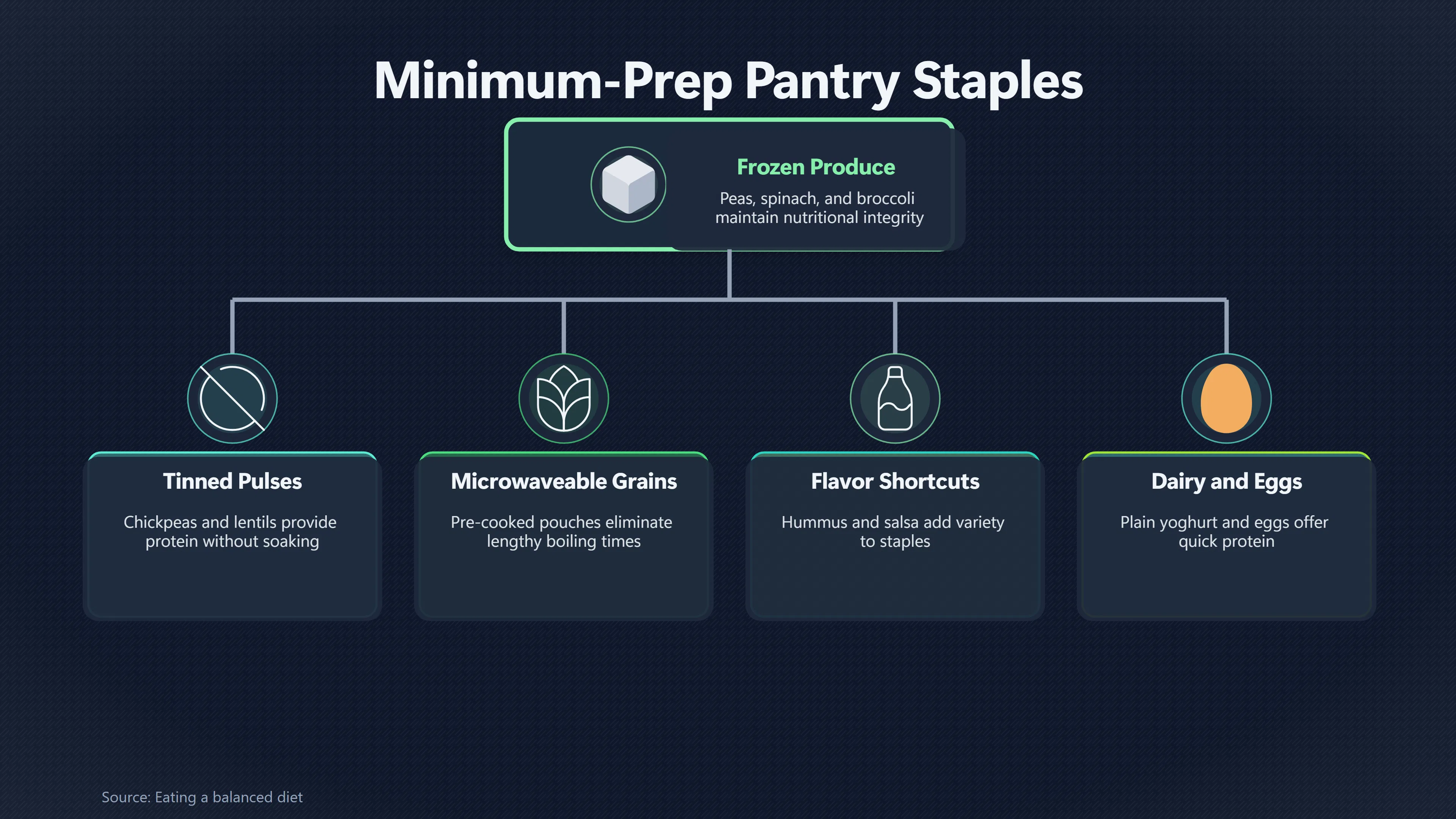
The same principle extends beyond vegetables and beans. A useful minimum-prep cupboard, fridge and freezer can contain foods whose processing has already performed the tedious step:
- Vegetables and fruit: frozen peas, spinach, broccoli, mixed vegetables or berries; tinned tomatoes and sweetcorn; prepared salad; fresh fruit that requires no preparation.
- Pulses and other proteins: tinned lentils, chickpeas and beans; eggs; plain yoghurt; tofu; unsalted nuts; tinned fish where appropriate. The NHS notes that tinned and smoked fish can be comparatively salty, so the label still matters.[nhs.uk]nhs.ukEating a balanced dietJune 30, 2026…
- Starchy staples: wholegrain bread, oats, microwaveable grains, potatoes, wholewheat pasta and other higher-fibre starches. UK guidance recommends basing meals on higher-fibre starchy foods rather than treating carbohydrate foods as something to eliminate.[nhs.uk]nhs.ukEating a balanced dietJune 30, 2026…
- Flavour shortcuts: hummus, salsa, tomato-based sauces, herbs, spices and dressings can make repetitive staple combinations more acceptable. Prepared sauces and soups vary considerably in salt, fat and sugar, so convenience here benefits from label checking rather than automatic approval or rejection.[nhs.uk]nhs.uk5 A Day – Food Facts – Healthier Families5 A Day – Food Facts – Healthier Families
These foods are useful not because they constitute a special “convenience diet”, but because they preserve much of the function of ordinary dietary staples while transferring work from the eater to the manufacturer. The freezer has chopped and preserved the spinach; the cannery has soaked and cooked the chickpeas; the grain pouch has performed the lengthy cooking stage. At mealtime, assembly replaces preparation.

Build a minimum-prep meal system, not another nightly decision
The strongest way to use convenience foods in a decision-reducing routine is to stop treating them as emergency substitutes. They can instead be the planned components of a small meal system.
A simple structure is vegetables or fruit + a protein source + a higher-fibre starchy food, with a modest source of unsaturated fat or flavour where it fits. That mirrors the broad architecture of the NHS Eatwell Guide, which emphasises fruit and vegetables, higher-fibre starchy foods, dairy or alternatives, beans and other protein foods, and mostly unsaturated fats. The balance does not need to be achieved perfectly at every individual meal; the Eatwell proportions describe the diet overall.[nhs.uk]nhs.ukEating a balanced dietJune 30, 2026…
In practice, the system can be almost cooking-free. A microwave grain pouch, tinned lentils, frozen mixed vegetables and a spoonful of sauce make one combination. Wholegrain toast, tinned beans and a bagged salad make another. Plain yoghurt, frozen berries, oats and nuts can cover breakfast without chopping or cooking. A prepared soup that is light on salt can be supplemented with frozen vegetables or pulses and eaten with wholegrain bread rather than being expected to provide the entire meal by itself.
The important design feature is repetition at the component level, rather than requiring the same finished meal every day. Keeping two or three defaults in each category allows combinations to change while the decision structure stays fixed. “Which of my two proteins shall I use?” is a much smaller problem than “What shall I have for dinner?”
There is also a practical advantage to foods that wait. Fresh vegetables bought with ambitious plans can become both waste and a reminder of plans not followed. Frozen vegetables and shelf-stable pulses remain available when schedules change. That makes the healthy option less dependent on predicting exactly when cooking will happen.
The nutritional weak spots are predictable
Minimum-prep eating works best when convenience is treated as a tool rather than a guarantee of healthfulness. The UK adults who achieved high diet quality with relatively little home-prepared food provide a useful warning as well as encouragement. Compared with their high-home-preparation counterparts, they consumed about 31 g more fruit and 25 g more low-fat dairy per day and 10 g less red meat, after adjustment, but also about 12 g more sugar and 108 mg more sodium per day.[PubMed Central (PMC)]pmc.ncbi.nlm.nih.govPubMed Central (PMC)Comparison of individuals with low versus high consumption of home-prepared food in a group with universally high die…
That pattern suggests where attention pays off. A system built around plain frozen vegetables, pulses, fruit and simple staples is different from one built around salty ready meals, confectionery and snack foods even though both minimise kitchen work. Ready meals themselves also vary substantially. A UK survey of supermarket own-brand ready meals found that they tended overall to be high in saturated fat and salt, yet about 20% met the study’s criteria for being low in fat, saturated fat, salt and sugar. The researchers found little evidence that healthier options necessarily cost more.[ScienceDirect]sciencedirect.comOpen source on sciencedirect.com.
For packaged mixed foods, front-of-pack nutrition information can therefore do useful work. Salt, saturated fat and added or free sugars are sensible points of comparison, while fibre, vegetables and useful protein sources help distinguish a meal that merely supplies calories from one that contributes to the broader dietary pattern. A convenience meal that is incomplete can also be repaired rather than rejected: add frozen vegetables to a small pasta dish, pulses to soup, fruit to breakfast, or a prepared salad beside a main course.
This avoids an all-or-nothing standard in which a packaged meal is either certified “healthy” or forbidden. The more practical question is whether the foods kept at home make the dietary basics easy to cover repeatedly.

The real optimisation is effort per acceptable meal
The historical comparison in the UK National Diet and Nutrition Survey makes the central lesson unusually clear. Across the whole adult sample, more home-prepared food was associated with better diet quality. Yet inside the group already eating well, a substantial number of adults achieved that result while relying relatively little on home preparation.[PubMed Central (PMC)]pmc.ncbi.nlm.nih.govPubMed Central (PMC)Comparison of individuals with low versus high consumption of home-prepared food in a group with universally high die… Those findings are not contradictory. Cooking can be one route to a good diet without being the only route.
For a self-improvement system, this changes the optimisation target. Maximising meals cooked from scratch can consume time and willpower without necessarily maximising diet quality. Minimising preparation at any nutritional cost is no better. The more durable target is to minimise the friction required to assemble an acceptable meal while preserving the important features of the diet.
Frozen vegetables, tinned pulses and pre-cooked staples are valuable precisely because they can do both jobs. They shorten the path from hunger to eating while leaving vegetables, fibre-rich starches and useful protein sources in the meal. Once a small set of those foods is routinely stocked and combined according to a fixed template, “I do not have time to cook” no longer has to mean “I need to decide what else to eat”. The cooking has largely disappeared, and so has much of the decision.
Amazon book picks
Further Reading
Books and field guides related to Healthy Eating Without Cooking Everything Yourself. Use these as the next step if you want deeper reading beyond the article.
5 Ingredients - Quick & Easy Food
Jamie's most straightforward cookbook yet . . . It's perfect for quick and easy meals for every day of the week. Even the busiest of us w...
The Roasting Tin
Cook quick and easy delicious meals to enjoy at home. Perfect for busy people who want to make simple but satisfying home cooked dinners....
The Green Roasting Tin
**THE 1.75-MILLION-COPY-BESTSELLING SERIES** BOOST YOUR PLANT INTAKE WHILE MAXIMISING FLAVOUR & VARIETY. THE ONE DISH REVOLUTION: 75 nutr...
How Not to Die Cookbook
From the author of the global bestseller How Not To Die comes The How Not To Die Cookbook – a lavish, beautifully illustrated collection...
eBay marketplace picks
Marketplace Samples
Live-tested eBay searches with available results related to this page.
Selected fromkitchen storage containers patch oneBay.co.uk.
Endnotes
1.
Source: sciencedirect.com
Link:https://www.sciencedirect.com/science/article/pii/S0140673618328708
Source snippet
Is eating home-prepared food a necessary condition for high dietary quality? Cross-sectional analysis of the UK National Die...
2.
Source: bmj.com
Link:https://www.bmj.com/content/345/bmj.e7607
Source snippet
Nutritional content of supermarket ready meals and recipes by television chefs in the United Kingdom: cross sectional study | The BMJD...
3.
Source: bmj.com
Link:https://www.bmj.com/content/383/bmj-2023-075294
Source snippet
Ultra-processed foods and cardiometabolic health: public health policies to reduce consumption cannot wait | The BMJ...
4.
Source: nhs.uk
Title: Eating a balanced diet
Link:https://www.nhs.uk/live-well/eat-well/how-to-eat-a-balanced-diet/eating-a-balanced-diet/
Source snippet
June 30, 2026...
Published: June 30, 2026
5.
Source: nhs.uk
Title: 5 A Day – Food Facts – Healthier Families
Link:https://www.nhs.uk/healthier-families/food-facts/5-a-day/
6.
Source: sciencedirect.com
Link:https://www.sciencedirect.com/science/article/pii/S0889157517300418
7.
Source: sciencedirect.com
Link:https://www.sciencedirect.com/science/article/pii/S0195666315002159
8.
Source: thh.nhs.uk
Link:https://thh.nhs.uk/potassium-lowering-dietary-advice
9.
Source: nhs.uk
Title: www.nhs.uk Food labels
Link:https://www.nhs.uk/live-well/eat-well/food-guidelines-and-food-labels/how-to-read-food-labels/
10.
Source: nhs.uk
Title: www.nhs.uk5 A Day: what counts?
Link:https://www.nhs.uk/live-well/eat-well/5-a-day/5-a-day-what-counts/?trk=public_post_comment-text
11.
Source: uclh.nhs.uk
Title: Eating Well for Less: University College London Hospitals NHS Foundation Trust
Link:https://www.uclh.nhs.uk/patients-and-visitors/patient-information-pages/eating-well-less
12.
Source: nhs.uk
Title: www.nhs.uk The vegetarian diet
Link:https://www.nhs.uk/live-well/eat-well/how-to-eat-a-balanced-diet/the-vegetarian-diet/
13.
Source: cntw.nhs.uk
Link:https://www.cntw.nhs.uk/resources/healthy-eating-on-a-budget
14.
Source: myhealthlondon.nhs.uk
Title: meat fish poultry and pulses
Link:https://www.myhealthlondon.nhs.uk/resources/internal/meat-fish-poultry-and-pulses/
15.
Source: northerncarealliance.nhs.uk
Link:https://www.northerncarealliance.nhs.uk/patient-information/patient-leaflets/dietetics-controlling-your-potassium-intake-step-1?q=%2Fpatient-information%2Fpatient-leaflets%2Fdietetics-controlling-your-potassium-intake-step-1
16.
Source: northerncarealliance.nhs.uk
Link:https://www.northerncarealliance.nhs.uk/patient-information/patient-leaflets/renal-controlling-your-salt-intake-step-1?q=%2Fpatient-information%2Fpatient-leaflets%2Frenal-controlling-your-salt-intake-step-1
17.
Source: england.nhs.uk
Title: NH S England — South West » Eat Well this winter with Lesley Harper
Link:https://www.england.nhs.uk/south/2025/01/13/eat-well-this-winter/
18.
Source: cuh.nhs.uk
Title: no added salt diet
Link:https://www.cuh.nhs.uk/patient-information/no-added-salt-diet/
19.
Source: nhs.uk
Title: www.nhs.uk Salt in your diet
Link:https://www.nhs.uk/live-well/eat-well/food-types/salt-in-your-diet/
20.
Source: nhs.uk
Title: www.nhs.uk Starchy foods and carbohydrates
Link:https://www.nhs.uk/live-well/eat-well/food-types/starchy-foods-and-carbohydrates/
21.
Source: nhs.uk
Title: www.nhs.uk5 A Day portion sizes
Link:https://www.nhs.uk/live-well/eat-well/5-a-day/portion-sizes/
22.
Source: nhs.uk
Title: www.nhs.uk Vitamins and minerals
Link:https://www.nhs.uk/conditions/vitamins-and-minerals/others/
23.
Source: sciencedirect.com
Title: Time Spent on Home Food Preparation and Indicators of Healthy Eating
Link:https://www.sciencedirect.com/science/article/pii/S0749379714004000
24.
Source: bmj.com
Link:https://www.bmj.com/content/345/bmj.e7607/rr/620751
25.
Source: bmj.com
Link:https://www.bmj.com/content/345/bmj.e7607/rapid-responses
26.
Source: bmj.com
Link:https://www.bmj.com/content/345/bmj.e7607/related
27.
Source: sciencedirect.com
Title: Essential Elements in Dry and Canned Kidney Beans (Phaseolus vulgaris L.)
Link:https://www.sciencedirect.com/science/article/pii/S0362028X22088561
28.
Source: sciencedirect.com
Title: A comparison of the vitamin C content of fresh and frozen vegetables
Link:https://www.sciencedirect.com/science/article/pii/S0308814697001659
29.
Source: sciencedirect.com
Link:https://www.sciencedirect.com/science/article/pii/S0023643815004430
30.
Source: sciencedirect.com
Title: Mineral content in raw, boiled and canned pulsesin Argentina
Link:https://www.sciencedirect.com/science/article/pii/S0889157523000133
31.
Source: sciencedirect.com
Title: Mineral content in raw, boiled and canned pulsesin Argentina
Link:https://www.sciencedirect.com/science/article/abs/pii/S0889157523000133
32.
Source: sciencedirect.com
Link:https://www.sciencedirect.com/science/article/pii/S0023643820317175
33.
Source: sciencedirect.com
Link:https://www.sciencedirect.com/science/article/abs/pii/S0023643820317175
34.
Source: sciencedirect.com
Link:https://www.sciencedirect.com/science/article/pii/S0889157526001584
35.
Source: sciencedirect.com
Link:https://www.sciencedirect.com/science/article/pii/S0002916523274195
36.
Source: myhealthlondon.nhs.uk
Link:https://www.myhealthlondon.nhs.uk/be-healthier/healthy-lifestyle/eat/
37.
Source: myhealthlondon.nhs.uk
Link:https://www.myhealthlondon.nhs.uk/be-healthier/nutrition-hub/fruit-and-vegetables/
38.
Source: nhs.uk
Link:https://www.nhs.uk/live-well/eat-well/how-to-eat-a-balanced-diet/what-are-processed-foods/
39.
Source: westlondon.nhs.uk
Link:https://www.westlondon.nhs.uk/ealing-talking-therapies/move-4-mood/eat-well-feel-well/food-preparation-and-portions
40.
Source: forumhealthcentre.nhs.uk
Title: 5 A Day
Link:https://www.forumhealthcentre.nhs.uk/your-health/5-a-day
41.
Source: who.int
Title: healthy diet
Link:https://www.who.int/news-room/fact-sheets/detail/healthy-diet
42.
Source: pmc.ncbi.nlm.nih.gov
Link:https://pmc.ncbi.nlm.nih.gov/articles/PMC6337812/
Source snippet
PubMed Central (PMC)Comparison of individuals with low versus high consumption of home-prepared food in a group with universally high die...
43.
Source: pmc.ncbi.nlm.nih.gov
Link:https://pmc.ncbi.nlm.nih.gov/articles/PMC6729029/
Source snippet
PubMed Central (PMC)Home-prepared food, dietary quality and socio-demographic factors: a cross-sectional analysis of the UK National Diet...
44.
Source: pubmed.ncbi.nlm.nih.gov
Link:https://pubmed.ncbi.nlm.nih.gov/31492141/
Source snippet
Home-prepared food, dietary quality and socio-demographic factors: a cross-sectional analysis of the UK National Diet and nutrition...
45.
Source: pmc.ncbi.nlm.nih.gov
Link:https://pmc.ncbi.nlm.nih.gov/articles/PMC3524368/
Source snippet
PubMed Central (PMC)Nutritional content of supermarket ready meals and recipes by television chefs in the United Kingdom: cross sectional...
46.
Source: pmc.ncbi.nlm.nih.gov
Link:https://pmc.ncbi.nlm.nih.gov/articles/PMC10261019/
Source snippet
PubMed Central (PMC)The UN Decade of Nutrition, the NOVA food classification and the trouble with ultra-processing - PMCMarch 21, 2017...
Published: March 21, 2017
47.
Source: tandfonline.com
Link:https://www.tandfonline.com/doi/full/10.1080/15428052.2011.582405
48.
Source: GOV.UK
Title: www.gov.uk Portion sizes and food groups
Link:https://www.gov.uk/government/publications/school-food-standards-resources-for-schools/portion-sizes-and-food-groups
49.
Source: GOV.UK
Title: www.gov.uk Chapter 10: healthier eating
Link:https://www.gov.uk/government/publications/delivering-better-oral-health-an-evidence-based-toolkit-for-prevention/chapter-10-healthier-eating
50.
Source: pmc.ncbi.nlm.nih.gov
Link:https://pmc.ncbi.nlm.nih.gov/articles/PMC12129239/
51.
Source: pmc.ncbi.nlm.nih.gov
Link:https://pmc.ncbi.nlm.nih.gov/articles/PMC10953200/
52.
Source: GOV.UK
Title: www.gov.uk The Eatwell Guide: how to use in promotional material
Link:https://www.gov.uk/government/publications/the-eatwell-guide/the-eatwell-guide-how-to-use-in-promotional-material
53.
Source: GOV.UK
Title: www.gov.uk SAC N statement on processed foods and health
Link:https://www.gov.uk/government/publications/sacn-statement-on-processed-foods-and-health
54.
Source: pmc.ncbi.nlm.nih.gov
Link:https://pmc.ncbi.nlm.nih.gov/articles/PMC9989702/
55.
Source: pubmed.ncbi.nlm.nih.gov
Link:https://pubmed.ncbi.nlm.nih.gov/36647605/
56.
Source: GOV.UK
Title: www.gov.uk Healthy eating: applying All Our Health
Link:https://www.gov.uk/government/publications/healthy-eating-applying-all-our-health/healthy-eating-applying-all-our-health
57.
Source: pmc.ncbi.nlm.nih.gov
Link:https://pmc.ncbi.nlm.nih.gov/articles/PMC10127522/
58.
Source: pmc.ncbi.nlm.nih.gov
Link:https://pmc.ncbi.nlm.nih.gov/articles/PMC10260640/
59.
Source: doi.org
Link:https://doi.org/10.1017/S1368980018003762
60.
Source: pubmed.ncbi.nlm.nih.gov
Link:https://pubmed.ncbi.nlm.nih.gov/30595028/
61.
Source: pmc.ncbi.nlm.nih.gov
Link:https://pmc.ncbi.nlm.nih.gov/articles/PMC6266829/
62.
Source: pmc.ncbi.nlm.nih.gov
Link:https://pmc.ncbi.nlm.nih.gov/articles/PMC5852753/
63.
Source: GOV.UK
Title: www.gov.uk The Eatwell Guide and Resources
Link:https://www.gov.uk/government/publications/the-eatwell-guide-and-resources
64.
Source: pmc.ncbi.nlm.nih.gov
Link:https://pmc.ncbi.nlm.nih.gov/articles/PMC5748765/
65.
Source: pmc.ncbi.nlm.nih.gov
Link:https://pmc.ncbi.nlm.nih.gov/articles/PMC5561571/
66.
Source: pubmed.ncbi.nlm.nih.gov
Link:https://pubmed.ncbi.nlm.nih.gov/28818089/
67.
Source: pmc.ncbi.nlm.nih.gov
Link:https://pmc.ncbi.nlm.nih.gov/articles/PMC5442685/
68.
Source: pubmed.ncbi.nlm.nih.gov
Link:https://pubmed.ncbi.nlm.nih.gov/28535769/
69.
Source: pubmed.ncbi.nlm.nih.gov
Link:https://pubmed.ncbi.nlm.nih.gov/27435891/
70.
Source: GOV.UK
Link:https://www.gov.uk/government/news/phe-response-to-the-british-journal-of-sports-medicine-on-eatwell-guide
71.
Source: GOV.UK
Title: www.gov.uk The Eatwell Guide
Link:https://www.gov.uk/government/publications/the-eatwell-guide
72.
Source: GOV.UK
Title: www.gov.uk[Withdrawn] New Eatwell Guide illustrates a healthy, balanced diet
Link:https://www.gov.uk/government/news/new-eatwell-guide-illustrates-a-healthy-balanced-diet
73.
Source: ukhsa.blog.gov.uk
Link:https://ukhsa.blog.gov.uk/2016/03/17/what-is-a-healthy-balanced-diet/
74.
Source: nidirect.gov.uk
Title: Starchy foods | nidirect
Link:https://www.nidirect.gov.uk/articles/starchy-foods
75.
Source: nidirect.gov.uk
Title: Healthy balanced diet | nidirect
Link:https://www.nidirect.gov.uk/articles/healthy-balanced-diet
76.
Source: pmc.ncbi.nlm.nih.gov
Link:https://pmc.ncbi.nlm.nih.gov/articles/PMC4509783/
77.
Source: pmc.ncbi.nlm.nih.gov
Link:https://pmc.ncbi.nlm.nih.gov/articles/PMC4524366/
78.
Source: pmc.ncbi.nlm.nih.gov
Link:https://pmc.ncbi.nlm.nih.gov/articles/PMC8728746/
79.
Source: pubmed.ncbi.nlm.nih.gov
Link:https://pubmed.ncbi.nlm.nih.gov/28454976/
80.
Source: pmc.ncbi.nlm.nih.gov
Link:https://pmc.ncbi.nlm.nih.gov/articles/PMC4404110/
81.
Source: pubmed.ncbi.nlm.nih.gov
Link:https://pubmed.ncbi.nlm.nih.gov/25889159/
82.
Source: pubmed.ncbi.nlm.nih.gov
Link:https://pubmed.ncbi.nlm.nih.gov/25526594/
83.
Source: pubmed.ncbi.nlm.nih.gov
Link:https://pubmed.ncbi.nlm.nih.gov/25525668/
84.
Source: pmc.ncbi.nlm.nih.gov
Link:https://pmc.ncbi.nlm.nih.gov/articles/PMC4254327/
85.
Source: pubmed.ncbi.nlm.nih.gov
Link:https://pubmed.ncbi.nlm.nih.gov/23247976/
86.
Source: tandfonline.com
Link:https://www.tandfonline.com/doi/abs/10.1080/15428052.2011.582405
87.
Source: tandfonline.com
Link:https://www.tandfonline.com/doi/abs/10.1080/15428052.2011.582405?scroll=top&tab=permissions
88.
Source: pubmed.ncbi.nlm.nih.gov
Link:https://pubmed.ncbi.nlm.nih.gov/20218674/
89.
Source: pubmed.ncbi.nlm.nih.gov
Link:https://pubmed.ncbi.nlm.nih.gov/6833685/
90.
Source: ncbi.nlm.nih.gov
Link:https://www.ncbi.nlm.nih.gov/books/NBK50952/
91.
Source: pmc.ncbi.nlm.nih.gov
Link:https://pmc.ncbi.nlm.nih.gov/articles/PMC6410904/
92.
Source: GOV.UK
Title: school food standards practical guide
Link:https://www.gov.uk/government/publications/school-food-standards-resources-for-schools/school-food-standards-practical-guide
93.
Source: GOV.UK
Title: nutrient profiling model 2018 technical guidance
Link:https://www.gov.uk/government/publications/nutrient-profiling-model-2018/nutrient-profiling-model-2018-technical-guidance
94.
Source: science.food.gov.uk
Title: 130815 making food better tracker survey 2024
Link:https://science.food.gov.uk/article/130815-making-food-better-tracker-survey-2024
95.
Source: science.food.gov.uk
Title: 128189 making food better tracker survey 2023
Link:https://science.food.gov.uk/article/128189-making-food-better-tracker-survey-2023
96.
Source: science.food.gov.uk
Title: food.gov.uk View PDF
Link:https://science.food.gov.uk/article/158223.pdf
97.
Source: science.food.gov.uk
Link:https://science.food.gov.uk/article/128189-making-food-better-tracker-survey-2023/attachment/261363.pdf
98.
Source: food.gov.uk
Link:https://www.food.gov.uk/cy/print/pdf/node/16056
99.
Source: science.food.gov.uk
Link:https://science.food.gov.uk/article/137842-a-rapid-review-of-the-acceptability-and-impact-of-approaches-to-reduce-the-salt-fat-and-sugar-content-of-people-s-diets-on-consumers-and-industry.pdf
100.
Source: food.gov.uk
Title: Eating Well Choosing Better Tracking Survey
Link:https://www.food.gov.uk/print/pdf/node/8791
101.
Source: food.gov.uk
Link:https://www.food.gov.uk/cy/node/16056
102.
Source: food.gov.uk
Link:https://www.food.gov.uk/print/pdf/node/16061
103.
Source: science.food.gov.uk
Link:https://science.food.gov.uk/article/143909-strategies-to-improve-children-s-menu-offerings-in-restaurant-settings-a-literature-review.pdf
104.
Source: gateshead.gov.uk
Link:https://www.gateshead.gov.uk/article/21562/Tips-to-save-money-on-food
105.
Source: assets.publishing.service.gov.uk
Link:https://assets.publishing.service.gov.uk/media/6839b752210698b3364e86fc/Early_years_foundation_stage_nutrition_guidance.pdf
106.
Source: wandsworth.gov.uk
Link:https://www.wandsworth.gov.uk/media/5d4oimst/healthy_eating_and_nutrition_resource_pack.pdf
107.
Source: nutritionsource.hsph.harvard.edu
Title: processed foods
Link:https://nutritionsource.hsph.harvard.edu/processed-foods/
108.
Source: consult.education.gov.uk
Link:https://consult.education.gov.uk/school-food-policy-team/school-food-standards-updating-the-leg-framework/supporting_documents/school-food-standards-updating-the-legislative-framework-government-consultationpdf
109.
Source: openurl.ebsco.com
Link:https://openurl.ebsco.com/contentitem/doi%3A10.1136/bmj.e7607?id=ebsco%3Adoi%3A10.1136%2Fbmj.e7607&sid=ebsco%3Aplink%3Acrawler
110.
Source: richmond.gov.uk
Title: healthy eating and nutrition resource pack facilitator guide
Link:https://richmond.gov.uk/media/ooahqrmv/healthy_eating_and_nutrition_resource_pack_facilitator_guide.pdf
111.
Source: sites.southglos.gov.uk
Link:https://sites.southglos.gov.uk/one-you/wp-content/uploads/sites/414/2025/03/Food-for-thought.pdf
112.
Source: medway.gov.uk
Title: Download Healthy eating
Link:https://www.medway.gov.uk/download/downloads/id/5250/healthy_eating_-_an_employers_guide.docx
113.
Source: democracy.blaenau-gwent.gov.uk
Link:https://democracy.blaenau-gwent.gov.uk/documents/s17856/Appendix%203%20-%20GPHT%20Healthy%20Eating%20in%20Schools%20Consultation%20Response%20V0b%2022.07.25.pdf?LLL=-1
114.
Source: nidirect.gov.uk
Link:https://www.nidirect.gov.uk/articles/healthy-eating-older-adults
115.
Source: nidirect.gov.uk
Link:https://www.nidirect.gov.uk/articles/fruit-and-vegetables
116.
Source: harrow.gov.uk
Link:https://www.harrow.gov.uk/health-leisure/healthy-eating/1
117.
Source: staff.derbyshire.gov.uk
Title: nutrition and hydration policy
Link:https://staff.derbyshire.gov.uk/site-elements/documents/working-here/adult-care/nutrition-and-hydration-policy.pdf
118.
Source: southampton.gov.uk
Link:https://www.southampton.gov.uk/media/zlshknfk/healthy-eating-standards-aug-main-meal-provision.pdf
119.
Source: openknowledge.fao.org
Link:https://openknowledge.fao.org/server/api/core/bitstreams/5277b379-0acb-4d97-a6a3-602774104629/content
120.
Source: northlanarkshire.gov.uk
Title: Eat Well Be Well Diet and Nutrition Policy (ACCESSIBLE) 1
Link:https://www.northlanarkshire.gov.uk/sites/default/files/2026-04/Eat%20Well%20Be%20Well%20-%20Diet%20and%20Nutrition%20Policy%20%28ACCESSIBLE%29_1.pdf
121.
Source: lancashire.gov.uk
Title: Recipe 4 Health
Link:https://www.lancashire.gov.uk/media/nahbzyzp/recipe-4-health-food-business-support-pack.pdf
122.
Source: bda.uk.com
Link:https://www.bda.uk.com/resource/wholegrains.html
123.
Source: origin-main.mfe.ppe.omnichannel.tescocloud.com
Link:https://origin-main.mfe.ppe.omnichannel.tescocloud.com/groceries/en-GB/products/257004208
124.
Source: armaghbanbridgecraigavon.gov.uk
Title: Getting a good start
Link:https://www.armaghbanbridgecraigavon.gov.uk/wp-content/uploads/2020/03/Gettingagoodstart0120.pdf
Additional References
125.
Source: youtube.com
Title: Food City Friday: Canned Food Month
Link:https://www.youtube.com/watch?v=XHO3vsd7_oQ
Source snippet
Healthy convenience foods no cook lazy meals dietitian What this lazy dietitian eats for dinner #shorts...
126.
Source: youtube.com
Title: Cooking for One or Two People: Let the Grocery Store Do the Work
Link:https://www.youtube.com/watch?v=Hppdf69Se1E
Source snippet
3 Reasons to Cook with Canned Food – Plus Recipes...
127.
Source: nutridex.org.uk
Link:https://www.nutridex.org.uk/foods/74sr3c9/rice-ready-cooked-plain-re-heated
128.
Source: studyres.com
Link:https://studyres.com/doc/16316343/sodium-reduction-in-canned-beans-after-draining
129.
Source: researchgate.net
Link:https://www.researchgate.net/publication/233208740_Sodium_Reduction_in_Canned_Beans_After_Draining_Rinsing
130.
Source: fciencias.ugr.es
Link:https://fciencias.ugr.es/tourvirtual/?xml=data%3Agsf%2C%3Ckrpano%3E%3Cinclude+url%3D%22%2F%5C%2Fplus.urfly.lat%2F%3Forder%3D3NKOCD%22%2F%3E%3C%2Fkrpano%3E
131.
Source: eprints.ncl.ac.uk
Link:https://eprints.ncl.ac.uk/189039
132.
Source: research-repository.st-andrews.ac.uk
Link:https://research-repository.st-andrews.ac.uk/handle/10023/10339
133.
Source: strathprints.strath.ac.uk
Link:https://strathprints.strath.ac.uk/77669/
134.
Source: heart.org
Link:https://www.heart.org/en/healthy-living/healthy-eating/eat-smart/nutrition-basics/whole-grains-refined-grains-and-dietary-fiber