Within Consistency
Does One Miss Really Break a Habit?
Missing one planned repetition usually matters far less than abandoning the routine after the miss.
On this page
- What the Lally habit study found about isolated omissions
- Why one lost repetition is not a reset
- When occasional misses become frequent enough to matter
Page outline Jump by section
Introduction
Missing one planned day does not normally reset habit formation. The best-known direct evidence comes from Phillippa Lally and colleagues’ real-world habit study: participants who missed a single opportunity showed, at most, a small temporary interruption in the growth of automaticity, with no detectable longer-term cost from that isolated omission. The researchers concluded that one missed opportunity did not materially affect habit formation.[Wiley Online Library]onlinelibrary.wiley.comWiley Online LibraryHow are habits formed: Modelling habit formation in the real world - Lally - 2010 - European Journal of Social Psycho…
That finding is narrower — and more useful — than the slogan that “missing days does not matter”. Habit formation depends on repeated behaviour in a recurring context, so omissions cannot become frequent without eventually reducing the repetitions that build the habit. The evidence supports a distinction between one miss and a pattern of missing. One lost repetition is usually a small interruption; persistent inconsistency can prevent the behaviour from becoming reliably automatic.[University College London]ucl.ac.ukUniversity College London How long does it take to form a habit? | UCL NewsUniversity College LondonHow long does it take to form a habit? | UCL News - UCL – University College LondonAugust 4, 2009…
What the Lally study found about one missed day
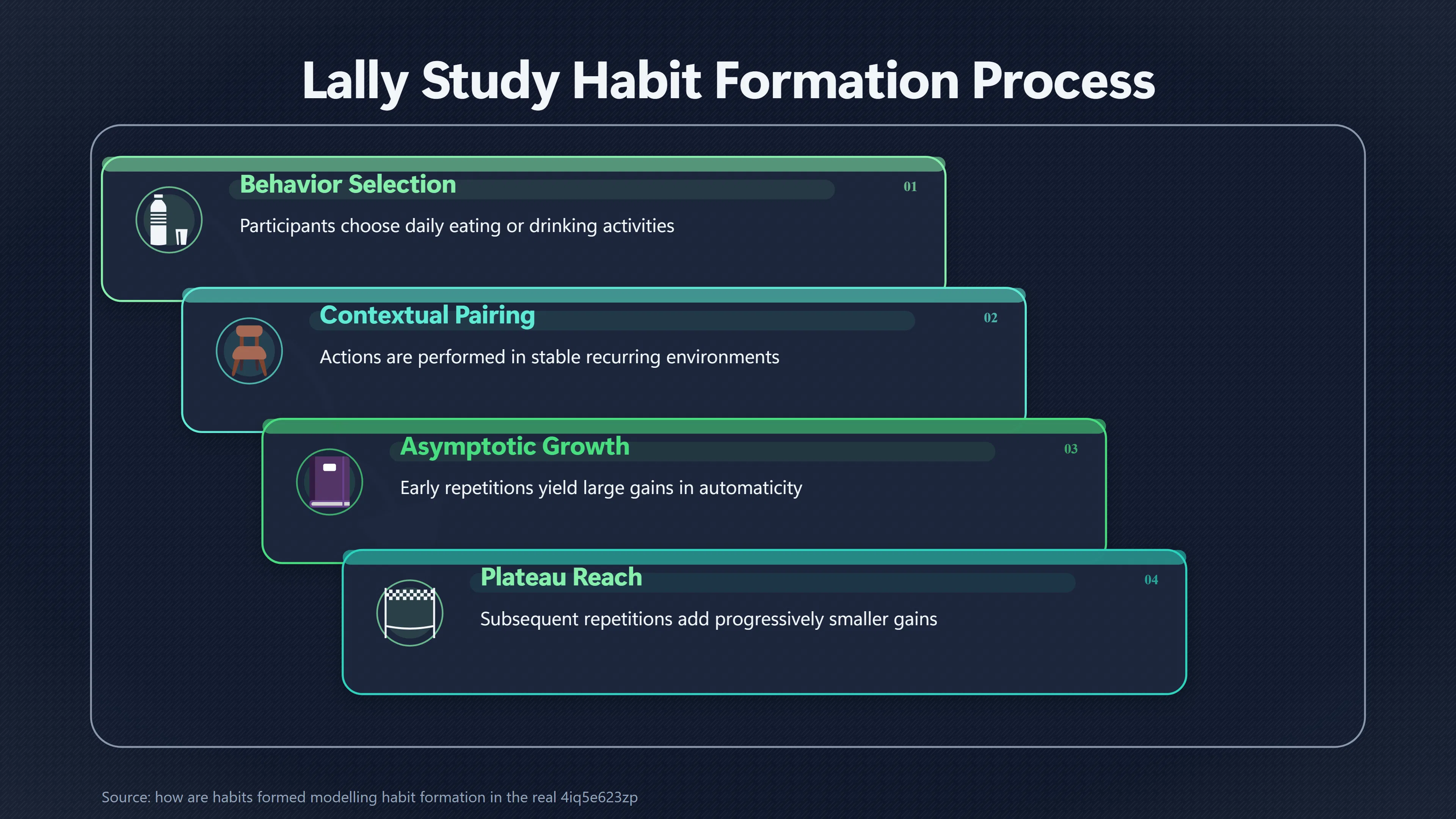
Lally and colleagues followed 96 volunteers for 12 weeks. Each participant chose an eating, drinking or activity behaviour — such as drinking water, eating fruit or exercising — and aimed to perform it every day in the same context, for example after breakfast. Participants recorded both whether they had performed the behaviour and their experience of its automaticity. Of the 96 recruits, 82 supplied sufficient data for analysis.[Wiley Online Library]onlinelibrary.wiley.comWiley Online LibraryHow are habits formed: Modelling habit formation in the real world - Lally - 2010 - European Journal of Social Psycho…
The central finding was that automaticity generally developed as an asymptotic curve rather than a straight line. In simple terms, early repetitions tended to produce comparatively large gains in automaticity; subsequent repetitions added progressively smaller gains as the behaviour approached its eventual plateau. For the 62 participants whose data could be fitted to the researchers’ model, the estimated time required to reach 95% of that plateau ranged from 18 to 254 days.[Wiley Online Library]onlinelibrary.wiley.comWiley Online LibraryHow are habits formed: Modelling habit formation in the real world - Lally - 2010 - European Journal of Social Psycho…
The researchers then examined occasions when somebody missed one planned performance. The comparison is unusually relevant to the everyday question of whether a single lapse “breaks” an emerging habit. Across two-day periods, automaticity increased by an average of about 0.79 points when the behaviour was performed on both days, compared with about 0.55 points when there was a missed opportunity between performances. The difference was not significant enough to support the idea that one omission derailed formation.[SciSpace]scispace.comhow are habits formed modelling habit formation in the real 4iq5e623zphow are habits formed modelling habit formation in the real 4iq5e623zp
The original analysis also found that the timing of the omission within the habit-building period did not significantly alter its effect. In other words, the data did not show that a single miss was especially destructive simply because it occurred early rather than late in the process. The study’s overall conclusion was therefore deliberately modest: repetition is necessary, but some missed opportunities can occur without derailing habit formation.[Wiley Online Library]onlinelibrary.wiley.comWiley Online LibraryHow are habits formed: Modelling habit formation in the real world - Lally - 2010 - European Journal of Social Psycho…
University College London summarised the practical result similarly: one missed opportunity did not significantly affect formation, whereas people who were very inconsistent in performing their chosen behaviour did not successfully establish habits. The researchers also cautioned that their study could not identify a precise minimum level of consistency required for success.[University College London]ucl.ac.ukUniversity College London How long does it take to form a habit? | UCL NewsUniversity College LondonHow long does it take to form a habit? | UCL News - UCL – University College LondonAugust 4, 2009…
Why one lost repetition is not a reset
The result makes sense once habit formation is understood as an accumulation process rather than a streak counter. Repeatedly performing an action in a stable context strengthens the association between that context and the behavioural response. The important input is repeated experience of the cue–behaviour pairing; nothing in this model requires every opportunity to occur consecutively. More recent methodological work on habit formation likewise stresses that consistent repetition, rather than the mere passage of time, is the key determinant of development.[Taylor & Francis Online]tandfonline.comOpen source on tandfonline.com.
Imagine someone trying to make drinking a glass of water after breakfast automatic. If they perform the behaviour on Monday through Thursday, forget on Friday and resume on Saturday, Friday supplies no new repetition. But the omission does not somehow delete the four preceding cue–behaviour pairings. Lally’s data are important precisely because they tested whether an isolated omission produced evidence of such a lasting setback and found that it did not.[Wiley Online Library]onlinelibrary.wiley.comWiley Online LibraryHow are habits formed: Modelling habit formation in the real world - Lally - 2010 - European Journal of Social Psycho…
This also explains why translating habit formation into a rigid number of consecutive days can be misleading. A 2024 systematic review and meta-analysis covering 20 health-habit studies and 2,601 participants found considerable variation in formation time. Among the relatively small number of studies that estimated it, reported medians were roughly 59–66 days and means 106–154 days, while individual estimates ranged from 4 to 335 days. Frequency of practice and contextual stability were among the factors associated with habit strength.[PubMed Central (PMC)]pmc.ncbi.nlm.nih.govOpen source on nih.gov.
That review also provides an important caution against making too much of any single study. Eleven of its 20 included studies were judged to have a high risk of bias, and only four reported mean or median times to habit formation. The evidence is therefore much stronger for the general proposition that formation varies greatly between people and behaviours than for any precise rule about how many misses are harmless.[MDPI]mdpi.comOpen source on mdpi.com.
The most defensible interpretation is consequently not “miss whenever you like”. It is that habit progress is not binary. A missed repetition means losing one opportunity to strengthen automaticity, not returning automatically to day one.
When misses become frequent enough to matter
The boundary becomes clearer when a single missed opportunity is compared with longer lapses. Lally and colleagues explicitly contrasted their result with Christopher Armitage’s earlier 12-week study of 94 new gym members. Armitage monitored actual gym attendance and found that earlier attendance influenced subsequent participation; his analysis suggested that behaviour during the first five weeks was particularly important to later maintenance.[PubMed]pubmed.ncbi.nlm.nih.govOpen source on nih.gov.
The apparent tension between the studies largely disappears once the unit of measurement is considered. Lally examined one missed daily opportunity. In the gym study, lapses were measured in weekly blocks, so failing to attend represented a much larger interruption. Lally and colleagues themselves argued that these findings can coexist: missing one opportunity need not prevent habit formation, while missing a week’s worth of opportunities may reduce subsequent performance and hinder acquisition.[studylib.net]studylib.netHow Habits Form: Real-World Habit Formation StudyHow Habits Form: Real-World Habit Formation Study
That distinction matters because habit formation is driven by repetitions, not calendar pages. A person planning a daily action who completes it on 29 of 30 opportunities has supplied the learning process with far more repetitions than somebody who completes it on 10 of 30. Calling both people imperfect obscures the difference that matters. Contemporary guidance on studying real-world habits specifically warns against treating elapsed time as though it were interchangeable with repetition, because doing so hides missed performances.[Taylor & Francis Online]tandfonline.comOpen source on tandfonline.com.
There is also no well-supported universal threshold at which occasional misses suddenly become “too many”. UCL’s account of the original study explicitly states that the researchers did not know what precise degree of consistency was necessary. Later reviews likewise identify frequency, context and characteristics of the behaviour as relevant, rather than supplying a simple percentage of required successful days.[University College London]ucl.ac.ukUniversity College London How long does it take to form a habit? | UCL NewsUniversity College LondonHow long does it take to form a habit? | UCL News - UCL – University College LondonAugust 4, 2009…
So the evidence supports a gradient rather than a cliff edge. One omission is unlikely to matter much. Increasing numbers of omissions progressively reduce opportunities for the behaviour to become automatic. Extended or repeated lapses can also make subsequent performance less likely, turning an isolated miss into a genuine disruption of the developing routine. Reviews of the literature therefore distinguish Lally’s reassuring result about a single opportunity from the broader problem of inconsistent performance.[PubMed Central (PMC)]pmc.ncbi.nlm.nih.govOpen source on nih.gov.
The useful lesson from one miss
For long-term habit building, the scientifically defensible response to one missed day is neither panic nor indifference. There is little basis for treating an isolated omission as a reset: the strongest directly relevant dataset found no material derailment of habit formation after one missed opportunity.[Wiley Online Library]onlinelibrary.wiley.comWiley Online LibraryHow are habits formed: Modelling habit formation in the real world - Lally - 2010 - European Journal of Social Psycho…
What matters next is whether the omission remains isolated. Returning to the behaviour when its usual cue next appears restores the repetition process without requiring the previous progress to be recreated. Conversely, allowing occasional misses to become routine reduces precisely the repeated, context-linked performances from which automaticity develops.[Taylor & Francis Online]tandfonline.comOpen source on tandfonline.com.
The practical distinction is therefore simple but evidence-based: one missed day is one missed repetition, not a broken habit. The greater risk begins when missing stops being the exception and becomes the new pattern.
Amazon book picks
Further Reading
Books and field guides related to Does One Miss Really Break a Habit?. Use these as the next step if you want deeper reading beyond the article.
Atomic Habits
Rating: 3.5/5 from 7 Google Books ratings
The #1 New York Times bestseller. Over 25 million copies sold! Translated into 60+ languages! Tiny Changes, Remarkable Results No matter...
Good Habits, Bad Habits
'The world's leading expert on habits' - Matthew Syed, bestselling author of Black Box Thinking and Rebel IdeasWhat if you could harness...
Tiny Habits
Improving your life is much easier than you think. Whether it’s losing weight, sleeping more, or restoring your work/life balance – the s...
The Power of Habit
NEW YORK TIMES BESTSELLER • MORE THAN 3 MILLION COPIES SOLD • This instant classic explores how we can change our lives by changing our h...
eBay marketplace picks
Marketplace Samples
Live-tested eBay searches with available results related to this page.
Selected fromhabit tracker board oneBay.co.uk.




Endnotes
1.
Source: onlinelibrary.wiley.com
Link:https://onlinelibrary.wiley.com/doi/full/10.1002/ejsp.674
Source snippet
Wiley Online LibraryHow are habits formed: Modelling habit formation in the real world - Lally - 2010 - European Journal of Social Psycho...
2.
Source: onlinelibrary.wiley.com
Link:https://onlinelibrary.wiley.com/doi/pdf/10.1002/ejsp.674
Source snippet
Wiley Online LibraryHow are habits formed: Modelling habit formation in the real world - Lally - 2010 - European Journal of Social Psycho...
3.
Source: onlinelibrary.wiley.com
Link:https://onlinelibrary.wiley.com/doi/abs/10.1002/ejsp.674?aff_id=24772
Source snippet
Wiley Online LibraryHow are habits formed: Modelling habit formation in the real world - Lally - 2010 - European Journal of Social Psycho...
4.
Source: onlinelibrary.wiley.com
Link:https://onlinelibrary.wiley.com/doi/abs/10.1002/ejsp.674?538fcd4b_page=6&947f74f7_page=5
Source snippet
Wiley Online LibraryHow are habits formed: Modelling habit formation in the real world - Lally - 2010 - European Journal of Social Psycho...
5.
Source: scispace.com
Title: how are habits formed modelling habit formation in the real 4iq5e623zp
Link:https://scispace.com/papers/how-are-habits-formed-modelling-habit-formation-in-the-real-4iq5e623zp
6.
Source: studylib.net
Title: How Habits Form: Real-World Habit Formation Study
Link:https://studylib.net/doc/8103714/modelling-habit-formation-in-the-real-world
7.
Source: mdpi.com
Link:https://www.mdpi.com/2227-9032/12/23/2488
8.
Source: onlinelibrary.wiley.com
Link:https://onlinelibrary.wiley.com/doi/10.1111/jpim.70043
9.
Source: onlinelibrary.wiley.com
Link:https://onlinelibrary.wiley.com/doi/full/10.1111/jpim.70043
10.
Source: mdpi.com
Link:https://www.mdpi.com/2227-9032/12/23/2488?_bhlid=47dee3946db8c7e6d3a6e92da693cbc5a7439e28
11.
Source: mdpi.com
Link:https://www.mdpi.com/2227-9032/12/23
12.
Source: mdpi.com
Link:https://www.mdpi.com/2227-9067/11/5/559
13.
Source: mdpi.com
Link:https://www.mdpi.com/2227-9032/11/13/1853/html
14.
Source: studylib.net
Title: Oxford Handbook of Human Motivation
Link:https://studylib.net/doc/28342403/the-oxford-handbook-of-human-motivation-richard-m-ryan-ox
15.
Source: onlinelibrary.wiley.com
Link:https://onlinelibrary.wiley.com/doi/10.1002/ejsp.674?538fcd4b_page=1&947f74f7page=3&=%2Fen-gt%2Four-commitment%23kI3HdLdDj7HLFW4BJlUYoy23RoHF9sl3JcIXrw%3D%3D
16.
Source: onlinelibrary.wiley.com
Link:https://onlinelibrary.wiley.com/doi/abs/10.1002/ejsp.674
17.
Source: onlinelibrary.wiley.com
Link:https://onlinelibrary.wiley.com/doi/abs/10.1002/ejsp.674?MixPanelId=15e3fe314440-0468d8411-64220f54-100000-15e3fe314460
18.
Source: onlinelibrary.wiley.com
Link:https://onlinelibrary.wiley.com/doi/10.1002/ejsp.674?2d235898_page=2&538fcd4b_page=6&d2101103_page=8&d73ad837_page=2
19.
Source: onlinelibrary.wiley.com
Link:https://onlinelibrary.wiley.com/doi/abs/10.1002/ejsp.674?cf_chl_jschl_tk=pmd_EwcJDaCFBR9OVEL1O_0qjioww0Gc86ZzpBvCBFhrDcE-1635261061-0-gqNtZGzNAjujcnBszQi9
20.
Source: onlinelibrary.wiley.com
Link:https://onlinelibrary.wiley.com/doi/abs/10.1002/ejsp.674?source=content_type%3Areact%7Cfirst_level_url%3Aarticle%7Csection%3Amain_content%7Cbutton%3Abody_link
21.
Source: onlinelibrary.wiley.com
Link:https://onlinelibrary.wiley.com/doi/abs/10.1002/ejsp.674?msockid=038ed114f43667dd0790c4bef5146634
22.
Source: onlinelibrary.wiley.com
Link:https://onlinelibrary.wiley.com/doi/10.1002/ejsp.674?947f74f7_page=5&b158b201_page=5
23.
Source: scispace.com
Title: can the theory of planned behavior predict the maintenance 36ql3tm0rf
Link:https://scispace.com/papers/can-the-theory-of-planned-behavior-predict-the-maintenance-36ql3tm0rf?citations_page=81
24.
Source: ucl.ac.uk
Title: University College London How long does it take to form a habit? | UCL News
Link:https://www.ucl.ac.uk/news/2009/aug/how-long-does-it-take-form-habit%20
Source snippet
University College LondonHow long does it take to form a habit? | UCL News - UCL – University College LondonAugust 4, 2009...
Published: August 4, 2009
25.
Source: tandfonline.com
Link:https://www.tandfonline.com/doi/full/10.1080/23311908.2022.2041277
26.
Source: pmc.ncbi.nlm.nih.gov
Link:https://pmc.ncbi.nlm.nih.gov/articles/PMC9226889/
27.
Source: pmc.ncbi.nlm.nih.gov
Link:https://pmc.ncbi.nlm.nih.gov/articles/PMC11641623/
28.
Source: pubmed.ncbi.nlm.nih.gov
Link:https://pubmed.ncbi.nlm.nih.gov/39685110/
29.
Source: pubmed.ncbi.nlm.nih.gov
Link:https://pubmed.ncbi.nlm.nih.gov/15898858/
30.
Source: pmc.ncbi.nlm.nih.gov
Link:https://pmc.ncbi.nlm.nih.gov/articles/PMC12318445/
31.
Source: pmc.ncbi.nlm.nih.gov
Link:https://pmc.ncbi.nlm.nih.gov/articles/PMC4721385/
32.
Source: pmc.ncbi.nlm.nih.gov
Link:https://pmc.ncbi.nlm.nih.gov/articles/PMC12109062/
33.
Source: pubmed.ncbi.nlm.nih.gov
Link:https://pubmed.ncbi.nlm.nih.gov/40060935/
34.
Source: pubmed.ncbi.nlm.nih.gov
Link:https://pubmed.ncbi.nlm.nih.gov/39702740/
35.
Source: doi.org
Link:https://doi.org/10.3390/healthcare12232488
36.
Source: pmc.ncbi.nlm.nih.gov
Link:https://pmc.ncbi.nlm.nih.gov/articles/PMC11139289/
37.
Source: tandfonline.com
Link:https://www.tandfonline.com/doi/abs/10.1080/23311908.2022.2041277
38.
Source: doi.org
Link:https://doi.org/10.1080/23311908.2022.2041277?urlappend=%3Futm_source%3Dresearchgate.net%26utm_medium%3Darticle
39.
Source: pmc.ncbi.nlm.nih.gov
Link:https://pmc.ncbi.nlm.nih.gov/articles/PMC8822701/
40.
Source: tandfonline.com
Link:https://www.tandfonline.com/doi/full/10.1080/08870446.2021.1981900
41.
Source: pmc.ncbi.nlm.nih.gov
Link:https://pmc.ncbi.nlm.nih.gov/articles/PMC8009798/
42.
Source: pubmed.ncbi.nlm.nih.gov
Link:https://pubmed.ncbi.nlm.nih.gov/27120333/
43.
Source: pmc.ncbi.nlm.nih.gov
Link:https://pmc.ncbi.nlm.nih.gov/articles/PMC4847906/
44.
Source: pmc.ncbi.nlm.nih.gov
Link:https://pmc.ncbi.nlm.nih.gov/articles/PMC1910606/
45.
Source: doi.org
Title: European Journal of Social Psychology
Link:https://doi.org/10.1002/%28ISSN%291099-0992
Additional References
46.
Source: youtube.com
Title: Hack Your Habits for Lasting Change: Insights from Wendy Wood and Adam Grant
Link:https://www.youtube.com/watch?v=wOwZnv_sMds
Source snippet
How to Change Your Habits | Katy Milkman...
47.
Source: youtube.com
Title: The Psychology of Habits | Dr. Benjamin Gardner
Link:https://www.youtube.com/watch?v=83cKQylK7zo
Source snippet
Hack Your Habits for Lasting Change: Insights from Wendy Wood and Adam Grant...
48.
Source: youtube.com
Title: How to Change Your Habits | Katy Milkman
Link:https://www.youtube.com/watch?v=19fJ67zXYgU
Source snippet
The Science of Making & Breaking Habits | Huberman Lab Essentials...
49.
Source: youtube.com
Title: How Can I Form a Lasting Habit? | Dr Philippa Lally
Link:https://www.youtube.com/watch?v=HY4Hku2gxIo
Source snippet
The Psychology of Habits | Dr. Benjamin Gardner...
50.
Source: researchgate.net
Link:https://www.researchgate.net/publication/298791113_Learning_from_Entrepreneurial_Failure_Emotions_Cognitions_and_Actions
51.
Source: researchgate.net
Link:https://www.researchgate.net/publication/381002606_The_influence_of_demographic_and_socio-economic_factors_on_non-vaccination_under-vaccination_and_missed_opportunities_for_vaccination_amongst_children_0-23_months_in_Kenya_for_the_period
52.
Source: researchgate.net
Link:https://www.researchgate.net/publication/386593213_Time_to_Form_a_Habit_A_Systematic_Review_and_Meta-Analysis_of_Health_Behaviour_Habit_Formation_and_Its_Determinants
53.
Source: researchgate.net
Link:https://www.researchgate.net/publication/240084536Effects_Of_Three_Months_Of_Pilates-based[Exercise
54.
Source: visualize.jove.com
Link:https://visualize.jove.com/39685110-time-to-form-a-habit-a-systematic-review-and-meta-analysis-of-health-behaviour-habit-formation-and-its-determinants
55.
Source: researchgate.net
Link:https://www.researchgate.net/publication/7842404_Can_the_Theory_of_Planned_Behavior_Predict_the_Maintenance_of_Physical_Activity