Within Consistency
Track How Fast You Return, Not Just Streaks
Completion rate, total repetitions, and speed of return can reveal progress that a flawless-streak counter hides.
On this page
- Why streak length can misrepresent accumulated progress
- Completion rates and rolling windows as alternative measures
- Using repeated slow returns to identify flaws in the habit system
Page outline Jump by section
Introduction
A habit tracker should answer a more useful question than “How long is my unbroken streak?”: when life interrupts the behaviour, how reliably and how quickly do I return? A flawless streak records consecutiveness, but it can hide the difference between substantial participation with occasional short lapses and a pattern in which one missed day repeatedly becomes a week away.
Research supports treating the tracker as a feedback system rather than a pass–fail scoreboard. Habit formation depends on repeated behaviour in recurring contexts, and one missed opportunity did not materially disrupt automaticity in a foundational real-world study. Meanwhile, experiments on behavioural logs show that merely displaying a streak as broken can reduce subsequent engagement.[Wiley Online Library]onlinelibrary.wiley.comWiley Online LibraryHow are habits formed: Modelling habit formation in the real world - Lally - 2010 - European Journal of Social Psycho…
For long-term self-improvement, three measurements therefore belong together: completion rate, accumulated repetitions and recovery speed. Streak length can remain useful, but it should not have sole authority over whether the system appears to be working.
Why streak length can misrepresent progress
Consider two people trying to exercise five times a week for eight weeks. One completes every planned session for three weeks, misses a session and then largely stops. The other completes four of five sessions most weeks and usually returns immediately after a miss. The first person can boast the longer peak streak. The second has accumulated more useful repetitions and demonstrated a more resilient pattern.
That distinction matters because habit learning is cumulative rather than an all-or-nothing process. In Phillippa Lally and colleagues’ 12-week study, 96 participants selected an eating, drinking or activity behaviour to perform daily in the same context. Automaticity generally increased along a curve rather than suddenly appearing after a particular run of consecutive days, and the estimated time to reach 95% of eventual automaticity ranged from 18 to 254 days among participants for whom the model fitted. Most importantly for tracking, missing one opportunity did not materially affect the habit-formation process.[Wiley Online Library]onlinelibrary.wiley.comWiley Online LibraryHow are habits formed: Modelling habit formation in the real world - Lally - 2010 - European Journal of Social Psycho…
A 2024 systematic review covering 20 health-habit studies and 2,601 participants reinforces the case against treating streak length as the master measure. The few studies that estimated formation time reported medians of 59–66 days and means of 106–154 days, with individual estimates ranging from 4 to 335 days. Frequency, timing, behavioural regulation and stable routines were among the factors associated with habit strength. The evidence base was limited and many studies had a high risk of bias, so these figures should not be converted into another rigid countdown.[PubMed Central (PMC)]pmc.ncbi.nlm.nih.govOpen source on nih.gov.
Streaks are not useless. They can provide an immediate incentive to keep going. The problem arises when the tracker makes preserving the streak look equivalent to making behavioural progress.
Silverman and Barasch demonstrated this problem across seven studies involving behaviours including exercise and language learning. People were more inclined to continue when a behavioural log highlighted an intact rather than a broken streak, even where underlying past behaviour was held constant. The representation of the record itself changed subsequent engagement. Allowing a broken streak to be perceived as repairable attenuated the effect.[DOI]doi.orgOn or Off Track: How (Broken) Streaks Affect Consumer Decisions | Journal of Consumer Research | Oxford Academic…
A tracker designed for durable consistency should therefore preserve the motivational benefit of visible progress without telling users, implicitly, that a single interruption has erased it.
Measure participation across a window
The simplest alternative is not to abolish streaks but to place them beside a completion rate over a rolling period. Instead of asking whether every scheduled behaviour happened consecutively, ask what proportion of the planned opportunities were completed recently.
For example, suppose a behaviour is planned once per day. A 28-day tracker might show:
- Completion rate: 24 of 28 planned repetitions, or 86%.
- Total repetitions: 73 since tracking began.
- Current streak: 4 days.
- Longest streak: 19 days.
- Typical recovery: 1 day after a missed opportunity.
- Longest recent interruption: 2 days.
Those numbers describe substantially more than “current streak: 4”. The latter makes the record look newly restarted; the fuller dashboard shows that participation remains high and that interruptions have so far been contained.
Rolling windows are particularly useful because they prevent ancient success from disguising recent deterioration. Someone who completed 170 of 200 opportunities overall might appear highly consistent even after struggling for the past month. A 28-day or four-week completion rate exposes the change sooner. Conversely, one bad day does not make a generally successful month look like zero.
There is good broader evidence for monitoring behavioural progress, although research has not established one universally optimal dashboard for personal habits. A meta-analysis of 138 studies involving 19,951 participants found that interventions intended to increase monitoring of goal progress increased monitoring and improved goal attainment. Reviews of health-behaviour interventions likewise identify self-monitoring as a potentially useful behaviour-change component, while also finding substantial variation across behaviours, populations and intervention designs.[White Rose Research Online]eprints.whiterose.ac.ukOpen source on whiterose.ac.uk.
That qualification matters. “Track recovery speed” is a sensible measurement policy derived from evidence about habit formation, self-monitoring and lapses; it is not a scientifically validated universal formula with a proven ideal recovery threshold. The purpose is diagnostic: to retain information that a binary streak counter discards.
Make speed of return a first-class metric
Completion rate describes how much behaviour happened. Recovery speed describes what happened after it did not happen.
A practical definition is the number of scheduled opportunities between a lapse and the next successful repetition. If Monday’s planned run is missed and Wednesday is the next scheduled run and is completed, the person has returned at the next opportunity. For a daily habit, a miss on Monday followed by completion on Tuesday is a one-day recovery.
Over time, the tracker can calculate a median or typical return time rather than overreacting to one unusual interruption. This produces a revealing distinction:
High completion + fast recovery usually indicates a robust system. Interruptions occur, but they remain interruptions.
High completion + slow recovery may indicate that good-looking averages depend on long periods of success separated by damaging breaks.
Lower completion + fast recovery can indicate that the behaviour is still difficult or badly specified, but individual misses are not cascading into abandonment.
Lower completion + slow recovery is a stronger signal that the habit system itself needs attention.
This approach shifts the policy of the tracker from punishing discontinuity to governing interruption. The objective after a miss becomes reducing the distance to the next successful repetition, not reconstructing yesterday’s perfect record.
That distinction also fits what is known about goal pursuit after setbacks. A meta-analysis of 94 tests found that implementation intentions — advance “if–then” plans specifying when, where or how to act — had a medium-to-large positive effect on goal attainment. Experimental work has also found that such plans can promote repeated attempts after an initial goal-directed action is blocked.[ScienceDirect]sciencedirect.comOpen source on sciencedirect.com.
A recovery-aware tracker can turn that principle into a concrete rule: when a lapse is recorded, activate the return plan. “If I miss my normal morning walk, I will take the next scheduled walk rather than waiting for Monday” is more operationally useful than watching a streak counter reset to zero.
Repeated slow returns are a systems warning
Recovery speed becomes most valuable when it is treated as diagnostic information rather than another score to perfect. One slow return may simply reflect illness, travel, a deadline or an emergency. A recurring pattern of slow returns suggests something more systematic.
Suppose a person completes a strength-training routine fairly reliably until work becomes unusually busy. Each disruption then produces ten days away. The important observation is not that three streaks were “broken”. It is that workload shocks repeatedly disable the route back into the behaviour.
That pattern should trigger investigation of the habit’s architecture. Habits are strongly associated with contextual cues, and changing the usual context can disrupt established habitual performance. Research following people through changes of circumstances, as well as large-scale UK evidence on the “habit discontinuity” effect, shows why apparently minor environmental changes can alter habitual behaviour.[PubMed]pubmed.ncbi.nlm.nih.govPub Med Changing circumstances, disrupting habitsPub Med Changing circumstances, disrupting habits
A useful tracker should therefore ask what changed around slow recoveries. Was the usual cue unavailable? Did the behaviour require equipment or a location that became inaccessible? Was the planned version too large to perform under time pressure? Did weekends, travel or shifts in working hours repeatedly remove the normal trigger?
The governance response is then to change the system rather than demand greater moral effort. A recurring cue problem calls for a more dependable cue. A routine that becomes impossible on busy days may need a smaller fallback version. A location-dependent habit may need an alternative implementation plan. If interruptions consistently coincide with a predictable circumstance, that circumstance belongs in the design.
Self-monitoring alone should not be treated as magic. A meta-review of health-behaviour research found mixed results across individual self-regulatory techniques, with no single technique consistently improving outcomes in every behaviour and population. A separate systematic review of physical-activity interventions found that combining self-monitoring with other components produced additional gains, particularly where interventions included prescribed goals and human counselling.[PubMed Central (PMC)]pmc.ncbi.nlm.nih.govOpen source on nih.gov.
The tracker is therefore most useful when it generates decisions, not merely data.

A better tracking policy
For a long-term habit, the governing rule can be simple: keep the streak if it motivates you, but never let it be the only prominent measure. Give accumulated participation and recovery equal or greater visibility.
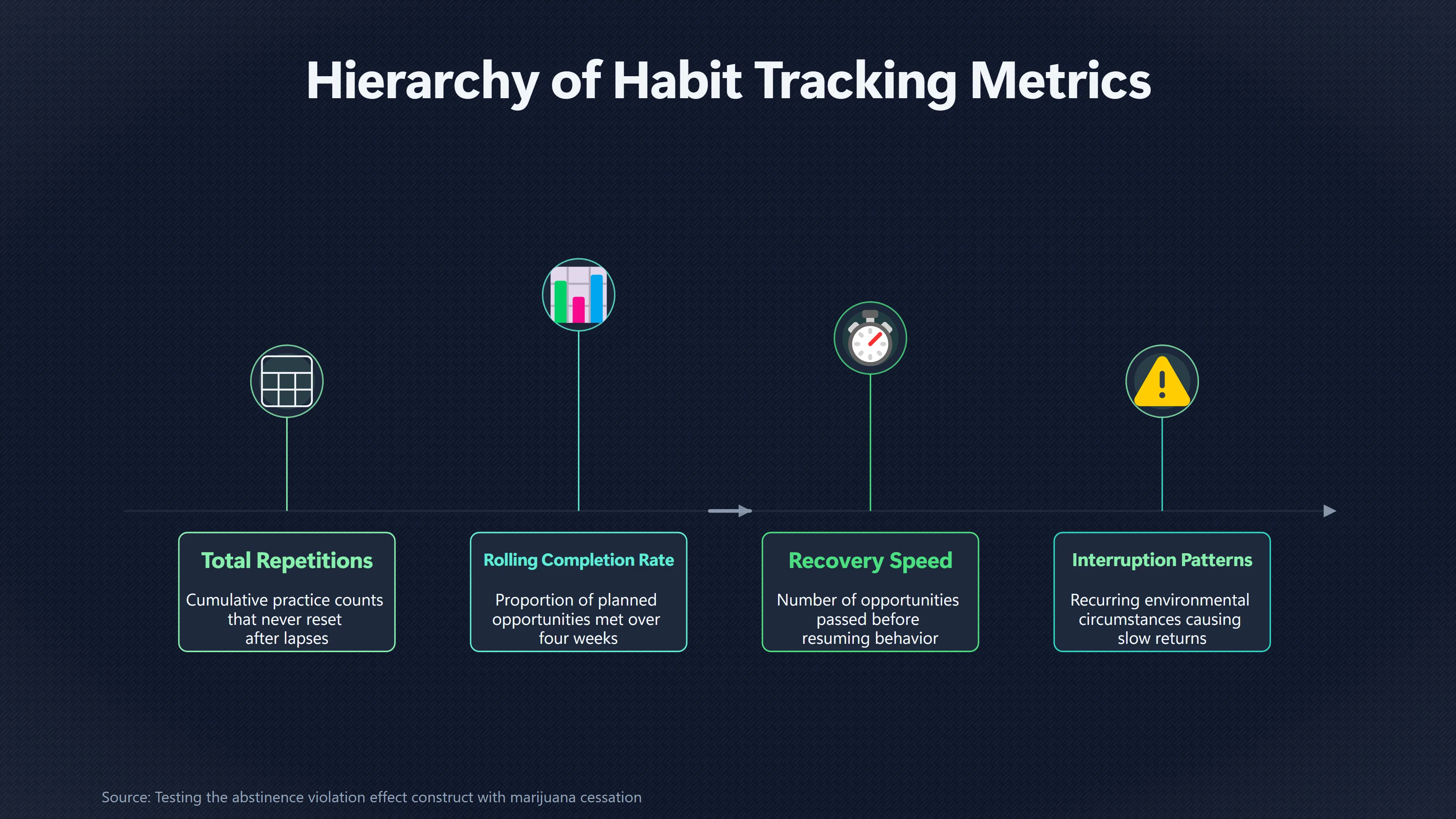
A practical dashboard can use four layers:
- Total repetitions show accumulated practice. They do not reset after a lapse.
- Rolling completion rate shows whether participation remains healthy over a meaningful recent period, such as the last four weeks.
- Recovery time records how many scheduled opportunities normally pass before the behaviour resumes.
- Interruption patterns record recurring circumstances associated with unusually slow returns.
The thresholds should follow the behaviour rather than an arbitrary universal standard. A daily flossing habit and a twice-weekly strength routine cannot sensibly use the same raw number of days as a recovery benchmark. Measure recovery primarily in planned opportunities: did the person return at the next scheduled opportunity, the second, the third or much later?
Nor should a completion percentage become a disguised perfection target. An 85% or 90% rate is not scientifically “correct” for habits in general. The useful question is whether the rolling rate and return speed are improving, stable or deteriorating relative to the person’s own plan.
This creates a healthier hierarchy of signals. A broken streak is an event. A falling completion rate is a trend. A repeatedly lengthening recovery time is a warning that deserves investigation.
What progress looks like after the streak breaks
The strongest sign of consistency is not that interruption has become impossible. Real routines encounter illness, travel, family demands, workload changes and disrupted environments. Habit research itself shows that context matters, while the considerable variation in habit-formation times argues against judging progress by a rigid consecutive-day formula.[PubMed Central (PMC)]pmc.ncbi.nlm.nih.govOpen source on nih.gov.
A more resilient measure asks whether interruptions are becoming easier to contain. Someone who once disappeared from a routine for three weeks after a missed session, later returns within a week and eventually resumes at the next scheduled opportunity has improved in a way that a streak counter handles poorly. Each lapse still resets the counter to zero; the recovery data reveal that the behavioural system has become more resilient.
That is the central advantage of tracking recovery speed. Perfect streaks measure the absence of interruption. Recovery metrics measure the ability to survive it. For self-improvement intended to last for years rather than a few ideal weeks, the second capability is often the more informative one.
Amazon book picks
Further Reading
Books and field guides related to Track How Fast You Return, Not Just Streaks. Use these as the next step if you want deeper reading beyond the article.
Atomic Habits
Rating: 3.5/5 from 7 Google Books ratings
The #1 New York Times bestseller. Over 25 million copies sold! Translated into 60+ languages! Tiny Changes, Remarkable Results No matter...

The Power of Habit
Rating: 4.0/5 from 145 Google Books ratings
Duhigg takes us to the edge of scientific discoveries that explain why habits exist and how they can be changed. Distilling information i...
Tiny Habits
Improving your life is much easier than you think. Whether it’s losing weight, sleeping more, or restoring your work/life balance – the s...
eBay marketplace picks
Marketplace Samples
Live-tested eBay searches with available results related to this page.
Selected fromhabit tracker board oneBay.co.uk.

Endnotes
1.
Source: onlinelibrary.wiley.com
Link:https://onlinelibrary.wiley.com/doi/full/10.1002/ejsp.674
Source snippet
Wiley Online LibraryHow are habits formed: Modelling habit formation in the real world - Lally - 2010 - European Journal of Social Psycho...
2.
Source: doi.org
Link:https://doi.org/10.1093/jcr/ucac029
Source snippet
On or Off Track: How (Broken) Streaks Affect Consumer Decisions | Journal of Consumer Research | Oxford Academic...
3.
Source: onlinelibrary.wiley.com
Link:https://onlinelibrary.wiley.com/doi/10.1002/ejsp.674
Source snippet
Wiley Online LibraryHow are habits formed: Modelling habit formation in the real world - Lally - 2010 - European Journal of Social Psycho...
4.
Source: sciencedirect.com
Link:https://www.sciencedirect.com/science/article/abs/pii/S0065260106380021
5.
Source: sciencedirect.com
Link:https://www.sciencedirect.com/science/article/pii/S0022103108000255
6.
Source: doi.org
Link:https://doi.org/10.1111%2Fjasp.12915
7.
Source: sciencedirect.com
Link:https://www.sciencedirect.com/org/science/article/pii/S2291522222001851
8.
Source: sciencedirect.com
Link:https://www.sciencedirect.com/science/article/pii/S0828282X21004888
9.
Source: sciencedirect.com
Link:https://www.sciencedirect.com/science/article/pii/S0001691816303626
10.
Source: doi.org
Link:https://doi.org/10.1371/journal.pone.0153490
11.
Source: onlinelibrary.wiley.com
Link:https://onlinelibrary.wiley.com/doi/abs/10.1002/ejsp.674?MixPanelId=15e3fe314440-0468d8411-64220f54-100000-15e3fe314460
12.
Source: onlinelibrary.wiley.com
Link:https://onlinelibrary.wiley.com/doi/abs/10.1002/ejsp.674
13.
Source: onlinelibrary.wiley.com
Link:https://onlinelibrary.wiley.com/doi/abs/10.1002/ejsp.674?msockid=038ed114f43667dd0790c4bef5146634
14.
Source: onlinelibrary.wiley.com
Link:https://onlinelibrary.wiley.com/doi/abs/10.1002/ejsp.674?source=content_type%3Areact%7Cfirst_level_url%3Aarticle%7Csection%3Amain_content%7Cbutton%3Abody_link
15.
Source: onlinelibrary.wiley.com
Link:https://onlinelibrary.wiley.com/doi/abs/10.1002/ejsp.674?cf_chl_jschl_tk=pmd_EwcJDaCFBR9OVEL1O_0qjioww0Gc86ZzpBvCBFhrDcE-1635261061-0-gqNtZGzNAjujcnBszQi9
16.
Source: sciencedirect.com
Link:https://www.sciencedirect.com/science/article/pii/S0272494407000898
17.
Source: doi.org
Link:https://doi.org/10.1002%2F%28SICI%291099-0992%28199912%2929%3A8%3C971%3A%3AAID-EJSP963%3E3.0.CO%3B2-A
18.
Source: sciencedirect.com
Title: Testing the abstinence violation effect construct with marijuana cessation
Link:https://www.sciencedirect.com/science/article/abs/pii/0306460394900485
19.
Source: sciencedirect.com
Title: Why behavior change is difficult to sustain
Link:https://www.sciencedirect.com/science/article/pii/S0091743514002102
20.
Source: sciencedirect.com
Link:https://www.sciencedirect.com/science/article/pii/S0738399118307699
21.
Source: sciencedirect.com
Link:https://www.sciencedirect.com/science/article/abs/pii/S0140673621026301
22.
Source: sciencedirect.com
Link:https://www.sciencedirect.com/science/article/pii/S0828282X21004876
23.
Source: sciencedirect.com
Link:https://www.sciencedirect.com/science/article/pii/S002210311100254X
24.
Source: sciencedirect.com
Title: Abstinence Violation
Link:https://www.sciencedirect.com/topics/psychology/abstinence-violation
25.
Source: sciencedirect.com
Title: Testing the abstinence violation effect construct with marijuana cessation
Link:https://www.sciencedirect.com/science/article/pii/0306460394900485
26.
Source: pmc.ncbi.nlm.nih.gov
Link:https://pmc.ncbi.nlm.nih.gov/articles/PMC11641623/
27.
Source: pubmed.ncbi.nlm.nih.gov
Link:https://pubmed.ncbi.nlm.nih.gov/39685110/
Source snippet
Time to Form a Habit: A Systematic Review and Meta-Analysis of Health Behaviour Habit Formation and Its Determinants - PubMed...
28.
Source: eprints.whiterose.ac.uk
Link:https://eprints.whiterose.ac.uk/id/eprint/87431/
29.
Source: pubmed.ncbi.nlm.nih.gov
Link:https://pubmed.ncbi.nlm.nih.gov/31662031/
30.
Source: pubmed.ncbi.nlm.nih.gov
Title: Pub Med Changing circumstances, disrupting habits
Link:https://pubmed.ncbi.nlm.nih.gov/15982113/
31.
Source: pubmed.ncbi.nlm.nih.gov
Link:https://pubmed.ncbi.nlm.nih.gov/27120333/
32.
Source: pmc.ncbi.nlm.nih.gov
Link:https://pmc.ncbi.nlm.nih.gov/articles/PMC7429262/
33.
Source: pmc.ncbi.nlm.nih.gov
Link:https://pmc.ncbi.nlm.nih.gov/articles/PMC9685716/
34.
Source: pubmed.ncbi.nlm.nih.gov
Title: Pub Med Habits and Goals in Human Behavior: Separate but Interacting Systems
Link:https://pubmed.ncbi.nlm.nih.gov/34283681/
35.
Source: pubmed.ncbi.nlm.nih.gov
Link:https://pubmed.ncbi.nlm.nih.gov/41627698/
36.
Source: pubmed.ncbi.nlm.nih.gov
Link:https://pubmed.ncbi.nlm.nih.gov/41525703/
37.
Source: pubmed.ncbi.nlm.nih.gov
Link:https://pubmed.ncbi.nlm.nih.gov/40219795/
38.
Source: pmc.ncbi.nlm.nih.gov
Link:https://pmc.ncbi.nlm.nih.gov/articles/PMC11161714/
39.
Source: pubmed.ncbi.nlm.nih.gov
Link:https://pubmed.ncbi.nlm.nih.gov/38787601/
40.
Source: pmc.ncbi.nlm.nih.gov
Link:https://pmc.ncbi.nlm.nih.gov/articles/PMC10733639/
41.
Source: pubmed.ncbi.nlm.nih.gov
Link:https://pubmed.ncbi.nlm.nih.gov/38145014/
42.
Source: pubmed.ncbi.nlm.nih.gov
Link:https://pubmed.ncbi.nlm.nih.gov/36749452/
43.
Source: pmc.ncbi.nlm.nih.gov
Link:https://pmc.ncbi.nlm.nih.gov/articles/PMC10372951/
44.
Source: pmc.ncbi.nlm.nih.gov
Link:https://pmc.ncbi.nlm.nih.gov/articles/PMC9704370/
45.
Source: pubmed.ncbi.nlm.nih.gov
Link:https://pubmed.ncbi.nlm.nih.gov/36083606/
46.
Source: academic.oup.com
Link:https://academic.oup.com/jcr/article/49/6/1095/6623414?guestAccessKey=1bb91501-7f0d-4dcc-806d-8124e533be13&login=false
47.
Source: udspace.udel.edu
Link:https://udspace.udel.edu/items/42ce576b-8e1f-429a-8541-e29e48dbcfbb/full
48.
Source: pmc.ncbi.nlm.nih.gov
Link:https://pmc.ncbi.nlm.nih.gov/articles/PMC9242484/
49.
Source: pmc.ncbi.nlm.nih.gov
Link:https://pmc.ncbi.nlm.nih.gov/articles/PMC9014843/
50.
Source: pmc.ncbi.nlm.nih.gov
Link:https://pmc.ncbi.nlm.nih.gov/articles/PMC8278682/
51.
Source: pmc.ncbi.nlm.nih.gov
Link:https://pmc.ncbi.nlm.nih.gov/articles/PMC8149892/
52.
Source: pubmed.ncbi.nlm.nih.gov
Link:https://pubmed.ncbi.nlm.nih.gov/35069798/
53.
Source: pmc.ncbi.nlm.nih.gov
Link:https://pmc.ncbi.nlm.nih.gov/articles/PMC7571594/
54.
Source: pmc.ncbi.nlm.nih.gov
Link:https://pmc.ncbi.nlm.nih.gov/articles/PMC7877301/
55.
Source: pmc.ncbi.nlm.nih.gov
Link:https://pmc.ncbi.nlm.nih.gov/articles/PMC6693254/
56.
Source: pubmed.ncbi.nlm.nih.gov
Link:https://pubmed.ncbi.nlm.nih.gov/30279029/
57.
Source: pubmed.ncbi.nlm.nih.gov
Link:https://pubmed.ncbi.nlm.nih.gov/30425028/
58.
Source: pubmed.ncbi.nlm.nih.gov
Link:https://pubmed.ncbi.nlm.nih.gov/28456347/
59.
Source: pmc.ncbi.nlm.nih.gov
Link:https://pmc.ncbi.nlm.nih.gov/articles/PMC5370453/
60.
Source: pmc.ncbi.nlm.nih.gov
Link:https://pmc.ncbi.nlm.nih.gov/articles/PMC4847906/
61.
Source: pmc.ncbi.nlm.nih.gov
Link:https://pmc.ncbi.nlm.nih.gov/articles/PMC4975085/
62.
Source: pubmed.ncbi.nlm.nih.gov
Link:https://pubmed.ncbi.nlm.nih.gov/25563570/
63.
Source: pmc.ncbi.nlm.nih.gov
Link:https://pmc.ncbi.nlm.nih.gov/articles/PMC4271133/
64.
Source: pmc.ncbi.nlm.nih.gov
Link:https://pmc.ncbi.nlm.nih.gov/articles/PMC4287360/
65.
Source: pmc.ncbi.nlm.nih.gov
Link:https://pmc.ncbi.nlm.nih.gov/articles/PMC3296289/
66.
Source: pmc.ncbi.nlm.nih.gov
Link:https://pmc.ncbi.nlm.nih.gov/articles/PMC3163190/
67.
Source: pubmed.ncbi.nlm.nih.gov
Link:https://pubmed.ncbi.nlm.nih.gov/34851220/
68.
Source: pubmed.ncbi.nlm.nih.gov
Link:https://pubmed.ncbi.nlm.nih.gov/10907649
70.
Source: pubmed.ncbi.nlm.nih.gov
Link:https://pubmed.ncbi.nlm.nih.gov/31973666/
71.
Source: pubmed.ncbi.nlm.nih.gov
Link:https://pubmed.ncbi.nlm.nih.gov/17907866/
72.
Source: pmc.ncbi.nlm.nih.gov
Link:https://pmc.ncbi.nlm.nih.gov/articles/PMC6760427/
73.
Source: pubmed.ncbi.nlm.nih.gov
Link:https://pubmed.ncbi.nlm.nih.gov/8197890/
74.
Source: pubmed.ncbi.nlm.nih.gov
Link:https://pubmed.ncbi.nlm.nih.gov/8916628/
75.
Source: pubmed.ncbi.nlm.nih.gov
Link:https://pubmed.ncbi.nlm.nih.gov/10890810/
76.
Source: ouci.dntb.gov.ua
Link:https://ouci.dntb.gov.ua/en/works/4z2RXmQ4/
77.
Source: ouci.dntb.gov.ua
Link:https://ouci.dntb.gov.ua/en/works/7BYjKk39/
Additional References
78.
Source: academic.oup.com
Link:https://academic.oup.com/jcr/article/49/6/1095/6623414?guestAccessKey=1bb91501-7f0d-4dcc-806d-8124e533be13
Source snippet
OUP AcademicOn or Off Track: How (Broken) Streaks Affect Consumer Decisions | Journal of Consumer Research | Oxford Academic...
79.
Source: youtube.com
Title: Tracking Your Progress Without Becoming Obsessed
Link:https://www.youtube.com/watch?v=yX100NomDhU
Source snippet
Hooked on Streaks: With Guests Chloë Hamilton & Jackie Silverman directly examines the behavioral science behind why unbroken streaks can...
80.
Source: youtube.com
Link:https://www.youtube.com/watch?v=AHgcnvRzyMI
Source snippet
How to Change with Dr. Katy Milkman | Being Well Podcast...
81.
Source: youtube.com
Link:https://www.youtube.com/watch?v=a0h0gJexEJw
Source snippet
Struggling to Stay Consistent? Use This Habit Tracking Secret | Atomic Habits by James Clear (Ch 16)...
82.
Source: youtube.com
Title: Hooked on Streaks: With Guests Chloë Hamilton & Jackie Silverman
Link:https://www.youtube.com/watch?v=STtXYkFD74U
Source snippet
The Problem with Habit Trackers (And What to Do Instead)...
83.
Source: youtube.com
Title: The Problem with Habit Trackers (And What to Do Instead)
Link:https://www.youtube.com/watch?v=nfRZPf_6a1c
Source snippet
The Truth About Habit Streaks (And Why You Were Lied To)...
84.
Source: youtube.com
Title: How to Change with Dr. Katy Milkman | Being Well Podcast
Link:https://www.youtube.com/watch?v=mkxBO6B8sKY
Source snippet
Tracking Your Progress Without Becoming Obsessed...
85.
Source: researchgate.net
Link:https://www.researchgate.net/publication/235326763_Clinical_Guidelines_for_Implementing_Relapse_Prevention_Therapy_A_Guideline_Developed_for_the_Behavioral_Health_Recovery_Management_Project
86.
Source: mendeley.com
Link:https://www.mendeley.com/catalogue/9b941020-7d28-3f53-9e02-24df88f9929d/
87.
Source: medrxiv.org
Link:https://www.medrxiv.org/content/10.64898/2026.04.21.26351387v1.full