Within Study Systems
Why the First Study Action Should Be Tiny
A tiny predefined first task can remove the extra decision that often comes between a study cue and actually beginning.
On this page
- Why vague tasks create another decision at the worst moment
- Examples of first actions that can begin immediately
- How short opening blocks keep the routine easy to repeat
Page outline Jump by section
Introduction
For a study-before-social-media routine, the first study action should be so concrete that there is almost nothing left to decide. “Study chemistry” is still a planning problem. “Answer questions 1–5 from yesterday’s acid–base set” is an action. “Revise vocabulary” requires choosing material and a method; “test myself on the first ten prepared flashcards” does not.
That distinction matters because starting is itself a self-regulation problem. Research on implementation intentions — plans linking a recognisable cue to a predetermined response — shows that specifying when and how an intended behaviour will happen can improve goal attainment, while newer educational research suggests that the quality and specificity of the plan matter.[DOI]doi.orgThe when and how of planning: Meta-analysis of the scope and components of implementation intentions in 642 tests: European Review of… The practical implication is simple: prepare tomorrow’s first few minutes today. When the study cue arrives, the learner should be able to begin before opening social media and without first deciding what “studying” means.
Why vague tasks create another decision at the worst moment
A vague instruction such as “work on my essay” describes a goal but not the next physical or cognitive action. At the moment of starting, the learner must still choose which document to open, which section to tackle, whether to read or write, and how much work counts. Each unanswered question creates another opportunity to postpone the task or switch to something immediately available.
That matters because procrastination is not explained simply by laziness or weak intentions. Piers Steel’s large meta-analytic review, covering 691 correlations, identified task aversiveness, delay, self-efficacy and impulsiveness among the stronger and more consistent predictors of procrastination.[PubMed]pubmed.ncbi.nlm.nih.govThe nature of procrastination: a meta-analytic and theoretical review of quintessential self-regulatory failure - PubMed… A first action cannot remove every cause of delay, but it can remove one avoidable source of friction: having to design the study session at precisely the moment when the learner is supposed to start it.
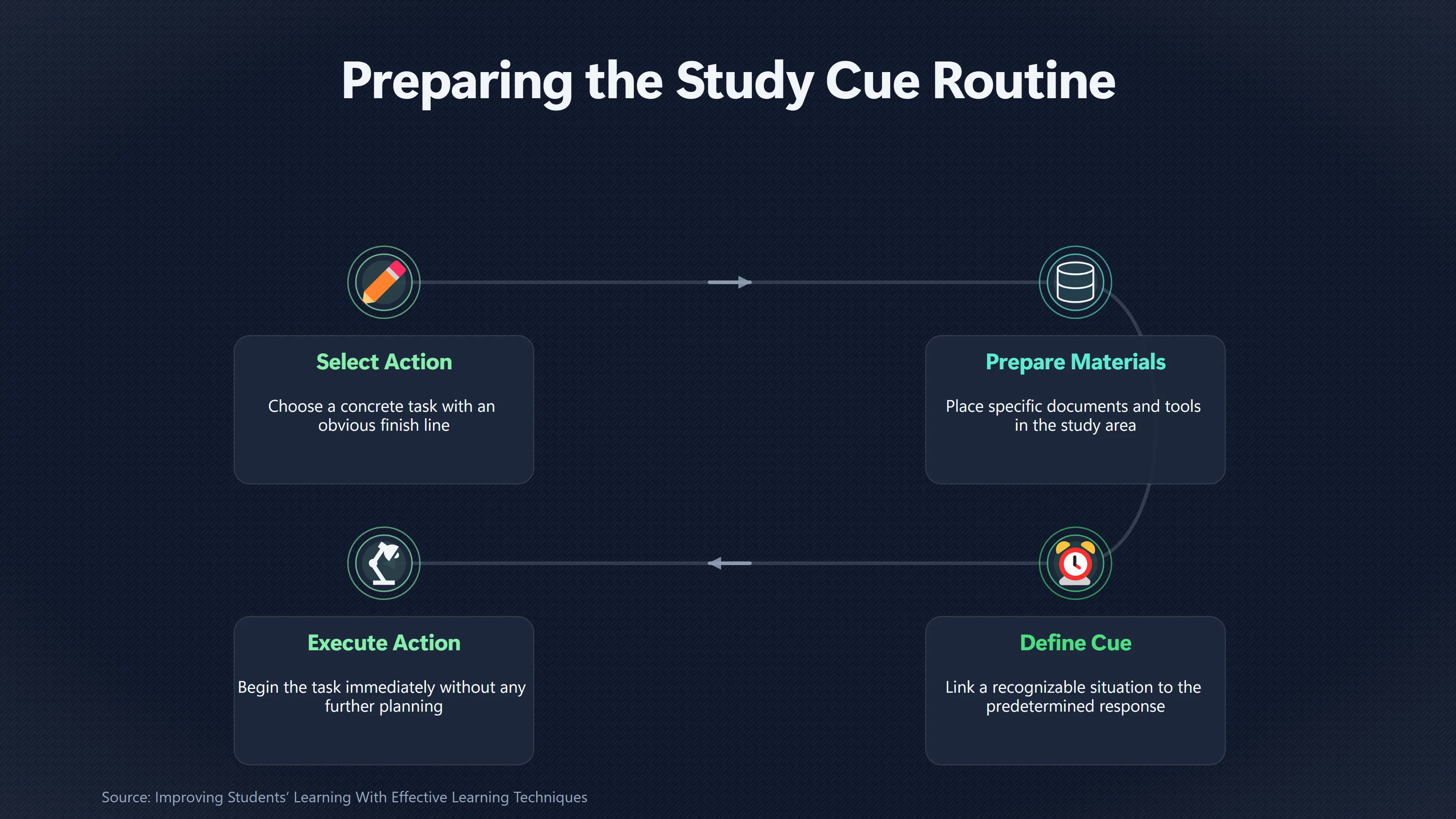
Implementation-intention research provides a useful mechanism for doing this. Instead of retaining only an outcome such as “I want to revise before checking Instagram”, the learner connects a detectable situation with a response: “When I sit at my desk after breakfast, I answer the five questions on the card beside my laptop.” A 2006 meta-analysis of 94 independent tests found a medium-to-large overall effect of implementation intentions on goal attainment and concluded that such plans can help with the particular problem of initiating goal-directed behaviour.[ScienceDirect]sciencedirect.comImplementation Intentions and Goal Achievement: A Meta‐analysis of Effects and Processes - ScienceDirect…
More recent evidence sharpens the point. A 2024 meta-analysis covering 642 independent tests found beneficial effects across cognitive, affective and behavioural outcomes, but effects varied with how plans were constructed. Contingent if–then plans produced larger effects, as did rehearsing plans and having strong motivation for the underlying goal.[DOI]doi.orgThe when and how of planning: Meta-analysis of the scope and components of implementation intentions in 642 tests: European Review of… In other words, “I should study tomorrow” and “After breakfast, I will answer these five questions” are not psychologically equivalent plans.
A particularly relevant field test appeared in Contemporary Educational Psychology in 2025. In a 42-day study, 357 German fifth- and sixth-form pupils received prompts on randomly selected evenings to plan when and where they would use a vocabulary-learning app the next day. Simply receiving the planning intervention did not produce a significant overall increase in studying. The important result was more specific: higher-quality plans — those using cues that were specific, salient and appropriate — were associated with a greater likelihood of studying.[ScienceDirect]sciencedirect.comPlanning promotes studying – The higher the plan quality the better: A micro-randomized trial - ScienceDirect… That is a useful warning against turning “make a plan” into another piece of generic self-improvement advice. The plan has to leave the learner with something executable.
First actions that can begin immediately
The best opening action has three properties: its materials are already identifiable, its stopping point is obvious, and beginning it does not require another round of planning. The learner should be able to read the instruction and act.
Useful examples include:
- Vocabulary: test yourself on the ten flashcards already marked for tomorrow.
- Mathematics: solve questions 1–3 on the prepared problem sheet.
- Chemistry: answer five retrieval questions from yesterday’s topic without looking at the notes.
- History: write from memory five facts about the topic on the card left on the desk, then check them.
- Languages: translate the first five prepared sentences, then correct them against the answers.
- Essay work: open the existing draft and write one paragraph answering the question already placed at the top.
- Reading: read the next three marked pages and write two retrieval questions about them.
- Exam revision: complete the first short question from a selected past paper, rather than beginning by browsing folders for a paper.
These are intentionally more precise than “do some flashcards”, “work on maths” or “read for ten minutes”. A numerical boundary — five questions, three problems, one paragraph — makes completion visible. Preparing the exact material in advance removes the selection step as well.
There is also a second reason to favour questions, problems and flashcards over merely opening a textbook: the first action can do useful learning immediately. Reviews of learning research consistently identify retrieval practice — attempting to recall information rather than merely rereading it — as an effective technique for improving later memory. A major review of ten common learning techniques rated practice testing and distributed practice as having particularly high utility, while a later review found retrieval benefits across different materials, ages and learner abilities.[DOI]doi.orgImproving Students’ Learning With Effective Learning TechniquesImproving Students’ Learning With Effective Learning Techniques - John Dunlosky, Katherine A. Rawson, Elizabeth J. Marsh, Mitchell J… A meta-analysis comparing testing with restudy likewise found a reliable testing effect on retention.[PubMed]pubmed.ncbi.nlm.nih.govThe effect of testing versus restudy on retention: a meta-analytic review of the testing effect - PubMedAugust 25, 2014…
This makes “answer five prepared questions” unusually suitable as a first action. It solves two problems at once: it provides an unambiguous behaviour to initiate, and the behaviour itself is educationally productive.
That does not mean every session must begin with a quiz. For subjects involving problem solving, composition or extended projects, the first action should match the work. The governing test is more basic: could you start it immediately without deciding what to do first? If the answer is no, the action probably needs another level of specification.
Prepare the decision before the cue arrives
A concrete first action works best when it is selected before the study period, not invented during it. This is the crucial difference between a routine and a morning negotiation.
Suppose the intended sequence is breakfast → study → social media. The night before, the learner can place one mathematics sheet on the desk, mark questions 4–6 and put a pencil beside it. The next morning, the cue does not lead to “What shall I revise?” It leads to question 4. For digital work, the equivalent might be leaving the required document ready and recording the exact opening instruction somewhere that does not require visiting a distracting feed.
Research on habit development supports making the surrounding context predictable. In a six-week study of 95 university students completing 2,482 repetitions of new study habits, greater context stability was associated with stronger automaticity and better attainment of habit-repetition goals. A second dataset involving users of a habit-building app produced the same broad pattern.[PubMed]pubmed.ncbi.nlm.nih.govContext Stability in Habit Building Increases Automaticity and Goal Attainment - PubMedJune 10, 2022… The study did not specifically test “five questions before social media”, so it should not be treated as direct evidence for that exact routine. Its relevance is narrower: repeating an intended behaviour in a stable context can help the context become a more effective cue.
The 2025 vocabulary experiment offers an especially concrete example of reducing choice. The learning app organised vocabulary into daily units, and a normal session took about five minutes; pupils could start by pressing the learning button rather than deciding afresh which words to practise. The researchers explicitly distinguished useful study plans from low-quality ones and found that plan quality was critical to whether planning helped.[ScienceDirect]sciencedirect.comPlanning promotes studying – The higher the plan quality the better: A micro-randomized trial - ScienceDirect…
A strong preparation rule is therefore: finish each study session by specifying the first action of the next one. Instead of leaving “biology revision” on tomorrow’s list, leave “answer cards 21–25 without notes”. Instead of “continue dissertation”, leave “open Results draft and write the explanation of Figure 2”. The decision is made while the learner is already engaged with the subject rather than at the vulnerable point of restarting it.
Why the opening block should stay short
The tiny first action should not be confused with the entire study target. Its purpose is to make entry into the session reliable. Five retrieval questions can lead into 30 minutes of revision; one mathematics problem can lead into a problem set. The learner is shrinking the threshold for starting, not necessarily the total amount of worthwhile study.
There is good evidence for specifying goal-directed actions and for retrieval practice as a learning method, but research does not establish a universal magic number of questions or minutes. Claims such as “the brain stops resisting after exactly five minutes” go beyond the evidence. What can be defended is the implementation principle: a bounded opening action gives the learner a clear response to execute, while an oversized or ambiguous task restores the planning problem that the routine was designed to remove. Implementation-intention evidence also suggests that specifying the response in advance is more useful than relying on intention alone.[DOI]doi.orgThe when and how of planning: Meta-analysis of the scope and components of implementation intentions in 642 tests: European Review of…
Keeping the opening modest has another practical advantage: it makes the routine usable on imperfect days. “Complete a two-hour revision session before social media” creates an expensive condition that may collapse when the morning is busy. “Complete five prepared retrieval questions first” preserves the intended order with a much smaller commitment. Once those questions are finished, continuing is a separate decision rather than a prerequisite for having started successfully.
This distinction helps prevent an easy mistake: making the minimum action progressively larger because the routine is going well. If five questions reliably trigger study, there is little reason to redefine the minimum as 20 questions. The opening action is an ignition mechanism, not a measure of ambition.
Make the first action almost mechanical
A useful first-action rule can be tested with four questions:
- Is the material predetermined? “Questions 6–10 on the printed sheet” is better than “find something to revise”.
- Is the action observable? Answering, solving, recalling or writing is clearer than “focus on” or “work on”.
- Is the minimum finish line obvious? Five cards or one paragraph gives a definite endpoint.
- Can it start immediately after the cue? If folders must be searched, resources selected or a study method chosen first, preparation is incomplete.
The resulting routine might be as small as: After I put my breakfast plate away, I sit at the desk and answer the five questions already waiting there. Social media comes afterwards. The important feature is not the number five. It is that the cue terminates in an action rather than another decision.
That is where the idea fits into self-improvement that works. The intervention is deliberately unglamorous: decide the first move in advance, make it small enough to execute consistently, and make that move useful learning rather than ceremonial preparation. Evidence on implementation intentions supports linking cues to specified responses; evidence on context stability supports repetition in predictable circumstances; and learning research gives good reason to make the response something active, such as retrieval practice.[doi.org]doi.orgThe when and how of planning: Meta-analysis of the scope and components of implementation intentions in 642 tests: European Review of…
For a study-before-social-media routine, success therefore need not begin with extraordinary discipline. It can begin with a question whose number, location and answer space were chosen yesterday.
Amazon book picks
Further Reading
Books and field guides related to Why the First Study Action Should Be Tiny. Use these as the next step if you want deeper reading beyond the article.
How to Become a Straight-A Student
Better grades - without burnout Most students believe that top grades are the result of endless cramming, stress, pressure and exhausting...
Atomic Habits
Rating: 3.5/5 from 7 Google Books ratings
The #1 New York Times bestseller. Over 25 million copies sold! Translated into 60+ languages! Tiny Changes, Remarkable Results No matter...
Make It Stick
To most of us, learning something "the hard way" implies wasted time and effort. Good teaching, we believe, should be creatively tailored...
Tiny Habits
Improving your life is much easier than you think. Whether it’s losing weight, sleeping more, or restoring your work/life balance – the s...
eBay marketplace picks
Marketplace Samples
Live-tested eBay searches with available results related to this page.
Selected fromstudy poster oneBay.co.uk.



Endnotes
1.
Source: doi.org
Link:https://doi.org/10.1080/10463283.2024.2334563
Source snippet
The when and how of planning: Meta-analysis of the scope and components of implementation intentions in 642 tests: European Review of...
2.
Source: sciencedirect.com
Link:https://www.sciencedirect.com/science/article/pii/S0361476X25000876
Source snippet
Planning promotes studying – The higher the plan quality the better: A micro-randomized trial - ScienceDirect...
3.
Source: sciencedirect.com
Link:https://www.sciencedirect.com/science/article/abs/pii/S0065260106380021
Source snippet
Implementation Intentions and Goal Achievement: A Meta‐analysis of Effects and Processes - ScienceDirect...
4.
Source: doi.org
Title: Improving Students’ Learning With Effective Learning Techniques
Link:https://doi.org/10.1177/1529100612453266
Source snippet
Improving Students’ Learning With Effective Learning Techniques - John Dunlosky, Katherine A. Rawson, Elizabeth J. Marsh, Mitchell J...
5.
Source: doi.org
Link:https://doi.org/10.1038/s44159-022-00089-1
6.
Source: sciencedirect.com
Title: Department of Error
Link:https://www.sciencedirect.com/science/article/pii/S0140673626009906
7.
Source: sciencedirect.com
Link:https://www.sciencedirect.com/science/article/pii/S0361476X25000876?dgcid=rss_sd_all
8.
Source: sciencedirect.com
Title: Department of Error
Link:https://www.sciencedirect.com/science/article/pii/S0140673625017726
9.
Source: sciencedirect.com
Title: Department of Error
Link:https://www.sciencedirect.com/science/article/pii/S0140673625007767?dgcid=rss_sd_all
10.
Source: sciencedirect.com
Title: Department of Error
Link:https://www.sciencedirect.com/science/article/pii/S0140673625007676
11.
Source: sciencedirect.com
Title: Department of Error
Link:https://www.sciencedirect.com/science/article/pii/S0140673625006208
12.
Source: sciencedirect.com
Title: Live long and prosper
Link:https://www.sciencedirect.com/science/article/pii/S0262407925004762
13.
Source: sciencedirect.com
Title: Department of Error
Link:https://www.sciencedirect.com/science/article/pii/S0140673625002089
14.
Source: sciencedirect.com
Title: Department of Error
Link:https://www.sciencedirect.com/science/article/pii/S0140673625000546
15.
Source: sciencedirect.com
Link:https://www.sciencedirect.com/science/article/abs/pii/S0165032724004245
16.
Source: doi.org
Link:https://doi.org/10.1177/20501579211029326
17.
Source: doi.org
Link:https://doi.org/10.3758/s13421-020-01033-5
18.
Source: sciencedirect.com
Link:https://www.sciencedirect.com/science/article/pii/S0191886919307019
19.
Source: sciencedirect.com
Link:https://www.sciencedirect.com/science/article/pii/S0191886999000914
20.
Source: sciencedirect.com
Link:https://www.sciencedirect.com/science/article/abs/pii/S0191886999000914
21.
Source: sciencedirect.com
Link:https://www.sciencedirect.com/science/chapter/bookseries/abs/pii/S0065260106380021
22.
Source: sciencedirect.com
Title: Task ambiguity and academic procrastination: An experience sampling approach
Link:https://www.sciencedirect.com/science/article/pii/S0959475222000160
23.
Source: sciencedirect.com
Link:https://www.sciencedirect.com/science/article/pii/S0959475217301810
24.
Source: sciencedirect.com
Title: How Retrieval Attempts Affect Learning: A Review and Synthesis
Link:https://www.sciencedirect.com/science/chapter/bookseries/abs/pii/S0079742116000165
25.
Source: sciencedirect.com
Link:https://www.sciencedirect.com/science/article/abs/pii/S019188690800192X
26.
Source: sciencedirect.com
Link:https://www.sciencedirect.com/
27.
Source: sciencedirect.com
Title: Browse journals and books beginning with letter s
Link:https://www.sciencedirect.com/browse/journals-and-books/s
28.
Source: sciencedirect.com
Link:https://www.sciencedirect.com/science/article/pii/S1093968726005256
29.
Source: sciencedirect.com
Title: The future of environmental sustainability labelling on food products
Link:https://www.sciencedirect.com/science/article/pii/S2542519620300747
30.
Source: pubmed.ncbi.nlm.nih.gov
Link:https://pubmed.ncbi.nlm.nih.gov/17201571/
Source snippet
The nature of procrastination: a meta-analytic and theoretical review of quintessential self-regulatory failure - PubMed...
31.
Source: pmc.ncbi.nlm.nih.gov
Link:https://pmc.ncbi.nlm.nih.gov/articles/PMC4500900/
Source snippet
PubMed Central (PMC)Promoting the translation of intentions into action by implementation intentions: behavioral effects and physiologica...
32.
Source: pubmed.ncbi.nlm.nih.gov
Link:https://pubmed.ncbi.nlm.nih.gov/25150680/
Source snippet
The effect of testing versus restudy on retention: a meta-analytic review of the testing effect - PubMedAugust 25, 2014...
Published: August 25, 2014
33.
Source: pubmed.ncbi.nlm.nih.gov
Link:https://pubmed.ncbi.nlm.nih.gov/35756236/
Source snippet
Context Stability in Habit Building Increases Automaticity and Goal Attainment - PubMedJune 10, 2022...
Published: June 10, 2022
34.
Source: pmc.ncbi.nlm.nih.gov
Link:https://pmc.ncbi.nlm.nih.gov/articles/PMC9226889/
35.
Source: pubmed.ncbi.nlm.nih.gov
Link:https://pubmed.ncbi.nlm.nih.gov/41784001/
36.
Source: pmc.ncbi.nlm.nih.gov
Link:https://pmc.ncbi.nlm.nih.gov/articles/PMC12533354/
37.
Source: pubmed.ncbi.nlm.nih.gov
Link:https://pubmed.ncbi.nlm.nih.gov/41102857/
38.
Source: pmc.ncbi.nlm.nih.gov
Link:https://pmc.ncbi.nlm.nih.gov/articles/PMC9669985/
39.
Source: pmc.ncbi.nlm.nih.gov
Link:https://pmc.ncbi.nlm.nih.gov/articles/PMC10229024/
40.
Source: pmc.ncbi.nlm.nih.gov
Link:https://pmc.ncbi.nlm.nih.gov/articles/PMC8356899/
41.
Source: pubmed.ncbi.nlm.nih.gov
Link:https://pubmed.ncbi.nlm.nih.gov/34393926/
42.
Source: pmc.ncbi.nlm.nih.gov
Link:https://pmc.ncbi.nlm.nih.gov/articles/PMC8149892/
43.
Source: pubmed.ncbi.nlm.nih.gov
Link:https://pubmed.ncbi.nlm.nih.gov/33006925/
44.
Source: pmc.ncbi.nlm.nih.gov
Link:https://pmc.ncbi.nlm.nih.gov/articles/PMC7442618/
45.
Source: pubmed.ncbi.nlm.nih.gov
Link:https://pubmed.ncbi.nlm.nih.gov/32116961/
46.
Source: pubmed.ncbi.nlm.nih.gov
Link:https://pubmed.ncbi.nlm.nih.gov/29733621/
47.
Source: pmc.ncbi.nlm.nih.gov
Link:https://pmc.ncbi.nlm.nih.gov/articles/PMC5608091/
48.
Source: pubmed.ncbi.nlm.nih.gov
Link:https://pubmed.ncbi.nlm.nih.gov/25965276/
49.
Source: pmc.ncbi.nlm.nih.gov
Link:https://pmc.ncbi.nlm.nih.gov/articles/PMC3983480/
50.
Source: pmc.ncbi.nlm.nih.gov
Link:https://pmc.ncbi.nlm.nih.gov/articles/PMC3043255/
51.
Source: pubmed.ncbi.nlm.nih.gov
Link:https://pubmed.ncbi.nlm.nih.gov/17201571/?dopt=Abstract
52.
Source: pubmed.ncbi.nlm.nih.gov
Link:https://pubmed.ncbi.nlm.nih.gov/7760291/
53.
Source: pubmed.ncbi.nlm.nih.gov
Link:https://pubmed.ncbi.nlm.nih.gov/12009041/
54.
Source: pubmed.ncbi.nlm.nih.gov
Link:https://pubmed.ncbi.nlm.nih.gov/19121142/
55.
Source: pubmed.ncbi.nlm.nih.gov
Link:https://pubmed.ncbi.nlm.nih.gov/26173288/
56.
Source: pubmed.ncbi.nlm.nih.gov
Link:https://pubmed.ncbi.nlm.nih.gov/29188447/
57.
Source: pubmed.ncbi.nlm.nih.gov
Link:https://pubmed.ncbi.nlm.nih.gov/30506327/
58.
Source: pubmed.ncbi.nlm.nih.gov
Link:https://pubmed.ncbi.nlm.nih.gov/28135976/
59.
Source: ouci.dntb.gov.ua
Link:https://ouci.dntb.gov.ua/en/works/7XJjALMl/
Additional References
60.
Source: youtube.com
Title: The ONLY Way To Stop Procrastinating | Mel Robbins
Link:https://www.youtube.com/watch?v=4x7MkLDGnu8
Source snippet
How to [reduce friction]({{ 'reduce-friction/' | relative_url }}) starting studying procrastination How to Stop Procrastination & Increase Motivation | Dr. Andrew Huberman...
61.
Source: nature.com
Link:https://www.nature.com/articles/s41539-026-00400-2
62.
Source: youtube.com
Title: How to Stop Procrastination & Increase Motivation | Dr. Andrew Huberman
Link:https://www.youtube.com/watch?v=48jlHaxZnig
Source snippet
Why you procrastinate even when it feels bad...
63.
Source: youtube.com
Title: Why you procrastinate even when it feels bad
Link:https://www.youtube.com/watch?v=FWTNMzK9vG4
Source snippet
Behavioral Activation- How to Get Motivated to Do Stuff that You Don't Want to Do...
64.
Source: researchgate.net
Link:https://www.researchgate.net/publication/37367696_Implementation_Intentions_and_Goal_Achievement_A_Meta-Analysis_of_Effects_and_Processes
65.
Source: researchgate.net
Link:https://www.researchgate.net/publication/6598646_The_Nature_of_Procrastination_A_Meta-Analytic_and_Theoretical_Review_of_Quintessential_Self-Regulatory_Failure
66.
Source: psychologytoday.com
Link:https://www.psychologytoday.com/gb/blog/life-love-etc/202403/beat-procrastination-by-aiming-low-one-tiny-step-at-a-time
67.
Source: mendeley.com
Link:https://www.mendeley.com/catalogue/e7b06926-1f59-3250-8601-aa3375f68ebe/
68.
Source: unb.ca
Link:https://www.unb.ca/fredericton/cetl/services/teaching-tips/instructional-methods/effective-learning-techniques.html
69.
Source: ucl.ac.uk
Link:https://www.ucl.ac.uk/study/current-students/exams-and-assessments/assessment-success-guide/effective-revision-and-assessment-planning