Within The Idea That Inconsistent People Simply Need “more Willpower”
Why Self Control Often Works Best Before Temptation
Changing situations, attention, or interpretation early can reduce the need to suppress a fully developed impulse later.
On this page
- The process model of self control
- Situation selection, modification, distraction, and reappraisal
- Why direct inhibition is often a late stage strategy
Page outline Jump by section
Introduction
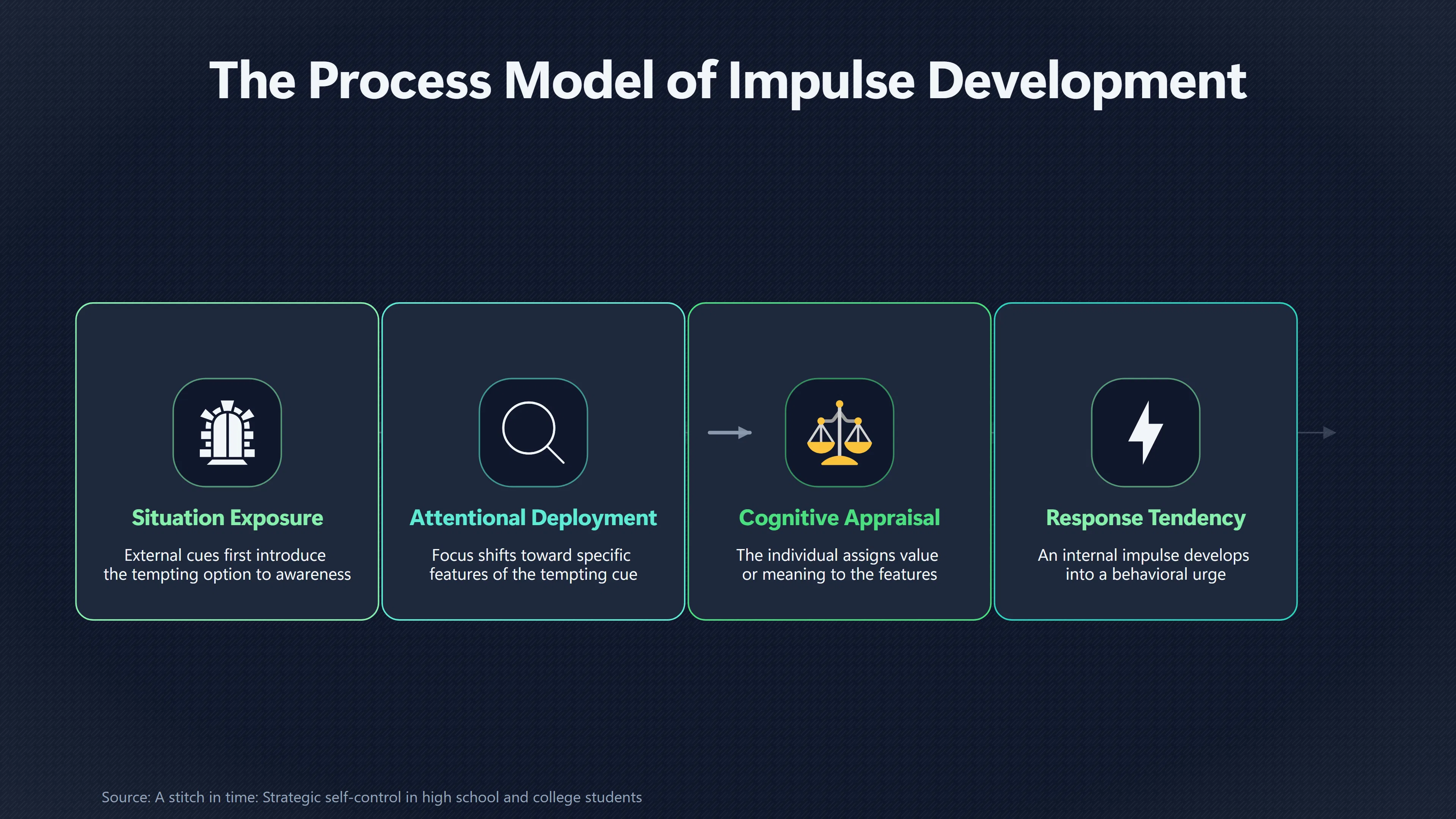
Self-control often works best before temptation becomes a contest of wills. Instead of waiting until an urge is strong and then trying to suppress it, people can intervene earlier: choose a less tempting situation, alter the situation they are already in, direct attention elsewhere, or change how they interpret the tempting option. This is the central insight of the process model of self-control, which treats an impulse as something that develops over time rather than appearing fully formed.[PubMed Central (PMC)]pmc.ncbi.nlm.nih.govPub Med Central (PMC)Situational Strategies for Self-ControlPubMed Central (PMC)Situational Strategies for Self-Control - PMCJanuary 1, 2016…
That distinction changes what “good self-control” looks like. Leaving the phone outside the study room can be self-control. Sitting away from the drinks at a party can be self-control. Looking away from an enticing food, or deliberately thinking about its less appealing consequences, can be self-control too. Research in classrooms and daily life suggests that these earlier, antecedent-focused strategies can support goal progress without requiring people to repeatedly win a late-stage internal battle.[PubMed]pubmed.ncbi.nlm.nih.govA Stitch in Time: Strategic Self-Control in High School and College Students - PubMed…
The evidence does not establish a universal rule that earlier is always better. Strategy effectiveness depends partly on the person and the particular self-control problem. But it does undermine the idea that inhibition at the moment of maximum temptation is the defining test of discipline.[PubMed]pubmed.ncbi.nlm.nih.govFrom willpower to strategies: Existing insights and outstanding issues in self-control strategy use in daily life - PubMedAugust 28…
The process model: intervene while the impulse is developing
The process model developed by Angela Duckworth, Tamar Gendler and James Gross organises self-control around the sequence through which an impulse develops. A situation exposes us to relevant cues; we direct attention towards some features of it; we appraise what those features mean or how valuable they seem; and this process produces a response tendency. Crucially, the sequence is iterative: attending to a tempting cue can make it more salient, which can further strengthen the impulse.[PubMed Central (PMC)]pmc.ncbi.nlm.nih.govPub Med Central (PMC)Situational Strategies for Self-ControlPubMed Central (PMC)Situational Strategies for Self-Control - PMCJanuary 1, 2016…
The model therefore identifies several points at which someone can intervene:
- Situation selection: choose where to go, what to encounter or what to avoid.
- Situation modification: remain in the situation but alter its tempting features.
- Attentional deployment: redirect attention away from temptation or towards something supporting the goal.
- Cognitive change or reappraisal: change the meaning or value assigned to what is happening.
- Response modulation: inhibit the resulting response once the impulse has already developed.[PubMed Central (PMC)]pmc.ncbi.nlm.nih.govPub Med Central (PMC)Situational Strategies for Self-ControlPubMed Central (PMC)Situational Strategies for Self-Control - PMCJanuary 1, 2016…
The ordering is important. Imagine trying to finish an hour of concentrated work while a phone sits beside the keyboard. Situation selection could mean working somewhere without the phone. Situation modification might mean switching it off and putting it in a bag. Attentional deployment means noticing it but returning attention to the document. Reappraisal might mean interpreting a notification not as an interesting opportunity but as an interruption that can wait. Response inhibition occurs when the desire to check is already strong and the person has to stop their hand reaching for the device.
All five can count as self-control. The difference is where in the development of the impulse they act. Earlier strategies try to prevent or weaken the temptation-producing process; inhibition tries to control its behavioural output.[PubMed]pubmed.ncbi.nlm.nih.govPub Med Situational Strategies for Self-ControlSituational Strategies for Self-Control - PubMedJanuary 1, 2016…
Change the situation before changing yourself
Situation selection is the earliest intervention because it changes exposure itself. Duckworth and colleagues give deliberately ordinary examples: studying in a library rather than a noisy room, exercising at a gym rather than expecting oneself to start from the sofa, or choosing social surroundings that make the desired behaviour easier.[PubMed Central (PMC)]pmc.ncbi.nlm.nih.govPub Med Central (PMC)Situational Strategies for Self-ControlPubMed Central (PMC)Situational Strategies for Self-Control - PMCJanuary 1, 2016…
Avoidance can sound like weakness under a willpower-centred view: surely a disciplined person ought to be able to face temptation and say no. The process model reverses that interpretation. If the goal is to behave in a particular way, deliberately avoiding a predictable obstacle can itself be skilled self-regulation. The person is acting while preferences are comparatively calm rather than delegating the entire decision to a future version of themselves facing a stronger impulse.
There is evidence that people conventionally described as having high self-control already behave in something like this fashion. Research reviewed by Duckworth and colleagues found that higher trait self-control was associated with greater proactive avoidance of temptation. In an experimental example, participants could perform an anagram task immediately in a distracting lounge or wait for access to a quieter laboratory; those higher in trait self-control were more likely to choose the less distracting environment.[PubMed Central (PMC)]pmc.ncbi.nlm.nih.govPub Med Central (PMC)Situational Strategies for Self-ControlPubMed Central (PMC)Situational Strategies for Self-Control - PMCJanuary 1, 2016…
This fits an important finding from everyday life. In an experience-sampling study, 205 adults produced 7,827 reports about their desires over a week. Subsequent analyses of this line of research found that people higher in trait self-control reported fewer problematic temptations and less motivational conflict rather than simply reporting more frequent victories over powerful desires.[PubMed]pubmed.ncbi.nlm.nih.govEveryday temptations: an experience sampling study of desire, conflict, and self-control - PubMed…
When complete avoidance is impractical, situation modification offers the next move. A student can silence notifications rather than leave the building; someone trying not to overeat can move tempting food out of immediate reach rather than avoid the gathering; a partygoer can sit away from where drinks are being served. The common mechanism is reducing the potency, proximity or convenience of the tempting cue before it has generated its strongest response.[PubMed Central (PMC)]pmc.ncbi.nlm.nih.govPub Med Central (PMC)Situational Strategies for Self-ControlPubMed Central (PMC)Situational Strategies for Self-Control - PMCJanuary 1, 2016…
Attention and interpretation are earlier control points too
Not every situation can be avoided or rearranged. At that point, self-control can still act upstream of direct inhibition by changing what receives attention.
Classic delay-of-gratification research illustrates why this matters. Children waiting for a preferred reward could make waiting easier by diverting attention from its arousing qualities. Later work continues to identify this comparatively “cool” attentional focus — shifting attention away from emotionally activating features — as an important mechanism in children’s ability to delay gratification.[PubMed]pubmed.ncbi.nlm.nih.govPub Med Delay of gratification in childrenDelay of gratification in children - PubMedMay 26, 1989…
The principle extends beyond children and sweets. Attention determines which parts of a situation receive continued processing. A person trying to concentrate need not repeatedly tell themselves do not check the phone while staring at it. They can immerse themselves in the next paragraph, turn their gaze elsewhere or otherwise give competing stimuli less attention. Distraction in this sense is not necessarily a failure to confront the urge; strategically deployed, it can prevent attention from continually feeding it.[PubMed Central (PMC)]pmc.ncbi.nlm.nih.govOpen source on nih.gov.
Reappraisal goes one stage further. The tempting object remains in awareness, but its meaning changes. Food can be represented in terms of how it will feel after overeating rather than its immediate taste; an invitation arriving during concentrated work can be construed as something enjoyable for later rather than an opportunity that must be acted on now. In the process model, changing the appraisal can change the value assigned to the option and therefore the response it generates.[PubMed Central (PMC)]pmc.ncbi.nlm.nih.govOpen source on nih.gov.
These techniques are not merely theoretical categories. In two studies of strategic self-control in daily life, Williamson and Wilkowski examined situation selection, situation modification, distraction, reappraisal and response inhibition. Each of the four antecedent-focused strategies uniquely predicted goal progress, whereas response inhibition did not show consistent effects. Planning self-control in advance also predicted initiating self-control independently of the current strength of temptation.[PubMed]pubmed.ncbi.nlm.nih.govNipping Temptation in the Bud: Examining Strategic Self-Control in Daily Life - PubMed…
That last result is especially important for self-improvement. Self-control need not wait for an urge to provide the signal to act. People can anticipate the conditions under which temptation is likely and prepare their response beforehand.

Planning can move the decision forwards in time
One practical way to act early is to decide in advance what will happen when a predictable cue appears. Implementation intentions are contingent plans of the form “if situation Y occurs, then I will do X”. Instead of leaving the response unspecified until temptation arrives, the person links an anticipated cue with a goal-supporting action beforehand.
The evidence for this broader planning technique is substantial. A classic meta-analysis covering 94 independent tests estimated a medium-to-large positive effect on goal attainment (d = 0.65). A much larger 2024 meta-analysis covering 642 independent tests found positive effects across cognitive, emotional and behavioural outcomes, with effects ranging from d = 0.27 to 0.66. Effects were stronger when plans genuinely used an if–then structure, when people were highly motivated and when the plans were rehearsed.[ScienceDirect]sciencedirect.comOpen source on sciencedirect.com.
The relevance to early self-control is timing. “I will ignore social media tonight” leaves much of the decision for later. “If I sit down to write, then my phone goes in the drawer until the timer finishes” connects a recognisable cue to an earlier intervention. The plan can therefore recruit situation modification or attentional control before browsing has become the dominant response.
This does not mean every implementation intention prevents temptation, nor that planning eliminates conscious choice. Rather, research suggests that if–then plans increase accessibility of the specified cue and strengthen the link between that cue and the intended response, making goal-directed action easier to initiate when the relevant moment arrives.[ScienceDirect]sciencedirect.comOpen source on sciencedirect.com.
Why inhibition is often the late-stage option
Direct inhibition — feeling a developed urge and deliberately stopping oneself from acting on it — remains a genuine form of self-control. Sometimes it is unavoidable. Situations cannot always be selected, other people cannot always be controlled, and unexpected temptations inevitably appear.
The problem is treating inhibition as the default strategy. By the time it becomes necessary, several earlier opportunities may already have passed. The tempting cue is present, attention has settled on it, the person has assigned it attractive value, and an action tendency is underway. Inhibition is therefore attempting to interrupt a process whose earlier stages have already favoured the competing response.[PubMed Central (PMC)]pmc.ncbi.nlm.nih.govPub Med Central (PMC)Situational Strategies for Self-ControlPubMed Central (PMC)Situational Strategies for Self-Control - PMCJanuary 1, 2016…
A particularly useful field test came from research with secondary-school and university students. Students judged strategies used earlier in the impulse-generation process — especially situation selection and modification — as much more effective than later strategies. More importantly, experimental studies assigned students to different strategies: those instructed to modify their situations were more successful at meeting academic goals than comparison groups using response modulation or no assigned strategy. Among university students, the benefit of situation modification was partly explained by experiencing less temptation during the week.[DOI]doi.orgA stitch in time: Strategic self-control in high school and college studentsA stitch in time: Strategic self-control in high school and college students
That mechanism deserves emphasis. The early strategy did not merely make participants better at resisting temptation. It reduced how much temptation they had to contend with. That is a different model of successful self-control.
A related body of work on habits reaches a compatible conclusion without proving the process model itself. Across six studies involving 2,274 participants, beneficial habits helped account for associations between trait self-control and positive behaviours including healthy eating, exercise, sleep and studying. Better self-control was associated with routines that allowed useful behaviour to proceed more automatically and with less reported effortful inhibition.[PubMed]pubmed.ncbi.nlm.nih.govOpen source on nih.gov.
The broader lesson is that visible struggle is a poor measure of how much self-regulation is occurring. A person who never opens the distracting website may appear to exercise less willpower than someone who opens it repeatedly and heroically closes it again. From a systems perspective, the first person may simply have intervened at a more advantageous point.
Earlier is a principle, not an iron law
The process model makes an intuitively powerful prediction: other things being equal, intervening earlier should often be advantageous because it prevents an impulse from gathering strength. But the evidence warrants a more careful claim than “early strategies always beat late ones”.
When Duckworth, Gendler and Gross published their major review of situational self-control in 2016, they explicitly described the evidence for the superiority of situational strategies as incomplete and called for stronger direct experimental comparisons. Subsequent field and daily-life studies have supplied encouraging evidence, but modern reviews still caution against searching for one universally superior self-control strategy.[PubMed Central (PMC)]pmc.ncbi.nlm.nih.govPub Med Central (PMC)Situational Strategies for Self-ControlPubMed Central (PMC)Situational Strategies for Self-Control - PMCJanuary 1, 2016…
A large experience-sampling analysis covering 14,067 reported self-control conflicts makes the qualification concrete. Researchers examined 22 strategies across three different problems: initiating an unpleasant but desirable activity, persisting with it and inhibiting an unwanted impulse. Eight strategies were positively associated with subjective self-regulatory success overall, but effectiveness frequently depended on the kind of conflict. People did better when there was a useful fit between strategy and situation.[PubMed]pubmed.ncbi.nlm.nih.govSelf-Regulatory Strategy Use, Efficacy, and Strategy-Situation-Fit in Self-Control Conflicts of Initiation, Persistence, and Inhibi…
That means “act earlier” should be understood as a design principle, not a rigid hierarchy. Situation selection is powerful when the situation is selectable. Modification helps when the environment is changeable. Distraction can help when attention is feeding an impulse, but it may be poorly suited to tasks that require engagement with the very material someone wants to avoid. Reappraisal depends on finding an interpretation that genuinely changes the temptation’s significance. And when none of those options is available, inhibition remains necessary.
The practical shift: reduce the size of the battle
For self-improvement, the most useful question is therefore not simply “How can I resist this more strongly?” It is “At what earlier point could I alter the sequence that keeps producing this battle?”
If the problem repeatedly begins with exposure, intervene at the situation: choose a different route, room, device configuration or social setting. If exposure cannot be avoided, modify it: increase distance, remove cues or add friction. If the temptation is already present, stop feeding it attention. If attention is unavoidable, change how the option is represented. Direct inhibition then remains available as the final layer rather than carrying the entire burden.
This framing avoids replacing one willpower myth with another. Early strategies do not make human behaviour perfectly controllable, and no single tactic works across every person and context. Contemporary research increasingly emphasises flexibility and strategy–situation fit.[PubMed]pubmed.ncbi.nlm.nih.govFrom willpower to strategies: Existing insights and outstanding issues in self-control strategy use in daily life - PubMedAugust 28…
What the evidence does support is a more useful definition of self-control. Discipline is not limited to the dramatic moment when someone feels a powerful impulse and says no. It can happen minutes, hours or even days earlier, when the person calmly arranges circumstances so that the impulse is weaker, less salient or never strongly develops at all. In many recurring self-improvement problems, the highest-leverage act of self-control may therefore be the one that makes a later act of willpower unnecessary.[PubMed]pubmed.ncbi.nlm.nih.govPub Med Situational Strategies for Self-ControlSituational Strategies for Self-Control - PubMedJanuary 1, 2016…

Amazon book picks
Further Reading
Books and field guides related to Why Self Control Often Works Best Before Temptation. Use these as the next step if you want deeper reading beyond the article.
The Willpower Instinct
Based on Stanford University psychologist Kelly McGonigal's wildly popular course "The Science of Willpower," The Willpower Instinct is t...
How to Change
Wall Street Journal bestseller “A welcome revelation.” --The Financial Times Award-winning Wharton Professor and Choiceology podcast host...
Good Habits, Bad Habits
'The world's leading expert on habits' - Matthew Syed, bestselling author of Black Box Thinking and Rebel IdeasWhat if you could harness...
Indistractable
*As heard on Steven Bartlett's Diary of a CEO* 'A must-read' Mark Manson We are living through a crisis of distraction. Plans get sidetra...
eBay marketplace picks
Marketplace Samples
Live-tested eBay searches with available results related to this page.
Selected frommotivational desk sign oneBay.co.uk.




Endnotes
1.
Source: sciencedirect.com
Link:https://www.sciencedirect.com/science/article/abs/pii/S0065260106380021
2.
Source: doi.org
Link:https://doi.org/10.1080/10463283.2024.2334563
3.
Source: doi.org
Title: A stitch in time: Strategic self-control in high school and college students
Link:https://doi.org/10.1037/edu0000062
4.
Source: doi.org
Title: Situational Strategies for Self-Control
Link:https://doi.org/10.1177/1745691615623247%C2%A0
5.
Source: sciencedirect.com
Link:https://www.sciencedirect.com/science/chapter/bookseries/abs/pii/S0065260106380021
6.
Source: sciencedirect.com
Link:https://www.sciencedirect.com/science/article/pii/S0022096522002053
7.
Source: sciencedirect.com
Link:https://www.sciencedirect.com/science/article/pii/S0005796718300251
8.
Source: sciencedirect.com
Link:https://www.sciencedirect.com/science/article/pii/S2352250X24000897
9.
Source: sciencedirect.com
Link:https://www.sciencedirect.com/science/article/pii/S014976342600165X
10.
Source: youtube.com
Link:https://www.youtube.com/watch?v=_6p8aq4zU8Y
Source snippet
Angela Duckworth - Self-Control Strategies for School-Age Children...
11.
Source: youtube.com
Title: Angela Duckworth
Link:https://www.youtube.com/watch?v=X1euhGUKIRc
Source snippet
Emotion Regulation with James J. Gross, PhD...
12.
Source: pmc.ncbi.nlm.nih.gov
Title: Pub Med Central (PMC)Situational Strategies for Self-Control
Link:https://pmc.ncbi.nlm.nih.gov/articles/4736542/
Source snippet
PubMed Central (PMC)Situational Strategies for Self-Control - PMCJanuary 1, 2016...
Published: January 1, 2016
13.
Source: pubmed.ncbi.nlm.nih.gov
Link:https://pubmed.ncbi.nlm.nih.gov/27158155/
Source snippet
A Stitch in Time: Strategic Self-Control in High School and College Students - PubMed...
14.
Source: pubmed.ncbi.nlm.nih.gov
Link:https://pubmed.ncbi.nlm.nih.gov/31658876/
Source snippet
Nipping Temptation in the Bud: Examining Strategic Self-Control in Daily Life - PubMed...
15.
Source: pubmed.ncbi.nlm.nih.gov
Link:https://pubmed.ncbi.nlm.nih.gov/39241278/
Source snippet
From willpower to strategies: Existing insights and outstanding issues in self-control strategy use in daily life - PubMedAugust 28...
16.
Source: pubmed.ncbi.nlm.nih.gov
Link:https://pubmed.ncbi.nlm.nih.gov/41908315/
Source snippet
Self-Regulatory Strategy Use, Efficacy, and Strategy-Situation-Fit in Self-Control Conflicts of Initiation, Persistence, and Inhibi...
17.
Source: pmc.ncbi.nlm.nih.gov
Title: Pub Med Central (PMC)Situational Strategies for Self-Control
Link:https://pmc.ncbi.nlm.nih.gov/articles/PMC4736542/
Source snippet
PubMed Central (PMC)Situational Strategies for Self-Control - PMCJanuary 1, 2016...
Published: January 1, 2016
18.
Source: pubmed.ncbi.nlm.nih.gov
Title: Pub Med Situational Strategies for Self-Control
Link:https://pubmed.ncbi.nlm.nih.gov/26817725/
Source snippet
Situational Strategies for Self-Control - PubMedJanuary 1, 2016...
Published: January 1, 2016
19.
Source: pubmed.ncbi.nlm.nih.gov
Link:https://pubmed.ncbi.nlm.nih.gov/22149456/
Source snippet
Everyday temptations: an experience sampling study of desire, conflict, and self-control - PubMed...
20.
Source: pmc.ncbi.nlm.nih.gov
Title: Pub Med Central (PMC)The ‘Operational’ Definition of Self-Control
Link:https://pmc.ncbi.nlm.nih.gov/articles/PMC6058080/
Source snippet
PubMed Central (PMC)The ‘Operational’ Definition of Self-Control - PMC...
21.
Source: pubmed.ncbi.nlm.nih.gov
Title: Pub Med Delay of gratification in children
Link:https://pubmed.ncbi.nlm.nih.gov/2658056/
Source snippet
Delay of gratification in children - PubMedMay 26, 1989...
Published: May 26, 1989
22.
Source: pubmed.ncbi.nlm.nih.gov
Link:https://pubmed.ncbi.nlm.nih.gov/38245607/
23.
Source: pmc.ncbi.nlm.nih.gov
Link:https://pmc.ncbi.nlm.nih.gov/articles/PMC13021067/
24.
Source: pmc.ncbi.nlm.nih.gov
Link:https://pmc.ncbi.nlm.nih.gov/articles/PMC6445882/
25.
Source: pubmed.ncbi.nlm.nih.gov
Link:https://pubmed.ncbi.nlm.nih.gov/25643222/
26.
Source: pubmed.ncbi.nlm.nih.gov
Link:https://pubmed.ncbi.nlm.nih.gov/41784001/
27.
Source: pmc.ncbi.nlm.nih.gov
Link:https://pmc.ncbi.nlm.nih.gov/articles/PMC12720225/
28.
Source: pmc.ncbi.nlm.nih.gov
Link:https://pmc.ncbi.nlm.nih.gov/articles/PMC12817966/
29.
Source: pmc.ncbi.nlm.nih.gov
Link:https://pmc.ncbi.nlm.nih.gov/articles/PMC11423838/
30.
Source: pubmed.ncbi.nlm.nih.gov
Link:https://pubmed.ncbi.nlm.nih.gov/38869854/
31.
Source: pmc.ncbi.nlm.nih.gov
Link:https://pmc.ncbi.nlm.nih.gov/articles/PMC11348397/
32.
Source: pmc.ncbi.nlm.nih.gov
Link:https://pmc.ncbi.nlm.nih.gov/articles/PMC10922454/
33.
Source: pubmed.ncbi.nlm.nih.gov
Link:https://pubmed.ncbi.nlm.nih.gov/36849699/
34.
Source: pmc.ncbi.nlm.nih.gov
Link:https://pmc.ncbi.nlm.nih.gov/articles/PMC10033625/
35.
Source: pmc.ncbi.nlm.nih.gov
Link:https://pmc.ncbi.nlm.nih.gov/articles/PMC8149892/
36.
Source: pubmed.ncbi.nlm.nih.gov
Link:https://pubmed.ncbi.nlm.nih.gov/34054628/
37.
Source: pmc.ncbi.nlm.nih.gov
Link:https://pmc.ncbi.nlm.nih.gov/articles/PMC7478946/
38.
Source: pubmed.ncbi.nlm.nih.gov
Link:https://pubmed.ncbi.nlm.nih.gov/28862919/
39.
Source: pmc.ncbi.nlm.nih.gov
Link:https://pmc.ncbi.nlm.nih.gov/articles/PMC5677575/
40.
Source: pubmed.ncbi.nlm.nih.gov
Link:https://pubmed.ncbi.nlm.nih.gov/27899059/
41.
Source: pmc.ncbi.nlm.nih.gov
Link:https://pmc.ncbi.nlm.nih.gov/articles/PMC5143362/
42.
Source: pubmed.ncbi.nlm.nih.gov
Link:https://pubmed.ncbi.nlm.nih.gov/26585633/
43.
Source: pmc.ncbi.nlm.nih.gov
Link:https://pmc.ncbi.nlm.nih.gov/articles/PMC4902773/
44.
Source: pubmed.ncbi.nlm.nih.gov
Link:https://pubmed.ncbi.nlm.nih.gov/27148101/
45.
Source: pmc.ncbi.nlm.nih.gov
Link:https://pmc.ncbi.nlm.nih.gov/articles/PMC4834631/
46.
Source: pmc.ncbi.nlm.nih.gov
Link:https://pmc.ncbi.nlm.nih.gov/articles/PMC4856169/
47.
Source: pubmed.ncbi.nlm.nih.gov
Link:https://pubmed.ncbi.nlm.nih.gov/26913617/
48.
Source: pubmed.ncbi.nlm.nih.gov
Link:https://pubmed.ncbi.nlm.nih.gov/25984785/
49.
Source: pmc.ncbi.nlm.nih.gov
Link:https://pmc.ncbi.nlm.nih.gov/articles/PMC4731333/
50.
Source: pmc.ncbi.nlm.nih.gov
Link:https://pmc.ncbi.nlm.nih.gov/articles/PMC4666116/
51.
Source: pubmed.ncbi.nlm.nih.gov
Link:https://pubmed.ncbi.nlm.nih.gov/25965276/
52.
Source: pmc.ncbi.nlm.nih.gov
Link:https://pmc.ncbi.nlm.nih.gov/articles/PMC4032877/
53.
Source: pubmed.ncbi.nlm.nih.gov
Link:https://pubmed.ncbi.nlm.nih.gov/24789842/
54.
Source: pmc.ncbi.nlm.nih.gov
Link:https://pmc.ncbi.nlm.nih.gov/articles/PMC3887268/
55.
Source: pubmed.ncbi.nlm.nih.gov
Link:https://pubmed.ncbi.nlm.nih.gov/23988760/
56.
Source: pmc.ncbi.nlm.nih.gov
Link:https://pmc.ncbi.nlm.nih.gov/articles/PMC3784634/
57.
Source: pubmed.ncbi.nlm.nih.gov
Link:https://pubmed.ncbi.nlm.nih.gov/23276276/
58.
Source: pmc.ncbi.nlm.nih.gov
Link:https://pmc.ncbi.nlm.nih.gov/articles/PMC3404050/
59.
Source: pubmed.ncbi.nlm.nih.gov
Link:https://pubmed.ncbi.nlm.nih.gov/22911686/
60.
Source: pubmed.ncbi.nlm.nih.gov
Link:https://pubmed.ncbi.nlm.nih.gov/22547657/
61.
Source: pmc.ncbi.nlm.nih.gov
Link:https://pmc.ncbi.nlm.nih.gov/articles/PMC3169162/
62.
Source: pmc.ncbi.nlm.nih.gov
Link:https://pmc.ncbi.nlm.nih.gov/articles/PMC3073393/
63.
Source: pubmed.ncbi.nlm.nih.gov
Link:https://pubmed.ncbi.nlm.nih.gov/11881765/
64.
Source: pubmed.ncbi.nlm.nih.gov
Link:https://pubmed.ncbi.nlm.nih.gov/30760176/
65.
Source: pubmed.ncbi.nlm.nih.gov
Link:https://pubmed.ncbi.nlm.nih.gov/12088128/
66.
Source: pubmed.ncbi.nlm.nih.gov
Link:https://pubmed.ncbi.nlm.nih.gov/14213305/
67.
Source: pubmed.ncbi.nlm.nih.gov
Link:https://pubmed.ncbi.nlm.nih.gov/2760808/
68.
Source: pubmed.ncbi.nlm.nih.gov
Link:https://pubmed.ncbi.nlm.nih.gov/18625273/
69.
Source: pubmed.ncbi.nlm.nih.gov
Link:https://pubmed.ncbi.nlm.nih.gov/19102598/
70.
Source: pubmed.ncbi.nlm.nih.gov
Link:https://pubmed.ncbi.nlm.nih.gov/19400679/
71.
Source: pubmed.ncbi.nlm.nih.gov
Link:https://pubmed.ncbi.nlm.nih.gov/25821515/
72.
Source: pmc.ncbi.nlm.nih.gov
Link:https://pmc.ncbi.nlm.nih.gov/articles/PMC4158366/
73.
Source: pubmed.ncbi.nlm.nih.gov
Link:https://pubmed.ncbi.nlm.nih.gov/29661056/
74.
Source: pubmed.ncbi.nlm.nih.gov
Link:https://pubmed.ncbi.nlm.nih.gov/23730907/
Additional References
75.
Source: youtube.com
Title: Behavior Change For Good: James Gross
Link:https://www.youtube.com/watch?v=bpumyqjjqUw
Source snippet
For an in-depth academic examination of antecedent self-control, watch Matter Over Mind: Situational Strategies for Self-Control, in whic...
76.
Source: nature.com
Link:https://www.nature.com/articles/s41598-024-52288-w
77.
Source: psychologicalscience.org
Link:https://www.psychologicalscience.org/news/releases/effective-self-control-strategies.html
78.
Source: nature.com
Link:https://www.nature.com/articles/s41598-024-58408-w
79.
Source: psychologicalscience.org
Title: researchers propose a new framework for understanding self control pspi
Link:https://www.psychologicalscience.org/observer/researchers-propose-a-new-framework-for-understanding-self-control-pspi
80.
Source: psychologicalscience.org
Title: Beyond Willpower: Strategies for Reducing Failures of Self-Control
Link:https://www.psychologicalscience.org/journals/pspi/1529100618821893/
81.
Source: psychologicalscience.org
Title: beyond willpower strategies for reducing failures of self control
Link:https://www.psychologicalscience.org/publications/beyond-willpower-strategies-for-reducing-failures-of-self-control.html
82.
Source: researchgate.net
Link:https://www.researchgate.net/publication/37367696_Implementation_Intentions_and_Goal_Achievement_A_Meta-Analysis_of_Effects_and_Processes
83.
Source: frontiersin.org
Link:https://www.frontiersin.org/journals/psychology/articles/10.3389/fpsyg.2021.565202/full
84.
Source: journals.sagepub.com
Link:https://journals.sagepub.com/doi/10.1177/08902070221150478