Within Useful Cues
Why Repeating a Habit in the Same Context Helps
Repeating the same action in a stable place or situation can strengthen context-response links until starting requires less deliberate thought.
On this page
- How context response associations strengthen
- Evidence linking stable place and time with automaticity
- Keeping enough consistency without making life rigid
Page outline Jump by section
Introduction
Repeating a desired behaviour in a stable context can make it progressively easier to start without a fresh decision each time. The important ingredient is not simply repetition: it is repetition in relation to recurring cues. When an action repeatedly follows the same situation — finishing breakfast, arriving at a particular desk, getting home from work — the situation can become associated with the response. Encountering it then increasingly brings the action to mind or creates an impulse to begin.[Sage Journals]journals.sagepub.comSage Journals Habits—A Repeat PerformanceSage JournalsHabits—A Repeat Performance - David T. Neal, Wendy Wood, Jeffrey M. Quinn, 2006…
This is why stable contexts matter for self-improvement. They provide predictable opportunities for the brain to learn a context-response relationship. Longitudinal studies show automaticity rising when behaviours are repeatedly performed in consistent circumstances, although the speed and strength of this process vary substantially between people and behaviours. More recent work directly manipulating context stability strengthens the case: people building habits in more stable settings reported greater automaticity and better completion of their intended actions.[Wiley Online Library]onlinelibrary.wiley.comWiley Online LibraryHow are habits formed: Modelling habit formation in the real world - Lally - 2010 - European Journal of Social Psycho…
The useful principle is therefore not “live by an inflexible timetable”. It is to give a developing behaviour enough contextual consistency for its triggers to become familiar.
How context-response associations strengthen
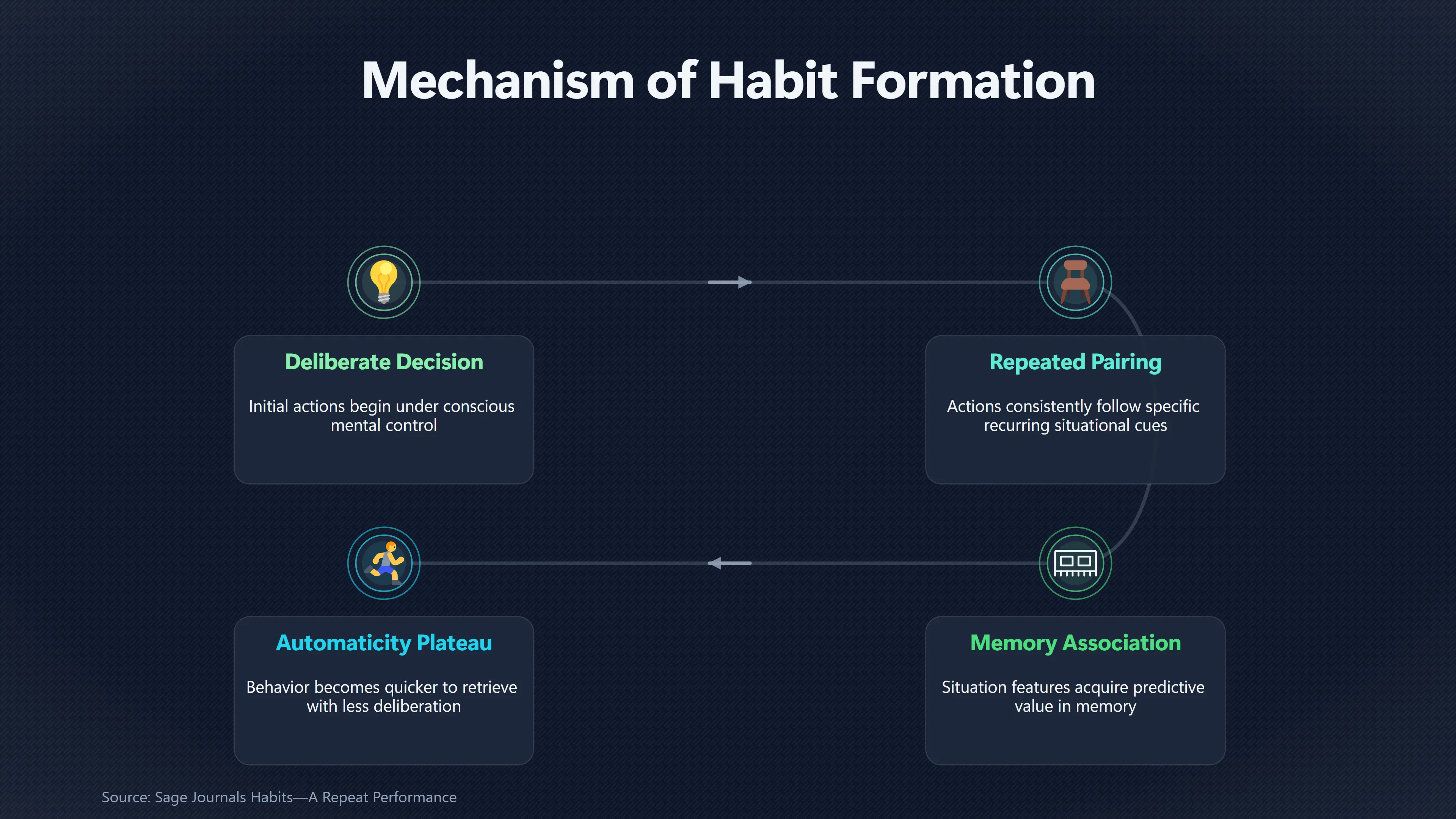
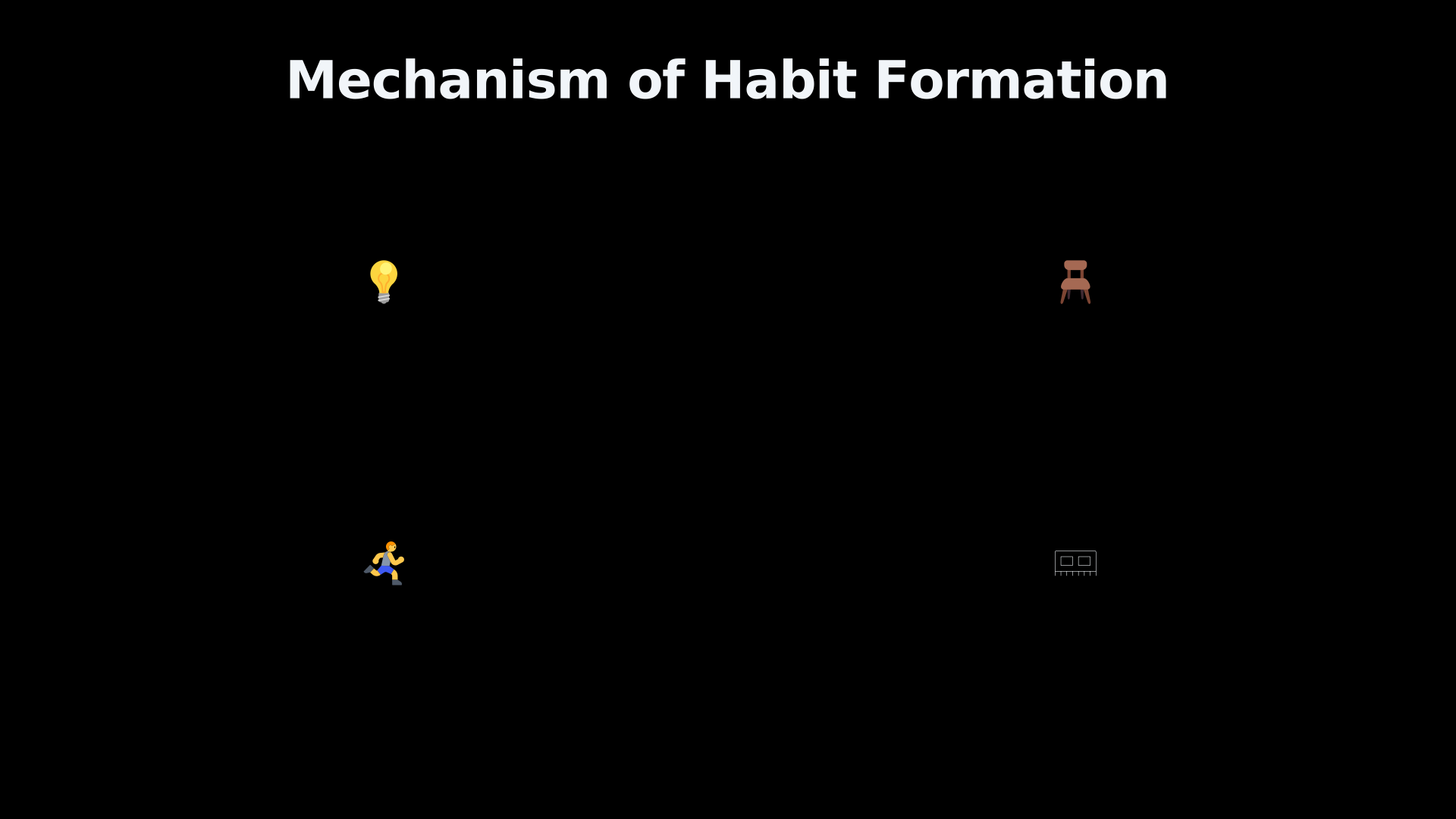
A new behaviour usually begins under deliberate control. You decide to read, practise a language or review tomorrow’s priorities, remember that decision at the relevant moment, and then make yourself start. Habit formation changes part of that sequence. Through repeated pairing, features of the situation become associated in memory with the response that has repeatedly followed them. Contemporary habit research therefore describes habits as forms of automaticity in which recurring contextual cues can activate previously learned responses.[PubMed Central (PMC)]pmc.ncbi.nlm.nih.govPubMed Central (PMC)A review and analysis of the use of ‘habit’ in understanding, predicting and influencing health-related behaviour - P…
Imagine deciding to read for ten minutes after breakfast. Initially, breakfast ending has little special relationship with reading: you have to remember your plan. If you repeatedly finish breakfast and then read, however, elements of that recurring situation can acquire predictive value. Finishing the meal, sitting in the same chair, seeing the book or simply reaching that point in the morning routine may increasingly activate the reading response.
That does not mean the environment literally forces the behaviour. Rather, the balance of control changes. The behaviour can become quicker to retrieve and less dependent on repeatedly asking, “Should I do this now?” Experiments examining established habits have found that strong habitual behaviours are particularly responsive to cues associated with their previous performance, including locations, while immediate goals exert less influence than people sometimes assume.[ScienceDirect]sciencedirect.comHow do habits guide behavior? Perceived and actual triggers of habits in daily life - ScienceDirect…
This explains why cue-specific repetition is more informative than repetition in the abstract. Drinking water twenty times in twenty unrelated circumstances gives you twenty performances, but relatively little repeated pairing with any one situation. Drinking water after the same recurring morning activity repeatedly gives both the behaviour and a recurring cue opportunities to become associated.
Research on a broad range of everyday behaviours supports this distinction. A study examining behavioural frequency, contextual stability and rewards found that contextual stability was independently associated with greater automaticity, alongside frequency and reward. The relationship also varied with perceived behavioural complexity, underlining that context is an ingredient in habit formation rather than a universal formula that produces identical results for every action.[PubMed Central (PMC)]pmc.ncbi.nlm.nih.govPubMed Central (PMC)Habits, Quick and Easy: Perceived Complexity Moderates the Associations of Contextual Stability and Rewards With Beha…
Stable contexts predict greater automaticity
One of the foundational real-world studies followed 96 volunteers who chose an eating, drinking or physical-activity behaviour and attempted to perform it daily in the same context, such as after breakfast, for 12 weeks. Automaticity generally increased with repetition towards a plateau rather than rising indefinitely at a constant rate. There was considerable individual variation, which is why the study’s often-repeated “66 days” figure should not be interpreted as a universal deadline for forming a habit.[Wiley Online Library]onlinelibrary.wiley.comWiley Online LibraryHow are habits formed: Modelling habit formation in the real world - Lally - 2010 - European Journal of Social Psycho…
That study demonstrated automaticity developing under consistent-context instructions, but it did not isolate context stability experimentally. A 2022 study by Marco Stojanovic, Axel Grund and Stefan Fries addressed that question more directly. In its first study, 95 university students completed 2,482 repetitions of newly chosen study habits over six weeks. One group was instructed to keep the place and time of performance stable, while another was instructed to vary rooms and times. The researchers also analysed a separate dataset covering 308 habits and 2,368 repetitions from 218 habit-building app users.[PubMed]pubmed.ncbi.nlm.nih.govContext Stability in Habit Building Increases Automaticity and Goal Attainment - PubMedJune 10, 2022…
Across the two datasets, greater context stability predicted greater automaticity and higher attainment of the goal set for each habit repetition. Automaticity partially mediated the relationship between context stability and goal attainment. In other words, the results were consistent with part of the practical advantage of a stable context coming from the behaviour becoming more automatic.[PubMed Central (PMC)]pmc.ncbi.nlm.nih.govPubMed Central (PMC)Context Stability in Habit Building Increases Automaticity and Goal Attainment - PMC…
There is an important qualification. The experimental results did not imply that every tiny increase in consistency produces an equal gain. In the group deliberately operating with highly variable places and times, the expected context-stability effect was not evident in the same way. The authors argued that a sufficiently recognisable stable context may first be needed before small variations in its stability become meaningful.[PubMed Central (PMC)]pmc.ncbi.nlm.nih.govPubMed Central (PMC)Context Stability in Habit Building Increases Automaticity and Goal Attainment - PMC…
Nor does every field study find a simple stability-to-habit relationship. An ecological momentary assessment study of physical activity and sedentary behaviour found relationships between context stability and behaviour, but its context-stability measures did not predict habit strength. The researchers concluded that the behavioural associations they observed did not appear to be explained by habit.[PubMed]pubmed.ncbi.nlm.nih.govThe influence of context stability on physical activity and sedentary behaviour habit and behaviour: An ecological momentary assess… This is a useful limit on the claim: stable contexts are well supported as part of habit learning, but their effects depend on how context, behaviour and automaticity are defined and measured.

The cue can be a routine, not just a clock
“Same context” does not necessarily mean “exactly 7.15 am in exactly the same chair”. Context can contain physical location, preceding actions, other people, time of day and other recurring features. For practical habit building, a particularly useful distinction is between a clock-time cue — “at 8 am” — and an event or routine cue — “after breakfast”.[PubMed Central (PMC)]pmc.ncbi.nlm.nih.govPubMed Central (PMC)Context Stability in Habit Building Increases Automaticity and Goal Attainment - PMC…
A randomised trial involving 192 adults compared these approaches for self-selected healthy eating behaviours. Participants linked their behaviour either to a daily routine or to a specific time and were followed with daily questionnaires for 84 days. Automaticity increased in both conditions, with no significant advantage for routine-based over time-based cues. What mattered strongly was plan enactment: people who repeatedly carried out the behaviour when their selected cue occurred were more likely to develop automaticity.[BPS PsycHub]bpspsychub.onlinelibrary.wiley.comBPS PsycHubHabit formation following routine‐based versus time‐based cue planning: A randomized controlled trial - Keller - 2021 - Britis…
Among participants whose individual trajectories met the study’s criterion for successful habit formation, the median modelled time to reach 95% of peak automaticity was 59 days, but estimates ranged enormously, from 4 to 335 days. Again, the practical lesson is not to count down towards a supposed magic day. It is to accumulate repetitions linked to a sufficiently dependable cue.[DOI]doi.orgHabit formation following routine‐based versus time‐based cue planning: A randomized controlled trial - Keller - 2021 - British Journa…
Routine cues can also solve a practical problem with exact clock times: ordinary life moves around. “After I make my morning coffee” can remain recognisable whether that happens at 7.10 or 8.20. A routine therefore allows chronological flexibility while preserving the important relationship — this recurring situation is followed by this response. The randomised trial does not establish that routine cues are universally superior, but it does show that an exact time is not necessary for automaticity to develop.[BPS PsycHub]bpspsychub.onlinelibrary.wiley.comBPS PsycHubHabit formation following routine‐based versus time‐based cue planning: A randomized controlled trial - Keller - 2021 - Britis…
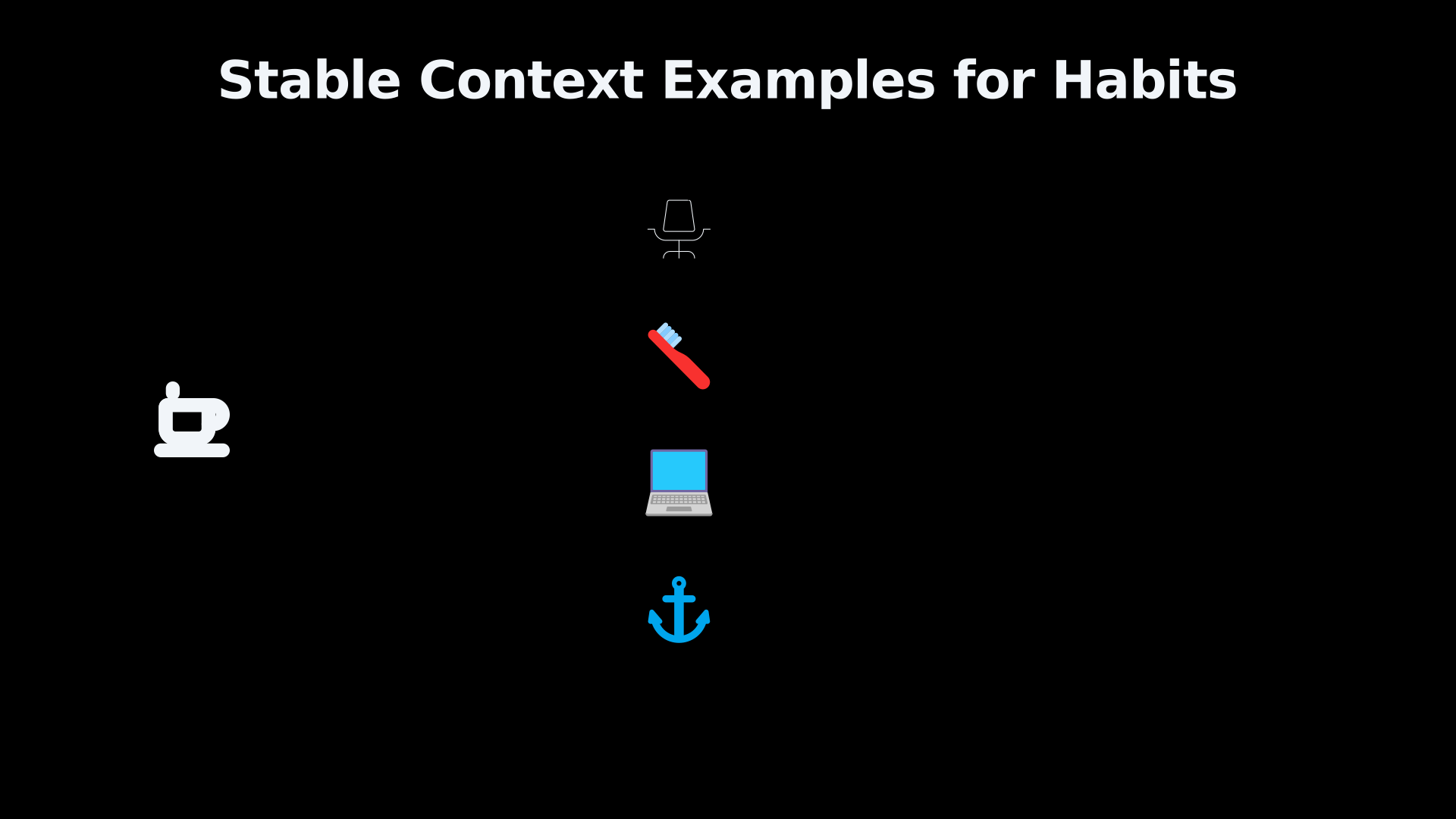
For a self-improvement habit, useful stable contexts might therefore look like:
- reviewing vocabulary after making the first morning drink;
- writing for ten minutes after sitting down at the home desk;
- stretching after brushing your teeth in the evening;
- planning tomorrow immediately after shutting down work for the day.
What these examples share is not rigid timing but a repeatable relationship between a recognisable situation and one particular response.
Why changing context can expose the habit
One of the clearest demonstrations of contextual control comes from what happens when familiar circumstances disappear. Wendy Wood and colleagues studied students transferring to a new university and examined behaviours including exercising, reading newspapers and watching television. Established habits were more likely to survive the move when relevant aspects of their performance context remained stable. When those contexts changed, habitual performance was disrupted and, in some cases, behaviour became more responsive to people’s current intentions.[PubMed]pubmed.ncbi.nlm.nih.govPub Med Changing circumstances, disrupting habitsChanging circumstances, disrupting habits - PubMed…
This “habit discontinuity” effect helps explain an everyday experience: a routine that seemed effortless at home can suddenly require thought while travelling, after moving house or following a change in working arrangements. The behaviour has not necessarily been erased. Some of the cues that reliably elicited it are simply absent.
That observation also sharpens what automaticity means. A well-established behaviour is not necessarily something that happens effortlessly everywhere. It may be easy precisely because the familiar environment is doing part of the triggering. Habit researchers have consequently emphasised that habitual responses are tied to contexts that repeatedly accompanied their previous performance.[Association for Psychological Science]psychologicalscience.orgAssociation for Psychological Science Habits—A Repeat PerformanceAssociation for Psychological ScienceHabits—A Repeat Performance - Current Directions in Psychological Science - APSAugust 1, 2006…
The same property that makes stable contexts useful during formation can therefore make a habit somewhat context-dependent. This is not a reason to avoid consistency. For a behaviour that is still difficult to initiate, dependable contextual support can be valuable. It is simply a reason not to confuse “automatic here” with “automatic under all possible circumstances”.
Keep consistency without making life rigid
The research points towards repeatable context, not perfect repetition of every environmental detail. Trying to reproduce an entire situation exactly can make a habit unnecessarily fragile and turn habit building into another demanding project.
A better approach is to identify the contextual feature that is genuinely dependable. For someone with regular mornings, that could be breakfast. For someone whose working hours move around, an exact time may be unreliable while “after I open my laptop for work” remains consistent. For another person, location may be the strongest anchor: sitting at a particular desk can reliably precede study even when the time varies.
This distinction matters because the evidence suggests that both time-based and routine-based cues can support automaticity. The crucial behavioural work is repeatedly enacting the intended response when the chosen cue appears.[BPS PsycHub]bpspsychub.onlinelibrary.wiley.comBPS PsycHubHabit formation following routine‐based versus time‐based cue planning: A randomized controlled trial - Keller - 2021 - Britis… Habit-formation guidance published in the British Journal of General Practice similarly distils the learning process to repeating a chosen action in the same context so that the context-behaviour association strengthens and initiation becomes less dependent on conscious attention.[PubMed Central (PMC)]pmc.ncbi.nlm.nih.govPubMed Central (PMC)Making health habitual: the psychology of ‘habit-formation’ and general practice - PMCDecember 1, 2012…
Consistency also need not mean perfection. In Lally and colleagues’ longitudinal work, missing a single opportunity did not materially derail the habit-formation process.[Wiley Online Library]onlinelibrary.wiley.comWiley Online LibraryHow are habits formed: Modelling habit formation in the real world - Lally - 2010 - European Journal of Social Psycho… That makes the useful target repeated pairing rather than an unbroken streak. If Tuesday goes wrong, Wednesday can still provide another instance of the same cue followed by the same response.
There is therefore a productive middle ground between chaos and rigidity. Early in habit formation, make the context specific enough to be recognisable and stable enough to recur. Allow normal variation that does not destroy the basic cue-response relationship. As automaticity develops, starting the behaviour should require less deliberate prompting — which is precisely the advantage stable contexts are meant to create.
The practical takeaway
Stable contexts work because they give repeated behaviour something dependable to attach to. Each successful repetition in relation to the same cue is another opportunity to strengthen the association between “this situation” and “this response”. Over time, encountering the situation can increasingly help initiate the behaviour without the same amount of remembering, deliberating or motivating yourself.[ScienceDirect]sciencedirect.comHow do habits guide behavior? Perceived and actual triggers of habits in daily life - ScienceDirect…
For self-improvement, that suggests a more useful question than “How can I become disciplined enough to do this every day?” Ask instead: “What recurring moment in my existing life could reliably become the place where this behaviour begins?” The answer might be a time, a location or, often most conveniently, an event already embedded in the day.
The evidence does not support treating context stability as a guarantee, nor does it justify rigid schedules or universal claims about how many days habits take to form. It supports a narrower and more useful conclusion: when a desired action is repeatedly performed in a sufficiently stable situation, the recurring context can gradually acquire greater control over its initiation, making the behaviour increasingly automatic.
Amazon book picks
Further Reading
Books and field guides related to Why Repeating a Habit in the Same Context Helps. Use these as the next step if you want deeper reading beyond the article.
Atomic Habits
Rating: 3.5/5 from 7 Google Books ratings
The #1 New York Times bestseller. Over 25 million copies sold! Translated into 60+ languages! Tiny Changes, Remarkable Results No matter...

The Power of Habit
Rating: 4.0/5 from 145 Google Books ratings
Duhigg takes us to the edge of scientific discoveries that explain why habits exist and how they can be changed. Distilling information i...
Tiny Habits
Improving your life is much easier than you think. Whether it’s losing weight, sleeping more, or restoring your work/life balance – the s...
Good Habits, Bad Habits
'The world's leading expert on habits' - Matthew Syed, bestselling author of Black Box Thinking and Rebel IdeasWhat if you could harness...
eBay marketplace picks
Marketplace Samples
Live-tested eBay searches with available results related to this page.
Selected frommotivational poster oneBay.co.uk.



Endnotes
1.
Source: sciencedirect.com
Link:https://www.sciencedirect.com/science/article/pii/S002210311100254X
Source snippet
How do habits guide behavior? Perceived and actual triggers of habits in daily life - ScienceDirect...
2.
Source: onlinelibrary.wiley.com
Link:https://onlinelibrary.wiley.com/doi/abs/10.1002/ejsp.674
Source snippet
Wiley Online LibraryHow are habits formed: Modelling habit formation in the real world - Lally - 2010 - European Journal of Social Psycho...
3.
Source: doi.org
Link:https://doi.org/10.1111/bjhp.12504
Source snippet
Habit formation following routine‐based versus time‐based cue planning: A randomized controlled trial - Keller - 2021 - British Journa...
4.
Source: bpspsychub.onlinelibrary.wiley.com
Link:https://bpspsychub.onlinelibrary.wiley.com/doi/abs/10.1111/bjhp.12504
Source snippet
BPS PsycHubHabit formation following routine‐based versus time‐based cue planning: A randomized controlled trial - Keller - 2021 - Britis...
5.
Source: journals.sagepub.com
Title: Sage Journals Habits—A Repeat Performance
Link:https://journals.sagepub.com/doi/10.1111/j.1467-8721.2006.00435.x
Source snippet
Sage JournalsHabits—A Repeat Performance - David T. Neal, Wendy Wood, Jeffrey M. Quinn, 2006...
6.
Source: pmc.ncbi.nlm.nih.gov
Link:https://pmc.ncbi.nlm.nih.gov/articles/PMC9226889/
Source snippet
PubMed Central (PMC)Context Stability in Habit Building Increases Automaticity and Goal Attainment - PMC...
7.
Source: pmc.ncbi.nlm.nih.gov
Link:https://pmc.ncbi.nlm.nih.gov/articles/PMC4566897/
Source snippet
PubMed Central (PMC)A review and analysis of the use of ‘habit’ in understanding, predicting and influencing health-related behaviour - P...
8.
Source: pmc.ncbi.nlm.nih.gov
Link:https://pmc.ncbi.nlm.nih.gov/articles/PMC6667662/
Source snippet
PubMed Central (PMC)Habits, Quick and Easy: Perceived Complexity Moderates the Associations of Contextual Stability and Rewards With Beha...
9.
Source: pubmed.ncbi.nlm.nih.gov
Link:https://pubmed.ncbi.nlm.nih.gov/35756236/
Source snippet
Context Stability in Habit Building Increases Automaticity and Goal Attainment - PubMedJune 10, 2022...
Published: June 10, 2022
10.
Source: pubmed.ncbi.nlm.nih.gov
Link:https://pubmed.ncbi.nlm.nih.gov/33502088/
Source snippet
The influence of context stability on physical activity and sedentary behaviour habit and behaviour: An ecological momentary assess...
11.
Source: pubmed.ncbi.nlm.nih.gov
Title: Pub Med Changing circumstances, disrupting habits
Link:https://pubmed.ncbi.nlm.nih.gov/15982113/
Source snippet
Changing circumstances, disrupting habits - PubMed...
12.
Source: psychologicalscience.org
Title: Association for Psychological Science Habits—A Repeat Performance
Link:https://www.psychologicalscience.org/journals/current-directions/j.1467-8721.2006.00435.x/
Source snippet
Association for Psychological ScienceHabits—A Repeat Performance - Current Directions in Psychological Science - APSAugust 1, 2006...
Published: August 1, 2006
13.
Source: pmc.ncbi.nlm.nih.gov
Link:https://pmc.ncbi.nlm.nih.gov/articles/PMC3505409/
Source snippet
PubMed Central (PMC)Making health habitual: the psychology of ‘habit-formation’ and general practice - PMCDecember 1, 2012...
Published: December 1, 2012
Additional References
14.
Source: frontiersin.org
Link:https://www.frontiersin.org/journals/psychology/articles/10.3389/fpsyg.2019.01556/full
Source snippet
FrontiersFrontiers | Habits, Quick and Easy: Perceived Complexity Moderates the Associations of Contextual Stability and Rewards With Beh...
15.
Source: youtube.com
Title: The Science of How Your Brain Forms Habits (and How to Take Control)
Link:https://www.youtube.com/watch?v=idhDz9miZ3w
Source snippet
Wendy Wood [habit automaticity]({{ 'habit-limits/' | relative_url }}) [context cues]({{ 'context-cues/' | relative_url }}) Habits - The Community Project...
16.
Source: youtube.com
Title: How Does Habit Formation Impact UX Design Choices
Link:https://www.youtube.com/watch?v=CbtvMTlEfwM
Source snippet
The Science of How Your Brain Forms Habits (and How to Take Control)...
17.
Source: youtube.com
Title: How Your Environment Quietly Controls Your Habits
Link:https://www.youtube.com/watch?v=uGWELW82Eoc
Source snippet
How Does Habit Formation Impact UX Design Choices...
18.
Source: youtube.com
Title: The Science of Making & Breaking Habits
Link:https://www.youtube.com/watch?v=Wcs2PFz5q6g
Source snippet
How Your Environment Quietly Controls Your Habits...
19.
Source: youtube.com
Title: The Science of Good and Bad Habits with Dr. Wendy Wood
Link:https://www.youtube.com/watch?v=h71_r9ocI3A
Source snippet
The Science of Making & Breaking Habits...