Within Sleep and Focus
When Sleep Loss Hits Attention Hardest
The same amount of sleep restriction can produce different vigilance deficits depending on when during the day attention is tested.
On this page
- Why morning vigilance can deteriorate more sharply
- How circadian alerting can mask sleep loss effects
- What timing means for demanding daily tasks
Page outline Jump by section
Introduction
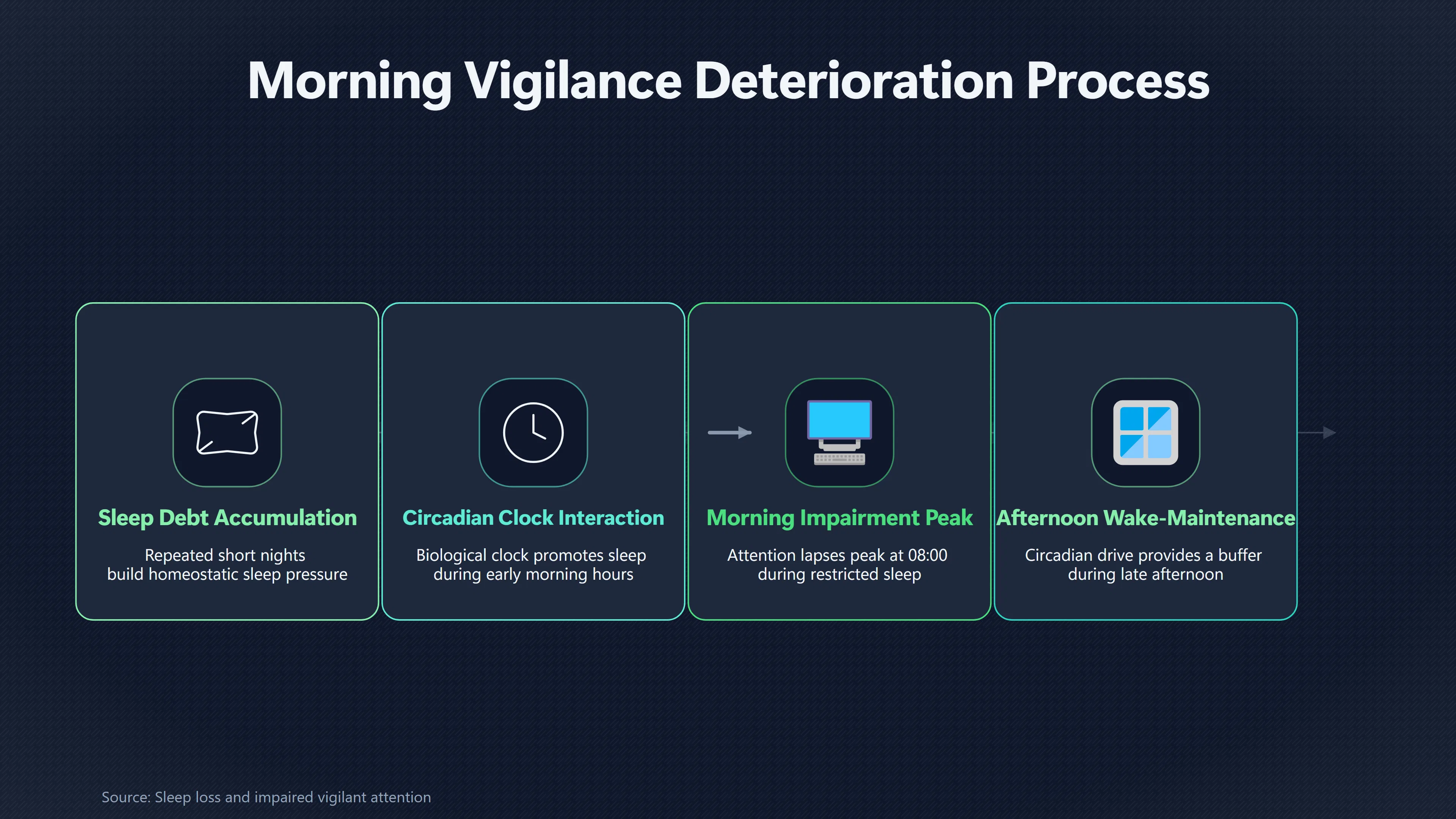
Sleep restriction does not impair attention by the same amount at every hour of the day. The clearest laboratory evidence suggests that, after repeated short nights, sustained-attention failures can be much more visible in the morning and substantially less visible in the late afternoon or early evening. In one controlled study, after eight days restricted to four hours of sleep per day, participants averaged 8.3 more psychomotor vigilance test (PVT) lapses at 08:00 than at 18:00.[PubMed]pubmed.ncbi.nlm.nih.govTime of day effects on neurobehavioral performance during chronic sleep restriction - PubMed…
This matters because an afternoon period of apparently good concentration does not necessarily mean that insufficient sleep has done little harm. Circadian alerting can temporarily support performance even while sleep debt remains. Conversely, the first hours of the morning can expose impairment particularly strongly, especially when a person’s biological clock is still promoting sleep. For practical self-improvement, the useful question is therefore not simply “How much sleep did I get?” but also “When am I asking my attention to perform?”
Why morning vigilance can deteriorate more sharply
A particularly informative experiment followed 90 healthy adults aged 21–49 during a 14-day laboratory protocol. Participants were assigned to different sleep schedules providing between 4.2 and 8.2 hours of total daily sleep opportunity, sometimes divided between night-time sleep and a daytime nap. During ten days of restricted sleep, researchers administered the PVT every two hours during scheduled wakefulness. The PVT measures sustained attention by recording unusually slow responses, or “lapses”, to unpredictable stimuli.[PubMed]pubmed.ncbi.nlm.nih.govTime of day effects on neurobehavioral performance during chronic sleep restriction - PubMed…
The amount of sleep mattered, but so did the clock. With less sleep, deficits accumulated more rapidly across successive days, yet this deterioration was strongest at 08:00. The rate became progressively smaller later in the day and was particularly reduced between 16:00 and 20:00. After eight days at roughly four hours of sleep a day, the difference between 08:00 and 18:00 reached 8.3 additional PVT lapses.[PubMed]pubmed.ncbi.nlm.nih.govTime of day effects on neurobehavioral performance during chronic sleep restriction - PubMed…
Crucially, the researchers had excluded tests performed immediately after nocturnal sleep or a nap from their main analysis, specifically to avoid simply measuring sleep inertia — the temporary grogginess immediately after waking. Their analysed morning tests began at 08:00 rather than immediately upon awakening. That strengthens the interpretation that the morning disadvantage was not merely a few minutes of post-sleep sluggishness.[ResearchGate]researchgate.netOpen source on researchgate.net.
Other work nevertheless shows that sleep inertia can add another layer of morning vulnerability. In a study measuring vigilant attention during partial chronic sleep restriction, PVT lapses were generally highest during the morning session and declined later in the day. Differences between the sleep-restricted and control groups were significant in the morning and at midday but not in the afternoon. The investigators considered stronger sleep inertia in the restricted group an important contributor to the early-morning result.[PubMed Central (PMC)]pmc.ncbi.nlm.nih.govPubMed Central (PMC)Heart Rate Variability for Evaluating Vigilant Attention in Partial Chronic Sleep Restriction - PMCJuly 1, 2014…
So “morning” can contain several overlapping disadvantages: residual sleep inertia soon after waking, accumulated pressure from inadequate prior sleep, and a biological clock that may not yet be supplying its strongest wake-promoting signal. Which component dominates depends on precisely when someone wakes, when they are tested and where that wake time falls within their own circadian cycle.
How circadian alerting can mask sleep-loss effects
Human alertness reflects at least two interacting processes. Homeostatic sleep pressure builds while we are awake and is reduced by sleep. The circadian system, meanwhile, produces a roughly 24-hour rhythm that promotes sleep at some biological times and wakefulness at others. Performance at any particular moment reflects their combined influence rather than sleep duration alone.[PubMed Central (PMC)]pmc.ncbi.nlm.nih.govPubMed Central (PMC)Sleep deprivation, vigilant attention, and brain function: a review - PMCJune 8, 2019…
That interaction produces a counter-intuitive pattern. After inadequate sleep, someone may perform poorly in the morning but improve during the afternoon even though they have now been awake for longer. A major review of vigilant-attention research describes the afternoon as relatively protected during sustained sleep restriction because the circadian drive for wakefulness partially counteracts rising homeostatic sleep pressure. This period is sometimes called the wake-maintenance zone.[PubMed Central (PMC)]pmc.ncbi.nlm.nih.govPubMed Central (PMC)Sleep deprivation, vigilant attention, and brain function: a review - PMCJune 8, 2019…
The effect is not merely a feature of partial sleep restriction. During prolonged total sleep deprivation, vigilance typically becomes particularly poor during the biological morning and can then improve during the subsequent afternoon despite the person having accumulated still more time awake. This apparent recovery is therefore not evidence that the underlying need for sleep has disappeared. It reflects the changing balance between sleep pressure and circadian support.[PubMed Central (PMC)]pmc.ncbi.nlm.nih.govPubMed Central (PMC)Sleep deprivation, vigilant attention, and brain function: a review - PMCJune 8, 2019…
That distinction is important outside the laboratory. A productive spell late in a sleep-deprived afternoon can create the impression that a short night “didn’t affect me much”. The evidence supports a narrower conclusion: performance at that particular circadian phase may be partially protected. It does not follow that attention would have been equally reliable earlier in the day, overnight, or after additional days of restriction.
There are also limits to the afternoon-protection idea. Circadian effects vary with the task, the amount of prior wakefulness and the severity of sleep debt. In forced-desynchrony experiments — protocols designed to separate biological time from time spent awake — simulated driving deteriorated independently with poor circadian timing, extended wakefulness and reduced sleep. More importantly, those factors interacted: combining sleep debt or long prior wakefulness with the early biological morning produced particularly poor driving performance.[PubMed]pubmed.ncbi.nlm.nih.govSimulated driving under the influence of extended wake, time of day and sleep restriction - PubMedMarch 1, 2012…
The circadian boost should therefore be understood as a buffer, not immunity. Even during a relatively favourable biological period, sufficiently severe sleep restriction can still impair performance.
Clock time is not the same as biological time
An 08:00 test does not occur at precisely the same biological time for everyone. People’s internal circadian phases differ, so two people who wake at the same clock time may be waking at different points in their biological night-to-day transition.
A study of 43 healthy young adults illustrates why this matters. After two nights of sleep restriction, participants completed a PVT two hours after waking. Researchers also measured dim-light melatonin onset (DLMO), a standard laboratory marker of circadian phase. Later melatonin timing — meaning participants had awakened at an earlier point in their internal circadian cycle — was associated with more PVT lapses, greater subjective sleepiness and more slow eye movements, an objective sign of drowsiness.[PubMed]pubmed.ncbi.nlm.nih.govOpen source on nih.gov.
The result helps explain why a fixed rule such as “never do important work before 10:00” is too crude. Morning risk depends partly on the relationship between the work period, habitual sleep timing and internal circadian phase. A late-timed person forced to wake early after restricted sleep may face a different attentional burden from someone whose biological clock is already strongly promoting wakefulness at the same wall-clock hour.[PubMed]pubmed.ncbi.nlm.nih.govOpen source on nih.gov.
Nor does every attention measure follow an identical daily curve. Complex visual-search research has found independent influences of circadian phase and time awake on task speed, while chronic sleep restriction affected speed more clearly than accuracy. This is a useful warning against treating “attention” as a single number: time-of-day effects depend partly on what the task actually demands and which performance measure is examined.[PubMed]pubmed.ncbi.nlm.nih.govOpen source on nih.gov.
Recent experimental work also reinforces how tightly sleep loss and circadian timing are intertwined. A 2025 laboratory study of 72 young adults deliberately shifted restricted sleep into different circadian portions of the day. The rate at which PVT impairment accumulated differed substantially according to where sleep was placed, providing further evidence that the consequences of a given sleep opportunity cannot be understood purely by counting its hours. Because this finding currently comes from a conference-supplement abstract rather than a full peer-reviewed report, its detailed implications should be treated as provisional.[OUP Academic]academic.oup.comOpen source on oup.com.
What timing means for demanding daily tasks
For everyday planning, the evidence supports a risk-management approach rather than an attempt to find a universally “optimal” hour. After inadequate sleep, the most sensible assumption is that sustained attention may be especially unreliable during the biological morning, while an afternoon improvement may conceal rather than erase the underlying sleep-related deficit.
That matters most for tasks where a brief lapse has disproportionate consequences. Reviews of occupational performance identify sleep restriction as particularly relevant to low-stimulation vigilance work and to demanding tasks that require flexible allocation of attention and working memory.[PubMed]pubmed.ncbi.nlm.nih.govOpen source on nih.gov. Driving studies provide a concrete example: under sleep restriction, circadian phase, prior wakefulness and accumulated sleep debt interact rather than operating as isolated risk factors. One controlled study found sleep-restriction effects on simulated driving to be strongest around the circadian low point.[PubMed]pubmed.ncbi.nlm.nih.govOpen source on nih.gov.
For ordinary self-management, three practical distinctions follow:
- After a short night, protect the early part of the day when possible. Avoid assuming that being technically awake means vigilance has fully recovered. For work that depends on prolonged monitoring, proofreading, repetitive checking or rapid detection of rare events, an early-morning session may expose sleep-loss deficits particularly strongly.
- Treat an afternoon rebound cautiously. Feeling and performing better later can be genuine, but circadian wake promotion may be temporarily compensating for sleep pressure. It is not evidence that the lost sleep has been repaid.[PubMed Central (PMC)]pmc.ncbi.nlm.nih.govPubMed Central (PMC)Sleep deprivation, vigilant attention, and brain function: a review - PMCJune 8, 2019…
- For safety-critical activity, timing is not an adequate countermeasure for insufficient sleep. Moving a demanding task to a more favourable circadian period may reduce one source of vulnerability, but it cannot reliably neutralise substantial sleep debt, especially when long hours awake are added to it.[PubMed]pubmed.ncbi.nlm.nih.govSimulated driving under the influence of extended wake, time of day and sleep restriction - PubMedMarch 1, 2012…
There is an important difference here between scheduling for productivity and scheduling for safety. If a non-urgent concentration task can be moved from a demonstrably poor personal period to a better one after an occasional short night, timing may improve the odds of reliable performance. Driving, operating equipment or other consequential work requires a higher standard: the evidence on circadian modulation should not be interpreted as identifying a “safe hour” at which serious sleep loss ceases to matter.
The useful lesson: judge sleep loss across the day
Time of day explains an apparent contradiction familiar to many people: after restricted sleep, concentration can be dreadful at one point and surprisingly normal a few hours later. Controlled studies show that this fluctuation can be real. Sustained-attention deficits from repeated sleep restriction are often expressed most strongly in the morning, while circadian wake promotion can provide partial protection later in the day.[PubMed]pubmed.ncbi.nlm.nih.govTime of day effects on neurobehavioral performance during chronic sleep restriction - PubMed…
For self-improvement, that changes how a short night should be evaluated. Do not judge the effect of inadequate sleep from one productive afternoon, and do not assume that every waking hour carries identical attentional risk. Sleep dose, time awake, biological time and individual circadian phase all help determine when the deficit becomes visible.
The practical priority remains adequate sleep. But when sleep has already been curtailed, task timing becomes part of attention management: recognise the morning as a potentially vulnerable period, use favourable hours for demanding but deferrable work where possible, and never mistake a circadian upswing in alertness for recovery from the underlying sleep loss.
Amazon book picks
Further Reading
Books and field guides related to When Sleep Loss Hits Attention Hardest. Use these as the next step if you want deeper reading beyond the article.
Why We Sleep
"Sleep is one of the most important but least understood aspects of our life, wellness, and longevity ... An explosion of scientific disc...
The Sleep Solution
With cutting-edge sleep science and time-tested techniques, The Sleep Solution will help anyone achieve healthy sleep and eliminate pills...
The Circadian Code
Change your daily routine, transform your health. Circadian rhythms are biological processes or clocks that exist in each one of our cell...
The Promise of Sleep
Sleep better, live longer with the groundbreaking information and step-by-step program in this revolutionary book. Healthful sleep has be...
eBay marketplace picks
Marketplace Samples
Live-tested eBay searches with available results related to this page.
Selected fromsleep accessories oneBay.co.uk.

Endnotes
1.
Source: researchgate.net
Link:https://www.researchgate.net/publication/45492707_Time_of_Day_Effects_on_Neurobehavioral_Performance_During_Chronic_Sleep_Restriction
2.
Source: academic.oup.com
Link:https://academic.oup.com/sleep/article/48/Supplement_1/A6/8134952
3.
Source: academic.oup.com
Link:https://academic.oup.com/sleep/article/44/7/zsab008/6092754
4.
Source: academic.oup.com
Link:https://academic.oup.com/sleep/article/49/7/zsag054/8500994
5.
Source: researchgate.net
Title: Sleep loss and impaired vigilant attention
Link:https://www.researchgate.net/publication/399311464_Sleep_loss_and_impaired_vigilant_attention
6.
Source: academic.oup.com
Link:https://academic.oup.com/sleepadvances/article-abstract/doi/10.1093/sleepadvances/zpaf046/8209744
7.
Source: academic.oup.com
Link:https://academic.oup.com/sleep/article/48/Supplement_1/A7/8135172
8.
Source: academic.oup.com
Link:https://academic.oup.com/sleep/article/47/Supplement_1/A62/7654170
9.
Source: academic.oup.com
Link:https://academic.oup.com/sleepadvances/article/doi/10.1093/sleepadvances/zpac038/6764767
10.
Source: academic.oup.com
Link:https://academic.oup.com/sleepadvances/article/3/1/zpac038/6764767
11.
Source: academic.oup.com
Link:https://academic.oup.com/sleep/article/45/9/zsac167/6648493
12.
Source: academic.oup.com
Link:https://academic.oup.com/sleep/article/45/1/zsab220/6358036
13.
Source: academic.oup.com
Link:https://academic.oup.com/sleep/article/44/11/zsab161/6312566
14.
Source: academic.oup.com
Link:https://academic.oup.com/sleep/article/44/11/zsab144/6295504
15.
Source: researchgate.net
Title: (PDF) Sleep deprivation, vigilant attention, and brain function: a review
Link:https://www.researchgate.net/publication/333668941_Sleep_deprivation_vigilant_attention_and_brain_function_a_review
16.
Source: academic.oup.com
Link:https://academic.oup.com/sleep/article/42/5/zsz032/5307024
17.
Source: academic.oup.com
Link:https://academic.oup.com/sleep/article-abstract/41/12/zsy177/5088074
18.
Source: academic.oup.com
Link:https://academic.oup.com/sleep/article-pdf/doi/10.1093/sleep/zsy148/25904599/zsy148.pdf
19.
Source: academic.oup.com
Link:https://academic.oup.com/sleep/article-abstract/40/suppl_1/A14/3780914
20.
Source: academic.oup.com
Link:https://academic.oup.com/sleep/article/40/suppl_1/A94/3781476
21.
Source: researchgate.net
Link:https://www.researchgate.net/publication/279159724_Inter-Individual_Differences_in_Neurobehavioural_Impairment_following_Sleep_Restriction_Are_Associated_with_Circadian_Rhythm_Phase
22.
Source: researchgate.net
Link:https://www.researchgate.net/figure/Model-based-projections-of-time-of-day-specifi-c-performance-impairment-plotted-against_fig2_45492707
23.
Source: researchgate.net
Link:https://www.researchgate.net/figure/Response-surface-maps-of-the-time-of-day-specifi-c-daily-rate-of-change-in-psychomotor_fig1_45492707
24.
Source: researchgate.net
Link:https://www.researchgate.net/figure/Sleepiness-measures-two-hours-after-waking-following-two-nights-of-sleep-restriction-as_fig3_279159724
25.
Source: researchgate.net
Link:https://www.researchgate.net/publication/51469185_Sleep_Wake_and_Phase_Dependent_Changes_in_Neurobehavioral_Function_under_Forced_Desynchrony
26.
Source: researchgate.net
Title: Errors and Accidents | Request PDFView Show
Link:https://www.researchgate.net/publication/286566422_Errors_and_Accidents
27.
Source: researchgate.net
Link:https://www.researchgate.net/publication/391882841_0014_The_Circadian_Timing_of_Sleep_Affects_the_Rate_of_Accumulation_of_Objective_Neurobehavioral_Impairment_Across_Days_of_Sleep_Restriction
28.
Source: researchgate.net
Link:https://www.researchgate.net/publication/391888259_0016_The_Circadian_Timing_of_Sleep_Affects_the_Dynamics_of_Subjective_Sleepiness_Across_Days_of_Sleep_Restriction
29.
Source: pubmed.ncbi.nlm.nih.gov
Link:https://pubmed.ncbi.nlm.nih.gov/20681233/
Source snippet
Time of day effects on neurobehavioral performance during chronic sleep restriction - PubMed...
30.
Source: pmc.ncbi.nlm.nih.gov
Link:https://pmc.ncbi.nlm.nih.gov/articles/PMC4074968/
Source snippet
PubMed Central (PMC)Heart Rate Variability for Evaluating Vigilant Attention in Partial Chronic Sleep Restriction - PMCJuly 1, 2014...
Published: July 1, 2014
31.
Source: pmc.ncbi.nlm.nih.gov
Link:https://pmc.ncbi.nlm.nih.gov/articles/PMC6879580/
Source snippet
PubMed Central (PMC)Sleep deprivation, vigilant attention, and brain function: a review - PMCJune 8, 2019...
Published: June 8, 2019
32.
Source: pmc.ncbi.nlm.nih.gov
Title: Pub Med Central (PMC)Circadian Rhythms, Sleep Deprivation, and Human Performance
Link:https://pmc.ncbi.nlm.nih.gov/articles/PMC3963479/
Source snippet
PubMed Central (PMC)Circadian Rhythms, Sleep Deprivation, and Human Performance - PMC...
33.
Source: pubmed.ncbi.nlm.nih.gov
Title: Pub Med Sleep deprivation, vigilant attention, and brain function: a review
Link:https://pubmed.ncbi.nlm.nih.gov/31176308/
Source snippet
Sleep deprivation, vigilant attention, and brain function: a review - PubMed...
34.
Source: pubmed.ncbi.nlm.nih.gov
Link:https://pubmed.ncbi.nlm.nih.gov/22239933/
Source snippet
Simulated driving under the influence of extended wake, time of day and sleep restriction - PubMedMarch 1, 2012...
Published: March 1, 2012
35.
Source: pubmed.ncbi.nlm.nih.gov
Link:https://pubmed.ncbi.nlm.nih.gov/22621353/
Source snippet
Time-of-day mediates the influences of extended wake and sleep restriction on simulated driving - PubMed...
36.
Source: pubmed.ncbi.nlm.nih.gov
Link:https://pubmed.ncbi.nlm.nih.gov/26043207/
37.
Source: pmc.ncbi.nlm.nih.gov
Link:https://pmc.ncbi.nlm.nih.gov/articles/PMC4456409/
38.
Source: pubmed.ncbi.nlm.nih.gov
Link:https://pubmed.ncbi.nlm.nih.gov/22836655/
39.
Source: pmc.ncbi.nlm.nih.gov
Link:https://pmc.ncbi.nlm.nih.gov/articles/PMC4503214/
40.
Source: pubmed.ncbi.nlm.nih.gov
Link:https://pubmed.ncbi.nlm.nih.gov/33438751/
41.
Source: pubmed.ncbi.nlm.nih.gov
Link:https://pubmed.ncbi.nlm.nih.gov/26534845/
42.
Source: pubmed.ncbi.nlm.nih.gov
Link:https://pubmed.ncbi.nlm.nih.gov/42496248/
43.
Source: pmc.ncbi.nlm.nih.gov
Link:https://pmc.ncbi.nlm.nih.gov/articles/PMC13287481/
44.
Source: pmc.ncbi.nlm.nih.gov
Link:https://pmc.ncbi.nlm.nih.gov/articles/PMC13357512/
45.
Source: pubmed.ncbi.nlm.nih.gov
Link:https://pubmed.ncbi.nlm.nih.gov/40720754/
46.
Source: pmc.ncbi.nlm.nih.gov
Link:https://pmc.ncbi.nlm.nih.gov/articles/PMC11939000/
47.
Source: pmc.ncbi.nlm.nih.gov
Link:https://pmc.ncbi.nlm.nih.gov/articles/PMC12323393/
48.
Source: pmc.ncbi.nlm.nih.gov
Link:https://pmc.ncbi.nlm.nih.gov/articles/PMC11187988/
49.
Source: pmc.ncbi.nlm.nih.gov
Link:https://pmc.ncbi.nlm.nih.gov/articles/PMC10109842/
50.
Source: pubmed.ncbi.nlm.nih.gov
Link:https://pubmed.ncbi.nlm.nih.gov/37193280/
51.
Source: pmc.ncbi.nlm.nih.gov
Link:https://pmc.ncbi.nlm.nih.gov/articles/PMC9453627/
52.
Source: pmc.ncbi.nlm.nih.gov
Link:https://pmc.ncbi.nlm.nih.gov/articles/PMC8883919/
53.
Source: pubmed.ncbi.nlm.nih.gov
Link:https://pubmed.ncbi.nlm.nih.gov/33734527/
54.
Source: pmc.ncbi.nlm.nih.gov
Link:https://pmc.ncbi.nlm.nih.gov/articles/PMC8271199/
55.
Source: pmc.ncbi.nlm.nih.gov
Link:https://pmc.ncbi.nlm.nih.gov/articles/PMC7423117/
56.
Source: pubmed.ncbi.nlm.nih.gov
Link:https://pubmed.ncbi.nlm.nih.gov/32785281/
57.
Source: pubmed.ncbi.nlm.nih.gov
Link:https://pubmed.ncbi.nlm.nih.gov/31070769/
58.
Source: pmc.ncbi.nlm.nih.gov
Link:https://pmc.ncbi.nlm.nih.gov/articles/PMC6941712/
59.
Source: pmc.ncbi.nlm.nih.gov
Link:https://pmc.ncbi.nlm.nih.gov/articles/PMC6519907/
60.
Source: pubmed.ncbi.nlm.nih.gov
Link:https://pubmed.ncbi.nlm.nih.gov/30169703/?dopt=Abstract
61.
Source: pmc.ncbi.nlm.nih.gov
Link:https://pmc.ncbi.nlm.nih.gov/articles/PMC6054682/
62.
Source: pmc.ncbi.nlm.nih.gov
Link:https://pmc.ncbi.nlm.nih.gov/articles/PMC6003377/
63.
Source: pubmed.ncbi.nlm.nih.gov
Link:https://pubmed.ncbi.nlm.nih.gov/29126328/
64.
Source: pubmed.ncbi.nlm.nih.gov
Link:https://pubmed.ncbi.nlm.nih.gov/29148844/
65.
Source: pmc.ncbi.nlm.nih.gov
Link:https://pmc.ncbi.nlm.nih.gov/articles/PMC5578645/
66.
Source: pubmed.ncbi.nlm.nih.gov
Link:https://pubmed.ncbi.nlm.nih.gov/28522096/
67.
Source: pubmed.ncbi.nlm.nih.gov
Link:https://pubmed.ncbi.nlm.nih.gov/26691014/
68.
Source: pmc.ncbi.nlm.nih.gov
Link:https://pmc.ncbi.nlm.nih.gov/articles/PMC5225193/
69.
Source: pubmed.ncbi.nlm.nih.gov
Link:https://pubmed.ncbi.nlm.nih.gov/27078176/
70.
Source: pubmed.ncbi.nlm.nih.gov
Link:https://pubmed.ncbi.nlm.nih.gov/24636873/
71.
Source: pmc.ncbi.nlm.nih.gov
Link:https://pmc.ncbi.nlm.nih.gov/articles/PMC3832615/
72.
Source: pubmed.ncbi.nlm.nih.gov
Link:https://pubmed.ncbi.nlm.nih.gov/24260280/
73.
Source: pmc.ncbi.nlm.nih.gov
Link:https://pmc.ncbi.nlm.nih.gov/articles/PMC3601314/
74.
Source: pubmed.ncbi.nlm.nih.gov
Link:https://pubmed.ncbi.nlm.nih.gov/23585751/
75.
Source: pmc.ncbi.nlm.nih.gov
Link:https://pmc.ncbi.nlm.nih.gov/articles/3700596/
76.
Source: pmc.ncbi.nlm.nih.gov
Link:https://pmc.ncbi.nlm.nih.gov/articles/PMC3600847/
77.
Source: pmc.ncbi.nlm.nih.gov
Link:https://pmc.ncbi.nlm.nih.gov/articles/PMC3454374/
78.
Source: pmc.ncbi.nlm.nih.gov
Link:https://pmc.ncbi.nlm.nih.gov/articles/3454374/
79.
Source: pubmed.ncbi.nlm.nih.gov
Link:https://pubmed.ncbi.nlm.nih.gov/23029352/
80.
Source: pmc.ncbi.nlm.nih.gov
Link:https://pmc.ncbi.nlm.nih.gov/articles/PMC3119835/
81.
Source: pubmed.ncbi.nlm.nih.gov
Link:https://pubmed.ncbi.nlm.nih.gov/21463024/
82.
Source: onlinelibrary.wiley.com
Link:https://onlinelibrary.wiley.com/doi/10.1111/j.1365-2869.2010.00823.x/full
83.
Source: pubmed.ncbi.nlm.nih.gov
Link:https://pubmed.ncbi.nlm.nih.gov/15912483/
84.
Source: pubmed.ncbi.nlm.nih.gov
Link:https://pubmed.ncbi.nlm.nih.gov/12749545/
85.
Source: pubmed.ncbi.nlm.nih.gov
Link:https://pubmed.ncbi.nlm.nih.gov/11094140/
86.
Source: pubmed.ncbi.nlm.nih.gov
Link:https://pubmed.ncbi.nlm.nih.gov/9174413/
87.
Source: pubmed.ncbi.nlm.nih.gov
Link:https://pubmed.ncbi.nlm.nih.gov/9231952/
88.
Source: pubmed.ncbi.nlm.nih.gov
Link:https://pubmed.ncbi.nlm.nih.gov/19962331/
89.
Source: pubmed.ncbi.nlm.nih.gov
Link:https://pubmed.ncbi.nlm.nih.gov/12371787/
Additional References
90.
Source: rex.libraries.wsu.edu
Link:https://rex.libraries.wsu.edu/esploro/outputs/journalArticle/Time-of-day-effects-on-neurobehavioral/99900547348101842
Source snippet
WSU LibrariesTime of day effects on neurobehavioral performance during chronic sleep restriction - Washington State University...
91.
Source: youtube.com
Title: Master Your Sleep & Be More Alert When Awake
Link:https://www.youtube.com/watch?v=nm1TxQj9IsQ
Source snippet
Circadian rhythm sleep deprivation cognitive performance time of day Episode 175: Hans Van Dongen on how fatigue and sleep loss lead to c...
92.
Source: youtube.com
Link:https://www.youtube.com/watch?v=2fVOu_dzt04
Source snippet
What time of day do we have peak cognitive performance? | Dr. Satchin Panda...
93.
Source: youtube.com
Title: Hans P.A. Van Dongen, Modeling sleep loss and circadian misalignment
Link:https://www.youtube.com/watch?v=jVTMyj48SVU
Source snippet
Episode 175: Hans Van Dongen on how fatigue and sleep loss lead to cognitive deficits...
94.
Source: youtube.com
Title: What time of day do we have peak cognitive performance? | Dr. Satchin Panda
Link:https://www.youtube.com/watch?v=D3JpwenLNeo
Source snippet
Towards individualized predictions of human sleep and circadian timing...
95.
Source: nature.com
Link:https://www.nature.com/articles/s41598-024-78814-4
96.
Source: nature.com
Link:https://www.nature.com/articles/s44323-026-00083-3
97.
Source: nature.com
Link:https://www.nature.com/articles/s41598-018-29380-z
98.
Source: youtube.com
Title: Towards individualized predictions of human sleep and circadian timing
Link:https://www.youtube.com/watch?v=RxWwNPvh4gM
Source snippet
Master Your Sleep & Be More Alert When Awake...
99.
Source: biorxiv.org
Link:https://www.biorxiv.org/content/10.1101/641480v1.full