Within Adapt the Plan
Why Small Routine Changes Are Easier to Test
Changing one plausible source of friction at a time makes it easier to learn which redesign actually improves a failing routine.
On this page
- How to identify the smallest change that targets the failure
- Why changing several variables at once obscures what worked
- When repeated small tests justify a larger redesign
Page outline Jump by section
Introduction
When a routine keeps failing in the same way, the most useful response is usually not a complete reset. It is a minimum useful adjustment: the smallest practical change that plausibly targets the recurring point of failure while leaving enough of the routine unchanged to see whether the change helped. This turns redesign into a simple experiment rather than another burst of reinvention.
The principle is not that smaller changes are automatically better. It is that targeted changes are easier to interpret. Behaviour-change frameworks recommend diagnosing whether a problem lies in capability, opportunity or motivation and matching the intervention to that problem, while NICE guidance explicitly recommends reviewing goals in light of experience, tailoring interventions and using small, manageable changes to daily routines.[Springer]link.springer.comThe behaviour change wheel: A new method for characterising and designing behaviour change interventions | Implementation Science…
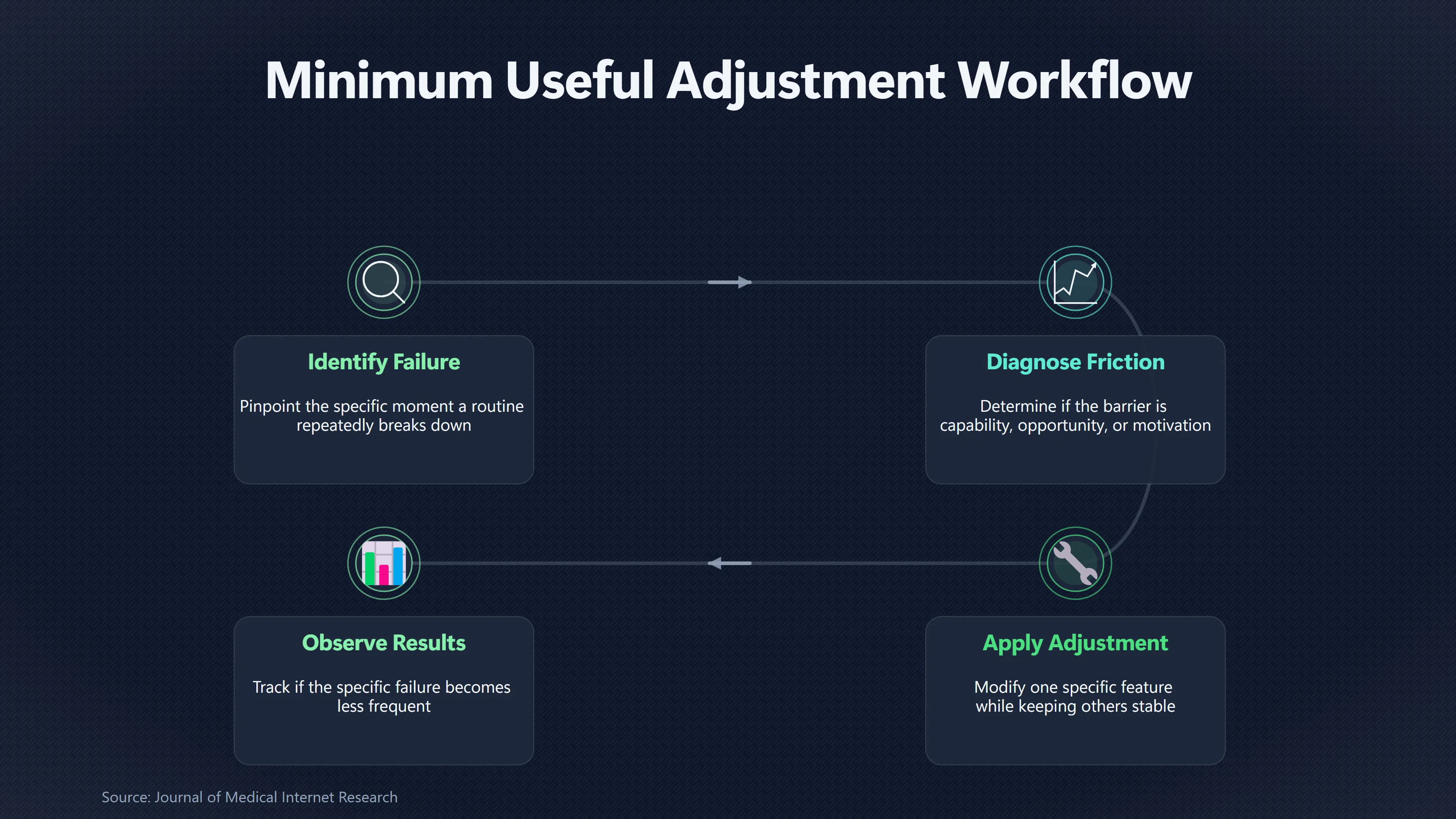
For a repeatedly failing routine, that suggests a practical rule: identify one plausible source of friction, change one relevant feature, keep the rest reasonably stable, and observe whether the same failure becomes less frequent. Escalate only when these focused tests stop producing useful improvements.
Find the smallest change that targets the failure
A minimum useful adjustment begins with a specific failure, not a vague judgement that the routine “isn’t working”. The useful question is: What repeatedly happens immediately before the routine breaks down?
The COM-B model provides a compact way of narrowing the possibilities. It treats behaviour as depending on capability — being able to perform it; opportunity — having a physical and social environment that permits it; and motivation — the reflective and automatic processes that energise or direct it. Importantly, the model links different diagnoses to different kinds of intervention rather than assuming that every behavioural problem needs more motivation.[Springer]link.springer.comThe behaviour change wheel: A new method for characterising and designing behaviour change interventions | Implementation Science…
For an ordinary routine, the diagnosis can be much simpler than the formal framework:
- The routine is forgotten: strengthen or relocate its cue. Instead of “read every evening”, try “after I put my dinner plate in the dishwasher, I read for ten minutes”.
- It starts but is repeatedly abandoned: reduce its minimum size. A planned 45-minute exercise session might become a 15-minute minimum rather than disappearing altogether on busy days.
- The timing repeatedly collides with something else: change the time while retaining the activity, place and target.
- Preparation creates the bottleneck: prepare the necessary equipment or materials in advance rather than changing the activity itself.
- A predictable obstacle defeats the plan: add one specific fallback rule for that obstacle.
- The environment keeps pulling behaviour elsewhere: alter the relevant part of the environment — for example, moving distracting devices rather than constructing an entirely new productivity system.
These are deliberately narrow interventions. Environmental restructuring, prompts, action plans and enablement are established categories within behaviour-change research; the important implementation decision is to select the one that corresponds to the observed barrier.[PubMed Central (PMC)]pmc.ncbi.nlm.nih.govPubMed Central (PMC)The behaviour change wheel: A new method for characterising and designing behaviour change interventions - PMC…
A useful test of “minimum” is therefore not whether the adjustment feels trivial. Ask instead: If my diagnosis is right, is this change large enough to affect the failure? Moving a workout from 18:00 to 17:45 is not useful if the recurring obstacle is an unpredictable commute lasting until 19:00. Moving it to the morning might be. The smallest intervention still has to reach the suspected cause.
Make the adjustment specific enough to test
Vague redesigns are difficult to evaluate because they leave considerable discretion at the moment when the old routine usually fails. “Try harder to study earlier” does not specify what will actually happen. “On weekdays, after breakfast, I will study at the kitchen table for 20 minutes” changes the situation more concretely.
Research on implementation intentions — plans linking a recognised situation to a predetermined response in an “if–then” structure — supports this kind of specificity. A major meta-analysis of 94 independent tests reported a medium-to-large overall effect on goal attainment. A much larger 2024 review covering 642 independent tests found positive effects across cognitive, emotional and behavioural outcomes, with stronger effects when plans used a contingent if–then format, motivation was high and the plans were rehearsed.[ScienceDirect]sciencedirect.comImplementation Intentions and Goal Achievement: A Meta‐analysis of Effects and Processes - ScienceDirect…
That evidence does not mean every failing routine can be repaired by writing an if–then sentence. It shows why a precise adjustment is more actionable than a general intention. If the recurring failure is “I skip the routine whenever the meeting runs late”, a testable adjustment might be: “If I am still at work at 18:00, I do the 15-minute version when I get home instead of cancelling the session.”
The change now contains an observable trigger and response. After several relevant occasions, it is possible to ask whether that rule actually improved completion. “Be more disciplined”, by contrast, provides almost nothing that can be tested or refined.
Why changing everything hides what worked
Suppose an evening study routine fails repeatedly. In response, someone simultaneously switches from evenings to mornings, changes rooms, buys a new planning app, reduces sessions from an hour to 25 minutes, starts using website blocking software and introduces a reward for completion.
If studying improves, what should be retained? The earlier time might have solved the problem. The shorter duration might have mattered. Perhaps removing online distraction did the work. Or the apparent improvement might simply reflect a temporary surge of attention associated with starting a new system.
This is the central informational advantage of minimum useful adjustments: fewer simultaneous changes reduce ambiguity about what produced the improvement.
The logic resembles, without being equivalent to, single-case experimental research. Formal single-case designs repeatedly measure an individual’s behaviour while an intervention is systematically manipulated, allowing the individual to serve as their own control. Researchers use such designs precisely because repeated measurement and controlled changes can help isolate whether an intervention affected the target behaviour.[PubMed Central (PMC)]pmc.ncbi.nlm.nih.govPubMed Central (PMC)Single Case Experimental Design: A New Approach for Non-invasive Brain Stimulation Research? - PMCMay 31, 2021… Research on technology-based behavioural interventions likewise notes that single-case experiments can help isolate the active elements of a larger treatment package.[JMIR]jmir.orgJournal of Medical Internet ResearchJournal of Medical Internet Research - Single-Case Experimental Designs to Evaluate Novel Technology-Based Health InterventionsFebrua…
An everyday routine experiment is far less controlled and should not be mistaken for scientific proof. Sleep, workload, illness, weather, deadlines and countless other variables continue changing. But the experimental logic remains useful: if you alter six things simultaneously, you voluntarily discard much of your ability to learn from the outcome.
That matters beyond the first improvement. If the redesigned routine later deteriorates, knowing which adjustment previously helped makes further adaptation easier. A wholesale redesign leaves behind a package; a sequence of targeted tests leaves behind knowledge.
Keep stable what does not need fixing
Small-change testing works best when the unaffected parts of the routine remain reasonably consistent. This is especially important for routines intended to become habitual.
In a 2022 study of intentional habit formation, researchers examined 95 students completing 2,482 study-habit repetitions and a second dataset containing 308 habits from 218 app users. Greater context stability was associated with stronger automaticity and higher attainment of the repetition goal in both datasets. In the student study, participants were experimentally instructed either to maintain or vary the time and place of their new study routine.[PubMed Central (PMC)]pmc.ncbi.nlm.nih.govPubMed Central (PMC)Context Stability in Habit Building Increases Automaticity and Goal Attainment - PMCJune 10, 2022…
Earlier work on everyday habit formation similarly had participants repeat a chosen eating, drinking or activity behaviour in the same context over 12 weeks, illustrating the importance habit research places on repeated behaviour in a consistent setting.[Wiley Online Library]onlinelibrary.wiley.comOpen source on wiley.com. More recent longitudinal research also continues to identify context stability, repetition and perceived difficulty among factors associated with habit strength.[PubMed]pubmed.ncbi.nlm.nih.govOpen source on nih.gov.
This creates an important distinction. Stability is valuable when a feature is helping; change is valuable when a feature is the suspected bottleneck. If a reading routine reliably starts after breakfast but repeatedly fails because 40 pages is unrealistic, keep breakfast as the cue and test a smaller reading target. Changing the cue, place and target together destroys useful stability without demonstrating that those additional changes were necessary.
NICE’s behaviour-change guidance fits this approach: action plans should specify when, where, how often and for how long behaviour will occur, while goals should be reviewed in light of experience and subsequent plans adapted to previous progress. Its maintenance guidance also states that small, manageable changes to daily routines are most likely to be maintained.[Nice]nice.org.ukNice Recommendations | Behaviour change: individual approaches | Guidance | NICENice Recommendations | Behaviour change: individual approaches | Guidance | NICE
Judge the test by the failure it was meant to fix
A routine adjustment needs a success criterion tied to its diagnosis. Otherwise almost any outcome can be rationalised afterwards.
Consider a person who intends to write for 30 minutes after dinner but completes only two sessions in a typical five-day working week. Their records suggest that the main problem is starting: once they begin, they usually complete the session. The first experiment should therefore target initiation rather than duration.
They might replace “write sometime after dinner” with “when I put my dinner plate away, I open the document and write the first sentence”. For the next relevant set of weekdays, the main measure is not word count or writing quality. It is how often writing starts after the cue.
If starts rise substantially while completion remains satisfactory, the adjustment has addressed the diagnosed bottleneck. The routine can remain largely unchanged. If starts do not improve, the result is informative too: the cue was probably not sufficient, or the diagnosis was incomplete.
This is where monitoring earns its place. NICE treats feedback and monitoring alongside goals and planning, recommending that progress be reviewed and interventions tailored accordingly.[Nice]nice.org.ukNice Recommendations | Behaviour change: individual approaches | Guidance | NICENice Recommendations | Behaviour change: individual approaches | Guidance | NICE The purpose of tracking in this context is not to accumulate perfect personal data. It is to answer a decision question: Did the particular failure become less common after the particular change?
A lightweight record is normally enough: opportunity, attempted or not, completed or not, and the main reason for failure. The measure should remain simple enough that tracking does not become a second routine that fails.
Give each change enough repetitions to teach you something
Minimum adjustments can be taken too far. Changing a routine after every unsuccessful attempt produces a different form of instability: nothing remains in place long enough to reveal a pattern.
Habit formation is inherently repetitive rather than instantaneous. Lally and colleagues followed participants for 12 weeks while they repeated behaviours in consistent contexts, and later research has likewise examined habit development across many individual repetitions rather than judging it from isolated attempts.[Wiley Online Library]onlinelibrary.wiley.comOpen source on wiley.com.
The right test period therefore depends more on opportunities than arbitrary calendar time. A weekday routine generates five potential observations a week; a Saturday routine generates only one. An adjustment designed specifically for “days when I work late” cannot be assessed properly until enough late-working days have actually occurred.
There is no universal number of repetitions that proves an everyday adjustment works. Formal single-case research requires repeated measurements because one before-and-after observation is weak evidence; everyday self-improvement inherits the same basic caution without acquiring the certainty of an experiment.[PubMed Central (PMC)]pmc.ncbi.nlm.nih.govOpen source on nih.gov.
The practical goal is to avoid two errors: abandoning a promising change after one unlucky failure, and preserving an ineffective one indefinitely because it sounded sensible. Look for a repeatable shift in the specific outcome the intervention was designed to change.
When small tests should give way to a larger redesign
Small adjustments are a learning strategy, not a commitment to endless tinkering. Several unsuccessful targeted tests can themselves reveal that the problem is broader than one point of friction.
A larger redesign becomes reasonable when different minimum changes repeatedly fail despite plausible diagnoses, or when observations increasingly implicate several interacting conditions. The Behaviour Change Wheel explicitly treats capability, opportunity and motivation as parts of an interacting behavioural system rather than independent switches. Some failing routines therefore genuinely require more than one intervention function.[Springer]link.springer.comThe behaviour change wheel: A new method for characterising and designing behaviour change interventions | Implementation Science…
Imagine a planned 06:00 exercise routine. First, placing clothes beside the bed does not improve completion. Second, adding a clear alarm cue does not help. Third, reducing the workout to 15 minutes produces little improvement. Records consistently show that the person sleeps through alarms after late shifts and has no realistic control over those shifts.
At this point, another tiny adjustment to the morning routine has diminishing value. The accumulated tests have challenged the underlying assumption that early morning is a viable context at all. Moving exercise to a different part of the week is now a larger redesign supported by evidence rather than an impulsive reset.
The same escalation rule applies when a routine succeeds only through an expanding collection of exceptions, reminders and rescue plans. Complexity can become evidence that the basic design no longer fits the person’s circumstances.
The sequence matters: diagnose narrowly, change minimally, observe repeatedly, retain what works, then escalate when the accumulated failures justify it. That is the advantage of small routine changes within adaptive self-improvement. Their value is not merely that they are easier to perform. Each one can produce information about what the routine actually needs, allowing repeated failure to become a source of better design rather than a trigger for starting over.

Amazon book picks
Further Reading
Books and field guides related to Why Small Routine Changes Are Easier to Test. Use these as the next step if you want deeper reading beyond the article.
Tiny Habits
Improving your life is much easier than you think. Whether it’s losing weight, sleeping more, or restoring your work/life balance – the s...
Atomic Habits
Rating: 3.5/5 from 7 Google Books ratings
The #1 New York Times bestseller. Over 25 million copies sold! Translated into 60+ languages! Tiny Changes, Remarkable Results No matter...
How to Change
Wall Street Journal bestseller “A welcome revelation.” --The Financial Times Award-winning Wharton Professor and Choiceology podcast host...
The Progress Principle
Explains how to foster progress, shows how to remove obstacles, including meaningless tasks and toxic relationships that disrupt employee...
eBay marketplace picks
Marketplace Samples
Live-tested eBay searches with available results related to this page.
Selected frommotivational poster oneBay.co.uk.


Current eBay listing
Motivational Quotes Framed Wall Art Poster Canvas Print Picture


Current eBay listing
Gym Motivational Posters Work Out Insperational Quotes Wall Art
Endnotes
1.
Source: link.springer.com
Link:https://link.springer.com/article/10.1186/1748
Source snippet
The behaviour change wheel: A new method for characterising and designing behaviour change interventions | Implementation Science...
2.
Source: sciencedirect.com
Link:https://www.sciencedirect.com/science/article/abs/pii/S0065260106380021
Source snippet
Implementation Intentions and Goal Achievement: A Meta‐analysis of Effects and Processes - ScienceDirect...
3.
Source: jmir.org
Title: Journal of Medical Internet Research
Link:https://www.jmir.org/2013/2/e22
Source snippet
Journal of Medical Internet Research - Single-Case Experimental Designs to Evaluate Novel Technology-Based Health InterventionsFebrua...
4.
Source: onlinelibrary.wiley.com
Link:https://onlinelibrary.wiley.com/doi/10.1002/ejsp.674
5.
Source: bpspsychub.onlinelibrary.wiley.com
Link:https://bpspsychub.onlinelibrary.wiley.com/doi/10.1111/bjop.70065
6.
Source: onlinelibrary.wiley.com
Link:https://onlinelibrary.wiley.com/doi/10.1111/bjhp.70019
7.
Source: link.springer.com
Link:https://link.springer.com/article/10.1007/s10865-023-00455-1
8.
Source: bpspsychub.onlinelibrary.wiley.com
Link:https://bpspsychub.onlinelibrary.wiley.com/doi/10.1111/bjhp.12509
9.
Source: sciencedirect.com
Link:https://www.sciencedirect.com/science/article/pii/S1499404620302001
10.
Source: link.springer.com
Link:https://link.springer.com/article/10.1186/s12889
11.
Source: bpspsychub.onlinelibrary.wiley.com
Link:https://bpspsychub.onlinelibrary.wiley.com/doi/10.1111/bjc.12086
12.
Source: sciencedirect.com
Link:https://www.sciencedirect.com/science/article/pii/S155171441500004X
13.
Source: jmir.org
Title: Journal of Medical Internet Research
Link:https://www.jmir.org/2014/8/e192/
15.
Source: sciencedirect.com
Link:https://www.sciencedirect.com/science/article/pii/S0271531711000674
16.
Source: onlinelibrary.wiley.com
Link:https://onlinelibrary.wiley.com/doi/full/10.1002/ejsp.674
17.
Source: onlinelibrary.wiley.com
Link:https://onlinelibrary.wiley.com/doi/abs/10.1002/ejsp.674?MixPanelId=15e3fe314440-0468d8411-64220f54-100000-15e3fe314460
18.
Source: onlinelibrary.wiley.com
Link:https://onlinelibrary.wiley.com/doi/abs/10.1002/ejsp.674?msockid=17570258034862e732eb114c02616368
19.
Source: bpspsychub.onlinelibrary.wiley.com
Link:https://bpspsychub.onlinelibrary.wiley.com/doi/10.1348/014466607X230876
20.
Source: onlinelibrary.wiley.com
Link:https://onlinelibrary.wiley.com/doi/pdf/10.1002/ejsp.258
21.
Source: sciencedirect.com
Link:https://www.sciencedirect.com/science/chapter/bookseries/abs/pii/S0065260106380021
22.
Source: sciencedirect.com
Link:https://www.sciencedirect.com/science/article/pii/S2211335523000037
23.
Source: sciencedirect.com
Link:https://www.sciencedirect.com/science/article/pii/S0022440516300073
24.
Source: sciencedirect.com
Link:https://www.sciencedirect.com/science/article/abs/pii/S0005796718301931
25.
Source: sciencedirect.com
Link:https://www.sciencedirect.com/science/article/pii/S1469029212001148
26.
Source: sciencedirect.com
Title: Single-Case Designs
Link:https://www.sciencedirect.com/topics/social-sciences/single-case-designs
27.
Source: sciencedirect.com
Link:https://www.sciencedirect.com/science/article/pii/S1877065717304542
28.
Source: sciencedirect.com
Link:https://www.sciencedirect.com/science/article/pii/S1469029218307970
29.
Source: sciencedirect.com
Link:https://www.sciencedirect.com/science/article/pii/S0895435615002255
30.
Source: sciencedirect.com
Title: Extended-Release Naltrexone: A Qualitative Analysis of Barriers to Routine Use
Link:https://www.sciencedirect.com/science/article/abs/pii/S0740547215002767
31.
Source: extranet.who.int
Link:https://extranet.who.int/fctcapps/fctcapps/fctc/kh/article12/e-library/behaviour-change-wheel-new-method-characterising-and-designing
32.
Source: link.springer.com
Link:https://link.springer.com/rwe/10.1007/978-0-387-09757
33.
Source: nice.org.uk
Title: Nice Recommendations | Behaviour change: individual approaches | Guidance | NICE
Link:https://www.nice.org.uk/Guidance/PH49/chapter/recommendations
34.
Source: pmc.ncbi.nlm.nih.gov
Link:https://pmc.ncbi.nlm.nih.gov/articles/3096582/
Source snippet
PubMed Central (PMC)The behaviour change wheel: A new method for characterising and designing behaviour change interventions - PMC...
35.
Source: doi.org
Link:https://doi.org/10.1080/10463283.2024.2334563
Source snippet
The when and how of planning: Meta-analysis of the scope and components of implementation intentions in 642 tests: European Review of...
36.
Source: pmc.ncbi.nlm.nih.gov
Link:https://pmc.ncbi.nlm.nih.gov/articles/PMC10790913/
Source snippet
PubMed Central (PMC)Single Case Experimental Design: A New Approach for Non-invasive Brain Stimulation Research? - PMCMay 31, 2021...
Published: May 31, 2021
37.
Source: pubmed.ncbi.nlm.nih.gov
Link:https://pubmed.ncbi.nlm.nih.gov/29253607/
Source snippet
Single-case experimental designs to assess intervention effectiveness in rehabilitation: A practical guide - PubMed...
38.
Source: pmc.ncbi.nlm.nih.gov
Link:https://pmc.ncbi.nlm.nih.gov/articles/PMC9226889/
Source snippet
PubMed Central (PMC)Context Stability in Habit Building Increases Automaticity and Goal Attainment - PMCJune 10, 2022...
Published: June 10, 2022
39.
Source: pubmed.ncbi.nlm.nih.gov
Link:https://pubmed.ncbi.nlm.nih.gov/35756236/
40.
Source: pubmed.ncbi.nlm.nih.gov
Link:https://pubmed.ncbi.nlm.nih.gov/42053513/
41.
Source: nice.org.uk
Link:https://www.nice.org.uk/guidance/ng183/chapter/recommendations
42.
Source: pmc.ncbi.nlm.nih.gov
Link:https://pmc.ncbi.nlm.nih.gov/articles/PMC3652808/
43.
Source: pmc.ncbi.nlm.nih.gov
Link:https://pmc.ncbi.nlm.nih.gov/articles/PMC5214372/
44.
Source: pubmed.ncbi.nlm.nih.gov
Link:https://pubmed.ncbi.nlm.nih.gov/41784001/
45.
Source: pubmed.ncbi.nlm.nih.gov
Link:https://pubmed.ncbi.nlm.nih.gov/41664442/
46.
Source: pmc.ncbi.nlm.nih.gov
Link:https://pmc.ncbi.nlm.nih.gov/articles/PMC12798663/
47.
Source: pmc.ncbi.nlm.nih.gov
Link:https://pmc.ncbi.nlm.nih.gov/articles/PMC12680251/
48.
Source: pmc.ncbi.nlm.nih.gov
Link:https://pmc.ncbi.nlm.nih.gov/articles/PMC12596556/
49.
Source: pmc.ncbi.nlm.nih.gov
Link:https://pmc.ncbi.nlm.nih.gov/articles/PMC10944418/
50.
Source: pubmed.ncbi.nlm.nih.gov
Link:https://pubmed.ncbi.nlm.nih.gov/35962435/
51.
Source: pmc.ncbi.nlm.nih.gov
Link:https://pmc.ncbi.nlm.nih.gov/articles/PMC10511844.1/
52.
Source: pmc.ncbi.nlm.nih.gov
Link:https://pmc.ncbi.nlm.nih.gov/articles/PMC9223740/
53.
Source: pubmed.ncbi.nlm.nih.gov
Link:https://pubmed.ncbi.nlm.nih.gov/35742582/
54.
Source: pmc.ncbi.nlm.nih.gov
Link:https://pmc.ncbi.nlm.nih.gov/articles/PMC10601531/
55.
Source: pmc.ncbi.nlm.nih.gov
Link:https://pmc.ncbi.nlm.nih.gov/articles/PMC8973264/
56.
Source: pmc.ncbi.nlm.nih.gov
Link:https://pmc.ncbi.nlm.nih.gov/articles/PMC8604265/
57.
Source: pmc.ncbi.nlm.nih.gov
Link:https://pmc.ncbi.nlm.nih.gov/articles/PMC8126294/
58.
Source: pmc.ncbi.nlm.nih.gov
Link:https://pmc.ncbi.nlm.nih.gov/articles/PMC8149892/
59.
Source: pmc.ncbi.nlm.nih.gov
Link:https://pmc.ncbi.nlm.nih.gov/articles/PMC8351788/
60.
Source: pmc.ncbi.nlm.nih.gov
Link:https://pmc.ncbi.nlm.nih.gov/articles/PMC8314334/
61.
Source: pubmed.ncbi.nlm.nih.gov
Link:https://pubmed.ncbi.nlm.nih.gov/33502088/
62.
Source: ncbi.nlm.nih.gov
Link:https://www.ncbi.nlm.nih.gov/books/n/ukhsdr0901/app5/?report=reader
63.
Source: niddk.nih.gov
Title: changing habits better health
Link:https://www.niddk.nih.gov/health-information/diet-nutrition/changing-habits-better-health
64.
Source: pmc.ncbi.nlm.nih.gov
Link:https://pmc.ncbi.nlm.nih.gov/articles/PMC7429724/
65.
Source: GOV.UK
Title: www.gov.uk N-of-1 study: comparative studies
Link:https://www.gov.uk/guidance/n-of-1-study-comparative-studies
66.
Source: GOV.UK
Link:https://www.gov.uk/government/publications/behaviour-change-guide-for-local-government-and-partners
67.
Source: pmc.ncbi.nlm.nih.gov
Link:https://pmc.ncbi.nlm.nih.gov/articles/PMC6265123/
68.
Source: pmc.ncbi.nlm.nih.gov
Link:https://pmc.ncbi.nlm.nih.gov/articles/PMC6357348/
69.
Source: doi.org
Title: Single-Case Designs | Springer Nature Link
Link:https://doi.org/10.1007/978
70.
Source: pubmed.ncbi.nlm.nih.gov
Link:https://pubmed.ncbi.nlm.nih.gov/30550313/
71.
Source: pubmed.ncbi.nlm.nih.gov
Link:https://pubmed.ncbi.nlm.nih.gov/30527785/
72.
Source: nice.org.uk
Title: the committees discussion
Link:https://www.nice.org.uk/guidance/ng90/chapter/the-committees-discussion
73.
Source: pmc.ncbi.nlm.nih.gov
Link:https://pmc.ncbi.nlm.nih.gov/articles/PMC5703565/
74.
Source: pubmed.ncbi.nlm.nih.gov
Link:https://pubmed.ncbi.nlm.nih.gov/29176800/
75.
Source: pmc.ncbi.nlm.nih.gov
Link:https://pmc.ncbi.nlm.nih.gov/articles/PMC6796229/
76.
Source: pubmed.ncbi.nlm.nih.gov
Link:https://pubmed.ncbi.nlm.nih.gov/27882790/
77.
Source: pmc.ncbi.nlm.nih.gov
Link:https://pmc.ncbi.nlm.nih.gov/articles/PMC5461816/
78.
Source: pmc.ncbi.nlm.nih.gov
Link:https://pmc.ncbi.nlm.nih.gov/articles/PMC4724460/
79.
Source: pubmed.ncbi.nlm.nih.gov
Link:https://pubmed.ncbi.nlm.nih.gov/26855121/
80.
Source: pmc.ncbi.nlm.nih.gov
Link:https://pmc.ncbi.nlm.nih.gov/articles/PMC4960517/
81.
Source: pmc.ncbi.nlm.nih.gov
Link:https://pmc.ncbi.nlm.nih.gov/articles/PMC4500900/
82.
Source: doi.org
Link:https://doi.org/10.1136/bmj.h1738
83.
Source: pubmed.ncbi.nlm.nih.gov
Link:https://pubmed.ncbi.nlm.nih.gov/25965276/
84.
Source: pmc.ncbi.nlm.nih.gov
Link:https://pmc.ncbi.nlm.nih.gov/articles/PMC4175746/
85.
Source: pmc.ncbi.nlm.nih.gov
Link:https://pmc.ncbi.nlm.nih.gov/articles/PMC4167892/
86.
Source: nice.org.uk
Link:https://www.nice.org.uk/guidance/ph49/chapter/context
87.
Source: pmc.ncbi.nlm.nih.gov
Link:https://pmc.ncbi.nlm.nih.gov/articles/PMC3505409/
88.
Source: doi.org
Link:https://doi.org/10.1080/17437199.2011.603640%C2%A0
89.
Source: pubmed.ncbi.nlm.nih.gov
Link:https://pubmed.ncbi.nlm.nih.gov/21749245/
90.
Source: nice.org.uk
Link:https://www.nice.org.uk/guidance/ph35/chapter/recommendations
91.
Source: doi.org
Link:https://doi.org/10.1186/1748
92.
Source: ncbi.nlm.nih.gov
Link:https://www.ncbi.nlm.nih.gov/books/NBK501960/
93.
Source: pubmed.ncbi.nlm.nih.gov
Link:https://pubmed.ncbi.nlm.nih.gov/17678574/
94.
Source: ncbi.nlm.nih.gov
Link:https://www.ncbi.nlm.nih.gov/books/NBK540937/
95.
Source: ncbi.nlm.nih.gov
Link:https://www.ncbi.nlm.nih.gov/books/NBK327618/?report=printable
96.
Source: pubmed.ncbi.nlm.nih.gov
Link:https://pubmed.ncbi.nlm.nih.gov/17511531/
97.
Source: pmc.ncbi.nlm.nih.gov
Link:https://pmc.ncbi.nlm.nih.gov/articles/PMC10016625/
98.
Source: pubmed.ncbi.nlm.nih.gov
Link:https://pubmed.ncbi.nlm.nih.gov/28628553/
Additional References
99.
Source: youtube.com
Title: Behavior Change Wheel & COM B Designing Effective Public Health Interventions
Link:https://www.youtube.com/watch?v=wFpcyeJROiw
Source snippet
For practical guidance on scaling down failing habits to eliminate entry friction, watch The 2-Minute Rule to Building Habits...
100.
Source: youtube.com
Title: How to Change Your Habits | Katy Milkman | Podcast Episode 345
Link:https://www.youtube.com/watch?v=19fJ67zXYgU
Source snippet
Behavior Change Wheel & COM B Designing Effective Public Health Interventions...
101.
Source: nature.com
Link:https://www.nature.com/articles/s41415-023-6310-y
102.
Source: nature.com
Link:https://www.nature.com/nature-index/topics/l4/single-case-experimental-design-in-clinical-interventions
103.
Source: reginfo.gov
Link:https://www.reginfo.gov/public/do/DownloadDocument?objectID=59595801
104.
Source: youtube.com
Title: What really changes behaviour? | Professor Susan Michie
Link:https://www.youtube.com/watch?v=4GzrNxPx1fg
Source snippet
How to Change Your Habits | Katy Milkman | Podcast Episode 345...
105.
Source: youtube.com
Title: BJ Fogg | The key to make positive habits (Shortened Talk)
Link:https://www.youtube.com/watch?v=A0veC0L7pM0
Source snippet
What really changes behaviour? | Professor Susan Michie...
106.
Source: youtube.com
Title: The 2-Minute Rule to Building Habits | James Clear
Link:https://www.youtube.com/watch?v=vzkZcRarLkg
Source snippet
BJ Fogg | The key to make positive habits (Shortened Talk)...
107.
Source: scribd.com
Link:https://www.scribd.com/document/385063184/David-H-Barlow-Michel-Hersen-Single-Case-Exper-B-ok-org
108.
Source: researchgate.net
Link:https://www.researchgate.net/publication/301956422_A_pilot_randomized_controlled_trial_testing_the_effects_of_a_routine-_based_intervention_on_outcomes_in_a_behavioural_weight_loss_programme