Within Sleep and Mood
Is Poor Sleep Really a Willpower Problem?
A failed habit after a poor night may reflect lower positive mood, impaired attention and higher effort costs rather than one simple loss of willpower.
On this page
- What sleep and self control studies show
- Why mood is only part of the pathway
- Avoiding discipline only explanations
Page outline Jump by section
Introduction
A habit failure after a poor night’s sleep can look like a straightforward failure of willpower: you skip the planned workout, abandon the difficult piece of work, order the easier meal or give in to a distraction. Sleep and self-control really are associated, but “less sleep equals less willpower” is too simple an explanation.
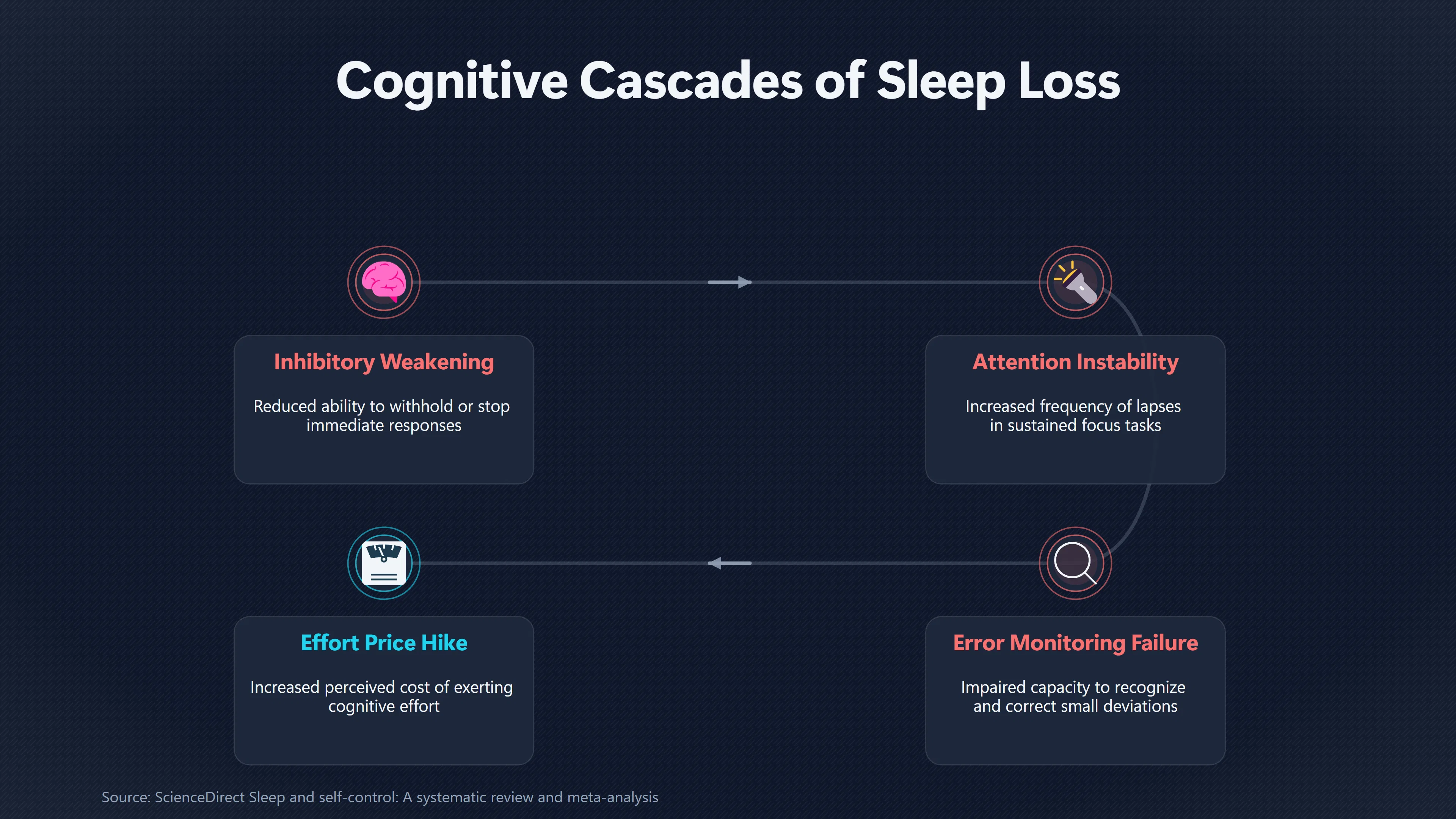
Sleep loss can change several ingredients of goal-directed behaviour at once. It can weaken inhibitory control, destabilise attention, reduce positive mood and make cognitive effort feel less worthwhile. Those changes can produce the outward appearance of low self-control even when the underlying problem is not a single depleted store of discipline. A 2021 meta-analysis of 61 independent studies found that both sleep quality and sleep duration were associated with self-control, including within-person effects, but its authors explicitly identified the causal processes linking the two as an important unresolved question.[PubMed]pubmed.ncbi.nlm.nih.govPub Med Sleep and self-control: A systematic review and meta-analysisSleep and self-control: A systematic review and meta-analysis - PubMedJune 5, 2021…
For self-improvement, that distinction matters. If yesterday’s plan becomes unusually difficult after poor sleep, the useful question is not only “Why wasn’t I disciplined enough?” but also “What changed in the machinery required to carry the plan out?”
What sleep and self-control studies actually show
The broad association is reasonably well established. In the 2021 systematic review and meta-analysis, better sleep quality showed correlations with better self-control of 0.26 between individuals and 0.35 within individuals; sleep duration showed smaller corresponding associations of 0.14 and 0.20. The review included experimental as well as observational research, but it did not establish that every behavioural failure following short sleep is caused by a unitary reduction in “willpower”.[PubMed]pubmed.ncbi.nlm.nih.govPub Med Sleep and self-control: A systematic review and meta-analysisSleep and self-control: A systematic review and meta-analysis - PubMedJune 5, 2021…
More specific cognitive evidence strengthens one part of the case. A 2025 meta-analysis examined 24 studies involving 712 healthy participants using Go/No-Go and Stop Signal tasks, which test the ability to withhold or stop a response. Sleep deprivation produced a moderate impairment in inhibitory control on both types of task.[PubMed]pubmed.ncbi.nlm.nih.govA meta-analytic investigation of the effect of sleep deprivation on inhibitory control - PubMedDecember 8, 2024… A broader 2025 meta-analysis covering 79 publications likewise found that sleep loss affected several components of executive functioning, although the size and form of the impairment differed by task and outcome measure.[ScienceDirect]sciencedirect.comThe impairments of sleep loss on core executive functions: General and task-specific effects - ScienceDirect…
That makes a genuine inhibition pathway plausible. When someone who intended not to check social media automatically reaches for a phone, or struggles to resist an immediately attractive alternative to a planned activity, poorer response inhibition may contribute.
But inhibition is only one mechanism. Sleep deprivation is particularly reliable at disrupting vigilant attention: the capacity to keep attention stably directed at a task. Performance becomes more variable and attentional lapses become more frequent, with deficits accumulating across repeated nights of restricted sleep.[Nature]nature.comSleep deprivation, vigilant attention, and brain function: a review | NeuropsychopharmacologyJune 8, 2019… In one controlled chronic-sleep-restriction experiment, shortened sleep increased attentional lapses fivefold even though participants did not uniformly report feeling less alert.[PubMed]pubmed.ncbi.nlm.nih.govChronic sleep curtailment, even without extended (>16-h) wakefulness, degrades human vigilance performance - PubMedJune 5, 2018…
That creates an important interpretive problem. Suppose someone sits down to study after insufficient sleep, repeatedly loses the thread, rereads paragraphs, checks unrelated tabs and eventually gives up. Calling the episode “low self-control” describes the outcome, but may misidentify much of the mechanism. Maintaining the intended behaviour has become cognitively harder because attention itself is less stable.
Sleep loss can even interfere with recognising errors. A systematic review and meta-analysis of performance and error monitoring found relatively inconsistent evidence about people’s overall judgements of their performance, but more consistent evidence that sleep loss impairs error monitoring.[PubMed]pubmed.ncbi.nlm.nih.govOpen source on nih.gov. That matters during behaviour change because successful self-regulation often requires noticing a small deviation early enough to correct it.
The hidden cost of effort
One of the most useful alternatives to a discipline-only explanation comes from research on effort discounting. People do not merely decide whether a goal is valuable; they continually weigh its expected benefit against what obtaining it seems likely to cost.
Sleep can alter that calculation.
In experiments comparing rested and sleep-deprived participants, sleep deprivation changed choices involving effortful monetary rewards without producing the same effect on delay discounting. In other words, the critical shift was not simply greater impatience for immediate rewards: effort itself had become more important to the choice.[PubMed]pubmed.ncbi.nlm.nih.govOpen source on nih.gov.
Research on sustained attention reaches a similar conclusion. One experiment found that sleep deprivation impaired vigilance and increased the extent to which rewards were discounted by the duration of the task. The authors interpreted the results as evidence that the perceived cost of attentional effort rises with sleep deprivation.[PubMed]pubmed.ncbi.nlm.nih.govOpen source on nih.gov. A wider review of sleep deprivation, effort allocation and performance similarly concluded that sleep loss can reduce willingness to exert effort and make cognitive performance feel more effortful; sufficiently strong external incentives can sometimes partially compensate, which itself argues against a simple all-or-nothing loss of capacity.[PubMed]pubmed.ncbi.nlm.nih.govPub Med Sleep deprivation, effort allocation and performancePub Med Sleep deprivation, effort allocation and performance
A small controlled study makes the distinction especially concrete. Twenty-four healthy young adults completed tasks after either three nights with only three hours of sleep opportunity per night or three nights with nine hours. Sleep restriction reduced their willingness to invest cognitive effort for reward, while motivation to invest physical effort was spared.[PubMed Central (PMC)]pmc.ncbi.nlm.nih.govOpen source on nih.gov.
That does not mean poor sleep always leaves physical motivation untouched; the study was small and tested particular laboratory choices. It does show why “motivation” should not automatically be treated as one global quantity. Sleep loss may change the cost-benefit calculation for some forms of effort more than others.
For everyday behaviour change, this produces a familiar pattern. Preparing a meal, starting a complicated work task or organising everything needed for tomorrow can contain numerous small decisions and attentional demands. After poor sleep, the desired outcome may still matter just as much while the route towards it has become more expensive. Choosing the easier option can therefore resemble a sudden collapse in character when it is partly a shift in perceived effort.
Why mood is only part of the pathway
Mood belongs in this explanation, but it should not absorb everything else.
A major 2024 meta-analysis covering 1,338 effect sizes from 154 studies and 5,717 participants found that total sleep deprivation, partial restriction and sleep fragmentation all reduced positive affect. Sleep loss also increased anxiety symptoms and altered emotional responses, while effects on negative affect and depressive symptoms were less consistent across different forms of sleep loss.[PubMed]pubmed.ncbi.nlm.nih.govOpen source on nih.gov. An earlier meta-analysis similarly found a particularly large reduction in positive mood after sleep loss.[PubMed]pubmed.ncbi.nlm.nih.govOpen source on nih.gov.
Lower positive affect can matter during behaviour change because an activity may have less immediate emotional pull. A workout that normally sounds satisfying may seem flat; studying may offer less sense of engagement; cooking may feel like an obligation rather than something worth starting. This can combine with increased effort costs: the task can simultaneously feel less rewarding and more demanding.
Yet treating mood as the whole explanation would simply replace one oversimplification with another. Experimental evidence separately identifies impaired inhibitory control, unstable attention and altered effort allocation. These processes can overlap and influence one another, but current research does not justify collapsing them into a single chain in which poor sleep causes bad mood, which then causes every subsequent failure.[sciencedirect.com]sciencedirect.comA meta-analytic investigation of the effect of sleep deprivation on inhibitory control - ScienceDirect…
Decision-making research provides another warning against simple stories. Reviews find that sleep loss can alter decision processes, but its effects are not uniform across tasks. A 2025 review argues that conventional outcome measures can conceal changes in underlying processes, including altered value sensitivity and greater decision noise, even when the final behavioural result appears unchanged.[PubMed]pubmed.ncbi.nlm.nih.govOpen source on nih.gov. Reviews of risky decision-making similarly report mixed effects rather than a universal shift towards recklessness.[PubMed]pubmed.ncbi.nlm.nih.govPub Med The effects of sleep deprivation on risky decision makingPub Med The effects of sleep deprivation on risky decision making
So “poor sleep makes people impulsive” is not a sufficiently precise general rule either.
The same person can have a harder day
Distinguishing a temporary state from a stable trait is particularly important for self-improvement.
The within-person findings in the sleep-and-self-control meta-analysis show that the relationship is not merely a comparison between chronically good sleepers who happen to be disciplined and chronically poor sleepers who are not. Variations in an individual’s own sleep are also associated with variations in self-control.[PubMed]pubmed.ncbi.nlm.nih.govPub Med Sleep and self-control: A systematic review and meta-analysisSleep and self-control: A systematic review and meta-analysis - PubMedJune 5, 2021…
Daily-life research illustrates the point. In a ten-working-day diary study, poorer sleep quality was associated with more procrastination the following day, although the relationship varied with participants’ trait self-control.[PubMed Central (PMC)]pmc.ncbi.nlm.nih.govOpen source on nih.gov. This is precisely why interpreting every difficult day as evidence about personality is risky: both relatively stable individual differences and changing daily conditions can shape behaviour.
There are also substantial individual differences in vulnerability to sleep loss. Reviews of vigilant attention find that some people show much greater performance impairment than others, and vulnerability in one cognitive domain does not necessarily predict vulnerability in another.[PubMed]pubmed.ncbi.nlm.nih.govPub Med Sleep deprivation, vigilant attention, and brain function: a reviewPub Med Sleep deprivation, vigilant attention, and brain function: a review Subjective impressions are imperfect guides too. Under repeated restriction, objective performance can deteriorate in ways that do not track reported alertness uniformly.[PubMed]pubmed.ncbi.nlm.nih.govOpen source on nih.gov.
That means a person can genuinely think, “I am tired, but basically functioning”, while some of the cognitive operations needed to execute a demanding habit have already become less reliable.
Avoiding discipline-only explanations
None of this makes self-control irrelevant. Sleep deprivation can impair inhibitory control, and sleep and self-control have a replicated overall association. The mistake is turning that relationship into a single-cause story.
When a planned behaviour fails after poor sleep, at least four overlapping explanations deserve consideration:
- Inhibition may be weaker. Stopping a tempting or habitual response can become harder.[PubMed]pubmed.ncbi.nlm.nih.govA meta-analytic investigation of the effect of sleep deprivation on inhibitory control - PubMedDecember 8, 2024…
- Attention may be less stable. More lapses and greater performance variability can make sustained goal-directed activity difficult.[PubMed Central (PMC)]pmc.ncbi.nlm.nih.govPubMed Central (PMC)Sleep deprivation, vigilant attention, and brain function: a review - PMC…
- The effort price may rise. Sleep loss can reduce willingness to invest cognitive effort and increase the apparent cost of sustained attention.[PubMed Central (PMC)]pmc.ncbi.nlm.nih.govOpen source on nih.gov.
- The emotional return may fall. Reduced positive affect can make worthwhile activities feel less engaging or rewarding in the moment.[PubMed]pubmed.ncbi.nlm.nih.govOpen source on nih.gov.
These mechanisms can converge on exactly the same observable event: the person does not do what they intended to do. Behaviour alone therefore cannot tell us that the missing ingredient was discipline.
This also helps explain why good self-control should not be equated with repeatedly winning internal battles. Research outside the sleep literature has found that people with higher trait self-control often rely more heavily on beneficial habits and report less effortful inhibition while pursuing goals.[PubMed Central (PMC)]pmc.ncbi.nlm.nih.govOpen source on nih.gov. In practical self-improvement, reducing the need for difficult moment-to-moment control can therefore be as important as becoming better at exerting it.
After a poor night, that principle becomes more valuable. A useful habit can be designed with a lower-friction version — a simpler meal rather than an elaborate one, a short pre-specified exercise session rather than deciding whether to train at all, or a clearly defined first work action rather than an open-ended demand to “be productive”. This is not because laboratory studies prove that any particular fallback routine will work. It follows from taking their mechanism seriously: when attention, positive mood, inhibition and willingness to invest effort are state-dependent, a behaviour-change system that assumes peak cognitive conditions every day is unnecessarily fragile.
The fairest interpretation of a bad day after bad sleep is therefore neither “sleep made the choice inevitable” nor “I lacked willpower”. Sleep loss changes the conditions under which self-control operates. Effective self-improvement recognises those changing conditions and makes the desired behaviour less dependent on having an unusually good cognitive and emotional day.
Amazon book picks
Further Reading
Books and field guides related to Is Poor Sleep Really a Willpower Problem?. Use these as the next step if you want deeper reading beyond the article.
Why We Sleep
"Sleep is one of the most important but least understood aspects of our life, wellness, and longevity ... An explosion of scientific disc...
The Willpower Instinct
Based on Stanford University psychologist Kelly McGonigal's wildly popular course "The Science of Willpower," The Willpower Instinct is t...
The Sleep Solution
With cutting-edge sleep science and time-tested techniques, The Sleep Solution will help anyone achieve healthy sleep and eliminate pills...
Indistractable
*As heard on Steven Bartlett's Diary of a CEO* 'A must-read' Mark Manson We are living through a crisis of distraction. Plans get sidetra...
eBay marketplace picks
Marketplace Samples
Live-tested eBay searches with available results related to this page.
Selected frommotivational poster oneBay.co.uk.
Current eBay listing
Motivational Quotes Framed Wall Art Poster Canvas Print Picture
Current eBay listing
Gym Motivational Posters Work Out Insperational Quotes Wall Art

Endnotes
1.
Source: sciencedirect.com
Title: ScienceDirect Sleep and self-control: A systematic review and meta-analysis
Link:https://www.sciencedirect.com/science/article/pii/S108707922100099X
Source snippet
Sleep and self-control: A systematic review and meta-analysis - ScienceDirect...
2.
Source: sciencedirect.com
Link:https://www.sciencedirect.com/science/article/pii/S1087079224001461
Source snippet
A meta-analytic investigation of the effect of sleep deprivation on inhibitory control - ScienceDirect...
3.
Source: sciencedirect.com
Link:https://www.sciencedirect.com/science/article/abs/pii/S1087079225001169
Source snippet
The impairments of sleep loss on core executive functions: General and task-specific effects - ScienceDirect...
4.
Source: nature.com
Link:https://www.nature.com/articles/s41386
Source snippet
Sleep deprivation, vigilant attention, and brain function: a review | NeuropsychopharmacologyJune 8, 2019...
Published: June 8, 2019
5.
Source: sciencedirect.com
Link:https://www.sciencedirect.com/science/article/pii/S108707922500067X
6.
Source: sciencedirect.com
Link:https://www.sciencedirect.com/science/article/pii/S1087079225001169
7.
Source: nature.com
Link:https://www.nature.com/articles/s41598-025-08289-4
8.
Source: nature.com
Link:https://www.nature.com/articles/s41366-022-01141-z
9.
Source: sciencedirect.com
Link:https://www.sciencedirect.com/science/article/pii/S0028393218301258
10.
Source: sciencedirect.com
Title: The neurocognitive consequences of sleep restriction: A meta-analytic review
Link:https://www.sciencedirect.com/science/article/abs/pii/S0149763417301641
11.
Source: sciencedirect.com
Link:https://www.sciencedirect.com/science/article/pii/S2352250X24000952
12.
Source: sciencedirect.com
Link:https://www.sciencedirect.com/science/article/pii/S0022103117306236
13.
Source: sciencedirect.com
Link:https://www.sciencedirect.com/science/article/abs/pii/S0022103117306236
14.
Source: sciencedirect.com
Title: The neurocognitive consequences of sleep restriction: A meta-analytic review
Link:https://www.sciencedirect.com/science/article/pii/S0149763417301641
15.
Source: sciencedirect.com
Link:https://www.sciencedirect.com/science/article/pii/S0191886923000181
16.
Source: sciencedirect.com
Link:https://www.sciencedirect.com/science/article/pii/S1087079221000757
17.
Source: sciencedirect.com
Title: The effects of sleep loss on capacity and effort
Link:https://www.sciencedirect.com/science/article/pii/S1984006314000583
18.
Source: sciencedirect.com
Title: Sleep deprivation, effort allocation and performance
Link:https://www.sciencedirect.com/science/chapter/bookseries/pii/S0079612319300378
19.
Source: nature.com
Link:https://www.nature.com/nature-index/topics/l4/sleep-deprivation-effects-on-decision-making
20.
Source: pubmed.ncbi.nlm.nih.gov
Title: Pub Med Sleep and self-control: A systematic review and meta-analysis
Link:https://pubmed.ncbi.nlm.nih.gov/34157493/
Source snippet
Sleep and self-control: A systematic review and meta-analysis - PubMedJune 5, 2021...
Published: June 5, 2021
21.
Source: pubmed.ncbi.nlm.nih.gov
Link:https://pubmed.ncbi.nlm.nih.gov/39700763/
Source snippet
A meta-analytic investigation of the effect of sleep deprivation on inhibitory control - PubMedDecember 8, 2024...
Published: December 8, 2024
22.
Source: pubmed.ncbi.nlm.nih.gov
Link:https://pubmed.ncbi.nlm.nih.gov/40946426/
Source snippet
The impairments of sleep loss on core executive functions: General and task-specific effects - PubMed...
23.
Source: pmc.ncbi.nlm.nih.gov
Link:https://pmc.ncbi.nlm.nih.gov/articles/PMC6879580/
Source snippet
PubMed Central (PMC)Sleep deprivation, vigilant attention, and brain function: a review - PMC...
24.
Source: pubmed.ncbi.nlm.nih.gov
Link:https://pubmed.ncbi.nlm.nih.gov/29784810/
Source snippet
Chronic sleep curtailment, even without extended (>16-h) wakefulness, degrades human vigilance performance - PubMedJune 5, 2018...
Published: June 5, 2018
25.
Source: pubmed.ncbi.nlm.nih.gov
Link:https://pubmed.ncbi.nlm.nih.gov/33894599/
26.
Source: pubmed.ncbi.nlm.nih.gov
Link:https://pubmed.ncbi.nlm.nih.gov/23729933/
27.
Source: pmc.ncbi.nlm.nih.gov
Link:https://pmc.ncbi.nlm.nih.gov/articles/PMC3649832/
28.
Source: pubmed.ncbi.nlm.nih.gov
Link:https://pubmed.ncbi.nlm.nih.gov/29601889/
29.
Source: pubmed.ncbi.nlm.nih.gov
Title: Pub Med Sleep deprivation, effort allocation and performance
Link:https://pubmed.ncbi.nlm.nih.gov/31072557/
30.
Source: pmc.ncbi.nlm.nih.gov
Link:https://pmc.ncbi.nlm.nih.gov/articles/PMC9642807/
31.
Source: pubmed.ncbi.nlm.nih.gov
Link:https://pubmed.ncbi.nlm.nih.gov/38127505/
32.
Source: pubmed.ncbi.nlm.nih.gov
Link:https://pubmed.ncbi.nlm.nih.gov/33367799/
33.
Source: pubmed.ncbi.nlm.nih.gov
Link:https://pubmed.ncbi.nlm.nih.gov/40505175/
34.
Source: pubmed.ncbi.nlm.nih.gov
Title: Pub Med The effects of sleep deprivation on risky decision making
Link:https://pubmed.ncbi.nlm.nih.gov/39080188/
35.
Source: pmc.ncbi.nlm.nih.gov
Link:https://pmc.ncbi.nlm.nih.gov/articles/PMC6225608/
36.
Source: pubmed.ncbi.nlm.nih.gov
Title: Pub Med Sleep deprivation, vigilant attention, and brain function: a review
Link:https://pubmed.ncbi.nlm.nih.gov/31176308/
37.
Source: pubmed.ncbi.nlm.nih.gov
Link:https://pubmed.ncbi.nlm.nih.gov/22754046/
38.
Source: pmc.ncbi.nlm.nih.gov
Link:https://pmc.ncbi.nlm.nih.gov/articles/PMC4731333/
39.
Source: pubmed.ncbi.nlm.nih.gov
Link:https://pubmed.ncbi.nlm.nih.gov/41609593/
40.
Source: pubmed.ncbi.nlm.nih.gov
Link:https://pubmed.ncbi.nlm.nih.gov/41570755/
41.
Source: pmc.ncbi.nlm.nih.gov
Link:https://pmc.ncbi.nlm.nih.gov/articles/PMC13003297/
42.
Source: pubmed.ncbi.nlm.nih.gov
Link:https://pubmed.ncbi.nlm.nih.gov/40810275/
43.
Source: pubmed.ncbi.nlm.nih.gov
Link:https://pubmed.ncbi.nlm.nih.gov/40628780/
44.
Source: pubmed.ncbi.nlm.nih.gov
Link:https://pubmed.ncbi.nlm.nih.gov/41425508/
45.
Source: pubmed.ncbi.nlm.nih.gov
Link:https://pubmed.ncbi.nlm.nih.gov/40564605/
46.
Source: pmc.ncbi.nlm.nih.gov
Link:https://pmc.ncbi.nlm.nih.gov/articles/PMC12189852/
47.
Source: pubmed.ncbi.nlm.nih.gov
Link:https://pubmed.ncbi.nlm.nih.gov/39278166/
48.
Source: pmc.ncbi.nlm.nih.gov
Link:https://pmc.ncbi.nlm.nih.gov/articles/PMC11280943/
49.
Source: pubmed.ncbi.nlm.nih.gov
Link:https://pubmed.ncbi.nlm.nih.gov/38759474/
50.
Source: pubmed.ncbi.nlm.nih.gov
Link:https://pubmed.ncbi.nlm.nih.gov/38238554/
51.
Source: pubmed.ncbi.nlm.nih.gov
Link:https://pubmed.ncbi.nlm.nih.gov/38154235/
52.
Source: pubmed.ncbi.nlm.nih.gov
Link:https://pubmed.ncbi.nlm.nih.gov/37905402/
53.
Source: pmc.ncbi.nlm.nih.gov
Link:https://pmc.ncbi.nlm.nih.gov/articles/PMC10544778/
54.
Source: pubmed.ncbi.nlm.nih.gov
Link:https://pubmed.ncbi.nlm.nih.gov/37394234/
55.
Source: pubmed.ncbi.nlm.nih.gov
Link:https://pubmed.ncbi.nlm.nih.gov/36331805/
56.
Source: pubmed.ncbi.nlm.nih.gov
Link:https://pubmed.ncbi.nlm.nih.gov/36394069/
57.
Source: pubmed.ncbi.nlm.nih.gov
Link:https://pubmed.ncbi.nlm.nih.gov/36062257/
58.
Source: pubmed.ncbi.nlm.nih.gov
Link:https://pubmed.ncbi.nlm.nih.gov/37476692/
59.
Source: pmc.ncbi.nlm.nih.gov
Link:https://pmc.ncbi.nlm.nih.gov/articles/PMC8286723/
60.
Source: pmc.ncbi.nlm.nih.gov
Link:https://pmc.ncbi.nlm.nih.gov/articles/8193556/
61.
Source: pmc.ncbi.nlm.nih.gov
Link:https://pmc.ncbi.nlm.nih.gov/articles/PMC7773722/
62.
Source: pmc.ncbi.nlm.nih.gov
Link:https://pmc.ncbi.nlm.nih.gov/articles/PMC8919502/
63.
Source: pmc.ncbi.nlm.nih.gov
Link:https://pmc.ncbi.nlm.nih.gov/articles/PMC7005570/
64.
Source: pubmed.ncbi.nlm.nih.gov
Link:https://pubmed.ncbi.nlm.nih.gov/30861067/
65.
Source: pubmed.ncbi.nlm.nih.gov
Link:https://pubmed.ncbi.nlm.nih.gov/31072564/
66.
Source: pmc.ncbi.nlm.nih.gov
Link:https://pmc.ncbi.nlm.nih.gov/articles/PMC11487484/
67.
Source: pubmed.ncbi.nlm.nih.gov
Link:https://pubmed.ncbi.nlm.nih.gov/30724028/
68.
Source: pmc.ncbi.nlm.nih.gov
Link:https://pmc.ncbi.nlm.nih.gov/articles/PMC6519907/
69.
Source: pmc.ncbi.nlm.nih.gov
Link:https://pmc.ncbi.nlm.nih.gov/articles/PMC9036851/
70.
Source: pmc.ncbi.nlm.nih.gov
Link:https://pmc.ncbi.nlm.nih.gov/articles/PMC6121948/
71.
Source: pmc.ncbi.nlm.nih.gov
Link:https://pmc.ncbi.nlm.nih.gov/articles/PMC6003377/
72.
Source: pubmed.ncbi.nlm.nih.gov
Link:https://pubmed.ncbi.nlm.nih.gov/29431514/
73.
Source: pmc.ncbi.nlm.nih.gov
Link:https://pmc.ncbi.nlm.nih.gov/articles/PMC5801309/
74.
Source: pubmed.ncbi.nlm.nih.gov
Link:https://pubmed.ncbi.nlm.nih.gov/29395984/
75.
Source: pubmed.ncbi.nlm.nih.gov
Link:https://pubmed.ncbi.nlm.nih.gov/28977574/
76.
Source: pubmed.ncbi.nlm.nih.gov
Link:https://pubmed.ncbi.nlm.nih.gov/28757454/
77.
Source: pmc.ncbi.nlm.nih.gov
Link:https://pmc.ncbi.nlm.nih.gov/articles/PMC6143346/
78.
Source: pubmed.ncbi.nlm.nih.gov
Link:https://pubmed.ncbi.nlm.nih.gov/27866988/
79.
Source: pubmed.ncbi.nlm.nih.gov
Link:https://pubmed.ncbi.nlm.nih.gov/27553441/
80.
Source: pubmed.ncbi.nlm.nih.gov
Link:https://pubmed.ncbi.nlm.nih.gov/27158937/
81.
Source: pubmed.ncbi.nlm.nih.gov
Link:https://pubmed.ncbi.nlm.nih.gov/26043207/
82.
Source: pmc.ncbi.nlm.nih.gov
Link:https://pmc.ncbi.nlm.nih.gov/articles/PMC4456409/
83.
Source: pubmed.ncbi.nlm.nih.gov
Link:https://pubmed.ncbi.nlm.nih.gov/26029094/
84.
Source: pmc.ncbi.nlm.nih.gov
Link:https://pmc.ncbi.nlm.nih.gov/articles/PMC4426706/
85.
Source: pubmed.ncbi.nlm.nih.gov
Link:https://pubmed.ncbi.nlm.nih.gov/25643222/
86.
Source: pubmed.ncbi.nlm.nih.gov
Link:https://pubmed.ncbi.nlm.nih.gov/26483932/
87.
Source: pmc.ncbi.nlm.nih.gov
Link:https://pmc.ncbi.nlm.nih.gov/articles/PMC4608917/
88.
Source: pubmed.ncbi.nlm.nih.gov
Link:https://pubmed.ncbi.nlm.nih.gov/25149821/
89.
Source: pubmed.ncbi.nlm.nih.gov
Link:https://pubmed.ncbi.nlm.nih.gov/24839251/
90.
Source: pubmed.ncbi.nlm.nih.gov
Link:https://pubmed.ncbi.nlm.nih.gov/24026225/
91.
Source: pubmed.ncbi.nlm.nih.gov
Link:https://pubmed.ncbi.nlm.nih.gov/23376698/
92.
Source: pmc.ncbi.nlm.nih.gov
Link:https://pmc.ncbi.nlm.nih.gov/articles/PMC3369235/
93.
Source: pmc.ncbi.nlm.nih.gov
Link:https://pmc.ncbi.nlm.nih.gov/articles/PMC3290659/
94.
Source: pubmed.ncbi.nlm.nih.gov
Link:https://pubmed.ncbi.nlm.nih.gov/19742409/
95.
Source: pmc.ncbi.nlm.nih.gov
Link:https://pmc.ncbi.nlm.nih.gov/articles/PMC1978335/
96.
Source: pmc.ncbi.nlm.nih.gov
Link:https://pmc.ncbi.nlm.nih.gov/articles/PMC2865224/
97.
Source: pubmed.ncbi.nlm.nih.gov
Link:https://pubmed.ncbi.nlm.nih.gov/12683469/?dopt=Abstract
98.
Source: pubmed.ncbi.nlm.nih.gov
Link:https://pubmed.ncbi.nlm.nih.gov/8776790/
99.
Source: pmc.ncbi.nlm.nih.gov
Link:https://pmc.ncbi.nlm.nih.gov/articles/PMC10358359/
100.
Source: pubmed.ncbi.nlm.nih.gov
Link:https://pubmed.ncbi.nlm.nih.gov/17083666/
101.
Source: pubmed.ncbi.nlm.nih.gov
Link:https://pubmed.ncbi.nlm.nih.gov/18591490/
102.
Source: pubmed.ncbi.nlm.nih.gov
Link:https://pubmed.ncbi.nlm.nih.gov/12753348/
103.
Source: pubmed.ncbi.nlm.nih.gov
Link:https://pubmed.ncbi.nlm.nih.gov/8480005/
104.
Source: pubmed.ncbi.nlm.nih.gov
Link:https://pubmed.ncbi.nlm.nih.gov/9218095/
105.
Source: pubmed.ncbi.nlm.nih.gov
Link:https://pubmed.ncbi.nlm.nih.gov/35094597/
106.
Source: pubmed.ncbi.nlm.nih.gov
Link:https://pubmed.ncbi.nlm.nih.gov/39710871/
107.
Source: pubmed.ncbi.nlm.nih.gov
Link:https://pubmed.ncbi.nlm.nih.gov/31392774/
108.
Source: pmc.ncbi.nlm.nih.gov
Link:https://pmc.ncbi.nlm.nih.gov/articles/PMC9019820/
109.
Source: pmc.ncbi.nlm.nih.gov
Link:https://pmc.ncbi.nlm.nih.gov/articles/PMC3700596/
110.
Source: pmc.ncbi.nlm.nih.gov
Link:https://pmc.ncbi.nlm.nih.gov/articles/1933584/
111.
Source: pubmed.ncbi.nlm.nih.gov
Link:https://pubmed.ncbi.nlm.nih.gov/18533328/
112.
Source: pubmed.ncbi.nlm.nih.gov
Link:https://pubmed.ncbi.nlm.nih.gov/20681233/
113.
Source: pubmed.ncbi.nlm.nih.gov
Link:https://pubmed.ncbi.nlm.nih.gov/11014055/
114.
Source: pmc.ncbi.nlm.nih.gov
Link:https://pmc.ncbi.nlm.nih.gov/articles/PMC2656292/
115.
Source: pubmed.ncbi.nlm.nih.gov
Link:https://pubmed.ncbi.nlm.nih.gov/17552375/
Additional References
116.
Source: youtube.com
Title: Improve Your Baseline Dopamine for Motivation & Drive | Dr. Andrew Huberman
Link:https://www.youtube.com/watch?v=35lS7gJVTyA
Source snippet
Sleep deprivation willpower self control prefrontal cortex 2-Minute Neuroscience: Prefrontal Cortex...
117.
Source: youtube.com
Link:https://www.youtube.com/watch?v=ajM6FMY0_MY
Source snippet
How to Increase Your Willpower & Tenacity | Huberman Lab Podcast...
118.
Source: youtube.com
Title: How to Increase Your Willpower & Tenacity | Huberman Lab Podcast
Link:https://www.youtube.com/watch?v=cwakOgHIT0E
Source snippet
Dr. K Explains: The Science of Self Control...
119.
Source: youtube.com
Title: 2-Minute Neuroscience: Prefrontal Cortex
Link:https://www.youtube.com/watch?v=i47_jiCsBMs
Source snippet
Improve Your Baseline Dopamine for Motivation & Drive | Dr. Andrew Huberman...
120.
Source: doi.org
Link:https://doi.org/10.1016%2Fj.paid.2023.112095
121.
Source: doi.org
Link:https://doi.org/10.1111/j.1365-2869.1994.tb00102.x
122.
Source: em-consulte.com
Link:https://www.em-consulte.com/article/1798015/sleep-well-feel-well-and-vice-versa-a-meta-analysi
123.
Source: tandfonline.com
Link:https://www.tandfonline.com/doi/full/10.1080/07420520802107031
124.
Source: researchgate.net
Link:https://www.researchgate.net/publication/395417428_The_Impairments_of_Sleep_Loss_on_Core_Executive_Functions_General_and_Task-specific_Effects
125.
Source: em-consulte.com
Link:https://www.em-consulte.com/article/1781512/the-impairments-of-sleep-loss-on-core-executive-fu