Within Study Systems
What Happens When Social Media Limits Just Shift Distraction?
Restricting a few social apps may simply redirect attention to messaging or other digital distractions instead of improving academic outcomes.
On this page
- What the multi quarter social media restriction trial found
- How students substituted messaging for restricted platforms
- Why routines should target the distraction pattern, not one app
Page outline Jump by section
Introduction
Limiting a few social-media apps can reduce use of those apps without reducing the underlying distraction. The clearest student experiment on this problem followed digital behaviour across three academic quarters and restricted Facebook, Instagram and Snapchat to ten minutes a day during the intervention period. Students did use those platforms less, but they shifted towards instant messaging, their overall device time did not fall, and their grades did not improve significantly.[PLOS]journals.plos.orgEffects of restricting social media usage on wellbeing and performance: A randomized control trial among students | PLOS OneAugust 24…
That distinction matters for a study routine that is supposed to begin before social media. If the real habit is “reach for something socially or digitally rewarding whenever studying becomes uncomfortable”, blocking Instagram may simply turn WhatsApp, YouTube or another available screen into the next escape route. More recent UK research with teenagers has observed the same broader substitution pattern across messaging, gaming, streaming and other screens.[GOV.UK]GOV.UKSocial Media Intervention Research 2026: Social media restriction pilots: Qualitative research with 13 to 17-year-olds in the UK - GOV.UK…
The practical lesson is therefore narrower than “screen limits do not work”. Limits can change behaviour. But a limit aimed at particular apps is not necessarily a limit on distraction, and reducing one measured category of screen use should not automatically be treated as evidence that more studying has taken its place.
What the multi-quarter restriction trial found
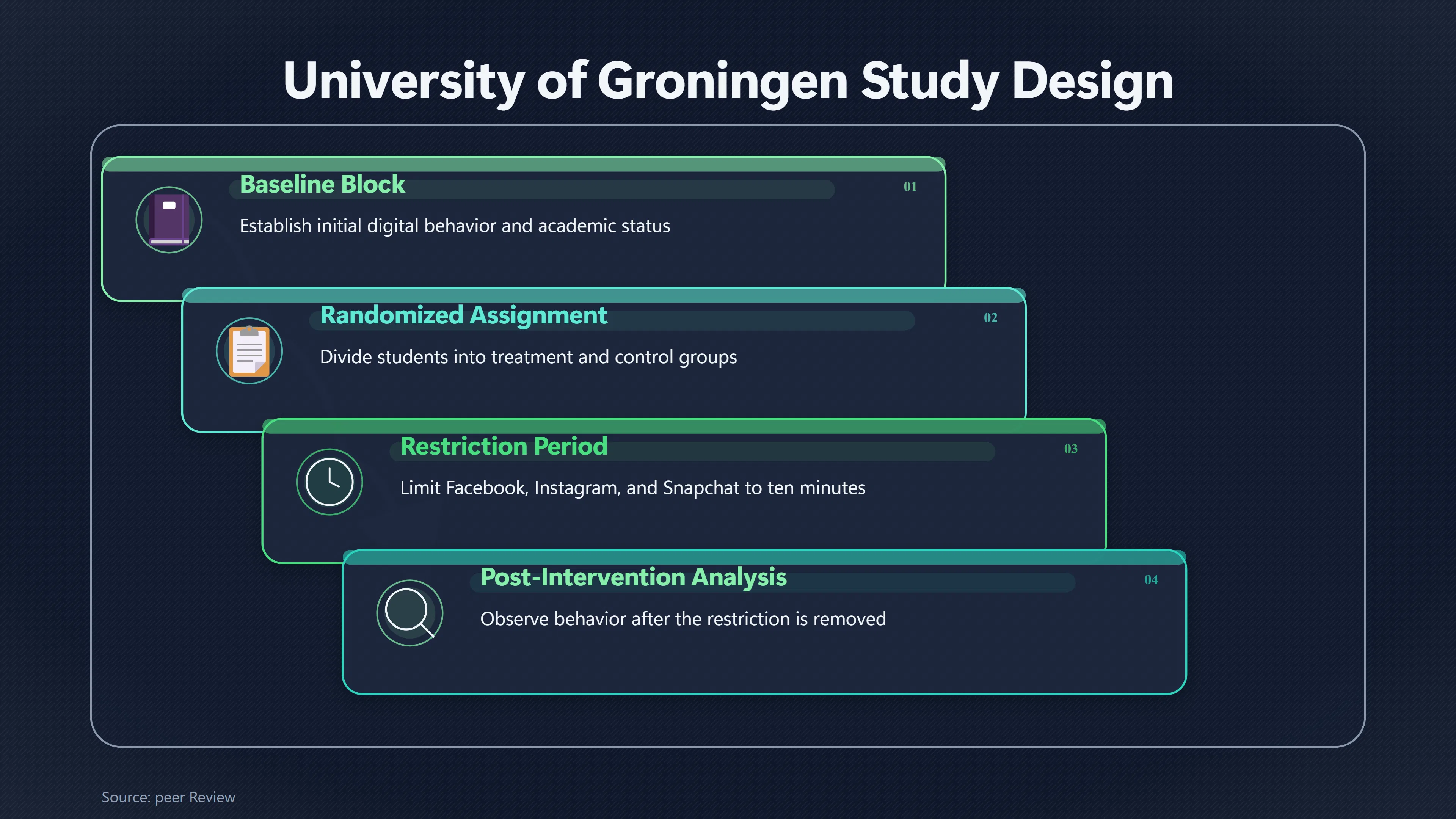
Avinash Collis and Felix Eggers designed their randomised controlled trial to get beyond a common weakness in research on social media: relying on people to estimate their own use. Students at the University of Groningen installed RescueTime, allowing the researchers to observe digital activity on computers and phones. They also obtained objective academic measures, including grades and credit points, alongside surveys of wellbeing. The study covered eight months, with the restriction itself lasting roughly two and a half months.[PubMed Central (PMC)]pmc.ncbi.nlm.nih.govPubMed Central (PMC)Effects of restricting social media usage on wellbeing and performance: A randomized control trial among students - P…
The first academic block established a baseline. During the second, students were randomly assigned to treatment and control groups; the treatment group could spend no more than ten minutes per day across Facebook, Instagram and Snapchat. A third block allowed the researchers to examine what happened after the restriction disappeared. The initial survey involved 191 students, although attrition reduced the samples available for later analyses; 122 students could be matched across the principal data sources used for the first two blocks.[PLOS]journals.plos.orgEffects of restricting social media usage on wellbeing and performance: A randomized control trial among students | PLOS OneAugust 24…
The intervention clearly changed its immediate target: restricted students spent less time on the specified social networks. But that did not translate into the expected academic payoff. The researchers found no significant treatment effect on grades during the restriction period. Students in the treatment group attempted courses carrying more credit, but they did not pass significantly more courses than the control group.[PLOS]journals.plos.orgEffects of restricting social media usage on wellbeing and performance: A randomized control trial among students | PLOS OneAugust 24…
That is an important distinction for self-improvement advice. A successful app restriction and a successful study intervention are different outcomes. The former asks whether time on named services fell. The latter asks whether the student actually redirected attention towards learning strongly enough to improve useful academic behaviour or results. In this trial, the first happened; convincing evidence for the second did not.
Nor did the restriction leave a durable reduction in social-media use. Among the 106 students with data throughout all three blocks and all four surveys, the treatment group’s social-media use returned after the limit was removed, with no significant difference from the control group in the final block. There were also no significant post-treatment differences in grades or credit points.[PLOS]journals.plos.orgEffects of restricting social media usage on wellbeing and performance: A randomized control trial among students | PLOS OneAugust 24…
The result should not be stretched into a claim that social media can never interfere with studying. The authors themselves noted limited statistical power for smaller effects, the restricted platforms reflected the digital environment of the period rather than today’s full mix of services, and a university-student sample cannot represent everyone. Their experiment tested a specific intervention against specific platforms.[PLOS]journals.plos.orgEffects of restricting social media usage on wellbeing and performance: A randomized control trial among students | PLOS OneAugust 24… What it demonstrates particularly well is something more useful here: removing one obvious outlet for distraction does not tell you what people will do with the released attention.
Where the displaced attention went
The strongest clue comes from the activity logs. During the restriction, instant messaging increased significantly relative to the control condition. Among the relevant users, average daily instant-messaging time in the treatment group rose from 25.1 minutes in the baseline block to 28.8 minutes during the restriction, while the control group’s corresponding average fell from 21.8 to 15.2 minutes. About 92.9% of the activity classified as instant messaging was WhatsApp. The difference-in-differences result for this substitution was statistically significant.[PubMed Central (PMC)]pmc.ncbi.nlm.nih.govPubMed Central (PMC)Effects of restricting social media usage on wellbeing and performance: A randomized control trial among students - P…
This makes the null academic result easier to understand. A student prevented from checking Instagram has not necessarily become a student who is revising. Messaging can satisfy some of the same immediate motives: social contact, novelty, relief from boredom or avoidance of an effortful task. Collis and Eggers consequently argued that social networks and instant messaging could function as substitutes, while noting that their student population might be particularly prone to substitution because social communication is an important part of their use.[PLOS]journals.plos.orgEffects of restricting social media usage on wellbeing and performance: A randomized control trial among students | PLOS OneAugust 24…
Evidence beyond this single trial suggests that the substitution can spread much further than messaging. A seven-day social-media abstinence study found participants describing replacement activities such as games, digital books and web searches when the habitual social-media option was unavailable. The researchers interpreted this as evidence that boredom relief may sometimes be attached less to one particular platform than to the availability of convenient digital stimulation.[PubMed Central (PMC)]pmc.ncbi.nlm.nih.govPubMed Central (PMC)Fear of Missing Out, Mental Wellbeing, and Social Connectedness: A Seven-Day Social Media Abstinence Trial - PMCJune…
That mechanism has also appeared in much newer UK evidence. In a 2026 Department for Science, Innovation and Technology-commissioned qualitative pilot, 309 families with 13- to 17-year-olds took part in interventions involving 15-minute app limits, an overnight social-media curfew or app removal. The study was qualitative rather than a randomised academic-performance trial, so it cannot establish the same kind of causal effect as the university experiment. It is nevertheless useful for observing what young people actually did when access became harder.[GOV.UK]GOV.UKSocial Media Intervention Research 2026: Social media restriction pilots: Qualitative research with 13 to 17-year-olds in the UK - GOV.UK…
Again, substitution was common. Reduced social-media use could lead to more messaging, YouTube, gaming, television, streaming or school-related device use. Some teenagers moved conversations to WhatsApp, iMessage or Messenger; others used browsers, laptops or even someone else’s phone. With the 15-minute limits, some participants became more deliberate about allocating scarce social-media time, but total screen exposure did not necessarily decline.[GOV.UK]GOV.UKSocial Media Intervention Research 2026: Social media restriction pilots: Qualitative research with 13 to 17-year-olds in the UK - GOV.UK…
The comparison is useful because the two studies were separated by population, period and method, yet expose the same design problem. A restriction defines what is unavailable. It does not define what behaviour should occupy the resulting gap.
Why an app limit can miss the distraction pattern
For studying, the key question is therefore not simply “Which app wastes my time?” It is “What happens at the moment I stop doing the work?”
Consider a student who intends to begin revision at 8am. Instagram is blocked until 9am. At 8.07, a difficult practice question creates a moment of friction. The student reaches for the phone, discovers Instagram is unavailable, sees three WhatsApp notifications and spends ten minutes answering them. Afterwards a link opens in the browser. By 8.30, the Instagram limit has technically worked perfectly, while the study routine has failed.
The intervention target in that example is too narrow. It treats a particular application as the behaviour when the more relevant behaviour is switching away from the study task towards an immediately rewarding alternative. Which alternative wins can depend on what remains easiest to access.
This helps reconcile apparently conflicting findings in restriction research. Not every experiment finds that reducing social-media use is useless. For example, other randomised studies have reported psychological benefits from particular forms of reduction or abstinence, while a seven-day experiment comparing larger and smaller reductions found no improvement in objectively measured sustained attention or wellbeing.[DOI]doi.orgNo More FOMO: Limiting Social Media Decreases Loneliness and Depression | Journal of Social and Clinical Psychology… These studies differ in intervention, population, duration and outcome, so they should not be collapsed into a verdict that “digital detoxes work” or “digital detoxes fail”.
For the narrower academic question, the Collis-Eggers trial is particularly informative because it combined random assignment with long-term behavioural tracking and actual academic outcomes. Its finding was not merely that students disliked the restriction or claimed to compensate elsewhere. Their logged behaviour showed substitution, while the hoped-for improvement in grades did not materialise.[PubMed Central (PMC)]pmc.ncbi.nlm.nih.govPubMed Central (PMC)Effects of restricting social media usage on wellbeing and performance: A randomized control trial among students - P…
Target the opening routine, not just the named app
A “study before social media” routine can respond to this problem by defining the protected behaviour more broadly than the restriction. The objective is not to accumulate minutes in which Instagram happens to be inaccessible. It is to preserve the opening study period from the class of distractions that normally replaces work.
For example, “no Instagram before 9am” leaves an obvious substitution problem. A more behaviourally precise rule would be: “After breakfast, I start the prepared problem set and keep recreational feeds, personal messaging and non-study browsing closed until the first 25-minute study block ends.” The distinction is small in wording but large in what it targets. The first rule controls one platform; the second protects a sequence of behaviour.
That does not require treating every digital activity as equally harmful. Messaging may be necessary, and study itself often requires a browser, videos or collaborative tools. Indeed, the 2026 UK pilot found that overly broad or poorly implemented restrictions could interfere with school communication and revision resources.[GOV.UK]GOV.UKSocial Media Intervention Research 2026: Social media restriction pilots: Qualitative research with 13 to 17-year-olds in the UK - GOV.UK… The aim is therefore not a blanket prohibition on screens. It is to identify the alternatives that reliably become escape routes during a particular study period.
A useful test is to watch what replaces a restriction. If Instagram falls but WhatsApp rises, the relevant boundary may need to include non-urgent messaging during the opening block. If both fall but YouTube becomes the default, the same principle applies there. If digital distraction falls and the student instead makes breakfast, tidies the room or repeatedly reorganises notes, the problem has moved beyond social media altogether. At that point, tightening another app limit is unlikely to address the underlying avoidance pattern.
This is also why measuring the routine itself matters more than celebrating a lower screen-time number. The most informative questions are whether the planned study block started on time, whether it stayed focused long enough to complete its defined task, and what displaced studying when it did not. App statistics can help diagnose the pattern, but they are intermediate measures rather than the goal.
The multi-quarter trial ultimately offers a useful warning for self-improvement systems: friction works on whatever behaviour it is attached to. Making several social platforms harder to access successfully reduced their use, yet students found another convenient social channel and academic success did not improve.[PubMed Central (PMC)]pmc.ncbi.nlm.nih.govPubMed Central (PMC)Effects of restricting social media usage on wellbeing and performance: A randomized control trial among students - P… A study routine is therefore more robust when it gives the freed attention somewhere specific to go — a prepared task, begun at a stable cue, with the main substitute distractions kept outside the opening block — rather than assuming that blocking one tempting app will automatically turn scrolling time into study time.
Amazon book picks
Further Reading
Books and field guides related to What Happens When Social Media Limits Just Shift Distraction?. Use these as the next step if you want deeper reading beyond the article.
Digital Minimalism
A New York Times, Wall Street Journal, Publishers Weekly, and USA Today bestseller "Newport is making a bid to be the Marie Kondo of tech...
Indistractable
*As heard on Steven Bartlett's Diary of a CEO* 'A must-read' Mark Manson We are living through a crisis of distraction. Plans get sidetra...
Deep Work
Trade paperback. Professor and popular blogger Cal Newport reveals the new key to achieving success and true meaning in professional life...
Atomic Habits
Rating: 3.5/5 from 7 Google Books ratings
The #1 New York Times bestseller. Over 25 million copies sold! Translated into 60+ languages! Tiny Changes, Remarkable Results No matter...
eBay marketplace picks
Marketplace Samples
Live-tested eBay searches with available results related to this page.
Selected fromstudy poster oneBay.co.uk.


Endnotes
1.
Source: journals.plos.org
Link:https://journals.plos.org/plosone/article?id=10.1371%2Fjournal.pone.0272416
Source snippet
Effects of restricting social media usage on wellbeing and performance: A randomized control trial among students | PLOS OneAugust 24...
2.
Source: GOV.UK
Link:https://www.gov.uk/government/publications/social-media-restriction-pilots-qualitative-research-with-13-to-17-year-olds-in-the-uk/social-media-intervention-research-2026-social-media-restriction-pilots-qualitative-research-with-13-to-17-year-olds-in-the-uk
Source snippet
Social Media Intervention Research 2026: Social media restriction pilots: Qualitative research with 13 to 17-year-olds in the UK - GOV.UK...
3.
Source: GOV.UK
Link:https://www.gov.uk/government/publications/social-media-restriction-pilots-qualitative-research-with-13-to-17-year-olds-in-the-uk
4.
Source: doi.org
Link:https://doi.org/10.1521/jscp.2018.37.10.751
Source snippet
No More FOMO: Limiting Social Media Decreases Loneliness and Depression | Journal of Social and Clinical Psychology...
5.
Source: doi.org
Link:https://doi.org/10.1007/s11423-025-10550-6
6.
Source: doi.org
Link:https://doi.org/10.1186/s12912-024-02513-8
7.
Source: doi.org
Link:https://doi.org/10.1026/0942-5403/a000392
8.
Source: journals.plos.org
Title: peer Review
Link:https://journals.plos.org/plosone/article/peerReview?id=10.1371%2Fjournal.pone.0272416
9.
Source: youtube.com
Link:https://www.youtube.com/watch?v=TWEY5cQt660
Source snippet
How to Disarm Internal Triggers and Improve Focus...
10.
Source: youtube.com
Title: How to Disarm Internal Triggers and Improve Focus
Link:https://www.youtube.com/watch?v=Lpxs7QVxcew
Source snippet
Indistractable: How to Control Your Attention and Choose Your Life...
11.
Source: youtube.com
Title: Indistractable: How to Control Your Attention and Choose Your Life
Link:https://www.youtube.com/watch?v=1Cn1lZM5LNU
Source snippet
Avoiding Distractions & Doing Deep Work | Dr. Cal Newport & Dr. Andrew Huberman...
12.
Source: youtube.com
Title: Avoiding Distractions & Doing Deep Work | Dr. Cal Newport & Dr. Andrew Huberman
Link:https://www.youtube.com/watch?v=f7V76Ky-_v8
Source snippet
Smartphones: It’s Time to Confront Our Global Addiction | Dr. Justin Romano | TEDxOmaha...
13.
Source: youtube.com
Link:https://www.youtube.com/watch?v=2ldLwkj4dRc
Source snippet
App limits substitution distraction screen time habit This Is What I Did To Finally Defeat My Screen Addiction...
14.
Source: pmc.ncbi.nlm.nih.gov
Link:https://pmc.ncbi.nlm.nih.gov/articles/PMC9401146/
Source snippet
PubMed Central (PMC)Effects of restricting social media usage on wellbeing and performance: A randomized control trial among students - P...
15.
Source: pmc.ncbi.nlm.nih.gov
Link:https://pmc.ncbi.nlm.nih.gov/articles/PMC7345987/
Source snippet
PubMed Central (PMC)Fear of Missing Out, Mental Wellbeing, and Social Connectedness: A Seven-Day Social Media Abstinence Trial - PMCJune...
16.
Source: pmc.ncbi.nlm.nih.gov
Link:https://pmc.ncbi.nlm.nih.gov/articles/PMC8664777/
Source snippet
PubMed Central (PMC)Does a 7-day restriction on the use of social media improve cognitive functioning and emotional well-being? Results f...
17.
Source: pubmed.ncbi.nlm.nih.gov
Link:https://pubmed.ncbi.nlm.nih.gov/41801197/
18.
Source: pmc.ncbi.nlm.nih.gov
Link:https://pmc.ncbi.nlm.nih.gov/articles/PMC12162677/
19.
Source: pubmed.ncbi.nlm.nih.gov
Link:https://pubmed.ncbi.nlm.nih.gov/39509203/
20.
Source: pmc.ncbi.nlm.nih.gov
Link:https://pmc.ncbi.nlm.nih.gov/articles/PMC11472914/
21.
Source: pmc.ncbi.nlm.nih.gov
Link:https://pmc.ncbi.nlm.nih.gov/articles/PMC11002763/
22.
Source: pmc.ncbi.nlm.nih.gov
Link:https://pmc.ncbi.nlm.nih.gov/articles/PMC10631628/
23.
Source: pmc.ncbi.nlm.nih.gov
Link:https://pmc.ncbi.nlm.nih.gov/articles/PMC10413073/
24.
Source: pubmed.ncbi.nlm.nih.gov
Link:https://pubmed.ncbi.nlm.nih.gov/36595638/
25.
Source: pubmed.ncbi.nlm.nih.gov
Link:https://pubmed.ncbi.nlm.nih.gov/36001541/
26.
Source: pubmed.ncbi.nlm.nih.gov
Link:https://pubmed.ncbi.nlm.nih.gov/34938826/
27.
Source: pmc.ncbi.nlm.nih.gov
Link:https://pmc.ncbi.nlm.nih.gov/articles/7369880/
28.
Source: pmc.ncbi.nlm.nih.gov
Link:https://pmc.ncbi.nlm.nih.gov/articles/PMC8519154/
29.
Source: pubmed.ncbi.nlm.nih.gov
Link:https://pubmed.ncbi.nlm.nih.gov/30334650/
Additional References
30.
Source: ziprecruiter.com
Title: nurses and technicians, clinical and hospital administrators and staff. * P
Link:https://www.ziprecruiter.com/Jobs/Cardiovascular-Technician/-in-Charlotte%2CNC
Source snippet
$21-$54/hr Cardiovascular Technician Jobs Charlotte, NCAugust 2, 2026 — Charlotte, NC · On-site About Cardiovascular Fueled by innovation...
Published: August 2, 2026
31.
Source: youtu.be
Title: The Jason Marc Campbell Podcast
Link:https://youtu.be/Jh-QqKIo8Bw
Source snippet
Nir Eyal On Mastering Internal Triggers, Time Blocking & Being Indistractable | Mind Like Water 🌱 Soundarya Balasubramani...
32.
Source: researchgate.net
Link:https://www.researchgate.net/publication/352433361_Does_a_7-day_restriction_on_the_use_of_social_media_improve_cognitive_functioning_and_emotional_well-being_Results_from_a_randomized_controlled_trial
33.
Source: researchgate.net
Link:https://www.researchgate.net/publication/362921158_Effects_of_restricting_social_media_usage_on_wellbeing_and_performance_A_randomized_control_trial_among_students
34.
Source: jamanetwork.com
Link:https://jamanetwork.com/journals/jamainternalmedicine/fullarticle/2817487
35.
Source: jamanetwork.com
Link:https://jamanetwork.com/journals/jama/fullarticle/2822082
36.
Source: sciencedirect.com
Link:https://www.sciencedirect.com/science/article/pii/S2451958820300270
37.
Source: sciencedirect.com
Link:https://www.sciencedirect.com/science/article/abs/pii/S1096751624000113
38.
Source: researchgate.net
Link:https://www.researchgate.net/publication/386049680_Causal_Manipulations_of_Social_Media_Use_Key_Methodological_Considerations
39.
Source: mdpi.com
Link:https://www.mdpi.com/1660-4601/19/18/11188