Within If Then Plans
Which Cues Make If Then Plans Easier to Follow?
A useful trigger is easy to notice and occurs at a moment when the planned action can realistically follow.
On this page
- Why distinctive cues are easier to notice
- Event cues versus vague internal states
- Testing whether a trigger works in real life
Page outline Jump by section
Introduction
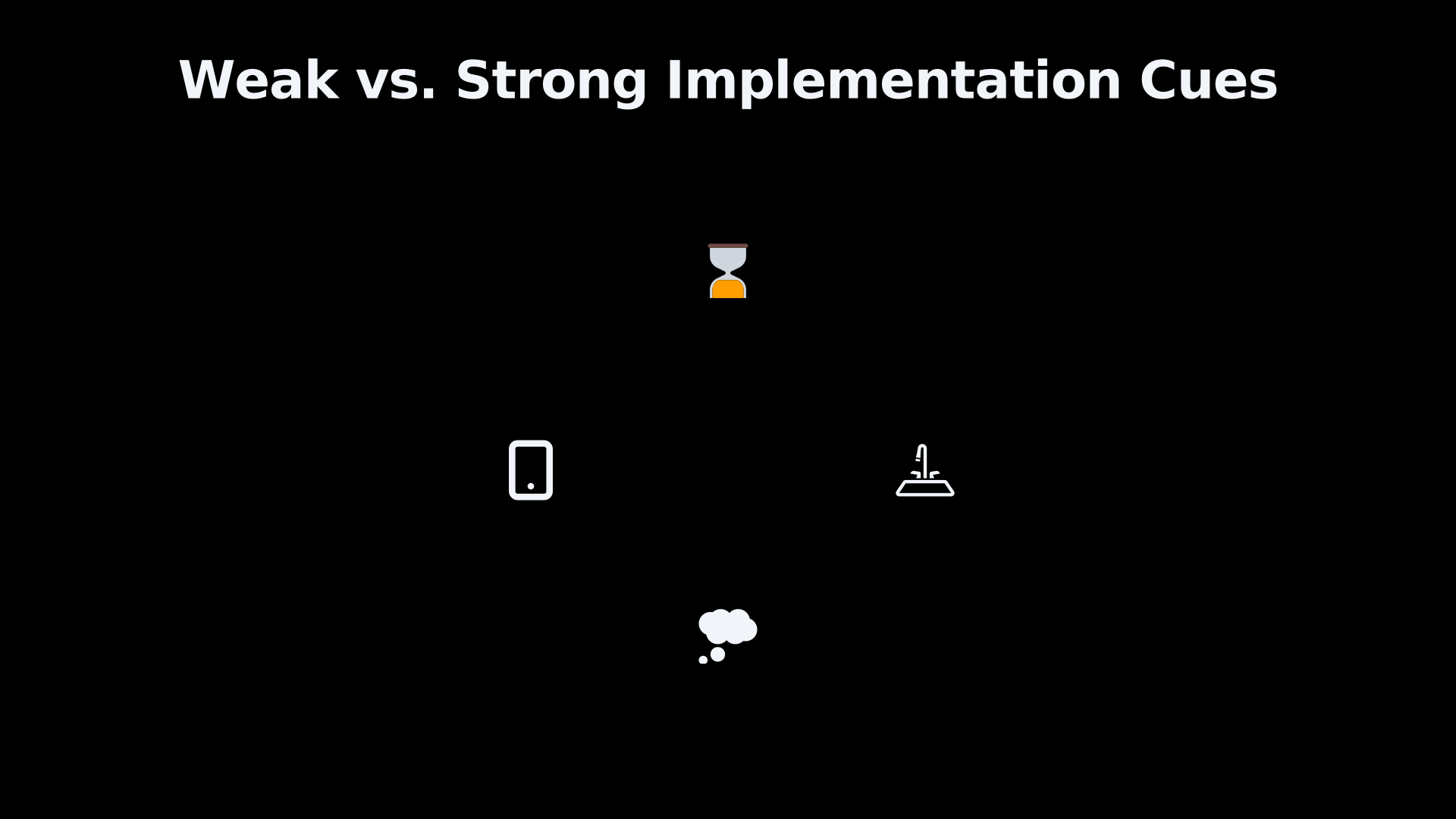
The best cue for an if-then plan is not merely specific: it is recognisable when it happens and tied to a moment when the planned response can realistically begin. “If I have some free time” is weak because there is no clean point at which “free time” announces itself. “If I put my lunch plate in the sink, then I will walk for ten minutes” gives the mind a much clearer event to detect.
This matters because the cue is part of the mechanism of an implementation intention. Research indicates that forming an if-then plan makes the specified situation more mentally accessible and strengthens its association with the intended response. Experiments have found that people can consequently recognise planned cues more quickly and accurately, while a recent meta-analysis of 642 independent tests found benefits across a wide variety of cue types.[wiley.com]onlinelibrary.wiley.comWiley Online LibraryIdentifying good opportunities to act: Implementation intentions and cue discrimination - Webb - 2004 - European Jour…
The practical rule is therefore to choose a cue that passes three tests: Will it actually occur? Will I notice it? Can I act when it does?
Why distinctive cues are easier to notice
An if-then plan effectively delegates part of action initiation to a future situation. That makes the “if” side more than a diary entry. In experimental work by Thomas Webb and Paschal Sheeran, the accessibility of the specified cue and the strength of the cue-response association both helped explain better goal attainment.[ScienceDirect]sciencedirect.comHow do implementation intentions promote goal attainment? A test of component processes - ScienceDirect…
Their earlier cue-discrimination experiments are particularly relevant to choosing triggers. Participants who formed implementation intentions became better at detecting the specified cue. In subsequent experiments they responded to it more accurately or more rapidly, without becoming correspondingly worse at dealing with irrelevant or ambiguous stimuli. The researchers characterised the result as swift and precise discrimination of the critical cue.[Wiley Online Library]onlinelibrary.wiley.comWiley Online LibraryIdentifying good opportunities to act: Implementation intentions and cue discrimination - Webb - 2004 - European Jour…
For everyday planning, that argues for cues with a clear boundary. Compare:
- Weak: “If it is later this evening, I will practise.”
- Better: “If I finish washing the dinner dishes, I will practise.”
- Weak: “If I get a chance at work, I will send the difficult email.”
- Better: “If the Tuesday team meeting ends, I will return to my desk and send the email.”
- Weak: “If I am not too busy in the morning, I will stretch.”
- Better: “If I switch off the shower, I will do my two-minute stretch.”
The stronger examples do not require a second judgement about whether “later”, “a chance” or “not too busy” has arrived. A concrete transition supplies the signal.
A cue also needs to occur at an opportune moment. The US National Cancer Institute’s research summary describes the critical situation in an implementation intention as one in which the response is feasible, or as an anticipated obstacle that needs to be handled.[Cancer Control]cancercontrol.cancer.govCancer ControlImplementation Intentions | Division of Cancer Control and Population Sciences (DCCPS)… A highly noticeable cue is therefore still poorly chosen if it routinely fires when the behaviour is impossible. “If my 9 am alarm sounds, I will go for a run” is of little use if 9 am normally finds you on a train.
There is an important qualification to the advice to make cues specific. Specificity should help identify the opportunity, not turn the plan into an elaborate specification. A physical-activity study found a generic single-situation intervention could perform as well as offering ten more specific situations, while a broader meta-analysis found that adding extra detail about how or for how long an action would be performed did not improve the effect associated with specifying time and place. In other words, clarity is useful; maximal detail is not the objective.[ScienceDirect]sciencedirect.comDoes Situation-Specificity Affect the Operation of Implementation Intentions? - ScienceDirect…
Event cues versus vague internal states
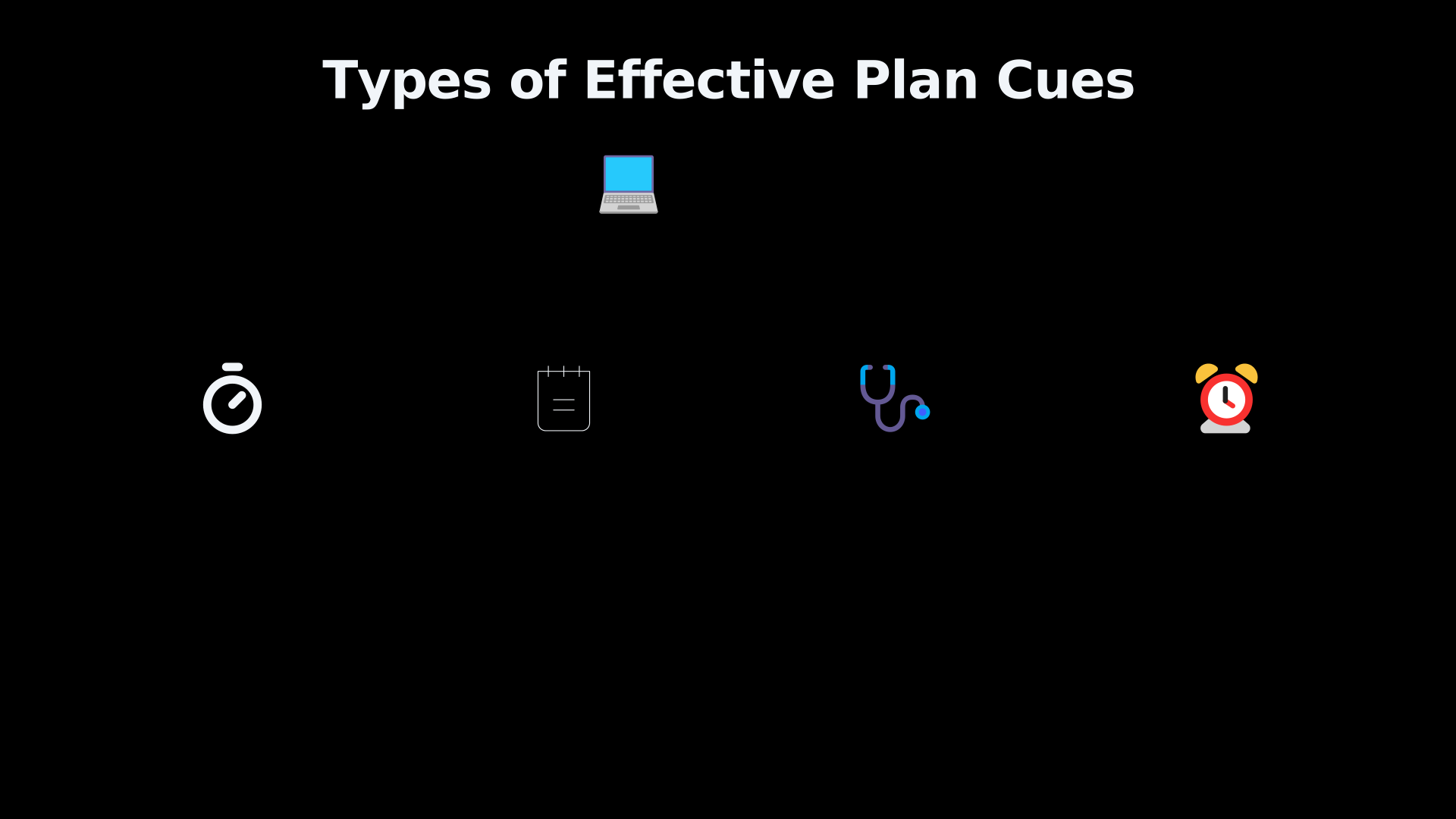
Events in an existing routine are often attractive triggers because the environment supplies the reminder. Finishing breakfast, shutting a laptop, entering the kitchen or hearing the end of a meeting all have observable boundaries. Research on prospective memory — remembering to carry out an intended future action — similarly distinguishes event-based cues from time-based intentions that may require monitoring the clock.[ScienceDirect]sciencedirect.comThe effect of implementation intention on prospective memory: A systematic and meta-analytic review - ScienceDirectMarch 30…
This does not mean that every if-then plan should use an external event. The large 642-test review by Paschal Sheeran, Olivia Listrom and Peter Gollwitzer found successful plans using many kinds of situations: time and place, task transitions, particular stimuli, thoughts, feelings and bodily sensations. Time plus place produced a larger estimated effect than time alone in the studies available for that comparison, and task junctures such as starting or ending a phase of work also performed well.[DOI]doi.orgThe when and how of planning: Meta-analysis of the scope and components of implementation intentions in 642 tests: European Review of…
Internal cues can be especially appropriate when the desired action is itself a response to an internal obstacle. For example:
If I notice that I am distracted while reading, then I will put the phone out of reach and return to the paragraph.
Here, distraction is not simply an inconveniently vague mood. Recognising distraction is precisely the situation in which the corrective action is needed. The recent meta-analysis found effective plans using cues including recognising distraction, feeling tempted or anxious, and experiencing bodily sensations such as hunger or discomfort. It found no simple overall pattern showing that external cues were categorically superior to internal ones.[ResearchGate]researchgate.netOpen source on researchgate.net.
The useful distinction, then, is not external good, internal bad. It is discriminable versus ambiguous.
“If I feel bad, I will use my coping strategy” leaves considerable interpretation to the future self. What counts as bad? Mild frustration? Fatigue? Anxiety? A specific internal event can be much more actionable: “If I notice myself rereading the same sentence because my attention has wandered, then I will close the distracting tab.”
The same principle applies to clock time. A time can be perfectly definite — “7 pm” — yet still be a poor real-world trigger if you do not naturally check the time around 7 pm. An event already embedded in a routine can sometimes do more of the retrieval work for you. Conversely, a clock cue is useful when the action genuinely needs to happen at that time and the time will be visible or externally signalled.
Prospective-memory research provides a useful caution against turning this into an absolute rule. Detailed implementation intentions have improved self-initiated remembering when obvious environmental prompts were absent, and experiments have also found benefits for difficult-to-detect event cues. The technique can therefore compensate to some extent for an imperfect cue; choosing a naturally conspicuous trigger simply reduces the amount of work the plan has to do.[psychologicalscience.org]psychologicalscience.orgOpen source on psychologicalscience.org.
Match the cue to the first executable action
A cue is only useful if the “then” response fits the situation it creates. This is an easy point to miss because people often choose triggers by asking When should I ideally do this? A better question is At what reliably occurring moment can I actually start?
Suppose the goal is to study after work. “If I leave work, then I will study for 45 minutes” contains a clear cue, but the action cannot literally follow while travelling home. A better plan might be:
If I put my keys on the hall table after work, then I will put my phone away and open my course notes.
The trigger occurs at the first useful transition into the setting where studying is feasible. The response also begins immediately rather than requiring a fresh decision about how to start.
This idea is consistent with the formal definition used by the National Cancer Institute: the “if” component should identify an opportune moment for the goal-directed response. It also fits the broader evidence that implementation intentions operate partly through a strong association between the specified situation and response.[Cancer Control]cancercontrol.cancer.govCancer ControlImplementation Intentions | Division of Cancer Control and Population Sciences (DCCPS)…
A quick cue-selection test is therefore:
- Occurrence: Is this situation likely to happen on the days when I want the behaviour?
- Detection: Will I know clearly when it has happened?
- Timing: Does it occur close enough to the desired action?
- Feasibility: Can I perform at least the first step immediately?
- Uniqueness: Is the cue specific enough that I will not encounter it repeatedly in irrelevant circumstances?
That final criterion deserves attention. If “opening my laptop” happens twenty times a day, it may be too broad for one particular response. “Opening my laptop at the kitchen table after breakfast” identifies a narrower opportunity without requiring an elaborate description.
Test the trigger in real life
Cue selection does not have to be perfect on the first attempt. Treat the first few encounters as a test of the trigger rather than a test of your character.
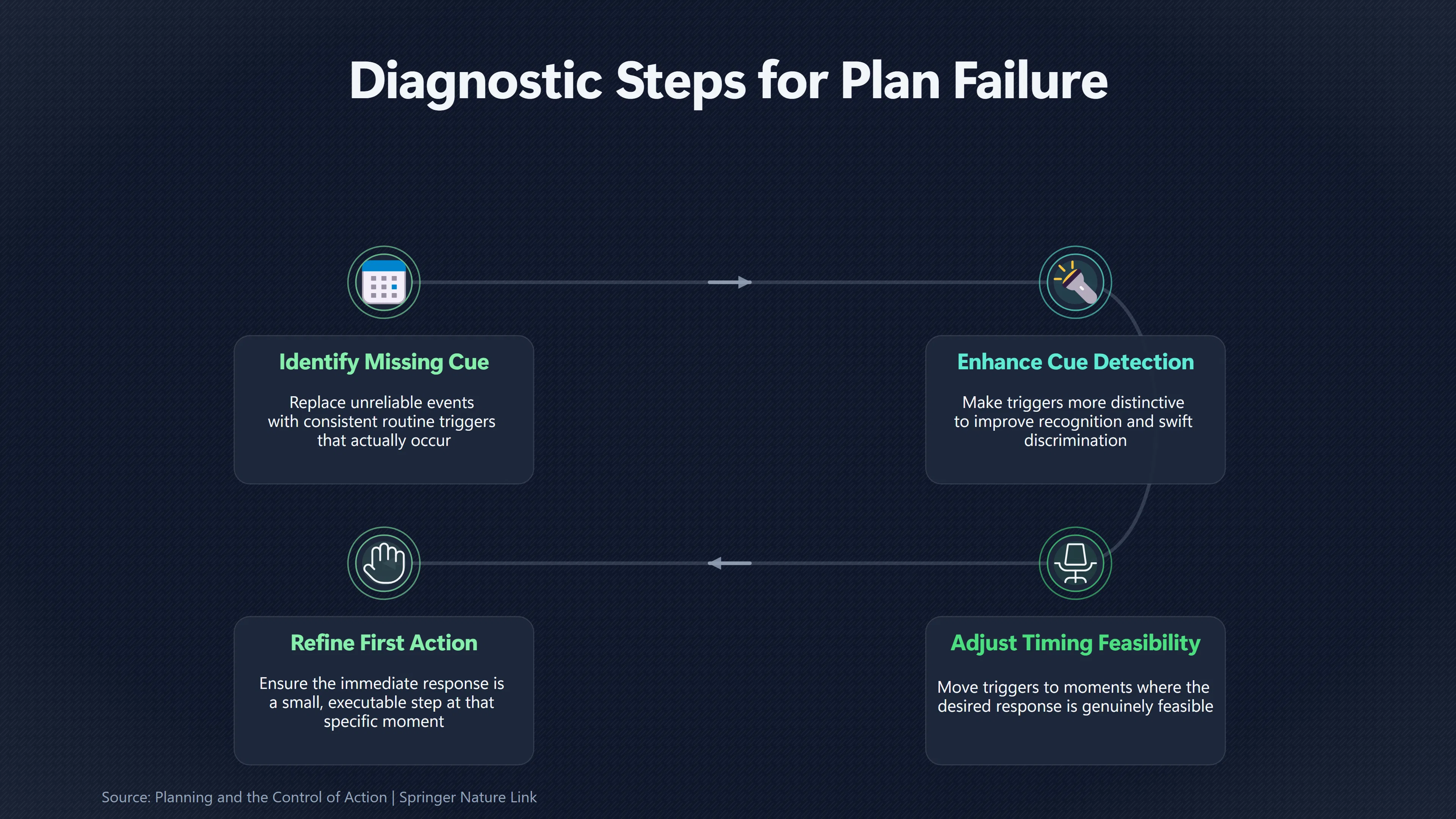
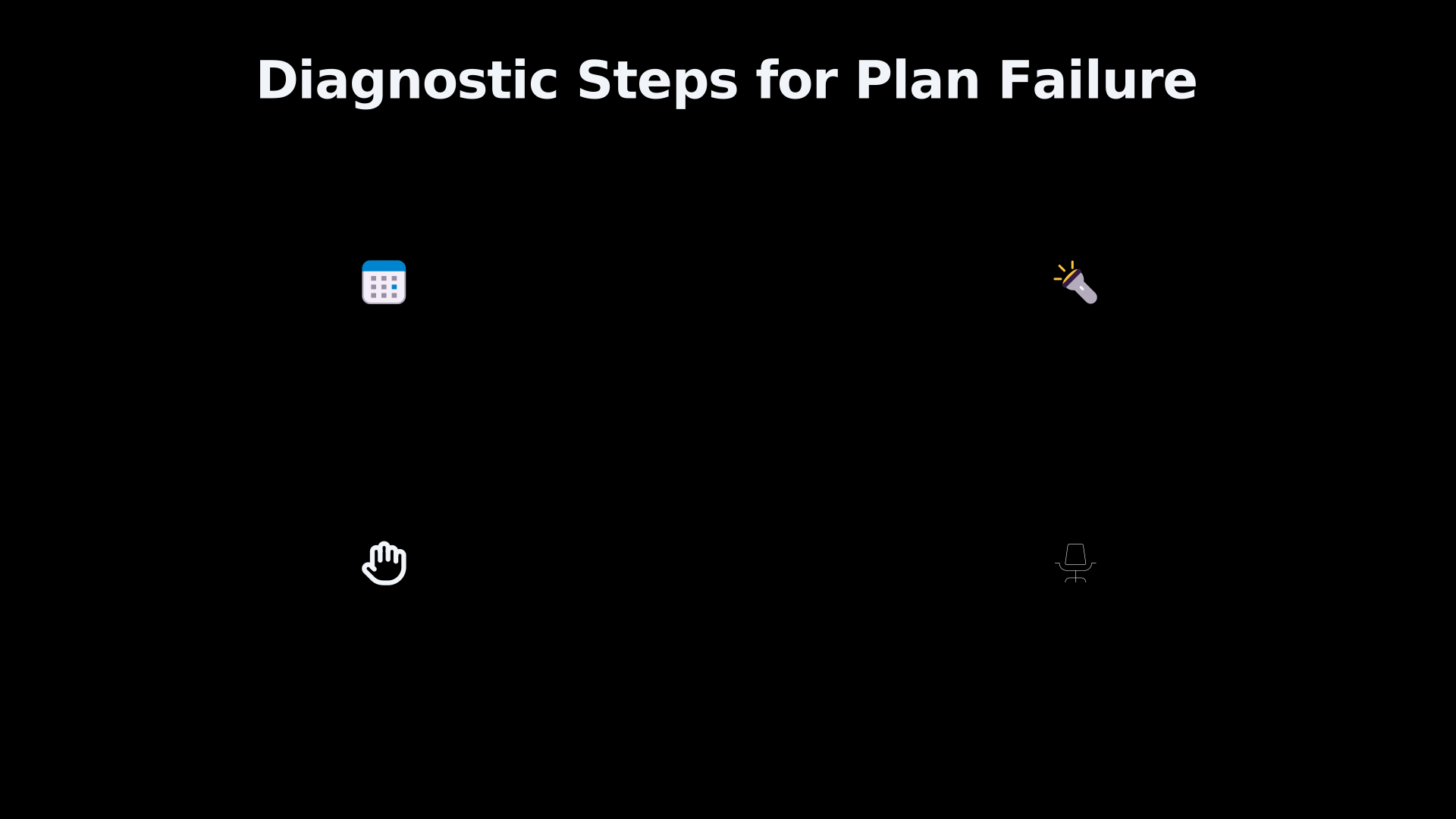
When the behaviour fails to start, identify where the chain broke. Three failures point to different repairs:
The cue never occurred. The plan was anchored to an unreliable event. Replace it with something that happens more consistently.
The cue occurred but you did not notice it. Make it more distinctive, choose a better-defined transition or, where appropriate, use an external signal such as a calendar alert.
You noticed the cue but could not act. The cue was mistimed. Move the trigger to a situation in which the response is genuinely feasible, or make the immediate response a smaller first action.
This diagnostic approach follows directly from the proposed mechanism. If implementation intentions work partly by increasing cue accessibility and forging a cue-response association, then a trigger that rarely occurs, cannot be discriminated or routinely arrives at an impossible moment breaks the pathway before the planned behaviour has much chance to begin.[ScienceDirect]sciencedirect.comHow do implementation intentions promote goal attainment? A test of component processes - ScienceDirect…
It is also worth testing a cue rather than endlessly adding detail to it. Evidence does not support the simplistic idea that ever-more-specific plans are always better. One physical-activity study found no advantage of choosing among ten specific situations over using a generic single situation, and the large contemporary meta-analysis found considerable variation within several cue categories.[ScienceDirect]sciencedirect.comDoes Situation-Specificity Affect the Operation of Implementation Intentions? - ScienceDirect…
Nor is “choose your own cue” automatically superior. In the 642-test meta-analysis, studies in which participants themselves specified the situation showed a relatively small average effect, leading the authors to suggest that curated cue choices may sometimes help. That should not be read as proof that someone else always knows your routine better; rather, it shows that generating a useful trigger is itself a planning skill.[ResearchGate]researchgate.netOpen source on researchgate.net.
The cue should make the moment obvious
A good if-then trigger solves a surprisingly narrow problem: when the opportunity arrives, you should not have to decide whether this is the moment you meant.
That is why routine transitions are often useful, why vague phrases such as “when I have time” are troublesome, and why internal states work better when they are defined as recognisable experiences rather than broad moods. The research does not identify one universally superior class of cue. Indeed, the most comprehensive recent review found useful effects for opportunities and obstacles, external and internal cues, task junctures, stimuli, thoughts and feelings.[DOI]doi.orgThe when and how of planning: Meta-analysis of the scope and components of implementation intentions in 642 tests: European Review of…
The practical aim is therefore not to find the theoretically perfect trigger. It is to find a reliable handover point from ordinary life to the planned action: an event you are likely to encounter, can recognise without much interpretation, and can realistically answer with the behaviour you chose in advance.
Amazon book picks
Further Reading
Books and field guides related to Which Cues Make If Then Plans Easier to Follow?. Use these as the next step if you want deeper reading beyond the article.
Atomic Habits
Rating: 3.5/5 from 7 Google Books ratings
The #1 New York Times bestseller. Over 25 million copies sold! Translated into 60+ languages! Tiny Changes, Remarkable Results No matter...

TINY HABITS: The Small Changes That Change Everything
Rating: 3.6/5 from 8 Google Books ratings
First published 2019. Subjects: Habit, Change (psychology), SELF-HELP / Motivational & Inspirational, SELF-HELP / Personal Growth / Happi...
The Power of Habit
Rating: 4.0/5 from 145 Google Books ratings
In The Power of Habit, award-winning business reporter Charles Duhigg takes us to the thrilling edge of scientific discoveries that expla...
Good Habits, Bad Habits: The Science of Making Positive Chang...
'The world's leading expert on habits' - Matthew Syed, bestselling author of Black Box Thinking and Rebel IdeasWhat if you could harness...
eBay marketplace picks
Marketplace Samples
Live-tested eBay searches with available results related to this page.
Selected fromself improvement wall art oneBay.co.uk.




Endnotes
1.
Source: onlinelibrary.wiley.com
Link:https://onlinelibrary.wiley.com/doi/10.1002/ejsp.205
Source snippet
Wiley Online LibraryIdentifying good opportunities to act: Implementation intentions and cue discrimination - Webb - 2004 - European Jour...
2.
Source: sciencedirect.com
Link:https://www.sciencedirect.com/science/article/abs/pii/S002210310600028X
Source snippet
How do implementation intentions promote goal attainment? A test of component processes - ScienceDirect...
3.
Source: doi.org
Link:https://doi.org/10.1080/10463283.2024.2334563
Source snippet
The when and how of planning: Meta-analysis of the scope and components of implementation intentions in 642 tests: European Review of...
4.
Source: bpspsychub.onlinelibrary.wiley.com
Link:https://bpspsychub.onlinelibrary.wiley.com/doi/full/10.1348/014466607X267010
Source snippet
Webb - 2008 - British Journal of Social Psychology - Wiley Online Library...
5.
Source: cancercontrol.cancer.gov
Link:https://cancercontrol.cancer.gov/brp/research/constructs/implementation-intentions
Source snippet
Cancer ControlImplementation Intentions | Division of Cancer Control and Population Sciences (DCCPS)...
6.
Source: sciencedirect.com
Link:https://www.sciencedirect.com/science/article/abs/pii/S0005789417300904
Source snippet
Does Situation-Specificity Affect the Operation of Implementation Intentions? - ScienceDirect...
7.
Source: researchgate.net
Link:https://www.researchgate.net/publication/378870694_The_When_and_How_of_Planning_Meta-Analysis_of_the_Scope_and_Components_of_Implementation_Intentions_in_642_Tests
8.
Source: sciencedirect.com
Link:https://www.sciencedirect.com/science/article/pii/S0165178115000360
Source snippet
The effect of implementation intention on prospective memory: A systematic and meta-analytic review - ScienceDirectMarch 30...
9.
Source: bpspsychub.onlinelibrary.wiley.com
Link:https://bpspsychub.onlinelibrary.wiley.com/doi/10.1111/bjhp.70090
10.
Source: bpspsychub.onlinelibrary.wiley.com
Link:https://bpspsychub.onlinelibrary.wiley.com/doi/10.1111/bjop.70065
11.
Source: bpspsychub.onlinelibrary.wiley.com
Link:https://bpspsychub.onlinelibrary.wiley.com/doi/10.1111/bjhp.70061
12.
Source: bpspsychub.onlinelibrary.wiley.com
Link:https://bpspsychub.onlinelibrary.wiley.com/doi/epdf/10.1111/bjop.70065
13.
Source: compass.onlinelibrary.wiley.com
Link:https://compass.onlinelibrary.wiley.com/doi/full/10.1111/spc3.70110
14.
Source: sciencedirect.com
Link:https://www.sciencedirect.com/science/article/pii/S0361476X25000876
15.
Source: doi.org
Link:https://doi.org/10.1002/tl.70005
16.
Source: bpspsychub.onlinelibrary.wiley.com
Link:https://bpspsychub.onlinelibrary.wiley.com/doi/abs/10.1111/bjhp.12563
17.
Source: researchgate.net
Link:https://www.researchgate.net/publication/353648400_Using_implementation_intentions_to_prevent_relapse_after_remission_from_psychological_treatment_for_depression_The_SMArT_intervention
18.
Source: sciencedirect.com
Link:https://www.sciencedirect.com/science/article/abs/pii/S0885201420301520
19.
Source: researchgate.net
Link:https://www.researchgate.net/publication/314131929_Reducing_fat_intake_using_implementation_intentions_A_meta-analytic_review
20.
Source: doi.org
Title: Planning and the Control of Action | Springer Nature Link
Link:https://doi.org/10.1007/978-3-319-44588
21.
Source: sciencedirect.com
Title: Forming implementation intentions improves prospective memory in early psychosis
Link:https://www.sciencedirect.com/science/article/abs/pii/S0165178115004199
22.
Source: sciencedirect.com
Link:https://www.sciencedirect.com/science/article/abs/pii/S0165178115000360
23.
Source: researchgate.net
Link:https://www.researchgate.net/publication/266246293_Tell_Me_a_Story_About_Healthy_Snacking_and_I_Will_Follow_Comparing_the_Effectiveness_of_Self-Generated_Versus_Message-Aided_Implementation_Intentions_on_Promoting_Healthy_Snacking_Habits_Among_College
24.
Source: researchgate.net
Link:https://www.researchgate.net/publication/260486103_Implementation_Intention_and_Action_Planning_Interventions_in_Health_Contexts_State_of_the_Research_and_Proposals_for_the_Way_Forward
25.
Source: sciencedirect.com
Link:https://www.sciencedirect.com/science/article/abs/pii/S1053810012000645
26.
Source: researchgate.net
Link:https://www.researchgate.net/publication/227298250_Committing_to_implementation_intentions_Attention_and_memory_effects_for_selected_situational_cues
27.
Source: bpspsychub.onlinelibrary.wiley.com
Link:https://bpspsychub.onlinelibrary.wiley.com/doi/abs/10.1348/014466607X267010
28.
Source: doi.org
Link:https://doi.org/10.3758/MC.38.2.221
29.
Source: researchgate.net
Link:https://www.researchgate.net/publication/23687757_Finding_the_Critical_Cue_Implementation_Intentions_to_Change_One%27s_Diet_Work_Best_When_Tailored_to_Personally_Relevant_Reasons_for_Unhealthy_Eating
30.
Source: bpspsychub.onlinelibrary.wiley.com
Link:https://bpspsychub.onlinelibrary.wiley.com/doi/10.1348/014466607X267010
31.
Source: sciencedirect.com
Link:https://www.sciencedirect.com/science/article/pii/S0167876006002856
32.
Source: researchgate.net
Link:https://www.researchgate.net/publication/37367696_Implementation_Intentions_and_Goal_Achievement_A_Meta-Analysis_of_Effects_and_Processes
33.
Source: doi.org
Link:https://doi.org/10.1002/EJSP.205
34.
Source: researchgate.net
Link:https://www.researchgate.net/publication/227955629_Experimental_tests_of_prospective_remembering_The_influence_of_cue-event_frequency_on_performance
35.
Source: researchgate.net
Link:https://www.researchgate.net/publication/227903416_Identifying_good_opportunities_to_act_Implementation_intentions_and_cue_discrimination
36.
Source: researchgate.net
Link:https://www.researchgate.net/publication/232586066_Implementation_Intentions_Strong_Effects_of_Simple_Plans
37.
Source: researchgate.net
Link:https://www.researchgate.net/publication/232586066_Implementation_Intentions
38.
Source: researchgate.net
Link:https://www.researchgate.net/publication/313484438_Improving_Prospective_Memory_in_Persons_With_Parkinson_Disease_A_Randomized_Controlled_Trial
39.
Source: sciencedirect.com
Link:https://www.sciencedirect.com/topics/social-sciences/intention
40.
Source: sciencedirect.com
Title: More than planned: Implementation intention effects in non-planned situations
Link:https://www.sciencedirect.com/science/article/pii/S0001691816304048
41.
Source: sciencedirect.com
Link:https://www.sciencedirect.com/science/article/pii/S002210311000003X
42.
Source: sciencedirect.com
Link:https://www.sciencedirect.com/science/article/pii/S1469029211000264
43.
Source: sciencedirect.com
Link:https://www.sciencedirect.com/science/article/pii/S1499404605000242
44.
Source: sciencedirect.com
Link:https://www.sciencedirect.com/science/article/pii/S0277953620307097
45.
Source: sciencedirect.com
Link:https://www.sciencedirect.com/science/article/pii/S002209651730721X
46.
Source: sciencedirect.com
Link:https://www.sciencedirect.com/science/article/pii/S0010027720301244
47.
Source: sciencedirect.com
Link:https://www.sciencedirect.com/science/article/abs/pii/S0740547220303020
48.
Source: sciencedirect.com
Link:https://www.sciencedirect.com/science/article/abs/pii/S0167876006002856
49.
Source: psychologicalscience.org
Link:https://www.psychologicalscience.org/journals/psychological-science/1467-9280.00385/
50.
Source: pubmed.ncbi.nlm.nih.gov
Link:https://pubmed.ncbi.nlm.nih.gov/19130080/
51.
Source: pubmed.ncbi.nlm.nih.gov
Link:https://pubmed.ncbi.nlm.nih.gov/18604955/
52.
Source: pubmed.ncbi.nlm.nih.gov
Link:https://pubmed.ncbi.nlm.nih.gov/37504049/
53.
Source: pubmed.ncbi.nlm.nih.gov
Link:https://pubmed.ncbi.nlm.nih.gov/34753411/
54.
Source: pubmed.ncbi.nlm.nih.gov
Link:https://pubmed.ncbi.nlm.nih.gov/34546833/
55.
Source: pubmed.ncbi.nlm.nih.gov
Link:https://pubmed.ncbi.nlm.nih.gov/32730052/
56.
Source: wp.nyu.edu
Title: peter gollwitzer
Link:https://wp.nyu.edu/motivationlab/publications/peter-gollwitzer/
57.
Source: pubmed.ncbi.nlm.nih.gov
Link:https://pubmed.ncbi.nlm.nih.gov/17295981/
58.
Source: pubmed.ncbi.nlm.nih.gov
Link:https://pubmed.ncbi.nlm.nih.gov/18272806/
59.
Source: pubmed.ncbi.nlm.nih.gov
Link:https://pubmed.ncbi.nlm.nih.gov/20204939/
60.
Source: pubmed.ncbi.nlm.nih.gov
Link:https://pubmed.ncbi.nlm.nih.gov/29506445/
61.
Source: pubmed.ncbi.nlm.nih.gov
Link:https://pubmed.ncbi.nlm.nih.gov/11760131/
62.
Source: pubmed.ncbi.nlm.nih.gov
Link:https://pubmed.ncbi.nlm.nih.gov/20173194/
63.
Source: pubmed.ncbi.nlm.nih.gov
Link:https://pubmed.ncbi.nlm.nih.gov/23355044/
64.
Source: oboe.com
Title: Implementation Intentions
Link:https://oboe.com/learn/unlocking-your-ambition-anlrf9/implementation-intentions-unlocking-your-ambition-2
65.
Source: memory-key.com
Link:https://www.memory-key.com/archive/research/topic/prospective-memory
Additional References
66.
Source: eprints.whiterose.ac.uk
Link:https://eprints.whiterose.ac.uk/id/eprint/10774/
Source snippet
White Rose Research OnlineIdentifying good opportunities to act: implementation intentions and cue discrimination - White Rose Research O...
67.
Source: youtube.com
Title: Why 99% Of People Will Never Achieve Their Goals (According To Psychology)
Link:https://www.youtube.com/watch?v=qgYDYJJlNHg
Source snippet
For a scientific breakdown of how setting up clear situational cues and if-then plans automates attention and action, see The Science of...
68.
Source: youtube.com
Link:https://www.youtube.com/watch?v=N7SDVVbxgNU
Source snippet
What Is Implementation Intention For Building Habits?...
69.
Source: youtube.com
Title: How to Automate Your Focus: The Science of If-Then Rules
Link:https://www.youtube.com/watch?v=MSPjnh5AEyE
Source snippet
Implementation Intention Explained: How to DOUBLE YOUR SUCCESS with a Goal or Habit...
70.
Source: youtube.com
Title: What is Implementation Intention | Explained in 2 min
Link:https://www.youtube.com/watch?v=6JqPF_8BWjw
Source snippet
Why 99% Of People Will Never Achieve Their Goals (According To Psychology)...
71.
Source: youtube.com
Title: What Is Implementation Intention For Building Habits?
Link:https://www.youtube.com/watch?v=tKVv5YlUcMI
Source snippet
4-Phases for Achieving Goals: A Mindset Theory...
72.
Source: guilfordjournals.com
Link:https://guilfordjournals.com/doi/10.1521/soco.2007.25.2.248
73.
Source: frontiersin.org
Link:https://www.frontiersin.org/journals/psychology/articles/10.3389/fpsyg.2022.905860/full
74.
Source: tandfonline.com
Link:https://www.tandfonline.com/doi/full/10.1080/17437199.2021.1876572
75.
Source: tandfonline.com
Link:https://www.tandfonline.com/doi/abs/10.1080/10503307.2021.1959079