Within Better Habits
Treat Repeated Failure as Data, Not a Verdict
A strong self-improvement plan changes when the same failure keeps recurring instead of treating the original design as sacred.

On this page
- Recognizing repeated failure patterns
- Choosing the smallest useful adjustment
- Re testing the redesigned routine
Page outline Jump by section
Introduction
Adaptive self-improvement means treating a repeatedly failing routine as a design problem rather than repeatedly demanding more effort from the same design. Monitoring is useful because it reveals a gap between intention and behaviour; the important next step is to use that information to change the conditions producing the behaviour. Research on self-regulation describes this as a feedback process: compare what happened with what was intended, decide whether the present strategy still fits, and alter the strategy when progress remains inadequate.[PubMed Central (PMC)]pmc.ncbi.nlm.nih.govPubMed Central (PMC)Theoretical explanations for maintenance of behaviour change: a systematic review of behaviour theories - PMCJuly 2…
This approach is deliberately different from changing everything after one bad day. Single lapses are noisy: illness, travel, an unusual deadline or simple chance can disrupt a sound routine. Repeated failures in a similar situation are more informative. They suggest that the plan may contain a predictable point of friction — the timing, cue, workload, environment, response to obstacles or even the target itself. The practical aim is therefore to identify that recurring failure window, make the smallest plausible adjustment, and re-test the redesigned routine before escalating to a larger change.
Recognise a pattern before redesigning the plan
A useful self-improvement system distinguishes an event from a pattern. Missing one planned evening run after an exceptionally long workday tells you little. Missing most evening runs specifically on days when work finishes late tells you much more: the routine appears vulnerable during a recognisable time window.
Progress monitoring helps expose patterns of this kind. A meta-analysis of 138 experimental studies involving 19,951 participants found that interventions designed to increase progress monitoring increased both monitoring frequency and goal attainment; changes in monitoring frequency statistically mediated the improvement in attainment. Effects were larger when progress was physically recorded or reported to someone else.[PubMed]pubmed.ncbi.nlm.nih.govDoes monitoring goal progress promote goal attainment? A meta-analysis of the experimental evidence - PubMedFebruary 1, 2016… That supports tracking, but it does not mean that merely collecting more data solves the problem. A wider meta-review found that self-monitoring, feedback and goal-setting techniques work inconsistently across behaviours and populations.[PubMed Central (PMC)]pmc.ncbi.nlm.nih.govPubMed Central (PMC)Self-Regulation Mechanisms in Health Behaviour Change: A Systematic Meta-Review of Meta-Analyses, 2006–2017 - PMCMarc…
The higher-value question is therefore not just “Did I fail?” but “Under what recurring conditions did the behaviour fail?” A simple record can distinguish several different problems:
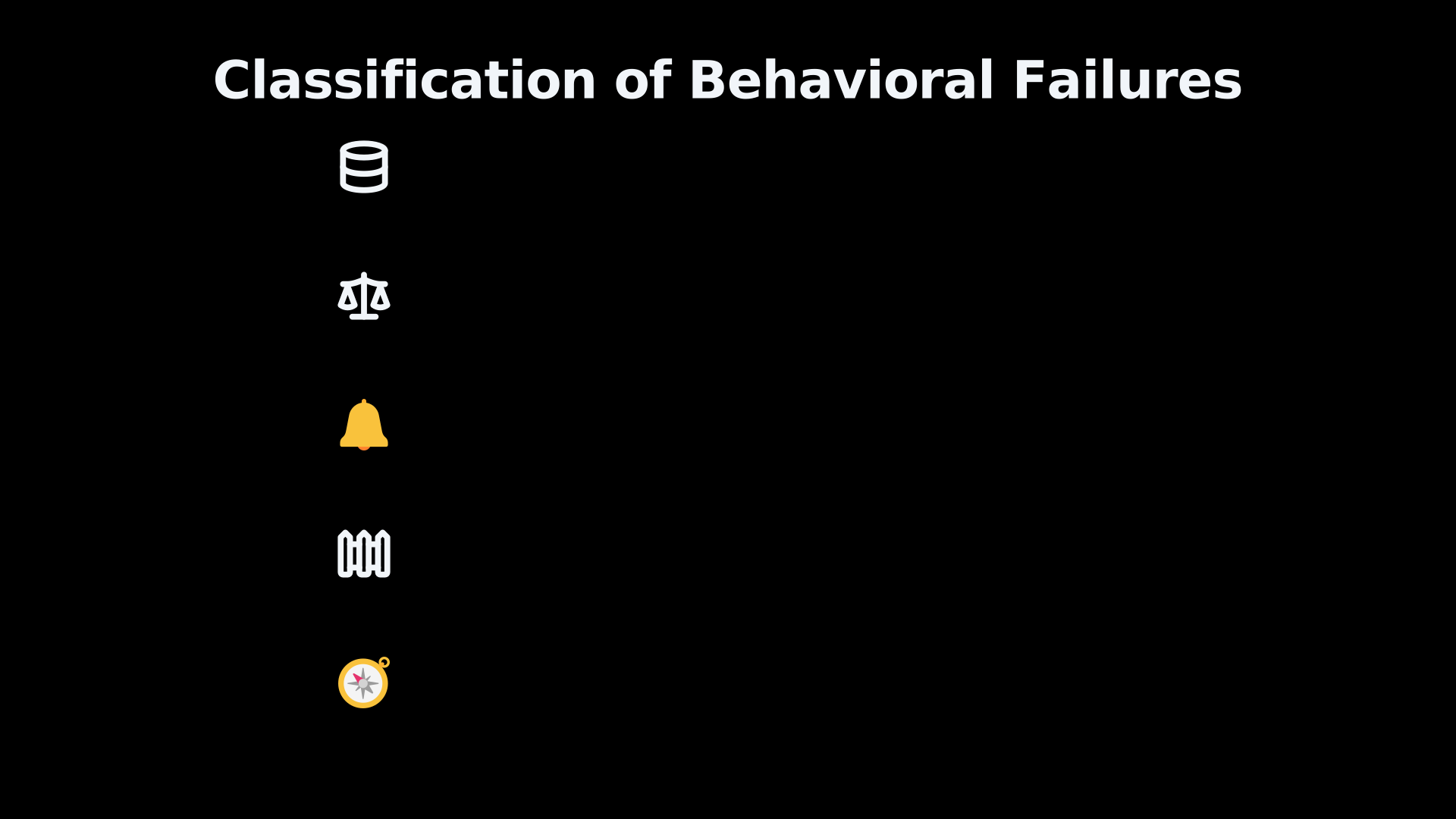
- Starting failure: the intended action never begins — for example, study sessions disappear whenever they are scheduled after dinner.
- Completion failure: the action starts but its planned size is repeatedly unrealistic — a 60-minute workout becomes ten minutes or nothing.
- Cue failure: the intended trigger is unreliable — “when I get some free time” never creates a dependable starting point.
- Obstacle failure: the same foreseeable interruption repeatedly defeats the plan — late meetings, childcare, tiredness, missing equipment or distracting devices.
- Recovery failure: one missed attempt turns into several because the system contains no clear rule for restarting.
This classification matters because the appropriate adjustment depends on where the failure occurs. Moving the workout earlier will not solve an exercise routine whose real problem is that it requires equipment the person rarely has available. Reducing session length will not fix a cue that never occurs consistently.
Behaviour-change guidance reflects this distinction between tracking and revision. NICE describes behaviour goals as things that should be reviewed in light of experience, with further plans made according to previous progress; its framework places monitoring alongside action planning rather than treating either as sufficient alone.[Nice]nice.org.ukRecommendations | Behaviour change: individual approaches | Guidance | NICEJanuary 2, 2014…
Repeated failure should also be interpreted locally before it is interpreted globally. Older relapse research provides an especially clear example: treating a lapse as proof of personal incapacity can increase the risk that the lapse becomes a broader relapse, whereas attributing it to an ineffective response to a specific high-risk situation creates an opportunity to develop a better response for the next occurrence.[PubMed Central (PMC)]pmc.ncbi.nlm.nih.govOpen source on nih.gov. Although those findings come from addiction research and should not simply be generalised to every self-improvement goal, the governance lesson is useful: diagnose the failed interaction between person, plan and situation before concluding that the entire goal or the person pursuing it is defective.

Make the smallest adjustment that could fix the failure
Once a recurring pattern is visible, the temptation is to redesign everything: a new app, a stricter schedule, a different diet, a larger goal or a more complicated productivity system. That makes the next result difficult to interpret. If five things change simultaneously and performance improves, you do not know which change mattered; if performance worsens, you do not know what caused that either.
A better rule is minimum useful adjustment: change the smallest element that plausibly targets the repeated failure.
Suppose the intended routine is “write for 45 minutes at 19:00”, but tracking shows that it fails four evenings out of five because family responsibilities make that window unpredictable. Possible interventions range from tiny to radical. The first test might simply move the session to 07:30. If starting remains difficult, the next adjustment might prepare the document and notes the previous night. Only after smaller changes fail would it make sense to question the session length, frequency or larger goal.
This mirrors a central idea in contemporary models of self-regulation. Monitoring does not merely indicate whether a goal has been reached; it can signal whether the current strategy or tactic should be maintained, changed or stopped. When a selected tactic produces insufficient progress, the person can return to strategy selection and try a different response rather than simply repeating the ineffective one.[Compass]compass.onlinelibrary.wiley.comCompass Self‐control: An integrative frameworkSelf‐control: An integrative framework - Werner - 2023 - Social and Personality Psychology Compass - Wiley Online Library…
The most useful adjustment usually targets the mechanism exposed by the record:
If the problem is timing, change the window. A planned behaviour that repeatedly collides with predictable demands should be moved rather than protected indefinitely through willpower. “Exercise after work” might become “exercise before the first meeting” or “walk during lunch”.
If the problem is scale, lower the entry requirement. A routine can be sound in principle yet too large to survive ordinary low-energy days. The redesign may preserve the frequency while shortening the minimum session.
If the problem is an obstacle, plan the response to that obstacle. Behaviour-change research distinguishes action planning — specifying when, where and how a behaviour will occur — from coping planning, which specifies what to do when anticipated barriers arise. A systematic review found variable but generally supportive evidence for coping planning, particularly where people received help forming their plans, while a broader review of planning interventions found small-to-medium effects across health behaviours but considerable heterogeneity.[Taylor & Francis Online]tandfonline.comOpen source on tandfonline.com. In practice, “I will walk at lunch” becomes “I will walk at lunch; if rain makes the normal route impractical, I will use the covered route through the shopping centre.”
If the environment repeatedly wins, change the environment. Removing friction from the intended behaviour or adding friction to the competing behaviour is often more targeted than strengthening the intention yet again. If every planned reading session becomes phone use, testing a phone-free room is a cleaner intervention than writing a more inspirational reading goal.
If the plan works only under ideal conditions, create a fallback mode. A resilient system may contain an ordinary version and a reduced version: 40 minutes of training normally, 10 minutes when time collapses; cooking the planned meal normally, a pre-selected simple alternative when work runs late. The fallback should preserve continuity without quietly becoming an excuse to abandon the intended standard altogether.
The governing principle is diagnosis before escalation. Behaviour-change taxonomies contain many possible techniques — UCL’s Behaviour Change Technique Taxonomy identifies 93 — but government guidance explicitly cautions that researchers still do not know with certainty which combinations work best for every behaviour, person and moment.[University College London]ucl.ac.ukOpen source on ucl.ac.uk. Adding more techniques is therefore not automatically an improvement. A change earns its place because it addresses an observed failure mode.
Re-test the redesigned routine
An adjustment is a hypothesis, not a solution merely because it sounds sensible. The redesigned routine has to be exposed to the situation that previously defeated it.
This is where an event-time-window view becomes especially useful. Instead of asking whether the plan works “in general”, watch the specific window associated with failure. If the original problem was skipped workouts after late meetings, evaluate the replacement routine across several late-meeting days. If impulse spending was concentrated on Sunday evenings, test the new purchasing rule across several Sunday evenings. The relevant unit is not the calendar week in the abstract but repeated encounters with the condition you are trying to govern.
A practical review cycle has three decisions:
- Keep it when the redesigned routine now succeeds reliably enough in the previously troublesome situation.
- Modify it again when the same failure mechanism remains visible.
- Diagnose a different problem when the original failure disappears but another bottleneck emerges.
That final possibility is important. Behavioural systems can move their constraint. Moving exercise to the morning may solve scheduling but expose a preparation problem because clothing and equipment are never ready. Preparing everything the night before may then reveal that the planned session itself is too long. Adaptive improvement is consequently iterative: each test generates information for the next decision.
Repeated prompting may sometimes be part of that redesign rather than a permanent requirement. One study of implementation-intention prompts among medical students found that performance benefits built across consecutive days of prompting but faded after prompting stopped, illustrating that an intervention can work while it is present without automatically creating a durable self-sustaining routine.[ScienceDirect]sciencedirect.comOpen source on sciencedirect.com. That distinction matters when evaluating any redesign. Ask not only whether performance improved immediately, but whether the new arrangement remains workable once temporary supports are reduced.
Re-testing also protects against a common mistake: abandoning a useful system because of normal variance. No realistic routine produces perfect adherence. The question is whether the adjustment has meaningfully changed the pattern. If a person previously missed four of five vulnerable occasions and now misses one of five, the redesign is doing useful work even though the record is not flawless.
Know when to adjust the system — and when to adjust the goal
Most repeated failures should initially trigger a change in how the goal is pursued, not an immediate abandonment of what the person values. But persistence is not always the right answer. Sometimes repeated difficulty indicates that the target itself has become unrealistic, excessively costly or incompatible with changed circumstances.
A 2025 meta-analytic review synthesising 235 studies and 1,421 effect sizes distinguishes several forms of goal adjustment, including disengaging from a goal, re-engaging with alternatives and remaining flexible about how striving occurs. The authors emphasise that adjustment is not a single uniformly beneficial act and rate the accumulated evidence as only low to moderate overall because much of it is cross-sectional and heterogeneous.[PubMed Central (PMC)]pmc.ncbi.nlm.nih.govOpen source on nih.gov. That caution is important: “be flexible” is not an evidence-based licence to quit whenever progress is uncomfortable.
Still, the evidence challenges the opposite rule that perseverance is invariably virtuous. An earlier meta-analysis across 31 samples found that capacities for both goal disengagement and re-engagement were positively associated with quality of life, with the association larger for re-engagement than disengagement.[PubMed]pubmed.ncbi.nlm.nih.govPub Med Goal adjustment capacities and quality of life: A meta-analytic reviewPub Med Goal adjustment capacities and quality of life: A meta-analytic review The reasonable interpretation is not that difficult goals should be abandoned, but that a mature self-improvement system needs an escalation path.
The sequence should ordinarily be:
First, question the tactic. Can the timing, cue, environment, scale or obstacle response be redesigned?
Then, question the strategy. Is there another route to the same valued outcome? Someone unable to sustain running because of recurring practical or physical constraints may still pursue cardiovascular fitness through walking, cycling or swimming.
Only then, when evidence warrants it, question the goal specification. Is the target still attainable, valuable and proportionate to its costs?
This hierarchy prevents two symmetrical errors: treating every setback as proof that the goal should be abandoned, and treating years of repeated failure as proof that still more determination is required.
Build a rule for adaptation before the next failure
The strongest version of this approach makes adjustment part of the original system rather than an emergency response improvised during discouragement. In effect, the plan contains a small governance rule: when a particular failure repeats often enough, review the mechanism and change one thing.
The threshold does not need to be mathematically sophisticated. For a behaviour attempted daily, three or four failures under similar circumstances may justify inspection. For a weekly behaviour, it may be sensible to review after several opportunities rather than waiting months. The appropriate window depends on the frequency and stakes of the behaviour, but the threshold should be large enough to distinguish a pattern from an isolated exception and small enough to prevent an obviously faulty design from running indefinitely.
A useful review can be reduced to four questions:
- What exactly keeps failing? Name the behaviour, not the character judgement.
- When does it keep failing? Identify the recurring situation or time window.
- What is the smallest plausible cause? Look first at timing, friction, scale, cues and foreseeable barriers.
- What single change will be tested next? Define the adjustment clearly enough that its effect can be observed.
This closes the loop that makes monitoring worthwhile. Self-improvement becomes less like issuing the same instruction to yourself with increasing frustration and more like maintaining a working system: observe performance, locate the recurring fault, make a controlled adjustment, and test again.
That approach is also consistent with the limits of the evidence. Reviews of self-regulatory interventions repeatedly find useful average effects for techniques such as monitoring, planning and feedback, but they also find substantial variation across behaviours, populations and contexts.[PubMed Central (PMC)]pmc.ncbi.nlm.nih.govPubMed Central (PMC)Self-Regulation Mechanisms in Health Behaviour Change: A Systematic Meta-Review of Meta-Analyses, 2006–2017 - PMCMarc… The practical lesson is not to search for a universally correct routine. It is to build a routine capable of learning from its own repeated failures.

The practical standard: improve the system, not the story about yourself
Repeated failure contains information only if it is made specific. “I am undisciplined” offers almost no design guidance. “My planned study block fails whenever it starts after 20:00 because I switch to passive entertainment first” points towards testable interventions: move the session, shorten it, change the preceding cue or restrict access to the competing activity during that window.
That difference is the heart of adaptive self-improvement. A sound plan is not sacred. It is provisional. Monitoring identifies recurring discrepancies; diagnosis turns them into plausible mechanisms; small adjustments test those mechanisms; re-testing shows whether the system has actually improved. Control-theory accounts of self-regulation have long described behaviour in these feedback-loop terms, and modern work on self-regulatory flexibility likewise emphasises matching strategies to changing situations rather than assuming that one strategy should always work.[Cambridge University Press]cambridge.orgUniversity Press Changing Behavior Using Control Theory (Chapter 9University Press Changing Behavior Using Control Theory (Chapter 9
The standard of success is therefore not never failing. It is becoming progressively better at responding to failure. When the same breakdown keeps appearing, do not merely renew the promise. Change the part of the system that keeps producing it.
Amazon book picks
Further Reading
Books and field guides related to Treat Repeated Failure as Data, Not a Verdict. Use these as the next step if you want deeper reading beyond the article.
Atomic Habits
Rating: 3.5/5 from 7 Google Books ratings
The #1 New York Times bestseller. Over 25 million copies sold! Translated into 60+ languages! Tiny Changes, Remarkable Results No matter...
How to Change
Wall Street Journal bestseller “A welcome revelation.” --The Financial Times Award-winning Wharton Professor and Choiceology podcast host...
Tiny Habits
Improving your life is much easier than you think. Whether it’s losing weight, sleeping more, or restoring your work/life balance – the s...

The Power of Habit
Rating: 4.0/5 from 145 Google Books ratings
In The Power of Habit, award-winning business reporter Charles Duhigg takes us to the thrilling edge of scientific discoveries that expla...
eBay marketplace picks
Marketplace Samples
Live-tested eBay searches with available results related to this page.
Selected frommotivational poster oneBay.co.uk.




Endnotes
1.
Source: sciencedirect.com
Link:https://www.sciencedirect.com/science/article/pii/S0959475221001195
2.
Source: cambridge.org
Title: University Press Changing Behavior Using Control Theory (Chapter 9)
Link:https://www.cambridge.org/core/books/abs/handbook-of-behavior-change/changing-behavior-using-control-theory/6F7BD075E7046390F126A4F445A7B02A
3.
Source: sciencedirect.com
Link:https://www.sciencedirect.com/org/science/article/pii/S1438887124002619
4.
Source: cambridge.org
Title: Planning and Implementation Intention Interventions (Chapter 39)
Link:https://www.cambridge.org/core/books/abs/handbook-of-behavior-change/planning-and-implementation-intention-interventions/E1C8DA422E9BA21E7D2C4881A04898D0
5.
Source: sciencedirect.com
Link:https://www.sciencedirect.com/science/article/abs/pii/S136984781830086X
6.
Source: sciencedirect.com
Link:https://www.sciencedirect.com/science/article/pii/S0002916522027861
7.
Source: sciencedirect.com
Link:https://www.sciencedirect.com/science/article/pii/S1162908810000186
8.
Source: sciencedirect.com
Title: Self-regulatory failure: A review with clinical implications
Link:https://www.sciencedirect.com/science/article/abs/pii/0272735887900055
9.
Source: sciencedirect.com
Link:https://www.sciencedirect.com/science/article/pii/S0747563215302946
10.
Source: sciencedirect.com
Title: Habit formation and change
Link:https://www.sciencedirect.com/science/article/pii/S2352154617301602
11.
Source: sciencedirect.com
Link:https://www.sciencedirect.com/science/chapter/bookseries/pii/S2215091919300148
12.
Source: sciencedirect.com
Link:https://www.sciencedirect.com/science/article/pii/S1469029212001148
13.
Source: sciencedirect.com
Title: Self-regulatory flexibility
Link:https://www.sciencedirect.com/science/article/pii/S2352250X24000915
14.
Source: sciencedirect.com
Title: Abstinence Violation
Link:https://www.sciencedirect.com/topics/psychology/abstinence-violation
15.
Source: sciencedirect.com
Link:https://www.sciencedirect.com/science/article/abs/pii/S2215091919300148
16.
Source: sciencedirect.com
Title: Why behavior change is difficult to sustain
Link:https://www.sciencedirect.com/science/article/pii/S0091743514002102
17.
Source: pmc.ncbi.nlm.nih.gov
Link:https://pmc.ncbi.nlm.nih.gov/articles/4975085/
Source snippet
PubMed Central (PMC)Theoretical explanations for maintenance of behaviour change: a systematic review of behaviour theories - PMCJuly 2...
18.
Source: compass.onlinelibrary.wiley.com
Title: Compass Self‐control: An integrative framework
Link:https://compass.onlinelibrary.wiley.com/doi/10.1111/spc3.12738
Source snippet
Self‐control: An integrative framework - Werner - 2023 - Social and Personality Psychology Compass - Wiley Online Library...
19.
Source: pubmed.ncbi.nlm.nih.gov
Link:https://pubmed.ncbi.nlm.nih.gov/26479070/
Source snippet
Does monitoring goal progress promote goal attainment? A meta-analysis of the experimental evidence - PubMedFebruary 1, 2016...
Published: February 1, 2016
20.
Source: pmc.ncbi.nlm.nih.gov
Link:https://pmc.ncbi.nlm.nih.gov/articles/PMC7571594/
Source snippet
PubMed Central (PMC)Self-Regulation Mechanisms in Health Behaviour Change: A Systematic Meta-Review of Meta-Analyses, 2006–2017 - PMCMarc...
21.
Source: pmc.ncbi.nlm.nih.gov
Link:https://pmc.ncbi.nlm.nih.gov/articles/PMC7429262/
Source snippet
PubMed Central (PMC)Self-regulatory behavior change techniques in interventions to promote healthy eating, [physical activity]({{ 'physical-capacity/' | relative_url }}), or weight l...
22.
Source: nice.org.uk
Link:https://www.nice.org.uk/Guidance/PH49/chapter/recommendations
Source snippet
Recommendations | Behaviour change: individual approaches | Guidance | NICEJanuary 2, 2014...
Published: January 2, 2014
23.
Source: pmc.ncbi.nlm.nih.gov
Link:https://pmc.ncbi.nlm.nih.gov/articles/PMC6760427/
24.
Source: tandfonline.com
Link:https://www.tandfonline.com/doi/abs/10.1080/17437199.2013.766832
25.
Source: ucl.ac.uk
Link:https://www.ucl.ac.uk/brain-sciences/behaviour-change/resources/advancing-behavioural-science
26.
Source: GOV.UK
Title: Behaviour change techniques review: descriptive studies
Link:https://www.gov.uk/guidance/behaviour-change-techniques-review-descriptive-studies
27.
Source: pmc.ncbi.nlm.nih.gov
Link:https://pmc.ncbi.nlm.nih.gov/articles/PMC12932095/
28.
Source: pubmed.ncbi.nlm.nih.gov
Title: Pub Med Goal adjustment capacities and quality of life: A meta-analytic review
Link:https://pubmed.ncbi.nlm.nih.gov/31131441/
29.
Source: pubmed.ncbi.nlm.nih.gov
Title: Pub Med Self-regulatory flexibility
Link:https://pubmed.ncbi.nlm.nih.gov/39276461/
30.
Source: bpspsychub.onlinelibrary.wiley.com
Link:https://bpspsychub.onlinelibrary.wiley.com/doi/10.1111/bjhp.70090
31.
Source: pubmed.ncbi.nlm.nih.gov
Link:https://pubmed.ncbi.nlm.nih.gov/41233533/
32.
Source: pmc.ncbi.nlm.nih.gov
Link:https://pmc.ncbi.nlm.nih.gov/articles/PMC12504904/
33.
Source: bpspsychub.onlinelibrary.wiley.com
Link:https://bpspsychub.onlinelibrary.wiley.com/doi/10.1111/bjhp.70019
34.
Source: doi.org
Link:https://doi.org/10.1080%2F00461520.2025.2533232
35.
Source: pmc.ncbi.nlm.nih.gov
Link:https://pmc.ncbi.nlm.nih.gov/articles/PMC11245776/
36.
Source: pmc.ncbi.nlm.nih.gov
Link:https://pmc.ncbi.nlm.nih.gov/articles/PMC11390029/
37.
Source: compass.onlinelibrary.wiley.com
Link:https://compass.onlinelibrary.wiley.com/doi/full/10.1111/spc3.12975
38.
Source: tandfonline.com
Link:https://www.tandfonline.com/doi/full/10.1080/19325037.2024.2338465
39.
Source: pubmed.ncbi.nlm.nih.gov
Link:https://pubmed.ncbi.nlm.nih.gov/38787601/
40.
Source: doi.org
Link:https://doi.org/10.1080/10463283.2024.2334563
41.
Source: pmc.ncbi.nlm.nih.gov
Link:https://pmc.ncbi.nlm.nih.gov/articles/PMC10895756/
42.
Source: pmc.ncbi.nlm.nih.gov
Link:https://pmc.ncbi.nlm.nih.gov/articles/PMC10765525/
43.
Source: pubmed.ncbi.nlm.nih.gov
Link:https://pubmed.ncbi.nlm.nih.gov/38178230/
44.
Source: doi.org
Link:https://doi.org/10.1186/s12966-023-01555-6
45.
Source: onlinelibrary.wiley.com
Link:https://onlinelibrary.wiley.com/doi/10.1002/smi.3318
46.
Source: pubmed.ncbi.nlm.nih.gov
Link:https://pubmed.ncbi.nlm.nih.gov/37393517/
47.
Source: pmc.ncbi.nlm.nih.gov
Link:https://pmc.ncbi.nlm.nih.gov/articles/PMC10153998/
48.
Source: ncbi.nlm.nih.gov
Link:https://www.ncbi.nlm.nih.gov/books/NBK601490/box/ch3.b36/?report=objectonly
49.
Source: pubmed.ncbi.nlm.nih.gov
Link:https://pubmed.ncbi.nlm.nih.gov/36042457/
50.
Source: pmc.ncbi.nlm.nih.gov
Link:https://pmc.ncbi.nlm.nih.gov/articles/PMC9403139/
51.
Source: pubmed.ncbi.nlm.nih.gov
Link:https://pubmed.ncbi.nlm.nih.gov/35995541/
52.
Source: pmc.ncbi.nlm.nih.gov
Link:https://pmc.ncbi.nlm.nih.gov/articles/PMC10511844.1/
53.
Source: ncbi.nlm.nih.gov
Link:https://www.ncbi.nlm.nih.gov/books/NBK580337/
54.
Source: pmc.ncbi.nlm.nih.gov
Link:https://pmc.ncbi.nlm.nih.gov/articles/PMC9066337/
55.
Source: pubmed.ncbi.nlm.nih.gov
Link:https://pubmed.ncbi.nlm.nih.gov/35464099/
56.
Source: tandfonline.com
Link:https://www.tandfonline.com/doi/full/10.1080/23311908.2022.2041277
57.
Source: doi.org
Link:https://doi.org/10.1080%2F17437199.2022.2034516
58.
Source: pubmed.ncbi.nlm.nih.gov
Link:https://pubmed.ncbi.nlm.nih.gov/37131926/
59.
Source: pmc.ncbi.nlm.nih.gov
Link:https://pmc.ncbi.nlm.nih.gov/articles/PMC7846352/
60.
Source: pmc.ncbi.nlm.nih.gov
Link:https://pmc.ncbi.nlm.nih.gov/articles/PMC7785474/
61.
Source: pmc.ncbi.nlm.nih.gov
Link:https://pmc.ncbi.nlm.nih.gov/articles/PMC7439658/
62.
Source: pubmed.ncbi.nlm.nih.gov
Link:https://pubmed.ncbi.nlm.nih.gov/32525446/
63.
Source: ucl.ac.uk
Title: Advancing behavioural science | Centre for Behaviour Change
Link:https://www.ucl.ac.uk/behaviour-change/resources/other-resources
64.
Source: pubmed.ncbi.nlm.nih.gov
Link:https://pubmed.ncbi.nlm.nih.gov/31662031/?dopt=Abstract
65.
Source: tandfonline.com
Link:https://www.tandfonline.com/doi/full/10.1080/17437199.2019.1679654
66.
Source: pmc.ncbi.nlm.nih.gov
Link:https://pmc.ncbi.nlm.nih.gov/articles/PMC6693254/
67.
Source: doi.org
Title: Goal adjustment capacities and quality of life: A meta‐analytic review
Link:https://doi.org/10.1111/jopy.12492
68.
Source: onlinelibrary.wiley.com
Link:https://onlinelibrary.wiley.com/doi/10.1111/jopy.12492
69.
Source: pubmed.ncbi.nlm.nih.gov
Link:https://pubmed.ncbi.nlm.nih.gov/31217762/
70.
Source: pmc.ncbi.nlm.nih.gov
Link:https://pmc.ncbi.nlm.nih.gov/articles/PMC5832245/
71.
Source: pmc.ncbi.nlm.nih.gov
Link:https://pmc.ncbi.nlm.nih.gov/articles/PMC5875102/
72.
Source: pubmed.ncbi.nlm.nih.gov
Link:https://pubmed.ncbi.nlm.nih.gov/29529158/
73.
Source: pmc.ncbi.nlm.nih.gov
Link:https://pmc.ncbi.nlm.nih.gov/articles/PMC5844157/
74.
Source: ncbi.nlm.nih.gov
Link:https://www.ncbi.nlm.nih.gov/books/NBK543706/
75.
Source: academic.oup.com
Link:https://academic.oup.com/edited-volume/42044/chapter/355798745?login=false
76.
Source: pmc.ncbi.nlm.nih.gov
Link:https://pmc.ncbi.nlm.nih.gov/articles/PMC5734364/
77.
Source: pmc.ncbi.nlm.nih.gov
Link:https://pmc.ncbi.nlm.nih.gov/articles/PMC5397239/
78.
Source: pubmed.ncbi.nlm.nih.gov
Link:https://pubmed.ncbi.nlm.nih.gov/28392775/
79.
Source: pmc.ncbi.nlm.nih.gov
Link:https://pmc.ncbi.nlm.nih.gov/articles/PMC5364185/
80.
Source: pubmed.ncbi.nlm.nih.gov
Link:https://pubmed.ncbi.nlm.nih.gov/27586069/
81.
Source: pubmed.ncbi.nlm.nih.gov
Link:https://pubmed.ncbi.nlm.nih.gov/27232287/
82.
Source: pmc.ncbi.nlm.nih.gov
Link:https://pmc.ncbi.nlm.nih.gov/articles/PMC4917920/
83.
Source: pubmed.ncbi.nlm.nih.gov
Link:https://pubmed.ncbi.nlm.nih.gov/26892502/
84.
Source: pmc.ncbi.nlm.nih.gov
Link:https://pmc.ncbi.nlm.nih.gov/articles/PMC4975085/
85.
Source: pubmed.ncbi.nlm.nih.gov
Link:https://pubmed.ncbi.nlm.nih.gov/26192390/
86.
Source: pmc.ncbi.nlm.nih.gov
Link:https://pmc.ncbi.nlm.nih.gov/articles/PMC4975080/
87.
Source: pubmed.ncbi.nlm.nih.gov
Link:https://pubmed.ncbi.nlm.nih.gov/25965276/
88.
Source: pubmed.ncbi.nlm.nih.gov
Link:https://pubmed.ncbi.nlm.nih.gov/25563570/
89.
Source: pubmed.ncbi.nlm.nih.gov
Link:https://pubmed.ncbi.nlm.nih.gov/25288375/
90.
Source: nice.org.uk
Link:https://www.nice.org.uk/guidance/ph49/chapter/context
91.
Source: nice.org.uk
Link:https://www.nice.org.uk/Guidance/PH49
92.
Source: nice.org.uk
Title: 1 Recom
Link:https://www.nice.org.uk/guidance/ph49/chapter/1-Recom-
93.
Source: pmc.ncbi.nlm.nih.gov
Link:https://pmc.ncbi.nlm.nih.gov/articles/PMC4145404/
94.
Source: pubmed.ncbi.nlm.nih.gov
Link:https://pubmed.ncbi.nlm.nih.gov/23312614/
95.
Source: pubmed.ncbi.nlm.nih.gov
Link:https://pubmed.ncbi.nlm.nih.gov/17083658/
96.
Source: pubmed.ncbi.nlm.nih.gov
Link:https://pubmed.ncbi.nlm.nih.gov/31662031/
97.
Source: pmc.ncbi.nlm.nih.gov
Link:https://pmc.ncbi.nlm.nih.gov/articles/PMC7872013/
98.
Source: pubmed.ncbi.nlm.nih.gov
Link:https://pubmed.ncbi.nlm.nih.gov/15951362/
99.
Source: pubmed.ncbi.nlm.nih.gov
Link:https://pubmed.ncbi.nlm.nih.gov/24591064/
100.
Source: ncbi.nlm.nih.gov
Link:https://www.ncbi.nlm.nih.gov/books/NBK501960/
101.
Source: pubmed.ncbi.nlm.nih.gov
Link:https://pubmed.ncbi.nlm.nih.gov/30335463/
102.
Source: pubmed.ncbi.nlm.nih.gov
Link:https://pubmed.ncbi.nlm.nih.gov/26641370/
103.
Source: pubmed.ncbi.nlm.nih.gov
Link:https://pubmed.ncbi.nlm.nih.gov/25840521/
104.
Source: pubmed.ncbi.nlm.nih.gov
Link:https://pubmed.ncbi.nlm.nih.gov/29189034/
105.
Source: pubmed.ncbi.nlm.nih.gov
Link:https://pubmed.ncbi.nlm.nih.gov/17259585/
106.
Source: pubmed.ncbi.nlm.nih.gov
Link:https://pubmed.ncbi.nlm.nih.gov/15018681/
107.
Source: doi.org
Link:https://doi.org/10.1093/ajcn/nqx048
108.
Source: ucl.ac.uk
Link:https://www.ucl.ac.uk/brain-sciences/archived-bcttv1-publications
Additional References
109.
Source: youtube.com
Title: The Science of Making & Breaking Habits
Link:https://www.youtube.com/watch?v=Wcs2PFz5q6g
Source snippet
For a detailed look at troubleshooting recurring behavioral breakdowns and tailoring [environmental cues]({{ 'useful-cues/' | relative_url }}) rather than relying on sheer moti...
110.
Source: nature.com
Link:https://www.nature.com/articles/s41562-025-02312-4
111.
Source: youtube.com
Title: Advantages of creating systems and not just setting goals
Link:https://www.youtube.com/watch?v=ROV36xBFD20
Source snippet
Best Ways to Build Better Habits & Break Bad Ones...
112.
Source: researchgate.net
Link:https://www.researchgate.net/publication/235652465_Does_planning_how_to_cope_with_anticipated_barriers_facilitate_health-related_behavior_change_A_systematic_review
113.
Source: ehps.net
Link:https://ehps.net/ehp/index.php/contents/article/view/2882
114.
Source: karger.com
Link:https://karger.com/hde/article/doi/10.1159/000550590/943498/Revisiting-Persistence-in-Developmental-Psychology
115.
Source: mdpi.com
Link:https://www.mdpi.com/1660-4601/19/12/7337
116.
Source: academic.oup.com
Link:https://academic.oup.com/eurjpc/article/30/15/1634/7156806
117.
Source: research.vu.nl
Link:https://research.vu.nl/en/publications/using-feedback-from-persuasive-technologies-to-disrupt-and-change/
118.
Source: discovery.ucl.ac.uk
Link:https://discovery.ucl.ac.uk/id/eprint/10163652/