Within No Magic Formula
What If the Best Moment to Help Is Wrong?
People can need behavioural support most when stress or competing demands leave them with the least attention available to use it.
On this page
- The difference between need and receptivity
- Why high pressure moments can defeat well timed support
- Designing prompts that respect attention and context
Page outline Jump by section
Introduction
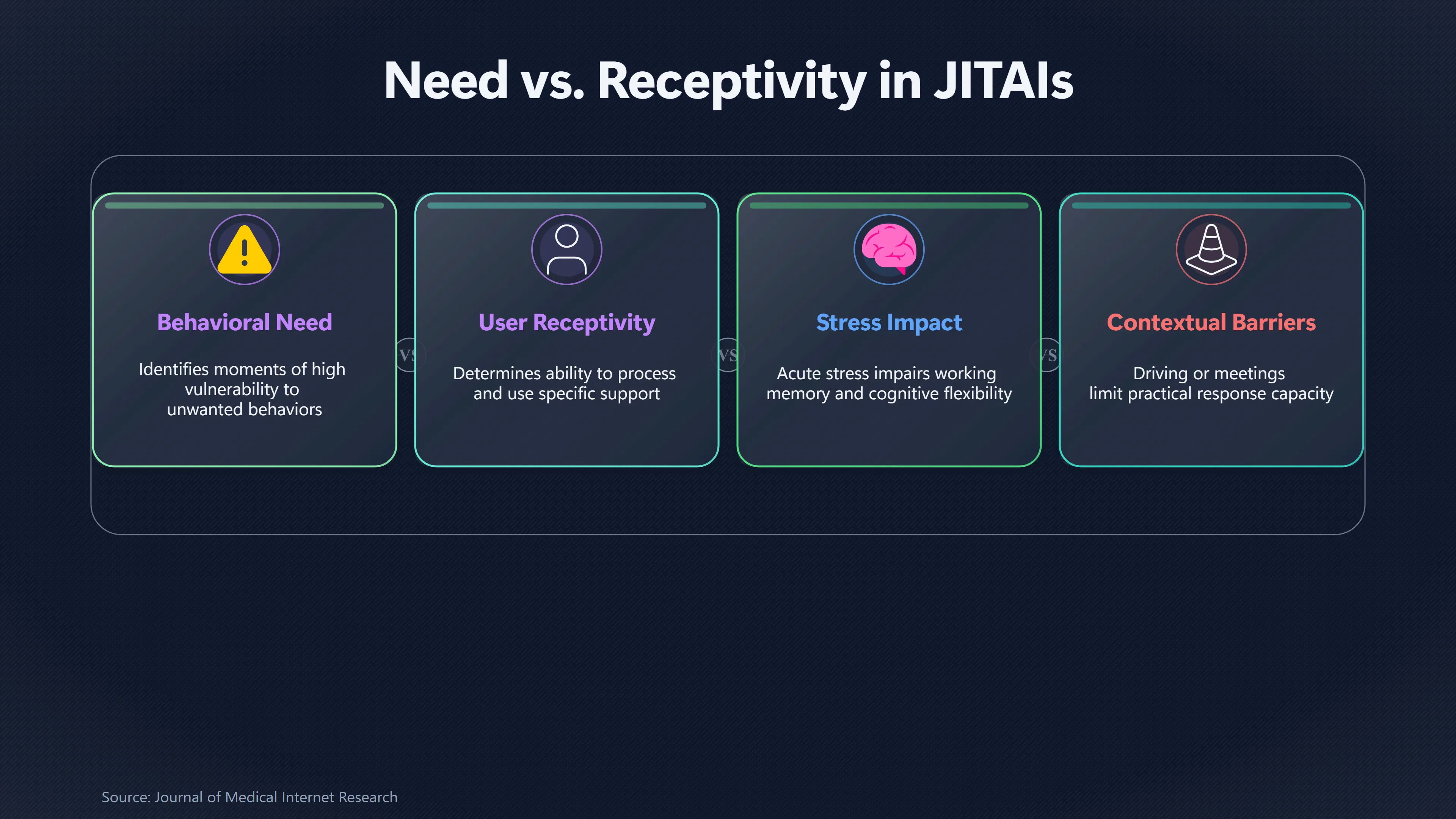
Help can be most necessary at exactly the moment a person is least able to use it. Stress, time pressure, competing tasks and emotional strain can raise the risk of abandoning a plan while simultaneously reducing the attention, working memory or practical freedom needed to respond to a prompt. Research on just-in-time adaptive interventions (JITAIs) therefore distinguishes need from receptivity: being vulnerable to an unwanted behaviour does not necessarily mean being willing and able to process support.[PubMed Central (PMC)]pmc.ncbi.nlm.nih.govPubMed Central (PMC)Just-in-Time Adaptive Interventions (JITAIs) in Mobile Health: Key Components and Design Principles for Ongoing Healt…

That distinction matters for self-improvement systems. A reminder that detects the “right” psychological moment can still be badly timed in practical terms. Effective personalisation therefore cannot simply ask, “When is this person most at risk?” It must also ask, “What, if anything, can this person realistically do right now?” Sometimes the best intervention is a tiny prompt, sometimes a different form of help, and sometimes no interruption at all.[OUP Academic]academic.oup.comOUP AcademicJust-in-Time Adaptive Interventions (JITAIs) in Mobile Health: Key Components and Design Principles for Ongoing Health Behavi…
Need and receptivity are different
In behavioural intervention research, receptivity is more demanding than merely receiving a notification. It concerns whether someone is presently able and willing to receive, process and use the particular support being offered. That state can change quickly with mood, location, activity and social circumstances. Crucially, it also depends on the intervention itself: someone can be receptive to one form of help but unreceptive to another at the same moment.[PubMed Central (PMC)]pmc.ncbi.nlm.nih.govPubMed Central (PMC)Just-in-Time Adaptive Interventions: Where Are We Now and What Is Next? - PMC…
Consider a stressful afternoon at work. Stress might make an old avoidance habit more tempting, so a behaviour system correctly identifies increased need. Yet the person might simultaneously be dealing with an urgent deadline or sitting in a meeting. A discreet reminder requiring almost no action might be usable; a five-minute exercise demanding reflection, reading and several decisions might not be. The latest conceptual work on JITAIs explicitly treats receptivity as intervention-specific rather than a simple on/off characteristic of the person.[PubMed Central (PMC)]pmc.ncbi.nlm.nih.govPubMed Central (PMC)Just-in-Time Adaptive Interventions: Where Are We Now and What Is Next? - PMC…
This creates a fundamental tension for adaptive self-improvement:
High behavioural risk does not imply high capacity to respond.
Indeed, the two can move in opposite directions. Stress is a particularly clear example. A meta-analysis covering 51 studies and 2,486 participants found that acute stress impaired working memory and cognitive flexibility overall, although its effects on inhibition were more complicated. In other words, some of the cognitive capacities useful for considering alternatives and implementing advice can deteriorate under the conditions in which behavioural support might appear most necessary.[PubMed Central (PMC)]pmc.ncbi.nlm.nih.govPubMed Central (PMC)The Effects of Acute Stress on Core Executive Functions: A Meta-Analysis and Comparison with Cortisol - PMCJune 28, 2016…
The implication should not be overstated: stress does not make people universally incapable of deliberate action, and laboratory findings about acute stress cannot be mechanically applied to every difficult moment in daily life. But the evidence gives a sound reason to reject the assumption that greater distress automatically justifies a more demanding intervention. A system that detects vulnerability but ignores available attention has solved only half of the timing problem.
Why the “perfect moment” can be the wrong moment
The problem becomes clearer when behavioural support is treated as an interruption rather than as abstract information. A notification competes with whatever the person is already doing.
A field study of mobile notifications collected 10,372 notifications from 20 participants. Both response time and perceived disruption varied with factors including the task the person was performing, its complexity and how far through it they were. Importantly, useful or important notifications could still be disruptive.[UCL Discovery]discovery.ucl.ac.ukOpen source on ucl.ac.uk.
That finding exposes a weakness in simplistic “right message, right time” thinking. Relevance and receptivity are not synonyms. A message can be highly relevant to the user’s goal while arriving at a moment when attending to it imposes an unreasonable switching cost.
This is why JITAI frameworks consider both states of vulnerability or opportunity and states of receptivity. Researchers give straightforward examples: driving can make a text-based intervention inappropriate; being in a meeting can make a phone call unusable even when a text might be acceptable; bad weather can make an outdoor-exercise suggestion poorly matched even if an indoor alternative remains feasible.[OUP Academic]academic.oup.comOUP AcademicJust-in-Time Adaptive Interventions (JITAIs) in Mobile Health: Key Components and Design Principles for Ongoing Health Behavi…
There is a subtler version of the same problem. The circumstances producing the behavioural risk may themselves produce the lack of receptivity. A difficult work event can create a need for emotion-regulation support while also occurring during a meeting. Morning time pressure can make a routine more likely to fail while leaving little attention for a digital intervention. Stress associated with smoking relapse risk may also impair cognitive processes needed to engage with the support being delivered. Recent JITAI scholarship highlights these conflicts as a central design problem rather than an edge case.[PubMed Central (PMC)]pmc.ncbi.nlm.nih.govPubMed Central (PMC)Just-in-Time Adaptive Interventions: Where Are We Now and What Is Next? - PMC…
So “intervene at the moment of maximum need” is not a safe general rule. The more useful target is an intersection:
enough need to make support worthwhile + enough receptivity to make that particular support usable.
And sometimes that intersection does not occur at the moment of peak vulnerability.

More prompts can create their own problem
Poorly timed support has consequences beyond one ignored notification. Repeated demands can contribute to intervention burden, fatigue, frustration and habituation. JITAI researchers therefore treat “provide nothing” as a genuine intervention option rather than a system failure. Withholding a prompt can preserve attention and reduce unnecessary intrusion.[PubMed Central (PMC)]pmc.ncbi.nlm.nih.govPubMed Central (PMC)Building health behavior models to guide the development of just-in-time adaptive interventions: A pragmatic framewor…
HeartSteps, an adaptive physical-activity intervention, illustrates why restraint matters. In a six-week micro-randomised trial involving 44 adults, contextually tailored activity suggestions could be delivered up to five times a day. Walking suggestions increased subsequent steps on average, but their effect was much stronger near the beginning of the study and declined with time. For walking prompts specifically, the estimated effect on 30-minute step counts was initially a 107% increase relative to no suggestion, but the detectable advantage disappeared by about day 29. Participants also reported that suggestions became boring after several weeks, supporting habituation as one plausible explanation.[PubMed]pubmed.ncbi.nlm.nih.govOpen source on nih.gov.
That does not prove that every reminder inevitably wears out. It demonstrates something more useful: the effectiveness of a prompt is time-varying. A message that worked repeatedly last week is not guaranteed to deserve the same share of someone’s attention next week.
Nor does sophisticated timing guarantee behaviour change. An exploratory trial of the Healthy Mind stress-management app compared sensor-informed notifications with notifications delivered within predefined time windows. Although notification frequency affected exposure, the adaptive timing approach did not produce a clear advantage over non-intelligent timing in intervention use. The authors explicitly treated the findings as exploratory.[PubMed Central (PMC)]pmc.ncbi.nlm.nih.govOpen source on nih.gov.
More recent evidence reinforces the need for caution. A 2026 micro-randomised analysis involving 287 people with hypertension examined notifications tailored to personal and environmental factors across 187,517 randomisation points. The notifications increased immediate engagement with the app, but physical-activity notifications did not significantly increase subsequent step counts, and dietary notifications did not significantly improve the measured lower-sodium choices. Opening an intervention, in other words, was not equivalent to changing the target behaviour.[JMIR]jmir.orgJournal of Medical Internet ResearchJournal of Medical Internet Research
These studies make “perfect timing” a hypothesis to test, not a feature that an algorithm can simply declare it has achieved.
Design for the attention people actually have
A personalised behaviour system should therefore adapt not just when it helps but how much attention the help requires. The relevant question is not merely whether a notification will be opened. It is whether the person can successfully complete the chain of actions the intervention expects.
A prompt saying “stand and stretch for two minutes” has a different receptivity threshold from a ten-minute lesson. A silent visual cue differs from a phone call. A reminder of an already practised coping technique differs from instructions for learning an unfamiliar one. Contemporary JITAI theory stresses precisely this point: receptivity must be defined in relation to the specific stimuli and tasks contained in an intervention. Clicking a message captures only one part of engagement; processing it cognitively and carrying out its requested action are separate demands.[PubMed Central (PMC)]pmc.ncbi.nlm.nih.govPubMed Central (PMC)Just-in-Time Adaptive Interventions: Where Are We Now and What Is Next? - PMC…
That suggests three practical design principles.
First, treat “not now” as useful information. Ignoring a prompt should not automatically trigger more reminders. It may indicate low receptivity, competing priorities or accumulated intervention fatigue. JITAI frameworks explicitly recommend considering non-intervention as an option when support would create unnecessary burden.[PubMed Central (PMC)]pmc.ncbi.nlm.nih.govPubMed Central (PMC)Building health behavior models to guide the development of just-in-time adaptive interventions: A pragmatic framewor…
Second, reduce the intervention when attention is scarce. High-risk moments may favour actions that are familiar, brief and immediately executable rather than educational material or elaborate reflection. This follows from the combination of evidence on stress-related cognitive impairment and intervention research emphasising the time and effort imposed by support.[PubMed Central (PMC)]pmc.ncbi.nlm.nih.govPubMed Central (PMC)The Effects of Acute Stress on Core Executive Functions: A Meta-Analysis and Comparison with Cortisol - PMCJune 28, 2016…
Third, learn from outcomes rather than assuming that responsiveness equals success. Micro-randomised trials were developed partly because repeated decision points allow researchers to test whether an intervention actually improves a near-term outcome, how that effect changes with context and whether it fades over time.[PubMed Central (PMC)]pmc.ncbi.nlm.nih.govOpen source on nih.gov. A self-improvement system applying the same logic informally should care less about how many reminders were opened and more about whether the reminders reliably helped the intended behaviour.
Personalisation sometimes means leaving you alone
The most important correction to formula-driven self-improvement is therefore not simply “send smarter reminders”. It is to recognise that behavioural need and human attention follow different rhythms.
A system can detect that someone is stressed, sedentary, distracted or approaching a familiar failure point without having enough evidence that this is the moment to demand action. Good adaptation must balance the expected benefit of intervening against interruption, effort, safety, habituation and the person’s present capacity to engage. Research on JITAIs increasingly frames optimisation in exactly these terms: deciding not only what support to provide, but whether support should be provided at a particular decision point at all.[PubMed Central (PMC)]pmc.ncbi.nlm.nih.govOpen source on nih.gov.
That changes what “self improvement that works” looks like in practice. The smartest support is not necessarily the system that notices every vulnerable moment. It is the one that can distinguish a moment when help is needed from a moment when help can actually be used — and that is willing to become quieter when those moments do not coincide.
Amazon book picks
Further Reading
Books and field guides related to What If the Best Moment to Help Is Wrong?. Use these as the next step if you want deeper reading beyond the article.
Scarcity
A surprising and intriguing examination of how scarcity—and our flawed responses to it—shapes our lives, our society, and our culture
Nudge
Rating: 3.5/5 from 29 Google Books ratings
Thaler and Sunstein offer a groundbreaking discussion of how to apply the science of choice to nudge people toward decisions that can imp...
Atomic Habits
Rating: 3.5/5 from 7 Google Books ratings
The #1 New York Times bestseller. Over 25 million copies sold! Translated into 60+ languages! Tiny Changes, Remarkable Results No matter...
Tiny Habits
Improving your life is much easier than you think. Whether it’s losing weight, sleeping more, or restoring your work/life balance – the s...
eBay marketplace picks
Marketplace Samples
Live-tested eBay searches with available results related to this page.
Selected fromdesk reminder sign oneBay.co.uk.


Endnotes
1.
Source: academic.oup.com
Link:https://academic.oup.com/abm/article/52/6/446/4733473
Source snippet
OUP AcademicJust-in-Time Adaptive Interventions (JITAIs) in Mobile Health: Key Components and Design Principles for Ongoing Health Behavi...
2.
Source: jmir.org
Title: Journal of Medical Internet Research
Link:https://www.jmir.org/2026/1/e78218
4.
Source: formative.jmir.org
Link:https://formative.jmir.org/2024/1/e49512/
5.
Source: formative.jmir.org
Link:https://formative.jmir.org/2023/1/e43099/
7.
Source: formative.jmir.org
Link:https://formative.jmir.org/2022/4/e34662
8.
Source: academic.oup.com
Link:https://academic.oup.com/abm/article/53/6/573/5091257
9.
Source: pmc.ncbi.nlm.nih.gov
Link:https://pmc.ncbi.nlm.nih.gov/articles/PMC5364076/
Source snippet
PubMed Central (PMC)Just-in-Time Adaptive Interventions (JITAIs) in Mobile Health: Key Components and Design Principles for Ongoing Healt...
10.
Source: pmc.ncbi.nlm.nih.gov
Link:https://pmc.ncbi.nlm.nih.gov/articles/PMC13217361/
Source snippet
PubMed Central (PMC)Just-in-Time Adaptive Interventions: Where Are We Now and What Is Next? - PMC...
11.
Source: pmc.ncbi.nlm.nih.gov
Link:https://pmc.ncbi.nlm.nih.gov/articles/PMC4732268/
Source snippet
PubMed Central (PMC)Building health behavior models to guide the development of just-in-time adaptive interventions: A pragmatic framewor...
12.
Source: pmc.ncbi.nlm.nih.gov
Link:https://pmc.ncbi.nlm.nih.gov/articles/PMC5003767/
Source snippet
PubMed Central (PMC)The Effects of Acute Stress on Core Executive Functions: A Meta-Analysis and Comparison with Cortisol - PMCJune 28, 2016...
Published: June 28, 2016
13.
Source: pubmed.ncbi.nlm.nih.gov
Link:https://pubmed.ncbi.nlm.nih.gov/27371161/
Source snippet
The effects of acute stress on core executive functions: A meta-analysis and comparison with cortisol - PubMed...
14.
Source: discovery.ucl.ac.uk
Link:https://discovery.ucl.ac.uk/id/eprint/1502364/
15.
Source: pubmed.ncbi.nlm.nih.gov
Link:https://pubmed.ncbi.nlm.nih.gov/30192907/
16.
Source: pmc.ncbi.nlm.nih.gov
Link:https://pmc.ncbi.nlm.nih.gov/articles/PMC6401341/
17.
Source: pmc.ncbi.nlm.nih.gov
Link:https://pmc.ncbi.nlm.nih.gov/articles/PMC5207732/
18.
Source: pubmed.ncbi.nlm.nih.gov
Link:https://pubmed.ncbi.nlm.nih.gov/28046034/
19.
Source: pmc.ncbi.nlm.nih.gov
Link:https://pmc.ncbi.nlm.nih.gov/articles/PMC9755932/
20.
Source: pmc.ncbi.nlm.nih.gov
Link:https://pmc.ncbi.nlm.nih.gov/articles/PMC9276848/
21.
Source: pmc.ncbi.nlm.nih.gov
Link:https://pmc.ncbi.nlm.nih.gov/articles/PMC11583291/
22.
Source: pubmed.ncbi.nlm.nih.gov
Link:https://pubmed.ncbi.nlm.nih.gov/42247635/
23.
Source: pmc.ncbi.nlm.nih.gov
Link:https://pmc.ncbi.nlm.nih.gov/articles/PMC13240989/
24.
Source: pmc.ncbi.nlm.nih.gov
Link:https://pmc.ncbi.nlm.nih.gov/articles/PMC12808932/
25.
Source: pubmed.ncbi.nlm.nih.gov
Link:https://pubmed.ncbi.nlm.nih.gov/41499691/
26.
Source: pubmed.ncbi.nlm.nih.gov
Link:https://pubmed.ncbi.nlm.nih.gov/41499773/
27.
Source: pubmed.ncbi.nlm.nih.gov
Link:https://pubmed.ncbi.nlm.nih.gov/41326784/
28.
Source: pubmed.ncbi.nlm.nih.gov
Link:https://pubmed.ncbi.nlm.nih.gov/40979180/
29.
Source: pubmed.ncbi.nlm.nih.gov
Link:https://pubmed.ncbi.nlm.nih.gov/40939059/
30.
Source: pmc.ncbi.nlm.nih.gov
Link:https://pmc.ncbi.nlm.nih.gov/articles/PMC12421209/
31.
Source: pubmed.ncbi.nlm.nih.gov
Link:https://pubmed.ncbi.nlm.nih.gov/40857095/
32.
Source: pmc.ncbi.nlm.nih.gov
Link:https://pmc.ncbi.nlm.nih.gov/articles/PMC11811111/
33.
Source: pubmed.ncbi.nlm.nih.gov
Link:https://pubmed.ncbi.nlm.nih.gov/39265816/
34.
Source: pubmed.ncbi.nlm.nih.gov
Link:https://pubmed.ncbi.nlm.nih.gov/39264703/
35.
Source: pubmed.ncbi.nlm.nih.gov
Link:https://pubmed.ncbi.nlm.nih.gov/39295772/
36.
Source: pmc.ncbi.nlm.nih.gov
Link:https://pmc.ncbi.nlm.nih.gov/articles/PMC11407068/
37.
Source: pubmed.ncbi.nlm.nih.gov
Link:https://pubmed.ncbi.nlm.nih.gov/38943558/
38.
Source: pmc.ncbi.nlm.nih.gov
Link:https://pmc.ncbi.nlm.nih.gov/articles/PMC11671620/
39.
Source: pubmed.ncbi.nlm.nih.gov
Link:https://pubmed.ncbi.nlm.nih.gov/38887953/
40.
Source: pmc.ncbi.nlm.nih.gov
Link:https://pmc.ncbi.nlm.nih.gov/articles/PMC11154014/
41.
Source: pubmed.ncbi.nlm.nih.gov
Link:https://pubmed.ncbi.nlm.nih.gov/38656787/
42.
Source: pubmed.ncbi.nlm.nih.gov
Link:https://pubmed.ncbi.nlm.nih.gov/38324358/
43.
Source: pmc.ncbi.nlm.nih.gov
Link:https://pmc.ncbi.nlm.nih.gov/articles/PMC10882474/
44.
Source: pmc.ncbi.nlm.nih.gov
Link:https://pmc.ncbi.nlm.nih.gov/articles/PMC10723744/
45.
Source: pubmed.ncbi.nlm.nih.gov
Link:https://pubmed.ncbi.nlm.nih.gov/37707948/
46.
Source: pmc.ncbi.nlm.nih.gov
Link:https://pmc.ncbi.nlm.nih.gov/articles/PMC10540022/
47.
Source: pmc.ncbi.nlm.nih.gov
Link:https://pmc.ncbi.nlm.nih.gov/articles/PMC11272684/
48.
Source: pubmed.ncbi.nlm.nih.gov
Link:https://pubmed.ncbi.nlm.nih.gov/36705954/
49.
Source: pubmed.ncbi.nlm.nih.gov
Link:https://pubmed.ncbi.nlm.nih.gov/36059746/
50.
Source: pubmed.ncbi.nlm.nih.gov
Link:https://pubmed.ncbi.nlm.nih.gov/35206455/
51.
Source: pubmed.ncbi.nlm.nih.gov
Link:https://pubmed.ncbi.nlm.nih.gov/35025583/
52.
Source: pubmed.ncbi.nlm.nih.gov
Link:https://pubmed.ncbi.nlm.nih.gov/34732334/
53.
Source: pmc.ncbi.nlm.nih.gov
Link:https://pmc.ncbi.nlm.nih.gov/articles/PMC8680205/
54.
Source: pubmed.ncbi.nlm.nih.gov
Link:https://pubmed.ncbi.nlm.nih.gov/34896431/
55.
Source: pubmed.ncbi.nlm.nih.gov
Link:https://pubmed.ncbi.nlm.nih.gov/34808440/
56.
Source: pubmed.ncbi.nlm.nih.gov
Link:https://pubmed.ncbi.nlm.nih.gov/34748879/
57.
Source: pubmed.ncbi.nlm.nih.gov
Link:https://pubmed.ncbi.nlm.nih.gov/34562543/
58.
Source: pubmed.ncbi.nlm.nih.gov
Link:https://pubmed.ncbi.nlm.nih.gov/34499570/
59.
Source: GOV.UK
Title: www.gov.uk Micro-randomised trial
Link:https://www.gov.uk/guidance/micro-randomised-trial
60.
Source: pmc.ncbi.nlm.nih.gov
Link:https://pmc.ncbi.nlm.nih.gov/articles/PMC8887814/
61.
Source: pmc.ncbi.nlm.nih.gov
Link:https://pmc.ncbi.nlm.nih.gov/articles/PMC9494762/
62.
Source: pubmed.ncbi.nlm.nih.gov
Link:https://pubmed.ncbi.nlm.nih.gov/36159209/
63.
Source: GOV.UK
Title: www.gov.uk Ecological momentary assessment
Link:https://www.gov.uk/guidance/ecological-momentary-assessment
64.
Source: pmc.ncbi.nlm.nih.gov
Link:https://pmc.ncbi.nlm.nih.gov/articles/PMC7968352/
65.
Source: pubmed.ncbi.nlm.nih.gov
Link:https://pubmed.ncbi.nlm.nih.gov/32485224/
66.
Source: pmc.ncbi.nlm.nih.gov
Link:https://pmc.ncbi.nlm.nih.gov/articles/PMC6374735/
67.
Source: pmc.ncbi.nlm.nih.gov
Link:https://pmc.ncbi.nlm.nih.gov/articles/PMC6713230/
68.
Source: pubmed.ncbi.nlm.nih.gov
Link:https://pubmed.ncbi.nlm.nih.gov/31462937/
69.
Source: pubmed.ncbi.nlm.nih.gov
Link:https://pubmed.ncbi.nlm.nih.gov/30497999/
70.
Source: pmc.ncbi.nlm.nih.gov
Link:https://pmc.ncbi.nlm.nih.gov/articles/PMC6293241/
71.
Source: pubmed.ncbi.nlm.nih.gov
Link:https://pubmed.ncbi.nlm.nih.gov/30396706/
72.
Source: pmc.ncbi.nlm.nih.gov
Link:https://pmc.ncbi.nlm.nih.gov/articles/PMC5756532/
73.
Source: pubmed.ncbi.nlm.nih.gov
Link:https://pubmed.ncbi.nlm.nih.gov/28690203/
74.
Source: pubmed.ncbi.nlm.nih.gov
Link:https://pubmed.ncbi.nlm.nih.gov/27663578/
75.
Source: pubmed.ncbi.nlm.nih.gov
Link:https://pubmed.ncbi.nlm.nih.gov/29448083/
76.
Source: pmc.ncbi.nlm.nih.gov
Link:https://pmc.ncbi.nlm.nih.gov/articles/PMC5436944/
77.
Source: pmc.ncbi.nlm.nih.gov
Link:https://pmc.ncbi.nlm.nih.gov/articles/PMC5243844/
78.
Source: pubmed.ncbi.nlm.nih.gov
Link:https://pubmed.ncbi.nlm.nih.gov/27576026/
79.
Source: pmc.ncbi.nlm.nih.gov
Link:https://pmc.ncbi.nlm.nih.gov/articles/PMC4814494/
80.
Source: pmc.ncbi.nlm.nih.gov
Link:https://pmc.ncbi.nlm.nih.gov/articles/PMC4732571/
81.
Source: pmc.ncbi.nlm.nih.gov
Link:https://pmc.ncbi.nlm.nih.gov/articles/PMC3617365/
82.
Source: pubmed.ncbi.nlm.nih.gov
Link:https://pubmed.ncbi.nlm.nih.gov/26651462/
83.
Source: pubmed.ncbi.nlm.nih.gov
Link:https://pubmed.ncbi.nlm.nih.gov/34926979/
84.
Source: pmc.ncbi.nlm.nih.gov
Link:https://pmc.ncbi.nlm.nih.gov/articles/PMC5840802/
85.
Source: pmc.ncbi.nlm.nih.gov
Link:https://pmc.ncbi.nlm.nih.gov/articles/PMC9972486/
86.
Source: pubmed.ncbi.nlm.nih.gov
Link:https://pubmed.ncbi.nlm.nih.gov/29318443/
87.
Source: pubmed.ncbi.nlm.nih.gov
Link:https://pubmed.ncbi.nlm.nih.gov/34527853/
Additional References
88.
Source: youtube.com
Link:https://www.youtube.com/watch?v=m1YWEM1a6Is
Source snippet
Adaptive Intervention: Healing with Data...
89.
Source: youtube.com
Title: Adaptive Intervention: Healing with Data
Link:https://www.youtube.com/watch?v=NnUwUB24qH8
Source snippet
Receptivity just in time adaptive interventions mHealth Exploring the State-of-Receptivity for mHealth Interventions...
90.
Source: youtube.com
Title: Video 1
Link:https://www.youtube.com/watch?v=c2owFV6o7os
Source snippet
Adaptive Interventions in Digital Health: Misconceptions & Opportunities -- Inbal Nahum-Shani...
91.
Source: youtube.com
Title: Exploring the State-of-Receptivity for m Health Interventions
Link:https://www.youtube.com/watch?v=42luajERH7s
Source snippet
Detecting Receptivity for mHealth Interventions in the Natural Environment...
92.
Source: youtube.com
Title: Detecting Receptivity for m Health Interventions in the Natural Environment
Link:https://www.youtube.com/watch?v=Eo1K7FfC-4Q
Source snippet
Video 1: Introduction to JITAI with Susan Murphy...
93.
Source: sciencedirect.com
Link:https://www.sciencedirect.com/science/article/abs/pii/B9780323900454000125
94.
Source: sciencedirect.com
Link:https://www.sciencedirect.com/science/article/pii/B9780323900454000125
95.
Source: sciencedirect.com
Link:https://www.sciencedirect.com/org/science/article/pii/S1438887120001582
96.
Source: bpspsychub.onlinelibrary.wiley.com
Link:https://bpspsychub.onlinelibrary.wiley.com/doi/10.1111/bjhp.12766
97.
Source: sciencedirect.com
Link:https://www.sciencedirect.com/org/science/article/pii/S2561760526000952