Within Accountability
What Should You Actually Report for Accountability?
Accountability becomes clearer when another person sees whether specific planned actions happened, rather than hearing a general self-assessment.
On this page
- Why completed behaviours make better reports
- Setting the measure before the week begins
- Keeping reports short without hiding missed actions
Page outline Jump by section
Introduction
For accountability, report what you did, not how committed, busy or “on track” you felt. A useful report compares a behaviour agreed in advance with a behaviour that can be observed afterwards: “I planned four 30-minute study sessions; I completed three” is more informative than “I worked quite hard this week”.
That distinction matters because accountability needs something another person can actually check. Research on progress monitoring finds that monitoring improves goal attainment on average, with stronger effects when the information is recorded and reported to somebody else or made public. Meanwhile, supportive-accountability research argues that expectations work best when they are clear, agreed beforehand and focused on processes rather than left ambiguous.[PubMed]pubmed.ncbi.nlm.nih.govDoes monitoring goal progress promote goal attainment? A meta-analysis of the experimental evidence - PubMedFebruary 1, 2016…
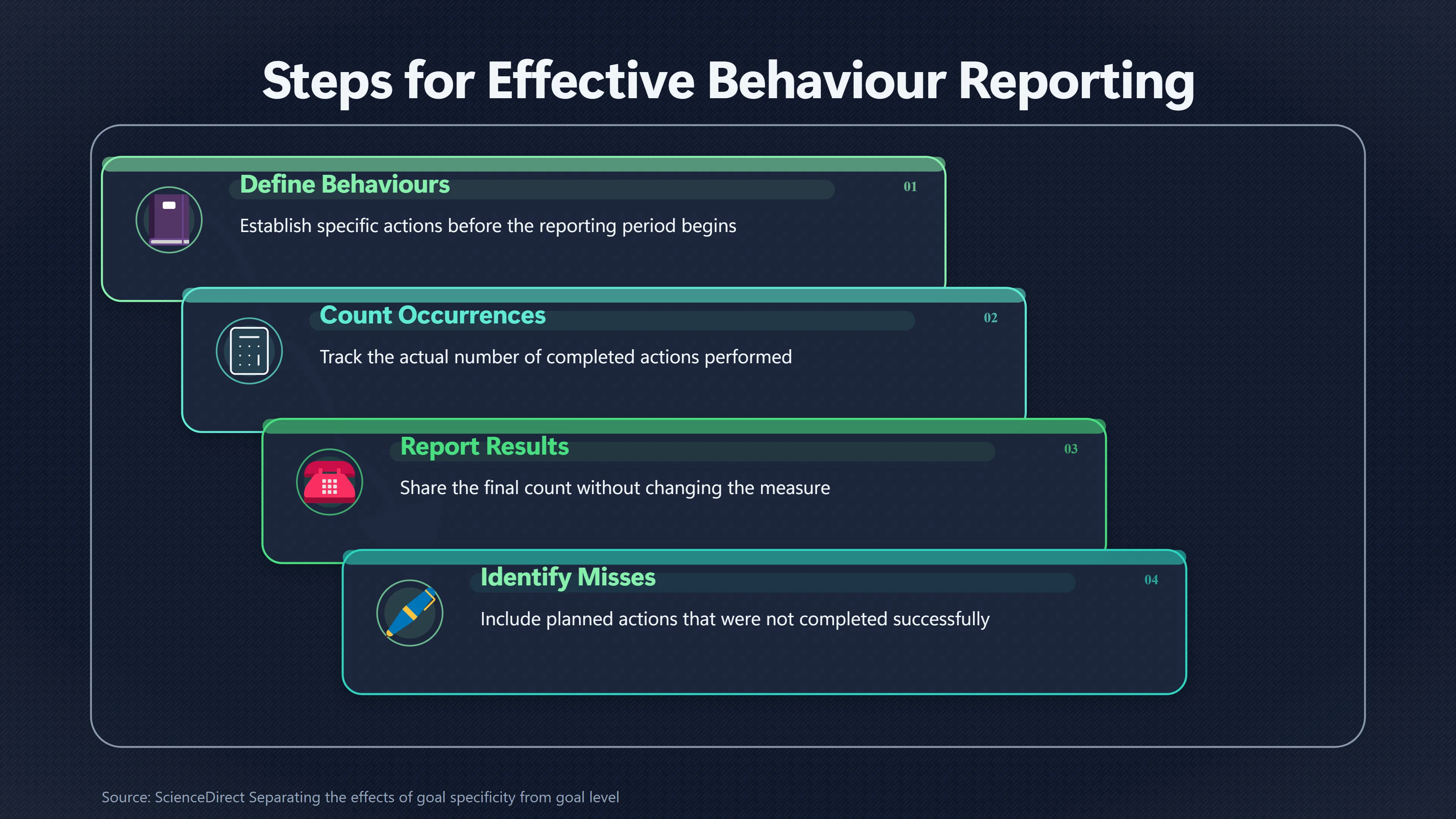
The practical principle is therefore simple: define the behaviour before the reporting period, count what happened, and report the result without quietly changing the measure afterwards.
Why completed behaviours make better reports
A vague progress report mixes together several different things: intention, effort, interpretation and action. Someone can sincerely say “I’m taking my fitness seriously” without revealing whether any planned exercise happened. Even “I had a good week” leaves the listener unable to distinguish five completed workouts from one unusually energetic session.
Behaviour reports remove much of that ambiguity. Consider the difference:
- Intention: “I’m going to read more.”
- General self-assessment: “I did fairly well with reading this week.”
- Outcome: “I want to finish 20 books this year.”
- Completed-behaviour report: “I planned to read for 25 minutes on five evenings and did it on four.”
The last version gives an accountability partner information that can be compared with the original commitment. It also preserves partial success: four out of five is neither an undefined “pretty good” nor a binary failure.
This fits the broader evidence on progress monitoring. Harkin and colleagues analysed 138 experimental studies involving 19,951 participants. Interventions designed to increase monitoring substantially increased monitoring frequency and produced a smaller but meaningful improvement in goal attainment (standardised effect size d = 0.40). Importantly for social accountability, effects on goal attainment were larger when progress was reported or made public and when monitoring information was physically recorded.[PubMed]pubmed.ncbi.nlm.nih.govDoes monitoring goal progress promote goal attainment? A meta-analysis of the experimental evidence - PubMedFebruary 1, 2016…
The study does not establish that a particular weekly reporting format is uniquely effective. Its more defensible implication is that accountability benefits from having actual progress information to communicate. A report such as “3/4 sessions completed” preserves information that “I’m still committed” does not.
Report the controllable action, not only the result
Completed behaviours are particularly useful when the eventual outcome is only partly under personal control. “Lose 1 kg this week”, “get a job” or “receive an A” can be affected by factors beyond the person’s immediate actions. By contrast, submitting three applications, completing four planned training sessions or doing five scheduled revision blocks describes behaviour the person can perform directly.
The supportive-accountability model developed by David Mohr, Pim Cuijpers and Kenneth Lehman makes this distinction explicit. It argues for clear expectations that concentrate on processes, are established with the participant and are understood before accountability occurs. Its examples distinguish outcome accountability, such as symptom severity, from process accountability, such as completing specified exercises or logging into an intervention.[PubMed Central (PMC)]pmc.ncbi.nlm.nih.govPubMed Central (PMC)Supportive Accountability: A Model for Providing Human Support to Enhance Adherence to eHealth Interventions - PMC…
There is an important limit to that principle. Research comparing process and outcome accountability does not show that process accountability universally produces better performance. A 2022 meta-analysis covering nine experiments and 1,080 participants found no overall superiority for either approach; task complexity moderated the results.[PubMed Central (PMC)]pmc.ncbi.nlm.nih.govPubMed Central (PMC)The Effect of Outcome vs. Process Accountability-Focus on Performance: A Meta-Analysis - PMCApril 27, 2022… For ordinary personal commitments involving straightforward, repeatable actions, however, behaviour counts have a narrower advantage: they tell the accountability partner unambiguously whether the agreed action occurred. That is a reporting advantage, not a claim that outcomes never matter.
Set the measure before the week begins
A behaviour report only becomes a meaningful accountability device when its definition precedes the behaviour. Otherwise, the target can move to accommodate whatever happened.
Suppose someone agrees simply to “work on my novel”. At the end of the week, researching a location, rearranging notes, thinking about a character on the train or writing 2,000 words could all retrospectively qualify as success. If the advance commitment was “three 45-minute drafting sessions by Sunday”, there is much less room to redefine success after seeing the result.
This is one reason specificity matters. Goal-setting research has long contrasted concrete goals with vague instructions such as “do your best”, although specificity should not be treated as a magic ingredient independent of difficulty, task knowledge and other conditions. Research separating specificity from goal level shows that the two properties should not simply be conflated.[ScienceDirect]sciencedirect.comScienceDirect Separating the effects of goal specificity from goal levelSeparating the effects of goal specificity from goal level - ScienceDirectApril 1, 1989… The relevant lesson for accountability is narrower: the reporting criterion needs enough precision for two people to agree afterwards whether it was met.
Research on implementation intentions reinforces the value of defining action in advance. Implementation intentions specify when, where or under what circumstances a goal-directed behaviour will occur. A major meta-analysis of 94 independent tests found a medium-to-large positive effect on goal attainment (d = 0.65), although implementation intentions are a planning technique rather than evidence specifically about social reporting.[ScienceDirect]sciencedirect.comImplementation Intentions and Goal Achievement: A Meta‐analysis of Effects and Processes - ScienceDirect… They nevertheless illustrate the same useful transition from “I intend to do X” towards a pre-specified action that can later be assessed.
For a weekly accountability report, a workable measure usually answers three questions:
- What counts? “A study session” means at least 30 minutes of uninterrupted practice questions.
- How many were planned? Four sessions between Monday and Sunday.
- What will be reported? Number completed out of four, rather than a general judgement about whether the week went well.
The denominator matters. Reporting “three workouts” sounds positive in isolation. If three were planned, it means full completion; if six were planned, it means half. Planned versus completed preserves the information accountability needs.
There is also value in deciding the reporting arrangement beforehand. The supportive-accountability model warns that introducing accountability only after an action has occurred can encourage self-justification rather than useful reflection. It therefore recommends making expectations and accountability procedures explicit in advance.[PubMed Central (PMC)]pmc.ncbi.nlm.nih.govPubMed Central (PMC)Supportive Accountability: A Model for Providing Human Support to Enhance Adherence to eHealth Interventions - PMC…

What should count as a completed behaviour?
The best reporting unit is usually small enough to repeat, concrete enough to count and closely enough connected to the larger goal to be worth doing. It does not need to capture everything that matters.
For example, someone trying to improve professionally might choose “complete two 45-minute portfolio sessions” rather than “advance my career”. Someone learning a language might report “complete five planned 20-minute practice sessions”, rather than rating how motivated they felt. Someone trying to maintain friendships might report “make the two calls I scheduled”, rather than declaring that they were “being more social”.
This does not mean that everything valuable must be reduced to a number. Nor should a person choose an easy-to-count behaviour merely because it makes an attractive score. A count of productivity-app logins is precise but useless if logging in has little connection with productive work. The measure should represent a behaviour there is a genuine reason to perform.
Digital self-monitoring research provides a concrete illustration of the underlying mechanism. In a 12-week behavioural weight-loss experiment involving 322 enrolled adults, participants tracked weight, eating and physical activity. Coaches could access those records for one randomly assigned group but not the other. The coach-access group recorded eating and physical activity more consistently and lost 6.2% of initial weight on average compared with 5.3% in the comparison condition. They also reported stronger supportive accountability.[PubMed Central (PMC)]pmc.ncbi.nlm.nih.govOpen source on nih.gov.
That experiment involved a structured treatment programme and expert coaches, so it should not be treated as proof that sending weekly numbers to a friend will reproduce the result. What it demonstrates more directly is the informational advantage of visible behavioural records: the coach did not have to rely on the participant’s retrospective claim that they had “mostly stuck to the programme”. Both parties could see recorded actions.
Evidence for self-monitoring itself is also less uniformly positive than simple productivity advice sometimes suggests. A meta-review covering 30 meta-analyses of health-behaviour interventions found inconsistent associations between individual self-regulation techniques and outcomes, partly because techniques such as goal setting and self-monitoring were often embedded within multi-component interventions that made their independent effects difficult to isolate.[PubMed]pubmed.ncbi.nlm.nih.govOpen source on nih.gov. A sensible behaviour report is therefore a tool for making accountability clearer, not a guaranteed behaviour-change treatment.
Keep reports short without hiding misses
Good accountability reports do not need to become weekly essays. In fact, excessive explanation can recreate the ambiguity that behavioural reporting was meant to remove.
A compact format can contain three pieces of information:
**Planned: 4 study sessions
Completed: 3/4
Missed: Thursday**
If useful, add one sentence identifying what should change next time: “Thursday was repeatedly squeezed out, so next week I am scheduling that session before work.”
What should be avoided is turning the explanation into a substitute score:
“It was a chaotic week and I had loads going on, but I definitely made progress and I’m feeling more focused.”
That statement may all be true. It still does not tell the other person whether the agreed behaviour occurred.
Missed actions are especially important to preserve because selective reporting destroys the informational value of accountability. If someone reports successful sessions but omits planned sessions that never happened, the report becomes a record of achievements rather than a comparison between commitment and performance. “3 completed” and “3/5 completed” contain different information.
A useful convention is therefore to report the denominator every time. For repeatable behaviours, completed/planned is often enough. For binary commitments, a simple done/not done works. For behaviours where quantity matters, use the quantity defined beforehand: “42 of 60 planned practice questions”, for example. The reporting system should make a miss as easy to record as a completion.
Physical recording has empirical support as part of progress monitoring: Harkin and colleagues found stronger goal-attainment effects when progress information was physically recorded rather than merely monitored mentally.[PubMed]pubmed.ncbi.nlm.nih.govDoes monitoring goal progress promote goal attainment? A meta-analysis of the experimental evidence - PubMedFebruary 1, 2016… That does not require an elaborate spreadsheet. A tick on a calendar, habit tracker, shared document or brief message can perform the essential function if it faithfully records the agreed measure.

The report should make reality easier to see
The point of reporting completed behaviours is not to create a surveillance system for ordinary life. It is to make a social accountability relationship depend on information that both people can interpret consistently.
That requires resisting two opposite mistakes. One is vagueness: “I’m doing better”, “I tried hard” or “I’m still working towards it”. The other is measurement overload, where dozens of metrics make reporting burdensome enough that the system itself becomes another task to avoid. The useful middle ground is a small number of pre-agreed behaviours that are closely connected with the goal.
A strong weekly report might therefore be no longer than:
**Writing — 3/4 planned sessions completed.
Exercise — 2/3 planned sessions completed.
Next week — same targets; move Friday’s writing session to the morning.**
The numbers are not valuable because numbers are inherently motivating. They are valuable because their meaning was fixed beforehand. The accountability partner can see what happened without having to interpret enthusiasm, excuses or retrospective definitions of success.
That is the distinctive advantage of behaviour reporting within social accountability: it turns “How are you getting on?” into a question with an answer. Intentions still matter for choosing a direction, and outcomes still matter for deciding whether the larger effort is working. But for the recurring accountability exchange itself, planned action versus completed action provides the clearest signal of whether intention became behaviour.
Amazon book picks
Further Reading
Books and field guides related to What Should You Actually Report for Accountability?. Use these as the next step if you want deeper reading beyond the article.
The 4 Disciplines of Execution
The Wall Street Journal bestseller with more than 500,000 copies sold, The 4 Disciplines of Execution: Revised and Updated will radically...
The 12 Week Year
The guide to shortening your execution cycle down from one year to twelve weeks Most organizations and individuals work in the context of...
Measure What Matters
#1 New York Times Bestseller Legendary venture capitalist John Doerr reveals how the goal-setting system of Objectives and Key Results (O...
Atomic Habits
Rating: 3.5/5 from 7 Google Books ratings
The #1 New York Times bestseller. Over 25 million copies sold! Translated into 60+ languages! Tiny Changes, Remarkable Results No matter...
eBay marketplace picks
Marketplace Samples
Live-tested eBay searches with available results related to this page.
Selected frommotivational sticker oneBay.co.uk.




Endnotes
1.
Source: sciencedirect.com
Title: ScienceDirect Separating the effects of goal specificity from goal level
Link:https://www.sciencedirect.com/science/article/pii/0749597889900538
Source snippet
Separating the effects of goal specificity from goal level - ScienceDirectApril 1, 1989...
Published: April 1, 1989
2.
Source: sciencedirect.com
Link:https://www.sciencedirect.com/science/article/abs/pii/S0065260106380021
Source snippet
Implementation Intentions and Goal Achievement: A Meta‐analysis of Effects and Processes - ScienceDirect...
3.
Source: sciencedirect.com
Link:https://www.sciencedirect.com/science/article/abs/pii/S002210310600028X
Source snippet
How do implementation intentions promote goal attainment? A test of component processes - ScienceDirect...
4.
Source: sciencedirect.com
Link:https://www.sciencedirect.com/science/article/pii/S1041608019301207
5.
Source: sciencedirect.com
Link:https://www.sciencedirect.com/science/chapter/bookseries/abs/pii/S0065260106380021
6.
Source: sciencedirect.com
Title: Goal Setting Theory
Link:https://www.sciencedirect.com/topics/social-sciences/goal-setting-theory
7.
Source: sciencedirect.com
Link:https://www.sciencedirect.com/science/article/abs/pii/S0749597811000264
8.
Source: pubmed.ncbi.nlm.nih.gov
Link:https://pubmed.ncbi.nlm.nih.gov/26479070/
Source snippet
Does monitoring goal progress promote goal attainment? A meta-analysis of the experimental evidence - PubMedFebruary 1, 2016...
Published: February 1, 2016
9.
Source: pmc.ncbi.nlm.nih.gov
Link:https://pmc.ncbi.nlm.nih.gov/articles/PMC3221353/
Source snippet
PubMed Central (PMC)Supportive Accountability: A Model for Providing Human Support to Enhance Adherence to eHealth Interventions - PMC...
10.
Source: pubmed.ncbi.nlm.nih.gov
Link:https://pubmed.ncbi.nlm.nih.gov/21393123/
Source snippet
Supportive accountability: a model for providing human support to enhance adherence to eHealth interventions - PubMed...
11.
Source: pmc.ncbi.nlm.nih.gov
Link:https://pmc.ncbi.nlm.nih.gov/articles/PMC9094407/
Source snippet
PubMed Central (PMC)The Effect of Outcome vs. Process Accountability-Focus on Performance: A Meta-Analysis - PMCApril 27, 2022...
Published: April 27, 2022
12.
Source: pubmed.ncbi.nlm.nih.gov
Link:https://pubmed.ncbi.nlm.nih.gov/35572269/
Source snippet
The Effect of Outcome vs. Process Accountability-Focus on Performance: A Meta-Analysis - PubMed...
13.
Source: pmc.ncbi.nlm.nih.gov
Link:https://pmc.ncbi.nlm.nih.gov/articles/PMC11537830/
14.
Source: pubmed.ncbi.nlm.nih.gov
Link:https://pubmed.ncbi.nlm.nih.gov/31973666/
15.
Source: pmc.ncbi.nlm.nih.gov
Link:https://pmc.ncbi.nlm.nih.gov/articles/PMC7429262/
16.
Source: pmc.ncbi.nlm.nih.gov
Link:https://pmc.ncbi.nlm.nih.gov/articles/PMC11161849/
17.
Source: pmc.ncbi.nlm.nih.gov
Link:https://pmc.ncbi.nlm.nih.gov/articles/PMC11094642/
18.
Source: pmc.ncbi.nlm.nih.gov
Link:https://pmc.ncbi.nlm.nih.gov/articles/PMC11891988/
19.
Source: pmc.ncbi.nlm.nih.gov
Link:https://pmc.ncbi.nlm.nih.gov/articles/PMC10851119/
20.
Source: pubmed.ncbi.nlm.nih.gov
Link:https://pubmed.ncbi.nlm.nih.gov/38178230/
21.
Source: pmc.ncbi.nlm.nih.gov
Link:https://pmc.ncbi.nlm.nih.gov/articles/PMC10765525/
22.
Source: pmc.ncbi.nlm.nih.gov
Link:https://pmc.ncbi.nlm.nih.gov/articles/PMC10357317/
23.
Source: pmc.ncbi.nlm.nih.gov
Link:https://pmc.ncbi.nlm.nih.gov/articles/PMC10246232/
24.
Source: pmc.ncbi.nlm.nih.gov
Link:https://pmc.ncbi.nlm.nih.gov/articles/PMC10024875/
25.
Source: pubmed.ncbi.nlm.nih.gov
Link:https://pubmed.ncbi.nlm.nih.gov/34192411/
26.
Source: pmc.ncbi.nlm.nih.gov
Link:https://pmc.ncbi.nlm.nih.gov/articles/PMC8149892/
27.
Source: pmc.ncbi.nlm.nih.gov
Link:https://pmc.ncbi.nlm.nih.gov/articles/PMC8122167/
28.
Source: pmc.ncbi.nlm.nih.gov
Link:https://pmc.ncbi.nlm.nih.gov/articles/PMC8628117/
29.
Source: pmc.ncbi.nlm.nih.gov
Link:https://pmc.ncbi.nlm.nih.gov/articles/PMC7420735/
30.
Source: pmc.ncbi.nlm.nih.gov
Link:https://pmc.ncbi.nlm.nih.gov/articles/PMC8045468/
31.
Source: pmc.ncbi.nlm.nih.gov
Link:https://pmc.ncbi.nlm.nih.gov/articles/PMC7071022
32.
Source: pmc.ncbi.nlm.nih.gov
Link:https://pmc.ncbi.nlm.nih.gov/articles/PMC7071958/
33.
Source: pmc.ncbi.nlm.nih.gov
Link:https://pmc.ncbi.nlm.nih.gov/articles/PMC6335452/
34.
Source: pubmed.ncbi.nlm.nih.gov
Link:https://pubmed.ncbi.nlm.nih.gov/30966912/
35.
Source: pmc.ncbi.nlm.nih.gov
Link:https://pmc.ncbi.nlm.nih.gov/articles/PMC6384514/
36.
Source: pmc.ncbi.nlm.nih.gov
Link:https://pmc.ncbi.nlm.nih.gov/articles/PMC5835880/
37.
Source: pmc.ncbi.nlm.nih.gov
Link:https://pmc.ncbi.nlm.nih.gov/articles/PMC5011555/
38.
Source: pmc.ncbi.nlm.nih.gov
Link:https://pmc.ncbi.nlm.nih.gov/articles/PMC4500900/
39.
Source: pubmed.ncbi.nlm.nih.gov
Link:https://pubmed.ncbi.nlm.nih.gov/12009041/
Additional References
40.
Source: eprints.whiterose.ac.uk
Link:https://eprints.whiterose.ac.uk/id/eprint/91437/
Source snippet
White Rose Research OnlineDoes Monitoring Goal Progress Promote Goal Attainment? A Meta-Analysis of the Experimental Evidence - White Ros...
41.
Source: academic.oup.com
Title: Academic Goal Setting | Oxford Bibliographies in Management | Oxford Academic
Link:https://academic.oup.com/reference/62383/reference-article-abstract/555049396
Source snippet
OUP AcademicGoal Setting | Oxford Bibliographies in Management | Oxford Academic...
42.
Source: youtube.com
Title: How Accountability Partners Keep You Committed | Atomic Habits Book
Link:https://www.youtube.com/watch?v=pCT66705VjU
Source snippet
Implementation Intention Explained: How to DOUBLE YOUR SUCCESS with a Goal or Habit...
43.
Source: youtube.com
Title: Deep Dive Into The 4 Disciplines of Execution
Link:https://www.youtube.com/watch?v=Zu66EC1Rfm4
Source snippet
To explore how reporting observable, controllable actions outperforms vague check-ins, watch The Four Disciplines of Execution, which det...
44.
Source: youtube.com
Link:https://www.youtube.com/watch?v=N7SDVVbxgNU
Source snippet
The 4 Disciplines of Execution Summary & Review...
45.
Source: youtube.com
Title: The Four Disciplines of Execution
Link:https://www.youtube.com/watch?v=2dazcqz7k7U
Source snippet
How Accountability Partners Keep You Committed | Atomic Habits Book Summary Chapter 17...
46.
Source: researchgate.net
Link:https://www.researchgate.net/publication/364936555_A_behavioral_view_on_responsibility_attribution_in_multi-level_governance_Upward_and_downward_responsibility_attribution_in_response_to_performance_below_aspirations
47.
Source: researchgate.net
Link:https://www.researchgate.net/publication/286357742_Calibrating_Public_Sector_Accountability_Translating_experimental_findings_to_public_sector_accountability
48.
Source: researchgate.net
Link:https://www.researchgate.net/publication/291335719_Does_Monitoring_Goal_Progress_Promote_Goal_Attainment_A_Meta-Analysis_of_the_Experimental_Evidence
49.
Source: researchgate.net
Link:https://www.researchgate.net/publication/37367696_Implementation_Intentions_and_Goal_Achievement_A_Meta-Analysis_of_Effects_and_Processes