Within Automaticity
Why Habits Do Not Form on a Fixed Day
Habit automaticity usually rises quickly at first and then slows toward a plateau, with formation times varying widely across people and behaviours.
On this page
- The shape of the automaticity learning curve
- Why estimates range from weeks to many months
- Better signs of progress than counting days
Page outline Jump by section
Introduction
There is no scientifically supported day on which a repeated behaviour suddenly becomes a habit. The best-known real-world dataset found something more useful: automaticity tends to rise rapidly at first, then improve by progressively smaller amounts as it approaches a plateau. In Phillippa Lally and colleagues’ study of daily eating, drinking and activity behaviours, the modelled time to reach 95% of each person’s eventual automaticity level ranged from 18 to 254 days, with a central estimate of about 66 days.[Wiley Online Library]onlinelibrary.wiley.comWiley Online LibraryHow are habits formed: Modelling habit formation in the real world - Lally - 2010 - European Journal of Social Psycho…
That 66-day figure is therefore not a deadline or universal “habit formation time”. It describes the middle of a remarkably wide distribution in one influential dataset. Later research has reinforced the larger lesson: different behaviours and different people follow very different timelines, and some continue gaining automaticity for several months.[PubMed]pubmed.ncbi.nlm.nih.govHabit formation following routine-based versus time-based cue planning: A randomized controlled trial - PubMedJanuary 6, 2021…
For self-improvement, the practical question is consequently not “Which day will my habit be finished?” but “Is the same cue increasingly bringing the behaviour to mind and making it easier to start?”
The automaticity curve rises fast, then flattens
The landmark Lally study followed 96 volunteers who chose a new eating, drinking or physical-activity behaviour and attempted it once each day in response to the same contextual cue, such as after breakfast. Participants recorded whether they performed the behaviour and rated how automatic it felt over 12 weeks. Researchers then fitted mathematical learning curves to individual participants rather than assuming everybody progressed at the same rate.[Wiley Online Library]onlinelibrary.wiley.comWiley Online LibraryHow are habits formed: Modelling habit formation in the real world - Lally - 2010 - European Journal of Social Psycho…
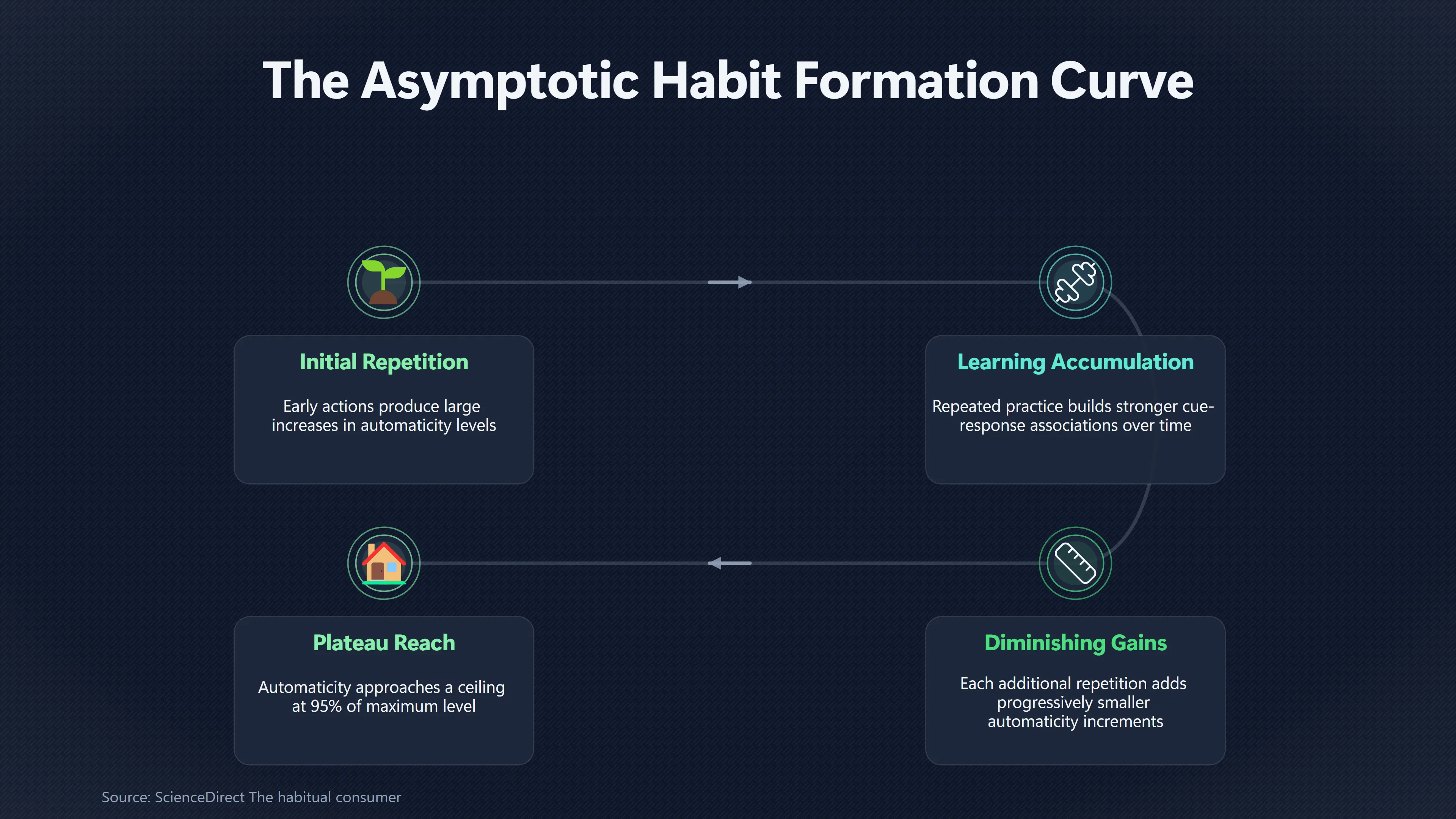
The resulting pattern was asymptotic. Imagine a curve that climbs steeply before gradually bending towards horizontal. Early repetitions can produce relatively large increases in automaticity. As learning accumulates, each additional repetition tends to add less. Eventually, further practice may still reinforce the behaviour, but measured automaticity changes comparatively little.[Wiley Online Library]onlinelibrary.wiley.comWiley Online LibraryHow are habits formed: Modelling habit formation in the real world - Lally - 2010 - European Journal of Social Psycho…
That shape matters because it changes what “forming a habit” means. There is no obvious psychological switch between “not habitual” and “habitual”. Automaticity is strengthening along a continuum. To make the learning curve measurable, Lally and colleagues operationalised the plateau as the point at which a participant reached 95% of their modelled maximum automaticity. It was this threshold — rather than some universal state in which a habit becomes complete — that produced the famous figure of roughly 66 days.[Wiley Online Library]onlinelibrary.wiley.comWiley Online LibraryHow are habits formed: Modelling habit formation in the real world - Lally - 2010 - European Journal of Social Psycho…
Lally herself has subsequently stressed this distinction. In a 2026 University of Surrey interview, she cautioned against turning the original result into the claim that everybody forms a habit in 66 days: it was an average from that particular study, not a rule for individuals.[University of Surrey]surrey.ac.ukUniversity of SurreyDoes it really take 66 days to form a habit? We asked the expert, Dr Pippa Lally | University of SurreyJanuary 21, 2026…
The curve also explains an experience that can otherwise be discouraging. Progress may feel obvious during the first few weeks and much less dramatic later. That slowing does not necessarily mean habit formation has stalled. It is exactly what an asymptotic learning process predicts: large early gains followed by smaller gains as automaticity approaches its ceiling.
Why estimates run from weeks to many months
The striking result in the original dataset is arguably not 66 days but the 18-to-254-day range. Even among people deliberately repeating relatively straightforward behaviours every day, the estimated time to reach 95% of maximum automaticity differed by more than seven months.[Wiley Online Library]onlinelibrary.wiley.comWiley Online LibraryHow are habits formed: Modelling habit formation in the real world - Lally - 2010 - European Journal of Social Psycho…
Subsequent studies have made a single fixed number even harder to defend. In a randomised trial of 192 adults building everyday nutrition habits, participants linked their chosen behaviour either to a routine or to a particular time. Among those who successfully formed habits, the median modelled time to peak automaticity was 59 days. Yet the reported individual range extended from 4 to 335 days, and only 23% of participants reached the study’s specified habit-formation threshold. Repeatedly carrying out the plan was a key predictor of increasing automaticity.[PubMed]pubmed.ncbi.nlm.nih.govHabit formation following routine-based versus time-based cue planning: A randomized controlled trial - PubMedJanuary 6, 2021…
A different experiment illustrates how the behaviour and circumstances can stretch the curve. Forty-eight students attempted a daily stretching exercise for 90 days, either after waking or before bed. Extrapolated learning curves placed automaticity at about 106 days for the morning group and 154 days for the evening group. The researchers investigated time-of-day physiology as a possible explanation, although a small experiment of this kind should not be treated as establishing a general rule that morning habits always form faster.[PubMed]pubmed.ncbi.nlm.nih.govPub Med Effects of circadian cortisol on the development of a health habitEffects of circadian cortisol on the development of a health habit - PubMedNovember 1, 2017…
The broader evidence remains limited. A 2024 systematic review and meta-analysis covered 20 habit-formation intervention studies involving 2,601 participants, but only four studies directly reported a time to habit formation. Their median estimates included 59 and 66 days, while mean estimates in other studies reached 106–154 days; individual estimates across the reviewed research ranged from 4 to 335 days. The authors also judged most included studies to have a high risk of bias.[PubMed]pubmed.ncbi.nlm.nih.govTime to Form a Habit: A Systematic Review and Meta-Analysis of Health Behaviour Habit Formation and Its Determinants - PubMed…
So even “two months” should be understood as orientation, not prediction. The available datasets indicate why several variables can move the plateau:
- Behavioural demands matter. In the original work, simpler behaviours such as drinking water tended to reach peak automaticity faster than more elaborate actions such as doing 50 sit-ups.[PubMed Central (PMC)]pmc.ncbi.nlm.nih.govPubMed Central (PMC)Making health habitual: the psychology of ‘habit-formation’ and general practice - PMCDecember 1, 2012…
- Repetition matters more than calendar time alone. A day only provides an opportunity for learning; the cue–response association is strengthened when the intended response is actually performed. In the nutrition trial, repeated plan enactment predicted automaticity.[PubMed]pubmed.ncbi.nlm.nih.govHabit formation following routine-based versus time-based cue planning: A randomized controlled trial - PubMedJanuary 6, 2021…
- Stable contexts can strengthen learning. Research comparing habit repetitions across stable and variable contexts found greater automaticity when performance contexts were more stable, consistent with the idea that recurring situations become retrieval cues for the response.[PubMed Central (PMC)]pmc.ncbi.nlm.nih.govOpen source on nih.gov.
- People differ substantially. The extremely wide individual ranges within the same studies show that behaviour type alone cannot explain the timing differences.[Wiley Online Library]onlinelibrary.wiley.comWiley Online LibraryHow are habits formed: Modelling habit formation in the real world - Lally - 2010 - European Journal of Social Psycho…
This is why translating population estimates into a personal countdown is misleading. Two people can start nominally similar behaviours on the same Monday and have very different learning curves.
Why 21 days and 66 days are both poor deadlines
The familiar claim that a habit takes 21 days to form did not emerge from a controlled habit-formation experiment. It is generally traced to plastic surgeon Maxwell Maltz’s observations about patients adjusting psychologically to changes in appearance, which were later popularised far beyond their original context. A modern systematic review concludes that empirical habit research does not support the 21-day rule.[PubMed Central (PMC)]pmc.ncbi.nlm.nih.govOpen source on nih.gov.
The irony is that 66 days can become the same kind of myth if stripped of its context. The original research was specifically estimating when self-reported automaticity approached an individually modelled ceiling. Participants did not all reach that point on day 66; estimates ranged from 18 to 254 days. Moreover, the asymptotic model fitted 62 participants, with a good fit for 39, rather than perfectly describing everyone in the original sample.[Wiley Online Library]onlinelibrary.wiley.comWiley Online LibraryHow are habits formed: Modelling habit formation in the real world - Lally - 2010 - European Journal of Social Psycho…
Nor does the research imply that nothing useful happens until the plateau. Because the learning curve rises fastest near the beginning, substantial automaticity can develop well before its eventual maximum. The plateau is better understood as the mature, slow-changing end of a gradual learning process than as the first day on which the behaviour counts as a habit.
This distinction resolves an apparent contradiction in popular advice. A behaviour can already be noticeably easier and more automatically prompted while still being months away from its modelled maximum automaticity. Habit strength is a matter of degree.
Better signs of progress than counting days
For someone deliberately using cue–response learning for self-improvement, elapsed time is therefore a weak progress measure by itself. The more informative question is whether initiating the behaviour is changing.
One useful sign is reduced deliberation. Early on, a cue such as finishing breakfast may be followed by remembering the plan, persuading yourself to act and consciously initiating the behaviour. With learning, the intended response should increasingly come to mind readily in that situation. Habit research characterises strong habits precisely in terms of responses being activated by contexts associated with previous performance.[ScienceDirect]sciencedirect.comScienceDirect The habitual consumerScienceDirect The habitual consumer
A second sign is that the behaviour feels progressively easier to initiate in its usual context. Qualitative research reported by Lally and colleagues found that people initially experienced behaviour change as cognitively effortful but found enactment easier as automaticity developed. Changes of context could temporarily disrupt performance: weekends and holidays sometimes removed familiar work-based cues, while returning to the old context reinstated the behaviour.[University of Surrey]surrey.ac.ukUniversity of Surrey Dr Phillippa Lally | University of SurreyUniversity of Surrey Dr Phillippa Lally | University of Surrey
A third sign is consistency around the cue rather than perfection on a streak counter. In Lally’s original dataset, missing a single opportunity did not materially derail the subsequent automaticity curve. Learning resumed with later repetitions. That does not make repetition unimportant — consistent performance was associated with better-fitting habit-development curves — but it does mean one missed day should not be interpreted as returning to day one.[Wiley Online Library]onlinelibrary.wiley.comWiley Online LibraryHow are habits formed: Modelling habit formation in the real world - Lally - 2010 - European Journal of Social Psycho…
The most realistic expectation, then, is a curve rather than a countdown. Early repetitions often produce the most noticeable change; improvement then slows as automaticity matures. For some simple behaviours that process may largely level off within weeks. For other people or behaviours it can continue for several months, and some attempts may never produce a strong plateau at all. Current evidence is too heterogeneous and too limited to supply a universal finishing date.[PubMed Central (PMC)]pmc.ncbi.nlm.nih.govOpen source on nih.gov.
For cue–response learning, that uncertainty is not a flaw in the strategy. It is a reason to measure the right thing. Count repetitions if they help you remain consistent, but judge progress by whether the recurring cue increasingly prompts the response with less remembering, deciding and effort.

Amazon book picks
Further Reading
Books and field guides related to Why Habits Do Not Form on a Fixed Day. Use these as the next step if you want deeper reading beyond the article.
Good Habits, Bad Habits
'The world's leading expert on habits' - Matthew Syed, bestselling author of Black Box Thinking and Rebel IdeasWhat if you could harness...
Atomic Habits
Rating: 3.5/5 from 7 Google Books ratings
The #1 New York Times bestseller. Over 25 million copies sold! Translated into 60+ languages! Tiny Changes, Remarkable Results No matter...

The Power of Habit
Rating: 4.0/5 from 145 Google Books ratings
Duhigg takes us to the edge of scientific discoveries that explain why habits exist and how they can be changed. Distilling information i...
Making Habits, Breaking Habits
"An accessible and informative guide for readers to take control of their lives" ( Publishers Weekly). Habits are more powerful than will...
eBay marketplace picks
Marketplace Samples
Live-tested eBay searches with available results related to this page.
Selected frommotivational wall art oneBay.co.uk.



Endnotes
1.
Source: onlinelibrary.wiley.com
Link:https://onlinelibrary.wiley.com/doi/10.1002/ejsp.674
Source snippet
Wiley Online LibraryHow are habits formed: Modelling habit formation in the real world - Lally - 2010 - European Journal of Social Psycho...
2.
Source: sciencedirect.com
Link:https://www.sciencedirect.com/science/article/abs/pii/S0268401218301063
Source snippet
The impact of users’ sense of belonging on social media habit formation: Empirical evidence from social networking and micro...
3.
Source: sciencedirect.com
Title: ScienceDirect The habitual consumer
Link:https://www.sciencedirect.com/science/article/pii/S1057740809001065
4.
Source: sciencedirect.com
Link:https://www.sciencedirect.com/science/article/pii/S002210311100254X
5.
Source: sciencedirect.com
Title: You are what you repeatedly do: Links between personality and habit
Link:https://www.sciencedirect.com/science/article/pii/S0191886921003755
6.
Source: bpspsychub.onlinelibrary.wiley.com
Link:https://bpspsychub.onlinelibrary.wiley.com/doi/abs/10.1111/bjhp.12504
7.
Source: sciencedirect.com
Title: Redefining habits and linking habits with other implicit processes
Link:https://www.sciencedirect.com/science/article/pii/S1469029219304716
8.
Source: sciencedirect.com
Link:https://www.sciencedirect.com/science/article/pii/S019188691730274X
9.
Source: onlinelibrary.wiley.com
Link:https://onlinelibrary.wiley.com/doi/pdf/10.1002/ejsp.674
10.
Source: onlinelibrary.wiley.com
Link:https://onlinelibrary.wiley.com/doi/abs/10.1002/ejsp.674?MixPanelId=15e3fe314440-0468d8411-64220f54-100000-15e3fe314460
11.
Source: onlinelibrary.wiley.com
Link:https://onlinelibrary.wiley.com/doi/abs/10.1002/ejsp.674?msockid=038ed114f43667dd0790c4bef5146634
12.
Source: onlinelibrary.wiley.com
Link:https://onlinelibrary.wiley.com/doi/abs/10.1002/ejsp.674
13.
Source: onlinelibrary.wiley.com
Link:https://onlinelibrary.wiley.com/doi/abs/10.1002/ejsp.674?source=content_type%3Areact%7Cfirst_level_url%3Aarticle%7Csection%3Amain_content%7Cbutton%3Abody_link
14.
Source: bpspsychub.onlinelibrary.wiley.com
Link:https://bpspsychub.onlinelibrary.wiley.com/share/SFKV2IDZIZUZFJF4X9N2?target=10.1111%2Fbjhp.12504
15.
Source: sciencedirect.com
Link:https://www.sciencedirect.com/science/article/pii/S266651822200016X
16.
Source: sciencedirect.com
Title: The habitual consumer
Link:https://www.sciencedirect.com/science/article/abs/pii/S1057740809001065
17.
Source: sciencedirect.com
Link:https://www.sciencedirect.com/science/article/abs/pii/S0005796725000890
18.
Source: sciencedirect.com
Link:https://www.sciencedirect.com/science/article/pii/S0160738322000640
19.
Source: sciencedirect.com
Link:https://www.sciencedirect.com/science/article/abs/pii/S146902921630125X
20.
Source: sciencedirect.com
Link:https://www.sciencedirect.com/science/article/pii/S0268401224000586
21.
Source: pubmed.ncbi.nlm.nih.gov
Link:https://pubmed.ncbi.nlm.nih.gov/33405284/
Source snippet
Habit formation following routine-based versus time-based cue planning: A randomized controlled trial - PubMedJanuary 6, 2021...
Published: January 6, 2021
22.
Source: pubmed.ncbi.nlm.nih.gov
Link:https://pubmed.ncbi.nlm.nih.gov/39685110/
Source snippet
Time to Form a Habit: A Systematic Review and Meta-Analysis of Health Behaviour Habit Formation and Its Determinants - PubMed...
23.
Source: surrey.ac.uk
Link:https://www.surrey.ac.uk/news/does-it-really-take-66-days-form-habit-we-asked-expert-dr-pippa-lally
Source snippet
University of SurreyDoes it really take 66 days to form a habit? We asked the expert, Dr Pippa Lally | University of SurreyJanuary 21, 2026...
Published: January 21, 2026
24.
Source: pmc.ncbi.nlm.nih.gov
Link:https://pmc.ncbi.nlm.nih.gov/articles/PMC11641623/
25.
Source: pubmed.ncbi.nlm.nih.gov
Title: Pub Med Effects of circadian cortisol on the development of a health habit
Link:https://pubmed.ncbi.nlm.nih.gov/28650196/
Source snippet
Effects of circadian cortisol on the development of a health habit - PubMedNovember 1, 2017...
Published: November 1, 2017
26.
Source: pmc.ncbi.nlm.nih.gov
Link:https://pmc.ncbi.nlm.nih.gov/articles/PMC3505409/
Source snippet
PubMed Central (PMC)Making health habitual: the psychology of ‘habit-formation’ and general practice - PMCDecember 1, 2012...
Published: December 1, 2012
27.
Source: pmc.ncbi.nlm.nih.gov
Link:https://pmc.ncbi.nlm.nih.gov/articles/PMC9226889/
28.
Source: pubmed.ncbi.nlm.nih.gov
Link:https://pubmed.ncbi.nlm.nih.gov/35756236/
29.
Source: surrey.ac.uk
Title: University of Surrey Dr Phillippa Lally | University of Surrey
Link:https://www.surrey.ac.uk/people/phillippa-lally
30.
Source: pubmed.ncbi.nlm.nih.gov
Link:https://pubmed.ncbi.nlm.nih.gov/42053513/
31.
Source: doi.org
Link:https://doi.org/10.3390/healthcare12232488
32.
Source: pubmed.ncbi.nlm.nih.gov
Link:https://pubmed.ncbi.nlm.nih.gov/39456116/
33.
Source: pmc.ncbi.nlm.nih.gov
Link:https://pmc.ncbi.nlm.nih.gov/articles/PMC11635905/
34.
Source: pubmed.ncbi.nlm.nih.gov
Link:https://pubmed.ncbi.nlm.nih.gov/38047612/
35.
Source: pmc.ncbi.nlm.nih.gov
Link:https://pmc.ncbi.nlm.nih.gov/articles/PMC10578412/
36.
Source: pmc.ncbi.nlm.nih.gov
Link:https://pmc.ncbi.nlm.nih.gov/articles/PMC10276207/
37.
Source: pmc.ncbi.nlm.nih.gov
Link:https://pmc.ncbi.nlm.nih.gov/articles/PMC10151500/
38.
Source: pubmed.ncbi.nlm.nih.gov
Link:https://pubmed.ncbi.nlm.nih.gov/35580819/
39.
Source: pubmed.ncbi.nlm.nih.gov
Link:https://pubmed.ncbi.nlm.nih.gov/35307293/
40.
Source: pmc.ncbi.nlm.nih.gov
Link:https://pmc.ncbi.nlm.nih.gov/articles/PMC12318445/
41.
Source: pmc.ncbi.nlm.nih.gov
Link:https://pmc.ncbi.nlm.nih.gov/articles/PMC7969808/
42.
Source: pubmed.ncbi.nlm.nih.gov
Link:https://pubmed.ncbi.nlm.nih.gov/33570978/
43.
Source: pubmed.ncbi.nlm.nih.gov
Link:https://pubmed.ncbi.nlm.nih.gov/33502088/
44.
Source: doi.org
Link:https://doi.org/10.1111/bjhp.12504
45.
Source: pmc.ncbi.nlm.nih.gov
Link:https://pmc.ncbi.nlm.nih.gov/articles/PMC7020232/
46.
Source: pubmed.ncbi.nlm.nih.gov
Link:https://pubmed.ncbi.nlm.nih.gov/32116961/
47.
Source: pubmed.ncbi.nlm.nih.gov
Link:https://pubmed.ncbi.nlm.nih.gov/31570762/
48.
Source: pubmed.ncbi.nlm.nih.gov
Link:https://pubmed.ncbi.nlm.nih.gov/30898975/
49.
Source: pmc.ncbi.nlm.nih.gov
Link:https://pmc.ncbi.nlm.nih.gov/articles/PMC6378489/
50.
Source: pmc.ncbi.nlm.nih.gov
Link:https://pmc.ncbi.nlm.nih.gov/articles/3505409/
51.
Source: pmc.ncbi.nlm.nih.gov
Link:https://pmc.ncbi.nlm.nih.gov/articles/PMC3552971/
52.
Source: pubmed.ncbi.nlm.nih.gov
Link:https://pubmed.ncbi.nlm.nih.gov/22935297/
53.
Source: pubmed.ncbi.nlm.nih.gov
Link:https://pubmed.ncbi.nlm.nih.gov/21749245/
54.
Source: pubmed.ncbi.nlm.nih.gov
Link:https://pubmed.ncbi.nlm.nih.gov/23211256/
55.
Source: pubmed.ncbi.nlm.nih.gov
Link:https://pubmed.ncbi.nlm.nih.gov/20658824/
56.
Source: pmc.ncbi.nlm.nih.gov
Link:https://pmc.ncbi.nlm.nih.gov/articles/PMC6033090/
57.
Source: surrey.ac.uk
Title: benjamin gardner
Link:https://www.surrey.ac.uk/people/benjamin-gardner
Additional References
58.
Source: ucl.ac.uk
Title: University College London How long does it take to form a habit? | UCL News
Link:https://www.ucl.ac.uk/news/2009/aug/how-long-does-it-take-form-habit%20
Source snippet
University College LondonHow long does it take to form a habit? | UCL News - UCL – University College London...
59.
Source: youtube.com
Link:https://www.youtube.com/watch?v=a0h0gJexEJw
Source snippet
How Long Does It Really Take to Form a Habit? Science Explains is particularly relevant because it examines the empirical research by Phi...
60.
Source: nature.com
Link:https://www.nature.com/articles/s41562
61.
Source: youtube.com
Title: How Long Does It Really Take to Form a Habit? Science Explains
Link:https://www.youtube.com/watch?v=TVKGp2MnvE0
Source snippet
How Long Does It Take to Build a Habit? HINT: It's NOT 21 Days...
62.
Source: researchgate.net
Link:https://www.researchgate.net/publication/348328187_Habit_formation_following_routine-based_versus_time-based_cue_planning_A_randomized_controlled_trial
63.
Source: researchgate.net
Link:https://www.researchgate.net/publication/386593213_Time_to_Form_a_Habit_A_Systematic_Review_and_Meta-Analysis_of_Health_Behaviour_Habit_Formation_and_Its_Determinants
64.
Source: frontiersin.org
Link:https://www.frontiersin.org/journals/psychology/articles/10.3389/fpsyg.2021.626750/full
65.
Source: frontiersin.org
Link:https://www.frontiersin.org/journals/psychology/articles/10.3389/fpsyg.2020.00167/full
66.
Source: frontiersin.org
Link:https://www.frontiersin.org/journals/psychology/articles/10.3389/fpsyg.2022.883795/full
67.
Source: youtube.com
Title: How Habits Work—Why You Can’t Just Try Harder
Link:https://www.youtube.com/watch?v=WS9UybF-4gs
Source snippet
The Truth About Habit Streaks (And Why You Were Lied To)...