Within Learning Goals
When Does a Learning Metric Become Meaningless?
Learning targets work best when their measures capture genuine understanding or skill rather than rewarding an arbitrary count.
On this page
- Why numerical specificity can mislead
- Choosing measures that represent real learning
- Examples of useful and distorted learning targets
Page outline Jump by section
Introduction
A learning goal becomes meaningless when its metric rewards counting learning-like activity rather than demonstrating learning. “Find five strategies”, “read ten papers” or “complete twenty practice problems” sounds admirably specific, but the number may be only loosely connected to competence. Once hitting the quota becomes the objective, a learner can succeed on paper while understanding little.

This is an important qualification to research showing that learning goals can outperform performance goals on unfamiliar, complex tasks. Those studies support directing attention towards acquiring useful knowledge, strategies and procedures rather than demanding an immediate result. But they do not establish that every learning target needs an arbitrary numerical quota.[Sage Journals]journals.sagepub.comSage JournalsThe Effect of Learning versus Outcome Goals on a Simple versus a Complex Task - Dawn Winters, Gary P. Latham, 1996…
For self-improvement that works, the better principle is specificity about the capability you want to acquire, combined with evidence that the capability has actually improved. Count strategies when the number genuinely represents useful learning; otherwise measure explanation, selection, application, correction, retention or transfer.
Why numerical specificity can mislead
Goal-setting research has good reasons for emphasising specificity. A vague intention such as “learn more about negotiating” provides little guidance about what to do or how to judge progress. In experiments on complex tasks, specific learning goals have successfully directed people towards discovering task-relevant strategies, and the strategies discovered have been positively associated with performance.[Wiley Online Library]onlinelibrary.wiley.comWiley Online LibraryThe effect of distal learning, outcome, and proximal goals on a moderately complex task - Seijts - 2001 - Journal of…
The crucial detail is what the number represented in those experiments. In one study of learning-goal difficulty, participants completed a tightly specified class-scheduling task for which researchers had identified four task-effective strategies. Learning could therefore be operationalised as how many of those particular strategies participants identified and used. The researchers compared goals such as discovering and implementing one or two strategies with discovering and implementing three or four. In that controlled setting, a strategy count had substantive meaning because the strategy universe was unusually constrained and researchers could inspect whether each strategy was actually used.[ResearchGate]researchgate.netOpen source on researchgate.net.
Everyday learning is rarely so tidy. Suppose you are learning data analysis and set a target to “discover ten ways to analyse a dataset”. Ten weak, overlapping or inappropriate techniques do not necessarily constitute more learning than three methods you understand deeply enough to select and apply correctly. A quota can turn strategy discovery into strategy collection.
That is a version of a wider measurement problem often described through Goodhart’s law: a useful indicator can become less informative once people optimise explicitly for the indicator. In education, commentators have applied the principle to measures that become targets even after their credibility as representations of learning has weakened.[PubMed Central (PMC)]pmc.ncbi.nlm.nih.govPubMed Central (PMC)“When a Measure Becomes a Target, It Ceases to be a Good Measure” - PMCFebruary 13, 2021… The practical warning is not that numerical goals are inherently bad. It is that a metric is only useful to the extent that success on it remains evidence of the capability you actually care about.
A strategy quota is particularly vulnerable to three distortions:
- Duplication: one underlying method can be divided into several nominally different “strategies” to inflate the count.
- Quality blindness: the metric treats effective and ineffective strategies alike unless effectiveness is independently checked.
- Stopping at the target: once the fifth strategy has been found, the learner has technically succeeded even if a sixth would be crucial or the first five have not been mastered.
The irony is that a poorly designed learning metric can recreate the very problem learning goals are meant to solve: attention shifts away from understanding the task and towards hitting a predetermined number.
Measure evidence of learning, not the appearance of it
A stronger learning target starts by asking: what would I be able to do if I genuinely understood this? The answer supplies the success criterion.
The Organisation for Economic Co-operation and Development’s discussion of formative assessment makes a similar distinction. Learning goals describe what learners are aiming to master, while success criteria make clear what they should be able to demonstrate; learners then monitor their progress against those goals. Assessment and feedback are useful because they provide evidence about the gap between present and desired capability.[OECD]oecd.orgusing formative assessment and feedback 189fb6dcUsing formative assessment and feedback: Unlocking High-Quality Teaching | OECDApril 3, 2025…
For an unfamiliar complex task, useful evidence commonly falls into several forms.
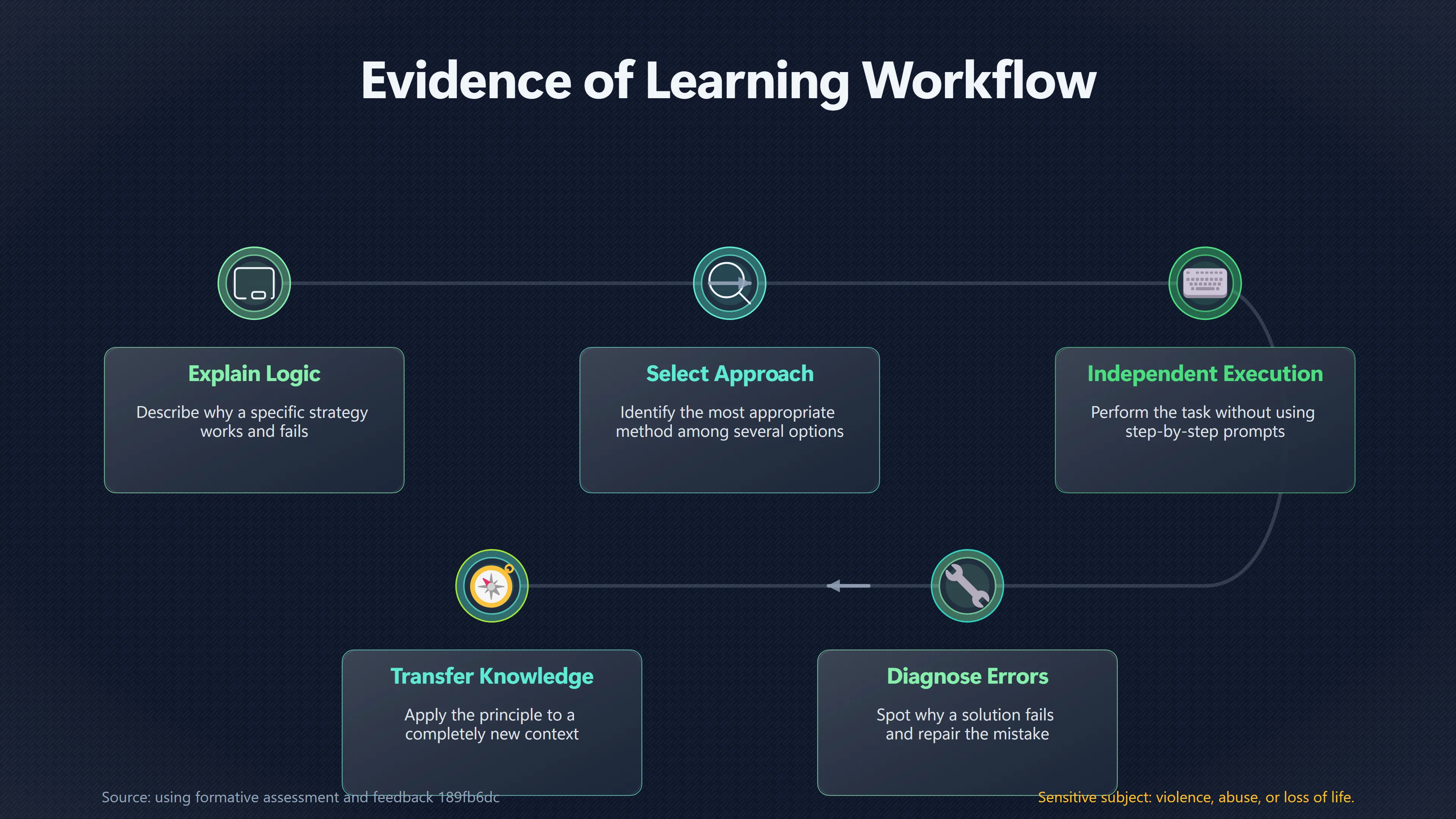
Explain it. Can you describe why a strategy works, which assumptions it depends on and where it can fail? This distinguishes possession of a rule from understanding of the rule.
Choose it. Given several plausible approaches, can you identify an appropriate strategy and explain the choice? This matters because competence in complex work often consists not merely of knowing procedures but knowing when to use them.
Apply it independently. Can you execute the method without copying an example or following step-by-step prompts? Research on worked examples illustrates why this distinction matters. Detailed examples are especially useful to novices, but guidance should be reduced as knowledge develops so that learners increasingly perform the task themselves. Studies of fading instructional guidance have found advantages on delayed and transfer tests, making independent performance a more informative signal than simply counting examples completed.[EEF]educationendowmentfoundation.org.uksupporting pupils with worked examplesEEFSupporting pupils with worked examples | EEFJune 20, 2022…
Diagnose errors. Can you spot why an attempted solution fails and repair it? Identifying and correcting mistakes can probe understanding that successful repetition alone may conceal.[EEF]educationendowmentfoundation.org.ukeef blog mistakes and explanationseef blog mistakes and explanations
Transfer the learning. Can you use the principle when the surface details change? Transfer — applying knowledge in a new context — is especially valuable evidence because memorising a familiar procedure can produce apparent mastery without flexible understanding. Research has found that retrieving and applying concepts across different examples can improve later transfer to new examples.[PubMed]pubmed.ncbi.nlm.nih.govOpen source on nih.gov. More recent experimental work with complex research-methods concepts likewise found benefits of sufficient retrieval practice on delayed retention and application measures.[ScienceDirect]sciencedirect.comOpen source on sciencedirect.com.
These measures need not eliminate numbers. They simply attach numbers to meaningful demonstrations. “Correctly diagnose four out of five unfamiliar cases and justify the chosen method” is numerical, but its quantity is anchored to competence. “Learn five strategies” may not be.

A useful metric should survive a change of example
One practical test for a learning metric is to ask whether somebody could maximise it without becoming substantially better at the underlying task. If the answer is yes, the measure needs revision.
Consider a novice learning spreadsheet modelling. A goal such as “identify six modelling techniques this week” is easy to audit but weakly diagnostic. The learner could list named techniques from articles without being able to recognise when any of them is appropriate.
A stronger target might be:
By Friday, build two unfamiliar models without following a template, explain why each major formula or modelling choice is appropriate, and identify one weakness in each model.
The deadline and demonstrations make the goal specific. Yet nothing depends on pretending that there is a scientifically meaningful optimum number of strategies to collect.
The same logic applies to learning a programming framework. “Complete 15 tutorials” measures activity. “Build a small feature without the tutorial, explain the main architectural choices and debug a deliberately introduced error” measures much more of the capability the tutorials were intended to produce.
For conceptual learning, “read five chapters” similarly records exposure rather than learning. A better measure might require recalling the central ideas after a delay and using them to analyse an unfamiliar case. Testing research reinforces the importance of this distinction: retrieval effects can extend beyond repeated questions to transfer, but transfer is more demanding, and benefits can vary with the form of practice and assessment.[Wiley Online Library]onlinelibrary.wiley.comOpen source on wiley.com.
The principle is therefore not “never count”. It is count the closest observable evidence of competence that is practical to collect.
Useful and distorted learning targets
The difference becomes clearer when apparently precise targets are placed side by side.
Distorted targetWhat it mainly measuresMore useful learning targetRead 10 articles about negotiationConsumptionExplain three important principles and apply them to two unfamiliar negotiation scenariosFind 8 strategies for debuggingStrategy accumulationDiagnose several unfamiliar faults, choose a debugging approach and explain why it fitsComplete 20 coding exercisesActivity volumeSolve new problems without prompts and explain the reasoning behind the solutionWatch 5 tutorials on presentingExposureDeliver a short presentation, review specific weaknesses, revise it and demonstrate improvementLearn 6 analysis methodsLabels acquiredGiven unfamiliar datasets, select suitable methods and justify why alternatives are less appropriateMemorise 30 conceptsImmediate recallRetrieve core concepts after a delay and use them accurately in new examples
This does not mean activity measures are worthless. Pages read, exercises attempted and practice sessions completed can be valuable process measures, especially when they help maintain consistent practice. The error is treating them as proof of learning.
Nor should every goal require a demanding examination. Measurement has costs. A five-minute explanation, a fresh problem, a short retrieval test or a comparison between two possible strategies may provide enough evidence for personal learning. The aim is not elaborate assessment; it is avoiding false precision.
Strategy counts work when the count has a reason
There are circumstances in which a numerical strategy goal is defensible. The original complex-task experiments provide a useful example: if a task has a relatively small set of identifiable, task-effective strategies, discovering more of them can plausibly represent greater task knowledge. Research has repeatedly linked learning goals, strategy development and performance under such conditions.[Sage Journals]journals.sagepub.comSage JournalsThe Effect of Learning versus Outcome Goals on a Simple versus a Complex Task - Dawn Winters, Gary P. Latham, 1996…
The case for a quota becomes weaker as the task becomes more open-ended. In writing, management, research, entrepreneurship or creative problem-solving, strategies can overlap, vary in quality and depend heavily on circumstances. Asking somebody to generate more ideas may sometimes broaden exploration, but the raw count should not automatically be interpreted as mastery.
Process feedback can help resolve this problem. In a stock-investment simulation, research comparing process and outcome feedback found that process feedback was more strongly associated with the quality of information search and task strategy, whereas outcome feedback related more strongly to effort and self-confidence.[Academy of Management Journals]journals.aom.orgOpen source on aom.org. For learning goals, this suggests a useful distinction: do not merely ask how many approaches were tried; examine whether the learner’s information search, reasoning and strategy selection are becoming better.
A sensible strategy quota therefore needs a justification beyond “specific goals need numbers”. Ask whether the strategies are distinguishable, whether quality can be assessed, whether the target covers a meaningful part of the task and whether attaining it predicts better performance. If those conditions are absent, specificity should come from the standard of demonstration, not an invented count.
When does a learning metric become meaningless?
The warning signs are straightforward. A learning measure is losing its meaning when the learner can improve the score without improving the relevant knowledge or skill; when quantity can rise while quality falls; when success depends heavily on repeating the same familiar examples; or when the measure rewards following scaffolding that the learner cannot yet do without.
The strongest check is to separate the practice from the test of learning. You may practise with worked examples, tutorials, flashcards, coaching or repeated attempts. But periodically test yourself with reduced assistance, a delay, a changed example or a problem that requires choosing the method rather than being told which one to use. Evidence on transfer and fading guidance supports this move from supported acquisition towards independent application.[Taylor & Francis Online]tandfonline.comOpen source on tandfonline.com.
That produces a more robust form of specificity:
“Learn five strategies” specifies a quantity.
“Be able to select, explain and independently apply an effective strategy to unfamiliar cases” specifies a capability.
For unfamiliar and complex tasks, the second is usually closer to what a learning goal is for. Numerical targets remain useful when their numbers genuinely represent progress, but specificity is a means, not the objective. A learning metric earns its place when meeting it provides credible evidence that you can understand, choose or do something you could not reliably understand, choose or do before.
Amazon book picks
Further Reading
Books and field guides related to When Does a Learning Metric Become Meaningless?. Use these as the next step if you want deeper reading beyond the article.
Make It Stick: The Science of Successful Learning
To most of us, learning something "the hard way" implies wasted time and effort. Good teaching, we believe, should be creatively tailored...
Peak: Secrets from the New Science of Expertise
El mayor experto mundial en rendimiento y desarrollo de habilidades, Anders Ericsson, nos enseña los secretos para conseguir ser el mejor...

How We Learn: The Surprising Truth About When, Where, and Why...
Rating: 3.1/5 from 7 Google Books ratings
First published 2014. Subjects: Psychology of Learning, Learning.
The Art of Learning: An Inner Journey to Optimal Performance
In his riveting new book, The Art of Learning, Waitzkin tells his remarkable story of personal achievement and shares the principles of l...
eBay marketplace picks
Marketplace Samples
Live-tested eBay searches with available results related to this page.
Selected frommotivational wall art oneBay.co.uk.




Endnotes
1.
Source: onlinelibrary.wiley.com
Link:https://onlinelibrary.wiley.com/doi/pdf/10.1002/job.70
Source snippet
Wiley Online LibraryThe effect of distal learning, outcome, and proximal goals on a moderately complex task - Seijts - 2001 - Journal of...
2.
Source: researchgate.net
Link:https://www.researchgate.net/publication/299646596_Distinguished_Scholar_Invited_Essay_Similarities_and_Differences_Among_Performance_Behavioral_and_Learning_Goals
3.
Source: researchgate.net
Link:https://www.researchgate.net/publication/232593812_The_Effects_of_Learning_Goal_Difficulty_Level_and_Cognitive_Ability_on_Performance
4.
Source: oecd.org
Title: using formative assessment and feedback 189fb6dc
Link:https://www.oecd.org/en/publications/unlocking-high-quality-teaching_f5b82176-en/full-report/using-formative-assessment-and-feedback_189fb6dc.html
Source snippet
Using formative assessment and feedback: Unlocking High-Quality Teaching | OECDApril 3, 2025...
Published: April 3, 2025
5.
Source: educationendowmentfoundation.org.uk
Title: supporting pupils with worked examples
Link:https://educationendowmentfoundation.org.uk/news/supporting-pupils-with-worked-examples
Source snippet
EEFSupporting pupils with worked examples | EEFJune 20, 2022...
Published: June 20, 2022
6.
Source: educationendowmentfoundation.org.uk
Title: eef blog mistakes and explanations
Link:https://educationendowmentfoundation.org.uk/news/eef-blog-mistakes-and-explanations
7.
Source: sciencedirect.com
Link:https://www.sciencedirect.com/science/article/pii/S0959475225001434
8.
Source: onlinelibrary.wiley.com
Link:https://onlinelibrary.wiley.com/doi/full/10.1002/acp.3796
9.
Source: researchgate.net
Title: Goal Setting Theory
Link:https://www.researchgate.net/publication/404925609_Goal_Setting_Theory
10.
Source: sciencedirect.com
Link:https://www.sciencedirect.com/science/article/pii/S1469029225002055
11.
Source: onlinelibrary.wiley.com
Link:https://onlinelibrary.wiley.com/doi/10.1002/9781394320769.ch5
12.
Source: onlinelibrary.wiley.com
Link:https://onlinelibrary.wiley.com/doi/10.1002/acp.3796
13.
Source: onlinelibrary.wiley.com
Link:https://onlinelibrary.wiley.com/doi/abs/10.1002/acp.3796
14.
Source: sciencedirect.com
Link:https://www.sciencedirect.com/science/article/pii/S0191491X20301644
15.
Source: iaap-journals.onlinelibrary.wiley.com
Link:https://iaap-journals.onlinelibrary.wiley.com/doi/full/10.1111/aphw.12071
16.
Source: researchgate.net
Link:https://www.researchgate.net/publication/286459059_the_goal_setting_and_goal_orientation_labyrinth_effective_ways_for_increasing_employee_performance
17.
Source: onlinelibrary.wiley.com
Link:https://onlinelibrary.wiley.com/doi/full/10.1002/jee.20070
18.
Source: sciencedirect.com
Link:https://www.sciencedirect.com/science/article/abs/pii/S1041608012001823
19.
Source: researchgate.net
Link:https://www.researchgate.net/publication/254213508_Goal_Setting_in_Principal_Evaluation_Goal_Quality_and_Predictors_of_Achievement
20.
Source: researchgate.net
Title: (PDF) Feedback, goal-setting and task performance revisited
Link:https://www.researchgate.net/publication/315678022_Feedback_goal-setting_and_task_performance_revisited
21.
Source: researchgate.net
Link:https://www.researchgate.net/publication/233130558_The_Effect_of_Commitment_to_a_Learning_Goal_Self-Efficacy_and_the_Interaction_Between_Learning_Goal_Difficulty_and_Commitment_on_Performance_in_a_Business_Simulation
22.
Source: researchgate.net
Title: (PDF) The combined effects of goal type and cognitive ability on performance
Link:https://www.researchgate.net/publication/226687931_The_combined_effects_of_goal_type_and_cognitive_ability_on_performance
23.
Source: onlinelibrary.wiley.com
Title: j.1756 8765.2008.01011.x
Link:https://onlinelibrary.wiley.com/doi/10.1111/j.1756-8765.2008.01011.x
24.
Source: asmepublications.onlinelibrary.wiley.com
Title: j.1365 2923.2004.01777.x
Link:https://asmepublications.onlinelibrary.wiley.com/doi/10.1046/j.1365-2923.2004.01777.x
25.
Source: onlinelibrary.wiley.com
Link:https://onlinelibrary.wiley.com/doi/10.1002/job.70
26.
Source: researchgate.net
Link:https://www.researchgate.net/publication/248943312_Enhancing_teaching_performance_through_goal_setting_implementation_and_seeking_feedback
27.
Source: researchgate.net
Link:https://www.researchgate.net/publication/246424703_Impact_of_process_and_outcome_feedback_on_relation_of_goal_setting_to_task_performance
28.
Source: onlinelibrary.wiley.com
Link:https://onlinelibrary.wiley.com/doi/10.1002/job.4030110104
29.
Source: researchgate.net
Link:https://www.researchgate.net/publication/284621413_Learning_versus_performance_goals_When_should_each_be_used
30.
Source: researchgate.net
Link:https://www.researchgate.net/publication/320609499_Goal_Setting_and_Goal_Orientation_An_Integration_of_Two_Different_yet_Related_Literatures
31.
Source: researchgate.net
Link:https://www.researchgate.net/publication/258152785_The_Effect_of_Employee_Learning_Goals_and_Goal_Commitment_on_Departmental_Performance
32.
Source: researchgate.net
Link:https://www.researchgate.net/profile/Paul-Earley
33.
Source: researchgate.net
Link:https://www.researchgate.net/publication/247399303_New_Developments_in_and_Directions_for_Goal-Setting_Research
34.
Source: researchgate.net
Link:https://www.researchgate.net/publication/8210100_Feedback_Specificity_Learning_Opportunities_and_Learning
35.
Source: sciencedirect.com
Link:https://www.sciencedirect.com/science/article/abs/pii/S0360131510002940
36.
Source: sciencedirect.com
Link:https://www.sciencedirect.com/science/article/pii/S0191491X17300615
37.
Source: sciencedirect.com
Link:https://www.sciencedirect.com/science/article/pii/S2590291122000778
38.
Source: sciencedirect.com
Link:https://www.sciencedirect.com/science/article/pii/S0747563218304618
39.
Source: sciencedirect.com
Link:https://www.sciencedirect.com/science/article/abs/pii/S0747563208002215
40.
Source: sciencedirect.com
Link:https://www.sciencedirect.com/science/article/abs/pii/S0749597817304594
41.
Source: sciencedirect.com
Link:https://www.sciencedirect.com/science/article/pii/S0959475216303103
42.
Source: journals.sagepub.com
Link:https://journals.sagepub.com/doi/10.1177/1059601196212007
Source snippet
Sage JournalsThe Effect of Learning versus Outcome Goals on a Simple versus a Complex Task - Dawn Winters, Gary P. Latham, 1996...
43.
Source: journals.aom.org
Link:https://journals.aom.org/doi/10.5465/AME.2005.15841964
44.
Source: pmc.ncbi.nlm.nih.gov
Link:https://pmc.ncbi.nlm.nih.gov/articles/PMC7901608/
Source snippet
PubMed Central (PMC)“When a Measure Becomes a Target, It Ceases to be a Good Measure” - PMCFebruary 13, 2021...
Published: February 13, 2021
45.
Source: pmc.ncbi.nlm.nih.gov
Link:https://pmc.ncbi.nlm.nih.gov/articles/PMC8864350/
Source snippet
PubMed Central (PMC)Proxyeconomics, a theory and model of proxy-based competition and cultural evolution - PMC...
46.
Source: tandfonline.com
Link:https://www.tandfonline.com/doi/abs/10.1080/01443410802322069
47.
Source: pubmed.ncbi.nlm.nih.gov
Link:https://pubmed.ncbi.nlm.nih.gov/29265856/
48.
Source: journals.aom.org
Link:https://journals.aom.org/doi/epdf/10.5465/256353
49.
Source: GOV.UK
Title: test development handbook 2023
Link:https://www.gov.uk/government/publications/national-curriculum-test-development-handbook/test-development-handbook-2023
50.
Source: tandfonline.com
Link:https://www.tandfonline.com/doi/full/10.1080/09243453.2022.2116461
51.
Source: pmc.ncbi.nlm.nih.gov
Link:https://pmc.ncbi.nlm.nih.gov/articles/PMC9122957/
52.
Source: educationendowmentfoundation.org.uk
Title: Working with worked examples
Link:https://educationendowmentfoundation.org.uk/news/eef-blog-working-with-worked-examples-simple-techniques-to-enhance-their-effectiveness
53.
Source: tandfonline.com
Link:https://www.tandfonline.com/doi/full/10.1080/17437199.2021.2023608
54.
Source: tandfonline.com
Link:https://www.tandfonline.com/doi/abs/10.1080/17437199.2021.2023608?scroll=top&tab=permissions
55.
Source: tandfonline.com
Link:https://www.tandfonline.com/doi/abs/10.1080/17437199.2019.1706616
56.
Source: pmc.ncbi.nlm.nih.gov
Link:https://pmc.ncbi.nlm.nih.gov/articles/PMC6459472/
57.
Source: betterworldbooks.com
Link:https://www.betterworldbooks.com/product/detail/teaching-mathematics-in-the-visible-learning-classroom-grades-6-8-9781544333182/new
58.
Source: pmc.ncbi.nlm.nih.gov
Link:https://pmc.ncbi.nlm.nih.gov/articles/PMC6255966/
59.
Source: journals.aom.org
Link:https://journals.aom.org/doi/10.5465/256353
60.
Source: doi.org
Title: Winsight™ Assessment System: Preliminary Theory of Action
Link:https://doi.org/10.1002/ets2.12155
61.
Source: journals.sagepub.com
Link:https://journals.sagepub.com/doi/full/10.1177/0149206317702220
62.
Source: pubmed.ncbi.nlm.nih.gov
Link:https://pubmed.ncbi.nlm.nih.gov/28358548/
63.
Source: pmc.ncbi.nlm.nih.gov
Link:https://pmc.ncbi.nlm.nih.gov/articles/PMC4949534/
64.
Source: journals.sagepub.com
Link:https://journals.sagepub.com/doi/10.1177/1548051816641874
65.
Source: journals.sagepub.com
Link:https://journals.sagepub.com/doi/pdf/10.1177/1548051816641874
66.
Source: tandfonline.com
Link:https://www.tandfonline.com/doi/full/10.1080/08959285.2011.580807
67.
Source: tandfonline.com
Link:https://www.tandfonline.com/doi/abs/10.1080/08959285.2011.580807
68.
Source: tandfonline.com
Link:https://www.tandfonline.com/doi/full/10.1080/0969594X.2010.516207
69.
Source: tandfonline.com
Link:https://www.tandfonline.com/doi/abs/10.1207/S15327043HUP1604_3
70.
Source: tandfonline.com
Link:https://www.tandfonline.com/doi/abs/10.1080/1360144980030208
71.
Source: journals.aom.org
Link:https://journals.aom.org/doi/abs/10.5465/ame.2005.15841964
72.
Source: journals.sagepub.com
Link:https://journals.sagepub.com/doi/abs/10.1177/1059601196212007
73.
Source: pmc.ncbi.nlm.nih.gov
Link:https://pmc.ncbi.nlm.nih.gov/articles/PMC10159400/
74.
Source: ncbi.nlm.nih.gov
Link:https://www.ncbi.nlm.nih.gov/books/NBK84220/
75.
Source: pmc.ncbi.nlm.nih.gov
Link:https://pmc.ncbi.nlm.nih.gov/articles/PMC4099468/
76.
Source: support-for-early-career-teachers.education.gov.uk
Title: education.gov.uk Year 2 Autumn week 1 induction tutor materials
Link:https://support-for-early-career-teachers.education.gov.uk/education-development-trust/year-2-embedding-a-positive-climate-for-learning/autumn-week-1-induction-tutor-materials/
77.
Source: rolleston.leicester.sch.uk
Link:https://www.rolleston.leicester.sch.uk/assessment/
Additional References
78.
Source: youtube.com
Title: From Good to Great: Using Deliberate Practice at Work | Humanizing Work Show
Link:https://www.youtube.com/watch?v=bwCvg6tl5ss
Source snippet
Deeper Competency-Based Learning: Making Equitable, Student-Centered, Sustainable Shifts...
79.
Source: nature.com
Link:https://www.nature.com/articles/s41599-026-06563-y
80.
Source: youtube.com
Title: What is Goodhart’s Law? And Why does it Matter?
Link:https://www.youtube.com/watch?v=uKVZ3Zxi1no
Source snippet
From Good to Great: Using Deliberate Practice at Work | Humanizing Work Show...
81.
Source: youtube.com
Title: Goodhart’s Law: Why Hitting Your Targets Can Wreck Your Company
Link:https://www.youtube.com/watch?v=Tzo7IRY92J8
Source snippet
What is Goodhart's Law? And Why does it Matter?...
82.
Source: youtube.com
Title: The Unintended Consequences of Measuring Things
Link:https://www.youtube.com/watch?v=lylI1Z1AHmg
Source snippet
Goodhart's Law: Why Hitting Your Targets Can Wreck Your Company...
83.
Source: usf.edu
Link:https://www.usf.edu/ods/accreditation/glossary.aspx
84.
Source: mtu.edu
Link:https://www.mtu.edu/ctl/online-learning/course-development/learning-objectives/
85.
Source: cambridge.org
Link:https://www.cambridge.org/core/journals/behavioral-and-brain-sciences/article/abs/dead-rats-dopamine-performance-metrics-and-peacock-tails-proxy-failure-is-an-inherent-risk-in-goaloriented-systems/89408A43F6D14BFD368FE5225A573032
86.
Source: assessmentforall.com
Link:https://assessmentforall.com/designing-an-adaptive-formative-feedback-structure-for-singapore-primary-mathematics-classroom/
87.
Source: frontiersin.org
Link:https://www.frontiersin.org/journals/education/articles/10.3389/feduc.2021.751283/full