Within Simple Metrics
When a Useful Metric Has Outlived Its Purpose
Once a metric has resolved the uncertainty it was introduced to test, it can often be retired, sampled less often or replaced.
On this page
- How temporary metrics prevent dashboards from expanding forever
- Signals that a measure has answered its original question
- Choosing whether to retire, reduce or replace the measure
Page outline Jump by section
Introduction
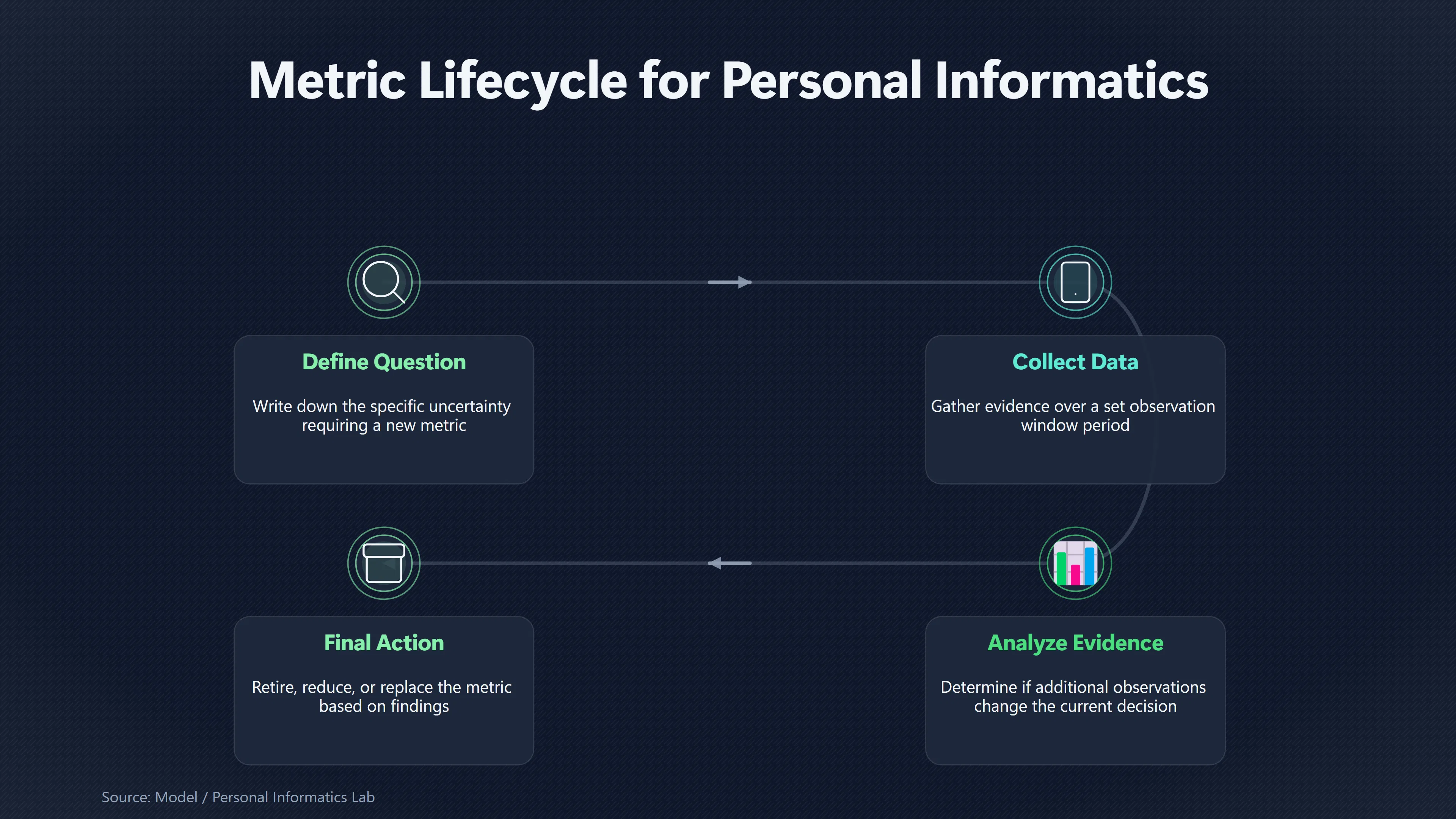
A personal metric should have an exit condition. If you began counting missed study sessions to discover whether an ambitious timetable was realistic, and several weeks of data have already shown that the timetable is the problem, continuing to count misses indefinitely adds little. The metric has done its job. The useful next move is to change the plan, then either retire the measure, check it less often or replace it with one that answers the next uncertainty.
This is not an argument against self-monitoring. Experimental evidence shows that progress monitoring can improve goal attainment. The narrower point is that evidence for monitoring does not imply that every useful measure should become permanent. Research on personal informatics shows that people commonly stop, suspend or change tracking after learning what they wanted to know, while newer research finds that users adjust their mix of metrics as their circumstances and purposes change.[nih.gov]pubmed.ncbi.nlm.nih.govDoes monitoring goal progress promote goal attainment? A meta-analysis of the experimental evidence - PubMedFebruary 1, 2016…
Temporary metrics stop the dashboard growing forever
The easiest way for a personal dashboard to become unwieldy is to treat every useful measure as a permanent addition. A sleep experiment adds bedtime and wake time. A study experiment adds sessions completed. A running plan adds weekly mileage. A distraction problem adds phone pickups. None is individually unreasonable, but if measures are only added and never removed, yesterday’s questions eventually compete with today’s for attention.
Research on personal informatics offers a better model. The original stage-based framework described tracking as an iterative process involving collection, integration, reflection and action rather than data collection as an end in itself. Later research explicitly incorporated lapsing, stopping and resuming into the picture. In surveys covering physical activity, finance and location tracking, Epstein and colleagues found that people could stop because tracking had served its purpose, because its upkeep was burdensome or because their needs had changed. Some documentary tracking was deliberately short-term: people accumulated enough information to reflect on it and then stopped.[personalinformatics.ianli.com]personalinformatics.ianli.comModel / Personal Informatics LabModel / Personal Informatics Lab
That matters for self-improvement because collection has a cost. It may require entering information, wearing or charging a device, checking an application, interpreting charts or simply spending attention on a number that would otherwise have remained in the background. In one six-month study involving repeated mobile assessments and photographic food records, adherence to both forms of self-monitoring declined over time, particularly for the more demanding photographic records. Qualitative personal-informatics research likewise identifies the effort of collecting and integrating data as a reason people abandon tracking.[PubMed Central (PMC)]pmc.ncbi.nlm.nih.govPubMed Central (PMC)Adherence to self-monitoring healthy lifestyle behaviours through mobile phone-based ecological momentary assessments…
Measurement is not necessarily neutral either. A 2022 systematic review of digital, in-the-moment health measurements found evidence that measurement itself can alter behaviour; among the predominantly physical-activity studies suitable for quantitative synthesis, pooled effects were small but meaningful. A much larger meta-analysis of the broader “question-behaviour effect” also found a small effect of measurement on health-related behaviour, although with substantial variation between studies.[PubMed]pubmed.ncbi.nlm.nih.govA systematic review and meta-analysis of studies of reactivity to digital in-the-moment measurement of health behaviour - PubMedMar…
Sometimes that reactivity is precisely why tracking helps: seeing the number prompts correction. But it also means that a metric is an intervention on attention, not just an innocent record. Keeping a measure permanently visible can continue directing attention towards what it counts even after that is no longer the most useful thing to optimise.
A practical design rule follows: when introducing a metric, write down the question that justifies it and the condition under which you expect to stop measuring it. For example:
- “Track planned workouts completed for four weeks to find out whether this schedule is realistic.”
- “Record bedtime for two weeks to see whether late nights are concentrated on particular days.”
- “Count unplanned phone checks during study sessions until the main trigger is clear.”
- “Measure practice-test accuracy until there is enough evidence to identify the weakest topic.”
This converts tracking from an accumulating autobiography into a sequence of small investigations.
How to tell when a metric has answered its question
A metric has not outlived its purpose merely because the number improved. The stronger test is whether additional observations are still likely to change the decision.
Suppose you track whether four planned study sessions happen each week. The first two weeks show two sessions completed; the next three show only one or two. Your notes repeatedly identify the same obstacle: the planned 7 pm start conflicts with childcare. More weeks of identical counts may make the graph longer without materially increasing what you know. The uncertainty was “Can this schedule actually be followed?” The evidence now says “not reliably under present conditions”. The appropriate intervention is to redesign the schedule.
Several signals are particularly useful.
The result repeatedly points to the same action. If another week of data would lead to the same decision under almost any plausible result, the marginal value of daily tracking is low.
The original uncertainty has been resolved. You introduced a measure because you genuinely did not know whether the problem was adherence, timing, workload, recovery or something else. Once the evidence distinguishes the plausible explanations well enough to act, collection can pause while you act.
The behaviour has become sufficiently predictable for the present purpose. If you needed a daily count to establish whether a routine was happening and it has now been stable for months, daily confirmation may no longer be worth the attention. This does not prove that the behaviour can never relapse; it means continuous high-frequency measurement may no longer be necessary.
The decision has moved downstream. Once study attendance is reliable, the important uncertainty may become whether the sessions produce durable learning. Once a running schedule is consistently followed, the relevant question may become whether performance or recovery is changing. Keeping the old metric as the centrepiece because it once mattered confuses historical usefulness with current usefulness.
This fits NICE’s behaviour-change guidance, which treats monitoring as part of an adaptive process: goals should be reviewed in light of experience, further plans should follow progress, and interventions should be tailored at planned review points. NICE also distinguishes monitoring a behaviour from monitoring its outcomes. The implication for personal use is not that monitoring should cease on a fixed timetable, but that the measure should remain connected to the question and decision it serves.[Nice]nice.org.ukRecommendations | Behaviour change: individual approaches | Guidance | NICEJanuary 2, 2014…
Recent research makes the same point at the level of individual metrics. A 2025 study of fitness-tracker users found that people used metrics for different purposes — including checking in, goal setting, self-comparison and curiosity — and reselected metrics as their circumstances and purposes changed. The researchers describe an evolving “metric ecology”, rather than a fixed set of numbers that remains equally useful throughout a person’s tracking journey.[DOI]doi.orgThe Framework of the Lived Experience of Metrics: Understanding the Purposes and Activities of Self-Tracking Metrics | Proceedings of…
Retire, reduce or replace?
“Stop tracking” is only one possible response. Once a measure has answered its original question, there are three useful choices: retire it, reduce its frequency or replace it. The right choice depends on what information could still change your behaviour.
Retire the metric when its information no longer has a current decision attached to it. If two weeks of recording interruptions established that notifications are the dominant cause of broken concentration, and you have now changed notification settings, there is little reason to preserve “interruptions per session” as a permanent life statistic. Remove it. If concentration becomes a problem again, tracking can resume.
Stopping in such circumstances should not automatically be interpreted as failure. Research into life after personal-informatics use found that people sometimes abandon tracking after accomplishing a goal or satisfying their curiosity. Related work describes this as “happy abandonment”: the tracker is no longer required because its purpose has been served.[PubMed Central (PMC)]pmc.ncbi.nlm.nih.govOpen source on nih.gov.
Reduce the metric when relapse matters but continuous measurement does not. A behaviour may be established enough that daily logging is unnecessary while still deserving an occasional check. Weekly, monthly or short periodic sampling can act as a tripwire. This approach preserves some feedback while reducing collection burden.
The distinction is important because successful change and permanent measurement are not the same thing. NICE, for example, recommends continued feedback and monitoring at regular intervals during long-term maintenance of health behaviour change, with the purpose of detecting relapse. That is conceptually different from assuming that the intensive measurement used during initial change must continue unchanged forever.[Nice]nice.org.ukOpen source on nice.org.uk.
Replace the metric when the old question has been answered but a new bottleneck has appeared. Imagine that you initially track whether three weekly strength sessions happen. After several months, adherence is consistently high. Continuing to celebrate “3/3” may be pleasant, but it tells you little about whether the programme remains appropriately challenging. If the next decision concerns progress, a suitable performance measure can take the adherence metric’s place rather than simply joining it.
Replacement is what keeps a minimal measurement system minimal. The governing question is not “Which numbers about me are interesting?” but “Which unresolved question currently deserves measurement?”
Use a review date instead of waiting to get bored
In practice, people often stop tracking reactively: logging becomes irritating, the device is forgotten or the application simply falls out of use. Personal-informatics research repeatedly finds forgetting, upkeep problems, intentional skipping and suspension among the routes into lapsing.[PubMed Central (PMC)]pmc.ncbi.nlm.nih.govPub Med Central (PMC)A Lived Informatics Model of Personal InformaticsPubMed Central (PMC)A Lived Informatics Model of Personal Informatics - PMC…
A cleaner method is to schedule the decision about the metric when you create it. The review need not be elaborate. At the end of a two-week, four-week or otherwise meaningful observation window, ask:
- What question was this metric supposed to answer?
- What does the accumulated evidence now suggest?
- What decision follows from that evidence?
- What plausible future observation would change that decision?
- Do I therefore need continuous measurement, occasional sampling, a different metric or no metric at all?
The fourth question prevents premature retirement. If tomorrow’s or next week’s value could genuinely reveal something important — for example, whether an intervention is working after an expected delay — collection still has information value. Conversely, if you cannot describe a plausible result that would alter your next action, continuing to record the number deserves scrutiny.
The same principle prevents a common mistake after making a change: collecting the old metric forever rather than defining a short verification period. If moving study sessions from evenings to mornings was the intervention, track adherence long enough to test whether the change actually solved the scheduling problem. If it did, close that measurement cycle. If it did not, the metric has generated a new decision rather than earned permanent residence on the dashboard.
Keep the learning even when you stop keeping the number
Retiring a metric does not require deleting what it taught you. Before removing it, preserve the conclusion in a form that is easier to use than a graph.
“Morning sessions happen reliably; evening sessions usually conflict with family responsibilities” is more actionable than six months of study-session counts. “I overspend mainly when ordering food after late work” may be more useful than permanently maintaining a detailed discretionary-spending dashboard. The purpose of the measurement cycle was to produce usable knowledge.
Research on what happens after people stop self-tracking supports this distinction. Former trackers do not necessarily return to a blank state: prior tracking can leave them with knowledge about their routines, and people may later resume collecting or reflecting on old data if their circumstances change. Personal-informatics models therefore treat lapsing and resumption as legitimate parts of tracking rather than assuming uninterrupted collection is the only successful path.[PubMed Central (PMC)]pmc.ncbi.nlm.nih.govPubMed Central (PMC)Beyond Abandonment to Next Steps: Understanding and Designing for Life after Personal Informatics Tool Use - PMC…
That suggests a compact retirement record: keep the question, finding, decision and restart trigger. For example: “Question: Is bedtime inconsistency mainly a weekend problem? Finding: yes. Decision: keep weekday routine unchanged and set a weekend cut-off. Restart tracking if daytime tiredness returns for several days.” The raw daily metric can disappear while the information it produced remains available.
There is an important exception. Some measures serve an enduring safety, medical, financial or other monitoring function rather than a temporary self-improvement experiment. Those should not be discontinued simply because their recent values are stable, particularly when monitoring has been recommended by a clinician or another qualified professional. The retirement principle applies most cleanly to discretionary personal metrics introduced to answer a bounded question.
For ordinary self-improvement tracking, however, successful measurement should often make itself unnecessary. Monitoring is valuable because it reduces uncertainty and improves decisions, not because a growing archive of numbers is inherently a sign of progress. The mature endpoint of a useful metric may therefore be surprisingly simple: you learnt what you needed to learn, changed what needed changing and stopped counting.
Amazon book picks
Further Reading
Books and field guides related to When a Useful Metric Has Outlived Its Purpose. Use these as the next step if you want deeper reading beyond the article.
How to Measure Anything
Now updated with new research and even more intuitive explanations, a demystifying explanation of how managers can inform themselves to m...
Essentialism
Have you ever found yourself struggling with information overload? Have you ever felt both overworked and underutilised? Do you ever feel...
Atomic Habits
Rating: 3.5/5 from 7 Google Books ratings
The #1 New York Times bestseller. Over 25 million copies sold! Translated into 60+ languages! Tiny Changes, Remarkable Results No matter...
Decisive
The New York Times-bestselling authors of Switch and Made to Stick offer a fascinating tour through the workings of our minds to reveal h...
eBay marketplace picks
Marketplace Samples
Live-tested eBay searches with available results related to this page.
Selected fromgoal tracker board oneBay.co.uk.




Endnotes
1.
Source: doi.org
Link:https://doi.org/10.1145/3706598.3713650
Source snippet
The Framework of the Lived Experience of Metrics: Understanding the Purposes and Activities of Self-Tracking Metrics | Proceedings of...
2.
Source: personalinformatics.ianli.com
Title: Model / Personal Informatics Lab
Link:https://personalinformatics.ianli.com/lab/model
3.
Source: doi.org
Link:https://doi.org/10.1145/3772318.3790446
4.
Source: v1.ianli.com
Link:https://v1.ianli.com/thesis/
5.
Source: personalinformatics.ianli.com
Link:https://personalinformatics.ianli.com/lab/survey
6.
Source: doi.org
Title: Status incentive and peer spillover effects on physical activity habits
Link:https://doi.org/10.1016/j.jebo.2025.107270
7.
Source: pubmed.ncbi.nlm.nih.gov
Link:https://pubmed.ncbi.nlm.nih.gov/26479070/
Source snippet
Does monitoring goal progress promote goal attainment? A meta-analysis of the experimental evidence - PubMedFebruary 1, 2016...
Published: February 1, 2016
8.
Source: pmc.ncbi.nlm.nih.gov
Title: Pub Med Central (PMC)A Lived Informatics Model of Personal Informatics
Link:https://pmc.ncbi.nlm.nih.gov/articles/PMC12435389/
Source snippet
PubMed Central (PMC)A Lived Informatics Model of Personal Informatics - PMC...
9.
Source: pmc.ncbi.nlm.nih.gov
Link:https://pmc.ncbi.nlm.nih.gov/articles/PMC5807077/
Source snippet
PubMed Central (PMC)Adherence to self-monitoring healthy lifestyle behaviours through mobile phone-based ecological momentary assessments...
10.
Source: pmc.ncbi.nlm.nih.gov
Link:https://pmc.ncbi.nlm.nih.gov/articles/PMC5428074/
Source snippet
PubMed Central (PMC)Beyond Abandonment to [Next Steps]({{ 'next-steps/' | relative_url }}): Understanding and Designing for Life after Personal Informatics Tool Use - PMC...
11.
Source: pubmed.ncbi.nlm.nih.gov
Link:https://pubmed.ncbi.nlm.nih.gov/35264084/
Source snippet
A systematic review and meta-analysis of studies of reactivity to digital in-the-moment measurement of health behaviour - PubMedMar...
12.
Source: nice.org.uk
Link:https://www.nice.org.uk/Guidance/PH49/chapter/recommendations
Source snippet
Recommendations | Behaviour change: individual approaches | Guidance | NICEJanuary 2, 2014...
Published: January 2, 2014
13.
Source: pmc.ncbi.nlm.nih.gov
Link:https://pmc.ncbi.nlm.nih.gov/articles/PMC5432203/
14.
Source: pubmed.ncbi.nlm.nih.gov
Link:https://pubmed.ncbi.nlm.nih.gov/42425416/
15.
Source: pubmed.ncbi.nlm.nih.gov
Link:https://pubmed.ncbi.nlm.nih.gov/42326773/
16.
Source: pmc.ncbi.nlm.nih.gov
Link:https://pmc.ncbi.nlm.nih.gov/articles/PMC13099072/
17.
Source: pmc.ncbi.nlm.nih.gov
Link:https://pmc.ncbi.nlm.nih.gov/articles/PMC12923002/
18.
Source: pmc.ncbi.nlm.nih.gov
Link:https://pmc.ncbi.nlm.nih.gov/articles/PMC12881904/
19.
Source: pmc.ncbi.nlm.nih.gov
Link:https://pmc.ncbi.nlm.nih.gov/articles/12881904
20.
Source: pmc.ncbi.nlm.nih.gov
Link:https://pmc.ncbi.nlm.nih.gov/articles/PMC11673225/
21.
Source: pmc.ncbi.nlm.nih.gov
Link:https://pmc.ncbi.nlm.nih.gov/articles/PMC12425467/
22.
Source: pubmed.ncbi.nlm.nih.gov
Link:https://pubmed.ncbi.nlm.nih.gov/38656787/
23.
Source: pmc.ncbi.nlm.nih.gov
Link:https://pmc.ncbi.nlm.nih.gov/articles/PMC10972539/
24.
Source: pmc.ncbi.nlm.nih.gov
Link:https://pmc.ncbi.nlm.nih.gov/articles/PMC10591122/
25.
Source: pmc.ncbi.nlm.nih.gov
Link:https://pmc.ncbi.nlm.nih.gov/articles/PMC10589825/
26.
Source: pmc.ncbi.nlm.nih.gov
Link:https://pmc.ncbi.nlm.nih.gov/articles/PMC10337346/
27.
Source: pmc.ncbi.nlm.nih.gov
Link:https://pmc.ncbi.nlm.nih.gov/articles/PMC11174977/
28.
Source: pmc.ncbi.nlm.nih.gov
Link:https://pmc.ncbi.nlm.nih.gov/articles/PMC10015600/
29.
Source: pmc.ncbi.nlm.nih.gov
Link:https://pmc.ncbi.nlm.nih.gov/articles/PMC10153998/
30.
Source: pmc.ncbi.nlm.nih.gov
Link:https://pmc.ncbi.nlm.nih.gov/articles/PMC9737307/
31.
Source: pmc.ncbi.nlm.nih.gov
Link:https://pmc.ncbi.nlm.nih.gov/articles/PMC9546475/
32.
Source: pubmed.ncbi.nlm.nih.gov
Link:https://pubmed.ncbi.nlm.nih.gov/35719870/
33.
Source: pmc.ncbi.nlm.nih.gov
Link:https://pmc.ncbi.nlm.nih.gov/articles/PMC9163273/
34.
Source: pmc.ncbi.nlm.nih.gov
Link:https://pmc.ncbi.nlm.nih.gov/articles/PMC9096719/
35.
Source: pmc.ncbi.nlm.nih.gov
Link:https://pmc.ncbi.nlm.nih.gov/articles/PMC9382055/
36.
Source: pmc.ncbi.nlm.nih.gov
Link:https://pmc.ncbi.nlm.nih.gov/articles/PMC8902300/
37.
Source: pubmed.ncbi.nlm.nih.gov
Link:https://pubmed.ncbi.nlm.nih.gov/34529044/
38.
Source: pmc.ncbi.nlm.nih.gov
Link:https://pmc.ncbi.nlm.nih.gov/articles/PMC7614249/
39.
Source: pmc.ncbi.nlm.nih.gov
Link:https://pmc.ncbi.nlm.nih.gov/articles/PMC8485346/
40.
Source: pmc.ncbi.nlm.nih.gov
Link:https://pmc.ncbi.nlm.nih.gov/articles/PMC8244882/
41.
Source: pubmed.ncbi.nlm.nih.gov
Link:https://pubmed.ncbi.nlm.nih.gov/33617740/
42.
Source: pmc.ncbi.nlm.nih.gov
Link:https://pmc.ncbi.nlm.nih.gov/articles/PMC8349933/
43.
Source: pubmed.ncbi.nlm.nih.gov
Link:https://pubmed.ncbi.nlm.nih.gov/33052123/
44.
Source: pmc.ncbi.nlm.nih.gov
Link:https://pmc.ncbi.nlm.nih.gov/articles/PMC7593856/
45.
Source: nice.org.uk
Link:https://www.nice.org.uk/guidance/ng183/chapter/recommendations
46.
Source: pmc.ncbi.nlm.nih.gov
Link:https://pmc.ncbi.nlm.nih.gov/articles/PMC7351123/
47.
Source: pmc.ncbi.nlm.nih.gov
Link:https://pmc.ncbi.nlm.nih.gov/articles/PMC7430559/
48.
Source: pmc.ncbi.nlm.nih.gov
Link:https://pmc.ncbi.nlm.nih.gov/articles/PMC7556417/
49.
Source: pmc.ncbi.nlm.nih.gov
Link:https://pmc.ncbi.nlm.nih.gov/articles/PMC7215523/
50.
Source: pmc.ncbi.nlm.nih.gov
Link:https://pmc.ncbi.nlm.nih.gov/articles/PMC7286862/
51.
Source: pubmed.ncbi.nlm.nih.gov
Link:https://pubmed.ncbi.nlm.nih.gov/32181749/
52.
Source: pmc.ncbi.nlm.nih.gov
Link:https://pmc.ncbi.nlm.nih.gov/articles/PMC7571594/
53.
Source: pmc.ncbi.nlm.nih.gov
Link:https://pmc.ncbi.nlm.nih.gov/articles/PMC6996756/
54.
Source: pmc.ncbi.nlm.nih.gov
Link:https://pmc.ncbi.nlm.nih.gov/articles/PMC6504043/
55.
Source: nice.org.uk
Title: Surveillance decision
Link:https://www.nice.org.uk/guidance/ph49/resources/2019-exceptional-surveillance-of-behaviour-change-individual-approaches-nice-guideline-ph49-6716978749/chapter/Surveillance-decision
56.
Source: pubmed.ncbi.nlm.nih.gov
Link:https://pubmed.ncbi.nlm.nih.gov/30202544/
57.
Source: pmc.ncbi.nlm.nih.gov
Link:https://pmc.ncbi.nlm.nih.gov/articles/PMC11774256
58.
Source: pmc.ncbi.nlm.nih.gov
Link:https://pmc.ncbi.nlm.nih.gov/articles/PMC5695980/
59.
Source: pmc.ncbi.nlm.nih.gov
Link:https://pmc.ncbi.nlm.nih.gov/articles/PMC5225122/
60.
Source: pmc.ncbi.nlm.nih.gov
Link:https://pmc.ncbi.nlm.nih.gov/articles/PMC4933960/
61.
Source: pmc.ncbi.nlm.nih.gov
Link:https://pmc.ncbi.nlm.nih.gov/articles/PMC4975085/
62.
Source: pubmed.ncbi.nlm.nih.gov
Link:https://pubmed.ncbi.nlm.nih.gov/40959606/
63.
Source: nice.org.uk
Link:https://www.nice.org.uk/guidance/ph49/evidence
64.
Source: nice.org.uk
Link:https://www.nice.org.uk/guidance/ph49/chapter/context
65.
Source: nice.org.uk
Link:https://www.nice.org.uk/Guidance/ph49?print=true
66.
Source: nice.org.uk
Title: behaviour change call for evidence
Link:https://www.nice.org.uk/guidance/ph49/resources/behaviour-change-call-for-evidence
67.
Source: nice.org.uk
Title: the evidence
Link:https://www.nice.org.uk/guidance/ph49/chapter/the-evidence
68.
Source: nice.org.uk
Title: how we made the decision
Link:https://www.nice.org.uk/guidance/ph49/resources/2019-exceptional-surveillance-of-behaviour-change-individual-approaches-nice-guideline-ph49-6716978749/chapter/how-we-made-the-decision
69.
Source: pmc.ncbi.nlm.nih.gov
Link:https://pmc.ncbi.nlm.nih.gov/articles/PMC3386977/
70.
Source: pmc.ncbi.nlm.nih.gov
Link:https://pmc.ncbi.nlm.nih.gov/articles/PMC6893884/
71.
Source: nice.org.uk
Link:https://www.nice.org.uk/about/what-we-do/research-and-development/research-recommendations/ph49/3
72.
Source: pubmed.ncbi.nlm.nih.gov
Link:https://pubmed.ncbi.nlm.nih.gov/28503678/
73.
Source: ncbi.nlm.nih.gov
Link:https://www.ncbi.nlm.nih.gov/books/NBK574093/
74.
Source: pmc.ncbi.nlm.nih.gov
Link:https://pmc.ncbi.nlm.nih.gov/articles/PMC4153404/
75.
Source: pmc.ncbi.nlm.nih.gov
Link:https://pmc.ncbi.nlm.nih.gov/articles/PMC12439622/
Additional References
76.
Source: sciencedirect.com
Link:https://www.sciencedirect.com/science/article/pii/S0895435619311461
Source snippet
Asking questions changes health-related behavior: an updated systematic review and meta-analysis - ScienceDirect...
77.
Source: youtube.com
Title: The KPI Trap: When Metrics Start Managing You
Link:https://www.youtube.com/watch?v=7S23c9EUNQo
Source snippet
For an in-depth look at how tracking measures can become counterproductive targets once they outlive their diagnostic purpose, see The Ps...
78.
Source: youtube.com
Link:https://www.youtube.com/watch?v=w1C86WwhxiY
Source snippet
Does More Health Data Make You Healthier?...
79.
Source: youtube.com
Title: The Psychology of Bad Targets | Goodhart’s Law Explained
Link:https://www.youtube.com/watch?v=Gs9eP_d9urE
Source snippet
Personal informatics and reflection: a critical examination of the nature of reflection...
80.
Source: scispace.com
Link:https://scispace.com/papers/a-systematic-review-and-meta-analysis-of-studies-of-1opqcqsj
81.
Source: researchgate.net
Link:https://www.researchgate.net/publication/312204737_Behavior_Change_with_Fitness_Technology_in_Sedentary_Adults_A_Review_of_the_Evidence_for_Increasing_Physical_Activity
82.
Source: researchgate.net
Link:https://www.researchgate.net/publication/350508879_Determinants_of_Longitudinal_Adherence_in_Smartphone-Based_Self-Tracking_for_Chronic_Health_Conditions_Evidence_from_Axial_Spondyloarthritis
83.
Source: researchgate.net
Link:https://www.researchgate.net/publication/359367631Digital_self-tracking_habits_and_the_myth_of_discontinuance_It_doesn%27t_just%27stop%27
84.
Source: researchgate.net
Link:https://www.researchgate.net/publication/291335719_Does_Monitoring_Goal_Progress_Promote_Goal_Attainment_A_Meta-Analysis_of_the_Experimental_Evidence
85.
Source: researchgate.net
Link:https://www.researchgate.net/publication/347593201_Exploring_Understandable_Algorithms_to_Suggest_Fitness_Tracker_Goals_that_Foster_Commitment