Within Spending Systems
Why Spending Feedback Works Better Before Checkout
Seeing how much money remains before checkout can connect one purchase to the rest of the month's spending plan.
On this page
- Why after the fact budgeting misses the decision moment
- What real time balance feedback adds
- How to track one problem category at purchase time
Page outline Jump by section
Introduction
Real-time spending feedback works on a simple principle: financial information is more useful for impulse control while a purchase can still be changed than after the money has gone. A monthly budget reviewed at home may show that restaurant, clothes or hobby spending is too high, but it cannot undo yesterday’s checkout. A live figure — such as “£84 left for eating out this month” — connects the item in front of the buyer to the rest of the spending plan.
The evidence does not support the stronger claim that displaying a balance automatically makes everybody spend less. Effects vary with the type of feedback and the shopper. But field experiments, banking studies and consumer research converge on a useful distinction: information delivered near a consequential decision can change behaviour in ways that delayed summaries often do not.[fca.org.uk]fca.org.ukMarch 11, 2015…
Why after-the-fact budgeting misses the decision moment
Traditional budgeting separates two activities that need to meet: planning and purchasing. People decide in advance what they would like to spend, then encounter individual buying decisions in completely different settings. The US Consumer Financial Protection Bureau (CFPB) found precisely this gap in its research on spending management. Consumers often wanted budgets and spending plans, yet did not regularly compare actual spending with those plans when making purchases. Tracking could feel burdensome, so the budget was not necessarily present when a decision had to be made.[Consumer Financial Protection Bureau]consumerfinance.govConsumer Financial Protection BureauConsumer insights on managing spending | Consumer Financial Protection BureauFebruary 28, 2017…
Banking evidence offers a useful comparison between delayed and timely information. In an analysis involving data from two large UK banks, the Financial Conduct Authority (FCA) found that annual account summaries did not produce detectable changes in overdraft charges, balances or switching. By contrast, customers signing up for text alerts or mobile banking experienced reductions in unarranged overdraft charges of about 5–8%; customers using both were associated with a larger reduction. Because customers were not randomly assigned to all of these services, that particular comparison should not be read as pure experimental proof that timing caused the difference. It does, however, show why merely supplying financial information is not enough.[FCA]fca.org.ukMarch 11, 2015…
Stronger evidence comes from subsequent UK overdraft-alert interventions. FCA research covering large-scale bank populations found that automatically enrolling customers into alerts for unarranged overdrafts and unpaid items substantially reduced the corresponding charges. Later field experiments involving more than one million current-account customers found that real-time alerts warning of arranged-overdraft use also reduced charges, whereas evidence for more generic low-balance warnings was weak or mixed.[FCA]fca.org.ukOpen source on fca.org.uk.
These studies concern overdrafts rather than discretionary impulse purchases, so they should not be treated as direct evidence that a checkout balance will stop someone buying trainers or ordering a takeaway. Their relevance is more specific: information becomes actionable when it arrives close enough to the financial consequence for the person to respond. The FCA describes this as “just-in-time” disclosure. Its research found that customers could still transfer money, cut non-essential spending or take another action before the unwanted outcome became unavoidable.[FCA]fca.org.ukFCAFinancial Conduct AuthorityOctober 19, 2025…
That distinction separates feedback from bookkeeping. A notification saying that £60 was spent yesterday improves the historical record. A display saying that only £75 remains in this month’s discretionary allowance before a £45 purchase asks a different question: is this item worth consuming 60% of what remains?
What a live balance adds before checkout
The most useful feedback is not necessarily an ordinary bank balance. A current account containing £1,400 can make a £70 purchase look comfortable even if £1,250 is already needed for rent, bills, food and other commitments. For impulse control, the more meaningful number is often spendable money after planned commitments, or the amount remaining in the particular category where overspending occurs.
That was the logic behind a CFPB prototype specifically designed around point-of-purchase feedback. Researchers tested a payment-card concept whose display could show how much remained after accounting for monthly bills, expenses and savings goals. Users could view remaining amounts for the month, week and day, alongside a budgeting app giving wider context.[GovInfo]govinfo.govGOVPUB FR PURL gpo153581February 2017August 16, 2025…
Interest was striking: more than 90% of the consumers questioned expressed interest in a tool or app supplying this kind of feedback, and respondents expected it to help with impulse spending, budgeting and uncertainty about their finances. But the limitation is important. The CFPB’s prototype research included a diverse but non-representative online sample of 144 respondents, followed by in-person testing with nine consumers using mock transactions. It was not a real-world trial demonstrating that the prototype reduced spending. The results establish perceived usefulness and help identify a plausible design, not an effect size.[Consumer Financial Protection Bureau]consumerfinance.govConsumer Financial Protection BureauConsumer insights on managing spending | Consumer Financial Protection BureauFebruary 28, 2017…
More direct behavioural evidence comes from grocery shopping. A field experiment by Natalia Montinari, Emma Runnemark and Erik Wengström randomly allocated shoppers at two stores to use mobile self-scanners or shop conventionally. Scanning gave shoppers a running total as they selected products — unusually immediate feedback because the cumulative cost was visible before the final checkout. Across shoppers overall, the effect on expenditure was negative but statistically insignificant. Among participants classified as having low self-control, however, using the scanner significantly reduced both expenditure and the number of items purchased.[Lund University]portal.research.lu.send UniversitySelf-Scanning and Self-Control: A Field Experiment on Real-Time Feedback and Shopping Behavior - Lund University…
That heterogeneous result matters for self-improvement. A tool designed to interrupt impulsive spending does not have to make every consumer spend less to be useful. Its relevant test is whether it helps people whose existing intentions are repeatedly defeated during the purchase process. The grocery experiment suggests that real-time totals may be particularly useful for at least some shoppers who recognise that self-control is a problem.[SSRN]papers.ssrn.comSelf-Scanning and Self-Control: A Field Experiment on Real-Time Feedback and Shopping Behavior by Natalia Montinari, Emma Runnemark…
There is also a warning against treating “show a number” as a universal nudge. Experiments on smart shopping carts found different reactions among shoppers depending on whether they were operating under a spending constraint. Real-time feedback did not simply push expenditure down across the board; some budget shoppers spent more, partly by choosing more national-brand products, while other shoppers reduced expenditure by substituting store brands.[Sage Journals]journals.sagepub.comSage Journals Smart Shopping Carts: How Real-Time Feedback Influences SpendingSage Journals Smart Shopping Carts: How Real-Time Feedback Influences Spending
The practical conclusion is therefore narrower and stronger than “balances prevent impulse buying”. Feedback needs a meaningful reference point. “You have £900 in your account” can function almost like permission to spend. “You have £90 left from the £250 restaurant allowance you chose for this month” shows the trade-off the buyer actually wanted to respect.

How to track one problem category at purchase time
For personal use, the evidence points towards a deliberately small system rather than comprehensive financial surveillance. Choose the category in which spontaneous decisions repeatedly defeat prior intentions — for example takeaway meals, clothes, cosmetics, games or hobby purchases — and make its remaining allowance visible before payment.
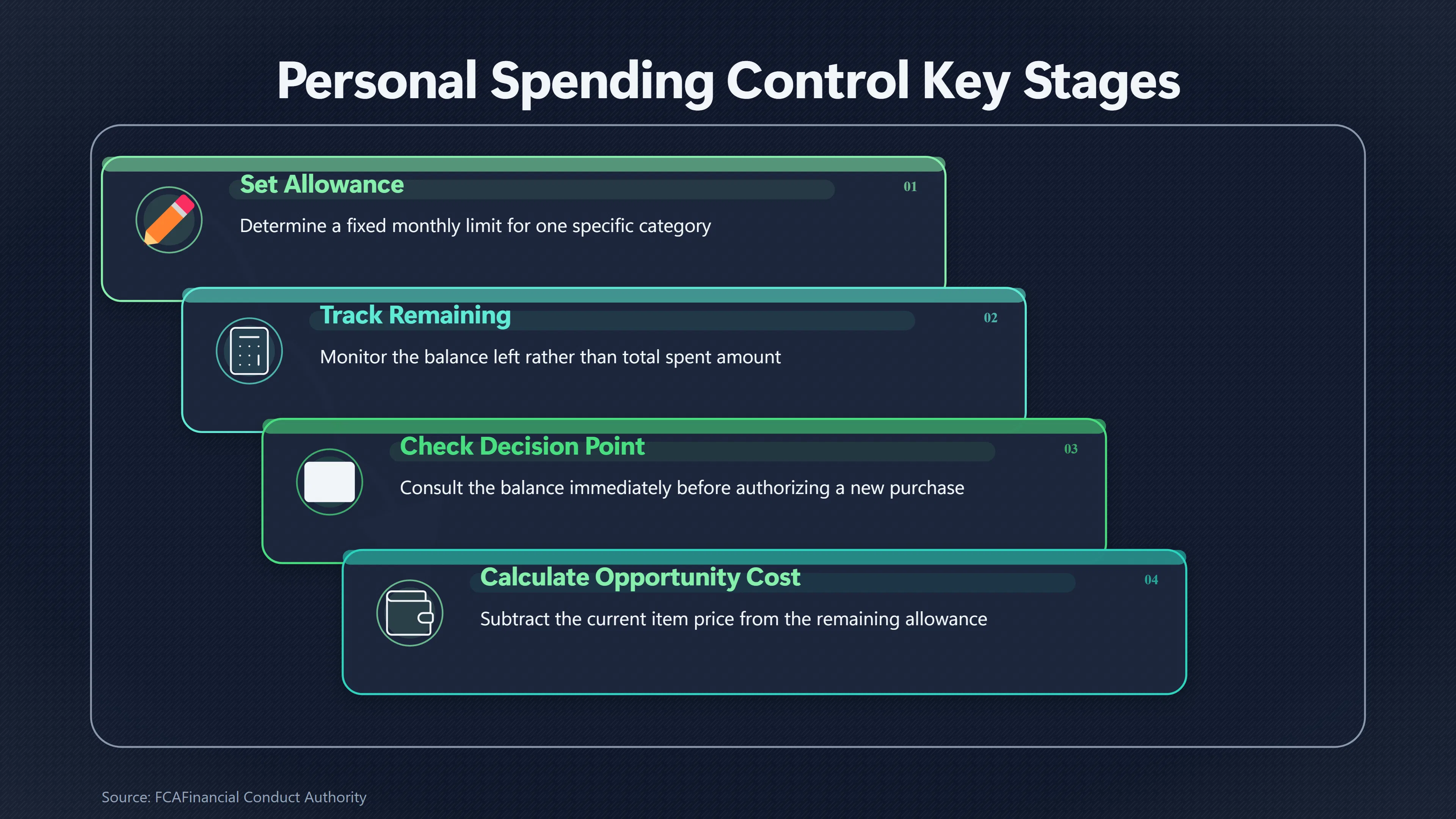
A workable sequence is:
- Set one allowance in advance. Decide the amount when relatively detached from the temptation: for example, £180 for takeaway food for the month.
- Track the remaining amount, not merely expenditure to date. “£47 left” translates the budget into a constraint more directly than “£133 spent”.
- Check it at the decision point. The check belongs after the urge to buy appears but before the payment is authorised.
- Include the proposed purchase. Convert “£47 remaining” into “£47 remaining now; £21 remaining if I place this £26 order”. That makes the opportunity cost visible.
- Keep the system narrow enough to maintain. A perfectly categorised budget that is rarely consulted is less useful at checkout than one reliable number for the category that repeatedly causes regret.
The reason to start with one category is practical as well as behavioural. The CFPB found that the work involved in tracking and benchmarking spending can itself prevent consumers from using budgets consistently. A point-of-purchase system loses its advantage if checking it requires opening a spreadsheet, reconciling several accounts and classifying previous transactions before every purchase.[Consumer Financial Protection Bureau]consumerfinance.govConsumer Financial Protection BureauConsumer insights on managing spending | Consumer Financial Protection BureauFebruary 28, 2017…
There is supporting evidence that increasing transaction salience — making spending harder to overlook — can affect behaviour over longer periods too. A field experiment using a smartphone application combined spending goals with feedback about credit-card purchases and found a significant reduction in expenditure. That intervention used weekly rather than literal pre-checkout feedback, so it does not establish the effect of a live remaining balance by itself. It does reinforce the broader mechanism: cashless spending becomes easier to regulate when transactions are made salient and compared with an explicit goal.[ScienceDirect]sciencedirect.comOpen source on sciencedirect.com.
The crucial distinction is actionable feedback
The strongest evidence in this area is not a clean trial proving that one particular “£X remaining” screen prevents a fixed percentage of impulse purchases. Direct pre-purchase evidence remains comparatively limited. The CFPB work was prototype research; grocery self-scanning produced heterogeneous effects; and some of the strongest large-scale causal evidence concerns overdraft alerts rather than discretionary shopping.
That uncertainty is worth preserving because it prevents a useful idea from becoming a behavioural-finance gimmick. Timing helps, but timing alone is not sufficient. In the FCA’s million-customer field experiment, some just-in-time overdraft alerts produced benefits while several generic early low-balance alerts did not show statistically significant reductions in charges. The content, trigger and opportunity to act all mattered.[FCA]fca.org.ukOpen source on fca.org.uk.
A newer UK research programme has taken the question even closer to checkout. The Behaviouralist, working with the Open Banking Implementation Entity, reports running a randomised controlled online experiment with a representative sample of 7,500 UK adults in an interactive shopping environment, specifically testing the effect of displaying a bank balance before checkout. The publicly accessible project description confirms the experimental design and purpose, although it does not provide enough outcome detail to justify claiming a particular reduction in purchases here.[The Behaviouralist]thebehaviouralist.comOpen source on thebehaviouralist.com.
The evidence therefore supports a sensible design rule rather than a guaranteed effect: put personally meaningful spending information where it can still change the decision. For an impulsive purchase, that means before the final tap, not in a weekly notification after several similar purchases have accumulated.
A budget tells you what you intended to do. Real-time feedback can turn that intention into a question at the only moment when the answer can still alter today’s purchase: if I buy this, what will I have left?
Amazon book picks
Further Reading
Books and field guides related to Why Spending Feedback Works Better Before Checkout. Use these as the next step if you want deeper reading beyond the article.
I Will Teach You to Be Rich
As seen on the new NETFLIX series! The groundbreaking NEW YORK TIMES and WALL STREET JOURNAL BESTSELLER that taught a generation how to e...
Your Money or Your Life
A fully revised edition of one of the most influential books ever written on personal finance with more than a million copies sold “The b...
The One Week Budget
Hate paying bills? So do I, and that's why I stopped! What if I told you that I haven't paid a bill in almost six years! Do you want to k...
The Psychology of Money
Doing well with money isn't necessarily about what you know. It's about how you behave. And behavior is hard to teach, even to really sma...
eBay marketplace picks
Marketplace Samples
Live-tested eBay searches with available results related to this page.
Selected fromself improvement wall art oneBay.co.uk.

Current eBay listing
Self Improvement Quote Framed Wall Art Poster Canvas Print Picture

Current eBay listing
Self improvement Framed Wall Art Poster Canvas Print Picture

Endnotes
1.
Source: fca.org.uk
Link:https://www.fca.org.uk/publications/occasional-papers/occasional-paper-no-10-message-received-impact-annual-summaries-text
Source snippet
March 11, 2015...
Published: March 11, 2015
2.
Source: fca.org.uk
Link:https://www.fca.org.uk/publications/occasional-papers/occasional-paper-no-40-time-act-field-experiment-overdraft-alerts
3.
Source: fca.org.uk
Link:https://www.fca.org.uk/publications/occasional-papers/occasional-paper-no-36-sending-out-sms-impact-automatically-enrolling-consumers-overdraft-alerts
4.
Source: fca.org.uk
Title: FCAFinancial Conduct Authority
Link:https://www.fca.org.uk/publication/occasional-papers/occasional-paper-40.pdf
Source snippet
October 19, 2025...
Published: October 19, 2025
5.
Source: govinfo.gov
Title: GOVPUB FR PURL gpo153581
Link:https://www.govinfo.gov/content/pkg/GOVPUB-FR-PURL-gpo153581/pdf/GOVPUB-FR-PURL-gpo153581.pdf
Source snippet
February 2017August 16, 2025...
Published: August 16, 2025
6.
Source: papers.ssrn.com
Link:https://papers.ssrn.com/sol3/papers.cfm?abstract_id=3080883
Source snippet
Self-Scanning and Self-Control: A Field Experiment on Real-Time Feedback and Shopping Behavior by Natalia Montinari, Emma Runnemark...
7.
Source: sciencedirect.com
Link:https://www.sciencedirect.com/science/article/pii/S0747563220302569
8.
Source: sciencedirect.com
Title: Nudging a second after
Link:https://www.sciencedirect.com/science/article/pii/S0378426625002018
9.
Source: papers.ssrn.com
Title: SSRN ID4825029 code430404
Link:https://papers.ssrn.com/sol3/Delivery.cfm/SSRN_ID4825029_code430404.pdf?abstractid=4825029&mirid=1&type=2
10.
Source: papers.ssrn.com
Link:https://papers.ssrn.com/abstract%3D2296753
11.
Source: sciencedirect.com
Link:https://www.sciencedirect.com/science/article/pii/S0167268123002950
12.
Source: portal.research.lu.se
Link:https://portal.research.lu.se/en/publications/self-scanning-and-self-control-a-field-experiment-on-real-time-fe/
Source snippet
nd UniversitySelf-Scanning and Self-Control: A Field Experiment on Real-Time Feedback and Shopping Behavior - Lund University...
13.
Source: consumerfinance.gov
Link:https://www.consumerfinance.gov/data-research/research-reports/consumer-insights-managing-spending/
Source snippet
Consumer Financial Protection BureauConsumer insights on managing spending | Consumer Financial Protection BureauFebruary 28, 2017...
Published: February 28, 2017
14.
Source: files.consumerfinance.gov
Title: 201702 cfpb Consumer Insights on Managing Spending
Link:https://files.consumerfinance.gov/f/documents/201702_cfpb_Consumer-Insights-on-Managing-Spending.pdf
Source snippet
Consumer Financial Protection BureauFebruary 2017...
Published: February 2017
15.
Source: journals.sagepub.com
Title: Sage Journals Smart Shopping Carts: How Real-Time Feedback Influences Spending
Link:https://journals.sagepub.com/doi/10.1509/jm.12.0060
16.
Source: thebehaviouralist.com
Link:https://thebehaviouralist.com/portfolio-item/open-banking-balance-statements/
17.
Source: omnipath.ai
Link:https://omnipath.ai/budgets/
18.
Source: doi.org
Link:https://doi.org/10.1017/nie.2024.29
19.
Source: consumerfinance.gov
Link:https://www.consumerfinance.gov/data-research/research-reports/data-spotlight-consumer-experiences-with-overdraft-programs/full-report/appendix-b-protocol-for-focus-groups-with-consumers/
20.
Source: journals.sagepub.com
Link:https://journals.sagepub.com/doi/10.1177/10949968231189505
21.
Source: consumerfinance.gov
Link:https://www.consumerfinance.gov/data-research/research-reports/big-techs-role-in-contactless-payments-analysis-of-mobile-device-operating-systems-and-tap-to-pay-practices/full-report/
22.
Source: consumerfinance.gov
Link:https://www.consumerfinance.gov/data-research/research-reports/mobile-financial-services-a-summary-of-comments-from-the-public-on-opportunities-challenges-and-risks-for-the-underserved/
23.
Source: doi.org
Title: If ‘money matters’, what about the monetary base?
Link:https://doi.org/10.1111/ecaf.12574
24.
Source: consumerfinance.gov
Link:https://www.consumerfinance.gov/data-research/research-reports/issue-spotlight-public-benefits-delivery-consumer-protection/
25.
Source: fca.org.uk
Title: fca confirms biggest shake up overdraft market
Link:https://www.fca.org.uk/news/press-releases/fca-confirms-biggest-shake-up-overdraft-market
26.
Source: fca.org.uk
Link:https://www.fca.org.uk/news/press-releases/fca-announces-proposals-fundamentally-reform-way-banks-charge-overdrafts-and-extends-protections
27.
Source: GOV.UK
Title: smart meter customer experience study 2017 main report
Link:https://www.gov.uk/government/publications/smart-meter-customer-experience-study-2016-18/smart-meter-customer-experience-study-2017-main-report
28.
Source: GOV.UK
Title: www.gov.uk New overdraft alerts as CMA banking rules come into force
Link:https://www.gov.uk/government/news/new-overdraft-alerts-as-cma-banking-rules-come-into-force
29.
Source: consumerfinance.gov
Link:https://www.consumerfinance.gov/archive/newsroom/cfpb-launches-inquiry-into-mobile-financial-services/
30.
Source: journals.sagepub.com
Link:https://journals.sagepub.com/doi/pdf/10.1509/jm.12.0060?download=true
31.
Source: journals.sagepub.com
Link:https://journals.sagepub.com/doi/abs/10.1509/jm.12.0060
32.
Source: journals.sagepub.com
Link:https://journals.sagepub.com/doi/10.1509/jm.12.0060?icid=int.sj-full-text.similar-articles.9
33.
Source: portal.research.lu.se
Link:https://portal.research.lu.se/sv/publications/self-scanning-and-self-control-a-field-experiment-on-real-time-fe/
34.
Source: sage.cnpereading.com
Link:https://sage.cnpereading.com/doi/10.1509/jm.12.0060
35.
Source: thebehaviouralist.com
Title: Portfolio Archive
Link:https://thebehaviouralist.com/portfolio-item/
36.
Source: thebehaviouralist.com
Title: Behavioural Science Case Studies
Link:https://thebehaviouralist.com/case-studies/
37.
Source: thebehaviouralist.com
Title: Consumer protection Archives
Link:https://thebehaviouralist.com/portfolio-item-category/consumer-protection/
Additional References
38.
Source: youtube.com
Title: Why we make bad financial choices – even when we know better
Link:https://www.youtube.com/watch?v=caGlzR9F2zI
Source snippet
In 3 psychological tricks to help you save money, behavioral scientist Wendy De La Rosa breaks down behavioral economics interventions an...
39.
Source: amsacta.unibo.it
Link:https://amsacta.unibo.it/id/eprint/5743/
Source snippet
AMS Acta - AlmaDL Università di Bologna...
40.
Source: mymoney.gov
Link:https://www.mymoney.gov/taxonomy/term/18954
41.
Source: youtube.com
Title: How Credit Cards Trick Your Brain (Psychology)
Link:https://www.youtube.com/watch?v=th77p-grvFY
Source snippet
Why we make bad financial choices -- even when we know better...
42.
Source: recon-global.co.uk
Link:https://www.recon-global.co.uk/
43.
Source: research-collection.ethz.ch
Link:https://www.research-collection.ethz.ch/handle/20.500.11850/430183
44.
Source: studylib.net
Link:https://studylib.net/doc/28265713/marketing-book-
45.
Source: scribd.com
Link:https://www.scribd.com/document/726690116/Driving-Value-From-Open-Banking-15-Fintech-Use-Cases-1671794344
46.
Source: spendfirst.com
Link:https://spendfirst.com/app/
47.
Source: bankofengland.co.uk
Link:https://www.bankofengland.co.uk/paper/2022/responses-to-the-bank-of-englands-discussion-paper-on-new-forms-of-digital-money