Within Automaticity
Why Stable Contexts Make Habits Easier to Trigger
Repeating the same action in a stable context gives recurring cues more opportunity to trigger the response with less deliberation.
On this page
- What context stability means in everyday life
- What studies find when contexts stay stable or vary
- How to choose a context you can repeat reliably
Page outline Jump by section
Introduction
Stable contexts make habits easier to trigger because they allow the same situation to predict the same response repeatedly. Doing an action 30 times in 30 different circumstances is therefore not necessarily equivalent to doing it 30 times after the same recurring event, in the same place or within the same part of a routine. In the second case, features of the situation can become reliable cues for the behaviour itself.
This is the important distinction between repetition and context-dependent repetition. Habit learning is not simply practice accumulating with time; it involves learning a relationship between circumstances and a response. Research ranging from classic prospective studies to newer longitudinal work generally finds stronger automaticity when behaviour occurs in stable contexts, although the size and consistency of the effect varies between behaviours and studies.[wiley.com]onlinelibrary.wiley.comWiley Online LibraryHow are habits formed: Modelling habit formation in the real world - Lally - 2010 - European Journal of Social Psycho…
For self-improvement, the practical implication is straightforward: when trying to make a useful behaviour more automatic, choose a recurring situation you can realistically reproduce rather than merely aiming to perform the behaviour whenever an opportunity appears.
What context stability means in everyday life
A context is stable when the circumstances surrounding repeated performances are sufficiently similar for recurring features to become predictive. Researchers have treated context as potentially including location, time, preceding actions, other people, mood and other aspects of the situation.[PubMed Central (PMC)]pmc.ncbi.nlm.nih.govPubMed Central (PMC)Reflecting on non-reflective action: An exploratory think-aloud study of self-report habit measures - PMCJuly 22, 2013…
That means stability does not necessarily require reproducing every detail. Consider three ways of practising ten minutes of vocabulary study:
- Highly variable: study whenever there is spare time, sometimes on the train, sometimes in bed and sometimes during lunch.
- Clock-based: study at 19:00 each evening.
- Routine-based: study immediately after clearing away the evening meal.
All three can produce repetition. The latter two additionally provide recurring contextual information that can become associated with starting the behaviour. The third may remain relatively stable even when dinner moves from 18:30 to 19:30, because the relevant relationship is “meal finished → vocabulary practice”, rather than a particular position on the clock.
Research does not establish one universally superior kind of cue. A 2024 systematic review of health-habit studies noted evidence for stronger habits among people whose target behaviour occurred in consistent contexts, while also reporting research finding no significant difference between time-based and routine-based cues in habit formation.[MDPI]mdpi.comTime to Form a Habit: A Systematic Review and Meta-Analysis of Health Behaviour Habit Formation and Its DeterminantsDecember 9, 2024… The useful principle is therefore reliable recurrence, not a rule that every habit must happen at an identical clock time.
Stability is about predictability, not perfect sameness
A recurring event can provide stability even while superficial details change. “After breakfast” might still be recognisable when breakfast contains different food or happens somewhat later at weekends. Likewise, “when I arrive at my desk” can recur despite changes in weather, clothing or the emails waiting on the screen.
This distinction matters because an attempt to reproduce an entire environment precisely can make a habit unnecessarily brittle. The aim is to preserve one or more dependable features that repeatedly accompany the behaviour.
There is also evidence that the relevant feature can differ between people. A 2026 study following older adults found that context stability was more consistently related to changes in habit strength than to behaviour itself, but the useful contextual cue was not identical across participants. Among people adopting physical activity, habit gains were associated with whichever individual cue was most stable for that person.[PubMed]pubmed.ncbi.nlm.nih.govExamining context stability, habits, and movement behaviors among behavioral adopters and maintainers: it's an individual vibe - Pu…
So “stable context” should not be interpreted as “everyone needs the same kind of cue”. It means that your recurring cue reliably predicts your recurring response.
Why stable contexts strengthen automatic behaviour
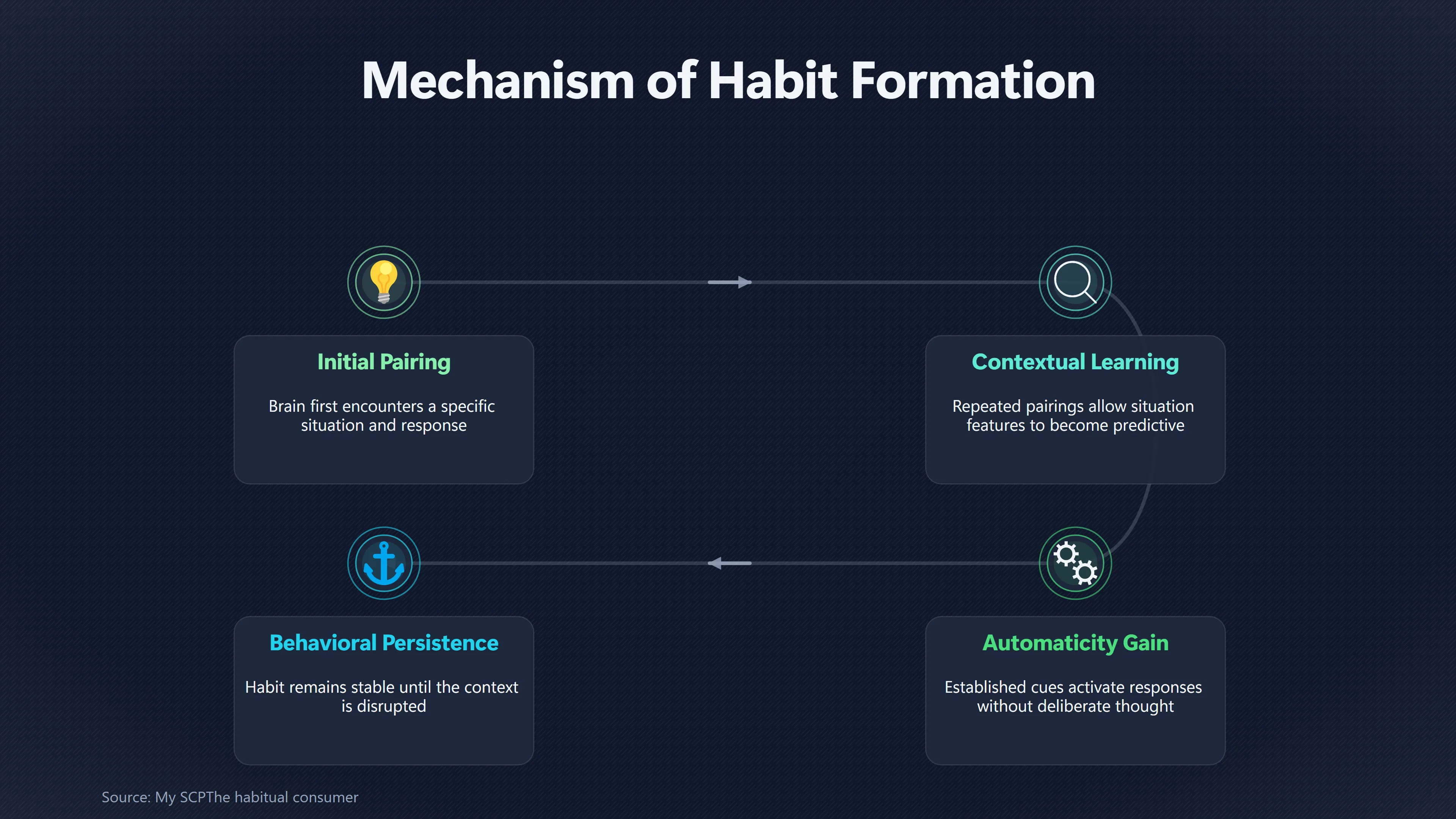
The mechanism can be understood as a learning problem. Suppose someone wants to read for 15 minutes every day. If reading follows breakfast each morning, the brain repeatedly encounters a similar relationship:
breakfast finishes → reading begins
Initially, breakfast finishing may do little by itself. The person still has to remember the plan and deliberately start reading. But repeated pairing gives features of that situation opportunities to become associated with the response. Habit theory proposes that sufficiently established contextual cues can then activate the learned response more readily, reducing dependence on renewed deliberation. Reviews describe habits accordingly as responses directly cued by contexts that have repeatedly covaried with previous performance.[My SCP]myscp.onlinelibrary.wiley.comMy SCPThe habitual consumerWood - 2009 - Journal of Consumer Psychology - Wiley Online LibraryOctober 2, 2009…
Variable practice gives the environment a less consistent relationship to learn. If reading happens after breakfast today, on a train tomorrow, at lunch the following day and just before sleep after that, “reading” is being repeated but no single situation is repeatedly predicting its initiation.
This explains why frequency alone is an incomplete description of habit. Danner, Aarts and de Vries found that the relationship between past behaviour, intention and subsequent behaviour depended on contextual stability: high-frequency behaviour performed in stable contexts showed the pattern expected of stronger habits, whereas frequency alone was insufficient.[BPS Psych Hub]bpspsychub.onlinelibrary.wiley.comOpen source on wiley.com.
The same principle also explains an everyday characteristic of established habits: changing surroundings can make a familiar action surprisingly easy to forget. Research on context disruption has found that changes such as moving home can weaken the influence of established habitual patterns, leaving behaviour more responsive to current intentions.[PubMed]pubmed.ncbi.nlm.nih.govOpen source on nih.gov. Context is therefore not merely scenery surrounding a habit. It can be part of the information that retrieves it.

What happens when contexts stay stable or vary
One of the clearest direct tests comes from Marco Stojanovic, Axel Grund and Stefan Fries. Their 2022 research examined context stability in two longitudinal datasets rather than simply assuming that repeated behaviour was habitual.[PubMed Central (PMC)]pmc.ncbi.nlm.nih.govPubMed Central (PMC)Context Stability in Habit Building Increases Automaticity and Goal Attainment - PMC…
In the first study, 95 university students formed study habits over six weeks, generating 2,482 recorded habit repetitions. Participants assigned to the stable-context condition were instructed to keep the place and time of performance stable, while those in the variable-context condition were instructed to change rooms and times. The manipulation produced a large difference in reported context stability. Across the data, greater context stability predicted greater automaticity, although the detailed results were more nuanced than a simple stable-group-versus-variable-group victory: the association between day-level stability and automaticity was evident particularly within the generally stable condition, while the overall group factor itself did not straightforwardly predict automaticity.[PubMed Central (PMC)]pmc.ncbi.nlm.nih.govPubMed Central (PMC)Context Stability in Habit Building Increases Automaticity and Goal Attainment - PMC…
The researchers then analysed 308 habits from 218 users of a habit-building app, covering 2,368 repetitions. Again, higher context stability predicted greater automaticity and better attainment of participants’ repetition goals. Across both datasets, automaticity partially mediated the relationship between context stability and goal attainment.[PubMed]pubmed.ncbi.nlm.nih.govOpen source on nih.gov.
That is especially relevant to self-improvement because it suggests two potentially reinforcing benefits. A stable situation provides repeated opportunities to learn the cue–response relationship, while increasing automaticity may in turn make successful performance easier when that situation recurs.
The older real-world study by Phillippa Lally and colleagues fits this picture from another direction. Ninety-six participants selected an eating, drinking or activity behaviour and attempted to perform it daily in the same context for 12 weeks. Automaticity generally increased with repeated performance in that consistent context, following a curve in which early repetitions tended to produce larger gains and later gains diminished towards a plateau. Importantly, missing one opportunity did not materially derail the process.[Wiley Online Library]onlinelibrary.wiley.comWiley Online LibraryHow are habits formed: Modelling habit formation in the real world - Lally - 2010 - European Journal of Social Psycho…
The lesson is not that a context must be reproduced without exception. What matters is establishing a sufficiently regular relationship between cue and response across many opportunities.
The evidence is supportive, but not perfectly uniform
Stable-context advice is theoretically strong and increasingly supported by longitudinal evidence, but it should not be presented as an experimentally settled law with a known optimal level of consistency.
A 2022 intensive diary study illustrates the distinction. Participants were encouraged to form the habit of filling half their dinner plate with vegetables and provided thousands of daily observations over as many as 56 days. People with higher average context stability also tended to have stronger habits. Yet the preregistered analyses did not show the expected positive next-day effects when the researchers examined whether an individual’s unusually stable context on one particular day produced greater habit strength the next.[PubMed Central (PMC)]pmc.ncbi.nlm.nih.govOpen source on nih.gov.
Physical activity research has also produced mixed findings. In an ecological momentary assessment study of 104 older adults, researchers measured physical, social, temporal and behavioural context while also using accelerometers. Some stable contexts predicted aspects of behaviour — for example, greater stability of physical context was associated with more moderate-to-vigorous physical activity — but none of the context-stability measures predicted self-reported habit strength.[PubMed]pubmed.ncbi.nlm.nih.govOpen source on nih.gov.
These results do not overturn the stable-context mechanism. They show why its practical interpretation should remain modest. Different behaviours may depend on different combinations of cues; researchers operationalise “context” in different ways; and much habit research still depends on people’s reports of how automatic their behaviour feels. Self-report measures themselves have known limitations, including difficulty recalling cues and judging one’s own automaticity.[DOI]doi.orgOpen source on doi.org.
A 2024 systematic review of 20 experimental or quasi-experimental health-habit studies likewise concluded that context and consistency matter while emphasising the limited evidence base and considerable heterogeneity between studies. Eleven of the 20 studies were rated at high risk of bias.[PubMed Central (PMC)]pmc.ncbi.nlm.nih.govOpen source on nih.gov. More recent longitudinal evidence continues to associate context stability with habit trajectories: a preregistered 2026 reanalysis of 254 participants followed over six months found context stability among the factors associated with habit strength, alongside behavioural frequency, motivation, perceived difficulty and affective experience.[Sage Journals]journals.sagepub.comOpen source on sagepub.com.
The defensible conclusion is therefore not “identical context guarantees a habit”. It is that repeating a response under reliably recurring circumstances creates better conditions for cue–response learning than repetition stripped of contextual consistency.

How to choose a context you can repeat reliably
For practical habit building, the best context is not necessarily the most precise one. It is the one that will actually recur often enough to provide repeated learning opportunities.
A useful context usually has three properties:
- It happens reliably. “After I brush my teeth” is useful only if tooth-brushing itself is dependable. An event that occurs unpredictably cannot provide many consistent learning opportunities.
- It is easy to recognise. A concrete transition such as finishing breakfast, entering the kitchen or sitting at a particular desk is easier to identify than a vague state such as “when I have some spare time”.
- It naturally permits the response. Choosing “after lunch” for a five-minute walk works only if lunch normally occurs somewhere that permits walking. A theoretically stable cue is of little value when the environment repeatedly prevents the intended action.
This suggests a different way to formulate a self-improvement habit. Instead of starting with “I will meditate every day”, specify the relationship you want to teach: “After I put my breakfast things away, I will sit in the chair by the window and meditate.” Instead of “I will review my finances regularly”, use something such as “After I make coffee on Saturday morning, I will open my budgeting sheet.”
The practical target is not rigid scheduling for its own sake. It is repeated covariance: when this situation occurs, this response follows.
Nor does one missed repetition require restarting. Lally and colleagues found that a single missed opportunity did not materially disrupt habit development, while their participants varied enormously in how quickly automaticity developed.[Wiley Online Library]onlinelibrary.wiley.comOpen source on wiley.com. Consistency should therefore be understood as a learning advantage, not as a perfection rule.
The most useful test is simple: if the behaviour disappeared from your to-do list, what recurring feature of ordinary life would still remind your brain of it? A good answer identifies the context that can carry more of the triggering work over time. Stable contexts make self-improvement easier not because sameness has some special motivational power, but because they repeatedly give the same cues the chance to predict — and eventually help activate — the same useful response.
Amazon book picks
Further Reading
Books and field guides related to Why Stable Contexts Make Habits Easier to Trigger. Use these as the next step if you want deeper reading beyond the article.
Good Habits, Bad Habits
'The world's leading expert on habits' - Matthew Syed, bestselling author of Black Box Thinking and Rebel IdeasWhat if you could harness...

The Power of Habit
Rating: 4.0/5 from 145 Google Books ratings
Duhigg takes us to the edge of scientific discoveries that explain why habits exist and how they can be changed. Distilling information i...
Atomic Habits
Rating: 3.5/5 from 7 Google Books ratings
The #1 New York Times bestseller. Over 25 million copies sold! Translated into 60+ languages! Tiny Changes, Remarkable Results No matter...
Tiny Habits
Improving your life is much easier than you think. Whether it’s losing weight, sleeping more, or restoring your work/life balance – the s...
eBay marketplace picks
Marketplace Samples
Live-tested eBay searches with available results related to this page.
Selected frommotivational wall art oneBay.co.uk.



Endnotes
1.
Source: onlinelibrary.wiley.com
Link:https://onlinelibrary.wiley.com/doi/abs/10.1002/ejsp.674
Source snippet
Wiley Online LibraryHow are habits formed: Modelling habit formation in the real world - Lally - 2010 - European Journal of Social Psycho...
2.
Source: doi.org
Link:https://doi.org/10.1186/s12966-022-01343-8
Source snippet
Effects of behavioral performance, intrinsic reward value, and context stability on the formation of a higher-order nutrition habit: a...
3.
Source: mdpi.com
Link:https://www.mdpi.com/2227-9032/12/23/2488
Source snippet
Time to Form a Habit: A Systematic Review and Meta-Analysis of Health Behaviour Habit Formation and Its DeterminantsDecember 9, 2024...
Published: December 9, 2024
4.
Source: myscp.onlinelibrary.wiley.com
Title: My SCPThe habitual consumer
Link:https://myscp.onlinelibrary.wiley.com/doi/10.1016/j.jcps.2009.08.003
Source snippet
Wood - 2009 - Journal of Consumer Psychology - Wiley Online LibraryOctober 2, 2009...
Published: October 2, 2009
5.
Source: bpspsychub.onlinelibrary.wiley.com
Link:https://bpspsychub.onlinelibrary.wiley.com/doi/10.1348/014466607X230876
6.
Source: onlinelibrary.wiley.com
Link:https://onlinelibrary.wiley.com/doi/abs/10.1002/ejsp.674?source=content_type%3Areact%7Cfirst_level_url%3Aarticle%7Csection%3Amain_content%7Cbutton%3Abody_link
7.
Source: bpspsychub.onlinelibrary.wiley.com
Link:https://bpspsychub.onlinelibrary.wiley.com/doi/10.1111/bjhp.12509
8.
Source: doi.org
Link:https://doi.org/10.1111/BJHP.12060
9.
Source: iaap-journals.onlinelibrary.wiley.com
Link:https://iaap-journals.onlinelibrary.wiley.com/doi/10.1111/aphw.70144?af=R
10.
Source: iaap-journals.onlinelibrary.wiley.com
Link:https://iaap-journals.onlinelibrary.wiley.com/doi/10.1111/aphw.70016
11.
Source: mdpi.com
Link:https://www.mdpi.com/2227-9032/12/23/2488?_bhlid=47dee3946db8c7e6d3a6e92da693cbc5a7439e28
12.
Source: compass.onlinelibrary.wiley.com
Link:https://compass.onlinelibrary.wiley.com/doi/10.1111/spc3.12845
13.
Source: bpspsychub.onlinelibrary.wiley.com
Link:https://bpspsychub.onlinelibrary.wiley.com/doi/10.1111/bjhp.12637
14.
Source: doi.org
Link:https://doi.org/10.1080%2F17437199.2022.2034516
15.
Source: bpspsychub.onlinelibrary.wiley.com
Link:https://bpspsychub.onlinelibrary.wiley.com/doi/pdfdirect/10.1111/bjhp.12509
16.
Source: myscp.onlinelibrary.wiley.com
Link:https://myscp.onlinelibrary.wiley.com/doi/abs/10.1016/j.jcps.2009.08.003
17.
Source: onlinelibrary.wiley.com
Link:https://onlinelibrary.wiley.com/doi/abs/10.1002/ejsp.674?538fcd4b_page=6&947f74f7_page=5
18.
Source: onlinelibrary.wiley.com
Link:https://onlinelibrary.wiley.com/doi/abs/10.1002/ejsp.674?msockid=038ed114f43667dd0790c4bef5146634
19.
Source: onlinelibrary.wiley.com
Link:https://onlinelibrary.wiley.com/doi/abs/10.1002/ejsp.674?MixPanelId=15e3fe314440-0468d8411-64220f54-100000-15e3fe314460
20.
Source: onlinelibrary.wiley.com
Link:https://onlinelibrary.wiley.com/doi/abs/10.1002/ejsp.674?cf_chl_jschl_tk=pmd_EwcJDaCFBR9OVEL1O_0qjioww0Gc86ZzpBvCBFhrDcE-1635261061-0-gqNtZGzNAjujcnBszQi9
21.
Source: onlinelibrary.wiley.com
Link:https://onlinelibrary.wiley.com/doi/10.1002/ejsp.674?947f74f7_page=5&b158b201_page=5
22.
Source: onlinelibrary.wiley.com
Link:https://onlinelibrary.wiley.com/doi/abs/10.1002/ejsp.674?msockid=17570258034862e732eb114c02616368
23.
Source: bpspsychub.onlinelibrary.wiley.com
Link:https://bpspsychub.onlinelibrary.wiley.com/doi/abs/10.1348/014466607x230876
24.
Source: pmc.ncbi.nlm.nih.gov
Link:https://pmc.ncbi.nlm.nih.gov/articles/PMC9226889/
Source snippet
PubMed Central (PMC)Context Stability in Habit Building Increases Automaticity and Goal Attainment - PMC...
25.
Source: pubmed.ncbi.nlm.nih.gov
Link:https://pubmed.ncbi.nlm.nih.gov/42053513/
Source snippet
What Makes a Habit? Investigating Potential Determinants of Habit Formation - PubMed...
26.
Source: pmc.ncbi.nlm.nih.gov
Link:https://pmc.ncbi.nlm.nih.gov/articles/PMC4296343/
Source snippet
PubMed Central (PMC)Reflecting on non-reflective action: An exploratory think-aloud study of self-report habit measures - PMCJuly 22, 2013...
Published: July 22, 2013
27.
Source: pubmed.ncbi.nlm.nih.gov
Link:https://pubmed.ncbi.nlm.nih.gov/41664442/
Source snippet
Examining context stability, habits, and movement behaviors among behavioral adopters and maintainers: it's an individual vibe - Pu...
28.
Source: pmc.ncbi.nlm.nih.gov
Link:https://pmc.ncbi.nlm.nih.gov/articles/PMC4566897/
Source snippet
PubMed Central (PMC)A review and analysis of the use of ‘habit’ in understanding, predicting and influencing health-related behaviour - PMC...
29.
Source: pubmed.ncbi.nlm.nih.gov
Link:https://pubmed.ncbi.nlm.nih.gov/17678574/
30.
Source: pubmed.ncbi.nlm.nih.gov
Link:https://pubmed.ncbi.nlm.nih.gov/27120333/
31.
Source: pubmed.ncbi.nlm.nih.gov
Link:https://pubmed.ncbi.nlm.nih.gov/35756236/
32.
Source: pmc.ncbi.nlm.nih.gov
Link:https://pmc.ncbi.nlm.nih.gov/articles/PMC9372943/
33.
Source: pubmed.ncbi.nlm.nih.gov
Link:https://pubmed.ncbi.nlm.nih.gov/35962435/
34.
Source: pubmed.ncbi.nlm.nih.gov
Link:https://pubmed.ncbi.nlm.nih.gov/33502088/
35.
Source: pmc.ncbi.nlm.nih.gov
Link:https://pmc.ncbi.nlm.nih.gov/articles/PMC11641623/
36.
Source: journals.sagepub.com
Link:https://journals.sagepub.com/doi/full/10.1177/01461672261440446
37.
Source: pmc.ncbi.nlm.nih.gov
Link:https://pmc.ncbi.nlm.nih.gov/articles/PMC13059544/
38.
Source: pmc.ncbi.nlm.nih.gov
Link:https://pmc.ncbi.nlm.nih.gov/articles/PMC13114073/
39.
Source: pubmed.ncbi.nlm.nih.gov
Link:https://pubmed.ncbi.nlm.nih.gov/39685110/
40.
Source: pubmed.ncbi.nlm.nih.gov
Link:https://pubmed.ncbi.nlm.nih.gov/39321606/
41.
Source: pmc.ncbi.nlm.nih.gov
Link:https://pmc.ncbi.nlm.nih.gov/articles/PMC11297519/
42.
Source: journals.sagepub.com
Link:https://journals.sagepub.com/doi/10.1177/20552076241265217
43.
Source: pmc.ncbi.nlm.nih.gov
Link:https://pmc.ncbi.nlm.nih.gov/articles/PMC11161714/
44.
Source: pubmed.ncbi.nlm.nih.gov
Link:https://pubmed.ncbi.nlm.nih.gov/36749452/
45.
Source: pmc.ncbi.nlm.nih.gov
Link:https://pmc.ncbi.nlm.nih.gov/articles/PMC12318445/
46.
Source: pubmed.ncbi.nlm.nih.gov
Link:https://pubmed.ncbi.nlm.nih.gov/31396122/
47.
Source: pmc.ncbi.nlm.nih.gov
Link:https://pmc.ncbi.nlm.nih.gov/articles/PMC6667662/
48.
Source: pmc.ncbi.nlm.nih.gov
Link:https://pmc.ncbi.nlm.nih.gov/articles/PMC6302524/
49.
Source: pmc.ncbi.nlm.nih.gov
Link:https://pmc.ncbi.nlm.nih.gov/articles/PMC4847906/
50.
Source: pubmed.ncbi.nlm.nih.gov
Link:https://pubmed.ncbi.nlm.nih.gov/23869847/
51.
Source: pmc.ncbi.nlm.nih.gov
Link:https://pmc.ncbi.nlm.nih.gov/articles/PMC3552971/
52.
Source: pubmed.ncbi.nlm.nih.gov
Link:https://pubmed.ncbi.nlm.nih.gov/20493623/
53.
Source: pubmed.ncbi.nlm.nih.gov
Link:https://pubmed.ncbi.nlm.nih.gov/41949147/
54.
Source: ouci.dntb.gov.ua
Link:https://ouci.dntb.gov.ua/en/works/4bV6Rb14/
55.
Source: ouci.dntb.gov.ua
Link:https://ouci.dntb.gov.ua/en/works/7WBRxZ59/
56.
Source: ouci.dntb.gov.ua
Link:https://ouci.dntb.gov.ua/works/7WBRxZ59/
Additional References
57.
Source: youtube.com
Title: Why is it so hard to break a bad habit? | TED-Ed
Link:https://www.youtube.com/watch?v=wr6fQ4KpbRM
Source snippet
Explore the scientific relationship between recurring [environmental cues]({{ 'useful-cues/' | relative_url }}) and automaticity in How to Form Habits That (Actually) Stick, wh...
58.
Source: youtube.com
Title: The Science of Making & Breaking Habits | Huberman Lab Podcast #53
Link:https://www.youtube.com/watch?v=Wcs2PFz5q6g
Source snippet
How to Break Unwanted Habits and How to Create New Desired Ones with Adam Grant and Wendy Wood...
59.
Source: youtube.com
Link:https://www.youtube.com/watch?v=kwkGr62qHm8
Source snippet
Why is it so hard to break a bad habit? | TED-Ed...
60.
Source: youtube.com
Link:https://www.youtube.com/watch?v=i4-CnaZllMo
Source snippet
The Science of Making & Breaking Habits | Huberman Lab Podcast #53...
61.
Source: researchgate.net
Link:https://www.researchgate.net/publication/362666582_Effects_of_behavioral_performance_intrinsic_reward_value_and_context_stability_on_the_formation_of_a_higher-order_nutrition_habit_an_intensive_longitudinal_diary_study
62.
Source: sciencedirect.com
Link:https://www.sciencedirect.com/science/article/abs/pii/S0277953622008735
63.
Source: sciencedirect.com
Link:https://www.sciencedirect.com/org/science/article/pii/S1438887123003849
64.
Source: sciencedirect.com
Link:https://www.sciencedirect.com/science/article/pii/S0272494407000898
65.
Source: doaj.org
Link:https://doaj.org/article/ddb0abc49adf4c609569451cad728fa3
66.
Source: tandfonline.com
Link:https://www.tandfonline.com/doi/abs/10.1080/08870446.2025.2528925