Within Immediate Rewards
Why Enjoyment Often Keeps Good Habits Going
People may choose goals for future benefits, yet immediate enjoyment often better predicts how long they keep going.
On this page
- What persistence studies found
- Why future benefits still matter
- Designing habits around immediate enjoyment
Page outline Jump by section
Introduction
People often choose long-term goals because of what those goals promise later: better health, stronger qualifications, financial security or some other future improvement. Yet when researchers look at what predicts whether people actually keep doing the necessary activity, a different factor repeatedly stands out: how rewarding the activity feels while it is happening.
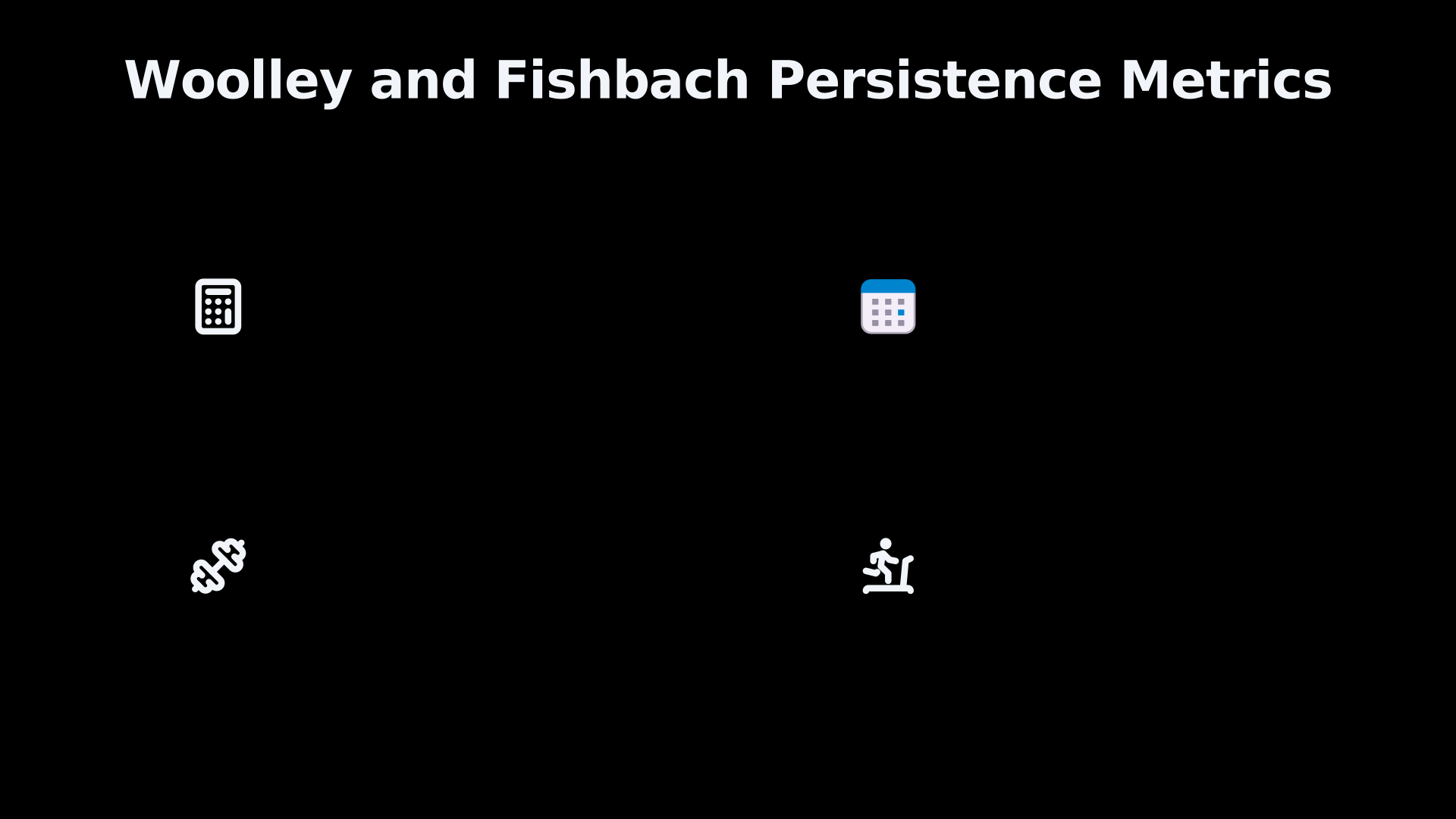
The clearest evidence comes from a five-study programme by psychologists Kaitlin Woolley and Ayelet Fishbach. Across New Year’s resolutions, studying, exercise and healthy eating, immediate rewards such as enjoyment, interest, fun and taste were more strongly associated with persistence than delayed rewards such as usefulness, importance and future health. Their pooled analysis estimated a substantially larger relationship between immediate rewards and persistence than between delayed rewards and persistence.[PubMed]pubmed.ncbi.nlm.nih.govPub Med Immediate Rewards Predict Adherence to Long-Term GoalsImmediate Rewards Predict Adherence to Long-Term Goals - PubMed…
This does not mean future benefits are irrelevant. Rather, the research points to a useful division of labour: future benefits can give people a reason to choose a goal; immediate enjoyment can help them keep doing it.
What persistence studies found
Woolley and Fishbach deliberately tested the same basic prediction in several settings and across different timescales. Their central question was not simply whether people liked enjoyable activities. It was whether immediate rewards predicted actual persistence after accounting for how valuable people considered the delayed rewards.[Kaitlin Woolley]kaitlinwoolley.comKaitlin Woolley
The New Year’s resolution study provides a particularly intuitive example. In January, the researchers recorded resolutions from participants recruited online. Two months later, 96 participants completed a follow-up survey. They rated the immediate experience of pursuing their resolution — whether it was enjoyable, engaging and positive — as well as delayed benefits such as whether it was important, useful or potentially life-changing. They then reported how successfully they had stuck to the resolution. Immediate rewards significantly predicted persistence to that point; delayed rewards did not.[Kaitlin Woolley]kaitlinwoolley.comKaitlin Woolley
That distinction became more striking when the researchers examined what participants expected to do in the future. Delayed rewards did help predict expectations of future persistence. In other words, people could look ahead and reasonably believe that an important goal would keep motivating them. Their behaviour up to that point, however, was more closely associated with how rewarding pursuing the resolution actually felt.[Kaitlin Woolley]kaitlinwoolley.comKaitlin Woolley
Studying showed a similar pattern. Researchers approached 79 undergraduate and postgraduate students working in a university library, with 68 subsequently reporting when they stopped studying. Students were much more likely to say that they came to the library to work on important material than enjoyable material — 95% versus 60% in a separate measure reported in the study. Yet enjoyment of the material was the stronger predictor of how long they actually continued working.[Kaitlin Woolley]kaitlinwoolley.comKaitlin Woolley
Exercise produced an especially concrete behavioural measure. Eighty gym-goers rated how important it was that their workout be enjoyable and fun and how important it was that it be useful for keeping them in shape. The researchers then recorded how long they exercised on their chosen cardio machine. Participants actually rated the delayed benefit more highly on average: usefulness for keeping in shape scored 4.91 on the study’s scale, compared with 3.93 for having fun. Nevertheless, valuing immediate enjoyment predicted workout duration, while valuing the delayed benefit did not.[Kaitlin Woolley]kaitlinwoolley.comKaitlin Woolley
The result was not confined to one-off sessions. In another study, 85 museum visitors reported how fun they found exercise and how important they considered it, alongside their typical weekly exercise over the previous three months. Fun predicted hours exercised, whereas perceived importance did not. The same participants rated the taste and health importance of green vegetables; taste was associated with how many meals containing green vegetables they had eaten over the previous week, while perceived health importance was not significantly associated after accounting for taste.[Kaitlin Woolley]kaitlinwoolley.comKaitlin Woolley
That finding is particularly revealing because participants plainly understood the long-term purpose of these behaviours. More than 91% said they exercised primarily for delayed benefits, and roughly 83% said the same about eating green vegetables. The behaviour could therefore be chosen for its future payoff while its continuation was more closely associated with its present experience.[Kaitlin Woolley]kaitlinwoolley.comKaitlin Woolley
The pooled result is stronger than any single study
Individual behavioural studies of this size can produce noisy estimates, so the most useful result is the authors’ random-effects meta-analysis across nine regression estimates drawn from the five studies and pilot data. It compared the associations between persistence and immediate versus delayed rewards while statistically controlling each type of reward for the other.[Kaitlin Woolley]kaitlinwoolley.comKaitlin Woolley
The pooled standardised regression coefficient for immediate rewards was β = 0.35 (95% confidence interval 0.28–0.42). Delayed rewards also had a statistically significant pooled association, but it was much smaller: β = 0.09 (95% confidence interval 0.02–0.16). The difference between the two predictors was statistically significant.[Kaitlin Woolley]kaitlinwoolley.comKaitlin Woolley
That nuance matters. A simplified retelling might say that long-term benefits do not motivate people, but the evidence does not support that conclusion. In the individual studies, delayed rewards generally failed to predict persistence significantly once immediate rewards were considered. When evidence was pooled, however, delayed rewards did have a small positive relationship with persistence. The result is therefore about relative predictive strength, not the complete irrelevance of future consequences.[Kaitlin Woolley]kaitlinwoolley.comKaitlin Woolley
Nor should these results be read as proof that enjoyment causes all of the observed differences. Much of this particular research programme measured naturally occurring differences in enjoyment and persistence rather than randomly assigning people to enjoy an activity more or less. The authors themselves considered alternative explanations, including the possibility that people who value positive experiences choose different activities.[Kaitlin Woolley]kaitlinwoolley.comKaitlin Woolley
There is, however, complementary experimental evidence. In separate research, Woolley and Fishbach found that directing people towards the most enjoyable rather than the most useful exercise, focusing attention on immediate rather than delayed rewards, and adding an immediate positive element such as music could increase persistence in health or academic activities.[OUP Academic]academic.oup.comOUP AcademicFor the Fun of It: Harnessing Immediate Rewards to Increase Persistence in Long-Term Goals | Journal of Consumer Research | O… A later series of experiments also found that receiving rewards sooner rather than later could increase intrinsic motivation — the extent to which the activity itself feels interesting or enjoyable — even when reward magnitude was considered separately.[PubMed]pubmed.ncbi.nlm.nih.govPub Med It's about time: Earlier rewards increase intrinsic motivationIt's about time: Earlier rewards increase intrinsic motivation - PubMedJune 1, 2018…

Why future benefits still matter
The studies reveal a gap between choosing a goal and executing it repeatedly. Delayed benefits are often excellent reasons for deciding that something deserves a place in your life. Improved cardiovascular health is a sensible reason to exercise; passing an examination is a sensible reason to revise. Neither fact guarantees that today’s workout or revision session will feel worth continuing once effort, boredom or competing alternatives enter the picture.
The exercise findings illustrate the distinction unusually well. Gym-goers placed greater stated value on a workout being useful for keeping fit than on it being fun. Yet fun was associated with how long they exercised. In an exploratory analysis, the delayed reward did predict how many days participants said they typically attended the gym, while immediate rewards predicted estimated weekly cardio duration. The researchers interpreted this cautiously as possible evidence that delayed benefits can be connected with plans while immediate rewards are more closely tied to persistence during action.[Kaitlin Woolley]kaitlinwoolley.comKaitlin Woolley
The New Year’s study points in the same direction: both immediate and delayed rewards were related to people’s expectations about whether they would continue their resolutions, whereas actual persistence so far was significantly predicted only by immediate rewards.[Kaitlin Woolley]kaitlinwoolley.comKaitlin Woolley The practical distinction is therefore not “health versus fun” or “importance versus enjoyment”. A durable goal may need both: a compelling answer to Why should I do this? and a satisfactory answer to Why would I want to keep doing this right now?
Evidence from the wider exercise literature supports taking that second question seriously. A meta-analysis covering 114 independent adult samples found a moderate association between affective judgements — including enjoyment, pleasure and intrinsic motivation — and physical activity, with a pooled correlation of r = 0.42 among correlational studies. The authors nevertheless cautioned that experimental evidence establishing causality was much thinner.[PubMed]pubmed.ncbi.nlm.nih.govA review and meta-analysis of affective judgments and physical activity in adult populations - PubMed…
A subsequent systematic review of 32 experimental studies found that interventions could improve these affective judgements, and that changes in them were associated with changes in physical activity in the subset of studies reporting behavioural outcomes. But the review also warned of possible publication bias and limited evidence about which specific intervention techniques reliably improve enjoyment.[PubMed]pubmed.ncbi.nlm.nih.govExperimental manipulation of affective judgments about physical activity: a systematic review and meta-analysis of adults - PubMedM… Taken together, this is good reason to treat enjoyment as an important design variable rather than a guaranteed behavioural lever.
Designing habits around immediate enjoyment
For self-improvement, the evidence changes what counts as an “optimal” version of a habit. People often optimise only for the distant outcome: the most efficient workout, healthiest food or most productive study method. That can be sensible when alternatives differ substantially in effectiveness or safety. But where several options can all advance the goal, the evidence gives present experience legitimate weight.
A useful decision rule is therefore to optimise enjoyment subject to the behaviour still serving the long-term goal. If cycling, swimming and running are all viable ways of meeting an exercise objective, choosing the one you genuinely look forward to is not necessarily an indulgent compromise. Enjoyment may be one of the properties that makes repeated participation feasible. Woolley and Fishbach’s experimental work directly supports this approach: selecting an exercise for enjoyment rather than usefulness increased persistence.[OUP Academic]academic.oup.comOUP AcademicFor the Fun of It: Harnessing Immediate Rewards to Increase Persistence in Long-Term Goals | Journal of Consumer Research | O…
Immediate enjoyment can also be added without replacing the core activity. Music during repetitive work or exercise is one example. Another is “temptation bundling”: pairing something immediately attractive with a behaviour whose main benefits arrive later. In a field experiment, participants given gym-only access to tempting audiobooks initially visited the gym 51% more frequently than controls, although the effect declined over time, especially after a disruption around Thanksgiving.[PubsOnline]pubsonline.informs.orgHolding the Hunger Games Hostage at the Gym: An Evaluation of Temptation Bundling | Management ScienceNovember 6, 2013… That decline is a useful reminder that no immediate reward makes persistence automatic.
The strongest interpretation of this research is therefore modest but consequential. Do not assume that because a goal is important enough, importance will reliably propel the repeated actions needed to achieve it. When choosing among genuinely useful ways to pursue a goal, ask which version offers interest, pleasure, satisfaction or some other immediate positive experience during the behaviour itself.
That question can sound secondary beside health, achievement or other distant outcomes. The persistence data suggest otherwise. The future benefit may explain why a good habit deserves to begin; the quality of today’s experience can help determine whether it happens often enough to matter.[Kaitlin Woolley]kaitlinwoolley.comKaitlin Woolley

Amazon book picks
Further Reading
Books and field guides related to Why Enjoyment Often Keeps Good Habits Going. Use these as the next step if you want deeper reading beyond the article.
How to Change
Wall Street Journal bestseller “A welcome revelation.” --The Financial Times Award-winning Wharton Professor and Choiceology podcast host...
The Joy Choice
Learn to live a happier and healthier life with the help of this book—start changing behaviors and create new habits using fun and easy s...
The Power of Habit
Rating: 4.0/5 from 145 Google Books ratings
Duhigg takes us to the edge of scientific discoveries that explain why habits exist and how they can be changed. Distilling information i...
Tiny Habits
Improving your life is much easier than you think. Whether it’s losing weight, sleeping more, or restoring your work/life balance – the s...
eBay marketplace picks
Marketplace Samples
Live-tested eBay searches with available results related to this page.
Selected frommotivation poster oneBay.co.uk.


Current eBay listing
Motivation Quotes Framed Wall Art Poster Canvas Print Picture
Current eBay listing
Gym Motivation Quote Framed Wall Art Poster Canvas Print Picture

Current eBay listing
Motivation Art Quote Framed Wall Art Poster Canvas Print Picture
Endnotes
1.
Source: kaitlinwoolley.com
Title: Kaitlin Woolley
Link:https://kaitlinwoolley.com/wp-content/uploads/2017/08/woolleyfishbachpspb.pdf
2.
Source: academic.oup.com
Link:https://academic.oup.com/jcr/article-abstract/42/6/952/2358882
Source snippet
OUP AcademicFor the Fun of It: Harnessing Immediate Rewards to Increase Persistence in Long-Term Goals | Journal of Consumer Research | O...
3.
Source: academic.oup.com
Link:https://academic.oup.com/abm/article/49/5/715/4562772?login=false
4.
Source: academic.oup.com
Link:https://academic.oup.com/abm/article-abstract/38/3/180/4569495?login=false
5.
Source: pubmed.ncbi.nlm.nih.gov
Title: Pub Med Immediate Rewards Predict Adherence to Long-Term Goals
Link:https://pubmed.ncbi.nlm.nih.gov/27899467/
Source snippet
Immediate Rewards Predict Adherence to Long-Term Goals - PubMed...
6.
Source: pubmed.ncbi.nlm.nih.gov
Title: Pub Med It’s about time: Earlier rewards increase intrinsic motivation
Link:https://pubmed.ncbi.nlm.nih.gov/29771568/
Source snippet
It's about time: Earlier rewards increase intrinsic motivation - PubMedJune 1, 2018...
Published: June 1, 2018
7.
Source: pubmed.ncbi.nlm.nih.gov
Link:https://pubmed.ncbi.nlm.nih.gov/20082164/
Source snippet
A review and meta-analysis of affective judgments and physical activity in adult populations - PubMed...
8.
Source: pubmed.ncbi.nlm.nih.gov
Link:https://pubmed.ncbi.nlm.nih.gov/30261826/
Source snippet
Experimental manipulation of affective judgments about physical activity: a systematic review and meta-analysis of adults - PubMedM...
9.
Source: pubsonline.informs.org
Link:https://pubsonline.informs.org/doi/abs/10.1287/mnsc.2013.1784
Source snippet
Holding the Hunger Games Hostage at the Gym: An Evaluation of Temptation Bundling | Management ScienceNovember 6, 2013...
Published: November 6, 2013
10.
Source: pmc.ncbi.nlm.nih.gov
Link:https://pmc.ncbi.nlm.nih.gov/articles/PMC4381662/
Source snippet
PubMed Central (PMC)Holding the Hunger Games Hostage at the Gym: An Evaluation of Temptation Bundling - PMC...
11.
Source: doi.org
Link:https://doi.org/10.1145/3757619
12.
Source: pmc.ncbi.nlm.nih.gov
Link:https://pmc.ncbi.nlm.nih.gov/articles/PMC9767299/
13.
Source: pmc.ncbi.nlm.nih.gov
Link:https://pmc.ncbi.nlm.nih.gov/articles/PMC7735992/
14.
Source: pmc.ncbi.nlm.nih.gov
Link:https://pmc.ncbi.nlm.nih.gov/articles/PMC5682236/
15.
Source: kaitlinwoolley.com
Title: Kaitlin Woolley
Link:https://kaitlinwoolley.com/papers/
16.
Source: pubmed.ncbi.nlm.nih.gov
Link:https://pubmed.ncbi.nlm.nih.gov/25843979/
17.
Source: pubmed.ncbi.nlm.nih.gov
Link:https://pubmed.ncbi.nlm.nih.gov/25921307/
18.
Source: coglode.com
Title: Temptation Bundling
Link:https://www.coglode.com/nuggets/temptation-bundling
19.
Source: ouci.dntb.gov.ua
Link:https://ouci.dntb.gov.ua/en/works/lmeaj3Pl/
20.
Source: lib.uchicago.edu
Link:https://www.lib.uchicago.edu/research/help/bibliographies/busfac/fishbach/
Additional References
21.
Source: dspace.library.uvic.ca
Link:https://dspace.library.uvic.ca/items/5ff14310-a78a-4337-ae4f-ef3130fada73
Source snippet
SpaceExperimental manipulation of affective judgments about physical activity: a systematic review and meta-analysis of adults...
22.
Source: youtube.com
Title: Prof. Ayelet Fishbach of the University of Chicago on the science of motivation
Link:https://www.youtube.com/watch?v=hWx-DOQ4WJE
Source snippet
For a deep dive into the research, watch The science of getting motivated by Ayelet Fishbach, where the co-author of this persistence res...
23.
Source: youtube.com
Title: The science of getting motivated | Ayelet Fishbach | TEDx Chicago
Link:https://www.youtube.com/watch?v=T8CegN1xssY
Source snippet
How to Set the Right Goals and Stay Motivated | Ayelet Fishbach | TED...
24.
Source: youtube.com
Title: Ayelet Fishbach, Ph.D. and Wendy Wood, Ph.D.: Get It Done
Link:https://www.youtube.com/watch?v=AaImWikt79Y
Source snippet
Prof. Ayelet Fishbach of the University of Chicago on the science of motivation...
25.
Source: youtube.com
Title: How to Set the Right Goals and Stay Motivated | Ayelet Fishbach | TED
Link:https://www.youtube.com/watch?v=g3CvsPAF3_0
Source snippet
Ayelet Fishbach || How to Motivate Yourself...
26.
Source: researchgate.net
Link:https://www.researchgate.net/publication/41041817_A_Review_and_Meta-Analysis_of_Affective_Judgments_and_Physical_Activity_in_Adult_Populations
27.
Source: researchgate.net
Link:https://www.researchgate.net/publication/294576232_For_the_Fun_of_It_Harnessing_Immediate_Rewards_to_Increase_Persistence_in_Long-Term_Goals
28.
Source: researchgate.net
Link:https://www.researchgate.net/publication/256040779_Holding_the_Hunger_Games_Hostage_at_the_Gym_An_Evaluation_of_Temptation_Bundling
29.
Source: researchgate.net
Link:https://www.researchgate.net/publication/325363397_It%27s_about_time_Earlier_rewards_increase_intrinsic_motivation
30.
Source: researchgate.net
Link:https://www.researchgate.net/publication/402189372_New_Year%27s_Resolutions_for_Health_Behavior_Change_A_Scoping_Review